Dr KARL SHUKER

Zoologist, media consultant, and science writer, Dr Karl Shuker is also one of the best known cryptozoologists in the world. Author of such seminal works as Mystery Cats of the World (1989), The Lost Ark: New and Rediscovered Animals of the 20th Century (1993; expanded in 2002 as The New Zoo), In Search of Prehistoric Survivors (1995), and more recently Extraordinary Animals Revisited (2007), Dr Shuker's Casebook (2008), Dinosaurs and Other Prehistoric Animals on Stamps: A Worldwide Catalogue (2008), and Karl Shuker's Alien Zoo: From the Pages of Fortean Times (2010), his many fans have been badgering him to join the blogosphere for years. The CFZ Blog Network is proud to have finally persuaded him to do so.


ShukerNature - http://www.karlshuker.blogspot.com

Dr Karl Shuker's Official Website - http://www.karlshuker.com


IMPORTANT: To view a complete, regularly-updated listing of my ShukerNature blog's articles (each one instantly clickable), please click HERE!

IMPORTANT: To view a complete, regularly-updated listing of my Eclectarium blog's articles (each one instantly clickable), please click HERE!

IMPORTANT: To view a complete, regularly-updated listing of my Starsteeds blog's poetry and other lyrical writings (each one instantly clickable), please click HERE!

Search This Blog

Loading...

Tuesday, 29 March 2011

TARZAN MEETS THE MOKELE-MBEMBE.


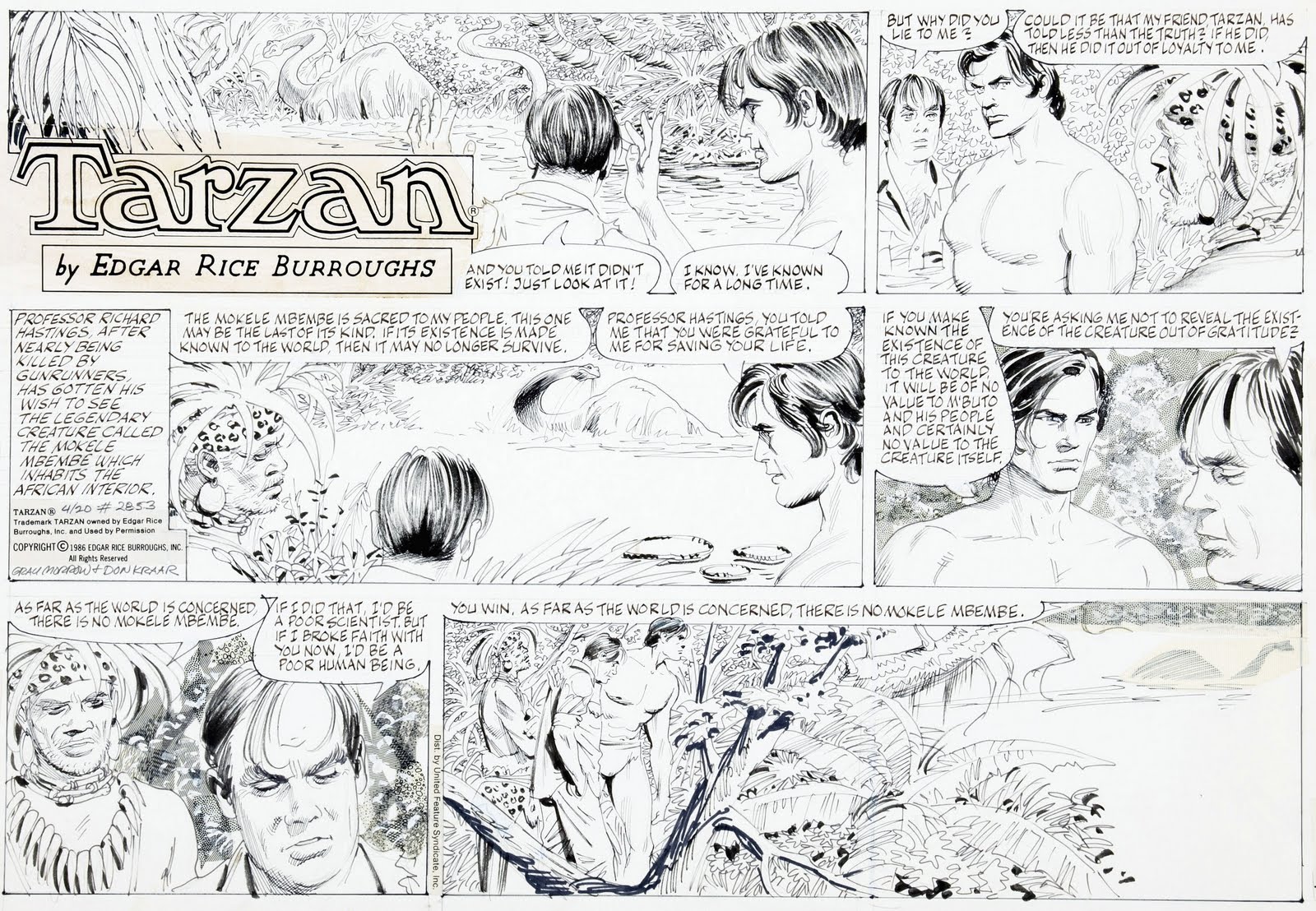
Not content back in 1963 with successfully battling a Nandi bear, in 1986 Tarzan encountered another of Africa’s cryptozooloogical heavyweights – the mokele-mbembe!

One of my many cryptozoological correspondents, the indefatigable Håkan Lindh from Sweden, who first brought the Tarzan-Nandi bear story to my attention (see here), informed me yesterday that the Tarzan Sunday comic strip ran a 12-issue story on Tarzan’s historic meeting with the mokele-mbembe, beginning in #2842 (2 February 1986) and ending in #2855 (20 April 1986). The story’s artist was Gray Morrow, and its writer was Don Kraar.

Unlike the Nandi bear, which was referred to within the story as a chalicothere yet was drawn as being entirely ursine in appearance, the mokele-mbembe is depicted exactly as described by real-life eyewitnesses. Namely, a long-necked, long-tailed sauropod dinosaur lookalike.

As I haven’t seen the entire run of strips constituting this story, I have no information to hand concerning the plot, or even how it begins and ends. So if anyone out there could post details, I’d greatly welcome them.

Saturday, 26 March 2011

MYSTERY MACAWS OF THE WEST INDIES.

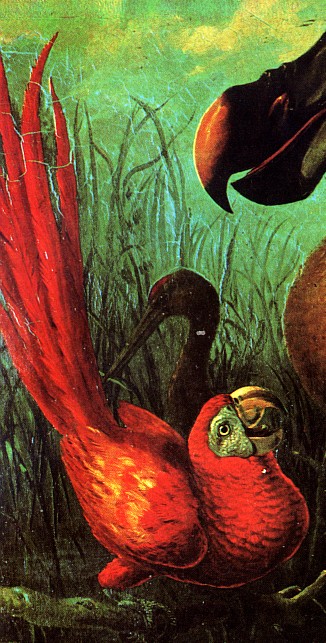
Close-up of the mysterious all-red macaw painted alongside the dodo in Keulemans's copy of Roelandt Savery's famous dodo painting

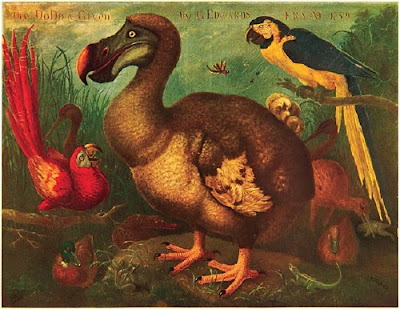
One of the most famous depictions of the dodo Raphus cucullatus is the beautiful oil painting by Flemish artist Roelandt Savery (1576-1639), which was painted in Holland in 1626. It was once owned by George Edwards (1694-1773), a very talented English bird painter and author in his own right, and it is now at London's Natural History Museum. This great work has become virtually the 'standard' notion of what the dodo looked like in life (though in more recent times, the veracity of its chubby form has been questioned), and has thus attracted great attention.
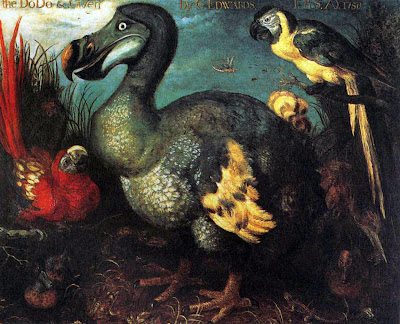
Roelandt Savery's famous dodo painting


In stark contrast, almost entirely ignored from an ornithological standpoint are the two very striking, colourful parrots that Savery painted to the dodo's immediate left and top-right in this same painting. Judging from their size and form, they are evidently macaws, but they do not resemble any known species. Apart from its green facial skin, the left-hand macaw (shown in close-up in this present ShukerNature blog post’s opening illustration) is almost totally red. And the top-right macaw is entirely green and yellow except for a black half-collar and white facial skin.

Interestingly, Japan's dodo expert Masauji Hachisuka owned a copy prepared by famous bird artist John Gerrard Keulemans (1842-1912) of Savery's painting that I have seen (reproduced below from a book in which it appears) and which is a near-identical reproduction of it, except that the colours of the macaws are more distinct (and the dodo itself is more brown than grey), emphasising the red plumage of the one bird and (especially) the green and yellow of the other.

Owned by Masauji Hachisuka, a copy by Keulemans of Roelandt Savery's dodo painting


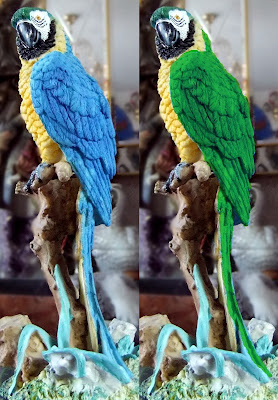
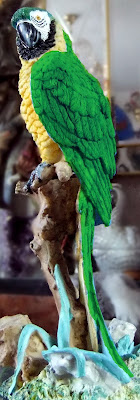
If these macaws were meant to be real, it suggests that they may be undescribed, lost species, or unusual freak/hybrid individuals (but what happened to the specimens that they were based upon?). Or could they have been 'invented' by Savery purely as colourful support for the more prosaic plumage of the dodo? Or perhaps they did exist but Savery's depictions of them were based not upon physical specimens but instead upon inaccurate verbal descriptions of known species? Oddly, the top-right macaw in Savery's painting looks very like the familiar blue and yellow macaw Ara ararauna of the South American mainland would look if its blue hues were completely replaced by green, so might it have been a rare colour mutant or even a preserved, sun-faded skin? Or could the painting itself have faded? Even if any of these possibilities are true, however, and this macaw were indeed blue and yellow after all, it would still differ from A. ararauna - due to the fact that its under-tail coverts were yellow whereas those of A. ararauna are blue.

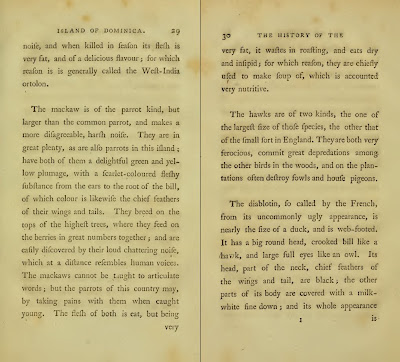
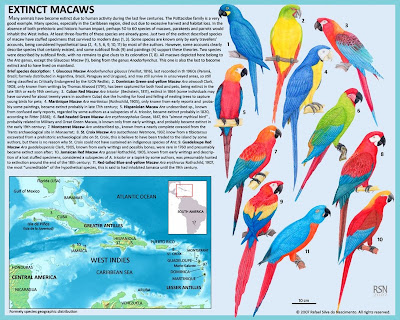
But what if it were genuinely green and yellow, and not blue and yellow? Although there is no species of macaw with almost exclusively green and yellow plumage alive today, two so-called green and yellow macaws, both now extinct, have been described and named from the West Indies. Having said that, one of these, the Jamaican green and yellow macaw Ara erythrocephala, which became extinct around 1842, also had a red head, blue wings, and a red-and-blue tail! But the other one, the Dominican green and yellow macaw Ara atwoodi, believed to have died out around 1800, was indeed predominantly green and yellow. So could it be that at least one such bird was brought back to Holland, perhaps as a pet, over two centuries earlier?

Dominican green and yellow macaw (Peter Haas/The Extinction Website)


And what of Savery's other mystery macaw? Various scientifically-unnamed red macaws seemingly existed several centuries ago on Guadeloupe and Hispaniola. Could a specimen of one of these brought back to Holland have been the model for his red macaw? Interestingly, in his book The Dodo and Kindred Birds (1953), Hachisuka included Keulemans's painting as the frontispiece and in the accompanying caption stated that the two macaws were indeed from the West Indies. Moreover, during the past few centuries the West Indies may have lost several endemic species of macaw.

Although I have since read more detailed accounts about them, I first learned about these seemingly-vanished Caribbean birds from Purnell's Encyclopedia of Animal Life, a very comprehensive 6-volume, 96-issue wildlife partwork published during the 1960s and edited by zoologists Drs Maurice Burton and Robert Burton, which included the following very succinct summary of most of them:


"The red macaw of Jamaica has not been seen since 1765 and the green and yellow macaw of the same island became extinct in the early 19th century. The Guadeloupe red macaw became extinct a century before this and the Dominican green and yellow macaw in the late 18th Century. The Martinique macaw has not been heard of since 1640 and then there was one which has been called the mysterious macaw. No specimen of this is known but a description of it was published in 1658 - and that is all we know of it except that it lived on 'one of the West Indian islands'."


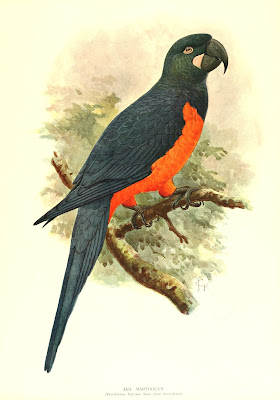
The red macaw of Jamaica is A. gossei, and is also known as the yellow-headed macaw; the Jamaican green and yellow macaw is A. erythrocephala; the Guadeloupe red macaw, also known as the lesser Antillean macaw, is A. guadeloupensis; the Dominican green and yellow macaw is A. atwoodi; and the Martinique macaw is A. martinica. As for the 'mysterious macaw': this is A. erythrura, and nowadays it is also known as the red-tailed blue and yellow macaw, and is thought to have formerly existed either on Jamaica or on Martinique. Additional erstwhile Caribbean macaws not noted above include the Cuban red macaw A. tricolor, the seemingly-unnamed Hispaniolan red macaw, and the purple macaw Anodorhynchus purpurascens of Guadeloupe.

The 'mysterious macaw', aka the red-tailed blue and yellow macaw Ara erythrura (John G. Keulemans, in Lord Walter Rothschild's Extinct Birds, 1907)


Having said that, because almost all of these ostensibly lost macaws are known only from descriptions and paintings, not from any physical remains (the Cuban red macaw is the lone exception, being represented by several preserved specimens in various museums around the world), some ornithologists have discounted them as hypothetical species that may never have existed. Instead, they suggest, these intangible birds may have been based solely upon misidentified or inaccurately-described known species (possibly even escapee pets belonging to certain mainland South American species).

Irrespective of these latter contentious (albeit scientifically-named) forms, however, there is always the intriguing possibility that there were others (certainly one, the enigmatic macaw of St Croix, St Vincent, A. autocthenes, known only from a single leg bone) that died out before their physical appearance had even been documented - except, perhaps, for a couple of perplexing portraits alongside, ironically, the most famous demised bird of all, the dodo?
Friday, 25 March 2011

TARZAN AND THE NANDI BEAR

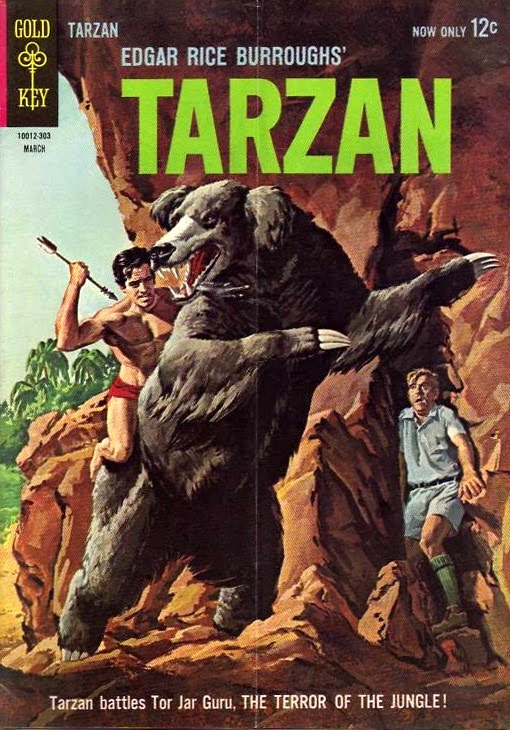
Front cover of Tarzan comic, March 1963, depicting Nandi bear (Gold Key)


A few days ago, Swedish correspondent Håkan Lindh briefly mentioned to me that he had once owned an issue of a Tarzan comic published by Gold Key during the 1960s that had featured a battle between Tarzan and a chemosit – one of the many names given to an East African cryptid most commonly known as the Nandi bear. In response to my request for further details, on 21 March 2011 Håkan posted the following fascinating account on my Facebook page:

"The issue where Tarzan fights the Nandi bear was published by Gold Key in March 1963. The story was simply called The Hunting of the Beast, but the beast was located to live in Nandi, and Tarzan also meets a proto-cryptozoologist that refer to it as "Nandi bear". It also looks a lot similar to a sloth bear.

"Tarzan was one of the comics that made me interested in cryptozoology, he seemed to stumble on lost valleys filled with dinosaurs and cavemen all the time, and even the hope for me to find something similar gave me hours of fun. :-)

"I also remembered that Tarzan at least once fought a spotted lion like the marozi, but I can´t remember if it was meant to show that particular cryptid. Hogarth draw that issue, but I lost it already in my teens so I can´t even remember the title of that adventure.

"Comics set in the jungle seems to have a fair share of cryptozoological connections. The Phantom found a living stegosaur in Africa, Mandrake caught a living Basilisk in South America (after proving a disputed photo was no hoax), and Tarzan had the whole of Pal-Ul-Don with its dinosaurs and tailed humans and apemen.

"And further away from the jungle, other comics, from Johnny Hazard, Donald Duck, Tintin, Mandrake etc found more living dinosaurs and plenty of yetis.

"So comics were indeed a lovely way to get introduced to cryptozoology if you were a kid in the sixties-seventies. :-) "

The Nandi bear featured extensively in Dr Bernard Heuvelmans’s classic tome On the Track of Unknown Animals (1958), and when I documented it almost 40 years later in one of my own books, In Search of Prehistoric Survivors (1995) I was able to include some accounts additional to and in some cases most-dating those discussed by Heuvelmans. By and large, however, this notoriously complicated and confusing cryptid seems lately to have gone out of fashion, as it were, with few (if indeed any) contemporary reports and little coverage in recent cryptozoological works.

Nandi bear, image #1 (Markus Bühler)


Having said that, here is what I wrote about it in my capacity as the cryptozoological contributor to the authoritative single-volume encyclopedia Chambers Dictionary of the Unexplained (2007):

NANDI BEAR

Ferocious man-eating African cryptid that in reality may be a composite beast, ‘created’ by the erroneous lumping together of reports describing several totally separate animals, known and unknown

“It is little wonder that pioneering cryptozoologist Dr Bernard Heuvelmans called it “an East African Proteus”, because few (if any) other terrestrial cryptids have been likened to so many different animals as the infamous man-devouring Nandi bear of Kenya’s Nandi district. Some eyewitnesses have likened this bloodthirsty creature to a bear, even though there are no known species of bear to be found anywhere in sub-Saharan Africa. Others have favoured a hyaena, albeit an extra-large, exceptionally hairy and ferocious version. Then there is the giant baboon counterpart, and even a grotesque variant likened by its one and only observer to a weird anteater (assuredly based upon an unexpected night-time encounter with an aardvark?). Not surprisingly, therefore, when attempting to disentangle these diverse strands in his book On the Track of Unknown Animals (1958), Heuvelmans sensibly proposed that the most likely explanation for such dramatic variation in descriptions of the Nandi bear is that the latter is actually a non-existent composite – i.e. ‘created’ by the erroneous lumping together of descriptions of several very different, totally separate animals.

“The ‘true’ Nandi bear, the cryptid whose descriptions most closely resemble a bear and which is sometimes called the chemosit (‘devil’), is, in Heuvelmans’s view, based upon sightings of very large, old, all-black specimens of the ratel or honey badger Mellivora capensis. Despite being a member of the weasel family, the ratel is remarkably ursine in overall appearance, especially when, in advanced years, its silver dorsal colouration darkens to black and thus matches the rest of its coat colour. It can also be exceedingly aggressive – so much so that not even a lion will dare attack it. Another version, conversely, known in Kenya’s Lower and Middle Tana River regions as the koddoelo, is much more baboon-like, but is considerably larger than any known species living today, as it allegedly measures 1.8 m long, and stands 1.08 m high at the shoulder. Extremely savage, it will attack humans on sight, has very large canine teeth and powerful forelegs. As recently as 650,000 years ago, a gorilla-sized baboon, Theropithecus oswaldi, did exist in Kenya, which, combining the gorilla’s stature with the ferocity of a baboon, would have indeed been a terrifying beast for any human to encounter. And if it has survived into the present-day, it would make an exceedingly convincing candidate for the koddoelo.

“As for the giant hyaena-like version of the Nandi bear, often termed the kerit or gadett (‘brain-eater’), but also sometimes chemosit: several separate candidates are on offer here. Some shot specimens have proven to be abnormally red-furred individuals of the spotted hyaena Crocuta crocuta; and unexpected encounters with the rare, heavily-maned brown hyaena Hyaena brunnea, capable of putting on a frighteningly belligerent display if threatened, have also been offered to explain Nandi bear reports. However, neither of these proposed solutions can explain the discovery of Nandi bear footprints that are hyaena-shaped yet as large as those of lions, or the shooting of two still-unidentified dark-furred beasts with rearward-sloping backs in the Nandi district during the late 1950s by Douglas Hutton that were later dismissed as ‘giant forest hyaenas’ (whatever they are!). A similar beast, with a lion-sized head, rearward-sloping back, long shaggy brown hair, and twice the size of a spotted hyaena, was shot in 1962 by the father of Nandi-born hunter Jamie McLeod. Tragically, however, its body was not preserved – especially as, very coincidentally, McLeod actually referred to it as a giant forest hyaena, even though science does not officially recognise any such species.

“The recent (geologically-speaking) prehistoric history of Kenya, conversely, does recognise a species that, if still alive today, would correspond perfectly with a hyaenid Nandi bear, as proposed by British cryptozoologist Dr Karl Shuker in his book In Search of Prehistoric Survivors (1995). Known as the short-faced hyaena Pachycrocuta brevirostris, it sported the typical sloping hyaenid outline but was the size of a lion, with enormous canine teeth, and was a more active hunter than its smaller, predominantly scavenging modern-day relatives. Such a creature could readily carry out the horrific attacks claimed for the Nandi bear by local people, and would certainly resemble the mystifying ‘giant forest hyaenas’.

“Alternatively (or perhaps even in addition to this), a second postulated prehistoric survivor that has been considered by various authors in relation to the Nandi bear is some form of chalicothere. These bizarre ungulates (hoofed mammals) had longer forelegs than hind legs, yielding a rearward-sloping back that gave them a surprisingly hyaenid outline, and in spite of their ungulate affinities possessed claws instead of hooves, which they used for digging up roots. A living chalicothere would certainly fit the description given by a number of Nandi bear eyewitnesses, and pictures of chalicothere reconstructions have even been identified by tribespeople here as the chemosit. Rinderpest seriously depleted the numbers of many ungulate species in Africa during the late 1800s, and according to native tribes the once-common Nandi bear also plummeted at this time, suggesting that it too may have succumbed to this disease – even though rinderpest does not normally kill carnivorous species, only ungulates. If, however, at least one type of Nandi bear is a reclusive species of chalicothere (i.e. a harmless but superficially hyaena-like ungulate, only occasionally seen by startled eyewitnesses and a victim of rinderpest), whereas the kills attributed to it are actually the work of genuine hyaenas, this would explain why its numbers have fallen in modern times and how an ungulate could be (albeit erroneously) blamed for the rapacious killing of humans. Indeed, with virtually no Nandi bear reports in recent years, it is possible that this most feared yet elusive of African cryptids may have already died out – lost to science before its controversial, confused identity was ever resolved.”

Chalicothere depicted upon a Russian postage stamp


As far as I am aware, the Tarzan comic mentioned by Håkan is the only one ever to feature the Nandi bear – or, specifically, the chemosit – in a starring role. Consequently, although Håkan has very kindly tracked down and emailed to me an electronic version of it (though, sadly, I haven’t been able to open it so far, as I do not know how to open files with the .cbz extension), I would very much to obtain a physical, hard-copy version too.

Meanwhile, as can be seen from the image opening this present Shukernature article – and which thus corroborates Håkan’s earlier comment - the comic’s front cover depicts the Nandi bear as being very ursine, and also extremely large!

I am now wondering whether anyone has a copy of this comic that, if they no longer want, they could possibly donate to me, or at least post here or send me a photocopy from it (for non-commercial, research purposes only) of one or more of Hogarth’s images of the Nandi bear. If you do, please post details here - and who knows, it may even help to incite a media-driven public revival of interest in this once-prominent but nowadays far-too-long-forgotten mystery beast!

Nandi bear, image #2 (Markus Bühler)


My sincere thanks as ever to Håkan for alerting me to this intriguing crypto-related comic and for sharing with me his own findings regarding it.

In addition, he has succeeded in tracking down an illustration of a page from the above-mentioned comic pitting Tarzan against a spotted lion. However, as can be readily seen from that illustration, reproduced below, although the lion in question is heavily spotted it is not a marozi. For whereas the latter mystery cat is relatively small, with only a very sparse mane even in the male, the lion in the comic is much bigger and has a full-sized mane.

Page from comic pitting Tarzan against a spotted lion (Gold Key?)


POSTSCRIPT

On 27 March 2011, I downloaded the free program CDisplay (at: http://download.cnet.com/CDisplay-Image-Display/3000-18488_4-10162238.html), which opens the .cbx format version of the 'Tarzan and the Nandi Bear' comic sent to me by Håkan. Intriguingly, I've now discovered that in the Nandi bear story, this cryptid is referred to as a chalicothere, yet it is depicted throughout as unquestionably ursine!

Also, click here to view the entire Tarzan-Nandi bear comic online!


UPDATE

On 23 April 2011, I visited Hay-On-Wye, the famous 'town of books' situated on the Welsh-English border, and containing more than 30 secondhand bookshops. One of these, Rose's Books, is devoted exclusively to children's books, and while browsing there I noticed a copy of the official Tarzan annual for 1967 (see photo below), published by World Distributors in conjunction with the popular television series from that same time period, starring Ron Ely as Tarzan. And, flicking through it, what should I find inside but the entire Nandi bear story (complete with its original title), reprinted exactly as it had appeared in the original March 1963 comic.


Thursday, 24 March 2011

DOG-FACED OGRES AND TREE-CLIMBING MAN-BEASTS.

Kopuwai, a dog-faced maero from New Zealand (Angus McBride/Finding Out)


In a recent ShukerNature post (click here), I presented the entire set of spectacular and much sought-after cryptozoological and zoomythological illustrations by Angus McBride that appeared on the back covers of 36 issues of Finding Out – a British partwork magazine for children that was published during the 1960s.

Many of the creatures so depicted were very familiar, but a few were rather less so, and one in particular – due in no small way to Angus McBride’s extremely dramatic illustration – has led to my receiving a number of requests for information regarding it. The creature in question was the maero (featuring on the back cover of Vol 16 #12 of Finding Out in 1966), and McBride’s illustration of it is the stunning artwork that opens this present blog post of mine.

As it happens, beneath each of these back cover images in Finding Out was a concise account of the entity that it depicted, so I am presenting as follows the account that appeared there for the maero:

“Dense rain forests, great mountains and river gorges were the homes of the maero, strange hairy people who lived in the South Island of New Zealand.

“Some stories say that they were dog-faced ogres, but these were not true maero. The Maoris' highly complicated folklore includes many different types of enchanted beings and monsters.

“One of the dog-faced ogres was Kopuwai of the Matau, who had the body of a man, the head of a dog and was covered with scales like a fish. He had a special understanding of dogs and the dog-like characteristic of a keen sense of smell.

“Kopuwai had a pack of fierce, two-headed dogs which helped him in his hunt for food. And his favourite food was men and women.

“One day he saw Kaiamio of the Rapuwai tribe and captured her for his wife. He kept her tied to a long piece of rope, but as the years passed Kaiamio did not give up hope of escaping from the horrible monster.

“Finally she managed to build a raft, and she escaped from the cave high in the mountains down the river and back to her own people. Kopuwai was so angry that he drank all the water in the river until it was dry (his name means "Water Stomach").

“Kaiamio brought her tribesmen back to the cave where they lit a fire and battered Kopuwai to death when he tried to escape through the vent in the top.

The dogs escaped and fled to another cave where they were turned to stone and could be seen afterwards with their front paws hanging out of the cave.”

Thus ended Kopuwai, a veritable cynocephalus. As for the genuine maero (also known as the macro), I documented this little-known arboreal man-beast as follows in my book From Flying Toads To Snakes With Wings (1997):

“One of the most unlikely homes for furry mystery beasts must surely be New Zealand. Separated from all other land masses for over 64 million years, this dual-island country does not harbor any native species of terrestrial mammal - officially. In reality, cryptozoologists have long been perplexed by the supposed existence here of a mystifying otter-like creature termed the waitoreke, with numerous eyewitness records on file. However, this is not the only mystery mammal documented from New Zealand.

“Virtually unknown is a strange tree-climbing entity called the macro. In a letter of May 2 1846 to English zoologist J.E. Gray (Annals and Magazine of Natural History), New Zealand's Governor, Sir George Grey, noted that the natives had described to him:

‘...another new animal which they call a 'Macro'; they say it is like a man covered over with hair, but smaller and with long claws; it inhabits trees and lives on birds; they represent it as being strong and active, and state they are afraid of them. I hope in a few weeks to be able to visit the country (mountains covered with forests) which the animals live in, and as I am not afraid of them, I hope I shall send you one before long.’

“Yet despite Grey's promise, nothing more was heard. As for J.E. Gray, it is clear that he was not previously aware of such a creature, because he did not mention it in his 'Notes on the Materials at Present Existing Towards a Fauna of New Zealand', within Ernst Dieffenbach's Travels in New Zealand (1842).

“There is a species of non-native mammal currently thriving in New Zealand that initially seems to provide a satisfactory identity for the macro. This is the brush-tailed possum Trichosurus vulpecula [see photo below], a superficially lemur-like marsupial that originated from Australia. Unfortunately, however, the first specimens introduced into New Zealand did not arrive here until 1858.


“Even the macro's name is controversial. As I learned from Canterbury Museum researcher Ron Scarlett, 'macro' is a corruption. If a genuine Maori word, it would be spelled 'makaro', 'makero', 'makiro', or 'makuro' (the letter 'c' does not exist in the Maori language, and consonants rarely occur consecutively within a word - they are almost always separated by a vowel). Yet none of these, with any meaning applicable to an animal, is listed in Williams's standard Dictionary of the Maori Language.

“Thus I concluded that if the macro is genuine, it must now be extinct - unless it never actually existed in New Zealand to begin with! Perhaps it was only a folk memory of a monkey, lemur, or Asian loris spied by the Maoris' ancestors during their travels, whose description was preserved orally through successive generations, but gradually became so distorted in the telling and retelling that it ultimately 'transformed' into a seemingly unknown species allegedly frequenting the Maoris' new home, New Zealand.

“This scenario is reminiscent of the version proposed by Dr Bernard Heuvelmans in On the Track of Unknown Animals (1958) for Australia's bizarre yara-ma-yha-who - a sucker-fingered, toothless, frog-like dwarf with vampiresque tendencies.

“Although no such entity has ever been formally discovered here, in overall appearance it readily recalls those small lemur-related primates from southeast Asia known as tarsiers. Accordingly, Heuvelmans suggested that perhaps the yara-ma-yha-who comprises a memory of tarsiers that was retained by Malays invading Australia prior to the white man's arrival here.

“In reality, however, the macro is neither extinct nor a folk memory of something from beyond Australia - in fact, it never existed at all! I very recently solved the mystery of the macro while perusing through A.W. Reed's A Treasury of Maori Folklore (1963). Once again, it contained no mention of any macro - but it did refer, and in detail, to entities called the maero. Confined in most reports to South Island, the maero has been conjectured by researchers to be the last remnants of a primitive tribe of people called the Ngati-mamoe, driven by the more advanced Maoris into Fjordland's virtually inaccessible valleys and mountains.

“According to traditional accounts, the maero were said to be hairy, with long finger nails that they used to catch birds and fishes. Two male maero were allegedly captured a long time ago by the Maoris of Pelorus Sound, and supposedly sported four-inch-long nails. These descriptions of the maero and Grey's report of the macro closely match one another. And their names do too - so much so that there is little doubt that 'macro' in Grey's report was simply a printing error, with 'maero' as the intended name.”

Representation of the yara-ma-yha-who (Tim Morris)


Incidentally, as I also noted in From Flying Toads To Snakes With Wings, the maero should not be confused (although it often is) with a much larger, man-like entity reputedly residing on North Island's Coromandel Peninsula (and Mount Moehau in particular), east of Auckland, and variously described as silver-haired or red-furred (based respectively upon sightings of old and young specimens?).

Usually referred to as Coromandel Man or the Moehau Monster, this human-sized biped has been reported spasmodically since the late 1930s, sometimes as a single being, or as one of several inhabiting this area. Many identities have been suggested, including an undiscovered bigfoot-like species, an eccentric hermit, or even a stranded extraterrestrial alien. More likely is that the sightings feature the last of the mainland Morioris or even involve racial memories of them. The Moriori were a tribe of Maori people (once thought to be pre-Maoris) that emigrated from mainland New Zealand to the Chatham Islands prior to 1500 AD, where they were later conquered and slaughtered in large numbers by other invading Maoris, who also refused to permit them to marry one another, so that pure-bred Morioris eventually died out there (the last apparently dying in 1933).

Wednesday, 23 March 2011

AHEAD BY A NOSE? OR A HEAD WITH A (VERY LONG) NOSE? HERE'S THE LETAYUSCHIY CHELOVEK - FAR-EASTERN RUSSIA'S MYSTERY MAN-BAT.

Did the bat-winged flying man seen independently by Kurentsov and Arsenyev look like this? (Dr Karl Shuker)


I’m presently compiling an updated version of the chapter on man-bats and other mysterious ‘things with wings’ that first appeared in my book Dr Shuker’s Casebook (2008). It contains many perplexing entities, but few are stranger than the examples reported from Russia. So below, in case you haven’t already seen it, is what I wrote about these latter beings. Also, it gives me the perfect opportunity to present here, as a ShukerNature exclusive, three different but equally brilliant, specially-commissioned visual interpretations prepared by Facebook friend and highly-talented artist Ben Male of the decidedly weird Petropavlovsk creature’s possible appearance – thanks Ben!

Petropavlovsk creature, visual interpretation #1 (Ben Male)


“The immense, forbidding taiga forests of the Primorskiy Kray Territory (Russian Far East) lays claim to the letayuschiy chelovek ('flying man'). One was briefly seen several years ago by hunter A.I. Kurentsov, when it flew over his fire on webbed, bat-like wings.

“On 11 July 1908, Russian author V.K. Arsenyev's dog was tracking some unseen creature leaving humanoid footprints alongside a mist-enshrouded river in the Sikhote Mountains, near Vladivostok. Suddenly, Arsenyev heard the beating of giant wings, and saw something large and dark emerge from the mist and fly over the river. Whatever it was, it emitted a bloodcurdling cry that resembled a woman's scream but ended in a lugubrious howl. When he told the local Udeyan people, they affirmed that it had been one of these flying men.

“Perhaps the most incredible report of all, however, came from Petropavlovsk, during the early 1990s, and was brought to public attention by Russian ufologist Alexander Rempel. On the tenth day after moving into a new house in this remote eastern Russian locality, the Ivanitzky family was horrified to discover a bizarre chirping beast under the bed. Attempts to dislodge this intruder by throwing slippers at it only incited it to grow larger, swelling up until it was almost three times its original size. Then, to their even greater alarm, it abruptly shot forth a long tentacle-like trunk from its nose, with which it tried to snare their legs!

“Thoroughly panic-stricken by now, the Ivanitzkys sprayed the entity with household chemicals, and soon afterwards it rolled over to a far corner and lay there, apparently dead. When they cautiously examined it, they saw that in general body form it resembled a dog, but it had short bluish fur, two three-fingered paws, and a flattish humanoid face with very large eyes, a tiny lipless mouth, and a triangular hole instead of a true nose. Most striking of all, however, were its strong bat-like wings, which yielded a 4.5-ft span.

“Frightened that they may have killed some exotic, State-protected species, they disposed of the body in a nearby ditch; but when they looked there a short while later, it had gone.”

Petropavlovsk creature, visual interpretation #2 (Ben Male)


It seems scarcely believable that this story is genuine, and even if it is, the thoroughly bizarre trunked beast of Petropavlosk sounds far more like some overtly exotic interdimensional visitor or extraterrestrial alien than anything that has ever originated on the Planet Earth that we know. Nevertheless, if nothing else, it will be interesting to see if anyone has ever read or heard of something similar, either from Russia or from elsewhere. And if you have indeed done so, please send in details!


Petropavlovsk creature, visual interpretation #3 (Ben Male)


POSTSCRIPT

After reading this post, British cryptozoologist Glen Vaudrey emailed me on 24 March to mention that the Petropavlosk creature reminded him of the night-gaunts that appear in various writings by H.P. Lovecraft (specifically, the poem 'Night-Gaunts', and the novella The Dream-Quest of Unknown Kadath). The Wikipedia entry for the night-gaunts (which, incidentally, Lovecraft based upon his childhood nightmares) contains the following description:

"Nightgaunts have a vaguely human shape, but are thin, black, and faceless. Their skin is slick and rubbery. They sport a pair of inward-facing horns on their heads, and have clawed hands and a long barbed tail which is used to "tickle" their victims into submission. They can fly using a set of membranous wings. They make no sound."

Glen may have a point!


All three pencil sketches of the Petropavlosk creature reproduced here are the exclusive copyright of Ben Male.

Tuesday, 22 March 2011

THE CRYPTOZOOLOGICAL WORLD OF DOCTOR DOLITTLE. PART 3: A MIGHTY MOTH, A BEAUTEOUS BIRD, AND A BURLY BEETLE.

The giant lunar moth in Doctor Dolittle's Garden


So far in this trilogy of ShukerNature articles on cryptids encountered by the famous if fictitious animal linguist-explorer Doctor Dolittle, created by Hugh Lofting during the early years of the 20th Century, the good Doctor has encountered such remarkable beasts as a two-headed descendant of the unicorn, a colossal cousin of the Loch Ness monster, a titanic turtle surviving from the age of Noah’s Ark, and a supposed dragon of decidedly dinosaurian persuasion. But – almost in the words of Al Jolson – you ain’t seen nothin’ yet!


THE GIANT LUNAR MOTH

Doctor Dolittle’s Garden (1927), the seventh book in the series, records how, after many years of very indifferent results, the good Doctor had suddenly achieved a totally unexpected breakthrough in his longstanding studies of insect language - as a result of which he had then planned to investigate certain ancient traditions recalled by local hawk moths concerning a race of giant moths as big as houses. But before he had even begun this project, one of these legendary creatures unexpectedly arrived in his own garden!

The evening in question was moonlit, and the Dolittle household’s members were chatting animatedly, when, abruptly, they heard a mysterious, muffled tapping sound on one of the windows. So the Doctor and his assistant, Tommy Stubbins, opened the curtains to see what was there. As then narrated by Stubbins:

Used as John Dolittle was to strange sights and unusual things, this vision outside the glass for a moment staggered even him. There was a face looking in at us. To begin with, it took one quite a while to realise that it was a face. It was so large that you did not take it in or see the connexion, at first, between the various features. In fact the entire window, at least six feet high by three feet wide, only encompassed part of it. But there was no mistaking the eyes – strange and very beautiful eyes. Anyone but those who, like the Doctor and myself, were intimately familiar with the anatomy of insects, would quite possibly have taken them for something else. But to us, in spite of their positively gigantic size, they were unmistakably the eyes of a moth.

Set close together, bulging outward, shimmering like vast iridescent opals in the pale candlelight from the room, they made us feel as though we were gazing through a powerful magnifying glass at an ordinary moth’s head.

‘Heaven preserve us!’ I heard the Doctor mutter at my elbow. ‘It must be the Giant Race. Snuff the candles out, Stubbins. Then we’ll be able to see the rest of him better.’

With trembling hands I did as I was told...The moth positively seemed to fill the whole garden.

His shoulders behind the head, which was pressed close against the panes, towered up to a height of at least two storeys. The enormous wings were folded close to the thick furry body, giving the appearance of the gable-end of a house – and quite as large. The enormous foot which had softly struck the window still rested on the sill. The great creature was quite motionless.

To cut short a rather long story (one third of the entire novel, in fact), it transpired that this astonishing insect was a giant moth that belonged to an entire race of such creatures living upon the moon. And this particular individual had been sent to Earth as a messenger - to locate Doctor Dolittle, and then personally transport him to the moon to solve what was at that stage a still-unrevealed problem there. It had even brought along a series of very large trumpet-shaped lunar flowers that released great quantities of pure oxygen, thus enabling itself and the Doctor to breathe while flying through the airless vacuum of space between the Earth and the moon.

The paperback edition of Doctor Dolittle's Garden that I read as a child, illustrating on its front cover the good Doctor with one of the oxygen-releasing lunar plants (Puffin Books)


And this is precisely what happened, with the Doctor’s astounding lunar discoveries and adventures (accompanied throughout by his sagacious old parrot, Polynesia) taking up the entire content of Book #8, Doctor Dolittle in the Moon (1928). Significantly, Lofting had originally decided that this would be the last Doctor Dolittle novel, stranding the Doctor on the moon indefinitely. But like so many other authors who attempted to kill off in one manner or another their most successful literary creations, Lofting finally relented, and in 1933 he published Doctor Dolittle’s Return, in which the good Doctor and Polynesia duly came back to Earth, but borne this time by a giant lunar locust.

The giant moth only makes a brief appearance in the 1967 film musical ‘Doctor Dolittle’, released by 20th Century Fox Studios, when it transports the Doctor back home to England from Sea Star Island at the end of the film.


MIRANDA, THE PURPLE BIRD OF PARADISE

Paradisaeidae, housing the surrealistically-exquisite, extravagantly-plumed birds of paradise, have always been my favourite taxonomic family of avians. So I was naturally more than a little delighted, when reading The Voyages of Doctor Dolittle (1922), Book #2 in the series, to encounter a character representing a singularly beautiful species that was seemingly undocumented by science, and whose very existence effectively ripped up the zoological rule book as to just what defines a bird of paradise!

The character in question was Miranda, the purple bird of paradise – a name that will not be found in any ornithological tome or formal scientific study of these species. The Doctor and his animal household had been anxiously awaiting her arrival, but in Chapter 9 they were all relieved to learn from Polynesia that she had just arrived, safe and sound, albeit very tired from her long journey, having travelled to England all the way from her homeland in Brazil (as revealed in an earlier chapter).

Miranda, the purple bird of paradise


Straight away, it is evident that Miranda was no ordinary bird of paradise, for the simple reason that all of this ornithological family’s 40-odd known species hail from New Guinea, its offlying islands, eastern Australia, or the Moluccas. Not a single species has ever been recorded from the New World. Nor do any of the known species resemble Miranda, as would soon become apparent from the delightful portrait of her produced by Lofting (presented above), and also from Stubbins’s succinct but eloquent verbal description:

In the centre of the big table, perched on the ink-stand, stood the most beautiful bird I have ever seen. She had a deep violet-coloured breast, scarlet wings and a long, long sweeping tail of gold. She was unimaginably beautiful but looked dreadfully tired. Already she had her head under her wing; and she swayed gently from side to side on top of the ink-stand like a bird that has flown long and far.

Once again, neither Lofting’s portrait nor Stubbins’s account correspond even vaguely with any species of bird of paradise – or, indeed, any species of any type of bird! – documented by science. And what makes her appearance even more remarkable is the fact that Miranda was a female bird of paradise, for in virtually every known species it is only the breeding male that sports such gorgeous, dazzling plumage; the females are far dowdier in form.

Yet again, therefore, the good Doctor was acquainted with a true creature of cryptozoology – one, moreover, that was evidently of unique morphological and zoogeographical significance, representing a very distinct branch of Paradisaeidae that had presumably split from the Australasian lineage at a very early stage in this ornithological family’s evolution.

Alternatively, of course, it may just be that Lofting’s knowledge concerning birds of paradise was not very accurate!


THE JABIZRI BEETLE

Our final example from the Dolittle menagerie of literary cryptids also appeared in the Voyages book, and, just like Miranda, was both very distinctive and very beautiful:

...the Doctor suddenly said, "Sh! - A Jabizri! - Don't you hear it?"

We listened and heard, somewhere in the air about us, an extraordinarily musical hum like a bee, but not just one note. This hum rose and fell, up and down almost like some one singing.

"No other insect but the Jabizri beetle hums like that," said the Doctor. "I wonder where he is - quite near, by the sound - flying among the trees probably. Oh, if I only had my butterfly-net! Why didn't I think to strap that around my waist too. Confound the storm: I may miss the chance of a lifetime now of getting the rarest beetle in the world - Oh look! There he goes!"

A huge beetle, easily three inches long I should say, suddenly flew by our noses. The Doctor got frightfully excited. He took off his hat to use as a net, swooped at the beetle and caught it. He nearly fell down a precipice on to the rocks below in his wild hurry, but that didn't bother him in the least. He knelt down, chortling, upon the ground with the Jabizri safe under his hat. From his pocket he brought out a glass-topped box, and into this he very skilfully made the beetle walk from under the rim of the hat. Then he rose up, happy as a child, to examine his new treasure through the glass lid.

It certainly was a most beautiful insect. It was pale blue underneath; but its back was glossy black with huge red spots on it.

"There isn't an entymologist [sic] in the whole world who wouldn't give all he has to be in my shoes to-day," said the Doctor.

As with Miranda and all of the other enigmatic creatures documented by me in this three-part article, the jabizri beetle has never been scientifically catalogued in the real world, but it thrives to delight readers everywhere in the truly wonderful world of Doctor Dolittle – which brought me so much pleasure and zoological inspiration back in my formative childhood years, and which I have so enjoyed revisiting during the course of preparing these accounts.

A still greatly-treasured, much-played LP of songs from the 1967 film musical 'Doctor Dolittle', bought for me as a child by my mother, in which the role of the good Doctor (played in the film by Rex Harrison) is performed delightfully by Tony Britton


So thank you, John Dolittle MD, for your profound influence in opening my eyes and mind to the exciting prospect that animals unknown to science may indeed exist, and not only in your world but also in the real one. True, they may not include pushmi-pullyus or great pink sea snails, but the creatures of cryptozoology are no less extraordinary, and due to your benevolent tutelage during my early days I have gone on to spend many very happy and productive years investigating and documenting their fascinating histories. Thank you again, I shall always be eternally grateful.

Monday, 21 March 2011

THE CRYPTOZOOLOGICAL WORLD OF DOCTOR DOLITTLE. PART 2: A GIANT SEA SNAIL, A LIVING DINOSAUR - AND EVEN A NESSIE NAME-CHECK!

Showing the great pink sea snail from the film musical 'Doctor Dolittle' (Dr Karl Shuker)


In Part 1 of this article, I documented the pushmi-pullyu – the most famous of several cryptozoologically-relevant animals featured in Hugh Lofting’s delightful series of Doctor Dolittle children’s novels. Now, in Part 2, I investigate some extremely sizeable aquatic examples.


THE GIANT SEA SNAIL

Second only to the pushmi-pullyu as the best-known Dolittle-associated literary cryptid, the great sea snail – or, to give it its full title in the novels, the great glass sea snail – was the subject of the good Doctor’s highly eventful sea quest to Spidermonkey Island, off the Brazilian coast, in Hugh Lofting’s second Dolittle novel, The Voyages of Doctor Dolittle (1922). Here is how he was first described to the Doctor, by a small round aquarium fish called the silver fidgit:

“He is an enormous salt-water snail, one of the winkle family, but as large as a big house. He talks quite loudly when he speaks, but this is not often. He can go to any part of the ocean, at all depths because he doesn't have to be afraid of any creature in the sea. His shell is made of transparent mother-o'-pearl so that you can see through it; but it's thick and strong. When he is out of his shell and he carries it empty on his back, there is room in it for a wagon and a pair of horses. He has been seen carrying his food in it when traveling... He is the only one in existence, since his second wife died long, long ago. He is the last of the Giant Shellfish. He belongs to past ages when the whales were land animals and all that. They say he is over seventy thousand years old."

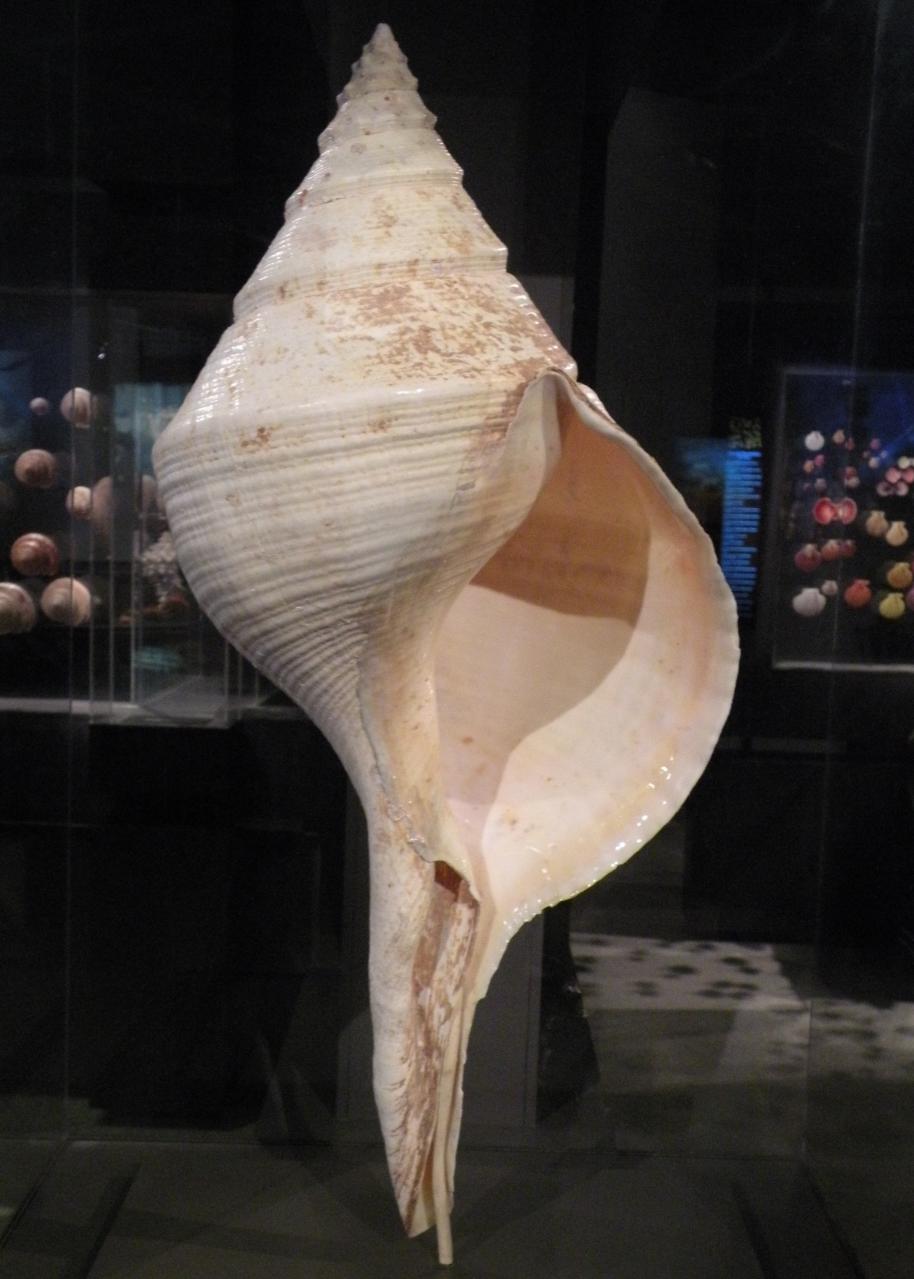
Winkles (i.e. periwinkles) belong to the gastropod order of molluscs. Needless to say, however, if it were real the great glass sea snail would be inconceivably bigger than any gastropod ever recorded by science. Indeed, even the world’s largest known species of gastropod, the Australian trumpet Syrinx aruanus, a member of the turban shell family, Turbinidae, ‘only’ measures up to 3 ft (90 cm) long and weighs up to 40 lb (18 kg). Also worthy of comment is that normal gastropods are not in the habit of exiting their shells at will and carrying them empty on their backs afterwards! Nor are their shells composed of transparent mother-of-pearl (nacre). All in all, therefore, the great glass sea snail was very clearly (pun intended!) a veritable wonder of the marine world.

The Australian trumpet Syrinx aruanus (Stephanie Dancer/Wikipedia)


And not just any old wonder either, but one of immense cryptozoological significance. For as the Doctor’s venerable and exceedingly knowledgeable parrot, Polynesia, subsequently speculated after finally witnessing at close range the great sea snail’s enormous pink-hued shell in shallow water close to shore:

"“That," whispered Polynesia, "is what sailors for hundreds of years have called the Sea-serpent. I've seen it myself more than once from the decks of ships, at long range, curving in and out of the water. But now that I see it close and still, I very strongly suspect that the Sea-serpent of history is no other than the Great Glass Sea-snail that the fidgit told us of.”

"...Seeing him in his full length like this, it was easy to understand how old-time, superstitious sailors had called him the Sea-serpent. He certainly was a most gigantic, and in his way, a graceful, beautiful creature."

The great glass sea snail as the great sea serpent? Although countless identities have been offered for this most perplexing of cryptids, I can’t recall a giant shell-sporting gastropod being among them. Then again, the Doctor’s unique linguistic skills gave him access to inside information from the animal kingdom that today’s cryptozoologists – and zoologists – can only dream of.

Consequently, it would appear that long before the likes of Oudemans, Heuvelmans, and other modern-day cryptozoologists had even considered the problem, the riddle of the great sea serpent’s identity had already been conclusively solved by Doctor Dolittle. What a guy!

Intriguingly, just as the pushmi-pullyu underwent a notable transformation between the original Lofting novels and the 20th Century Fox Studios film musical – metamorphosing from a horned African descendant of the gazelle and the unicorn lineages into a hornless Tibetan species whose morphology now more readily allied it with the llamas – so too did the great glass sea snail.

Out went its shell’s transparent appearance and its occurrence in the sea around Spidermonkey Island, and in came an opaque version whose pink colouration was emphasised instead, and a completely new location too, this time in the vicinity of Sea Star Island - a unique floating isle that could turn up anywhere in the world but which was presently lying just off the African coastline. The scenes on Sea Star Island were actually filmed on the tropical Caribbean island of St Lucia, and in view of its dramatic change in colour scheme, the great glass sea snail was referred to in the film as the great pink sea snail. However, it was still of gargantuan size, and transported all of the good Doctor’s human and animal friends back home to England within its shell’s capacious inner chambers. The Doctor himself, meanwhile, remained on Sea Star Island for a time, but was later borne through the skies to England by another exceedingly large - and equally noteworthy - cryptozoological creature, which I’ll be documenting in Part 3 of this article.


Moby Dick - the great white whale, star of the famous novel by Herman Melville


I was seven years old when the film musical was released in Britain in 1967, and on the day that my father took me to see it at the local cinema I was in a state of great excitement, especially as my mother had told me to make sure that I didn’t miss seeing “the great pink whale”. Sadly, however, despite paying particular attention throughout the film (no mean feat in itself, as its running time was a rather lengthy 152 minutes), I never did spot this wonderful yet evidently highly-elusive creature – but for good reason. When, returning home afterwards, I told my mother that I hadn’t spotted it, she confessed, in a rather embarrassed state, that she had somehow confused Dolittle’s great pink snail with another famous oceanic mega-beast – Moby Dick, the great white whale! Thus was born the great pink whale - albeit neither in nature nor on screen, but at least for a short time in my mother’s hazy recollection and, as a result, in my own enthusiastic imagination. A pity, really, as a great pink whale would almost certainly have been an even more amazing sight than either a great pink snail or a great white whale!


The exceedingly elusive great pink whale!


Still, for a nascent cryptozoologist like I already was, even at the tender age of seven, the film musical did afford one especially memorable and unexpected delight. When the Doctor was discussing with travelling companion Emma Fairfax (a character, incidentally, created specifically for the film as a gentle love interest for him) how the great pink sea snail could easily take all of his friends, including Emma herself, back home to their Westcountry village of Puddleby-on-the-Marsh in England, he revealed that this remarkable sea-beast had an equally remarkable – and famous – freshwater relative:

Dolittle: “He told me he’d been planning to visit his cousin in Scotland for 300 years and kept putting it off. It’d be a great opportunity for him.”

Fairfax: “His cousin in Scotland?”

Dolittle: “Yes, you’ve heard of the Loch Ness monster?”

Fairfax: “Yes,”

Dolittle: “Well, that’s a cousin.”

Fairfax: “Good Heavens!”

So not only had Doctor Dolittle solved the mystery of the great sea serpent, he was also clearly au fait with Nessie! Perhaps, therefore, the world was a little hasty anointing Heuvelmans as ‘the Father of Cryptozoology’! As for the great sea snail having famous family - well, just imagine, the Loch Ness monster, no less, as a cousin! What a small world it is!


LIVING DINOSAURS AND A METHUSELIAN MEGA-TURTLE

Staying with freshwater cryptids: in Doctor Dolittle’s Post Office (1924), the good Doctor journeyed to the small tropical African kingdom of Fantippo, to establish a mail service. During his time there, he paid a visit to a small, mysterious offshore island known as No-Man’s-Land, where, according to the Fantippan people, dreadful dragons reputedly existed. During his sea-voyage to it, his ship was wrecked, but the good Doctor and his dog Jip were rescued by one of these so-called dragons, which turned out to be something even more notable:

At length the extraordinary creature that had come to their rescue reached the island, and with Jip and the Doctor still clinging to his wide back, he crawled out of the water on to the beach...

The tremendous animal which the Fantippans had called a dragon had now climbed right up the beach and was standing fully revealed in all his strangeness. At first he looked like some curious mixture between a crocodile and a giraffe. He had short, spreading legs, but enormously long tail and neck. On his head were two stubby little horns...

‘How very interesting!’ said the Doctor. ‘Naturalists have thought your kind of animal are no longer living, you know. You are quiffenodochi, are you not?’

‘Oh no,’ said the beast. ‘The quiffenodochus has gone long ago. We are the piffilosaurus. We have six toes on the back feet, while the quiffenodochi, our cousins, have only five. They died out about two thousand years ago.’

‘But where are the rest of your people?’ asked the Doctor. ‘I thought you said that many of you had swum out to rescue us.’

‘They did,’ said the piffilosaurus; ‘but they kept hidden under the water, lest the natives on the shore should see...While I was bringing you here they were swimming all around you under the water, ready to help if I needed them. They have gone around to the secret cove so that they may come ashore unseen...’


Doctor Dolittle and the piffilosaurus.


In short, decades before the amphibious long-necked mokele-mbembe began to hit the cryptozoological headlines in a big way, Doctor Dolittle had already encountered a company of living sauropods! Nor was that his only reptilian revelation.

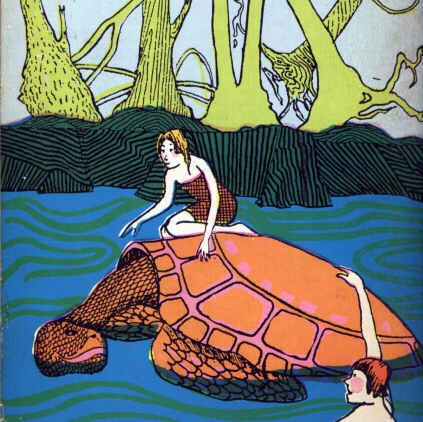
The Doctor’s final adventure in the Post Office novel was his truly historic expedition to Junganyika, the Secret Lake, which no human had ever before seen, hidden away amid some of tropical Africa’s wildest, densest, and least accessible mangrove swamps. His guide was a snake so enormous that South American cryptozoology’s colossal sucuriju gigante or giant anaconda seems positively puny in comparison. And his goal was to meet Mudface - a huge turtle, measuring fully 12 ft across his shell, who lived upon a mud pile rising up above the Secret Lake’s water surface, and was also the world’s oldest living creature, having been alive at the time of Noah’s Ark.

Moreover, in the tenth novel of the Dolittle duodecalogue series, Doctor Dolittle and the Secret Lake (1949), much of its content was devoted to Mudface’s very detailed, extensive account of events as witnessed by him prior to and during the Great Flood.

Mudface


Mudface was fictitious, but he certainly calls to mind the now-famous giant turtles inhabiting a lake in the centre of Hanoi, capital city of Vietnam. Here is what I have written about these fascinating if taxonomically-contentious reptiles in the soon-to-be-published third incarnation of my Lost Ark/New Zoo series of volumes dealing with new and rediscovered animals of modern times:


"TURNING TURTLE IN HANOI

"During the past five centuries, Hoan Kiem Lake, a small alga-choked but seemingly well-oxygenated expanse of freshwater situated in the centre of modern-day Hanoi, Vietnam, has been associated with legends and stories of giant turtles (i.e. freshwater tortoises), and for many years at least three such creatures have been regularly reported here. On 24 March 1998, however, events escalated when a passing cameraman succeeded in filming three of them with his videocamera while they surfaced to gulp air.

"After the film had been shown on television, Hanoi National University biologist Professor Ha Dinh Duc announced that he had been studying these outsized chelonians since 1991, and believed that they constitute a new species. Conversely, a number of other herpetologists consider them to be conspecific with Pelochelys bibroni, but this identification was discounted by Dr Peter C.H. Pitchard, co-chairman of the Tortoise and Freshwater Turtle Specialist Group within the Survival Specialist Commission (SSC), after he had visited Hanoi to view them himself. Instead, he announced that in his opinion: "...these turtles are either an outlying population of the Chinese species Trionyx [=Rafetus] swinhoei or that they are a new species. Certainly they are not Pelochelys bibroni". This conclusion was also favoured by Dr Patrick P. McCord, a leading U.S. expert on soft-shelled freshwater tortoises, of which R. swinhoei is one such species. Accordingly, Prof. Duc later dubbed the Hoan Kiem turtles ‘Rafetus hoankiemensis’, thereby classing them as a distinct species within the existing genus Rafetus, which in 2000 he formally named R. leloii.

"A stuffed specimen, preserved almost 40 years ago, is currently on exhibition at a small temple on an island in Hoan Kiem Lake. According to Duc, R. leloii is the world's largest freshwater tortoise, attaining lengths of up to 6.5 ft and weights of up to 440 lb, with a greenish-brown carapace, pink belly, a green and yellow football-sized head, downcast mouth, oval shell, and peeling skin.

"However, there have already been claims that the narrow-headed soft-shelled turtle Chitra indica (another Asian freshwater tortoise) can attain lengths of 6 ft. In any event, the existence of what could be a new species of very sizeable reptile remaining 'undetected' by science while existing in full view of downtown urban Hanoi's teeming populace is sufficiently noteworthy in itself to encourage further investigation of these remarkable animals - especially as they may be the only representatives of their kind. Having said that, in 2003 herpetologists Drs B. Farkas and R.G. Webb published a paper in which they denounced R. leloii as an invalid species, reclassifying its trio of representatives as specimens of R. swinhoei."

So far in this series of articles, I have documented a remarkable twin-headed land beast, and some equally astonishing aquatic cryptids. In the third and final part, I shall be examining a trio of truly incredible ‘things with wings’ that Doctor Dolittle has encountered during his numerous and very varied exploits around the globe – and beyond!


POSTSCRIPT

A day after I posted this article, Jonathan Downes added a fascinating disclosure on the CFZ bloggo - namely, that although no great pink whale ever appeared in the Doctor Dolittle novels, one such creature did occur in a notable children's novel by acclaimed authoress Joan Aiken. A pink sperm whale called Rosie, she featured in (and also on the front cover of) Night-Birds On Nantucket (1966). Click here for full details. Thanks, Jon!

Friday, 18 March 2011

THE CRYPTOZOOLOGICAL WORLD OF DOCTOR DOLITTLE. PART 1: IN PRAISE OF THE PUSHMI-PULLYU.


Long before I’d even heard of Dr Bernard Heuvelmans, let alone read his seminal cryptozoological tome, On the Track of Unknown Animals, I’d already been greatly influenced by a very noteworthy, albeit entirely fictitious, figure of considerable relevance to mysterious and undiscovered beasts. I am referring of course to animal linguist genius Doctor Dolittle (or Dr John Dolittle MD, to give him his full title), created by Hugh Lofting. His fascinating adventures and discoveries featured in no less than 12 wonderful children’s novels by Lofting - all of which I had read and re-read many times with great joy during my formative pre-teen years.

They also formed the basis for an equally delightful film musical, ‘Doctor Dolittle’, released by 20th Century Fox Studios in 1967. One of my all-time favourite films, it starred Rex Harrison in the eponymous role, alongside Anthony Newley, Samantha Eggar, Richard Attenborough, and a scene-stealing supporting cast of real-life animals. It featured a very tuneful selection of thoroughly charming songs too, composed by Leslie Bricusse (one of which, ‘Talk to the Animals’, went on to win an Academy Award for Best Song).

Showing the film musical's version of the pushmi-pullyu (Dr Karl Shuker)


During his varied escapades as chronicled by Lofting, the good Doctor encountered many different kinds of animal, ranging from the mundane to the marvellous - including a select few that were unquestionably unknown to modern-day science, and which so enthralled me that I can state in all honesty that the onset in my childhood of what would become a lifelong interest for me in cryptozoology was due in no small way to my fascination with these latter mystery beasts.

Consequently, it seemed only right that ShukerNature should survey some of Lofting’s most significant literary cryptids from the Doctor Dolittle series of novels, so here are six of my particular favourites.


THE PUSHMI-PULLYU

Out of all of the extraordinary creatures that appeared in Hugh Lofting’s series of Doctor Dolittle novels, it was the pushmi-pullyu that was unquestionably the most readily identifiable member of Dolittle’s marvellous menagerie, due not only to Lofting’s own input but also to this bicranial wonder’s very memorable appearance in the afore-mentioned Doctor Dolittle film musical from 1967.

Here is how Lofting introduced the pushmi-pullyu, native to darkest Africa and exceptionally elusive, in the very first Dolittle novel, The Story of Doctor Dolittle (1920):

"Pushmi-pullyus are now extinct. That means, there aren't any more. But long ago, when Doctor Dolittle was alive [early 1800s], there were some of them still left in the deepest jungles of Africa; and even then they were very, very scarce. They had no tail, but a head at each end, and sharp horns on each head. They were very shy and terribly hard to catch...[The native people] get most of their animals by sneaking up behind them while they are not looking. But you could not do this with the pushmi-pullyu because, no matter which way you came towards him, he was always facing you. And besides, only one half of him slept at a time. The other head was always awake and watching. This was why they were never caught and never seen in Zoos. Though many of the greatest huntsmen and the cleverest menagerie-keepers spent years of their lives searching through the jungles in all weathers for pushmi-pullyus, not a single one had ever been caught. Even then, years ago, he was the only animal in the world with two heads."

This is not entirely true, of course. There are many fully-confirmed cases of dicephalous or bicephalic (i.e. two-headed) animals on record, including various specimens of two-headed snakes, terrapins, lambs, calves, and even, rarely, humans. However, in every one of these cases, the two heads emerge either from a single neck or, if each head has its own neck, from a single upper torso. What made the pushmi-pullyu so very special is that its heads emerged from opposite ends of its body. Indeed, its body was actually two front halves fused together in opposite directions at their mid-riff.

Such an extraordinary entity is known technically as an amphicephalus, and in reality is exceedingly rare. Indeed, I know only of a few semi-amphicephalic terrapins, which were conjoined twins joined end to end, and, in contrast to the pushmi-pullyu, each twin had an almost fully-formed body, not just a front half.


A semi-amphicephalic terrapin


The much more extreme condition exhibited by the pushmi-pullyu, conversely, would have rendered it an anatomical impossibility in real life – if only for the fundamental physiological reason that it would not have been able to defaecate, having no anus! Happily, such indelicate matters were discreetly passed over by Lofting, who wrote his novels in a more genteel age when, unlike in today’s brasher times, such subjects were most definitely off-limits in a children’s book (even though I would hazard a guess that, schoolboys being schoolboys whatever decade they happened to be born in, the pushmi-pullyu’s excretory paradox attracted its fair share of sniggers and risible comments even back in the 1920s!).

What an amphicephalic llama would look like


Moving swiftly on: just as intriguing as its anatomy was its taxonomy. Just what was the pushmi-pullyu? In the film musical, it was simply portrayed as an amphicephalic Tibetan llama (even though Tibet is normally home to lamas, not llamas!), but in the novel Lofting revealed that it had a much more complex, interesting ancestry:

"Excuse me, [said Doctor Dolittle] surely you are related
to the Deer Family, are you not?"

"Yes," said the pushmi-pullyu "to the Abyssinian Gazelles and the Asiatic Chamois on my mother's side. My father's greatgrandfather was the last of the Unicorns."


Lofting also included the sketch of the pushmi-pullyu reproduced here (Lofting provided all of the illustrations himself for the Dolittle books), which portrays each of its heads with a pair of short horns, curling backwards slightly at their tips, and each head also possesses an extraordinarily large lower jaw (mandibular prognathism?). Whatever it was, therefore, it clearly was not of llama extraction.

Reading through the pushmi-pullyu’s description of its own ancestry, one might initially assume that the most cryptozoological aspect of it was this very curious creature’s derivation on its paternal side from the unicorn lineage. In reality, however, its maternal side was no less interesting either, because there is no such animal as the Asiatic chamois known to science. The only modern-day chamois, Rupicapra rupicapra, is almost entirely confined to Europe (it also exists a little way into Asian Turkey). So how can we explain Lofting’s assertion?

It may of course simply be that Lofting was mistaken, wrongly assuming that the chamois was Asian in zoogeographical distribution. Alternatively, he may have been loosely referring to one of the chamois’s close relatives - the serows, the gorals, the tahrs, or the takins, all of which, like the chamois, are known as goat-antelopes, but all of which, unlike the chamois, are Asian.

Chamois on Czechoslovakian postage stamp


Back in the age when the Doctor Dolittle books were set (the early 1800s), anything – or anyone – with two heads invariably winded up on display in a sideshow or circus. And sure enough, so did the pushmi-pullyu, though in this instance it was a voluntary act, as it wanted to help the Doctor raise enough money to pay for a boat that he had borrowed but which had later been shipwrecked. The pushmi-pullyu’s arrival at the circus - whose astonished owner, the normally world-weary, seen-it-all showman Albert Blossom, was forced to concede in a boisterous song-and-dance number that “I’ve never seen anything like it!” (watch it here) - provides one of the most entertaining scenes of all in the film musical, enhanced enormously by a glorious, deliberately over-the-top performance by none other than Richard Attenborough, the eminent actor brother of Britain’s foremost television naturalist, David Attenborough.

The pushmi-pullyu at Blossom's Circus in the 1967 20th Century Fox Studios film musical, 'Doctor Dolittle' (20th Century Fox)


How sad, therefore, that the pushmi-pullyu was not real – one could well imagine the whispered, reverential tones of Richard’s brother discussing its origins and behaviour in an episode of ‘Life On Earth’!

Join me again for Part 2 of this article, when I’ll be casting a glance over a couple of giant aquatic cryptids encountered by the good Doctor on his travels.

Thursday, 17 March 2011

HOW I LOST A LEOPON, THEN FOUND IT AGAIN - TWICE!

The leopon article from the 28 January 1970 issue of London's Daily Mirror newspaper that I rediscovered by chance(?) at Hay on Wye in the year 2000


It’s often been said that there is no such thing in life as coincidence, and some of my own experiences certainly support this claim. The following example is a case in point.

I mentioned in a previous ShukerNature blog post, re the reverse mermaid (click http://karlshuker.blogspot.com/2011/03/rene-magritte-and-reverse-mermaid-very.html), that even as a child I’d snip articles and reports on strange animals from newspapers and then paste them into a series of large scrapbooks, which were the humble foundation of what in later years would become my cryptozoological archives.

When I was around 10 years old, at the onset of the 1970s, I well remember seeing in one newspaper a very large two-page spread about a truly extraordinary big cat known as a leopon, which proved to be a male hybrid of a leopard and a lioness that had been born in a Japanese zoo. The spread was dominated by a wonderful photograph of this astonishing animal, revealing that its sturdy body was leonine in form but was extensively patterned all over with leopard-like rosettes, and its leopardine head was encircled with a thick lion-like mane. Clearly, it was indeed a crossbreed of these two great cat species, and as I previously hadn’t even suspected that they could successfully hybridise and produce viable offspring, let alone seen photos of any, I was completely captivated by this article and in particular by its amazing photograph.

Consequently, even today, over 40 years later, I still cannot comprehend why on earth I didn’t retain the article and paste it without delay into one of my scrapbooks. Yet for some completely unknown reason, I didn’t. Instead, rather like a dream in dawn’s first light, it somehow slipped away from me and was gone, lost forever from my life, it seemed, but never forgotten.

It was now 1988, and I was earnestly preparing the manuscript of my very first book, Mystery Cats of the World, for publication the following year. It included a section on leopons in relation to my coverage of an African crypto-cat known as the marozi or spotted lion, which some investigators have speculated (albeit very implausibly) may be naturally-occurring lion x leopard hybrids. Back in those pre-internet days, information on such esoteric creatures was very difficult to trace, and on more than one occasion while writing my leopon section I cursed myself for not having retained that informative newspaper article from my childhood. Then again, I mused, perhaps it might be possible to obtain a copy of it after all. Thinking back, I reflected that the article must have been published in or around 1969 or 1970, and of the various newspapers that my family read at that time, the most likely one in which it would have appeared, based upon its layout and style as I recalled, would have been London’s Daily Mirror.

Marozis or spotted lions (William M. Rebsamen)

Armed with these admittedly sparse details, I wrote to the archive department of the Mirror, and asked if there was any chance that they could trace the leopon article and sell a photocopy of it to me for research purposes in relation to my book. I certainly didn’t have high expectations of obtaining any result, but a few weeks later a large flat envelope arrived, and there inside was an A3-sized photocopy of the leopon article! It was dated 28 January 1970, occupied pages 12 and 13, and was entitled ‘The lion who just can’t change his spots’.

Gazing at it again after almost 20 years, I was thoroughly amazed, but delighted. The photo, by globetrotting Mirror cameraman Kent Gavin, was exactly as I’d pictured it in my mind’s eye, and there was also a second, much smaller one, showing the leopon’s leopard father, Kaneo, and his lioness mother, Sonoko, together. Reading the article’s text revealed that the leopon himself – the extremely exotic-looking subject of the main photo - was called Johnny, who lived with his parents and four siblings at a zoo in Kobe. Needless to say, I lost no time in writing a very grateful letter of thanks to the Mirror archivist who’d successfully uncovered the much-prized article for me, and I also made sure that this time it was placed safely on file – after which I naturally assumed that this was the end of the lengthy saga of the discarded leopon article.

In fact, I couldn’t have been more wrong, because by far the most extraordinary episode was still to occur.

Eleven years had now passed since my mystery cats book had been published to great acclaim in June 1989, and, as is so often the case with me on sunny Saturday afternoons in the spring and summertime, I found myself on that very eventful day in question at Hay On Wye. Situated on the English-Welsh border, this is the so-called ‘Town of Books’ that is famous worldwide for housing within its modest-sized borders around 30 different second-hand bookshops.

One of my favourites is C. Arden - The Natural History Bookshop (see my photo of it below), which contains a veritable treasure trove of wildlife books on every conceivable field of natural – and unnatural – history. Outside, there is a bookcase (arrowed in photo) often containing bargains and sell-off volumes, usually priced at no more than a pound or so each, which are generally arranged very haphazardly, due to the considerable number of browsers who sift through them in search of a find.


For reasons that I simply cannot even begin to understand, despite being confronted by shelf after shelf of enticing titles my gaze was instead drawn to a large creamy-white nondescript-looking volume sticking out a little near the bottom of a pile of books on a shelf close to the ground on the right-hand side of this bookcase. I couldn’t see its title, and, indeed, could scarcely even see the book itself, so why should I have even given it a second glance, let alone felt compelled to pull it out from under the weight of books piled on top of it? And yet, inexplicably, I did.

And once I was holding it, I noticed that there was something sandwiched between two of its pages, something that looked like a folded sheet from a newspaper. Taking it out, I carefully unfolded it, and then, if anyone had been standing nearby, they might well have heard a mighty clang – the sound of my jaw crashing to the floor, as my eyes struggled to accept what they were looking at.

There, in my visibly trembling hands, were pages 12 and 13 from the Daily Mirror for 28 January 1970 – ‘The lion who just can’t change his spots’!! As seen in this article's opening photograph of them, the pages were a little brown – they were, after all, just over 30 years old – but I scarcely even noticed that. All I could see was Johnny the Japanese leopon’s photo staring back at me!

Johnny the male leopon in the article's main photograph (Kent Gavin)


Apparently, there is a one in 14 million probability of winning the jackpot in the UK National Lottery. But what is the probability of my opening a book selected seemingly at random in a town over 80 miles away from my home and packed with countless thousands of other books, only to find inside it a copy of the exact same newspaper article that I had thrown away 30 years earlier and had wished with all my heart ever since that I hadn’t? It must be so minuscule as to be virtually incalculable, and yet, somehow, incredibly, I’d done it!

I hardly need state that I immediately went inside the shop, paid my pound for the book, and came out again, still quaking in shock, with its precious newspaper article tucked back safely inside its pages. And as soon as I arrived back home, I took the article out, placed it inside a transparent plastic A4 packet, and filed it away in the appropriate place within my archives, where it remains to this day - except when, every so often, I take it out again, gently unfold its slightly brittle pages, and gaze with a mixture of awe and rapt reverence at its fondly-remembered photograph of Johnny the Japanese leopon. Ironically, I can’t even remember what the book was in which I’d found this newspaper article, or even what happened to it afterwards – I suspect that it was given away to a charity shop with various other surplus books of mine when I had one of my periodic weeding-out sessions.

Some writers and readers fervently believe in the existence of a library angel - a supernatural force or entity that helps them to locate a certain book (or other publication) if their need to find it is sufficiently compelling. So was I guided by divine intervention to locate a copy of my long-lost leopon article? If that seems unlikely, how much likelier is it that I could have found it in the way that I did simply by random chance?

Leopon