A mapinguary confrontation (William Rebsamen)
A few blogs ago, I noted that the ITV sci-fi
series ‘Primeval’ is one of my all-time favourite television shows. And
many of you know that I am currently working upon an expanded, updated
version of my 1995 cryptozoology book
In Search of Prehistoric Survivors.
Consequently, I could not be anything but greatly intrigued to stumble
upon an internet article recently that was entitled ‘Primeval
Survivors?’ – and, reading it, I was certainly not disappointed.
As you’ll see if you access it in issue #38 (April 2009) of the online teenage magazine
Flipside Extra – at
http://www.flipside.org.uk/38/primeval.cfm
and published by the Institution of Engineering and Technology - the
article in question deftly utilises the excellent ‘Primeval’ TV series
as a means of introducing cryptozoology, including the possibility that
there are undiscovered prehistoric creatures lurking in the modern world
(and without needing access here via any Anomaly), my own
cryptozoological views, and those of science journal
Nature’s
editor, Dr Henry Gee, who looks upon cryptozoology in a positive light.
All in all, then, a pleasant surprise indeed! BTW, I’m still considering
ideas for the title to my book’s update. How about
In Search of Primeval Survivors?! Now there’s a thought!
Back
to the present, however, and herewith my latest blog post – the first of a two-part account regarding some of South America’s cryptids. These
will include some mystery birds, so if you’re interested in them, check
out the current issue of
Paranormal Magazine, which has an entire article on crypto-birds by me.
SOUTH AMERICAN MYSTERY BEASTS
Part 1.
A
62-ft-long anaconda may sound like the stuff of nightmares, but
according to the renowned South American explorer Lt.-Col. Percy
Fawcett, this is precisely what he and his exploration team encountered
in western Brazil during 1907 while voyaging by canoe along the Rio
Abuna, near to its confluence with the Rio Negro. Uncomfortably close to
Fawcett's canoe, several feet of broad, powerful, undulating,
serpentine coils and a huge triangular head rose up above the surface of
the river, and as he and his team watched in horror, a truly colossal
anaconda began emerging onto the riverbank. Greatly alarmed by the
threat posed to his team by this limbless leviathan, Fawcett shot the
snake dead, and then proceeded to measure its gargantuan form. To his
amazement, he discovered that the portion of its body that had emerged
from the water prior to being shot was 45 ft long, and the portion
remaining in the water was 17 ft, thereby adding up to a grand total of
62 ft!
Needless to say, however, Fawcett and his team
had no means of transporting an immensely heavy, rapidly-decomposing
(and extremely odiferous!), 62-ft carcase back to civilisation.
Consequently, his claims concerning its size remain unconfirmed - and
Fawcett himself famously vanished in the Brazilian jungle during 1925,
never to be seen again.
As there has never been a
fully-confirmed specimen of anaconda measuring over 30 ft, some snake
experts today are highly sceptical of Fawcett's account. Others,
conversely, are not so dismissive. One thing, however, is for sure -
giant anacondas are just one of a remarkable number of controversial,
still-unrecognised creatures reported over the years from the vast
uncharted depths of South America's verdant jungles of mystery.

Giant anaconda (William Rebsamen)
SUCURIJU GIGANTE - OR, BEWARE OF THE SERPENT!
Immense
anacondas may seem fanciful to western science, but they are apparently
very real to the Indian tribes inhabiting riverside localities within
the 'green hell' of Amazonia, who even give these oversized serpents
their own specific name - sucuriju gigante.
Some
reports seem too incredible to be taken seriously, yet have been
vehemently championed by eyewitnesses to the events in question. Thus,
in 1948 a stupendous anaconda emerged from the River Oiapoc in Brazil's
Guapore territory, and hid itself within the fortifications of Fort
Tabatinga - until it was finally dispatched by a hail of at least 500
machine-gun bullets fired by a team of soldiers sent to kill it.
According to an illustrated report of this incident later published in a
Rio de Janeiro newspaper, when its colossal carcase was measured this
monstrous snake was found to be 115 ft long! How accurate this claim is,
however, will never be known, because after they had killed it the
soldiers pushed the anaconda's body back into the river.
Less
incredible but still very impressive was the anaconda once spotted by
Amazon voyager F.W. Up de Graffe lying in shallow water underneath his
canoe. Writing in 1923:
"It
measured 50 ft for certainty, and probably nearer 60. This I know from
the position in which it lay. Our canoe was a 24 footer; the snake's
head was 10 or 12 ft beyond the bow; its tail was a good 4 ft beyond the
stern; the center of its body was looped up into a huge S, whose length
was the length of our dugout and whose breadth was a good 5 ft."
There
are certain fundamental problems facing anyone attempting to assess
reports of giant snakes. Eyewitnesses tend to be notoriously inaccurate
when estimating the length of a long snake - especially one that is
coiled up. Evidence supplied in the form of extra-lengthy snake skins is
of little value either, as skins can be stretched quite considerably.
As for photographs purporting to show giant snakes, these rarely contain
any scale by which the reptile's size can be determined. And, for
obvious reasons, the prospect of capturing and bringing back for
scientific examination a living specimen of a serpentine giant is a
daunting one to say the very least!
Nevertheless, the
likelihood of anacondas existing that do exceed 30 ft, and possibly
quite considerably, cannot be ruled out of hand. If the anaconda were a
terrestrial species, giant specimens would be highly unlikely, simply
because they would be too heavy to move efficiently. As the anaconda is
primarily aquatic, however, its body weight - even if fairly immense -
would be effectively buoyed by its surrounding watery medium, thus
permitting it to grow to sizes far in excess of anything that a
land-living serpent could emulate.
THE ANOMALOUS ANDEAN WOLF
The
pelt depicted below is currently unique - the only preserved example of
a pelt from the elusive, still-controversial Andean wolf. It came from a
market in Buenos Aires, where it and three others just like it were
spotted by German animal dealer Lorenz Hagenbeck in 1927. After learning
that it was from a strange form of dog allegedly inhabiting the Andes,
Hagenbeck purchased this pelt - the fate of the others is unknown - and
brought it back to Europe, where it is now housed at the Zoological
State Museum in Munich, Germany.
Perplexed scientists examined
its luxuriant, dense pelage, unlike anything previously documented, and
proposed that it originated from an as-yet-undescribed,
mountain-dwelling version of the maned wolf Chrysocyon jubatus.
German zoologist Dr Ingo Krumbiegel paired it with an equally mysterious
canine skull of Andean origin, and in 1949 published a paper in which
he formally described this reclusive, montane-adapted maned wolf, and
subsequently named it Dasycyon hagenbecki ('Hagenbeck's
thick-furred dog'). No sightings or further specimens of this supposed
new species, however, have ever been recorded. Hair analyses later
suggested that the pelt may be (or may at least be descended) from a
domestic sheepdog, but this identity of a wolf in sheepdog's clothing
has not been confirmed. During the late 1990s, Guillaume Chapron, a
member of the IUCN/SSC-Veterinary Specialist Group, expressed an
interest in researching the Andean wolf during some planned field work
in Argentina, but again there have been no further developments to date.
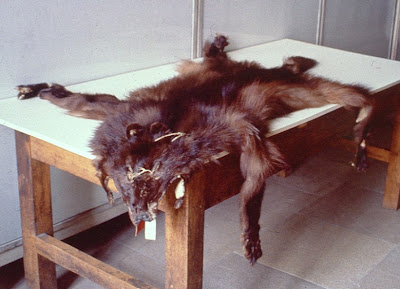
Andean wolf pelt (Dennis Vrettos)
MAKE WAY FOR THE MINHOCÃO
Every
so often, an unexpected, unheralded upheaval of land occurs in Uruguay
and in Parana, southern Brazil, substantial enough in some cases to have
caused the collapse of roads and hillsides, and even the diversion of
river courses. Even so, this could be dismissed as nothing more than an
earth tremor or suchlike - were it not for the amazing fact that a
bizarre subterranean creature sometimes reveals itself during this
subsidence.
Described by eyewitnesses as resembling a
huge worm, but with a pair of small stubby horns on its head, and
covered in black scaly skin, it is generally referred to as the minhocão
(see an earlier blog of mine for a detailed account of this cryptid).
Over the years, many attempts have been made to offer a zoological
identity for this cryptic beast - ranging from a giant lungfish to a
surviving species of gargantuan armadillo-related prehistoric mammal
known as a glyptodont. As I have proposed in previous publications and
also in a previous ShukerNature blog post, however, the minhocão's
description and behaviour corresponds closest to what one would expect
for a giant species of caecilian - a limbless, worm-like, burrowing
amphibian, which sometimes does have a pair of small tentacles on its
head, and skin embedded with small scales.
IN SEARCH OF THE MAPINGUARY
For a number of years, Brazilian zoologist Dr David Oren, from the Goeldi Museum, has led expeditions into the dense jungle heartland of the Mato Grosso in search of an extraordinary mystery beast known to the local Indians as the mapinguary. According to their description, it is covered in reddish fur, stands as tall as an average adult human when squatting on its hind legs, leaves peculiar footprints that look as if they are back-to-front and other, equally strange bottletop-shaped impressions, emits a loud shouting cry, defecates horse-like droppings,

and is claimed to be invulnerable to bullets. Rather more bizarrely, they also claim that it gives off a foul, lethal stench to ward away would-be attackers, and has a second mouth in its stomach! Despite its grotesque-sounding appearance, Oren is confident that although he has yet to observe a specimen, he has at least determined the mapinguary's identity - stating that he believes it to be a surviving species of mylodontid ground sloth.
Officially deemed to have become extinct several thousand years ago, various mummified specimens have been discovered in sealed-away caves. These reveal that they did indeed have red fur, feet that could leave footprints which may appear reversed to anyone unfamiliar with ground sloth foot structure, and a powerful tail whose tip, if used for support while squatting upright, could yield the strange bottletop prints. Moreover, preserved mylodontid faecal pellets that do resemble those of horses have also been found, as have preserved mylodontid pelts, which contain bony nodules that may actually deflect bullets and other missiles. As for the mapinguary's stench emission and stomach-sited 'second mouth': Oren proposes that a specialised scent gland may be present on the mapinguary's belly, releasing a vile skunk-like gaseous odour as a defence mechanism. If the mapinguary is indeed revealed one day to be a living ground sloth, it may well comprise the largest species of mammal native to South America - and hence a major cryptozoological success story.
LAKE TITICACA'S MYSTERY BEAST
One of South America's least-known creatures of cryptozoology is the enigmatic water beast reported from Peru's mighty Lake Titicaca in 1910 by Adolph F. Bandelier, within his book The Islands of Titicaca and Koati. According to Bandelier, a 12-ft-long animal variously said to resemble a manatee or a seal has been sighted near the islands of Tiquina and Titicaca, and also close to the peninsulas of Tiquina and Copacavana, in Lake Titicaca. As yet, however, no formal verification of its existence, let alone its identity, has been forthcoming.
THE CHACO'S DEADLY SLUG-SNAKE
Equally obscure is the formidable mystery beast reported from the Paraguayan Chaco region in 1954 within the autobiography of Charles W.T. Craig, entitled Black Jack's Spurs. The locals claim that this weird-sounding creature resembles a slug-like serpent, but sports the head of a dog, a poisonous barbed spike in its stumpy tail, and is as broad as a horse. Veteran cryptozologist Dr Bernard Heuvelmans opined in 1986 that it could be a form of giant catfish known to the locals as the manguruyu. Moreover, they claim that this fish can grow up to 18 ft long and weigh up to half a ton, but such gargantuan sizes have never been scientifically verified.
GUMS! - IDENTIFYING FAWCETT'S GIANT TOOTHLESS RIVER SHARK
According to Lt.-Col. Fawcett, the Paraguay River contains
"...a freshwater shark, huge but toothless, said to attack men and swallow them whole if it gets a chance
". However, very few shark species inhabit freshwater, and those that do are well supplied with teeth. Consequently, not all cryptozoologists who accept Fawcett's statement believe this creature to be a shark. British investigator Mike Grayson, for instance, has suggested that it may in reality be a sturgeon, some species of which do bear a very superficial resemblance to sharks and can attain a huge size. Having said that, as Grayson readily concedes, sturgeons normally do not attack and eat people (but perhaps this component of the report is based upon local superstition?). However, there is also a zoogeographical problem with this identity, inasmuch as there is not a single known species of sturgeon native to South America.
My own view is that if such a creature exists and is not a real shark, it may conceivably be a giant catfish. There are more catfish species in South America than anywhere else, and some of these are also among the world's largest. Moreover, some other very big species, such as the European catfish (wels) have been accused of swallowing people (albeit, again, a claim more probably folkloric than factual), and elderly specimens of certain giant catfishes, such as the Mekong River's pa beuk, are indeed toothless. So perhaps 'Gums' (an apt name coined by Grayson for Fawcett's edentate enigma) is actually an old toothless catfish, possibly belonging to a still-undescribed extra-large species.
Click
here to read Part 2 of this article.


 Posts
Posts