The tantalizingly short but fascinating item – from the 1 September 1866 issue in Vol. 2 of a long-discontinued English periodical entitled Hardwicke's Science-Gossip – recently came to my attention:
BLUE BIRDS OF GALILEE. – In the translation of Renan's "Life of Jesus" (cheap edition), there is mention made at page 74 of "blue birds (at Galilee) so light that they rest on a blade of grass without bending it." Is there a blue bird in that region so small as to afford foundation for the statement, and if so, what is its scientific name? – H.G. [these being the initials of this query's author – their full name was not given]
Named after its publisher, Robert Hardwicke, based in London, Hardwicke's Science-Gossip was published on the first day of each month from 1865 (Vol. 1) to 1893 (Vol. 29), after which it was succeeded by Science-Gossip. Its editors were Mordecai Cubitt Cooke (ed. 1865-1871) and John Ellor Taylor (ed. 1872-1893). Throughout the brief interchange of correspondence concerning these birds that appeared in this periodical's pages, and which will be presented in full below, the editor was Cooke.

First of all, however, a word about the source from which H.B. had quoted the line regarding the blue birds. Published in 1863, the book in question was a very popular work entitled The Life of Jesus, written by French biblical scholar Ernest Renan (1823-1892) after having visited Galilee and Jerusalem during the early 1860s. Hence his account was based upon first-hand knowledge, not merely upon trawling through the writings of others. Whereas he appeared distinctly uninspired by Jerusalem's environs, Renan was greatly enamoured by what he considered to be the natural beauty of Galilee. Here is the full excerpt from his book regarding its wildlife that contained the line about the blue birds that had piqued H.B.'s curiosity:
The saddest country in the world is perhaps the region round about Jerusalem. Galilee, on the contrary, was a very green, shady, smiling district, the true home of the Song of Songs, and the songs of the well-beloved. During the two months of March and April the country forms a carpet of flowers of an incomparable variety of colors. The animals are small and extremely gentle — delicate and lively turtle-doves, blue-birds so light that they rest on a blade of grass without bending it, crested larks which venture almost under the feet of the traveller, little river tortoises with mild and lively eyes, storks with grave and modest mien, which, laying aside all timidity, allow man to come quite near them, and seem almost to invite his approach.
All of the other animal species mentioned in this excerpt are readily identifiable and familiar sights in Galilee, which makes the zoologically unrecognizable blue birds all the more perplexing.

Back now, therefore, to H.G.'s plea for assistance in identifying Renan's feather-light blue mystery mini-birds of Galilee. It was initially answered, albeit exceedingly succinctly, in the 1 November 1866 issue of Hardwicke's Science-Gossip by a correspondent signing off with the initials T.G.P.:
BLUE BIRD OF GALILEE. – H.G. inquires as to this bird, mentioned by Renan. The bird that learned author probably refers to is Cinnaris [sic] osea, the Sun-bird or Honeysucker of Palestine.
This comment was challenged in the 1 December 1866 issue by the memorably-named Lester Lester, of Monkton Wyld (nowadays a small settlement within the civil parish of Wootton Fitzpaine, in the southwest English county of Dorset), who responded somewhat pompously as follows:
THE BLUE BIRD OF GALILEE. – Will T.G.P. allow one who has lately been reading Tristram's "Land of Israel" to suggest that the Blue Bird of Galilee is most probably the Blue Rock-thrush (Petrocincla cyanea), and not the Sun-bird (Cinnaris [sic] osea)? The habitat of this latter bird is the Ghor or deep valley of the Jordan and Dead Sea, most especially about Jericho, and not the rocky hills of Galilee.
T.G.P.'s communication was also responded to in the 1 January 1867 issue of Vol. 3, this time by none other than the Rev. Dr H.B. [Henry Baker] Tristram (1822-1906) himself – the English clergyman/scholar/ornithologist who was the author of the book Land of Israel that Lester had cited (or, to give it its full, correct title, The Land of Israel: A Journal of Travels in Palestine, Undertaken With Special Reference to Its Physical Character, published in 1865).

However, Rev. Dr Tristram was even more emphatic than Lester in his dismissal of T.G.P.'s sunbird suggestion:
THE BLUE BIRD OF GALILEE. – I see that a correspondent in a late number inquired what was "the blue bird of Galilee." I suppose that fancy may be allowed some scope in the question, but as a matter of fact there are but two birds to which it can be applied – the blue Thrush (Petrocincla cyanea) which is scattered about the Galilean hills and glens in small numbers all the year round, and the Roller (Coracias garrula) which is very common over the whole country in summer only. The Sun-bird (Nectarinia osea) is quite out of the question. It is not blue, and it barely exists in Galilee; one or two pairs merely straggling into the neighbourhood of the Lake of Galilee. It is a bird of the Lower Jordan valley and Dead-Sea basin strictly, and even there will only be seen by those who look closely for it.
Beneath this communication was a short square-bracketed addendum provided by the periodical's editor, who at that time was Cooke. As will be seen below, this addendum consists of a summary of a presumably longer response by T.G.P. to Tristram's missive (T.G.P.'s full response was not published, which is a great shame as it would have been most enlightening to discover what further support he offered for his preferred sunbird identity). Here it is:
["T.G.P." writes to us again in support of his opinion that the bird alluded to by Renan, as "so small and light that it can rest on a blade of grass without bending it," must be some such small creature as Cinnyris osea.]
And those were the last words on the subject to appear in Hardwicke's Science-Gossip. For despite my checking methodically through every succeeding volume of its entire run (all but Vol. 1 of which can be found online here, courtesy of the Biodiversity Heritage Library), no further mention of these enigmatic birds was found. Nor have I been able to uncover any details regarding them elsewhere.
Moreover, perusing a comprehensive online checklist of the birds of the Israel/Palestine region provided me with no additional species worthy of consideration. Consequently, I am focusing my attention now upon the trio mentioned in the above-quoted correspondence between T.G.P., Lester, Tristram, and editor Cooke.

Let’s begin with the blue rock thrush. Nowadays referred to scientifically as Monticola solitarius (Petrocincla cyanea as used by the writers quoted above is now obsolete), this species was traditionally classified as a thrush, but in more recent times it has been recategorised as a chat, and thus assigned to the flycatcher family Muscicapidae. Nevertheless, it retains its long-familiar turdine English name. Moreover, as both its English and its taxonomic names suggest, this is a montane species, and is certainly common in the hills and mountains of Galilee. However, despite the confident assertions by Lester and Tristram that it may well be the identity of Renan's blue mystery mini-birds encountered by him there, there are two major problems associated with this identification.
Firstly: only the adult male blue rock thrush is blue, adult females and juvenile individuals are brown. So unless all of the birds seen by Renan were males, or specimens of the brown females were also there but he either didn't notice them or (if he did) he didn't realize that they belonged to the same species as the blue ones, this weighs heavily against the blue rock thrush as an identity contender. Secondly, and on the subject of weighing heavily: the blue rock thrush is the size of a European starling Sturnus vulgaris and weighs up to 2 oz (60 g), with a total length of up to 9 in. Needless to say, therefore, this bird is far too big to be able to "rest on a blade of grass without bending it".
As noted by Tristram, the European roller Coracias garrulus is indeed common throughout the Galilee district in summer, and both sexes sport predominantly blue plumage. In terms of size, however, this stocky species is even bigger than the blue rock thrush, being the size of a European jay Garrulus glandarius, boasting a total length of up to 1 ft, sometimes slightly more, and a weight of up 5.3 oz (150 g). Consequently, it has even less chance than the blue rock thrush of being able to "rest on a blade of grass without bending it".

When I first read that memorable descriptive line from Renan's account of the Galilean mystery blue birds, I thought straight away that the only birds small enough and light enough in weight to correspond with it would be hummingbirds – but these of course are all exclusively New World in occurrence. However, as I then thought, they do have some similarly-sized Old World ecological counterparts – the nectariniids or sunbirds. Although taxonomically unrelated, by sharing the hummingbirds' lifestyle the sunbirds through convergent evolution have come to look and behave very much like them. Could it be, therefore, that the identity of Renan's feather-light mini-birds is a sunbird?
Only one species exists in the Israel/Palestine region of the Middle East – the Palestine sunbird Cinnyris osea (formerly Nectarinia osea). Contrary to Tristram's claim, this species can appear blue, or at least the breeding male can, which sports iridescent plumage that shimmers green or blue in sunlight, depending upon the angle at which it is observed. And it is certainly a much better fit for Renan's mini-birds than either the blue rock thrush or the roller in terms of its size, with even the male (larger than the female) not exceeding a total length of 4.75 in, and a weight of 0.3 oz (8 g). One could certainly imagine such a minuscule bird being able to rest upon a sturdy blade of grass without bending it, especially with a mountain breeze providing a counterbalance to the sunbird's weight (such that it is) upon the blade.
This is so obvious that it surprises me how readily both Lester and (especially) Tristram (given his ornithological expertise) rejected T.G.P.'s suggestion that the Palestine sunbird was the likeliest candidate for Renan's mystery mini-birds. (Having said that, Lester was basing his view upon what he had read in Tristram's book, as opposed to proffering an entirely independent one of his own.) True, their opposition was founded largely upon claims that this species simply wasn't common enough in the Galilean district to be a tenable identity, but they should have conceded that in terms of size alone, as well as colouring, it was a far more plausible one than either of their own favoured, but much heavier, candidates.
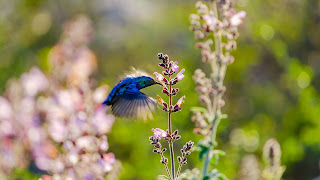
So how can this ornithological paradox be reconciled? Might it simply be that the Palestine sunbird is actually more common in Galilee than attested to by Tristram and Lester? Or perhaps, more specifically, it is more common there during the months of March and April to which Renan was alluding in his description of its wildlife? Worth noting, moreover, is that this species' males do sport their iridescent breeding plumage during those particular months (click here, for instance, to see a photograph of one such specimen exhibiting shimmering blue/green plumage that was snapped during March 2013 in Israel by Volker Hesse).
Of course, as with the blue rock thrush contender, if we are to take the Palestine sunbird's identity candidature seriously we would have to assume that because only its breeding males are blue (or green, depending upon viewing angle), these were the only individuals to catch Renan's eye, with the even smaller, dowdy, grey-and-white females overlooked by him or at least not deemed attractive enough to merit a mention in his description. To my mind, this is not an unreasonable prospect, as the breeding males are exceedingly eyecatching, resembling living jewels, and therefore certainly likely to eclipse the drab females when attracting an observer's attention.
A further possibility is that Renan's description was overly romantic – a criticism that has been directed at his writings by various scholars and critics in the past. Perhaps he saw sunbirds somewhere else in the Israel/Palestine region as opposed to in Galilee, but added them to his account of Galilee's wildlife as a descriptive flourish – i.e. poetic licence? Or might he have misremembered where he saw them, erroneously claiming that they occurred in Galilee when in reality he had seen them elsewhere in this region? Or could these feather-light fliers have been entirely fictitious, created by Renan to enhance still further the idyllic image of Galilee conjured forth by his lyrical narrative?

One final, admittedly remote, but nonetheless intriguing identity for Renan's mystery mini-birds of Galilee comes to mind – is it possible that they were not birds at all but were instead a certain very famous avian impersonator from the insect world? The species that I have in mind is the hummingbird hawk moth Macroglossum stellatarium, which so closely resembles a hummingbird not only in size but also in behaviour that when seen in flight and hovering around flowers, imbibing nectar using its long slender proboscis, it is often mistaken by non-naturalists for such a bird.
Furthermore, not only does this species occur in the Israel/Palestine region and can produce 3-4 broods a year so that adults are seen all year round, but also its body in particular (and to a lesser extent its wings) can appear a powdery slaty-blue colour when viewed in sunlight. And as it is even smaller and lighter in weight than the Palestine sunbird, it assuredly could "rest on a blade of grass without bending it".
How ironic it would be if both Renan and the trio of correspondents debating his mystery mini-birds in the pages of Hardwicke's Science-Gossip more than 150 years ago had all been led entirely astray, that the true nature of those tiny blue blade-resters was not avian at all, but rather that of an incognito insect, a masquerading moth.


 Posts
Posts