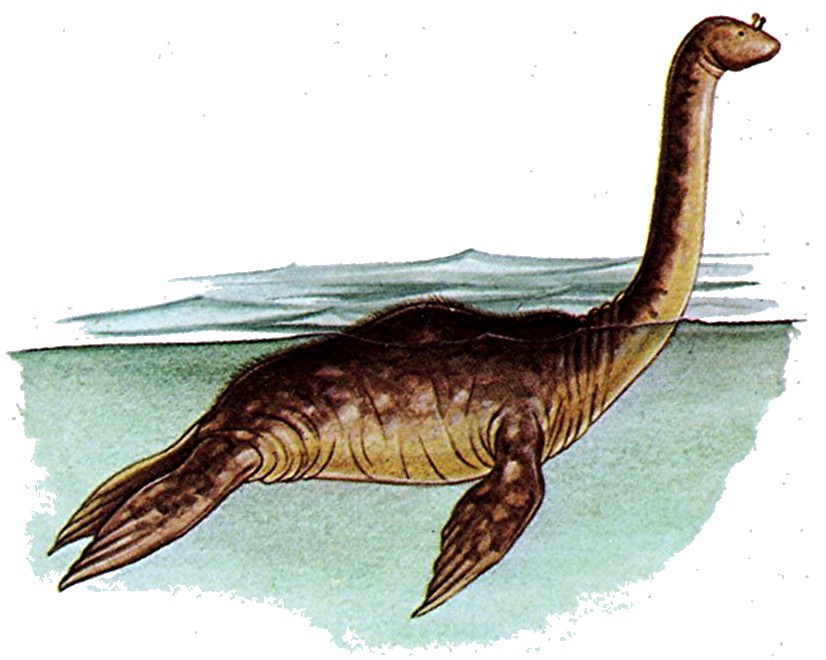
Brian Froud's wonderful rendition of
Peter Costello's proposed long-necked freshwater seal graces the cover of the
1975 Panther paperback edition of Costello's classic crypto-book In Search
of Lake Monsters (© Peter Costello/Brian Froud/Panther Books)
In Part 1 of this ShukerNature blog article (click here), I investigated the candidature of an
undiscovered species of giant long-necked seal as an identity for certain sea
serpents, as promoted in particular by Drs Anthonie Oudemans and Bernard
Heuvelmans. However, the concept of such a creature is not confined to the contemplation
of marine cryptids, as now revealed.
MEGALOTARIA, MEET NESSIE!
Heuvelmans believed that it was his hypothesised long-necked
seal, which he had formulated and dubbed Megalotaria longicollis in his
seminal book Le Grand Serpent-de-Mer (1965), rather than any postulated
form of surviving plesiosaur that was responsible for those water monsters
yielding the now-iconic, vertically-held, periscope-like head-and-neck image
firmly planted in everyone's mind when picturing water monsters (and most especially
the Loch Ness monster), whether marine or freshwater in habitat, though in his
book he confined himself to those cryptids on record from the seas and oceans.
Just under a decade later, however, one of
Heuvelmans's cryptozoological disciples and longstanding correspondents, Irish
author Peter Costello, produced what was very much a companion book to his mentor's
sea serpent tome but concentrating its attention instead upon lake monsters, in
particular Nessie. (Judging from a footnote in his sea serpent tome –
"Which will appear in a separate book on 'monsters' of lochs, lakes,
marshes and rivers – freshwater unknown animals" – apparently Heuvelmans had
originally planned to prepare such a book himself, but subsequently assisted
Costello in producing his own book instead.)
Nessie as a long-necked seal (©
Robert Elsmore)
Published in 1974, Costello's book was entitled In
Search of Lake Monsters, and in this global study he followed much the same
course as Heuvelmans did in his own, i.e. analysing an extensive collection of
eyewitness reports of aquatic cryptids from around the world (but freshwater in
this instance, with particular emphasis upon Scottish loch monsters), and then
providing what he considered to be the most likely identification for them.
Here, however, he diverged markedly from Heuvelmans, pursuing the Oudemans
approach instead.
For whereas Heuvelmans had proffered a series of no
less than nine different hypothetical cryptids as the collective solution to
the sea serpent mystery, Costello bravely put forward only a single identity to
explain virtually all of the lake monsters documented by him (including Nessie),
diverse though they seemed to be in form, and therefore potentially inviting
criticism of the kind that Oudemans's Megophias had attracted, i.e. that
his solution was of the 'one-size-fits-all' variety – but that was not all. The
single identity that he proposed was none other than Heuvelmans's very own
giant long-necked seal, Megalotaria longicollis, thereby deeming it to
be capable of living in freshwater habitats as well as in marine environments.
Artistic reconstruction of Megalotaria
(Identity of artist/copyright holder unknown to me, so I would welcome receipt
of appropriate credit details)
As expected, therefore, for the most part Costello's
description of this giant long-necked seal reiterated that of Heuvelmans for
the same hypothetical species. However, he did also provide a few additional
details, especially when specifically relevant to its inhabiting a freshwater
domain, such as the assertion (rather than merely a speculation as offered by
Heuvelmans for maritime Megalotaria) that it hunts by sonar, especially
in stygian bodies of water like Loch Ness where vision is rendered largely or
entirely superfluous, and that its hearing is therefore exceptionally sharp. As
noted in Part 1 of this ShukerNature article, however, currently there is no
conclusive evidence that pinnipeds do use sonar. He also claimed that it gives
vent to a sharp staccato cry that sounds like a sea-lion's bark.
According to Costello, therefore, Nessie is merely
a lake-dwelling long-necked seal, a freshwater-confined representative of
Heuvelmans's marine Megalotaria, not even sufficiently distinct, despite
its different habitat, to warrant any taxonomic delineation from the latter
creature. Yet if this were true, why have other maritime pinnipeds only rarely
or never established exclusively freshwater intraspecific populations? The only
notable examples are two totally freshwater subspecies of the ringed seal Pusa
(=Phoca) hispida – namely the greatly-endangered Saimaa seal P.
h. saimensis (confined entirely to Finland's Lake Saimaa) and the Ladoga
seal P. h. ladogensis (confined entirely to Russia's Lake Ladoga) – and
some non-taxonomically discrete colonies of the common seal Phoca vitulina
in a few lakes, such as Alaska's Lake Iliamna (already well-known to monster
seekers for the giant fishes that allegedly inhabits its voluminous waters) and
certain lakes in Quebec (a few researchers do elevate these Canadian
individuals to the rank of a valid subspecies of common seal, known as the Ungava
seal P. v. mellonae).
For the most part and with the vast majority of
pinniped species (particularly the bigger ones), however, colonisation of
freshwater simply does not occur. Yet it's not as if they never find their way
inland from the sea – on the contrary, every year there are confirmed reports
of seals in various rivers across the UK, for instance, and there are even verified records
of specimens of known seal species in Loch Ness itself. However, whereas these have
not led to the establishment of landlocked freshwater seal colonies (despite
being much smaller than Megalotaria and therefore enabling a given
volume and prey content of freshwater to accommodate and sustain more specimens
of these seals than would be the case with a giant long-necked seal), according
to the freshwater long-necked seal hypothesis the marine Megalotaria has
somehow managed to accomplish this feat in numerous lakes all across the world.
Reconstructing Nessie as Megalotaria
(© Robert Elsmore)
But how could this particular pinniped species
(always assuming that it does exist, of course!) have been so markedly
successful at freshwater colonisation on an international scale, which would
surely have involved some very visible migrations into freshwater at the onset,
while also being so extraordinarily (indeed, inexplicably) adept at eluding all
attempts by scientists and laymen alike to confirm its reality that not so much
as a single skull or skeleton has ever come to scientific attention anywhere
across its entire global distribution?
It is just about within the realms of possibility
that amid the vastness of the world's seas and oceans the maritime Megalotaria
can still evade scientific detection even in modern times, but how can its
freshwater counterparts do the same, even when their lakes occur in close
proximity to human habitation? For me the concept of Megalotaria, whether
in the seas or (especially) in freshwater lakes, remains a particularly thorny
one both to grasp and to retain.
THE RAPACIOUS TIZHERUK AND
REPTILIAN SEALS
Much less familiar a cryptid than the longneck sea
serpent (and its freshwater equivalents) is a second aquatic mystery beast
whose identity may be that of a still-undiscovered species of long-necked seal.
The Bering Sea
separates Alaska from Far East Russia, and contains a number of islands, which have been
and, in some cases, still are inhabited by members of the Inuit nation.
According to their traditional lore, the seas around at least two of these
islands are home to a very mysterious, and allegedly highly dangerous, marine
creature known as the tizheruk to the Inuits that once lived on tiny King
Island (the entire population had resettled on the Alaskan mainland by 1970),
and as the pal rai yuk to those still living on the much larger Nunivak Island.
In his book Searching For Hidden Animals
(1980), pioneering American cryptozoologist Dr Roy P. Mackal (until his
retirement working in an official capacity as a biochemist at the University of
Chicago) noted that the Inuits originally inhabiting King Island had provided a
detailed account of the greatly-feared tizheruk to ethnologist Dr John White,
formerly of Chicago's Field Museum of Natural History. Based upon this
information, which he shared with Mackal, White revealed that only the tizheruk's
head and neck are usually observed, which rear 7-8 ft out of the water. The head is snake-like in
appearance, and on the rare occasions when the tail is visible it can be seen
to bear a flipper at its end. These animals are generally encountered in the
bay areas, less frequently in the open sea, and by placing their ears against
the inside of their boats the Inuits can hear them coming up for air. Moreover,
if they tap against their boats, the sound often attracts these animals, their
curiosity bringing them closer as they seek to discover the tapping noise's
nature – not that the Inuits make a point of attracting tizheruks, however,
because they claim that these creatures will actively attack humans, and they
recounted numerous episodes to White in which hunters had reputedly been killed
by them.
Artistic representation of the
tizheruk (© Hodari Nundu)
Mackal considered that the tizheruk was most
probably a scientifically-unknown species of long-necked seal, and went on to
suggest a more specific identity for it that is extremely thought-provoking.
Namely, a currently-undiscovered northern counterpart of the Antarctic's
(in)famously aggressive leopard seal Hydrurga leptonyx (aka the sea
leopard).
Generally up to 12 ft long, weighing as much as 1300 lb, named after its throat's spotting, possessing a
visibly elongate neck (especially when striking prey or stretching it to look
at something – click here to view a very
famous and truly spectacular example of its neck-elongating behaviour),
and belonging to the phocid (earless) family of seals, this formidable beast is
the second largest seal species indigenous to the Antarctic – only the southern
elephant seal Mirounga leonina is bigger. It is also voraciously
carnivorous, second only to the killer whale as the Antarctic's top predator,
preying upon creatures as large as fur seals and emperor penguins.
A leopard seal stretching its neck to
peer down into the sea, revealing how elongate it can become (© Jerzy
Strzelecki/Wikipedia)
Moreover, those cryptozoologists favouring a
reptilian rather than any mammalian identity for long-necked marine cryptids
can take at least a crumb of comfort from the fact that, as commented upon by
many scientists and laymen alike over the years, the leopard seal is
startlingly reptilian in superficial morphological appearance. This is especially true when
seen on land, across which it can move at a remarkable speed, albeit by vertical wriggling (a mammalian trait) rather than horizontally (which is how reptiles typically, though not invariably, undulate).
In his book Sea Elephant: The Life and Death of
the Elephant Seal (1952), British marine mammalogist L. Harrison Matthews
penned the following memorable description of the leopard seal's very
distinctive mode of terrestrial locomotion and its reptile-like mien while performing
it, based upon his first-hand observation of this fascinating species at South Georgia:
And
when it moves the resemblance [to a snake] is heightened for, unlike every
other sort of seal, it holds the foreflippers closely pressed to the body and makes
no use of them to help itself along – it wriggles with an up-and-down looping
movement, pressing the chest and the pelvic region to the ground alternately.
Leopard seal wriggling via vertical undulations across some ice with its front flippers pressed tightly and
almost invisibly against its body (public domain)
One of the best descriptions of this rapacious
mammal's surprisingly reptilian appearance
coupled with its notoriously savage nature can be found in Alfred Lansing's
book Endurance: The True Story of Shackleton's Incredible Voyage to the
Antarctic (1959). It documents the history of polar explorer Sir Ernest
Shackleton's third and final Antarctic expedition, the ill-fated Imperial
Trans-Antarctic Expedition 1914-17, during which his ship Endurance was
lost, resulting in the expedition having to spend months camped upon an ice
floe hunting seals and penguins in order to survive. Lansing's book includes an evocative account of a
terrifying attack upon expedition member Thomas Orde-Lees one day in March 1916
by a ferocious, very tenacious, and extremely cunning leopard seal of
exceptional size:
Returning
from a hunting trip, Orde-Lees, travelling on skis across the rotting surface
of the ice, had just about reached camp when an evil, knob like head burst out
of the water just in front of him. He turned and fled, pushing as hard as he
could with his ski poles and shouting for Wild to bring his rifle.
The
animal – a sea leopard – sprang out of the water and came after him, bounding across
the ice with the peculiar rocking-horse gait of a seal on land. The beast
looked like a small dinosaur, with a long, serpentine neck.
After
a half-dozen leaps, the sea leopard had almost caught up with Orde-Lees when it
unaccountably wheeled and plunged again into the water. By then. Orde-Lees had
nearly reached the opposite side of the floe; he was about to cross to safe ice
when the sea leopard's head exploded out of the water directly ahead of him.
The animal had tracked his shadow across the ice. It made a savage lunge for
Orde-Lees with its mouth open, revealing an enormous array of saw like teeth.
Orde-Lees' shouts for help rose to screams and he turned and raced away from
his attacker.
The
animal leaped out of the water again in pursuit just as Wild arrived with his
rifle. The sea leopard spotted Wild, and turned to attack him. Wild dropped to
one knee and fired again and again at the onrushing beast. It was less than 30 feet away when it finally dropped.
Two
dog teams were required to bring the carcass into camp. It measured 12 feet long, and they estimated its weight at about
1,100 pounds…The sea leopard's jawbone, which measured nearly 9 inches across, was given to Orde-Lees as a souvenir
of his encounter.
In
his diary that night, [fellow expedition member Frank] Worsley observed: "A
man on foot in soft, deep snow and unarmed would not have a chance against such
an animal as they almost bound along with a rearing, undulating motion at least
five miles an hour. They attack without provocation, looking on man as a
penguin or seal" .
If, as postulated by Mackal, a creature comparable
in form and ferocity to the leopard seal existed in the Bering Strait, it would certainly make a plausible identity for
the tizheruk.
Leopard seal photographed on land in
1910 during the Terra Nova (British Antarctic) Expedition 1910-1912 (public
domain)
Moreover, it is well known that leopard seals are
very inquisitive. Quoting Matthews again from his elephant seal book:
Many
a time when I have been fishing with the pram moored to the floating kelp I
have brought a leopard [seal] right alongside by playing on its curiosity – if
you tap gently and regularly with a rowlock on the gunwale or thwart you very
soon find any leopard that may be near swimming alongside and looking up into
your face.
Needless to say, this instantly recalls the
identical activity carried out by the Inuits and the identical response to it
given by the tizheruk.
Concluding his book's tizheruk coverage, Mackal
speculated that this cryptid may resemble an enlarged version of the leopard
seal in general appearance, but more specialised in that it either lacks
forelimbs completely (as the Inuits seem not to mention them in their lore relating
to it), or possesses reduced versions that it keeps folded tightly against its
body when seen out of the water (just as the leopard seal does), rendering them
virtually invisible and thus enhancing its superficially serpentine appearance.
Most southern hemisphere seals have a northern
hemisphere counterpart of sorts, thereby making the leopard seal a noteworthy
exception – unless its northern hemisphere counterpart is simply awaiting
formal discovery, meanwhile living in scientific anonymity amid the chilling
waters around certain islands in the Bering Sea?
SWAN-NECKED SEALS IN PINNIPED
PREHISTORY
As noted at the beginning of Part 1 of this
ShukerNature blog article, whereas plesiosaurs do at least have a fossil record
substantiating their erstwhile existence, there is no evidence whatsoever in
the currently-known fossil record for the existence at any time in pinniped history
of an extreme, veritable giraffe-necked form like Megalotaria as
predicted by Heuvelmans et al. as the identity of aquatic longnecks.
Indeed, the only confirmed evidence for the former existence of any
seals possessing necks that were in any way longer than those of modern-day
species is the series of fossil remains from the so-called swan-necked seals
belonging to the extinct phocid genus Acrophoca.
Acrophoca longirostris skeleton at the Smithsonian
Institution of Natural History (© Ryan Somma/Wikipedia)
But just how long were their necks, and were
they long enough to justify their popular 'swan-necked' tag? Dating from the
late Miocene to early Pliocene (approximately 7-4 million years ago), the first
species to be discovered and named was Acrophoca longirostris, which was
formally described by palaeontologist Dr Christian de Muizon in 1981, and whose
fossils have been uncovered in Chile and Peru. It measured up to 5 ft in total length, and in Muizon's description he
revealed that both the length of its cervical vertebrae and the total length of
its cervical column exceeded those of all modern-day seals. Moreover, its
cervical column length was approximately 21% of its total vertebral column
length, whereas in modern-day seals it is generally 17-19%. Its skull was also
noticeably lengthy (hence its species name, longirostris).
Yet although the neck of A. longirostris was
proportionately longer, it was not as streamlined as the neck of what may well
be its closest modern-day relative – the leopard seal. Moreover, its flippers
were less well-developed, a second characteristic indicating that it was less
adapted for swimming than the leopard seal, and that it may therefore have
spent much of its time around the Pacific's coasts rather than out at sea (a
behavioural preference that, if true, has been perpetuated by the leopard seal,
in spite of its more specialised form for swimming).
Acrophoca longirostris depicted in a mural at the Staatliches Museum für Naturkunde Karlsruhe in Germany (© Markus Bühler)
As for its 'swan-necked' appellation: in a Tetrapod
Zoology blog article of 4 February 2006 dealing with Acrophoca, palaeontologist
Dr Darren Naish stated that because the necks of seals are sufficiently
flexible to exhibit a marked lengthening effect when they lunge at prey,
stretch, or spy-hop:
…when
alive, Acrophoca would have
been capable of looking even longer in the neck than we might think just from
its fossils. But clearly it’s a stretch [pun intended?!] to imagine this animal
as having a long long long neck like a swan, or a plesiosaur, so, sadly,
‘swan-necked seal’ really is a bit of an exaggeration.
In 2002, with fellow palaeontologist Dr Stig A. Walsh,
Naish co-described what appeared to be a new, second Acrophoca species, based
upon fossils retrieved in Chile, but they declined to give it a formal scientific
name. This was because substantial new fossil material hailing from Peru suggested the presence of several additional Acrophoca
species, so it was felt best to await their full description first. Interestingly,
one of these new species had an even longer skull than A. longirostris,
so it may have looked more unusual than the latter.
HIDDEN-NECK LONG-NECKED SEALS – A
LITTLE-KNOWN PARADOX
Ironically, however, we do not even have to look
back into prehistory to uncover bona fide, fully-verified long-necked seals. So
far, this two-part article has been assessing attempts by various
cryptozoologists down through the ages to propose as the identity of longneck
aquatic cryptids the existence of a highly-specialised species of seal whose
defining characteristic is its long neck. In reality, however, what is not
readily realised is that science has already confirmed the existence of several
such species – species, moreover, which are actually alive today. But how can
this be? Allow me to explain.
With the notable exception of the leopard seal's
well-delineated neck, in most modern-day seal species the neck is largely
hidden, often concealed by blubber, to the point of seeming to be all but
non-existent in certain forms. A close examination of such species' skeletons,
conversely, reveals a very different – and extremely surprising – picture.
On 15 March 2013, American biologist Cameron A. McCormick's blog Biological
Marginalia posted a fascinating article entitled 'The hidden necks of seals',
containing a table of measurements obtained from a range of different pinniped
species. For each species, the length of its neck was given as a percentage of
the combined length of its thoracic and lumbar (T-L) vertebrae, and the results
were quite remarkable to read. Using this comparison, the bearded seal Erignathus
barbatus had the shortest neck among phocids, at only 21% T-L, whereas the harp
seal Pagophilus groenlandicus boasted the longest neck, at 35% T-L –
exceeding even the leopard seal's 29% T-L. As for otariids, the shortest neck
was that of the Australian sea-lion Neophoca cinerea at 34.5% T-L, and
the longest was that of the northern fur seal Callorhinus ursinus at 41%
T-L.
An adult bull specimen of the
northern fur seal (public domain)
But what was most significant was that even the
shortest necks were actually much longer than they outwardly appeared to be in
the living animal. So in a very real sense, some already-known, modern-day seal
species are actually cryptic long-necked seals, or, to be precise, hidden-neck
long-necked seals.
In view of this unexpected revelation, one can
scarcely even begin to guess at what the neck percentage T-L value might be for
a giraffe-necked, Megalotaria-type of long-necked seal – especially when
we take into account (judging at least from the above data) that there may be
an additional neck portion hidden from sight beneath blubber at its basal
region. In fact, such an exceptionally long neck could well be of truly
plesiosaurian proportions!
THE SEAL(S) OF APPROVAL
Prior to the establishment of the Journal of
Cryptozoology in 2012, the appearance in a peer-reviewed academic journal
of a paper dealing with cryptids was probably just as rare as the beasts
documented in it. This is why, back in late 2008 (and in June 2009 online), the
publication by the mainstream scientific journal Historical Biology of a
paper contemplating the possible existence of still-undiscovered pinniped species
was of particular note – and, one hopes, an indication of increasing mainstream
approval for serious cryptozoological research.
Authored by Drs Darren Naish and Michael A. Woodley
(the latter being a Royal Holloway, University of London postgraduate biology
student at that time), both with well known cryptozoological interests,
together with Royal Holloway computer scientist Dr Hugh P. Shanahan, it was
entitled ‘How many extant pinniped species remain to be described?’. In it, the
authors examined the description record of the pinnipeds using non-linear and
logistic regression models in an attempt to ascertain the number of
still-undescribed species, and they combined that work with an evaluation of
cryptozoological data, featuring such alleged pinniped cryptids as the longneck
sea serpent, the merhorse, Vancouver’s serpentiform Cadborosaurus, and the tizheruk.
Artistic representation of
Cadborosaurus as an exceedingly serpentiform pinniped-like cryptid (© Richard
Svensson)
From the results obtained, they revealed that three
possibly new, currently undescribed species of pinniped match their statistical
expectations, but even these, the authors felt, would need to possess some
exceptional characteristics if they do indeed exist.
A giraffe-proportioned neck combined with huge body
size would certainly be exceptional, but for all the reasons presented and
assessed in this two-part article, it seems to me at least that these would be highly
improbable characteristics for a seal species to possess and yet remain
undiscovered by science, especially if it did indeed occur in both marine and
freshwater habitats. Consequently, I am not expecting to witness the formal
scientific discovery of a Megalotaria-type pinniped any day soon – but
how I would love to be proved wrong!
AND FINALLY – THE ONE THAT WON'T
GO AWAY
As readers of this article will no doubt have
realised by now, I am definitely not a proponent of the giraffe-necked, Megalotaria-type
giant seal as an identity for any aquatic cryptid. Consequently, I would like
nothing more than to jettison it as far away from my thoughts as possible when
reviewing such creatures, but there is one tantalising case that always
prevents me from doing so – and this is it.
The Orkney Islands
and Caithness on the mainland of northern Scotland are separated by a strait of seawater known as the
Pentland Firth, which is a popular habitat for seals throughout
the year. Two species are known to occur here, the common seal and the grey
seal Halichoerus grypus – but at about 9.30 am on or around 5 August
1919, off the Orkney island of Hoy, what seems to have been a third, and
dramatically different, seal species also made an appearance in this strait, to
the astonishment of its eyewitnesses. These consisted of a holidaying lawyer
named J. Mackintosh Bell and some local cod fishermen friends of his whom he
had chosen to work with on their boat while visiting the Orkneys. His friends
had seen the creature before, were very perplexed as to what it might be, and had
actually just begun to tell him about it in the hope that he may be able to
identify what it was when the subject of their conversation abruptly appeared,
not far away from the boat that they were in.
Lieutenant-Commander Rupert T. Gould of Britain's Royal Navy investigated and documented aquatic
monsters in his spare time, and after learning about this sighting he contacted
Bell and asked him for full details. Bell duly forwarded an in-depth account, which Gould
later published in slightly abbreviated form within his book The Case For
the Sea-Serpent (1930). Four years later, moreover, Gould wrote the first
comprehensive study of Nessie, entitled The Loch Ness Monster and Others,
spending several days at the loch, travelling around it on his motorbike, and
interviewing many eyewitnesses during his researches for this book.
The Case For the Sea-Serpent, Singing Tree Press's 1969 reprint
(© Singing Tree Press)
As far as I am aware, Bell's original, full-length account has never appeared
in print, but here is the slightly abbreviated version of it that Gould
published in his sea serpent book:
The very
first day I was there, I think it was about 5 August, I went afloat with a crew
of four at about 9.30 a.m. for the purpose of firstly
lifting lobster creels and then for cod fishing. On making our way to the
creels, which had been set in a line between Brims Ness and Tor Ness, my
friends said "We wonder if we will see that sea monster which we often
see, and perhaps you will be able to tell us what it is."
We got to
the creels, hauled some, and were moving slowly with the motor to another, when
my friends said very quietly "There he is."
I looked,
and sure enough about 25—30 yards from the boat a long neck as thick as an
elephant's fore leg, all rough-looking like an elephant's hide, was sticking
up. On top of this was the head which was much smaller in proportion, but of
same colour. The head was like that of a dog, coming sharp to the nose. The eye
was black and small, and the whiskers were black. The neck, I should say, stuck
about 5-6 ft., possibly more, out of the
water.
The animal
was very shy, and kept pushing its head up then pulling it down, but never
going quite out of sight. The body I could not then see. Then it disappeared,
and I said "If it comes again I'll take a snapshot of it." Sure
enough it did come and I took as I thought a snap of it, but on looking at the
camera shutter, I found it had not closed owing to its being swollen, so I did
not get a photo. I then said "I'll shoot it" (with my .303 rifle) but
the skipper would not hear of it in case I wounded it, and it might attack us.
It
disappeared, and as was its custom swam close alongside the boat about 10 feet down. We all saw it plainly, my
friends remarking that they had seen it many times swimming just the same way
after it had shown itself on the surface. My friends told me that they had seen
it the year before just about the same place. It was a common occurrence, so
they said. 'That year (1919) was the last of several years in which they saw it
annually. It did not show itself again for two or three years, and then it was
only seen once. As to its body, it was, seen below the water, dark brown,
getting slightly lighter as it got to the outer edge, then at the edge appeared
to be almost grey. It had two paddles or fins on its sides and two at its
stern. My friends thought it would weigh 2 or 3 tons, some thinking 4 to 6. Not
only my friends, but others, lobster fishing, got many chances of seeing it. .
.
I may say
that since 1919 all cod and other deep-sea coarse fish have left the Pentland Firth. I think the reason is that such
monsters frequent the rocky caves, which are always covered by deep water. My
friends think the animal may have been killed by a passing steamer, but I think
it is possibly a native of warmer seas, and that if we get a really hot summer
it will be seen again.
Bell also furnished Gould with two sketches that he had
drawn of the animal, one showing how it looked when swimming underwater, plus a
map of the approximate location where they had seen it. This was on the
northern side of the Pentland Firth, roughly 1.6 miles north-westward of Tor Ness, the southern point of
the Orkney island of Hoy, and about an eighth of a mile offshore, in some 20
fathoms of water.
Bell's sketch of the creature that showed its
head and very long neck (public domain)
When Gould wrote to Bell requesting the approximate dimensions of the
creature, Bell provided the following additional details:
. . .
Dimensions. Neck, so far as seen, say 6—7 feet. Body never seen when
neck straight up, but just covered by the water. You could detect the paddles
causing the water to ripple. When under water, swimming, the body, I think, to
the end of the tail flappers would be about 12 ft. long - and, if the neck were
stretched to say 8ft., the neck and body 18—20 ft. long. The skipper of the
boat remarked that sometimes the top of the head, when seen from a boat
vertically, was a bright red. Neck thickness say 1 foot diameter : Head very like
a black retriever — say 6" long by 4" broad. Whiskers black and
short. Circumference of body say 10-11 feet, but this I am not sure of, as I
never saw all round it, but it would be 4-5 ft. across the back. . .
Needless to say, everything about this creature,
both in Bell's verbal accounts and in his sketches, screams out
"Seal!!" – very long neck notwithstanding.
Bell's sketch of the creature that showed its
appearance when swimming underwater (public domain)
When documenting it in his 2007 review of the
long-necked seal concept, Robert Cornes stated: "If this account is true
and there appears no reason to think otherwise, then it is arguably the most
convincing for the existence of a seal with a long neck". Indeed it is,
because if Bell's testimony and sketches are accurate, it is difficult
to comprehend how the creature that he and his friends saw could have been anything
other than a seal – and an exceptionally, extraordinarily long-necked one at
that.
It is for this reason, if for no other, that the
concept of the long-necked seal, even in its most bizarre, giraffe-necked
manifestation, continues to frustrate and fascinate me in equal measure, and
seems destined to do so for a long time to come.
A delightful cartoon seeing the funny
side of the long-necked seal, in every sense! (© William Rebsamen)
This ShukerNature blog article is excerpted from my
forthcoming book, Here's Nessie!: A Monstrous
Compendium from Loch Ness.
SELECT BIBLIOGRAPHY
CHAMPAGNE, Bruce A. (2007). A classification system for large,
unidentified marine animals based on the examinations of reported observations.
In: HEINSELMAN, Craig (Ed.), Elementum Bestia: Being an Examination
of Unknown Animals of the Air, Earth, Fire and Water. Crypto (Peterborough), pp.
144-172.
COLEMAN, Loren and HUYGHE, Patrick (2003). The
Field Guide to Lake
Monsters, Sea Serpents, and Other Mystery Denizens of the
Deep. Tarcher/Penguin (New York).
CORNES, Robert (2007). The seal serpent: the case
for the surreal seal. In: DOWNES, Jonathan (Ed.), CFZ 2007 Yearbook
(CFZ Press: Bideford), pp. 83-199.
COSTELLO, Peter (1974). In Search of Lake Monsters. Garnstone Press (London).
GOULD, R[upert].T. (1930). The Case For the
Sea=Serpent. Philip Allan (London).
GREW, Nehemiah (1681). Musaeum Regalis
Societatis: Or a Catalogue and Description of the Natural and Artificial
Rarities Belonging to the Royal Society and Preserved at Gresham Colledge [sic].
W. Rawlins (London).
HEUVELMANS, Bernard (1965). Le Grand Serpent-de-Mer.
Plon (Paris).
HEUVELMANS, Bernard (1968). In the Wake of the
Sea-Serpents. Rupert Hart-Davis (London).
LANSING, Alfred (1959). Endurance: The True
Story of Shackleton's Incredible Voyage to the Antarctic. Hodder and Stoughton (London).
MACKAL, Roy P. (1980). Searching For Hidden
Animals: An Inquiry Into Zoological Mysteries. Doubleday (Garden City).
MAGIN, Ulrich (1996). St George without a dragon:
Bernard Heuvelmans and the sea serpent. Fortean Studies, 3: 223-234.
MARDIS, Scott (1996). Sealing Champ's fate: more
thoughts on the lake monster. Vox, 2 (No. 25; 7 August): 7.
MATTHEWS, L. Harrison (1952). Sea Elephant: The
Life and Death of the Elephant Seal.
MacGibbon and Kee (London).
McCORMICK, Cameron A. (2013). The hidden necks of
seals. Biological Marginalia, https://biologicalmarginalia.wordpress.com/2013/03/15/the-hidden-necks-of-seals/
15 March.
MUIZON, Christian de (1981). Les vertébrés fossiles
de la formation Pisco (Pérou). Première partie: deux nouveaux Monachinae
(Phocidae, Mammalia) du Pliocene de Sud-Sacaco. Travaux de l’Insitut
Français d’Études Andines, 22: 1-161.
NAISH, Darren (2001). Sea serpents, seals and
coelacanths: an attempt at a holistic approach to the identity of large aquatic
cryptids. Fortean Studies, 7: 75-94.
NAISH, Darren (2006). Swan-necked seals. Tetrapod
Zoology, http://darrennaish.blogspot.co.uk/2006/02/swan-necked-seals.html 4
February.
OUDEMANS, Anthonie C. (1892). The Great
Sea-Serpent: An Historical and Critical Treatise. E.J. Brill (Leiden).
PARSONS, James (1751). A dissertation upon the
class of the Phocae Marinae. Philosophical Transactions, 47: 109-122.
SHUKER, Karl P.N. (1995). In Search of
Prehistoric Survivors. Blandford (London).
TAYLOR, Michael P.; WEDEL, Mathew J.; and NAISH, Darren (2009). Head and neck posture in sauropod dinosaurs inferred from extant animals. Acta Palaeontologica Polonica, 54(2): 213-220.
WALSH, Stig A. and NAISH, Darren (2002). Fossil
seals from late Neogene deposits in South America: a
new pinniped (Carnivora, Mammalia) assemblage from Chile. Palaeontology, 45: 821-842.
WOODLEY, Michael A. (2008). In the Wake of
Bernard Heuvelmans. CFZ Press (Bideford).
WOODLEY, Michael A; NAISH, Darren; and SHANAHAN, Hugh
P. (2008) [2009]. How many extant pinniped species remain to be described? Historical
Biology, 20(4): 225-235.
* * * * *




 Posts
Posts