Dr KARL SHUKER

Zoologist, media consultant, and science writer, Dr Karl Shuker is also one of the best known cryptozoologists in the world. He is the author of such seminal works as Mystery Cats of the World (1989), The Lost Ark: New and Rediscovered Animals of the 20th Century (1993; greatly expanded in 2012 as The Encyclopaedia of New and Rediscovered Animals), Dragons: A Natural History (1995), In Search of Prehistoric Survivors (1995), The Unexplained (1996), From Flying Toads To Snakes With Wings (1997), Mysteries of Planet Earth (1999), The Hidden Powers of Animals (2001), The Beasts That Hide From Man (2003), Extraordinary Animals Revisited (2007), Dr Shuker's Casebook (2008), Karl Shuker's Alien Zoo: From the Pages of Fortean Times (2010), Cats of Magic, Mythology, and Mystery (2012), Mirabilis: A Carnival of Cryptozoology and Unnatural History (2013), Dragons in Zoology, Cryptozoology, and Culture (2013), The Menagerie of Marvels (2014), A Manifestation of Monsters (2015), Here's Nessie! (2016), and what is widely considered to be his cryptozoological magnum opus, Still In Search Of Prehistoric Survivors (2016) - plus, very excitingly, his four long-awaited, much-requested ShukerNature blog books (2019-2024).

Dr Karl Shuker's Official Website - http://www.karlshuker.com/index.htm

IMPORTANT: To view a complete, regularly-updated listing of my ShukerNature blog's articles (each one instantly clickable), please click HERE!

IMPORTANT: To view a complete, regularly-updated listing of my published books (each one instantly clickable), please click HERE!

IMPORTANT: To view a complete, regularly-updated listing of my Eclectarium blog's articles (each one instantly clickable), please click HERE!

IMPORTANT: To view a complete, regularly-updated listing of my Starsteeds blog's poetry and other lyrical writings (each one instantly clickable), please click HERE!

IMPORTANT: To view a complete, regularly-updated listing of my Shuker In MovieLand blog's articles (each one instantly clickable), please click HERE!

IMPORTANT: To view a complete, regularly-updated listing of my RebelBikerDude's AI Biker Art blog's thematic text & picture galleries (each one instantly clickable), please click HERE!

Search This Blog


PLEASE COME IN, I'VE BEEN EXPECTING YOU...

PLEASE COME IN, I'VE BEEN EXPECTING YOU...
WELCOME TO SHUKERNATURE - ENJOY YOUR VISIT - BEWARE OF THE RAPTOR!


Showing posts with label mystery parrots. Show all posts

Thursday, 22 July 2021

MYSTERY OF THE MACAW MOSAIC - A (NOT SO) ROMAN RIDDLE?

The macaw-depicting mosaic panel sold by Christie's at auction in 2003 (© Christie's – reproduced here on a strictly non-commercial Fair Use basis for educational/review purposes only)

I'm very grateful to Brazil-based Facebook friend and parrot aficionado Rafael Nascimento for having kindly brought to my attention the most intriguing marble mosaic panel depicted at the beginning of this present ShukerNature blog article.

As seen, this mosaic panel is decorated with five bird depictions, shown variously surrounding and perched upon a water vessel, and according to its description in a catalogue produced by the famous auction house Christie's it is of Roman origin and dates from approximately the 2nd Century AD. This attractive artifact was sold on 11 December 2003 by Christie's for the very princely sum of US$ 107,550. Its previous owner was an unnamed private collector who had owned it since c.1980.

What is so intriguing about this 2nd-Century AD mosaic from a zoological standpoint, however, but which to my knowledge has never previously been pointed out in the cryptozoological literature, is that it depicts a blue-and-yellow macaw Ara ararauna (aka blue-and-gold macaw). This is a readily-recognisable parrot species native to South America – i.e. a continent whose own existence (let alone that of its indigenous fauna) was not discovered by the West for another 1300 years! So how can this anachronistic ornithological anomaly be explained?

It is remotely conceivable that the mosaic has been partially reconstituted in modern times but with a South American macaw erroneously added rather than an African parrot when filling the gaps. Yet judging from the photograph of it reproduced here, it doesn't look as if this mosaic has been reconstituted in any way, and even if it had been, this would surely have been alluded to in its description by Christie's.

Nevertheless, if we assume that this mosaic has not been reconstituted, and also that it neither is a fake nor has been misidentified but is indeed genuine, then we must also assume that the macaw's depiction upon it indicates that Romans were trading with South America many centuries before this continent was supposedly revealed to Europe. And if so, this mosaic constitutes an immensely significant historical artifact.

Worth noting, incidentally, is that whoever wrote its description for Christie's catalogue was clearly not well-versed in ornithology. For what they referred to as a pileated woodpecker is actually a hoopoe (bottom right in the mosaic), what they called a greenfinch is a European roller (top right, perched upon the water vessel), and what they termed a chaffinch is a goldfinch (top left). Indeed, the only correctly-identified bird on the mosaic was the partridge (bottom left). Let us hope, therefore, that their dating and authenticity abilities in relation to this particular object were more accurate – but were they?

 
A blue-and-yellow macaw (copyright-free)

For if this macaw-depicting mosaic truly provided firm evidence of Roman trading with South America, why had it not attracted considerable attention from historians and archaeologists? A detailed online search by me concerning it had proved singularly unable to uncover any evidence of such attention. Not surprisingly, I was very mystified, but I subsequently obtained some information that may conceivably explain these anomalies.

My discovery began via fellow cryptozoological investigator Andy McGrath, who kindly informed me that after reading some posts concerning it on Facebook and a short report by me in my regular Alien Zoo column in Fortean Times, he had discovered that due to how attractive this mosaic panel was, it had actually been pictured on the front cover of the Christie's catalogue containing it. This fact proved invaluable to me in uncovering some very thought-provoking additional information.

In early 2021, the eagerly-awaited English-language edition of a fascinating book written by Dutch art crime detective/investigator Arthur Brand and entitled Hitler's Horses was published (after originally appearing in Dutch as De paarden van Hitler in 2019). It documented the incredible real-life story of how 'Striding Horses' by Nazi sculptor Josef Thorak, a spectacular statue featuring two gigantic bronze horses, which had been a favourite of Adolf Hitler but had later vanished, long assumed destroyed during the bombing of Berlin in World War II, was sensationally rediscovered via some complex, dangerous sleuthing by Brand.

Mentioned almost in passing within Brand's book, moreover, were some most intriguing details relevant to the macaw mosaic. Brand recalled a conversation that he'd had with an enigmatic figure from the art world named Michel van Rijn, during which van Rijn had shown him an auction catalogue whose cover had depicted a Roman mosaic panel depicting five birds around a drinking vessel, one of these birds being a South American blue and yellow macaw! (Although not named, judging from Brand's description of the mosaic panel this catalogue must surely have been Christie's?) Bursting out laughing, Brand had asked where this forgery (his word) had originated. Here is van Rijn's reply:

Tunisia, I think. There's a village just south of Sousse where they churn out fake Greek and Roman mosaics. A regular goldmine.

I wish to make absolutely clear here that I am entirely unaware of any formal, professional confirmation that this particular artefact is indeed a fake, a forgery. Yet if what van Rijn had said about it and the veritable mosaic fake factory operating near Sousse does have merit, might this be why the macaw mosaic panel has signally failed to influence the accepted mainstream views concerning early Roman trading?

 
The original 2019 Dutch edition of Hitler's Horses, by Arthur Brand (© Arthur Brand/Boekerij – reproduced here on a strictly non-commercial Fair Use basis for educational/review purposes only)


Tuesday, 14 April 2020

COCK-A-HOOP OVER A COCKATOO – A SHUKERNATURE PICTURE OF THE DAY

One of the four colour sketches of the cockatoo owned by the Holy Roman Emperor Frederick II of Sicily and contained in his book De Arte Venandi cum Avibus, dating from the mid-13th Century AD (public domain / Biblioteca Apostolica Vaticana – reproduced here on a strictly non-commercial Fair Use basis for educational/review purposes only)

It's been a while since ShukerNature featured a Picture of the Day, but the one presented above is greatly deserving of that accolade, and here's why.

History scholars have long known that sometime between 1217 and 1238 AD, al-Malik Muhammad al-Kamil, the fourth Ayyubid sultan of Egypt, gave as a gift to the Holy Roman Emperor Frederick II of Sicily a mysterious white parrot. However, the taxonomic identity of this latter bird had always remained controversial – until June 2018.

For that was when, via a paper published by the journal Parergon, Melbourne University researcher Dr Heather Dalton and a team of Finnish scholars revealed that while studying a Latin-language falconry book entitled De Arte Venandi cum Avibus ('The Art of Hunting with Birds') dating from the 1240s that had been written by Frederick II and contained over 900 pictures of animals maintained by him in his palaces, they discovered that it included no fewer than four colour sketches (plus a written description) of his enigmatic white parrot.

A sulphur-crested cockatoo (© Donald Hobern/Wikipedia – CC BY 2.0 licence)

These sketches conclusively identified it as a female of either the sulphur-crested cockatoo Cacatua galerita or the very similar lesser sulphur-crested (aka yellow-crested) cockatoo C. sulphurea - it was painted with red flecks in its eyes, like females of these species, whereas males have black eyes. Moreover, some specimens, particularly females, have much paler crests than others – not all have the striking golden-shaded crest that characterises their species.

Split into several geographically-discrete subspecies, Cacatua galerita is native to northern Australia, New Guinea, and certain Indonesian islands. Also split into several subspecies, C. sulphurea is native to Timor, Sulawesi, and the Lesser Sundas. Consequently, not only do these images constitute the earliest-known European depictions of a cockatoo, pre-dating by 250 years the previous holder of this record (an altarpiece artwork by Italian painter Andrea Mantegna dating from 1496 and entitled 'Madonna della Vittoria'), but also they provide proof of merchant trading between northwestern Australasia and the Middle East (as commented upon further by Dr Dalton in a June 2018 article published by Pursuit, a Melbourne University periodical), from whence exotic items would in turn be imported into Europe.

Frederick II's falconry book is housed in the Vatican Library.

Two more illustrations of Frederick II's cockatoo from De Arte Venandi cum Avibus (public domain / Biblioteca Apostolica Vaticana – reproduced here on a strictly non-commercial Fair Use basis for educational/review purposes only)


Tuesday, 23 April 2019

THE STRANGE SAGA OF THE PARROT WORLD'S SEA-GREEN SCARLET PIMPERNEL - DOES THE ULTRA-ELUSIVE GLAUCOUS MACAW STILL EXIST?


Digital creation of glaucous macaws, by Andrés González (© Andrés González/Wikipedia - CC BY-SA 3.0 licence)

Most ornithologists currently recognise 17 species of living macaw. However, there are varying degrees of evidence to suggest that several additional forms have also existed in modern times but do so no longer. Some of them were confined to various Caribbean islands, and I have previously reviewed those examples briefly here on ShukerNature (I have now conducted and written up a much more extensive investigation of their cases that will be appearing shortly). But the ostensibly lost, highly controversial species under consideration by me right now hailed from continental South America – and, who knows, it may still do so.

Some of the most spectacular of all macaws are unquestionably those breathtaking beauties in blue that belong to the genus Anodorhynchus. Both in size and in colour, the three officially-recognised blue macaw species belonging to this genus exhibit an interesting gradation.

Glaucous macaw (centre) with hyacinth macaw (left) and Lear's macaw (right), on a Brazilian postage stamp (public domain)

The largest of this trio is the hyacinth or hyacinthine macaw A. hyacinthinus, named after its magnificent, exclusively blue plumage. Next in line is the mid-sized Lear's macaw A. leari, in which much of the hyacinth macaw's vivid cobalt shading has been replaced by subdued turquoise.

Then comes the glaucous macaw A. glaucus, slightly smaller than Lear's, with a plumage incorporating (as its name stresses) a subtle range of greenish-blue and sea-green hues - particularly upon its head, belly, and the upper surface of its tail feathers. In addition, its throat is brownish-grey, and the feathers around the lower portion of its face are sooty in colour. Tragically, however, this last-mentioned species is now extinct – or is it?

Glaucous macaw, as painted by Paul Louis Oudart for Louis Pierre Vieillot's work La Galerie des Oiseaux, 1825-1834, appearing in it as Plate 24 (public domain)

The scientific debut of the glaucous macaw took place in 1816, when it was formally described by French ornithologist Louis Pierre Vieillot. Its distribution at that time appeared to encompass southern Brazil, central and southern Paraguay, northern Argentina, and northeastern Uruguay, but by the end of the 19th Century this once-common species had seemingly vanished throughout its entire range. The reasons for this astonishing disappearance are still unknown, because the glaucous macaw had rarely been studied in the wild, although the major felling of yatay palms whose nuts were its staple diet, and the capturing of birds for the pet trade undoubtedly contributed.

Over the years, however, a few specimens had been exhibited in various of the world's major zoos - one of these was received by London Zoo in 1886, and a well-known example lived at Paris's Jardin d'Acclimatation from 1895 until 1905. Indeed, it is often claimed that this Paris specimen was the very last glaucous macaw. Conversely, some authorities confer that sombre distinction upon an individual that arrived at Buenos Aires Zoo in the 1920s and was still alive there in 1936, but there are others who believe that this latter bird was actually a Lear's macaw.

A glaucous macaw (foreground) with a Spix's macaw Cyanopsitta spixii, in a Hamburg animal dealer's premises, snapped by Karl Neunzig in 1895 (public domain)

Yet even if it was a genuine glaucous macaw, there is no certainty that it really was the last one. On the contrary, the published literature dealing with this exceptionally secretive species contains an appreciable number of reports alleging the much more recent existence of glaucous macaws, both in captivity and in the wild. Some of these are very vague, little more than rumours; but certain others are compelling enough to have stimulated cautious expectation within ornithological circles that this controversial bird's formal rediscovery is not very far away.

For instance, in her book Macaws: A Complete Guide (1990), parrot specialist Rosemary Low revealed that in 1970 the late Rossi dalla Riva of Brazil, an occasional breeder of rare parrots and very knowledgeable regarding his local region's avifauna, claimed that glaucous macaws nested there, but he would not name the precise locality, fearing that local collectors would send their hunters to trap them. Low also noted that in 1988, after spending some months in the field (she did not name the area), a very experienced bird trapper came back home and announced that he had spied glaucous macaws, but had not been able to photograph or capture any of them.

Another early glaucous macaw illustration, from Alexandre Bourjot Saint-Hilaire's Histoire Naturelle des Perroquets, 1837-1838 (public domain)

In his own book, The World of Macaws (1985), Dieter Hoppe noted that he had heard tell that during the 1970s a glaucous macaw had apparently been exhibited in a bird park either in Belgium or in the Netherlands, and that another supposed specimen had been alive somewhere in Australia during or around 1960. Hoppe also documented a much more tangible, firsthand encounter. Several years earlier, he had visited an animal dealer who had shown him two very strange hyacinth macaws, much smaller than normal and with atypical sea-green plumage; Hoppe believed that these were glaucous macaws.

In addition, he has published a photo of an odd-looking macaw assumed by the photographer, Tony Silva, to have been a Lear's macaw, but which was principally sea-green in colour instead of deep turquoise - another incognito specimen of A. glaucus? Certainly, there is a very real possibility that there are currently a number of unrecognised specimens of this scarcely-known species hiding 'undercover' in captivity, i.e. erroneously labelled as hyacinth or Lear's macaws.

A glaucous macaw skin, at Huub Veldhuijzen van Zanten-Naturalis Biodiversity Center in the Netherlands (© Huub Veldhuijzen van Zanten-Naturalis Biodiversity Center/Wikipedia - CC BY-SA 3.0 licence)

In 1982, writing in his Handbook of Macaws, Dr A.E. Decoteau claimed to be in regular correspondence with a European aviculturalist (no name or country of abode given) who was supposedly breeding a flock of glaucous macaws, from a tame pair that he had owned for several years. However, I have yet to see any mention elsewhere of this sensational programme of captive breeding.

Perhaps the most promising of the glaucous macaw's many reputed reappearances in modern times took place during February 1992, following the arrival at British Customs of a pair of Lear's macaws imported by parrot breeder Harry Sissen on loan from Mulhouse Zoo, situated near Strasbourg, in France. When he came to Customs to inspect them, Sissen was amazed to find that the female seemed to be a glaucous macaw. On 31 March 1992, London's The Mail on Sunday newspaper contained a fascinating full-page account of this remarkable episode written by Howard Smith, which included an excellent colour photograph snapped by Lynn Hilton that clearly portrayed the sea-green colour of the bird's breast and head, with indications of brown markings present upon its throat.

The Mail on Sunday newspaper's article, featuring Lynn Hilton's colour photo of the Mulhouse Zoo mystery macaw – please click to enlarge for reading purposes (© The Mail on Sunday/Howard Smith/Lynn Hilton – reproduced here on a strictly non-commercial Fair Use basis for educational, review purposes only)

Subsequent to its arrival in Britain, this extraordinary specimen was scrutinised by at least two leading parrot experts, Robin Pickering and Joseph Cuddy – among the very few people to have examined every one of the eight preserved skins known to be from genuine glaucous macaws, housed in various of the major museums across the globe. Neither of them reportedly had any doubt regarding the bird's identity as a bona fide A. glaucus.

Moreover, Peter Colston, then scientific officer at the London Natural History Museum's ornithological department at Tring in Hertfordshire, was shown photos of the bird by The Mail on Sunday, and he agreed that its head was reminiscent of the glaucous macaw's. However, he also pointed out that it did not seem to possess this species' characteristic sooty facial feathers.

A second glaucous macaw skin, preserved as a taxiderm specimen, at Huub Veldhuijzen van Zanten-Naturalis Biodiversity Center (© Huub Veldhuijzen van Zanten-Naturalis Biodiversity Center/Wikipedia - CC BY-SA 3.0 licence)

At present, therefore, Sissen's import remains unidentified. It may yet prove to be nothing more than a Lear's macaw (albeit an aberrant, green-tinged one).

Yet if it really is a glaucous macaw and can be demonstrably shown to be one (perhaps by comparative DNA tests), and if other incognito specimens hiding in plain sight can also be found and unmasked, then the only sizeable species of South American bird believed to have become extinct since this continent's western colonisation will be extinct no longer, and the search for the sea-green scarlet pimpernel of the parrot world will finally be at an end.

Glaucous macaw painting, from Monographia Psittacorum, 1832, authored by Johann Georg Wagler (public domain)

Having said that, expeditions by ornithologists during the 1990s to southwestern Paraguay, a potential hideaway for surviving glaucous macaws, failed to uncover any evidence for its continuing existence. Only the region's oldest residents had any recollection of this species, which was apparently last confirmed there more than a century earlier, back in the 1870s. Conversely, the late George Smith, a naturalist who was very informed regarding the history of the glaucous macaw, believed that it still survived in remote areas of Bolivia, where trappers encountered by him were able to identify it.

Smith also noted that when he had flown over these areas, there were vast stands of palm trees, "as far as they eye could see", but these have still never been scientifically investigated, so who knows what secrets they may be hiding? Tellingly, the IUCN still categorises this enigmatic bird as Critically Endangered rather than as Extinct.

A beautiful modern-day rendition of the glaucous macaw by Rafael Nascimento (© Rafael Nascimento)

Moreover, if we wish to confirm that the longterm concealment of a brightly-hued parrot species of stature in South America is by no means impossible or even unparalleled in modern times, we do not have to look far to offer a very apposite precedent, no further in fact than one of the glaucous macaw's very own congeners – Lear's macaw.

The existence of this famously elusive species first became known to science in 1831, when Victorian bird painter and nonsense-rhymes writer Edward Lear painted a macaw of unrecorded origin that he believed to be (and duly labelled as) a hyacinth macaw but which was later recognised to be a separate species. In 1856, it was named in honour of him by French biologist Charles L. Bonaparte (although some authorities also refer to it as the indigo macaw).

Edward Lear in 1867, and his exquisite painting from 1831 of the macaw species named after him (public domain)

Yet despite having been represented in aviaries worldwide since 1831, Lear's macaw remained a major conundrum to ornithologists for over a century - because no-one knew where these captive specimens had actually been caught. Not even their country of origin, much less their precise provenance, was known. Indeed, a prevalent view back then was that this species might even be extinct in the wild - always assuming that it was a valid species, and not a hybrid of the hyacinth macaw and the glaucous macaw, as some researchers were beginning to suggest.

In 1964, the late Dr Helmut Sick, a German-born Brazilian ornithologist, began an intensive programme of searches for this mysterious missing macaw in a bid to solve its riddles once and for all. It was a programme that would take 14 years before success arrived, but arrive it did. On 31 December 1978, he spied three Lear's macaws in a little-explored area of Brazil's northeastern Bahia region, called the Raso de Catarina. And in January 1979 he sighted a flock of about 20, proving that it was not a hybrid form. These turned out to be part of a population numbering just over 100 birds.

Lear's macaws (public domain)

Moreover, in June 1995, a team of Brazilian biologists discovered a second population of Lear's macaw, several hundred miles from the first one, consisting of 22 birds on a nesting cliff. By 2010, the total wild population was estimated to be just over 1,000 birds, and it is also represented in captivity.

Although only three species of Anodorhynchus macaw are formally recognised nowadays, there was once an alleged fourth, and even a fifth, member of this genus. The fourth, of which more is known, is (or was) the purple macaw, the fifth the black macaw.

A hyacinth macaw, revealing its plumage's much more intense blue colouration in comparison with the more turquoise counterpart exhibited by Lear's macaw (public domain)

As noted earlier here, in terms of plumage colouration this genus's official trio of species can be arranged in a very neat gradation, beginning with, as its name indicates, the intense hyacinth-blue shade of the hyacinth macaw, then moving subtly into the slightly more turquoise-blue hues of Lear's macaw, which then transforms further, yielding a paler, turquoise-green or sea-green shade, in the aptly-named glaucous macaw.

But what if this colour gradation were also extrapolated in the opposite direction? That is, in addition to the hyacinth macaw's striking blue hue faintly greening into turquoise and thence even more so into a glaucous tone, how about deepening it, to yield a macaw whose plumage was a darker, predominantly violet or purple shade?

The purple macaw, as depicted by celebrated bird artist John G. Keulemans in Lord Walter Rothschild's classic work Extinct Birds, 1907 (public domain)

If this quartet of macaws were then arranged in a continuous linear spectrum of transforming colour, running from purple into blue into turquoise-blue into pale turquoise-green, the line-up would be: purple macaw, hyacinth macaw, Lear's macaw, and glaucous macaw. Of course, the purple macaw is purely hypothetical – isn't it?

In reality, such a bird may actually have existed – so if you'd like to read about the purple macaw's fascinating history, as well as that of a possible fifth Anodorhynnchus species, the even more obscure black macaw, as prepared by me exclusively for ShukerNature, all you need to do is click here!

A pair of digitally-created purple macaws discovered online (original source presently unknown to me – reproduced here on a strictly non-commercial Fair Use basis for educational, review purposes only)

This ShukerNature article is very greatly expanded and updated from my original 1993-published coverage of the glaucous macaw contained in my book The Lost Ark, which in turn was the first in my trilogy of groundbreaking, definitive tomes collectively documenting new and rediscovered animals of the 20th and 21st Centuries.

Incidentally, please note that my glaucous macaw coverage did not reappear in either of The Lost Ark's two sequel tomes – The New Zoo (2002) and The Encyclopaedia of New and Rediscovered Animals (2012). So now, and constituting yet another ShukerNature exclusive, this is the first time that it has been reprinted (and updated) in more than 25 years.


Saturday, 4 October 2014

A TRIO OF NEW MYSTERY MACAW CASES


Jan Steen's red mystery macaw (on left) and Roelandt Savery's red mystery macaw (on right)

In five previous ShukerNature posts (click here, here, here, here, and here), I have drawn attention to a number of mystifying forms of macaw, all of which may potentially involve either now-vanished or still-undiscovered species. Now, here are two additional cases, plus a personal encounter with a macaw of undetermined identity.
JAN STEEN AND A MYSTERY MACAW

Certain of my previous mystery macaw investigations featured classical works of art depicting specimens that do not correspond to any species currently known to science from the present day. Yet another example of this kind has lately been brought to my attention, courtesy of Brazilian bird artist and crypto-ornithological researcher Rafael Nascimento.

The bird in question is a large red macaw, depicted sitting on a perch in the top-left corner of an oil painting from c.1665 by Dutch artist Jan Steen, entitled 'The Way You Hear It, Is The Way You Sing It'.

Jan Steen's oil painting, 'The Way You Hear It, Is The Way You Sing It' (click picture to enlarge it)

Although several living species of macaw are partly red, none is almost exclusively so, like the specimen in this painting.

Conversely, as I soon realised when viewing it, this bird does closely resemble another red mystery macaw – one which appears on the left-hand-side in Flemish artist Roelandt Savery's celebrated painting from 1626 of Mauritius's famously-demised flightless icon, the dodo Raphus cucullatus.

Roelandt Savery's 1626 dodo painting, featuring the red mystery macaw on the left (click picture to enlarge it)

Both macaws have pale wing plumes but otherwise uniformly red plumage. Yet although no living species of macaw corresponds with such birds, they readily recall an account penned during the 1650s by French missionary Jean-Baptiste Du Tertre of a very large, almost entirely red parrot native to the Caribbean island of Guadeloupe.

Close-up comparison of the red mystery macaw in Jan Steen's painting (on left) and the red mystery macaw in Roelandt Savery's dodo painting (on right)

A century and a half earlier, this still-unidentified but now long-vanished parrot form had also been observed there by Christopher Columbus's landing party, who claimed that it was as big as a chicken (which certain species of macaw are indeed). Could some specimens of Guadeloupe's red parrots have been brought back to Holland by travellers sometime after Columbus's time, upon which the mystery red parrots in the paintings by Savery and Steen were duly based, either independently or with Steen's being inspired by Savery's? Who can say for certain?

Nevertheless, for there now to be two classical works of art depicting what is clearly one and the same variety of mystery red macaw certainly suggests that the transportation of some such parrots into Europe from Guadeloupe might indeed be the case, and also that continued examination of such works may well reveal other cryptozoological surprises. Nor is this the only hitherto-unpublicised mystery macaw to have been brought to my attention lately…


GUYANA'S BLUE MYSTERY MACAW

Just four species of predominantly blue-plumaged macaw are recognised by science. These are: the hyacinthine macaw Anodorhynchus hyacinthinus, Lear's macaw A. leari (endangered in the wild), glaucous macaw A. glaucus (probably extinct), and Spix's macaw Cyanopsitta spixii (extinct in the wild), all of which are only on record from central South America, predominantly Brazil.

Brazilian postage stamp from 1993, depicting the hyacinthine macaw (on left), glaucous macaw (centre), and Lear's macaw (right)

On 28 October 2013, however, I received an email from pets expert/author David Alderton that contained the following very interesting news:

"I was going through some old papers last week, and I came across some notes that I'd made at a CITES meeting…I discussed this with the Guyanese representative - a vet called Mrs Pilgrim, and a parrot enthusiast who lived in Guyana - Louis Martin. They both independently told me of reports of a rare, large blue macaw that inhabited the hinterland forests of Guyana. Louis confirmed that it was not a hyacinthine macaw, but believed it to be a new species.  I wondered whether you'd ever come across reports of this type? It was the fact that two experienced parrot observers told me independently that made me think these sightings could be more than just hearsay. According to Louis, it was completely blue, but not as big as a hyacinthine. (It had initially struck me that these reports might possibly refer to blue & gold (Ara ararauna) macaws missing their gold plumage, which is then replaced by white, based on the range of this species.  Individuals of this type have been recorded in the wild, and I think there is one in a zoo in France, but this seems unlikely)."

I agree that it is unlikely that a mutant of this nature would be responsible, because it would be blue and white, not completely blue.

Apart from two highly controversial blue-type macaws – the so-called purple macaw and the black macaw – that may (or may not) have once existed on certain Caribbean islands but which are now long-extinct (click here for my ShukerNature article on these two enigmatic forms) – I have not encountered reports of mystery all-blue macaws before.

Spix's macaw, the fourth, and smallest, known species of blue macaw, depicted in a painting from 1878 by Joseph Smit

Consequently, David's disclosure is most interesting, especially as Louis Martin discounted the possibility that the unidentified Guyanan form was a hyacinthine macaw – the only common species of blue macaw in the wild.

If any parrot enthusiasts are reading this, and have any additional information, Id love to hear from you!


A MYSTERY MACAW OF MY OWN

Finally, while on the subject of unidentified macaws, I have a little mystery of my own.

In 2004, while visiting the Mandalay Bay Hotel (since renamed the Delano Las Vegas) on the Strip in Las Vegas, Nevada, I saw and photographed a very beautiful macaw (with its equally glamorous handler!). It reminded me of various hybrid macaws that I had previously seen in photos in books, so I naturally assumed that I'd soon be able to identify it once I was back home (when photographing the macaw with its handler, it never occurred to me to enquire about the identity of her macaw, as my concentration seemed to be a little distracted - can't think why!! lol).

Unidentified hybrid macaw observed by me at the Mandalay Bay Hotel, Las Vegas, in 2004 (© Dr Karl Shuker)

Anyway, when I did eventually get around to investigating this macaw back home, I discovered to my surprise that it corresponded closely to several different hybrid forms - in particular, the harlequin macaw and the Catalina macaw, even though these are derived from different pairs of progenitor species (the harlequin macaw is a blue-and-yellow macaw Ara ararauna x red-and-green macaw aka green-winged macaw Ara chloroptera hybrid, whereas the Catalina macaw is a blue-and-yellow macaw Ara ararauna x scarlet macw Ara macao hybrid).

Close-up of the Mandalay Bay Hotel hybrid macaw (© Dr Karl Shuker)

So now, 10 years later, I still have no conclusive identity for it, and once again therefore would greatly welcome any opinions offered here.

Harlequin macaw (left) and Catalina macaw (right) (© Nancy Forrester's Secret Garden, click here)


Sunday, 23 February 2014

DOMINICA'S DEAD PARROT - A PERFECT PICTURE OF MYSTERY?

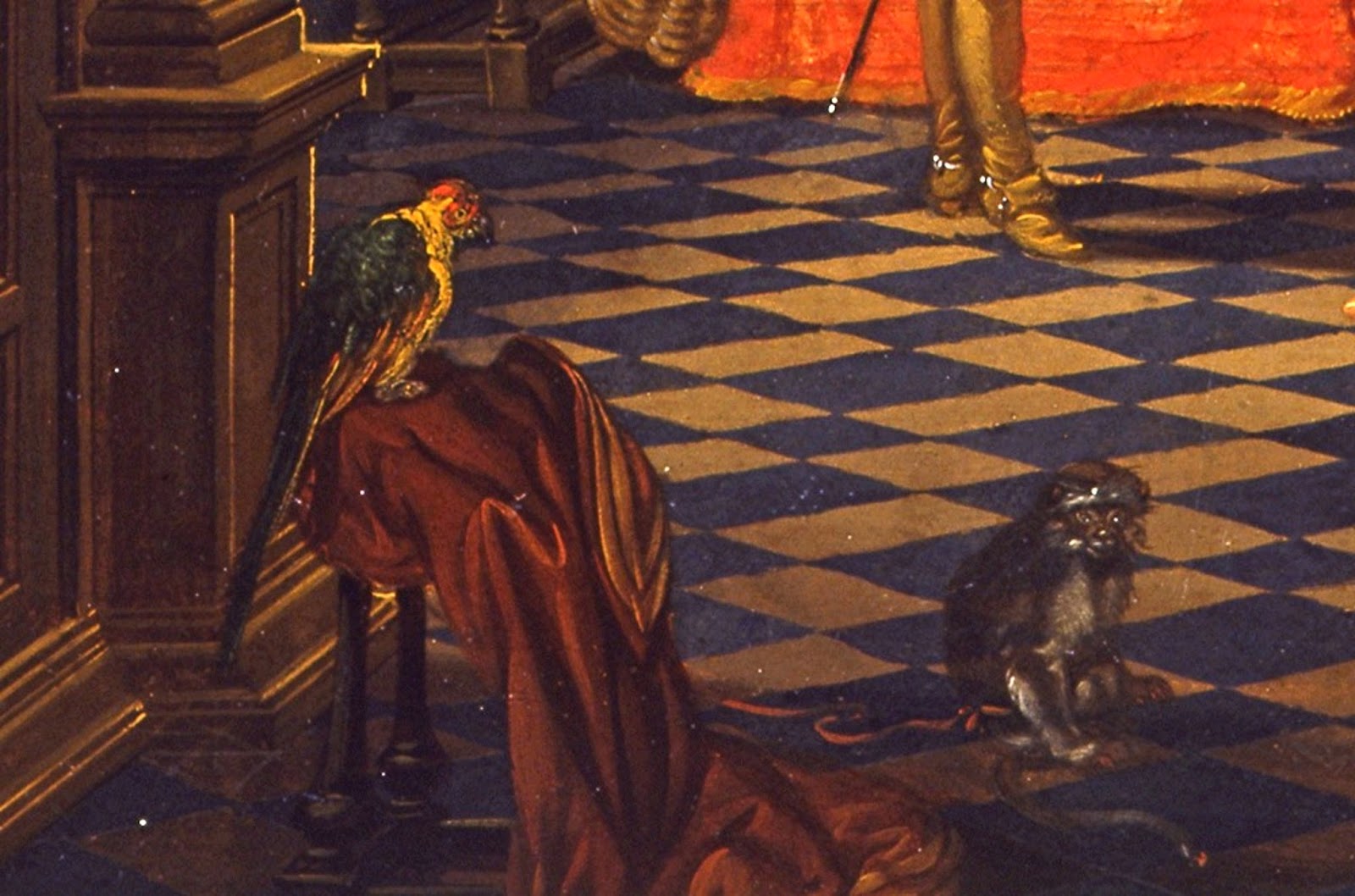
Close-up of the mystery parrot in Bartholomeus van Bassen's famous painting 'Renaissance Interior With Banqueters' (1618-1620) (this high-res image supplied to me courtesy of Michael Klauke, Associate Registrar for Collections at the North Carolina Museum of Art)

In various of my books, magazine articles, and ShukerNature blog posts, I have documented a number of mystery birds that have appeared in paintings by famous artists and which may conceivably represent lost species undescribed by science. In recent times, several additional examples have come to my attention, but perhaps the most significant of these is the following one, which may feature a hitherto-unrecognised depiction of a long-extinct bird officially known only from a single verbal description.

Bartholomeus van Bassen (1590-1652) was a celebrated Dutch architect and painter. Perhaps his most famous painting was 'Renaissance Interior With Banqueters' - an extremely detailed, sophisticated work of art that took from 1618 to 1620 to complete. Having said that, although I naturally cannot help but be highly impressed by its scale and by the architectural splendours and opulence that it depicts, the most fascinating aspect of it for me is an ostensibly insignificant bird perching upon a chair in this painting's bottom left-hand corner. Closer examination of this bird reveals it to be a parrot, but it does not appear to correspond with any species known to be living today. What could it be?

Bartholomeus van Bassen's famous painting 'Renaissance Interior With Banqueters' (1618-1620) (this high-res image supplied to me courtesy of Michael Klauke, Associate Registrar for Collections at the North Carolina Museum of Art)
Please click painting to view it in greatly-enlarged form.

Whenever an identification of a mystifying bird in a painting is attempted, it should always be borne in mind that artists have often included entirely fictitious examples in their works, simply to enhance their visual appeal. In this particular case, conversely, van Bassen's painting is so meticulously executed and so accurate in all other details, including those of other creatures included in it, that it seems highly unlikely that he would have added a made-up bird.

This fascinating case was first brought to my attention during spring 2012 ago by pet expert and fellow author David Alderton, with whom I have since corresponded in some detail concerning this mystery parrot. With regard to the possibility that it is an ornithological invention on van Bassen's part, David shares my own view that this is improbable:

"What I would say is that the other animals in the scene are very clearly recognisable. Based on its position in the painting, and its perch on rare/expensive material, this tends to suggest that this parrot is significant. It would have been rare and exotic of course - representing a flamboyant display of wealth in a very clear visual way, and I can't see it would have been a "fictional" bird."

So if we assume that the parrot represents a bona fide species, are there any that resemble it in some way?

On first glance, it recalls the Carolina parakeet Conuropsis carolinensis, a predominantly green-plumaged species with a bright yellow head marked with red. Once common in North America, it suffered greatly from habitat destruction, from being captured for the pet trade, and by being heavily persecuted due to its fondness for farmers' crops, until the last confirmed specimen died in Cincinnati Zoo in 1918. Closer observation, however, reveals a number of marked differences between this now-demised species and van Bassen's painted parrot.

John James Audubon's famous painting of Carolina parakeets (eastern subspecies)

The latter has golden-yellow underparts, whereas the Carolina parakeet's were green; it also has yellow lateral tail feathers whereas all of the Carolina's tail feathers were green; its wing primaries are red, not green like the Carolina's; the red markings on its head are more extensive than the Carolina's; and its relative proportions are very different from the Carolina's. Van Bassen's parrot has a much longer tail, a more powerful beak, and, judging scale from the chair upon which it is perched, a much larger overall body size. Indeed, in general appearance, the category of parrots that it most closely agrees with is the macaws.

Consequently, attempts to liken it to various small species of South American conure parakeet, such as the sun conure Aratinga solstitialis and the jenday conure A. jandaya, are not satisfactory either, unless of course the bird has been badly painted, with incorrect plumage and/or dimensions. For all of the reasons already discussed in relation to the prospect of its being a fictitious species, however, this notion seems untenable.

Two jenday conures (left and middle) and a sun conure (right) ((c) Chris Gladis/Wikipedia)

However closely one studies images of a painting, even close-up ones of a specific section of it, there can be no substitute for viewing the painting itself directly. Happily, David Alderton was able to do precisely this, when 'Renaissance Interior With Banqueters' was on display several years ago at the National Gallery in London. As a result, he noticed various features of the parrot not readily visible even in close-up images of it. These include the presence of a white brow line above its eye, and, of particular interest, the extensive amount of bare white facial skin – a feature that is characteristic of macaws. Usually this area is limited to the sides of the face around the eyes, and at the beak's base, but in van Bassen's bird it also extends onto the top of the head.

After viewing the bird directly in the painting, David wondered whether it may be a Cuban red macaw Ara tricolor, whose last confirmed wild specimen was shot in 1864, since when this species has been deemed to be extinct. However, in a short account of van Bassen's mystery parrot that he posted on his Pet Info Club website (http://www.petinfoclub.com/Collectibles/Painting_portrays_extinct_parrot.aspx), he conceded that the Cuban macaw's plumage exhibited certain noticeable differences from the latter's, which indeed it does. The most significant of these are the Cuban red macaw's blue wing primaries, its red cheeks, neck, and underparts, its red and blue tail feathers, and the much less extensive area of white facial skin. Exit the Cuban red macaw from further consideration.

Cuban red macaw (from Walter Rothschild's book Extinct Birds, 1907)

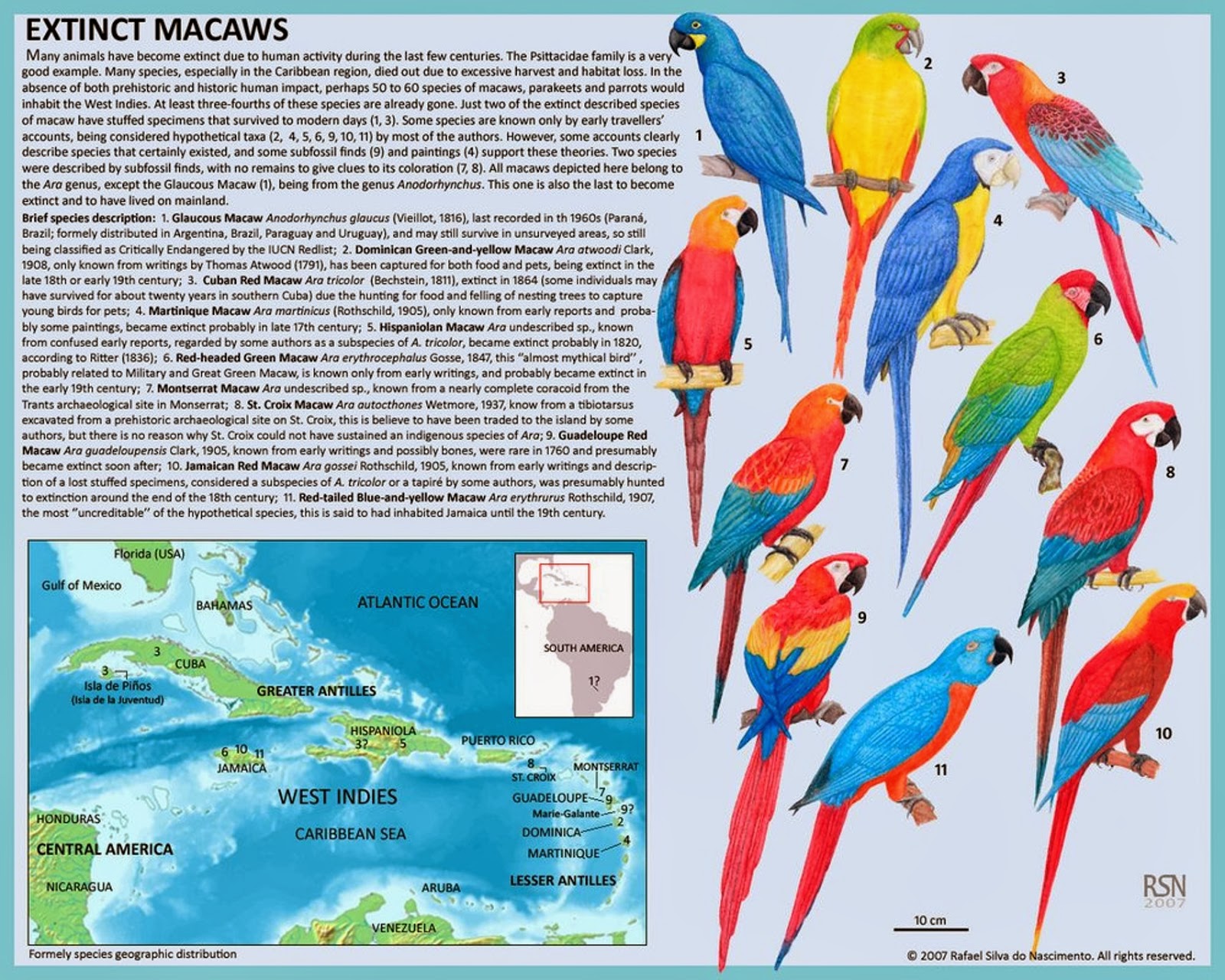
However, the Cuban red macaw is not the only extinct Caribbean macaw on record. Several additional species from a number of different West Indian islands – including Guadeloupe, Jamaica, Dominica, Hispaniola, and Martinique - have also been described and named (click here for a detailed ShukerNature article of mine investigating these mystery macaws). Yet whereas the Cuban is physically represented in various museums by a number of preserved specimens, these others are known only from eyewitness descriptions (plus some paintings based solely upon them, not directly upon living specimens). And some of those descriptions are so vague that ornithologists have dismissed certain of the Caribbean's 'lost' macaws as hypothetical species - originating from confusion with known parrots, or even based upon specimens of various South American species of macaw introduced into the West Indies as pets that may have subsequently escaped.

One of the most interesting of these Caribbean mystery macaws is the Dominican green and yellow macaw Ara atwoodi, named after traveller Thomas Atwood, whose History of the Island of Dominica (1791) contains the following informative account of it:

"The mackaw [sic] is of the parrot kind, but larger than the common parrot [this latter parrot actually constituting two separate but closely-related species of much smaller Amazon parrot], and makes a more disagreeable, harsh noise. They are in great plenty, as are also parrots in this island; have both of them a delightful green and yellow plumage, with a scarlet-coloured fleshy substance from the ears to the root of the bill, of which colour is likewise the chief feathers of the wings and tails. They breed on the tops of the highest trees, where they feed on the berries in great numbers together; and are easily discovered by their loud chattering noise, which at a distance resembles human voices. The mackaws cannot be taught to articulate words; but the parrots of this country may, by taking pains with them when caught young. The flesh of both is eat [sic = edible], but being very very fat, it wastes in roasting, and eats dry and insipid; for which reason, they are chiefly used to make soup of, which is accounted very nutritive."

It certainly must have been, because however plentiful these macaws were in Atwood's day, their numbers must have swiftly diminished thereafter, because his description is all that remains to suggest that they ever existed at all. No other reports of them, and no preserved specimens or paintings of living specimens, are known – unless...

A photoshop-created representation of the Dominican green and yellow macaw's possible appearance in life ((c) Rafael Silva do Nascimento)

There is no doubt that Atwood's description of the Dominican green and yellow macaw accords well with the parrot in van Bassen's painting - incorporating the precise configuration of its head's red colouration, its red wing feathers, and obviously its predominantly green and yellow plumage. True, Atwood did not mention any area of white on the Dominican macaws' faces, but it is worth noting that in some species of macaw this region turns red if the bird becomes excited, so perhaps he simply didn't observe any macaws when in a quiescent state, only when they were squawking animatedly while feeding.

Consequently, the only inconsistency in appearance between van Bassen's bird and Atwood's Dominican macaws is the mention of red tail feathers in his description, whereas the central tail feathers of van Bassen's parrot are green and the lateral ones are yellow. Perhaps, however, there was a slight degree of variation in the plumage colouration of the Dominican macaw (sexual dimorphism, for instance?) that could account for this discrepancy? In all other respects, the match is much closer than for any other species, living or extinct.

In 2011, a year before I made known to him the mystery parrot in van Bassen's painting, Brazilian bird artist Rafael Silva do Nascimento had prepared a beautiful painting of his, own reconstructing the likely appearance of the Dominican green and yellow macaw as based upon Atwood's description of it, which is reproduced here with Rafael's kind permission. As you can see, his macaw and van Bassen's parrot, prepared entirely independently of one another, accord very closely indeed, providing further confirmation of just how well Atwood's verbal description compares with van Bassen's painted bird.

Rafael Silva do Nascimento's painting of the Dominican green and yellow macaw ((c) Rafael Silva do Nascimento)

So could it be that the enigmatic parrot perched in this highly-renowned Dutch artist's early 17th-Century painting was a living Dominican green and yellow macaw, brought back to Europe as an eyecatching pet by (or for) a wealthy Dutch citizen? During that period, all manner of rare and extremely exotic fauna were being transported here from every known corner of the globe, many of which had never before been seen in Europe. Consequently, a colourful macaw would be nothing special or unexpected on that score.

What would be very special, and extremely unexpected, conversely, is if the macaw species in question subsequently became extinct but its exquisite appearance was preserved under the very nose of every art-lover in an extremely famous, spectacular painting, yet without its identity or zoological significance being recognised – until now?

If true, this is a great tragedy. After all, to paraphrase a certain classic comedy sketch from the golden age of British television, it may be an ex-parrot, but it had lovely plumage.


I wish to offer my sincere thanks to David Alderton for bringing this extremely intriguing crypto-ornithological mystery to my attention and for kindly sharing his thoughts and information concerning it with me; to Michael Klauke, Associate Registrar for Collections at the North Carolina Museum of Art, for most generously making available to me some high-resolution and close-up images of van Bassen's painting and its mystifying parrot; to Rafael Silva do Nascimento for very kindly permitting me to include his Dominican macaw painting here and also for providing me with a copy of Atwood's original description of Dominica's macaws; and to all of my Facebook friends who offered opinions and suggestions regarding this painted bird's possible identity when I posted an enquiry regarding it on my FB Wall in April 2012.

Reconstructions of the likely appearance of the various extinct species of West Indian macaw that have been reported by various travellers and subsequently named by scientists ((c) Rafael Silva do Nascimento)