Dr KARL SHUKER

Zoologist, media consultant, and science writer, Dr Karl Shuker is also one of the best known cryptozoologists in the world. He is the author of such seminal works as Mystery Cats of the World (1989), The Lost Ark: New and Rediscovered Animals of the 20th Century (1993; greatly expanded in 2012 as The Encyclopaedia of New and Rediscovered Animals), Dragons: A Natural History (1995), In Search of Prehistoric Survivors (1995), The Unexplained (1996), From Flying Toads To Snakes With Wings (1997), Mysteries of Planet Earth (1999), The Hidden Powers of Animals (2001), The Beasts That Hide From Man (2003), Extraordinary Animals Revisited (2007), Dr Shuker's Casebook (2008), Karl Shuker's Alien Zoo: From the Pages of Fortean Times (2010), Cats of Magic, Mythology, and Mystery (2012), Mirabilis: A Carnival of Cryptozoology and Unnatural History (2013), Dragons in Zoology, Cryptozoology, and Culture (2013), The Menagerie of Marvels (2014), A Manifestation of Monsters (2015), Here's Nessie! (2016), and what is widely considered to be his cryptozoological magnum opus, Still In Search Of Prehistoric Survivors (2016) - plus, very excitingly, his four long-awaited, much-requested ShukerNature blog books (2019-2024).

Dr Karl Shuker's Official Website - http://www.karlshuker.com/index.htm

IMPORTANT: To view a complete, regularly-updated listing of my ShukerNature blog's articles (each one instantly clickable), please click HERE!

IMPORTANT: To view a complete, regularly-updated listing of my published books (each one instantly clickable), please click HERE!

IMPORTANT: To view a complete, regularly-updated listing of my Eclectarium blog's articles (each one instantly clickable), please click HERE!

IMPORTANT: To view a complete, regularly-updated listing of my Starsteeds blog's poetry and other lyrical writings (each one instantly clickable), please click HERE!

IMPORTANT: To view a complete, regularly-updated listing of my Shuker In MovieLand blog's articles (each one instantly clickable), please click HERE!

IMPORTANT: To view a complete, regularly-updated listing of my RebelBikerDude's AI Biker Art blog's thematic text & picture galleries (each one instantly clickable), please click HERE!

Search This Blog


PLEASE COME IN, I'VE BEEN EXPECTING YOU...

PLEASE COME IN, I'VE BEEN EXPECTING YOU...
WELCOME TO SHUKERNATURE - ENJOY YOUR VISIT - BEWARE OF THE RAPTOR!


Showing posts with label earth hound. Show all posts

Thursday, 10 September 2020

REVIEWING 'THE DARK' (AKA 'THE RELIC' AKA 'THE GOD RAT')


Three different video/DVD covers for The Dark – the centre picture is on the cover of the DVD version that I own (© Craig Pryce/Lightshow Communications – reproduced here on a strictly non-commercial Fair Use basis for educational/review purposes only)

Readers of ShukerNature may not all know that in July 2020 I launched a new blog, Shuker In MovieLand (SIML), in which I review all manner of movies (and occasionally TV shows) that I've previously watched. They include a wide range of genres, from sci-fi, fantasy, super-heroes, and animation, to musicals, comedy, historical drama, crime fiction, and much more besides. Needless to say, however, as a cryptozoologist I have a particular preference for monster movies, and have already reviewed on SIML several films that contain a cryptozoology theme. Most of these are well known movies, but, intriguingly, the review of mine on SIML that currently boasts more hits than any other is of a very obscure, little-known monster movie, variously entitled The Dark, The Relic, and The God Rat.

As I feel sure that it will be of interest to ShukerNature readers too, I am reproducing my review of this movie here, and I earnestly suggest that you seek out the movie itself and watch it, because it makes very entertaining viewing. So, without further ado, here is my review of The Dark, whose original, shorter version I posted on my Facebook timeline on 30 November 2019.

Last night [29 November 2019] I watched a long-anticipated cryptozoology-themed movie, The Dark (aka The Relic aka The God Rat – see later), originally released in Italy in 1993. Directed by Craig Pryce, it stars Stephen McHattie as a leather-jacketed, motorbike-riding cryptozoologist (sounds familiar??) named Gary 'Hunter' Henderson. He is seeking a mysterious, scientifically-undescribed subterranean beast akin to a giant carnivorous rodent that excavates huge tunnels underneath a graveyard, feeds upon recently-interred corpses, and secretes a slimy substance that has miraculous, swift-acting healing properties. Filmed in Canada, this unusual movie also stars Neve Campbell, making her big-screen debut, as Hunter's girlfriend Jesse Donovan.

The monster is only seen in brief glimpses, and then only its toothy long-jawed head and long-clawed forepaws for the most part. The plot is fairly pedestrian - a good cryptozoologist seeking to study and preserve the creature for its taxonomic significance as an apparent prehistoric survivor and also for its slime's potentially immense medicinal benefits versus a bad vengeful ex-cop relentlessly seeking to slay it in revenge for its self-defence killing of his police partner when he was still on the force.

Stephen McHattie as Gary 'Hunter' Henderson in The Dark (© Craig Pryce/Lightshow Communications – reproduced here on a strictly non-commercial Fair Use basis for educational/review purposes only)

However, what has always intrigued me about this movie, which had particularly spurred me on for so long to seek it out on DVD (no easy matter!) and view it, was that its cryptid subject is more than a little reminiscent of a bona fide mystery beast. Reported from Scotland, this latter cryptid is known as the earth hound, and is indeed said to frequent graveyards and devour buried corpses. My book Mysteries of Planet Earth (1999) was the first crypto-book to investigate and document the earth hound, but if you click here you can access a ShukerNature blog article of mine concerning this fascinating mystery beast.

The DVD of The Dark that I own actually has a German-language cover (see centre picture in the trio of photographs opening this present blog post), on which this movie is entitled The Relic (in English) and The God Rat (in German), but the movie that plays on the DVD disc itself is the original English version and is entitled in its opening credits as The Dark.

Incidentally, this present movie should not be confused – but often is – with another cryptozoology-themed film also entitled The Relic. Directed by Peter Hyams and originally released in 1997, its very different plot concerns a monstrous entity inadvertently transported back to the USA from South America, which duly runs amok in Chicago's Field Museum of Natural History. I have this movie on DVD too, but haven't watched it yet – be sure that once I do, however, I shall be duly reviewing on Shuker In MovieLand!

Last, but by no means least, The Dark is currently available (as of today, 10 September 2020, anyway) to watch in its entirety free of charge on YouTube (click here to do so). Consequently, if you're a fan of monster movies with a cryptozoology theme like I am, I strongly recommend that you make the most of this golden opportunity to watch this otherwise difficult-to-find movie while you can, in case it is subsequently deleted from YT.

Reconstruction of the likely appearance in life of the mysterious earth hound as based upon alleged eyewitness descriptions (© William M. Rebsamen)


Saturday, 23 January 2016

LET'S ALL LOOK OUT FOR THE LAVELLAN


A 19th-Century painting of some aquatic shrews (public domain)

In an earlier ShukerNature blog article, I documented a quite small and little-known but thoroughly fascinating if somewhat macabre mystery beast from Scotland known as the earth hound (click here) – and now, here is a second one, the lavellan.

According to local lore in Caithness and Sutherland, apparently the stronghold of this cryptid, the lavellan is – or was – a rodent with flashing eyes, a disproportionately-large mouse-like or rat-like head, and similar body colouration too. However, it was larger than a rat, had an exceedingly venomous bite, was also a blood-sucker, and inhabited marshes as well as deep water-filled hollows in rivers.

A water vole - one identity that has been proposed for the lavellan (© public domain)

Any cattle drinking from a body of water containing a lavellan would invariably die, and, bizarrely, this creature could inflict lethal injuries upon livestock from a distance too, from as far away in fact as approximately 100 ft, though the precise mechanism responsible for this fatal activity is never elucidated in such reports. Yet, paradoxically, if farmers had sick animals, they could be cured if they drank water in which the pelt from a dead lavellan had been dipped.

Interestingly, its name in Scottish Gaelic is also applied to the water shrew Neomys fodiens (which, interestingly, does have a weakly venomous bite) and the water vole Arvicola amphibius, both species having been identified as the lavellan by various authors. Yet the latter creature was supposedly much larger than either of them. Conversely, in John Fleming's book History of British Animals (1828), he claimed that it was likely to be the stoat Mustela erminea, because in early highland lore the stoat supposedly exuded some kind of "foul matter" that was toxic to horses and other animals.

A stoat - another identity proposed for the lavellan (public domain)

The lavellan's most diligent modern-day investigator is naturalist Raymond Bell, who has memorably dubbed it a 'giant vampire shrew' in various talks and writings that he has prepared on this subject. He has speculated that it may have been at least in part nothing more than a fictitious bogey-beast invented by parents to ward their children away from deep water, or even an attempt to explain away mysterious diseases arising in livestock. However, he also concedes that some bona fide creature might have been at the core of the lavellan legend too, but what that creature was may never be determined.

(As an entertaining digression, 1959 saw the release of a Ray Kellogg-directed science-fiction film that went on to become a highly popular cult movie - The Killer Shrews, in which visitors to a remote island are terrorised by giant mutant shrews. The most famous aspect of the film is that whereas close-ups of the shrews utilise hand-puppets, wider shots of the entire creatures feature coonhounds dressed up to look like shrews! A sequel, Return of the Killer Shrews, was produced in 2012. Both films starred James Best.)

Promotional poster for The Killer Shrews (© McLendon-Radio Pictures Distributing Company – reproduced here on a strictly non-commercial Fair Use educational/review basis only)

Incidentally, a real-life creature that has been colloquially dubbed a giant killer shrew is Deinogalerix koenigswaldi, which lived during the late Miocene Epoch (11.3-5.6 million years ago) on what was then the Italian island of Gargano, now the Gargano Peninsula. With a skull length of 8 in and a total body length of 2 ft, it occupied the ecological niche filled today by dogs and cats. Yet in spite of its generic name (Deinogalerix translates as 'terror shrew'), it was actually a giant species of gymnure or hairy hedgehog, a group of eulipotyphlan insectivores whose largest modern-day representative is the wonderfully-named moonrat Echinosorex gymnura (click here for a ShukerNature article devoted to this very distinctive mammal).

It is fascinating to consider that the ostensible familiarity of Great Britain's extensively-studied, exhaustively-documented natural history can nevertheless still harbour such riddles as the lavellan and the earth hound. But will their mysteries ever be solved? Perhaps someone reading this present article of mine has the answer to that question and, if so, I very much look forward to hearing from you!

Artistic restoration of Deinogalerix koenigswaldi in life (© Stanton Fink (aka Apokryltaros)/Wikipedia CC BY 3.0 licence)


This ShukerNature blog article was excerpted and expanded from my book The Menagerie of Marvels – further information has been collected by Raymond Bell, who may in due course submit a formal paper on this cryptid to the Journal of Cryptozoology, the world's only peer-reviewed scientific journal devoted to mystery animals, published annually. Look out for Vol. 4, coming soon!


Thursday, 20 December 2012

UNEARTHING THE EARTH HOUND - A CORPSE-DEVOURING CRYPTID FROM SCOTLAND

Behold, the earth hound! (Shaun Histed-Todd)


"Without a doubt, this must be the book of the year. Even before one opens the cover up the sheer quality of the publication grabs you. It is plush and impressive and the contents match the sleeve. This is Karl's finest work since The Lost Ark and is crammed so damn full of new information you just don't know where to begin. I pride myself in cryptozoological knowledge but there's stuff in here I've never heard of. Earth hound, weird subterranean carnivores that burrow into graves to devour cadavers, the sandewan, a Zimbabwean entity whose calling-card is a constant trail of blood, giant blue eels in the Ganges, and legions more."

Richard Freeman – Review of my book Mysteries of Planet Earth (Carlton: London, 1999) in Animals and Men, No. 20 (December 1999)


Cryptozoologically-speaking, Scotland is world-famous for the Loch Ness monster, and also for its plethora of pantheresque and cougar-like mystery cats that allegedly roam its lonely moors and shadowy glens. However, these are not the only cryptids on record from this northernmost country of the United Kingdom. As highlighted above in Richard Freeman's review of my book Mysteries of Planet Earth, I always strive to uncover and document intriguing but hitherto little-publicised, obscure mystery beasts, and one excellent example - far less familiar but no less fascinating than Nessie and Scotland's alien big cats - is the extraordinary, and distinctly macabre, earth hound of Banffshire (a former northeastern Scottish county now split up into two other counties).


STRANGER THAN FICTION?

They do say that art imitates life, and sometimes it does so even without anyone initially realising it! So it was with the earth hound. Back in 1994, Canadian actor Stephen McHattie starred in an intriguing horror movie entitled ‘The Dark’, in which a mystifying – and quite monstrous – rat-like creature inhabiting graveyards was pursued by a cryptozoological biker. It is well known that two of my own abiding passions are cryptozoology and riding motorbikes, but at the time of this film’s release I had no idea that just a few years later I would be investigating a hitherto-obscure graveyard-inhabiting mystery beast allegedly resembling a grotesque rat, and apparently living in my very own British homeland!

Two stills from 'The Dark'

I first learnt of the earth hound’s existence when I happened to read a short account of it written by British folklorist Paul Screeton and published in his own magazine, Folklore Frontiers. This summarised an earlier article, from the 1992-1993 volume of the journal Scottish Studies, written by Alexander Fenton and cryptozoological chronicler David Heppell, which reviewed what little information appears to have been documented on this cryptid.

What would seem to be the earliest currently-revealed reference to the earth hound – also known variously as the yard pig or yard swine – appeared in the Reverend Walter Gregor’s book Notes on the Folk-Lore of North East Scotland (1881), in which he wrote of:

"...a mysterious dreaded sort of animal, called the “yird swine”…believed to live in graveyards, burrowing among the dead bodies and devouring them."


A CLOSE ENCOUNTER OF THE BITING KIND

During their researches, Fenton and Heppell discovered a detailed letter on the subject of the earth hound within the archives of the Department of Natural History of the Natural Museums of Scotland. Written in 1917 by A. Smith of Wartle in Aberdeenshire to James Ritchie in Edinburgh, it recorded that a local gardener named Archibald recalled how his father was ploughing some fields in Deveron around 50 years earlier (i.e. around 1867) when he uncovered an earth hound in its nest. When he attempted to kill it with his foot, the earth hound bit his boot so hard that its teeth cut into the leather, so his father killed it with the plough’s swingle-tree, and took its carcase back home with him. (A swingle-tree is a wooden or metal horizontal bar used to balance the pull of a draught horse pulling a plough or carriage, known as a singletree in America.)

In his letter, Smith described the earth hound as being somewhat like a rat in basic form and brown in colour, but its head was long like a hound’s, and its tail was bushier than a rat’s. He also claimed that the nests of earth hounds were sometimes exposed by ploughs but the creatures themselves were only very rarely spied, and inhabited churchyards.

Depiction of the fraught encounter by Archibald's father with an earth hound (William Rebsamen)

Worth noting here is that the field being ploughed when this particular earth hound had been uncovered was very close to a churchyard – indeed, this churchyard was later abandoned due to the firmly-held belief that it was infested with these creatures. It was also believed that earth hounds always lived close to water, and constructed their nests in haughs (stretches of river-deposited land forming part of river valleys).

When his father arrived home with the earth hound’s carcase, Archibald saw it himself, as did all of their neighbours, who viewed it with great interest. In his letter, Smith stated that Archibald:

"...describes it as being something between a rat and a weasel, and about the size of a ferret, head very like that of a dog, and I think he said the tail was not very long. At a casual glance it would be mistaken for a rat, but was quite unlike on close examination."


OTHER INFORMATION

Interestingly, further details from Smith were present in a note bearing the same date as his previous letter but posted the following day, and referring to a meeting in Mastrick with someone who may have been Archibald himself, although this is not made clear in the note. Yet whoever this person was, he had evidently seen the earth hound carcase and knew of the incident itself, because Smith had questioned him directly about it. According to this person’s testimony, the earth hound had run some distance along the plough before it had been killed, and additional morphological information contained in this note revealed that it had been:

"...about the size of a rat. Asked about colour, he thought it was like a dark rat. It had feet like a mole, and a tail about half as long as a rat’s. Head was long and nostrils very prominent, suggesting a pig’s. Head somewhat like that of a guinea-pig. It had noticeable white “tusks”, whatever that might mean – (probably incisors)…Mastrick is about 10 minutes’ walk from here, and curiously enough is close to the churchyard."

Reconstruction of the supposed morphology of the earth hound, based upon eyewitness descriptions (William Rebsamen)

A paragraph about earth hounds that appeared in the People’s Journal in June 1950 referred to them as ‘yird pigs’ or ‘earth huns’, claiming that they were “really rats...only found in graveyards”. More recently, in April 1990, when Alexander Fenton visited a Banffshire town called Reith, he discovered that the earth hound was still spoken of there. A Reith friend stated that they are between a rat and a rabbit, and live in graveyards, digging down and breaking into the coffins. He even took Fenton to a churchyard where such creatures are still said to dwell – Walla kirkyard at the edge of the River Deveron (thus in the vicinity of the earth hound incident featuring Archibald’s father over a century before) - but, sadly, no sign of any was found there.


IN SEARCH OF AN IDENTITY

So what exactly is the earth hound – a still-undiscovered mini-beast awaiting detection if it hasn’t died out by now, or just a macabre Scottish legend, or even nothing more than a monstrous misidentification of some already known species? In the film ‘The Dark’, the movie equivalent of this mystery beast turned out to be an archaic species of rat previously thought by scientists to be long extinct. In contrast, I think it highly unlikely that Scotland’s earth hound will ever be shown to be a prehistoric survivor, but its tantalisingly scant documentation yet lingering recollection among the local Banff people is sufficiently noteworthy to warrant some consideration as to what it may – or may not – be.


Consequently, I included a concise account of the earth hound in my book Mysteries of Planet Earth (1999), the first cryptozoologically-related book ever to document this mystery beast, and which also contained a specially-commissioned full-colour reconstruction of its likely appearance by acclaimed wildlife artist William Rebsamen from Fort Worth, Arkansas. This superb illustration is now included here too, along with a second picture by William, depicting the boot-biting earth hound encounter described above.

As a result, I have since received some suggestions and ideas regarding what this mystifying mammal could be. Two of the most intriguing ones, for different reasons, are as follows.


BADGERING FORTH AN EXPLANATION?

One of these is the suggestion that because ‘earth hound’ and ‘earth pig’ have been used as local names in Britain for the European badger Meles meles, and because badgers have been known to dig through graves, the Scottish earth hound may be one and the same creature as the badger. If only it were that simple! The fundamental, irreconcilable problem with this proposed identity is that the description of the earth hound as documented in all of the sources presented here is radically different in shape, size, and colour from that of the European badger, which in any case is one of the most distinctive, readily-identifiable, and familiar mammals throughout the British Isles. Consequently, it is inconceivable that any country-living person would not recognise a badger (even a very young, small badger) if they should encounter one. Also, badgers do not make nests in ploughable haughs or fields. Instead, they construct extensive setts in woodlands.

European badger – radically different in appearance from the earth hound (Peter Trimming/Wikipedia)

In short, whatever the earth hound is, or was, it certainly has no affinity with a badger, other than the sharing with it of a country name - something that occurs with many other animal species, often featuring zoologically unrelated species linked only by some common behavioural or very superficial morphological trait. In the case of the Scottish earth hound and the badger, the only similarities of any kind are their powerful digging feet (something that all burrowing animals necessarily possess anyway) and their underground (but very different) abodes – a simple nest in the case of the former animal, a complex and sizeable sett in the latter.


BEWARE THE WOLVERINE, MY SON!

The other intriguing identity is that the earth hound stories refer to young specimens of the wolverine Gulo gulo (adult wolverines are the largest members of the weasel or mustelid family). Unfortunately, however, as with the badger suggestion, the morphology and lifestyle of the earth hound do not correspond at all with that of wolverines, of any age, which are not fossorial at all. In addition, whereas the badger is at least native to Britain, the wolverine is not, though it does occur in parts of northern mainland Europe.

Young wolverine – not corresponding physically or behaviourally with the earth hound (Zefram/Wikipedia)

Having said that, and as also documented in Mysteries of Planet Earth, a few specimens have allegedly been sighted in recent years in various parts of Great Britain. If genuine, these may be escapees from fur farms (wolverines have not been maintained in British zoos for several years). Even so, the wolverine is simply too dissimilar in every way from descriptions of the earth hound for this to be a viable identity.


RAT, MOLE, OR FERRET?

So what is left? Just a Scottish myth, or something more? Reading through the earth hound accounts, three very different zoological identities come to my mind. One is that the rat-like earth hound is indeed a rodent of some kind. However, although it is comparable to rats in size, colour, and superficial form, and makes nests like the black rat (but not like the much more common brown rat, which isn’t a nest-builder), it still doesn’t closely match either of these two known species of British rat (or any other known British rodent) on account of its furry tail, digging feet, hound-like head, and large tusks.

Conversely, moles definitely possess large digging feet, but not a hound-like head or tusks. They do build nests, but only inside their deep burrows, not in fields, and they certainly do not burrow into graves and devour human corpses present there.

Equally, if we assume that the earth hound may be a small mustelid related to the weasel and to North America’s black-footed ferret Mustela nigripes (which until its near-extinction in the wild lived in abandoned prairie dog burrows), it is difficult to reconcile the possibility that until at least a century ago a very distinct species of mammal (rodent or mustelid) undocumented by science had been alive and well and living in Scotland.

Black-footed ferret (Mariomassone/Wikipedia)

After all, if this were indeed the case, surely there would have been a few preserved specimens or skins, or at least some illustrations of this creature, possibly even a blurry photo or two – especially as Great Britain is one of the most extensively-studied places in the world in relation to wildlife. Yet there does not seem to be any physical evidence of its existence on record anywhere. If only Archibald had preserved the carcase of the specimen killed by his father. That, to me, is the single biggest reason for casting a very sceptical eye over the earth hound file – at least for now. If, of course, someone should uncover additional information, and, ideally, some tangible evidence for this fascinating mystery beast’s reality, I would be only too delighted to reconsider!


PAW-NOTE

After first learning of its existence from my book Mysteries of Planet Earth, Richard Freeman became so interested in the earth hound that he subsequently wrote a suitably gruesome, chilling horror story concerning this necrophagous nightmare, which he has included in his recently-published collection of short stories. Accompanying his earth hound story was a spectacular, specially-commissioned artwork by Shaun Histed-Todd, who has kindly permitted me to include it in my writings too. So here it is, in two different colour versions, opening and closing this present ShukerNature blog post – thanks, Shaun!

The earth hound wakes! (Shaun Histed-Todd)


Monday, 20 April 2009

OTTER KINGS TO EARTH HOUNDS - IN SEARCH OF BRITAIN'S LESSER-KNOWN MYSTERY BEASTS

Grace Connolly was a recently-married young woman who lived in the townland of Creevelea, at the northwestern corner of Glenade Lake, just inside County Leitrim's border with County Sligo, in Ireland. One bright morning in September 1722, Grace went down to the lake, to bathe and perhaps also to wash clothes. Tragically, however, she did neither, for while there she was attacked and killed by a water monster that rose up out of the lake's depths.
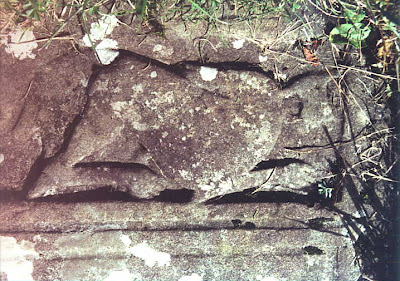

Carving of the dobhar-chú on Grace Connolly's tombstone (Dave Walsh)

When her husband, Terence McGloughlan (in keeping with Gaelic custom, Grace had retained her maiden name after marrying him), discovered Grace's body lying at the lake's edge later that day, he was half-crazed with grief. However, his grief turned to fury when he saw that his wife's assassin was actually lying asleep across her prone form. It was a dobhar-chú - a mysterious, elusive beast of Irish folk tradition, also known as a king otter or master otter, because it superficially resembled a normal otter but was much bigger, with powerful hound-like limbs.

Terence lost no time in slaying the monster, but its death cries alerted its equally formidable mate, which emerged from the lake and pursued Terence, who fled on horseback. Eventually, however, he ambushed the avenging dobhar-chú and slew it.

Needless to say, this could be readily discounted as just another traditional Irish folk story - were it not for the stark fact that Grace Connolly's grave exists. And carved upon her tombstone is a detailed depiction of her cryptozoological nemesis - the dobhar-chú.

This still-unidentified mystery beast is just one of many strange, enigmatic beasts reported over the years - and centuries - from the British Isles, thereby demonstrating that Nessie and various pantheresque or puma-resembling big cats are not the only mystery creatures associated with our green and pleasant lands.

MASTERING THE MASTER OTTER

The mystery of the dobhar-chú or master otter is particularly intriguing, thanks to the existence of Grace Connolly's tombstone and the portrait depicted upon it. As revealed in my books Mysteries of Planet Earth (1999) and The Beasts That Hide From Man (2003), both of which contain a detailed account of this remarkable case, Grace's grave can be found in Conwall Cemetery, in the town of Drummans, forming part of the approach to the Valley of Glenade from the coastal plain of north County Leitrim and south County Donegal, and not far from Bundoran.

Grace's name, and that of her husband, together with the year of her death, are still legible, as is the remarkable carved image of the dobhar-chú. The creature is depicted lying down with its head and neck flung backwards so as to lie flat along its back, thus representing it in its death throes, because a spear-like weapon (gripped at its upper end by a human fist) is piercing the base of its neck and re-emerging below its body. The creature itself curiously combines the short head and tiny ears, large paws, and long heavy neck of an otter with the long limbs and powerful thighs, deep-chested body, and lengthy curved tuft-tipped tail of a hound-like dog.

As true otters are very familiar beasts in Ireland, it would seem unlikely that this is merely a badly-executed portrayal of a normal otter. Yet if it is an accurate depiction, then the creature that it illustrates would appear to be unknown to science. Even more intriguing is that whereas this carving represents a creature killed back in 1722, a very similar beast has also been reported from this same area of Ireland in much more recent times.

Immediately to the west of County Sligo is County Mayo, off whose western coast is a small isle called Achill Island, containing a lake known as Sraheens Lough. During May 1968, several observers independently reported seeing a strange creature either running on land near to the lake or emerging directly from it. The mystery beast was said to be 8-10 ft long, roughly 2.5 ft high, and shiny black or very dark brown in colour, with a small head but a long neck and tail, and four powerful legs on which it rocked from side to side as it ran. A modern-day dobhar-chú? Perhaps - but until a specimen is (if ever) obtained, this mystifying mammal will continue to linger with leprechaun-like evanescence amid the twilight limbo between Celtic folklore and contemporary fact.

WHEN A SEA MONSTER SET FORTH FROM THE FIRTH OF TAY?

It's not every day that you see a sea serpent - and certainly not one that is actually making its way laboriously on land, along a major road, in full view of passing traffic. Yet that is what at least two eyewitnesses may well have seen, judging from their independent yet closely corroborating statements. The first of these was Maureen Ford, driving with some friends along the A85 towards Perth at 11.30 pm on 30 September 1965. Suddenly, as she neared Perth, she saw what she subsequently described as "a long grey shape [which] had no legs but I'm sure I saw long pointed ears", by the roadside yet only a few yards from the banks of the River Tay, which enters close by into a North Sea inlet - the Firth of Tay.

At 1.00 am the very next morning, this bizarre beast was seen again, but on the opposite side of the road, to which it had apparently crossed meanwhile. Its eyewitness this time was Robert Swankie, driving along the same road but in the opposite direction from Ford, i.e. away from Perth and on towards Dundee. As he drove along, however, his vehicle's headlights abruptly exposed an extraordinary sight - a weird creature with a 20-ft-long body that was "...humped like that of a giant caterpillar" (i.e. undulating vertically), and a head over 2 ft long, bearing a pair of pointed ear-like appendages. The creature was moving very slowly, making "...a noise like someone dragging a heavy weight through the grass".

Swankie wanted to stop, in order to obtain an even closer look at this scientifically-unidentified animal, but there was a car close behind him, so he deemed it best to carry on driving; however, he did subsequently report his sighting to the police. Suggestions that perhaps it had all simply been a trick of the light have since been discounted by cryptozoological investigators, pointing out that if this had indeed been true, why then had Swankie not seen monsters elsewhere on his journey?

After all, there was nothing special, optically speaking, about the particular stretch of road along which he and Ford had independently, and on opposite sides, spied an elongate mystery beast - one which, moreover, closely recalls many sightings of comparably serpentiform sea serpents and also lake monsters, including the equally inexplicable horse-eels of Lough Nahooin and elsewhere in Ireland. And optical illusions in any event do not normally feature an accompanying soundtrack of dragging noises.

Perhaps therefore, some highly elusive, still-unrecognised water beast did indeed emerge from the sea that evening under the cover of darkness, to make a rare, short foray overland, but by sheer chance had been spotted separately by two late-night travellers.

TEGGIE OF BALA LAKE

Also called Llyn Tegid, Bala Lake is Wales's largest lake, and, thanks to Teggie, its resident monster, it has also lately become its most famous, cryptozoologically speaking. In recent times, a number of sightings have been claimed here, featuring a reclusive creature variously likened to a crocodile or to the long-necked Nessie-type beasts more famously reported from Scotland. For example, while fishing from a small boat on the lake in March 1995, Paul and Andrew Delaney, visiting from London and unaware of Teggie reports, peered in great surprise at a small head that appeared at the lake's surface only 80 yards or so away, then proceeded to raise itself on a long slender neck until it was about 10 ft above the surface. This and other reports prompted an investigation of the lake later that same year by a Japanese TV crew, who obtained a sonar trace of a very large, unidentified object moving swiftly under the water, but failed to film Teggie, who remains steadfastly aloof.

THE EARTH HOUND OF BANFFSHIRE


The earth hound (William Rebsamen)


One of Britain's most macabre mystery beasts must surely be the earth hound or yard pig of Banffshire, northern Scotland, which allegedly lives in or near graveyards and digs inside coffins to feed upon corpses. Alexander Fenton and veteran Scottish cryptozoological chronicler David Heppell have uncovered a number of fascinating accounts regarding this creature.

One such account, written in 1917 by a Mr A. Smith, documents the description of an earth hound by a gardener who had dug up and killed it about half a century earlier, while ploughing some haughs (alluvial flats) close to a churchyard. According to the gardener, it was brown in colour rather like a rat, but had a long hound-like head, and a tail bushier than a rat's. This same specimen was later seen by a second eyewitness, who stated that it was:

"...something between a rat and a weasel, and about the size of a ferret, head very like that of a dog...the tail was not very long. At a casual glance it would be mistaken for a rat, but was quite unlike on close examination."

An earth hound killed in c.1915 near Mastrick, again near a churchyard, was said to have mole-like feet, white tusks, and prominent pig-like nostrils. Even as recently as spring 1990, Fenton was soberly informed of the earth hound by a Banffshire friend. Yet surely, if such a creature truly existed on Scotland, there would be specimens of it in museums by now - unless the very unsavoury nature of its lifestyle has effectively warded off attempts to seek out and preserve specimens of this weird animal?

CENAPRUGWIRION

Among the least-known yet most mystifying of British cryptozoological beasts is a curious 1-ft-long lizard-like reptile supposedly inhabiting burrows in and around Abersoch in North Wales. Known as the cenaprugwirion or genaprugwirion (sometimes translated as 'daft flycatcher'), it is readily distinguished from all species of native lizards not only by its length but also by its combination of an orange-sized head, dewlap (skin flap) beneath its chin, large mobile eyes, long fly-catching tongue, and mud-brown colour. Apparently once common here, it is rarely reported nowadays, which is a great tragedy, because this tantalising creature bears more than a passing resemblance to one of the world's most remarkable reptiles - the tuatara Sphenodon punctatus of New Zealand.
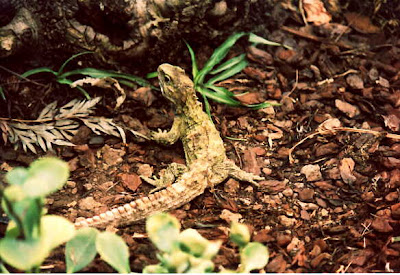
Tuatara (Dr Karl Shuker)

A veritable 'living fossil', the tuatara is the only modern-day representative of an otherwise long-extinct reptilian lineage known as the sphenodontids, and is found nowhere else in the world - officially. During the 19th Century, however, tuataras were commonly imported into Britain, and as they are not only well-suited to surviving Britain's climate but also have an extremely long lifespan (several decades), it has been suggested that perhaps some tuataras escaped into the Welsh countryside a century ago and established a viable colony, whose members were ultimately dubbed cenaprugwirions by the local people.

THE BEAST OF SOAY

Soay is a small unassuming island just south of Skye, largest of the Inner Hebridean isles. On 13 September 1959, however, the waters surrounding it witnessed an extraordinary incident - a decidedly close encounter between two fishermen and an incredible reptilian sea monster. Swimming to within 20 yards of the dinghy containing angler Tex Geddes and engineer James Gavin came a huge sea creature with a blunt tortoise-like head and gaping toothless mouth (through which they could plainly hear it breathing), red mouth lining, cylindrical neck, rounded face, and two large protruding eyes. Its body was scaly, burly, and the expanse visible above the sea surface was estimated by the two men to be 8-10 ft long. Overall, therefore, Soay's unwonted visitor may well have recalled a giant marine turtle - had it not been for the row of distinctive triangular spines running along the midline of its back, which bestowed upon it a disturbingly prehistoric appearance. Some zoologists sought to identify it as an escapee iguana, but there is even less resemblance between this lizard and the Soay beast than between the latter and a turtle. Happily, the bizarre creature posed no threat to its eyewitnesses, and was last spied by them swimming away towards the island of Barra.

EYEWITNESS REPORT - HOOKING THE HORNED MONSTER OF LOUGH DUBH

One of the most terrifying mystery beasts ever recorded within the chronicles of British cryptozoology was encountered by schoolteacher Alphonsus Mullaney and his young son, also called Alphonsus, while fishing one day after school in mid-March 1962 at Lough Dubh in County Galway, Ireland. As the shocked teacher later recalled to a Sunday Review reporter:


“Suddenly there was a tugging on the line. I thought it might be caught on a root, so I took it gently. It did not give. I hauled it slowly ashore, and the line snapped. I was examining the line when the lad screamed.

"Then I saw the animal. It was not a seal or anything I had ever seen. It had for instance short thick legs, and a hippo face. It was as big as a cow or an ass, square faced, with small ears and a white pointed horn on its snout. It was dark grey in colour, and covered with bristles or short hair, like a pig.”

After the two Mullaneys promptly fled, a party of brave locals with guns later returned, but no trace of the monster was found. However, as noted by lake monster author Peter Costello, far from basking in the resulting publicity of their amazing sighting the Mullaneys actively shunned all television interviews, and the father did everything to assist his son in blotting their very frightening experience from his young mind. Accordingly, Costello considers a hoax to be out of the question. As for the creature itself, of which no further sightings have been reported: it bears no resemblance to any other lake monster on file - or indeed, to any other beast of any kind - and therefore remains a total enigma.

UNSOLVED HISTORICAL CASES - THE WINGED SNAKE OF HYDE PARK AND HAMMERSMITH

Perusing old back issues of long-vanished British journals can be a surprisingly successful means of uncovering baffling yet fascinating cryptozoological reports - as evinced by the following still-unexplained account, which appeared in The Gentleman's Magazine on 20 April 1798. Penned by a correspondent identified only as 'SB', it concerned a surrealistic snake(?) allegedly sighted a few miles west of London at the beginning of August 1776:

“The strange object was of the serpent kind: its size that of the largest common snake; and as well as it could be discovered from so transient a view of it, resembled it by a kind of grey mottled skin. The head of this extraordinary animal appeared about the size of a small woman's hand. It had a pair of short wings very forward on the body, near its head; and the length of the whole body was about two feet. Its flight was very gentle; it seemed too heavy to fly either fast or high; and its manner of flying was not in an horizontal attitude, but with its head considerably higher than the tail; so that it seemed continually labouring to ascend without ever being able to raise itself much higher than seven or eight feet from the ground.”

Not long afterwards, the same magazine published a second account, by a pseudonymous correspondent identified only as 'JR', describing a supposed sighting by a friend of a similar (or even the same?) creature, this time encountered on the road between Hammersmith and Hyde Park Corner on the evening of 15 July 1797. Dark in colour, roughly 2 ft long, and "about the thickness of the lower part of a man's arm", it had very short wings placed near the head, and flew less than 7-8 ft above the ground, with its head raised above its body.

With no details supplied concerning the correspondents' identities, an outright hoax or a somewhat abstruse example of 18th Century satire cannot be discounted. Certainly, to the best of my knowledge Hyde Park and Hammersmith are not renowned nowadays for visitations from serpents of the winged variety, which is probably no bad thing!

THE WALKING FIR CONE OF DUMPTON PARK

It was on 16 April 1954 when Police Constable S. Bishop, while walking through Dumpton Park in Ramsgate, Kent, encountered a bizarre-sounding beast that he likened to "a walking fir-cone". Since then, nothing more has been heard of this novel creature, but PC Bishop's evocative description of it continues to tease and torment. What could it have been?

When I first read it, Bishop's description immediately conjured up images of pangolins. Also known as scaly anteaters, these extraordinary beasts, covered in huge brown scales, really do resemble animated pine or fir cones. However, they are wholly confined to tropical Asia and Africa, and due to their insectivorous diet are very difficult to maintain in captivity. Accordingly, they are rarely exhibited in zoos, and are seldom if ever kept as pets in the western world. Thus, despite being fir cone lookalikes, pangolins surely cannot be considered seriously as candidates for the Dumpton Park beast's identity.

More recently, however, a second identity was suggested to me that offers a greater degree of plausibility, yet does not compromise the fir cone similarity factor. John Mitchell from San Francisco had read my account of the Dumpton Park beast in my book From Flying Toads To Snakes With Wings (1997), and offered a most intriguing identity for consideration. Namely, the Australian stumpytail or shingleback skink Trachydosaurus rugosus - also called the pine-cone skink, because its large brown overlapping scales make this lizard look uncannily like a pine or fir cone on legs, as discovered by Mitchell when introduced to a pet specimen owned by a friend. Around 14 in long when adult, with a tail so closely resembling its head that it is difficult to distinguish one end of the creature from the other, the stumpytail is possibly the best-known lizard in Australia, due to its abundance and presence in or around a number of Australian suburbs. Moreover, its placid temperament and tough survival ability make this lizard a popular pet, frequently maintained by herpetological enthusiasts worldwide. Hence there is rather more potential for the Dumpton Park beast being an escapee stumpytail skink than an absconded pangolin.

As with all of the cryptic beasts documented here, however, in the absence of a specimen or even a good photo of one, any attempt at identification is fraught with difficulty - and especially so with those that seemingly bear little if any resemblance to animals currently known to science. Far too much hot air is generated within cryptozoological circles arguing vehemently but vainly about what a given mystery beast is and is not, instead of sensibly accepting that without a physical specimen to examine, all that we can have are theories and opinions, not facts. In the case of the animals surveyed here, although they are less famous than Nessie and Britain's mystery cats, they are no less fascinating, and certainly are no less deserving of further investigation, in the hope that one day theories and opinions regarding them can indeed be replaced by hard facts - the true goal of any serious cryptozoologist.