Dr KARL SHUKER

Zoologist, media consultant, and science writer, Dr Karl Shuker is also one of the best known cryptozoologists in the world. He is the author of such seminal works as Mystery Cats of the World (1989), The Lost Ark: New and Rediscovered Animals of the 20th Century (1993; greatly expanded in 2012 as The Encyclopaedia of New and Rediscovered Animals), Dragons: A Natural History (1995), In Search of Prehistoric Survivors (1995), The Unexplained (1996), From Flying Toads To Snakes With Wings (1997), Mysteries of Planet Earth (1999), The Hidden Powers of Animals (2001), The Beasts That Hide From Man (2003), Extraordinary Animals Revisited (2007), Dr Shuker's Casebook (2008), Karl Shuker's Alien Zoo: From the Pages of Fortean Times (2010), Cats of Magic, Mythology, and Mystery (2012), Mirabilis: A Carnival of Cryptozoology and Unnatural History (2013), Dragons in Zoology, Cryptozoology, and Culture (2013), The Menagerie of Marvels (2014), A Manifestation of Monsters (2015), Here's Nessie! (2016), and what is widely considered to be his cryptozoological magnum opus, Still In Search Of Prehistoric Survivors (2016) - plus, very excitingly, his four long-awaited, much-requested ShukerNature blog books (2019-2024).

Dr Karl Shuker's Official Website - http://www.karlshuker.com/index.htm

IMPORTANT: To view a complete, regularly-updated listing of my ShukerNature blog's articles (each one instantly clickable), please click HERE!

IMPORTANT: To view a complete, regularly-updated listing of my published books (each one instantly clickable), please click HERE!

IMPORTANT: To view a complete, regularly-updated listing of my Eclectarium blog's articles (each one instantly clickable), please click HERE!

IMPORTANT: To view a complete, regularly-updated listing of my Starsteeds blog's poetry and other lyrical writings (each one instantly clickable), please click HERE!

IMPORTANT: To view a complete, regularly-updated listing of my Shuker In MovieLand blog's articles (each one instantly clickable), please click HERE!

IMPORTANT: To view a complete, regularly-updated listing of my RebelBikerDude's AI Biker Art blog's thematic text & picture galleries (each one instantly clickable), please click HERE!

Search This Blog


PLEASE COME IN, I'VE BEEN EXPECTING YOU...

PLEASE COME IN, I'VE BEEN EXPECTING YOU...
WELCOME TO SHUKERNATURE - ENJOY YOUR VISIT - BEWARE OF THE RAPTOR!


Showing posts with label hybrid cats. Show all posts

Saturday, 3 March 2018

REARING HER LION X TIGER HYBRID CUBS WITH DOGGED DETERMINATION! A SHUKERNATURE PICTURE HISTORY EXCLUSIVE


Vintage picture postcard from my collection, depicting a canine foster mother with her trio of lion x tiger hybrid cub fosterlings (from the archives of Dr Karl Shuker)

Just over a week ago on ShukerNature (click here), I briefly mentioned how, several years ago, while browsing through some picture postcards at a local collectors fair, I chanced upon a vintage example depicting a dog acting as foster mother to three lion x tiger hybrid cubs.

Never having seen this picture before, I swiftly purchased the postcard, and subsequently reproduced it in my book Cats of Magic, Mythology, and Mystery (2012) – which as far as I'm aware is the first time that this picture has ever appeared in any publication, certainly any dealing specifically with unusual cats.

My book Cats of Magic, Mythology, and Mystery, published in 2012 (© Dr Karl Shuker/CFZ Press)

Since then, I've browsed online several times seeking other early illustrations of lion x tiger hybrids, to include in a planned future article, and have found some very interesting examples (adding to various ones already contained in my archives and included by me in my above-cited book). However, I have never once spotted my postcard's picture, not even when I have conducted specific Google Image Searches for it.

Consequently, as a ShukerNature Picture History exclusive, I am presenting it herewith – seemingly the first time, therefore, that this fascinating image has ever appeared online too. In addition, its caption has served as a starting point for me to conduct some research into the history of this picture and its subjects, so here is what I've uncovered.

Once again, my vintage picture postcard of a canine foster mother with her three lion x tiger hybrid cub fosterlings (from the archives of Dr Karl Shuker)

As seen here, this postcard's inset caption reads as follows: "FOSTER MOTHER WITH HYBRID LION-TIGER CUBS. The Bostock Jungle, Earls Court Exhibition. Direction: FRANK C. BOSTOCK.". But who was Frank C. Bostock, what was his Jungle, and when did it appear at Earl's Court?

In fact, as zoological historians will be readily aware, the name Bostock is intimately associated with menageries and other animal-featuring exhibitions, including circuses, during the late 1800s and early 1900s, being a major part of a veritable menagerie dynasty.

Edward H. Bostock (public domain)

It all began in 1805, when George Wombwell (1777-1850) founded a menagerie in Soho, London, but which began touring Britain in 1810 as Wombwell's Travelling Menagerie, and subsequently traversed widely across the European continent, followed by North America (coast to coast), South Africa, India, the Orient, and even as far afield as Australia and New Zealand. During this time, it had continued to expand unabatedly, until at its height it was the largest of its kind in the world.

By the late 1880s, this mega-menagerie was owned and run by one of Wombwell's great-nephews, Edward Henry Bostock (1858-1940), whose father James Bostock had in 1852 married Emma Wombwell, a much-loved niece of George Wombwell. Edward purchased it on 28 February 1889 from his mother Emma (who had received it earlier from her sister, a Mrs Edmonds, who in turn had inherited it from Wombwell upon his death). Edward had previously worked there until September 1883, and enhanced its already-considerable success by combining it with a circus, and renaming it Bostock and Wombwell's Menagerie (subsequently Bostock and Wombwell's Royal Menagerie). So popular did this enterprise prove to be that it continued to tour Britain until December 1931, when it staged its final show, at the Old Sheep Market in Newcastle, northern England. In 1932, Edward sold his animals to London Zoo at Whipsnade.

A poster for Bostock and Wombwell's Menagerie, dating from c.1900 (public domain)

Meanwhile, back in 1897 Edward built in Glasgow his very own Scottish Zoo, a non-touring attraction that was the first permanent zoo in Scotland, but which again incorporated a circus too, so it became known formally as the Zoo-Circus Building (and later the Zoo-Hippodrome Building). He also became a Fellow of the Zoological Society of London.

Edward was always looking out for particularly unusual, exotic animals with which to draw in ever greater audiences to his zoo and touring menagerie, and, as I have documented in two earlier ShukerNature articles (click here and here), it was he who purchased in May 1908 the extraordinary three-species big cat hybrid Uneeka, a lijagupard (lion x jaguar-leopard hybrid), for display in Glasgow after she had been exhibited for a couple of weeks at London Zoo.

Frederick Frohawk's exquisite illustration from 1908 of Uneeka the lijagupard when still living at London Zoo (public domain)

No less involved with menageries than Edward, however, was his younger brother, Frank Charles Bostock (1866-1912). Edward utilised Glasgow as his primary base, but after running his own menagerie for a time in Britain before selling it to Edward, Frank then broke away by journeying to the USA in 1893 and establishing wild animal shows there instead, with partners Francis and Joseph Ferari, especially in New York at Coney Island's vast Dreamland amusement park until 1903, and becoming known as 'The Animal King'. During the opening decade of the 20th Century, Frank returned to Britain from New York as an extremely experienced menagerie keeper and exhibitor but also greatly skilled in the American 'big show' tradition of public entertainment.

Accordingly, he deftly combined these two previously quite discrete elements to great success via the creation of a huge touring animal-themed exhibition officially known as Bostock's Arena and Jungle (but often shortened simply to Bostock's Jungle), which travelled from city to city and, in 1908, was staged at Earl's Court Exhibition Centre, London – during which the three lion x tiger hybrids featured in my vintage picture postcard were displayed. Big cat hybrids were very popular in such shows back then, due to their unusual nature and often very distinctive appearance.

Frank C. Bostock (public domain)

Tragically, however, the immense effort that Frank put into all of his shows and tours proved too much. In early October 1912, after having already become seriously ill with what was claimed by the media to be nervous exhaustion but which was apparently a stroke, he was found to have contracted influenza too, and passed away on 8 October, his 46th birthday, at his Kensington Mansions home in London. Unlike a number of other menagerie owners, Frank was famous and much-respected for the kind treatment that he always showed to his animals – a memorable quote attributed to him is: "Kindness is the whip used to lead dumb animals to obey" – and his funeral was attended by many hundreds of fans and fellow showmen, including the legendary circus owner Pat Collins. At the time of his death, Frank owned over 1000 animals, but I have yet to discover what happened to them afterwards – were they purchased, perhaps, by Edward, or sold off separately to other menageries, zoos, circuses, and/or private individuals? If anyone reading this article of mine has any information, I'd be most grateful to receive it and incorporate here, but credited fully to them by me as always.

Finally: one of Frank's most celebrated animal stars, who brought him considerable fame and prestige, was a trained chimpanzee called Consul the Man Chimp – so-named because of his almost-human behaviour. Insured for what was then the enormous sum of £20,000 and dressed in the nattiest of human clothes (which he would put on and take off all by himself, mend if required, and even wash and put out to dry), Consul habitually walked upright, smoked cigarettes, drank wine and whisky as well as tea and hot chocolate, ate meals using a knife and fork, always travelled first-class, stayed only in the best hotels, and expertly drove his own electric car. Nor was Consul unique. Following his death in 1904, he was replaced by a succession of new Consuls, some performing simultaneously at different shows run by Frank, who as already noted was an accomplished animal trainer. Reading about Consul and his successors, I am reminded irresistibly of another so-called 'man chimp' (aka a humanzee) – whose name was Oliver (read all about him here), and whose famously human demeanour now, in the light of those displayed by Frank's Consuls, seems a good deal less exceptional than traditionally deemed.

Vintage picture postcard (from the same series as my dog/cubs card presented here) depicting one of the later Consul the Man Chimp individuals, who took part in the 1908 Bostock's Jungle exhibition at Earl's Court in London where the lion x tiger hybrid cubs also appeared (public domain)


POSTSCRIPT

Shortly after completing this ShukerNature article, I was interested to discover that Frank C. Bostock had written a book on the subject of animal training, published in 1903, entitled The Training of Wild Animals, and currently still in print. Tracing a copy of the original edition online, I saw that it had been edited by wildlife authoress/journalist Ellen Velvin FZS, whose Editor's Note at the beginning of the book provides what certainly appears to be a direct corroboration of Frank's reputation with regard to his animals, and as such definitely bears reiterating. So here it is in full:

Before editing this book, I took the op­portunity offered by Mr. Frank C. Bostock of practically living in one of his animal exhibitions for a few weeks, in order to see things as they were, and not as I had always heard of them.

I was allowed to go in and out at all times and all hours; to enter the training-schools whenever I liked; to go behind the runways and cages,—a special privilege given to the trainers only, as a rule,—and to be a spectator of whatever happened to be going on at the time.

The thing which interested me most, and to which I paid special attention, was that at no time in this exhibition did I once see the slightest act of cruelty in any way. Each one of the trainers and keepers had pride in his own special animals, and I had many proofs of their kindness and consideration to their charges. The sick animals were most care­fully looked after and doctored, and in one case of a lion cub having convulsions, I noticed dim eyes in more than one keeper when the poor little animal was convulsed and racked with suffering.

Had I seen the least cruelty or neglect in any way, I need scarcely say nothing would have induced me to edit this book.

Illustration from a programme advertising one of Frank's American animal shows from 1901, held in Buffalo, New York, in which he would sit casually reading a newspaper in the midst of a pride of 25 lions (public domain)


Monday, 19 February 2018

BEHOLD, UNEEKA! UNCOVERING A HITHERTO-FORGOTTEN PHOTOGRAPH OF THE ONLY LIVING LIJAGUPARD EVER TO BE EXHIBITED IN BRITAIN – A SHUKERNATURE WORLD-EXCLUSIVE!


Newly-uncovered by me, the only known photograph of Uneeka the lijagupard in the living state (from the archives of Dr Karl Shuker)

A few months ago here on ShukerNature, I recalled the eventful history of a truly remarkable big cat – namely, an adult female three-way hybrid aptly dubbed Uneeka, her parents being a male lion and a female jaguar x leopard hybrid (click here to access my article), thereby making her a lijagupard. Originally claimed to be a new species and exhibited in London Zoo for just over a fortnight during April 1908, then purchased by Glasgow-based circus/menagerie owner Edward H. Bostock on 2 May for the very sizeable sum of 1030 guineas and taken back with him to Glasgow in Scotland, Uneeka was allegedly killed just over a year later by a lion that supposedly broke through from its own cage into Uneeka's. Yet, very strangely, when Uneeka's pelt was dressed and subsequently mounted as a taxiderm specimen (since displayed in Paris's National Museum of Natural History), it was found not to bear a single tear or scratch.

Although there are photographs available of this taxiderm specimen, some of which have featured in various scientific papers and other publications, as far as I am aware only one illustration depicting Uneeka when alive has ever appeared in any documentation of her. Included in a number of my own writings and also present online, this was a very elegant rendition executed in 1908 by English zoological artist Frederick W. Frohawk – and here it is:

Uneeka, depicted in 1908 by Frederick W. Frohawk (public domain)

Consequently, I was both delighted but also very startled when recently browsing through some vintage issues of a London weekly magazine entitled the Illustrated London News to discover in one of them a b/w photograph of Uneeka in the living state! Portraying her sitting inside a cage, this zoologically-invaluable image was one of a series of photographs depicting various London-themed subjects that had lately been in the news, all presented together on a single page in the 9 May 1908 issue of this magazine.

And so it is with great pleasure that now, as a ShukerNature world-exclusive, I reproduce here in this present article of mine (the first time to my knowledge that it has ever appeared in a zoological publication) this ostensibly unique, certainly hitherto long-forgotten photograph of Uneeka as a then still-living lijagupard – the only such hybrid ever exhibited alive anywhere in Britain.

The photograph of Uneeka with its original caption underneath (from the archives of Dr Karl Shuker)

Despite its great age (almost 120 years old), this photograph clearly reveals not only Uneeka's lioness-like head and face but also the large size and intricate patterning of her rosettes, emphasising how extremely attractive and exotic this elegant felid must have appeared to those visitors who had been fortunate enough to observe her during her short period of display at London Zoo and her somewhat longer exhibition at Glasgow prior to her mysterious demise there. The photo's brief accompanying caption confirms that Uneeka had just been sold to Bostock for the afore-mentioned sum of 1030 guineas, so presumably she had been snapped while still in London, and was awaiting transportation back to Glasgow with him.

Down through the years, I have been blessed with some exceedingly fortunate if entirely unexpected, unsought-for picture-related discoveries relative to unusual big cats, of which my uncovering this long-overlooked vintage photograph of Uneeka the lijagupard is only the most recent.

The January 1970 newspaper article re Johnny the Japanese leopon that I rediscovered entirely by accident 30 years later and now treasure greatly! (© Dr Karl Shuker)

Back in 2000, for example, and via the most unlikely manner conceivable, I rediscovered a copy of an illustrated newspaper article that I had originally seen over 30 years earlier, in January 1970, concerning the popularity in a Japanese zoo of an inordinately handsome male leopon (leopard x lioness) hybrid called Johnny (click here to access my full account of the truly extraordinary events leading up to my refinding this well-remembered but long-lost article).

A few years later, while idly browsing through a box of old picture postcards at a local collector's fair, I spotted – and swiftly purchased – a vintage postcard whose picture was of a domestic dog acting as a foster mother to some lion x tiger hybrid cubs, and which I had never seen before, nor since, but which I subsequently published in my book Cats of Magic, Mythology, and Mystery (2012), the first time as far as I can tell that it had ever appeared in any publication. Interestingly, its caption revealed that these cubs had been displayed at Earl's Court Exhibition Centre in London, and by none other than Frank C. Bostock, who was Edward's brother and a menagerie owner in his own right, as part of his very sizeable touring show Bostock's Jungle. Moreover, I subsequently discovered that it was in 1908 that they had been displayed there, i.e. the same year that Edward H. Bostock's very different and even more notable big cat hybrid Uneeka had been on show at London Zoo. Click here for further details concerning this picture postcard.

Remarkably, not long after happening upon that postcard, and at the very same collector's fair, I was looking through a box of assorted brochures when I found in excellent condition a copy of a Bristol Zoo guide that I had once owned many years ago as a child in the late 1960s but which I had cut up for its pictures, to paste into a scrapbook, and had bitterly regretted doing so afterwards, but had never found another copy of it. The reason why this particular zoo guide had meant so much to me was that its front cover consisted of a beautiful full-colour photograph of a white tiger, the first picture of a white tiger that I had ever seen. But now, almost 40 years later, there was this fondly-remembered picture in front of me again. So, not surprisingly, I lost no time in buying the guide, where it takes pride of place in my collection of zoo guides (click here for more details).

The much-loved Bristol Zoo guide from the 1960s that I was fortunate enough to find again and buy again, after almost 40 years, complete with its beautiful white tiger cover (© Bristol Zoo Gardens/Dr Karl Shuker)

And just last year, I was astounded to learn that a book that I owned just so happened to contain the only known colour photograph of Cubanacan – a magnificent male litigon (the offspring of a mating between a male lion and a female tiger x lioness hybrid). Once the world's largest big cat in captivity, he was born at India's Alipore Zoo in 1979, and had been exhibited there during the 1980s until his eventual death.

Moreover, what made my ownership of a book containing this important photograph even more significant was that Indian researchers had long thought the photo to be lost, until I brought its existence in that book to the attention of celebrated Indian naturalist Shubhobroto S. Ghosh (currently Wildlife Project Manager of World Animal Protection in India). Shortly afterwards, I co-authored with him a Cubanacan-themed article (click here to read it online) in which we reproduced this historic picture for the very first time in any Indian publication (click here for my full ShukerNature account of this wonderful rediscovery).

If only my good fortune in serendipitously unearthing obscure and long-overlooked big cat illustrations could extend to rediscovering equally arcane images of the avian persuasion too – for then, the alleged missing thunderbird photograph (click here for details) might one day be neither alleged nor missing!

The only known colour photograph of Cubanacan the litigon, which I fortuitously rediscovered (© Alipore Zoo)


Saturday, 2 September 2017

THE ONZA HERESY - UNMASKING A MYSTERY CAT FROM MEXICO?


The Rodriguez onza (© International Society of Cryptozoology – permission to reproduce in my writings granted to me in perpetuity by J. Richard Greenwell, ISC Secretary)

For zoologists, the year 1986 opened in a decidedly dramatic manner - with the apparent procurement on 1 January of a legendary creature whose existence had been denied by science for centuries. That evening, Mexican ranger Andres Rodriguez Murillo surprised a very large cat close to his home in the valley behind Parrot Mountain, in Mexico's Sinaloa State. Fearing that it was a jaguar about to attack him, he shot it, but when he examined its body he found that it was neither a jaguar Panthera onca nor a puma Puma concolor - the only other large felid 'officially' existing in Mexico.

It did resemble a puma superficially, but its limbs were longer and its body was more slender, giving it a cheetah-like outline; in addition, its ears were unusually big, and the inner surfaces of its forelimbs bore dark markings not possessed by pumas. As Rodriguez had little knowledge of wildlife, he contacted an expert hunter by the name of Manuel Vega to come over and identify it for him. When Vega arrived, he felt sure that he recognised the cat - identifying it as an onza, the fabled third large cat of Mexico.

The puma (top) and the jaguar (bottom) – Mexico's two official large cats (public domain)

The onza's existence within the rugged mountainlands of the Sierra Madre Occidental is supported by more than 300 years' worth of local eyewitness accounts (even including the testimony of visiting missionaries and Jesuit priests) from Sinaloa and also Sonora. Yet these had always been dismissed by zoologists as reports of poorly-seen or misidentified pumas.

Conversely, back in the 18th Century accounts of this controversial creature appeared in the works of several of Mexico's learned Jesuit scholar-priests. They recorded that the onza is greatly feared by ranchers and peasants, and is said to be an unusually aggressive animal, far more dangerous than either the burly jaguar or the diffident puma, but far more elusive too.

My very first book, Mystery Cats of the World (1989) (© Dr Karl Shuker)

However, it may be that the onza's history can be traced back even further than this. According to Spanish conquistador Bernal Diaz del Castillo, in 1519 the famous zoo owned by the Aztec king Montezuma contained two types of 'lion' (puma). One was the normal puma, but the other was a much more mystifying cat that supposedly resembled a wolf. As wolves have noticeably longer legs than pumas, was this unidentified animal the onza? Further details concerning the onza's early history are given in my book Mystery Cats of the World.

Some 20th-century accounts of alleged onzas had actually been supported for a short time by complete specimens, though in every case these were somehow lost or destroyed. In spring 1926, for example, hunter-cowboy C.B. Ruggles trapped and killed a supposed onza southeast of Yaqui River in Mexico's Sonora State. After taking some photos of its carcase, and noting that it had very skinny hindquarters, with dark spots on the inner side of its limbs, Ruggles discarded it. A few years later, American naturalist J. Frank Dobie reported shooting an onza caught in traps set on Mexico's Barrancas de la Viboras; regrettably, its skin was subsequently devoured by bugs.

Clell and Dale Lee posing with their hunting dogs alongside the carcase of the Shirk onza (© International Society of Cryptozoology – permission to reproduce in my writings granted to me in perpetuity by J. Richard Greenwell, ISC Secretary)

In 1938, while in the company of renowned hunters Dale and Clell Lee from Arizona, Indiana banker Joseph Shirk shot an onza on Sinaloa's La Silla Mountain; photos show that, as with all of the others, it resembled an extremely gracile, long-limbed puma with big ears and unusual limb markings. Although much of its carcase was discarded, its skull was retained - only to vanish without trace when sent to a museum whose name, frustratingly, does not appear to have been placed on record. The dead body of a large unidentified felid that may well have been an onza was taken to Texas University in the late 1950s, but this cannot be traced either.

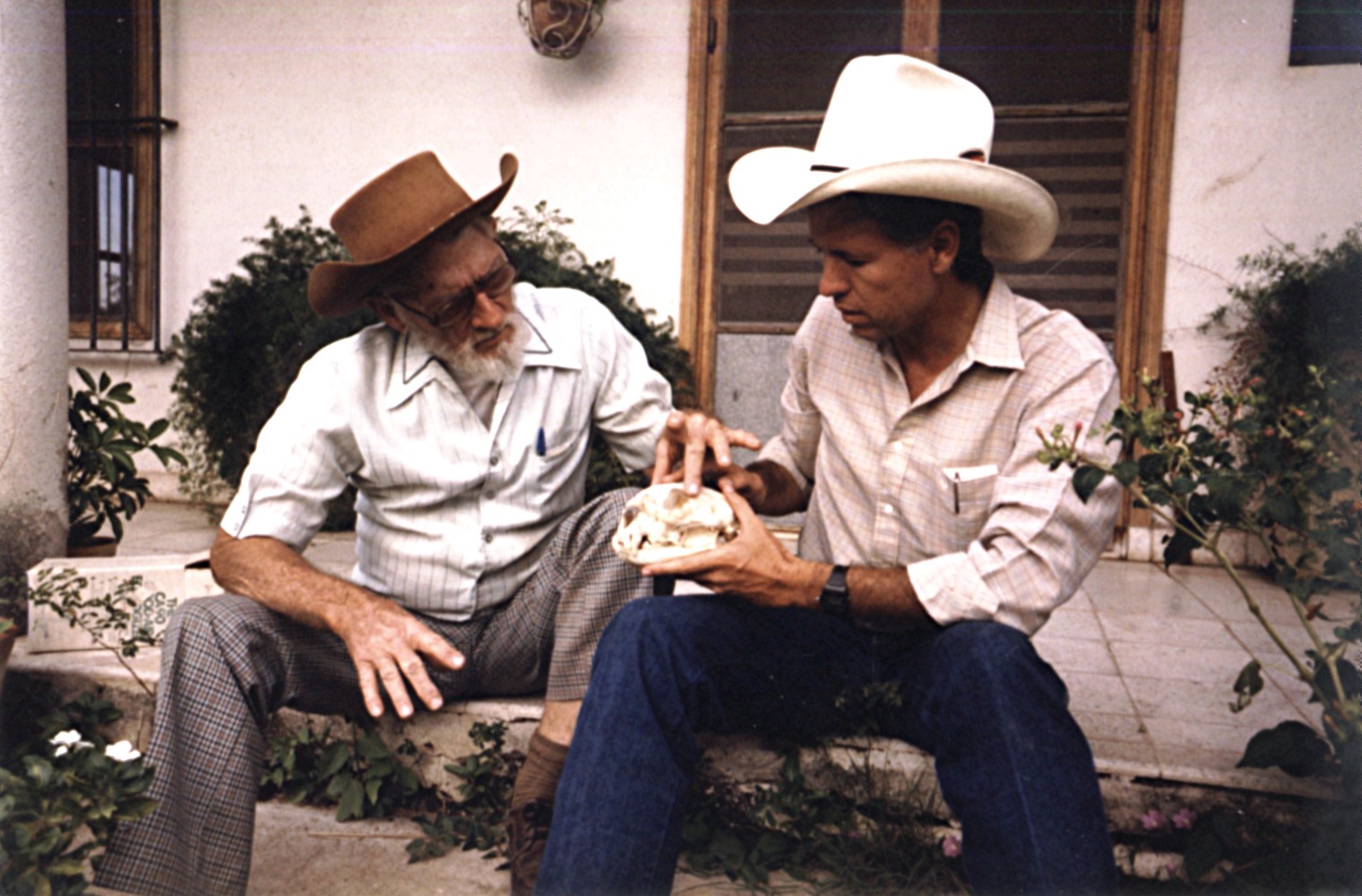
J. Richard Greenwell, at that time the secretary of the International Society of Cryptozoology (ISC), who had a particular interest in the onza, succeeded in locating two onza skulls - one from a specimen shot in 1938 on La Silla Mountain by R.R.M. Carpenter while accompanied by Dale and Clell Lee (thus providing a remarkable parallel to the history of the Shirk specimen), the other from an onza shot by Jesus Vega (father of Manuel Vega) in much the same area sometime during the mid-1970s (this skull is now owned by rancher Ricardo Urquijo).

Robert E. Marshall and Ricardo Urquijo with the Vega onza skull (© International Society of Cryptozoology – permission to reproduce in my writings granted to me in perpetuity by J. Richard Greenwell, ISC Secretary)

Additionally, another onza investigator, Arizona hunter Robert E. Marshall, was successful in obtaining the incomplete skull (its lower jaw was missing) of an onza shot during the 1950s at Los Frailes, Sinaloa. Marshall was also the author of The Onza – published in 1961, it was the first book devoted to this cryptid; a second, Onza! The Hunt For a Legendary Cat, written by Neil B. Carmony, was published in 1995. Both make fascinating reading, and I highly recommend them to anyone interested in cryptozoology.

Around the time of the shooting of the Rodriguez specimen in January 1986, an onza was allegedly captured alive, and held for several days in captivity at a ranch in northern Sonora, where it was supposedly photographed too. Tragically, however, when no-one showed any interest in it, its owner shot it and threw its body away. As for the photographs, these have yet to make a published appearance. And in early 1987, yet another onza was reportedly shot in Sinaloa, this time by a wealthy Mazatlan businessman; but, true to form, its remains were not preserved.

Robert E. Marshall's book The Onza (© Robert E. Marshall/Exposition Press – reproduced here on a strictly educational, non-commercial Fair Use basis only)

In short, with the exception of three skulls, physical remains of onzas have displayed a disconcerting tendency to disappear beyond the reach of scientists. The Rodriguez specimen, however, changed all of that - for instead of destroying its remains, the ranchers contacted Richard Greenwell. Following a complex series of interchanges, the precious specimen was transported to the Regional Diagnostic Laboratory of Animal Pathology, belonging to Mexico's Ministry of Agriculture and sited in Mazatlan, Sinaloa.

There it was painstakingly studied and dissected by a biological team headed by American puma researcher Dr Troy Best, who had been working alongside Greenwell during his earlier onza investigations. After the dissection, extensive samples of skeletal material, tissues, and blood were taken for examination and analysis in various U.S. research institutions, in a bid to uncover the onza's taxonomic status. Several different taxonomic identities have been offered over the years, but the principal four are as follows.

Neil B. Carmony's book Onza! (© Neil B. Carmony/High-Lonesome Books – reproduced here on a strictly educational, non-commercial Fair Use basis only)

The most exciting possibility is that it could be a currently undescribed species - one that quite conceivably descended from the typical puma, but later diverged from it to fill the ecological niche left vacant by the extinction approximately 11,000 years ago of Miracinonyx trumani - an extraordinary felid now known to have been a true American cheetah (it was first classed as a cheetah-like puma). Indeed, German felid specialist Dr Helmut Hemmer initially mooted that the onza may actually be a surviving representative of Truman's cheetah, but after studying casts of two onza skulls and comparing them with fossil material from M. trumani, he changed his mind. However, regardless of whether it is even related to (let alone synonymous with) Truman's cheetah, if the onza is indeed a valid species in its own right it should be distinguishable from the puma via the biochemical and genetic analyses conducted by those researchers studying the Rodriguez specimen (see below).

Another intriguing, frequently-raised possibility is that the onza is a naturally-occurring hybrid of puma and jaguar (i.e. either a pumajag or a jaguma). No evidence for this identity was obtained, however, from examination of the Rodriguez specimen. In any case, hybrids of this type that have been bred in captivity bear no resemblance to onzas, appearing visibly intermediate between puma and jaguar instead.

Artistic representation of a Truman's cheetah attacking a pronghorn (© Hodari Nundu)

Two rather more conservative but still-interesting identities remain. The onza may simply be a mutant, non-taxonomically distinct form of the puma, the result of a genetic aberration that has yielded an uncommonly slim, leggy variety. If so, could it even be that an atavistic phenotype-influencing gene surviving from the period of shared ancestry by pumas and cheetahs but suppressed in normal pumas is somehow expressing itself in onza specimens, i.e. is responsible for 'onzaism' in pumas? If we take the Rodriguez specimen as a bona fide onza, the onza's gracility is, indisputably, a natural facet of its appearance (rather than starvation-induced emaciation), because this specimen was found to possess adequate amounts of body fat. Genetically-induced onzaism may be confined to Mexico due to genetic drift; then again, as I noted in my 1989 mystery cats book, onza-like cats have also been reported from South America, so if the onza is indeed a freak non-taxonomic variety of puma, perhaps the mutant onza-inducing gene (should it exist) is more widely distributed among the global puma population after all. If not a genetic freak, the onza could be a separate subspecies of puma, kept apart from the Mexican puma Puma concolor azteca by behavioural differences and dissimilar habitat preferences. If the last-mentioned identity were the correct one, however, then once again (as with the possibility that it is a separate species) we would expect the onza to be distinguishable biochemically and genetically from other pumas. But is it?

Early biochemical tests had failed to uncover any characteristics differentiating the Rodriguez specimen from pumas, which would seem to suggest that onza and puma are very closely related. Yet this conclusion stems from a fundamental assumption that, although widely accepted in the zoological (and especially the cryptozoological) community, has never actually been confirmed. Namely, that the onza specimen whose tissues provided these biochemical results, i.e. the Rodriguez specimen, really was an onza!

Illustration of a pair of pumas (© William M. Rebsamen)

However, is it conceivable that Manuel Vega had been mistaken, and that this animal had merely been a malformed or infirm puma that only outwardly resembled a genuine onza? After reflecting upon this disturbing possibility for some time, in January 1998 I heretically aired it within an onza article of mine published in the British monthly magazine All About Cats – and it seems that my suspicions may indeed have been justified.

Only a few months after my article had appeared in print, the much-delayed volume of the ISC's scientific journal Cryptozoology covering the years 1993-1996 was finally published, and contained a report by a research team featuring Prof. Stephen O'Brien, an expert in feline molecular genetics. The team's report revealed that after conducting comparative protein and mitochondrial DNA analyses using tissue samples taken from the Rodriguez onza and from specimens of known North American cat species, the results obtained for the Rodriguez onza were found to be indistinguishable from those of North American pumas. Of course, this does not necessarily mean that all onzas are pumas, but how savagely ironic it would be for the most celebrated supposed onza specimen not to have been an onza after all.

Cutting from the Arizona Daily Star (Tucson) newspaper dated 1 October 1938, featuring the then newly-snapped photograph of Clell and Dale Lee with the Shirk onza - the first onza photo ever published in the USA (© International Society of Cryptozoology – permission to reproduce in my writings granted to me in perpetuity by J. Richard Greenwell, ISC Secretary)

On 15 April 1995, an alleged male onza was shot behind Parrot Mountain, this time by rancher Raul Jiminez Dominguez. Later that same day, after having been frozen, the onza's corpse was examined by two biologists from the Universidad Nacional Autonoma de Mexico, who took tissue samples away with them for electrophoretic analysis. The remainder of its carcase was preserved and dissected at Mazatlan for future study. Frustratingly, no further information has been made public concerning this specimen, but let us continue to hope that it will eventually provide a precise, unequivocal answer to the longstanding question of the onza's taxonomic identity.

Meanwhile, Mexico's feline enigma seems destined to remain a cryptozoological controversy - a far cry indeed from its popular yet sadly premature image as an erstwhile mystery cat whose reality is no longer in doubt.

Drawing of the onza (© Hodari Nundu)

Finally: please be aware that certain early 20th-Century animal encyclopaedias contain photographs of jaguarundis Puma yagouaroundi labelled as onzas (confusingly, this species is indeed sometimes termed an onza in certain Mexican states, including Jalisco). Nevertheless, anything less like the very large, long-limbed onza of cryptozoology than the much smaller, short-limbed jaguarundi of mainstream zoology would be difficult to imagine.

Having said that: in 2016, Mexican Facebook friend and artist Hodari Nundu revealed that he once saw in Jalisco a dead specimen of what he refers to as a 'giant' jaguarundi. And he subsequently learnt of a possible second location for such specimens, but he has refrained from publicly identifying this location in order to keep these cats safe if any do indeed exist there, noting only that it is a very long distance from Jalisco. This indicates that if other extra-large jaguarundis do occur in Mexico, they may be relatively widespread. Moreover, if they are of this species' dark-grey/black colour phase, such cats may even explain reports here of mystery 'black panthers'.

Jaguarundi, grey colour phase (© Bodlina/Wikipedia – CC BY 3.0 licence)


This ShukerNature blog article is adapted from my book The Encyclopaedia of New and Rediscovered Animals – the most comprehensive book ever published on the subject of such creatures.


Sunday, 6 August 2017

RECALLING LONDON ZOO'S LIJAGUPARD - THE SUBJECT OF A (VERY) CROSSBRED CONTROVERSY


Frederick W. Frohawk's exquisite illustration of the London lijagupard (public domain)

In my previous ShukerNature blog article (click here), I drew attention to a very remarkable, and extremely sizeable, feline hybrid – Cubanacan the litigon, the result of a successful mating between a lion and a tigon (tiger x lioness hybrid), who was formerly exhibited at Alipore Zoo in Kolkata, India. Now, here is another truly extraordinary episode appertaining to big cat crossbreeding.

It began just over a century ago - with the arrival at London Zoo in mid-April 1908 of a singularly mysterious felid that resembled a slim, gracile lioness but was elegantly dappled with large brown rosettes recalling those of the Himalayan snow leopard Uncia uncia! Its owner was J.D. Hamlyn, a London-based animal dealer, who asserted that it had been captured in the Congolese jungles and represented a wholly new species (dubbed a Congolese spotted lion) - a statement that naturally attracted a great deal of media publicity. It was even portrayed in a beautiful drawing prepared by English zoological artist Frederick W. Frohawk, which opens this present ShukerNature article.

However, London Zoo's superintendent, cat expert Reginald I. Pocock, was sceptical of such grandiose claims, and dismissed this feline enigma as a leopard x lion hybrid (leopon). A fortnight later, it was removed from London to Glasgow, having been purchased via auction at Aldridges on 2 May 1908 by Glasgow-based circus and menagerie owner Edward H. Bostock for the very handsome sum of 1,030 guineas. Tragically, it died just over a year later, in August 1909 - reputedly killed by a lion that broke through into its cage from a neighbouring enclosure - and was later exhibited as a mounted taxiderm specimen in standing pose (very closely resembling its pose in Frohawk's drawing) at France's National Museum of Natural History in Paris.

Even in death, however, this enigmatic felid, which had been named Uneeka - on account of its truly remarkable, virtually unique zoological identity (as I'll reveal shortly) - continued to be surrounded by controversy. For as astutely pointed out by Pocock on 2 November 1912 in a letter to The Field (and in which his scepticism concerning the above-noted 'official' claim that Uneeka had been killed by a lion was only too evident): "That this story was of a piece with the original account of the hybrid given out when it first appeared on the market [i.e. that it was an entirely new species procured in the Congo] may be inferred from the condition of the dressed skin, which had no sign of a tear or scratch upon it in London shortly after the alleged tragedy". So if Uneeka had not been killed by a lion after all, how had this contentious animal met its death? More than a century later, there is still no confirmed answer to that question.

Reginald I. Pocock, a legendary name in British zoology (Wikipedia - reproduced here on a strictly educational, non-commercial Fair Use basis only)

Conversely, by mid-May 1908 Pocock had already uncovered the early history of this controversial cat, and its extraordinary identity was duly exposed.

At the turn of the century, a male jaguar had mated with a leopardess at Chicago's Lincoln Park Zoo, the result of which was a litter of three jagupards (aka jaguleps), one male and two females. All three of these hybrids were later sold to a travelling menagerie, but whereas the male was killed by a lion, his two sisters grew to adulthood, and both of them mated with a lion. Remarkably, these matings were viable, yielding several cubs in or around 1904 - and it was one of these that subsequently found its way to London Zoo, deceitfully billed as a new species.

Bearing in mind that this amazing animal was the complex product of genetic intermingling between three different species of big cat - lion Panthera leo, leopard P. pardus, and jaguar P. onca - it is little wonder that it seemed so exotic in appearance and engendered such confusion. After all, it isn't every day that a lijagupard (aka lijagulep) turns up in London - or anywhere else, for that matter!


UPDATE: 19 February 2018

Today, I posted a new ShukerNature blog article on the subject of Uneeka the lijagupard, specifically showcasing a long-forgotten photograph of her in the living state that I recently uncovered. It is the only such photograph known to me, and as far as I am aware it has never before been included in any zoological publication - click here to view this exciting picture and to read my new article about Uneeka.


This ShukerNature blog article is excerpted and expanded from my book Cats of Magic, Mythology, and Mystery, which contains detailed histories of a wide range of feline hybrids, including ligers and tigons, litigons, liligers, and titigers, leopons and lipards, jaglions, pumapards, jagupards, and many others too.