Dr KARL SHUKER

Zoologist, media consultant, and science writer, Dr Karl Shuker is also one of the best known cryptozoologists in the world. He is the author of such seminal works as Mystery Cats of the World (1989), The Lost Ark: New and Rediscovered Animals of the 20th Century (1993; greatly expanded in 2012 as The Encyclopaedia of New and Rediscovered Animals), Dragons: A Natural History (1995), In Search of Prehistoric Survivors (1995), The Unexplained (1996), From Flying Toads To Snakes With Wings (1997), Mysteries of Planet Earth (1999), The Hidden Powers of Animals (2001), The Beasts That Hide From Man (2003), Extraordinary Animals Revisited (2007), Dr Shuker's Casebook (2008), Karl Shuker's Alien Zoo: From the Pages of Fortean Times (2010), Cats of Magic, Mythology, and Mystery (2012), Mirabilis: A Carnival of Cryptozoology and Unnatural History (2013), Dragons in Zoology, Cryptozoology, and Culture (2013), The Menagerie of Marvels (2014), A Manifestation of Monsters (2015), Here's Nessie! (2016), and what is widely considered to be his cryptozoological magnum opus, Still In Search Of Prehistoric Survivors (2016) - plus, very excitingly, his four long-awaited, much-requested ShukerNature blog books (2019-2024).

Dr Karl Shuker's Official Website - http://www.karlshuker.com/index.htm

IMPORTANT: To view a complete, regularly-updated listing of my ShukerNature blog's articles (each one instantly clickable), please click HERE!

IMPORTANT: To view a complete, regularly-updated listing of my published books (each one instantly clickable), please click HERE!

IMPORTANT: To view a complete, regularly-updated listing of my Eclectarium blog's articles (each one instantly clickable), please click HERE!

IMPORTANT: To view a complete, regularly-updated listing of my Starsteeds blog's poetry and other lyrical writings (each one instantly clickable), please click HERE!

IMPORTANT: To view a complete, regularly-updated listing of my Shuker In MovieLand blog's articles (each one instantly clickable), please click HERE!

IMPORTANT: To view a complete, regularly-updated listing of my RebelBikerDude's AI Biker Art blog's thematic text & picture galleries (each one instantly clickable), please click HERE!

Search This Blog


PLEASE COME IN, I'VE BEEN EXPECTING YOU...

PLEASE COME IN, I'VE BEEN EXPECTING YOU...
WELCOME TO SHUKERNATURE - ENJOY YOUR VISIT - BEWARE OF THE RAPTOR!


Showing posts with label thylacine. Show all posts

Tuesday, 28 March 2023

MOUNT POPA’S ERSTWHILE MYSTERY DOG, AND AUSTRALIA’S STILL-UNEXPLAINED YOKYN – A COUPLE OF CURIOUS CANINE CRYPTIDS

 
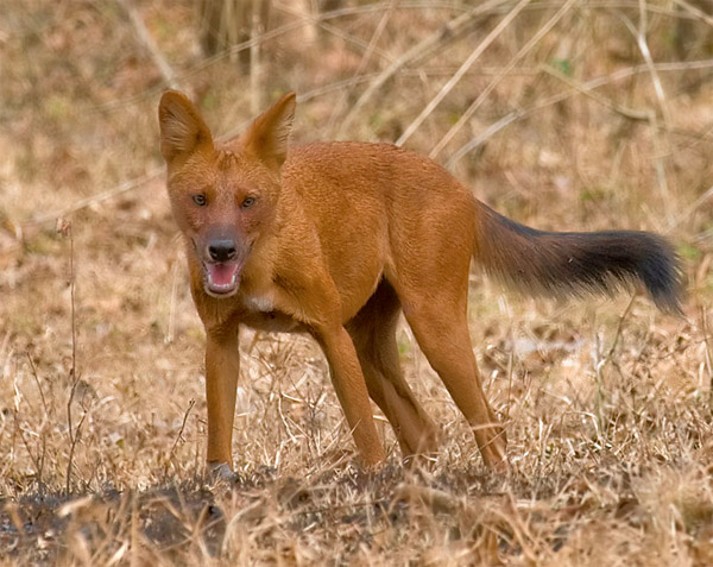
A Burmese dhole – this dhole subspecies was not scientifically described until 1941, when its existence was finally accepted (© Yathin S. Krishnappa/Wikipedia – CC BY-SA 3.0 licence)

Down through the decades, I have documented a wide range of canine cryptids, but two of the least-known examples are those presented here, making their ShukerNature debut. One is now a former mystery canid, the other remains an enigma.

A wild dog of once-controversial scientific status was a mysterious specimen discovered on Mount Popa, a dormant volcano in the region of Mandalay in central Burma (now Myanmar). Renowned British zoologist Reginald I. Pocock stated in 1936 that no specimens of Asia's very distinctive wild red dog or dhole Cuon alpinus had ever been obtained from Burma, but shortly afterwards he learnt that acclaimed mammalogist and animal collector Guy C. Shortridge had secured a specimen on Mount Popa.

Naturally, Pocock was anxious to examine this unique example, an adult female, especially as Shortridge alleged that it only had five pairs of teats (female dholes have 6-8 pairs), and weighed only 19 lb (unusually light for a dhole). However, after studying its skull, uncovered at the British Museum, Pocock recognized that it had been nothing more than an old, small domestic dog Canis familiaris, with a high crown and short muzzle. But, ironically, genuine Burmese dholes were obtained later, and in 1941 Pocock christened their subspecies C. a. adustus – a taxonomic classification still recognised today.

 
A dingo – the identity of Australia's elusive yokyn? (Katy Platt/Wikipedia – copyright-free)

As for the yokyn – this still-unexplained canine cryptid is a strange dog-like beast reputedly well-known to Australian aboriginals and farmers. Said to be approximately half the size of a full-grown dingo, with disproportionately long claws, a stocky, muscular  build, and a very variable pelage (sometimes brindled, sometimes even multi-coloured), a specimen has yet to be formally examined, so its identity remains uncertain (Fate, May 1977; also click here for additional details online).

An unknown species, an odd type of feral domestic dog, a dingo Canis dingo (aka C. lupus dingo aka C. familiaris dingo), a dog-dingo crossbreed, and even a surviving mainland race of the marsupial Tasmanian wolf Thylacinus cynocephalus are among those identities on offer. If anyone reading this ShukerNature article has further information concerning the yokyn, I'd love to receive details.

This ShukerNature article is excerpted and updated from my book Extraordinary Animals Revisited.


Friday, 6 December 2019

SHUKERNATURE BOOK 2 IS HERE! LIVING GORGONS, BOTTLED HOMUNCULI, AND OTHER MONSTROUS BLOG FAUNA

ShukerNatureBook 2 is here! – which also just so happens to be Book #30, my 30th published book in 31 years of cryptozoological research and writing  (and not counting those many additional volumes for which I have acted as consultant and/or contributor rather than sole author) (© Dr Karl Shuker/Coachwhip Publications)

Here be monsters! Following the success of my first ShukerNature book, published by Coachwhip in April of this year, I now take great pleasure in inviting readers to pay a second visit in hard-copy format to my long-running, award-winning blog – which for over a decade has been uniquely uncovering and documenting the most extraordinary, and truly monstrous, denizens of cryptozoology and unnatural history ever reported and investigated.

Within this second spellbinding Coachwhip-published compilation in book form of blog articles selected and updated from ShukerNature, you will encounter such incredible entities as an eight-legged blue devil in Belize and the big grey man of Ben MacDhui, thylacines in New Zealand, Chile's lost mini-llamas, and Canada's elusive duck beavers, medieval bottled manikins, the garden of a water-horse, and the menagerie of Medusa, resurrected lijagupards and rediscovered litigons, Lewis Carroll's mock turtle and the cryptids of Doctor Dolittle, a marvellous mini-beast named after yours truly, Herman Melville's Polynesian mystery cat and Harry Potter's giant whip scorpion, plus Loys's South American 'ape', gargantuan grasshoppers, and other fascinating fauna of the fraudulent kind, chupacabra chimpanzees, griffinosaurs, celestial stags, Australian monkeys, Europe's last wildmen, what may (or may not?) be the real-life biblical Tree of Knowledge of Good and Evil, a decapitated unicorn from South Africa, and so much more besides.

Its full wraparound cover (© Dr Karl Shuker/Coachwhip Publications)

Its gates are open wide, waiting only for you to step inside its sequestered, shadowy domain and see with your own disbelieving eyes the monsters and miracles lurking there! From living gorgons to hidden homunculi, it's high time for a return visit in tangible, page-turning state to ShukerNature!

Copies can be ordered directly from Amazon US here, from Amazon UK here (please ignore the latter UK site's glitch-generated overlong delivery estimate), and at all good online or shopping street bookstores.

Holding my very own first copy of ShukerNature Book 2 (© Dr Karl Shuker)


Wednesday, 14 February 2018

NEVER IN NEW ZEALAND! WHEN THYLACINES STALKED KIWIS??


Albeit for all the wrong reasons, a very memorable engraving prepared by Friedrich Specht, portraying a concealed thylacine in the wild paying very close attention to a couple of unsuspecting kiwis nearby – from Das Buch Für Alle (1890) (public domain)

I used to think that double-takes were exclusive to clowns in circuses and comedy actors in silent movies. Yet not so long ago, while browsing the internet in search of information regarding the Queensland moa (click here to read my subsequent ShukerNature coverage of this avian anomaly), I performed a double-take that even the great Chaplin himself would, I'm sure, have been justifiably proud.

And the reason for my doing so was that I had unexpectedly caught sight of the illustration opening this present ShukerNature article – an illustration whose content did not immediately register upon my consciousness, so that my gaze momentarily passed elsewhere – until, that is, its patent zoological absurdity suddenly detonated inside my mind, causing me to look back instantly at it, mesmerised by doubt, amazement, and total bewilderment!

Yes, I had observed it correctly – this extraordinary engraving did indeed portray a concealed thylacine (aka Tasmanian wolf and Tasmanian tiger) Thylacinus cynocephalus in the wild paying very close attention to a trio of unsuspecting kiwis nearby. Artistically, it was well executed, but zoogeographically it was preposterous, for the simple reason that although thylacines are known from physical evidence to have existed at one time or another in Tasmania (confirmed until 1936), the Australian mainland (confirmed until c.2,300 years ago), and New Guinea (confirmed until c.4,500 years ago), these remarkably wolf-like marsupial mammals have never existed at any time in New Zealand, whereas kiwis have never existed anywhere else at any time other than in New Zealand.

So how can we explain this illustration of the impossible, depicting a scene that could never have occurred in nature?

Engraving of Friedrich Specht, from 1892 (public domain)

Researching it online, I discovered to my great surprise that this most perplexing picture had been prepared by none other than the celebrated German wildlife illustrator Friedrich Specht (1839-1909), whose exquisite natural history engravings adorned many major multi-volume works published during the late 1800s, including Alfred E. Brehm's Brehms Tierleben (1864-1869) and Sir Richard Lydekker's The Royal Natural History (1894-1896). More specifically, I learned that this particular engraving by him had appeared in Das Buch Für Alle (1890), though I have so far been unable to locate a copy of the latter public-domain book online in order to see the engraving in situ and thus discover the precise context in which it appeared.

Bearing in mind how meticulously accurate his wildlife artwork has always been in the various natural history tomes containing it that I have both perused and purchased down through the years (including Lydekker's above-mentioned series and an English translation of Brehm's), the only plausible if somewhat startling explanation for this incongruous image is that Specht simply wasn't aware either that thylacines have never existed in New Zealand or that kiwis have never existed in Tasmania or mainland Australia. Yet someone as zoologically knowledgeable as Specht would certainly have done, surely?

Perhaps not, because while researching this thylacine-featuring Specht engraving I came upon a second example that included what may be another zoogeographical mismatch. As seen here, this one, which once again had appeared in Das Buch Für Alle, featured two thylacines pursuing an emu Dromaius novaehollandiae. On first sight, this seems straightforward, because Tasmania was indeed once home its very own emu subspecies, D. n. diemenensis, but which, tragically, had been hunted into extinction by the mid-1800s. However, it was supposedly distinguishable morphologically from the mainland Australian version, D. n. novaehollandiae, not only by throat-related colouring and neck feathering differences (paler throat, unfeathered neck) but also by a somewhat smaller overall size.

Yet based upon the relative proportions of the emu and the thylacines depicted in Specht's engraving, and also the appearance of that emu's throat (dark) and neck (feathered), it seems to me that the latter bird is of the mainland Australian subspecies rather than of the Tasmanian subspecies. However, as the thylacine became extinct on the mainland over 2,000 years ago, it would surely be rather unlikely that mainland Australia was the setting portrayed in this image.

Specht's engraving of two thylacines pursuing a taxonomically ambiguous emu, from Das Buch Für Alle (1890) (public domain)

Once again, therefore, Specht's knowledge of Antipodean fauna may have been deficient here, not realising that the Tasmanian emu looked different from its mainland Australian relative, and/or not realising that the thylacine had died out long ago in mainland Australia.

Having said that, it is true that around the time of the Tasmanian emu's extinction, mainland Australian emus were introduced onto its island homeland, and there is even some thought that these mainland interlopers may have actually hastened their native Tasmanian kin into extinction by hybridising with its last few surviving individuals. So, even if Specht's depicted emu is indeed of the mainland Australian subspecies, its occurrence in the presence of thylacines may not be inconsistent with a Tasmanian setting for his engraving after all.

Incidentally, while researching these two anomalous illustrations I also discovered that both of them were included in Tasmanian Tiger: A Lesson To Be Learnt (1998), authored by Eric Guiler and Philippe Godard, with the contribution of David Maguire. Yet while they shared my bemusement regarding the thylacine and kiwis example, and also my reservations concerning the thylacines and emu example, they did not provide any additional background information relating to either of them.

It is often said that a picture is worth a thousand words, but in at least the example of Specht's thylacine and kiwis engraving, it is probably worth a good deal less, with only its high level of artistry to commend it. Even so, discovering it was certainly a highlight of that particular online surfing session for me – then again, I am easily pleased!

Above: Hand-coloured lithograph, c.1910, of a Tasmanian emu prepared by John G. Keulemans, from The Birds of Australia by Gregory M. Mathews (public domain); Below: painting by John Gould of mainland Australian emus for his book Birds of Australia, Vol. 6 (1865) (public domain)


Saturday, 8 July 2017

IS THE OZENKADNOOK TIGER A CARDBOARD CRYPTID?


The (in)famous Ozenkadnook tiger photograph (copyright owner's identity presently ambiguous, it would seem - see below - although traditionally attributed to Rilla Martin)

One of cryptozoology's most iconic images is the so-called Ozenkadnook Tiger Photograph, reproduced above. It depicts a large, seemingly dark-bodied, white-striped Australian mystery beast supposedly snapped in b/w during 1964 by Melbourne-based Rilla Martin while holidaying in Victoria. She had apparently been driving along a dirt track near Ozenkadnook when she saw the creature at the edge of some woods, and after stopping the car she managed to snap a single photo of it before it ran off.

In typical cryptozoological tradition, the photo's depiction of the beast is far from clear; but as its burly head looks vaguely dog-like, it has inspired various Aussie cryptid enthusiasts to speculate that the striped creature may be a living mainland thylacine Thylacinus cynocephalus. Yet this externally wolf-like marsupial officially died out here over 3,000 years ago, i.e. long before its official extinction on Tasmania in 1936.

A pre-1936 public domain photograph of a living Tasmanian thylacine in captivity, colourised by person(s) unknown to me; found online (public domain/colourising © unknown to me)

Moreover, the bizarre reverse-striping pattern exhibited by the photographed creature bears no resemblance to the thylacine's striping, and has led others to suggest that these markings are not genuine features of it at all, but merely constitute reflected sunlight.

Having said that, such a situation would not in itself automatically exclude the thylacine from consideration as an identity for this mystery beast, as succinctly demonstrated by the following very pertinent photograph:

Pre-1936 photograph of a captive thylacine dappled by sunlight and somewhat resembling the photographed Ozenkadnook tiger (public domain)

Less likely than a thylacine explanation, but suggested by some mystery beast fans, is that the Ozenkadnook tiger was a living marsupial lion Thylacoleo carnifex, which according to the currently-documented fossil record became extinct around 50,000 years ago (although there are a couple of intriguing aboriginal petroglyphs in existence that depict a mysterious beast very reminiscent of Thylacoleo but which are only around 6,500 years old, thereby indicating if identified correctly that this singular species did persist into relatively recent times).

Yet even if has survived right up to the present day undiscovered by science (and popularly proposed by cryptozoologists as the identity of an elusive feline cryptid known as the yarri or Queensland marsupial tiger), its morphology as deduced from fossil finds differs markedly from that of the creature in the photograph.

Specially prepared colour drawing of the yarri or Queensland tiger to which the reverse striping coat pattern ostensibly exhibited by the Ozenkadnook tiger has been deliberately applied, in order to show how the former cryptid might look if it were one and the same species as the latter cryptid, depicted below it (© Markus Bühler / copyright owner's identity presently ambiguous, it would seem - see below - although traditionally attributed to Rilla Martin)

Less contentious options on offer include a dingo or a domestic dog, whereas more sceptical views have leaned toward an unspecified hoax of some kind. With no consensus of opinion surfacing, the controversy as to what Martin's photo really depicts has rumbled on for over 50 years, but in a recent newspaper article (click here) a remarkable new allegation was made.

Namely, that the beast was nothing more than a large cardboard cut-out, created, painted with stripes, and then photographed in the bush by the father of one Bill Leak - a recently-deceased newspaper cartoonist – with a friend. Bill's father was apparently well known for his love of practical jokes, and the allegation was made in The Australian on 24 March 2017 by 'Jack the Insider', aka columnist Peter Hoysted, who had known Bill and had included this claim as part of a memorial article regarding him.

A taxiderm Tasmanian thylacine and a thylacine skeleton at Tring Natural History Museum, two views  (© Dr Karl Shuker)

Supposedly, the hoax was only staged and the photo snapped as a joke to show some friends, but allegedly the photo somehow reached the media and soon attracted appreciable global attention, at which point Leak Snr became nervous that the truth would be exposed, so he destroyed the cut-out and told his son never to speak to anyone about it. Yet clearly he did, at least after his father's death, hence Hoysted's report following Bill's own death.

Various subsequent coverages have seized upon this 'confession by proxy' as proof that the Ozenkadnook Tiger photo is truly a hoax and should therefore be dismissed as being of any potential cryptozoological significance. However, in my opinion such an attitude overlooks two glaring and decidedly worrying shortcomings concerning Hoysted's recent revelation.

Alongside a thylacine picture in my study (© Dr Karl Shuker)

Firstly, the revelation is entirely anecdotal (and not even first-hand), as there seems to be no physical, tangible evidence substantiating it. True, in an update of 20 August 2010 to an article of his own concerning this perplexing picture that he had originally posted on his Tetrapod Zoology blog two days earlier (click here to read it),  British palaeontologist and cryptozoology chronicler Dr Darren Naish did point out an unidentified object in it that he interpreted as possibly being an artificial supporting structure, which if so would be consistent with the creature being merely a cardboard cut-out. But obviously this interpretation is merely a personal opinion, not a verified fact.

Sadly, however, opinions are all that can be offered regarding what may or may not be present in this photo because, very regrettably, the original negative was lost back in the mid-1960s when it was loaned to a newspaper. Consequently, there is no opportunity to subject it to the high-tech type of photographic analysis available nowadays.

Outstanding thylacine model sculpted and painted by Facebook friend Jeff Johnson (© Jeff Johnson)

Secondly, Hoysted's revelation signally yet inexplicably fails to include any mention of Rilla Martin, the person who for the past five decades has been the name directly associated with the snapping of this photo, and who has even been interviewed by the media concerning it. Indeed, as noted by Darren in his 2010 article, although the photo is popularly known as the Ozenkadnook tiger photo it is even better known, at least by some, as the Rilla Martin photo, thus emphasising just how closely associated she is with it.

In a new Tetrapod Zoology article concerning the Ozenkadnook tiger photo, documenting Hoysted's newspaper article and posted online on 29 March 2017 (click here), Darren mentioned that he had personally asked Hoysted how Martin had become involved if it was actually Bill Leak's father who had snapped the photo, not her. In response, Hoysted had "surmised that Martin somehow agreed to take credit for the photo, but other details are as yet unclear". In short, this is just Hoysted's personal opinion, uncorroborated by any tangible evidence.

Thylacine (aka Tasmanian tiger) illustration in eminent 19th-Century Australian zoologist Gerard Krefft's opus The Mammals of Australia, 1871 (public domain)

Consequently, until – if ever – these two fundamental flaws can be resolved, in my opinion this latest allegation regarding the enigmatic Ozenkadnook Tiger Photograph is unproven, and I for one shall continue to consider it as such. In situations of this kind, I always ask myself one simple question: if unsubstantiated claims like these were being put forward in support of a cryptid's status as a reality, rather than in support of a cryptid's status as a hoax, would they be so readily accepted by sceptics? And I think that we all know the answer to that question.


For more information regarding this Australian cryptid as well as related musings concerning putative surviving mainland thylacines and marsupial lions, be sure to check out my books Mystery Cats of the World, Cats of Magic, Mythology, and Mystery, and Still In Search Of Prehistoric Survivors.


Thursday, 17 March 2016

PROF. HENRY BAUER REVIEWS A MANIFESTATION OF MONSTERS IN THE JOURNAL OF SCIENTIFIC EXPLORATION


Below is a very positive review of my recent book A Manifestation of Monsters, which has just appeared in the Journal of Scientific Exploration (vol. 30, no. 1, pp. 133-134, 2016), and was penned by Prof. Henry H. Bauer, whose Loch Ness monster book, The Enigma of Loch Ness, remains one of the standard works on this cryptozoological subject.

As can be seen from my book's front cover (the spectacular artwork is by Michael J. Smith), it contains a vast diversity of subjects, including such cryptozoological stalwarts as Nessie, mokele-mbembe, Jersey devil, thylacine, bigfoot, Mongolian death worm, chupacabra, and coelacanths, as well as many much less familiar, much more obscure mystery beasts too that will not be found in any other crypto-book. So be sure to check it out (published by Anomalist Books, it is available in both paperback and Kindle editions on Amazon and elsewhere, and contains a foreword by Ken Gerhard). Here is Prof. Bauer's review:

Click the above image to enlarge it for reading purposes (© Journal of Scientific Exploration/Prof. Henry H. Bauer)


Sunday, 30 August 2015

MY LATEST BOOK, A MANIFESTATION OF MONSTERS, IS NOW AVAILABLE TO PRE-ORDER ON AMAZON!


Front cover of my latest book, A Manifestation of Monsters (© Dr Karl Shuker/Michael J. Smith/Anomalist Books)

I'm delighted to announce that my latest book, A Manifestation of Monsters: Examining the (Un)Usual Subjects, published by Anomalist Books and containing a foreword by my good friend and fellow cryptozoologist Ken Gerhard, is now available to pre-order on Amazon.

Please click its title above to access its own dedicated web-page on my website, which includes direct clickable links to its ordering pages on Amazon's American and British sites.

Fellow cryptozoologist and good friend Ken Gerhard, who very kindly wrote the foreword to my new book - thanks, Ken!! (© Ken Gerhard)

And here's a summary of what inspired this 22nd book of mine and what it contains:

During the 30 years in which I have been investigating and documenting mystery creatures, my writings have been guided by countless different inspirations, but what inspired this present book was a spectacular work of art. Namely, the wonderful illustration that now graces its front cover, which was prepared by Michael J. Smith, an immensely talented artist from the USA, and which I first saw in 2012. It depicts no less than 17 cryptids and other controversial creatures, including the Loch Ness monster, bigfoot, coelacanth, mokele-mbembe, Jersey devil, chupacabra, Mongolian death worm, Tasmanian wolf, dogman, giant squid, skunk ape, and dodo.

Ever since seeing it, my notion of preparing a book inspired directly by this painting and the eclectic company of entities that it portrays has always stayed with me, but the fundamental problem that I faced if I were to do so was how to categorise them collectively.

What single term could be used that would effectively embrace, encompass, and enumerate this exceptionally diverse array of forms, as well as the range of additional creatures that would also be included in the book? 'Cryptid' was not sufficiently comprehensive, nor was 'mystery creature' or 'unknown animal', because some of the depicted beasts seem to exist far beyond the perimeters - and parameters - of what is traditionally deemed to be the confines of cryptozoology. Consequently, I eventually concluded that there was only one such term that could satisfy all of those requirements – indeed, it was tailor-made for such a purpose. The term? What else could it be? 'Monster'!

UPDATE: 2 September 2015 Look what manifested through the post today! (© Dr Karl Shuker)
 
Derived from the Latin noun 'monstrum' and the Old French 'monstre', 'monster' has many different modern-day definitions - a very strange, frightening, possibly evil (and/or ugly) mythical creature; something huge and/or threatening; a malformed, mutant, or abnormal animal specimen; and even something extraordinary, astonishing, incredible, unnatural, inexplicable. These definitions collectively cover all of this book's subjects – and so too, therefore, does the single word 'monster' from which the definitions derive.

Thus it was that this became a book of monsters, but not just a book – a veritable manifestation of monsters. That is, a unique exhibition, a singular gathering, an exceptional congregation of some of the strangest, most mystifying, and sometimes truly terrifying creatures ever reported - still-unidentified, still-uncaptured, still-contentious. Even 'mainstream' species like the dodo and coelacanth, whose reality and zoological identity are fully confirmed, still succeed in eliciting controversies, and are veritable monsters - the dodo having been referred to by various researchers as a monstrous dove, and the coelacanth as a resurrected prehistoric monster.

So, if you're looking for monsters, you've certainly come to the right place, and will certainly be purchasing the right book. Just pray that once you open it and encounter the incredible creatures lurking inside, you don't live to regret your bravery – or foolishness - in having done so. In fact, just pray that you do live...

Hoping that you enjoy encountering my manifestation of monsters!!

Michael J. Smith's spectacular original artwork, 'Cryptids', which inspired my book and which now appears on its front cover – thanks, Michael!! (© Michael J. Smith)


Saturday, 6 June 2015

MARSUPIAL SABRE-TOOTHS, QUEENSLAND TIGERS, BLUE MOUNTAINS LIONS, AND A MOST ELUSIVE CRYPTO-CUTTING


Screen-shot of the elusive and highly bemusing Australian newspaper cutting containing a Thylacosmilus-like sketch (source and copyright owner unknown to me)

A great many cryptozoological mysteries have crossed my path down through the years, and I've managed to provide answers to quite a number of them, but some still perplex me to this day – and this is one of them.

In 1980, a very popular television series screened in the UK was Arthur C. Clarke's Mysterious World, produced by Yorkshire TV, in which the renowned, eponymous science-fiction writer presented a wide range of unexplained phenomena. Four episodes in this series were devoted to cryptozoological subjects. One of these dealt with sea monsters, one with lake monsters, one with man-beasts, and one (entitled 'Dragons, Dinosaurs and Giant Snakes' and viewable online here) with a wide assortment of other mystery creatures – including giant snakes, the king cheetah, the New Guinea dragon, the mokele-mbembe, and the thylacine or Tasmanian wolf Thylacinus cycnocephalus.

Vintage illustration from 1919 of the very canine thylacine (public domain)

The very short thylacine section included the briefest of shots (viewable at 6.43 to 6.44 in the online version linked to above) revealing an assortment of newspaper cuttings, one of which caught my eye due to the extremely intriguing sketch that it contained – bearing a remarkable resemblance to the long-extinct South American 'marsupial sabre-tooth' known as Thylacosmilus. Yet because this cutting was shown immediately before a clip of film depicting the last living thylacine (with all of the other cuttings in that shot dealing specifically with the thylacine), the creature that the sketch represented had evidently been reported from Australia, not South America. Indeed, during that same brief shot the narrator actually stated: "Who would believe the current stories of a sabre-toothed killer loose even now in the Australian bush…?" before moving on to introduce the thylacine clip.

Consequently, I could only assume that the cutting concerned the Queensland tiger (aka the yarri), because this is the only notable big-toothed feline cryptid reported Down Under (Australia's so-called mystery pumas and black panthers appear little if any different from their official namesakes), and that the sketch was therefore meant to represent (accurately or otherwise) an eyewitness description of one such animal.

Artistic impression of the very feline yarri or Queensland tiger, but given enlarged canines, not enlarged thylacoleonid incisors (© Dami Editore s.r.l.)

I have long been fascinated by this particular cryptid and have amassed a very sizeable file of sighting reports (many of which have been documented by me in various of my books, particularly Mystery Cats of the World, In Search of Prehistoric Survivors, and Cats of Magic, Mythology, and Mystery), but I am only aware of a single yarri eyewitness who has ever compared what they saw to a sabre-tooth, and even then, as the eyewitness specified, the comparison merely concerned the shape of its teeth, not their size.

Australian cryptozoologist/author Rebecca Lang's spectacular Thylacoleo carnifex figurine, created by Sean Cooper, and constructed/painted by Jeff Johnson (© Rebecca Lang/Sean Cooper/Jeff Johnson)

Equally, the most popular identity for the yarri that has been proffered by cryptozoologists is a living thylacoleonid – characterised in its most famous, biggest, and most recently-surviving species, the marsupial or pouched lion Thylacoleo carnifex, by greatly-enlarged, tusk-like incisors (whereas in true, placental sabre-tooths it was the upper canines that were greatly enlarged).

Reconstruction of the yarri with thylacoleonid enlarged incisors (© William Rebsamen)

Moreover, even true, placental sabre-tooths did not possess the extremely pronounced, paired, scabbard-like lower-jaw flanges sported by the creature portrayed in the cutting's sketch. Only South America's marsupial sabre-tooth Thylacosmilus exhibited these very distinctive attributes, composed of bone, which served to sheath and protect its huge curved upper canines.

Thylacosmilus skull at London's Natural History Museum (© Alexei Kouprianov/Wikipedia)

Formally described and named in 1933, known to exist in Argentina from the early Miocene to the late Pliocene epoch, and believed to have been as large as a modern-day leopard or jaguar, the single but highly impressive species Thylacosmilus atrox is popularly referred to as the marsupial or pouched sabre-tooth (the translation of its generic name), due to its deceptively similar outward appearance to the true, placental (eutherian) sabre-tooths or machairodontids but much closer taxonomic affinity to the marsupials as a fellow metatherian. Indeed, it was long classed, along with the morphologically more canine South American borhyaenids, within the same taxonomic order, Marsupialia, as the New World's opossums and caenolestids (rat opossums) and all of Australia's marsupials too. Nowadays, however, Marsupialia is split up into several separate orders, and Thylacosmilus plus the borhyaenids are now housed within the wholly-extinct taxonomic order Sparassodonta.

Restoration of Thylacosmilus atrox in life (with glyptodont in background) – interestingly, it has been portrayed here with very thylacine-like stripes (public domain)

Contrary to former belief, Thylacosmilus became extinct at least one million years before South America was invaded by the eutherian sabre-tooth genus Smilodon (during the mid-Pleistocene), following the latter continent's connection to North America via the appearance of the interconnecting isthmus of Panama. Consequently, the two forms never encountered one another, thereby dismissing prior claims that, as has often happened in instances when metatherian and eutherian counterparts have been brought together, Thylacosmilus was out-competed and thus annihilated by Smilodon.

What if…? – Thylacosmilus vs Smilodon, an imaginary confrontational scenario, as these two mighty feline forms never met in reality (© Hodari Nundu)

All very interesting, undoubtedly, but unfortunately it doesn't shed any light upon the mystery of why this highly-specialised and exclusively South American feline carnivore had inspired a sketch ostensibly depicting a Queensland tiger in an Australian newspaper cutting.

Shortly after the Arthur C. Clarke-presented TV series was screened in Britain, I wrote to its producers Simon Welfare and John Fairley requesting a copy of this particular cutting (it had not been included in the bestselling book of the series), but I learnt from them that they hadn't retained any of the cuttings in that shot, and had no idea what had happened to them. The series' principal researcher, Adam Hart-Davis (now famous as an author, TV presenter, and producer in his own right), very kindly sent me for my own personal research use a videocassette containing all four of its cryptozoological episodes, and by pausing the video at the exact shot showing the cuttings I could just about read the cutting's heading (though as was often the case when freeze-framing video tapes, the picture shook quite considerably).

It's that missing cutting again! (Copyright owner and source unknown to me)

With the advent of the internet, these episodes are now available to view online on YouTube, so I have been able to obtain a slightly better screen-shot of the cutting, as included at the beginning of this present ShukerNature blog article, but it is still not clear enough for much of its its text to be read, and the cutting was not included in its entirety within the shot anyway. However, I can pick out the words 'New South Wales' in the second line of main text beneath the heading, which makes things only more confusing still, because the yarri is apparently confined to Queensland, whereas NSW's feline cryptids are supposedly of the more prosaic puma and black panther varieties – but with one very notable yet little-known exception, documented by me as follows in my book In Search of Prehistoric Survivors (1995):

"Speaking of out-of-place felids, one or more African lions on the loose is the conservative explanation generally offered by naturalists when faced with the enigma of the Blue Mountains' maned mystery beasts. West of Sydney, New South Wales, the Blue Mountains have long been associated with rumours and reports of huge cat-like beasts of ferocious temperament. Interestingly, they are not confined to modern reports but were well known to the aboriginals who once inhabited this range. They called them warrigals ('rock dogs') - a name sometimes applied nowadays to the dingo, but it is clear from their descriptions that their warrigals were something very different from a dingo.

"Rex Gilroy has made a detailed study of the Blue Mountain lions, and according to his published account (Nexus, June-July 1992) the aboriginals described these animals as 6-7 ft long, around 3 ft high, with a large cat-like head, big shearing teeth that protruded from their jaws, brown fur (sometimes light, sometimes dark - sexual, or age, differences?), and a long shaggy mane. Testifying to these animals' continuing presence here, this is also an accurate portrait of the terrifying leonine beast that approached three young shooters in the Mulgoa district south of Penrith, close to the Blue Mountains' eastern escarpment, one day in 1977 - fleeing into nearby scrub only when the alarmed trio fired at it. A similar creature had been reported from this same region in 1972, where it had allegedly been killing sheep.

"Back in April 1945, a bushwalking party clambering down Mount Solitary's Korrowal Buttress made good use of their binoculars to watch four warrigals moving across Cedar Valley. And as recently as 1988, some campers near Hampton, west of Katoomba, saw one for themselves - this area had been experiencing some severe cases of cattle mutilation, a feature that crops up time and again when charting sightings of warrigals.

"Based upon the longstanding history of these animals, I find it difficult to believe that they could be escapee lions or suchlike. An undiscovered native species is the only tenable explanation - echoed by Gilroy, who proposes that the warrigal is a surviving species of pouched lion. As it differs markedly in appearance from the yarri, however, we can only assume that if Gilroy's hypothesis is correct there are two separate species of pouched lion currently prowling various portions of Australia's wildernesses - a remarkable concept, but nonetheless the only one that offers a satisfactory conclusion to this extraordinary saga."

So could the elusive cutting be referring these very mysterious protruding-toothed warrigals and be suggesting that they may be marsupial sabre-tooths, or at least comparing them to such creatures? This could then explain the presence within it of the otherwise-anomalous Thylacosmilus-reminiscent sketch.

Portrayal of Thylacosmilus revealing its characteristic lower jaw flanges (public domain)

Needless to say, I have spent quite some time seeking this very bemusing, tantalising cutting online, but as I have neither a source nor a publication date for it (other than the knowledge that it must have been published sometime prior to the TV series' original screening in 1980), it is not proving an easy task. Not even lengthy periods browsing through the archives of Trove, the invaluable website granting access to countless newspaper reports from Australian newspapers, has unfurled it so far (although during the process of searching for it on Trove, I did uncover a number of yarri articles previously unknown to me!).

And so, gentle reader, here is where you come in. If by any chance you have a copy of this highly elusive cutting, or any information concerning it, especially its date and/or source of publication, I would very greatly welcome any details that you could post here, and a scan of the cutting itself if you do happen to have the original to hand. Thanks very much!


UPDATE: 6 June 2015

Not long after posting this ShukerNature blog article online, I learnt independently from two of my longstanding Australian crypto-colleagues - Dr David Waldron and Paul Cropper - that the Thylacosmilus-like sketch featured in the mystery newspaper cutting had actually been prepared by none other than Australian cryptozoologist Rex Gilroy, who had brought to popular attention the previously-obscure Blue Mountains lions or warrigals. They also both revealed that this same sketch had featured in an article by Rex Gilroy on Australian cryptids that had originally appeared in the December 1976 issue of Psychic Australian, and which can be read online here. Here is the sketch as featured there, and which, as revealed in the article, is his impression of the possible morphology of the Blue Mountains lion based upon eyewitness accounts from the New England area of northern New South Wales:

Rex Gilroy's sketch of the Blue Mountains lion or warrigal from his Psychic Australian article (© Rex Gilroy/Psychic Australian)

Presumably, therefore, eyewitness claims that this cryptid possesses protruding teeth coupled with the fact that with the lone exception of the dingo, all of Australia's large confirmed mammalian species are marsupials, suggested to Rex that the Blue Mountains lion may resemble a marsupial sabre-tooth (and thence Thylacosmilus?), thereby influencing his resulting sketch of its putative appearance.

Out of the Dreamtime: The Search For Australasia's Unknown Animals (© Rex and Heather Gilroy/Uru Publications)
  
His very extensive (43-chapter) self-published book Out of the Dreamtime: The Search For Australasia's Unknown Animals (2006?), co-authored with his wife Heather, contains an entire chapter on the Blue Mountain lions, but all attempts by me to locate a copy to purchase have so far failed (his website, click here, from which copies of all of his books could formerly be purchased, hasn't been updated for some years, and there does not seem to be any functioning facility on it now for book purchasing). So if anyone can suggest a source for his book, I'd greatly welcome details.

Reconstruction of the yarri (top), inspired by the controversial Ozenkadnook tiger photograph (bottom) snapped in 1964 by Rilla Martin near Goroke in Western Australia (© Markus Bühler/© Rilla Martin)