Dr KARL SHUKER

Zoologist, media consultant, and science writer, Dr Karl Shuker is also one of the best known cryptozoologists in the world. He is the author of such seminal works as Mystery Cats of the World (1989), The Lost Ark: New and Rediscovered Animals of the 20th Century (1993; greatly expanded in 2012 as The Encyclopaedia of New and Rediscovered Animals), Dragons: A Natural History (1995), In Search of Prehistoric Survivors (1995), The Unexplained (1996), From Flying Toads To Snakes With Wings (1997), Mysteries of Planet Earth (1999), The Hidden Powers of Animals (2001), The Beasts That Hide From Man (2003), Extraordinary Animals Revisited (2007), Dr Shuker's Casebook (2008), Karl Shuker's Alien Zoo: From the Pages of Fortean Times (2010), Cats of Magic, Mythology, and Mystery (2012), Mirabilis: A Carnival of Cryptozoology and Unnatural History (2013), Dragons in Zoology, Cryptozoology, and Culture (2013), The Menagerie of Marvels (2014), A Manifestation of Monsters (2015), Here's Nessie! (2016), and what is widely considered to be his cryptozoological magnum opus, Still In Search Of Prehistoric Survivors (2016) - plus, very excitingly, his four long-awaited, much-requested ShukerNature blog books (2019-2024).

Dr Karl Shuker's Official Website - http://www.karlshuker.com/index.htm

IMPORTANT: To view a complete, regularly-updated listing of my ShukerNature blog's articles (each one instantly clickable), please click HERE!

IMPORTANT: To view a complete, regularly-updated listing of my published books (each one instantly clickable), please click HERE!

IMPORTANT: To view a complete, regularly-updated listing of my Eclectarium blog's articles (each one instantly clickable), please click HERE!

IMPORTANT: To view a complete, regularly-updated listing of my Starsteeds blog's poetry and other lyrical writings (each one instantly clickable), please click HERE!

IMPORTANT: To view a complete, regularly-updated listing of my Shuker In MovieLand blog's articles (each one instantly clickable), please click HERE!

IMPORTANT: To view a complete, regularly-updated listing of my RebelBikerDude's AI Biker Art blog's thematic text & picture galleries (each one instantly clickable), please click HERE!

Search This Blog


PLEASE COME IN, I'VE BEEN EXPECTING YOU...

PLEASE COME IN, I'VE BEEN EXPECTING YOU...
WELCOME TO SHUKERNATURE - ENJOY YOUR VISIT - BEWARE OF THE RAPTOR!


Showing posts with label Doctor Dolittle. Show all posts

Saturday, 7 December 2024

GREEN PIGS THROUGH THE LOOKING-GLASS - MUSING ON THE MOME RATHS AND OTHER CARROLLIAN CREATURES.

 
In Lewis Carroll's Looking-Glass Land, mome raths are small green pigs with long snouts (© Dr Karl Shuker)

Down through the years, I've documented here on ShukerNature, and subsequently in various of my books, a number of mysterious creatures featured in certain famous works of literary fiction, investigating their possible origins, in particular the real-life animals that may have inspired their creation.

Such book-dwelling beasts chronicled by me include (but are by no means limited to): the Cheshire cat and the mock turtle from Lewis Carroll's classic children's book Alice's Adventures in Wonderland (click here and here to read my respective accounts of them); the tiny but deadly snakeling Karait from Rudyard Kipling's stand-alone short story 'Rikki-Tikki-Tavi' (click here); the rather larger but no less lethal Indian swamp adder (aka the Speckled Band) and the giant rat of Sumatra confronted by the great detective Sherlock Holmes (click here and here); the dream-like hound of the hedges from Charles G. Finney's celebrated fantasy novel The Circus of Dr Lao (click here); the wild were-worms of the Last Desert as referred to by Bilbo Baggins in J.R.R. Tolkien's The Hobbit (click here); Sir Arthur Conan Doyle's huge Brazilian black cat (click here); Ron Weasley's giant spider nemesis in a Harry Potter novel (click here); plus a veritable menagerie of scientifically-unrecognised fauna, from a purple bird of paradise and gigantic luna moths that really are from the moon to some shy living dinosaurs, a giant pink sea snail, and the incredible bicranial pushmi-pullyu, all inhabiting the delightful Doctor Dolittle novels written by Hugh Lofting (click here, here, and here).

 
The 1969 Bancroft Classics #47 hardback edition of Through the Looking-Glass that I owned as a child (© Bancroft Books – reproduced here on a strictly non-commercial Fair Use basis for educational/review purposes only)

As it's been a quite while since I last wrote about any such literary cryptids, however, I feel that it's high time I did so again – and what better source to choose from than Lewis Carroll's second Alice book, Through the Looking-Glass, and What Alice Found There (to give it its full title), which was published in 1871, six years after Alice's Adventures In Wonderland. As a child I enjoyed this sequel novel even more than the original, afore-mentioned Alice book, because its storyline and characters were far less familiar to me.

In particular, I was fascinated by the poem 'Jabberwocky', one of the world's best known nonsense poems. Alice encounters it quite early in Through the Looking-Glass, but as it is written in mirror-image format, she initially finds its verses difficult to read. Moreover, even when she is able to read their reflection in the titular looking-glass, she still cannot understand them because she discovers that they are packed with bizarre made-up words – words that confused but captivated me just as much as they did with Alice, until she encountered the nursery-rhyme character Humpty Dumpty, a self-proclaimed etymological expert, who explained many of them to her.

 
The full version of Lewis Carroll's self-penned nonsense poem 'Jabberwocky', as featured in his second Alice novel, Through the Looking-Glass and What Alice Found There – please click this poem's picture here to enlarge it for reading purposes (public domain)

Moreover, the latent cryptozoologist stirring within me even as a youngster meant that I was additionally fascinated by this poem's tantalizingly brief, ambiguous references to a number of strange-sounding beasts that seemed endemic to Looking-Glass Land – creatures like the slithy toves, for instance, or the bandersnatch, the borogoves, the mome raths, and, needles to say, the eponymous monster itself, the jabberwock. Some of these were succinctly described by Humpty Dumpty, but others were not, thereby remaining enigmatic and elusive. Consequently, down through the years my childhood memories of this poem have inspired me to seek out further information concerning its fabulous if fictitious fauna in the hope of determining what kinds of creatures they were – and here is what I've found out.

As Humpty Dumpty explained to Alice, many of those weird words in 'Jabberwocky' are portmanteaus, i.e. they have been formed by combining two or more separate, well-known words together to yield a totally new albeit far less familiar one. 'Slithy', for instance, arises from the combination of 'slimy' and 'lithe', 'frumious' from 'fuming' and 'furious', 'mimsy' from 'flimsy' and 'miserable', 'chortled' from 'chuckled' and 'snorted', and so forth (Humpty Dumpty elucidating most of these for Alice). Then there are some that are simply extrapolations from existing words, such as 'beamish', defined by Carroll as beaming radiantly with joy or happiness (though, interestingly, scholars have subsequently discovered that this is one peculiar-sounding word in 'Jabberwocky' that Carroll did not invent, its usage having been traced back as far as 1530).

 
A chortling mome rath beneath a beamish moon!

For the most part, however, such forms of word derivation do not assist in revealing the respective natures of the various anomalous animals mentioned in 'Jabberwocky'. Consequently, it is fortunate that between Humpty Dumpty's in-book revelations, the accompanying illustrations prepared by Sir John Tenniel (who had previously prepared those that had illustrated the first Alice book), and various explanatory notes made by Carroll in a publication that preceded Through the Looking-Glass's first printing by almost 20 years, much of the mystery surrounding them can be dissipated.

The publication preceding Through the Looking-Glass was a periodical entitled Mischmasch, written and illustrated by Carroll himself, which was published in 1855. It was here in which the original, significantly shorter version of 'Jabberwocky' first appeared, consisting of just the first verse of what would subsequently become the full multi-verse version in Through the Looking-Glass, published 16 years later. Needless to say, therefore, as the jabberwock itself is not actually mentioned in the first verse, that original single-verse version was not titled 'Jabberwocky'. Instead, Caroll dubbed it 'Stanza of Anglo-Saxon Poetry'. And as will be seen, it is very intriguing how Carroll's concept of what some of his fictional creatures look like changed quite dramatically from his descriptions of them in this periodical to his descriptions of them (as verbalized via Humpty Dumpty) in the novel.

 
A vintage colorized version from 1927 of Tenniel's illustration depicting some of the cryptic creatures alluded to in Carroll's poem 'Jabberwocky'  - the two badger-faced animals with corkscrew-shaped muzzles and webbed feet are toves; the two long-legged birds (one of them is kneeling with legs bent) are borogoves; and the four small long-snouted pigs are mome raths (green in colour, according to Humpty Dumpty, hence tinted here accordingly), of which three are in the foreground above the toves and borogoves, with the fourth one just visible in the background to the left of the sundial) (public domain)

So let's begin our annotated checklist of the 'Jabberwocky' wildlife. The creatures first mentioned in it are the slithy toves, which as noted earlier are apparently slimy and lithe, and are the subjects of the most detailed description of any creature name-checked in the poem. According to Humpty Dumpty:

Toves are something like badgers, they're something like lizards, and they're something like corkscrews...Also they make their nests under sun-dials, also they live on cheese.

And that is still not all. For as noted in the poem, they "gyre and gimble in the wabe", which as defined by Humpty Dumpty means that they go round and round like a gyroscope, and bore holes like a gimlet. As for the wabe, he states that this is the grass plot around a sundial (where the toves make their nests) and is so named because it "goes a long way before it, and a long way behind it".


Only in Looking-Glass Land – a green pig beneath a blue moon!

Conversely, back in 1855 Carroll described the toves quite differently in Mischmasch, stating that they were "a species of Badger [which] had smooth white hair, long hind legs, and short horns like a stag [and] lived chiefly on cheese". Moreover, rather than defining the wabe as the grass plot around a sundial, he claimed that it was the side of a hill.

Moving on to the borogoves, they are described merely as mimsy in the poem itself, which as we have seen earlier indicates that they are flimsy and miserable. However, Humpty Dumpty expands upon this briefest of accounts by stating that a "borogove is a thin shabby-looking bird with its feathers sticking out all round, something like a live mop". Tenniel's picture illustrates them as vaguely stork-like, with very long legs (one of them is kneeling, so its lengthy legs are largely concealed beneath its body). Conversely, again, in his Mischmasch periodical Carroll had described this species as: "An extinct kind of Parrot. They had no wings, beaks turned up, and made their nests under sun-dials: lived on veal". Interestingly, therefore, it would appear that when writing Through the Looking-Glass, Carroll transferred to the toves the distinctive habit of making their nests under sundials that he had originally attributed in Mischmasch to the borogoves.

 
You lookin' at me? Is this mome rath feeling rather wrathful?

Now we come to my favourite members of the 'Jabberwocky' zoo (though you've probably already guessed that, by virtue of their pictorial preponderance in this blog article!). Namely, the mome raths. Humpty Dumpty merely describes them as "a sort of green pig", whereas in perhaps his single most dramatic change of identity for any animal referred to in this poem, Carroll stated in Mischmasch:

'Rath' is "a species of land turtle. Head erect, mouth like a shark, the front forelegs curved out so that the animal walked on its knees, smooth green body, lived on swallows and oysters.

Transforming from a green land turtle to a green pig in just 16 years is quite a metamorphosis, that's for sure! Having said that, I personally consider a small long-snouted green pig to be a much more delightful concept than a shark-mouthed, knee-walking land turtle, green-coloured or otherwise. And speaking of long-snouted: Tenniel appears to have been wholly responsible for giving that particular characteristic to the quartet of mome raths depicted by him, an example of artistic licence, perhaps, as it certainly does not feature in either of the verbal portraits quoted above for this porcine species.

 
A mome rathlet (or green piglet, if you prefer!) – how cute is that??

Perhaps the most unexpected of all portrayals of the mome raths, however, appears in Walt Disney's classic 1951 animated feature film Alice in Wonderland. One rather sad, downbeat scene features a tearful Alice having inadvertently become lost in the dark, forbidding Tulgey Wood, home of the jabberwock (but never seen in this movie version). Suddenly, a voice breaks the somber stillness, warning Alice somewhat peremptorily not to step on the mome raths. Shocked, she looks down, and there all around her are small entities resembling flowers but walking on two tiny legs. These very atypical mome raths duly assemble themselves in various shapes, culminating in a large arrow that points to the route leading out of Tulgey Wood, which a very thankful Alice swiftly follows. Although these floral mome raths are certainly endearing (albeit inexplicable!), I feel that some animated green pigs would have been more appealing to this movie's viewers, as well as being far more in-keeping with its somewhat psychedelic visuals.

But now to the descriptive component of this creature's name – from where is the 'mome' in 'mome rath' derived? Here, for the first time, we find little (if any) satisfactory explanations. Even the etymological egomaniac that is Humpty Dumpty confesses to Alice that he is uncertain regarding the derivation of 'mome' – an admission indeed! – offering only this vaguely hopeful suggestion: "I think it's short for 'from home', meaning that they'd lost their way, you know". Rather like Little Bo Peep's sheep, then? As for 'rath': whenever I read 'Jabberwocky' as a child, 'rath' always reminded me of the word 'rasher' – who knows, perhaps I was onto something!


A couple of seriously strange mome raths!

And with regard to this poem's claim that "the mome raths outgrabe", Humpty Dumpty reveals that "'outgribing' is something between bellowing and whistling, with a kind of sneeze in the middle" (with 'outgrabe' being the past tense of 'outgribe'). So now we know!

Moving now into the second verse of 'Jabberwocky', it includes three more mystery beasts, the first, and also the foremost, of these being this poem's eponymous beast itself – the jabberwock. Yet in spite of its being the title character, very little descriptive information is provided for this monster. It is said to have "jaws that bite" and "claws that catch", which apart from confirming that it does indeed possess these particular anatomical accoutrements is of very little use, bearing in mind that their respective, exceedingly succinct one-verb descriptions fit the activity of the jaws and claws of most animals thus equipped.

 
"Beware the Jabberwock, my son!"

The only other details provided are the statements in the fourth verse that the jabberwock has "eyes of flame", that it "came whiffling through the tulgey wood", and that it "burbled". The first statement is self-explanatory, and so, in a sense, is "whiffling" – for instead of being a Carrollian invention, this is a real word whose usage can be traced back as far as 1568, and is defined in the Merriam-Webster Dictionary as emitting or producing a light whistling or puffing sound. As for "burbled", Carroll stated in a letter dating from 1877 (six years after Through the Looking-Glass was published) that he didn't remember creating it, but surmised that it may be a composite of 'bleat', 'murmur', and 'warble'. Interestingly, 'burble' subsequently entered the English language as an accepted word, and today is defined in the Merriam-Webster Dictionary as a verb that means to make a bubbling sound, and also to babble or prattle, plus a noun that means prattle. So, surprisingly, it looks like when pondering the origin of 'burble', Carroll didn't consider two words that seem much more likely to have been bona fide components of it, namely 'bubble' and 'babble', than either 'bleat' or 'murmur' (though his third proposed component, 'warble', does still seems promising as a contender in this capacity).

Due to the scarcity of morphological details provided in thje poem, Tenniel was evidently given free rein when preparing his detailed full-page illustration of the jabberwock, which is reproduced in vintage colorized form below. As can be seen, Tenniel's terror is a most curious creature – combining a very lengthy elongate neck and tail, a pair of insect-like antennae, and a pair of catfish-like mouth barbels with huge bat-like wings, long bushy side-whiskers, and the incisors of a rabbit, plus, just for good monstrous measure, no doubt, it is wearing a very natty waistcoat!

 
Vintage colorized version of Tenniel's original illustration of the jabberwock, from Through the Looking-Glass (public domain)

The other two mystery beasts name-checked in the second verse are the jubjub bird and the frumious bandersnatch. No details whatsoever are given in it regarding the jubjub bird, but as the father in the poem tells his son to beware both of these entities, we must assume that they were dangerous ones. The only additional clue regarding the bandersnatch is Carroll's use of the portmanteau adjective 'frumious' to describe it. This is a word that Carroll deferred from defining until a few years later, in the preface to his lengthy stand-alone nonsense poem The Hunting of the Snark, published in 1876, and in which both the jubjub bird and the bandersnatch reappear. Two of this latter poem's main characters hear the jubjub bird's very scary cry (described as a shrill and high scream), whereas a third main character is attacked by the bandersnatch and is driven insane after trying to bribe it. In this composition's preface, Carroll states that 'frumious' is a composite of 'fuming' and 'furious', so clearly the bandersnatch is a beast best avoided!

Meanwhile, here is a very charming but somewhat idiosyncratic illustration from 1902 depicting the jubjub bird and the bandersnatch, prepared by Peter Newell (1862-1924), an American artist and writer of children's books, in which neither of these creatures seems even remotely belligerent, let alone frumious:

 
Illustration of the jubjub bird and the bandersnatch by Peter Newell in a 1902 edition of Through the Looking-Glass (public domain)

No further creatures appear in 'Jabberwocky', but those that are present there have frustrated and fascinated generations of readers eager to learn more about them, and no doubt will continue to so for the foreseeable future.

Except for this ShukerNature blog article's opening photograph of a mome rath, which I created by digitally manipulating a public-domain stock photo of a typical shorter-snouted pink porker, all mome rath illustrations included here (as well as the first jabberwock illustration) were created by Magic Studio.


In a mome rath galaxy far, far away, Through the Looking-Glass meets The Lord of the Rings, or could it be Planet of the Pigs?


Tuesday, 22 March 2011

THE CRYPTOZOOLOGICAL WORLD OF DOCTOR DOLITTLE. PART 3: A MIGHTY MOTH, A BEAUTEOUS BIRD, AND A BURLY BEETLE.

The giant lunar moth in Doctor Dolittle's Garden

So far in this trilogy of ShukerNature articles on cryptids encountered by the famous if fictitious animal linguist-explorer Doctor Dolittle (click here and here for Parts 1 and 2 respectively), created by Hugh Lofting during the early years of the 20th Century, the good Doctor has encountered such remarkable beasts as a two-headed descendant of the unicorn, a colossal cousin of the Loch Ness monster, a titanic turtle surviving from the age of Noah’s Ark, and a supposed dragon of decidedly dinosaurian persuasion. But – almost in the words of Al Jolson – you ain’t seen nothin’ yet!


THE GIANT LUNAR MOTH

Doctor Dolittle’s Garden (1927), the seventh book in the series, records how, after many years of very indifferent results, the good Doctor had suddenly achieved a totally unexpected breakthrough in his longstanding studies of insect language - as a result of which he had then planned to investigate certain ancient traditions recalled by local hawk moths concerning a race of giant moths as big as houses. But before he had even begun this project, one of these legendary creatures unexpectedly arrived in his own garden!

The evening in question was moonlit, and the Dolittle household’s members were chatting animatedly, when, abruptly, they heard a mysterious, muffled tapping sound on one of the windows. So the Doctor and his assistant, Tommy Stubbins, opened the curtains to see what was there. As then narrated by Stubbins:

Used as John Dolittle was to strange sights and unusual things, this vision outside the glass for a moment staggered even him. There was a face looking in at us. To begin with, it took one quite a while to realise that it was a face. It was so large that you did not take it in or see the connexion, at first, between the various features. In fact the entire window, at least six feet high by three feet wide, only encompassed part of it. But there was no mistaking the eyes – strange and very beautiful eyes. Anyone but those who, like the Doctor and myself, were intimately familiar with the anatomy of insects, would quite possibly have taken them for something else. But to us, in spite of their positively gigantic size, they were unmistakably the eyes of a moth.

Set close together, bulging outward, shimmering like vast iridescent opals in the pale candlelight from the room, they made us feel as though we were gazing through a powerful magnifying glass at an ordinary moth’s head.

‘Heaven preserve us!’ I heard the Doctor mutter at my elbow. ‘It must be the Giant Race. Snuff the candles out, Stubbins. Then we’ll be able to see the rest of him better.’

With trembling hands I did as I was told...The moth positively seemed to fill the whole garden.

His shoulders behind the head, which was pressed close against the panes, towered up to a height of at least two storeys. The enormous wings were folded close to the thick furry body, giving the appearance of the gable-end of a house – and quite as large. The enormous foot which had softly struck the window still rested on the sill. The great creature was quite motionless.

To cut short a rather long story (one third of the entire novel, in fact), it transpired that this astonishing insect was a giant moth that belonged to an entire race of such creatures living upon the moon. And this particular individual had been sent to Earth as a messenger - to locate Doctor Dolittle, and then personally transport him to the moon to solve what was at that stage a still-unrevealed problem there. It had even brought along a series of very large trumpet-shaped lunar flowers that released great quantities of pure oxygen, thus enabling itself and the Doctor to breathe while flying through the airless vacuum of space between the Earth and the moon.

The paperback edition of Doctor Dolittle's Garden that I read as a child, illustrating on its front cover the good Doctor with one of the oxygen-releasing lunar plants ((c) Puffin Books - reproduced here on a strictly non-commercial Fair Use basis for educational/review purposes only) )

And this is precisely what happened, with the Doctor’s astounding lunar discoveries and adventures (accompanied throughout by his sagacious old parrot, Polynesia) taking up the entire content of Book #8, Doctor Dolittle in the Moon (1928). Significantly, Lofting had originally decided that this would be the last Doctor Dolittle novel, stranding the Doctor on the moon indefinitely. But like so many other authors who attempted to kill off in one manner or another their most successful literary creations, Lofting finally relented, and in 1933 he published Doctor Dolittle’s Return, in which the good Doctor and Polynesia duly came back to Earth, but borne this time by a giant lunar locust.

The giant moth only makes a brief appearance in the 1967 film musical ‘Doctor Dolittle’, released by 20th Century Fox Studios, when it transports the Doctor back home to England from Sea Star Island at the end of the film.


MIRANDA, THE PURPLE BIRD OF PARADISE

Paradisaeidae, housing the surrealistically-exquisite, extravagantly-plumed birds of paradise, have always been my favourite taxonomic family of avians. So I was naturally more than a little delighted, when reading The Voyages of Doctor Dolittle (1922), Book #2 in the series, to encounter a character representing a singularly beautiful species that was seemingly undocumented by science, and whose very existence effectively ripped up the zoological rule book as to just what defines a bird of paradise!

The character in question was Miranda, the purple bird of paradise – a name that will not be found in any ornithological tome or formal scientific study of these species. The Doctor and his animal household had been anxiously awaiting her arrival, but in Chapter 9 they were all relieved to learn from Polynesia that she had just arrived, safe and sound, albeit very tired from her long journey, having travelled to England all the way from her homeland in Brazil (as revealed in an earlier chapter).

Miranda, the purple bird of paradise (public domain)


Straight away, it is evident that Miranda was no ordinary bird of paradise, for the simple reason that all of this ornithological family’s 40-odd known species hail from New Guinea, its offlying islands, eastern Australia, or the Moluccas. Not a single species has ever been recorded from the New World. Nor do any of the known species resemble Miranda, as would soon become apparent from the delightful portrait of her produced by Lofting (presented above), and also from Stubbins’s succinct but eloquent verbal description:

In the centre of the big table, perched on the ink-stand, stood the most beautiful bird I have ever seen. She had a deep violet-coloured breast, scarlet wings and a long, long sweeping tail of gold. She was unimaginably beautiful but looked dreadfully tired. Already she had her head under her wing; and she swayed gently from side to side on top of the ink-stand like a bird that has flown long and far.

Once again, neither Lofting’s portrait nor Stubbins’s account correspond even vaguely with any species of bird of paradise – or, indeed, any species of any type of bird! – documented by science. And what makes her appearance even more remarkable is the fact that Miranda was a female bird of paradise, for in virtually every known species it is only the breeding male that sports such gorgeous, dazzling plumage; the females are far dowdier in form.

Yet again, therefore, the good Doctor was acquainted with a true creature of cryptozoology – one, moreover, that was evidently of unique morphological and zoogeographical significance, representing a very distinct branch of Paradisaeidae that had presumably split from the Australasian lineage at a very early stage in this ornithological family’s evolution.

Alternatively, of course, it may just be that Lofting’s knowledge concerning birds of paradise was not very accurate!


THE JABIZRI BEETLE

Our final example from the Dolittle menagerie of literary cryptids also appeared in the Voyages book, and, just like Miranda, was both very distinctive and very beautiful:

...the Doctor suddenly said, "Sh! - A Jabizri! - Don't you hear it?"

We listened and heard, somewhere in the air about us, an extraordinarily musical hum like a bee, but not just one note. This hum rose and fell, up and down almost like some one singing.

"No other insect but the Jabizri beetle hums like that," said the Doctor. "I wonder where he is - quite near, by the sound - flying among the trees probably. Oh, if I only had my butterfly-net! Why didn't I think to strap that around my waist too. Confound the storm: I may miss the chance of a lifetime now of getting the rarest beetle in the world - Oh look! There he goes!"

A huge beetle, easily three inches long I should say, suddenly flew by our noses. The Doctor got frightfully excited. He took off his hat to use as a net, swooped at the beetle and caught it. He nearly fell down a precipice on to the rocks below in his wild hurry, but that didn't bother him in the least. He knelt down, chortling, upon the ground with the Jabizri safe under his hat. From his pocket he brought out a glass-topped box, and into this he very skilfully made the beetle walk from under the rim of the hat. Then he rose up, happy as a child, to examine his new treasure through the glass lid.

It certainly was a most beautiful insect. It was pale blue underneath; but its back was glossy black with huge red spots on it.

"There isn't an entymologist [sic] in the whole world who wouldn't give all he has to be in my shoes to-day," said the Doctor.

As with Miranda and all of the other enigmatic creatures documented by me in this three-part article, the jabizri beetle has never been scientifically catalogued in the real world, but it thrives to delight readers everywhere in the truly wonderful world of Doctor Dolittle – which brought me so much pleasure and zoological inspiration back in my formative childhood years, and which I have so enjoyed revisiting during the course of preparing these accounts.

A still greatly-treasured, much-played LP of songs from the 1967 film musical 'Doctor Dolittle', bought for me as a child by my mother, in which the role of the good Doctor (played in the film by Rex Harrison) is performed delightfully by Tony Britton


So thank you, John Dolittle MD, for your profound influence in opening my eyes and mind to the exciting prospect that animals unknown to science may indeed exist, and not only in your world but also in the real one. True, they may not include pushmi-pullyus or great pink sea snails, but the creatures of cryptozoology are no less extraordinary, and due to your benevolent tutelage during my early days I have gone on to spend many very happy and productive years investigating and documenting their fascinating histories. Thank you again, I shall always be eternally grateful.


Monday, 21 March 2011

THE CRYPTOZOOLOGICAL WORLD OF DOCTOR DOLITTLE. PART 2: A GIANT SEA SNAIL, A LIVING DINOSAUR - AND EVEN A NESSIE NAME-CHECK!

Showing the great pink sea snail from the film musical 'Doctor Dolittle' (Dr Karl Shuker)

In Part 1 of this article (click here to access it), I documented the pushmi-pullyu – the most famous of several cryptozoologically-relevant animals featured in Hugh Lofting’s delightful series of Doctor Dolittle children’s novels. Now, in Part 2, I investigate some extremely sizeable aquatic examples.


THE GIANT SEA SNAIL

Second only to the pushmi-pullyu as the best-known Dolittle-associated literary cryptid, the great sea snail – or, to give it its full title in the novels, the great glass sea snail – was the subject of the good Doctor’s highly eventful sea quest to Spidermonkey Island, off the Brazilian coast, in Hugh Lofting’s second Dolittle novel, The Voyages of Doctor Dolittle (1922). Here is how he was first described to the Doctor, by a small round aquarium fish called the silver fidgit:

“He is an enormous salt-water snail, one of the winkle family, but as large as a big house. He talks quite loudly when he speaks, but this is not often. He can go to any part of the ocean, at all depths because he doesn't have to be afraid of any creature in the sea. His shell is made of transparent mother-o'-pearl so that you can see through it; but it's thick and strong. When he is out of his shell and he carries it empty on his back, there is room in it for a wagon and a pair of horses. He has been seen carrying his food in it when traveling... He is the only one in existence, since his second wife died long, long ago. He is the last of the Giant Shellfish. He belongs to past ages when the whales were land animals and all that. They say he is over seventy thousand years old."

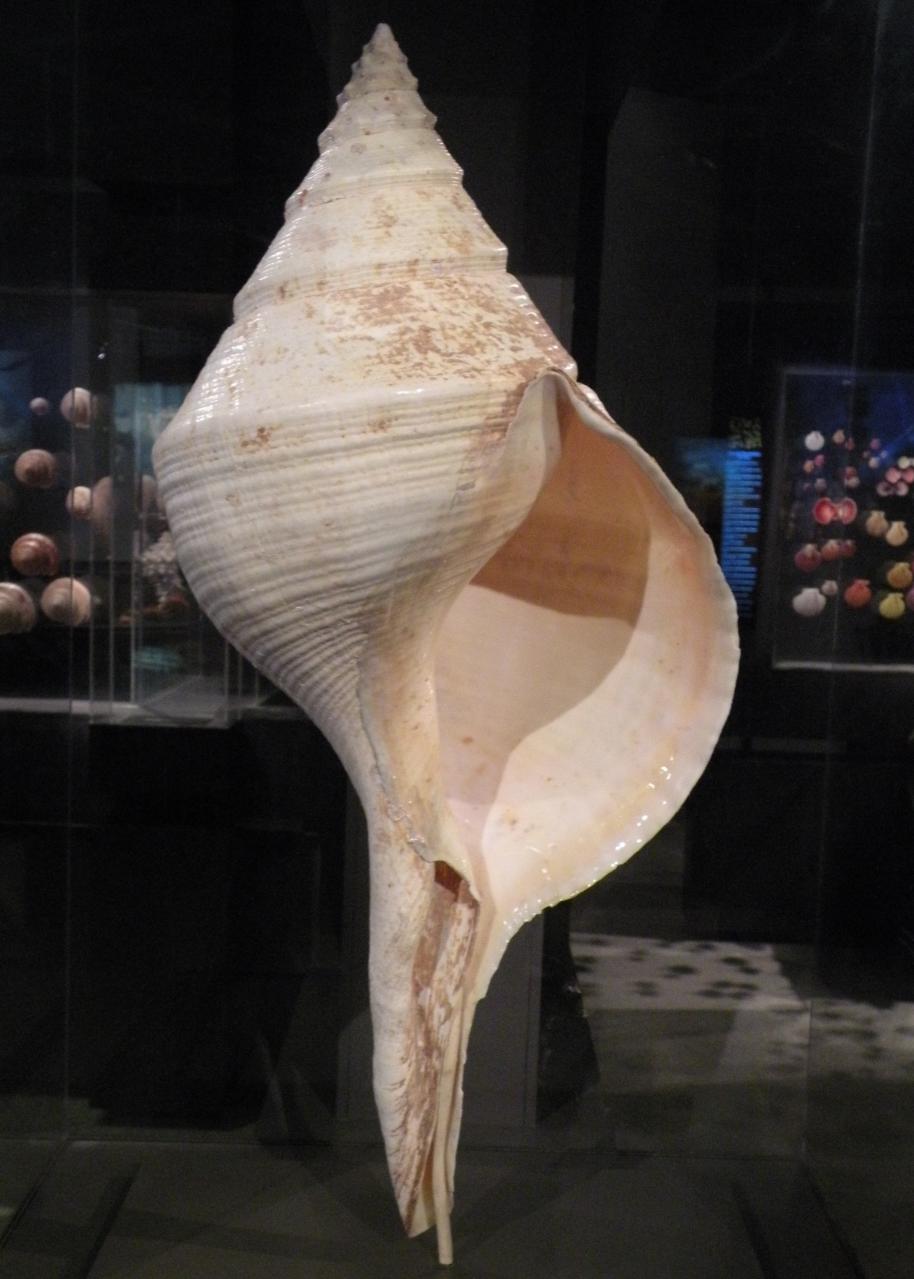
Winkles (i.e. periwinkles) belong to the gastropod order of molluscs. Needless to say, however, if it were real the great glass sea snail would be inconceivably bigger than any gastropod ever recorded by science. Indeed, even the world’s largest known species of gastropod, the Australian trumpet Syrinx aruanus, a member of the turban shell family, Turbinidae, ‘only’ measures up to 3 ft (90 cm) long and weighs up to 40 lb (18 kg). Also worthy of comment is that normal gastropods are not in the habit of exiting their shells at will and carrying them empty on their backs afterwards! Nor are their shells composed of transparent mother-of-pearl (nacre). All in all, therefore, the great glass sea snail was very clearly (pun intended!) a veritable wonder of the marine world.

The Australian trumpet Syrinx aruanus (Stephanie Dancer/Wikipedia)

And not just any old wonder either, but one of immense cryptozoological significance. For as the Doctor’s venerable and exceedingly knowledgeable parrot, Polynesia, subsequently speculated after finally witnessing at close range the great sea snail’s enormous pink-hued shell in shallow water close to shore:

"“That," whispered Polynesia, "is what sailors for hundreds of years have called the Sea-serpent. I've seen it myself more than once from the decks of ships, at long range, curving in and out of the water. But now that I see it close and still, I very strongly suspect that the Sea-serpent of history is no other than the Great Glass Sea-snail that the fidgit told us of.”

"...Seeing him in his full length like this, it was easy to understand how old-time, superstitious sailors had called him the Sea-serpent. He certainly was a most gigantic, and in his way, a graceful, beautiful creature."

The great glass sea snail as the great sea serpent? Although countless identities have been offered for this most perplexing of cryptids, I can’t recall a giant shell-sporting gastropod being among them. Then again, the Doctor’s unique linguistic skills gave him access to inside information from the animal kingdom that today’s cryptozoologists – and zoologists – can only dream of.

Consequently, it would appear that long before the likes of Oudemans, Heuvelmans, and other modern-day cryptozoologists had even considered the problem, the riddle of the great sea serpent’s identity had already been conclusively solved by Doctor Dolittle. What a guy!

Intriguingly, just as the pushmi-pullyu underwent a notable transformation between the original Lofting novels and the 20th Century Fox Studios film musical – metamorphosing from a horned African descendant of the gazelle and the unicorn lineages into a hornless Tibetan species whose morphology now more readily allied it with the llamas – so too did the great glass sea snail.

Out went its shell’s transparent appearance and its occurrence in the sea around Spidermonkey Island, and in came an opaque version whose pink colouration was emphasised instead, and a completely new location too, this time in the vicinity of Sea Star Island - a unique floating isle that could turn up anywhere in the world but which was presently lying just off the African coastline. The scenes on Sea Star Island were actually filmed on the tropical Caribbean island of St Lucia, and in view of its dramatic change in colour scheme, the great glass sea snail was referred to in the film as the great pink sea snail. However, it was still of gargantuan size, and transported all of the good Doctor’s human and animal friends back home to England within its shell’s capacious inner chambers. The Doctor himself, meanwhile, remained on Sea Star Island for a time, but was later borne through the skies to England by another exceedingly large - and equally noteworthy - cryptozoological creature, which I’ll be documenting in Part 3 of this article.

Moby Dick - the great white whale, star of the famous novel by Herman Melville (Wikipedia)


I was seven years old when the film musical was released in Britain in 1967, and on the day that my father took me to see it at the local cinema I was in a state of great excitement, especially as my mother had told me to make sure that I didn’t miss seeing “the great pink whale”. Sadly, however, despite paying particular attention throughout the film (no mean feat in itself, as its running time was a rather lengthy 152 minutes), I never did spot this wonderful yet evidently highly-elusive creature – but for good reason. When, returning home afterwards, I told my mother that I hadn’t spotted it, she confessed, in a rather embarrassed state, that she had somehow confused Dolittle’s great pink snail with another famous oceanic mega-beast – Moby Dick, the great white whale! Thus was born the great pink whale - albeit neither in nature nor on screen, but at least for a short time in my mother’s hazy recollection and, as a result, in my own enthusiastic imagination. A pity, really, as a great pink whale would almost certainly have been an even more amazing sight than either a great pink snail or a great white whale!

The exceedingly elusive great pink whale! (public domain(

Still, for a nascent cryptozoologist like I already was, even at the tender age of seven, the film musical did afford one especially memorable and unexpected delight. When the Doctor was discussing with travelling companion Emma Fairfax (a character, incidentally, created specifically for the film as a gentle love interest for him) how the great pink sea snail could easily take all of his friends, including Emma herself, back home to their Westcountry village of Puddleby-on-the-Marsh in England, he revealed that this remarkable sea-beast had an equally remarkable – and famous – freshwater relative:

Dolittle: “He told me he’d been planning to visit his cousin in Scotland for 300 years and kept putting it off. It’d be a great opportunity for him.”

Fairfax: “His cousin in Scotland?”

Dolittle: “Yes, you’ve heard of the Loch Ness monster?”

Fairfax: “Yes,”

Dolittle: “Well, that’s a cousin.”

Fairfax: “Good Heavens!”

So not only had Doctor Dolittle solved the mystery of the great sea serpent, he was also clearly au fait with Nessie! Perhaps, therefore, the world was a little hasty anointing Heuvelmans as ‘the Father of Cryptozoology’! As for the great sea snail having famous family - well, just imagine, the Loch Ness monster, no less, as a cousin! What a small world it is!


LIVING DINOSAURS AND A METHUSELIAN MEGA-TURTLE

Staying with freshwater cryptids: in Doctor Dolittle’s Post Office (1924), the good Doctor journeyed to the small tropical African kingdom of Fantippo, to establish a mail service. During his time there, he paid a visit to a small, mysterious offshore island known as No-Man’s-Land, where, according to the Fantippan people, dreadful dragons reputedly existed. During his sea-voyage to it, his ship was wrecked, but the good Doctor and his dog Jip were rescued by one of these so-called dragons, which turned out to be something even more notable:

At length the extraordinary creature that had come to their rescue reached the island, and with Jip and the Doctor still clinging to his wide back, he crawled out of the water on to the beach...

The tremendous animal which the Fantippans had called a dragon had now climbed right up the beach and was standing fully revealed in all his strangeness. At first he looked like some curious mixture between a crocodile and a giraffe. He had short, spreading legs, but enormously long tail and neck. On his head were two stubby little horns...

‘How very interesting!’ said the Doctor. ‘Naturalists have thought your kind of animal are no longer living, you know. You are quiffenodochi, are you not?’

‘Oh no,’ said the beast. ‘The quiffenodochus has gone long ago. We are the piffilosaurus. We have six toes on the back feet, while the quiffenodochi, our cousins, have only five. They died out about two thousand years ago.’

‘But where are the rest of your people?’ asked the Doctor. ‘I thought you said that many of you had swum out to rescue us.’

‘They did,’ said the piffilosaurus; ‘but they kept hidden under the water, lest the natives on the shore should see...While I was bringing you here they were swimming all around you under the water, ready to help if I needed them. They have gone around to the secret cove so that they may come ashore unseen...’


Doctor Dolittle and the piffilosaurus (public domain)

In short, decades before the amphibious long-necked mokele-mbembe began to hit the cryptozoological headlines in a big way, Doctor Dolittle had already encountered a company of living sauropods! Nor was that his only reptilian revelation.

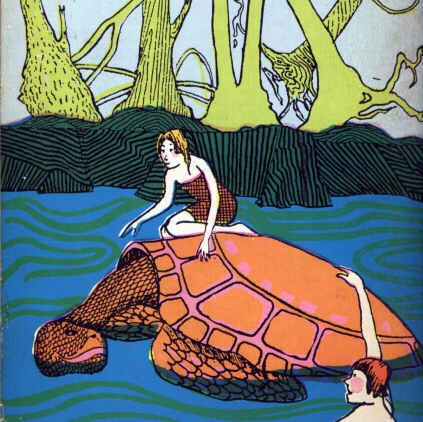
The Doctor’s final adventure in the Post Office novel was his truly historic expedition to Junganyika, the Secret Lake, which no human had ever before seen, hidden away amid some of tropical Africa’s wildest, densest, and least accessible mangrove swamps. His guide was a snake so enormous that South American cryptozoology’s colossal sucuriju gigante or giant anaconda seems positively puny in comparison. And his goal was to meet Mudface - a huge turtle, measuring fully 12 ft across his shell, who lived upon a mud pile rising up above the Secret Lake’s water surface, and was also the world’s oldest living creature, having been alive at the time of Noah’s Ark.

Moreover, in the tenth novel of the Dolittle duodecalogue series, Doctor Dolittle and the Secret Lake (1949), much of its content was devoted to Mudface’s very detailed, extensive account of events as witnessed by him prior to and during the Great Flood.

Mudface (public domain)

Mudface was fictitious, but he certainly calls to mind the now-famous giant turtles inhabiting a lake in the centre of Hanoi, capital city of Vietnam. Here is what I have written about these fascinating if taxonomically-contentious reptiles in the soon-to-be-published third incarnation of my Lost Ark/New Zoo series of volumes dealing with new and rediscovered animals of modern times:


"TURNING TURTLE IN HANOI

"During the past five centuries, Hoan Kiem Lake, a small alga-choked but seemingly well-oxygenated expanse of freshwater situated in the centre of modern-day Hanoi, Vietnam, has been associated with legends and stories of giant turtles (i.e. freshwater tortoises), and for many years at least three such creatures have been regularly reported here. On 24 March 1998, however, events escalated when a passing cameraman succeeded in filming three of them with his videocamera while they surfaced to gulp air.

"After the film had been shown on television, Hanoi National University biologist Professor Ha Dinh Duc announced that he had been studying these outsized chelonians since 1991, and believed that they constitute a new species. Conversely, a number of other herpetologists consider them to be conspecific with Pelochelys bibroni, but this identification was discounted by Dr Peter C.H. Pitchard, co-chairman of the Tortoise and Freshwater Turtle Specialist Group within the Survival Specialist Commission (SSC), after he had visited Hanoi to view them himself. Instead, he announced that in his opinion: "...these turtles are either an outlying population of the Chinese species Trionyx [=Rafetus] swinhoei or that they are a new species. Certainly they are not Pelochelys bibroni". This conclusion was also favoured by Dr Patrick P. McCord, a leading U.S. expert on soft-shelled freshwater tortoises, of which R. swinhoei is one such species. Accordingly, Prof. Duc later dubbed the Hoan Kiem turtles ‘Rafetus hoankiemensis’, thereby classing them as a distinct species within the existing genus Rafetus, which in 2000 he formally named R. leloii.

"A stuffed specimen, preserved almost 40 years ago, is currently on exhibition at a small temple on an island in Hoan Kiem Lake. According to Duc, R. leloii is the world's largest freshwater tortoise, attaining lengths of up to 6.5 ft and weights of up to 440 lb, with a greenish-brown carapace, pink belly, a green and yellow football-sized head, downcast mouth, oval shell, and peeling skin.

"However, there have already been claims that the narrow-headed soft-shelled turtle Chitra indica (another Asian freshwater tortoise) can attain lengths of 6 ft. In any event, the existence of what could be a new species of very sizeable reptile remaining 'undetected' by science while existing in full view of downtown urban Hanoi's teeming populace is sufficiently noteworthy in itself to encourage further investigation of these remarkable animals - especially as they may be the only representatives of their kind. Having said that, in 2003 herpetologists Drs B. Farkas and R.G. Webb published a paper in which they denounced R. leloii as an invalid species, reclassifying its trio of representatives as specimens of R. swinhoei."

So far in this series of articles, I have documented a remarkable twin-headed land beast, and some equally astonishing aquatic cryptids. In the third and final part (click here to access it), I shall be examining a trio of truly incredible ‘things with wings’ that Doctor Dolittle has encountered during his numerous and very varied exploits around the globe – and beyond!


POSTSCRIPT

A day after I posted this article, Jonathan Downes added a fascinating disclosure on the CFZ bloggo - namely, that although no great pink whale ever appeared in the Doctor Dolittle novels, one such creature did occur in a notable children's novel by acclaimed authoress Joan Aiken. A pink sperm whale called Rosie, she featured in (and also on the front cover of) Night-Birds On Nantucket (1966). Click here for full details. Thanks, Jon!


Friday, 18 March 2011

THE CRYPTOZOOLOGICAL WORLD OF DOCTOR DOLITTLE. PART 1: IN PRAISE OF THE PUSHMI-PULLYU.


Long before I’d even heard of Dr Bernard Heuvelmans, let alone read his seminal cryptozoological tome, On the Track of Unknown Animals, I’d already been greatly influenced by a very noteworthy, albeit entirely fictitious, figure of considerable relevance to mysterious and undiscovered beasts. I am referring of course to animal linguist genius Doctor Dolittle (or Dr John Dolittle MD, to give him his full title), created by Hugh Lofting. His fascinating adventures and discoveries featured in no less than 12 wonderful children’s novels by Lofting - all of which I had read and re-read many times with great joy during my formative pre-teen years.

They also formed the basis for an equally delightful film musical, ‘Doctor Dolittle’, released by 20th Century Fox Studios in 1967. One of my all-time favourite films, it starred Rex Harrison in the eponymous role, alongside Anthony Newley, Samantha Eggar, Richard Attenborough, and a scene-stealing supporting cast of real-life animals. It featured a very tuneful selection of thoroughly charming songs too, composed by Leslie Bricusse (one of which, ‘Talk to the Animals’, went on to win an Academy Award for Best Song).

Showing the film musical's version of the pushmi-pullyu (Dr Karl Shuker)

During his varied escapades as chronicled by Lofting, the good Doctor encountered many different kinds of animal, ranging from the mundane to the marvellous - including a select few that were unquestionably unknown to modern-day science, and which so enthralled me that I can state in all honesty that the onset in my childhood of what would become a lifelong interest for me in cryptozoology was due in no small way to my fascination with these latter mystery beasts.

Consequently, it seemed only right that ShukerNature should survey some of Lofting’s most significant literary cryptids from the Doctor Dolittle series of novels, so here are six of my particular favourites.


THE PUSHMI-PULLYU
 
Out of all of the extraordinary creatures that appeared in Hugh Lofting’s series of Doctor Dolittle novels, it was the pushmi-pullyu that was unquestionably the most readily identifiable member of Dolittle’s marvellous menagerie, due not only to Lofting’s own input but also to this bicranial wonder’s very memorable appearance in the afore-mentioned Doctor Dolittle film musical from 1967.

Here is how Lofting introduced the pushmi-pullyu, native to darkest Africa and exceptionally elusive, in the very first Dolittle novel, The Story of Doctor Dolittle (1920):

"Pushmi-pullyus are now extinct. That means, there aren't any more. But long ago, when Doctor Dolittle was alive [early 1800s], there were some of them still left in the deepest jungles of Africa; and even then they were very, very scarce. They had no tail, but a head at each end, and sharp horns on each head. They were very shy and terribly hard to catch...[The native people] get most of their animals by sneaking up behind them while they are not looking. But you could not do this with the pushmi-pullyu because, no matter which way you came towards him, he was always facing you. And besides, only one half of him slept at a time. The other head was always awake and watching. This was why they were never caught and never seen in Zoos. Though many of the greatest huntsmen and the cleverest menagerie-keepers spent years of their lives searching through the jungles in all weathers for pushmi-pullyus, not a single one had ever been caught. Even then, years ago, he was the only animal in the world with two heads."

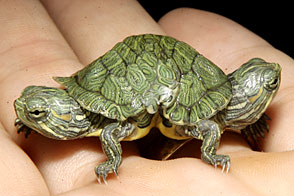
This is not entirely true, of course. There are many fully-confirmed cases of dicephalous or bicephalic (i.e. two-headed) animals on record, including various specimens of two-headed snakes, terrapins, lambs, calves, and even, rarely, humans. However, in every one of these cases, the two heads emerge either from a single neck or, if each head has its own neck, from a single upper torso. What made the pushmi-pullyu so very special is that its heads emerged from opposite ends of its body. Indeed, its body was actually two front halves fused together in opposite directions at their mid-riff.

Such an extraordinary entity is known technically as an amphicephalus, and in reality is exceedingly rare. Indeed, I know only of a few semi-amphicephalic terrapins, which were conjoined twins joined end to end, and, in contrast to the pushmi-pullyu, each twin had an almost fully-formed body, not just a front half.

A semi-amphicephalic terrapin (public domain)

The much more extreme condition exhibited by the pushmi-pullyu, conversely, would have rendered it an anatomical impossibility in real life – if only for the fundamental physiological reason that it would not have been able to defaecate, having no anus! Happily, such indelicate matters were discreetly passed over by Lofting, who wrote his novels in a more genteel age when, unlike in today’s brasher times, such subjects were most definitely off-limits in a children’s book (even though I would hazard a guess that, schoolboys being schoolboys whatever decade they happened to be born in, the pushmi-pullyu’s excretory paradox attracted its fair share of sniggers and risible comments even back in the 1920s!).

What an amphicephalic llama would look like

Moving swiftly on: just as intriguing as its anatomy was its taxonomy. Just what was the pushmi-pullyu? In the film musical, it was simply portrayed as an amphicephalic Tibetan llama (even though Tibet is normally home to lamas, not llamas!), but in the novel Lofting revealed that it had a much more complex, interesting ancestry:

"Excuse me, [said Doctor Dolittle] surely you are related to the Deer Family, are you not?"

"Yes," said the pushmi-pullyu "to the Abyssinian Gazelles and the Asiatic Chamois on my mother's side. My father's greatgrandfather was the last of the Unicorns."


Lofting's own drawing of the pushmi-pullyu (public domain)

Lofting also included the sketch of the pushmi-pullyu reproduced here (Lofting provided all of the illustrations himself for the Dolittle books), which portrays each of its heads with a pair of short horns, curling backwards slightly at their tips, and each head also possesses an extraordinarily large lower jaw (mandibular prognathism?). Whatever it was, therefore, it clearly was not of llama extraction.

Reading through the pushmi-pullyu’s description of its own ancestry, one might initially assume that the most cryptozoological aspect of it was this very curious creature’s derivation on its paternal side from the unicorn lineage. In reality, however, its maternal side was no less interesting either, because there is no such animal as the Asiatic chamois known to science. The only modern-day chamois, Rupicapra rupicapra, is almost entirely confined to Europe (it also exists a little way into Asian Turkey). So how can we explain Lofting’s assertion?

It may of course simply be that Lofting was mistaken, wrongly assuming that the chamois was Asian in zoogeographical distribution. Alternatively, he may have been loosely referring to one of the chamois’s close relatives - the serows, the gorals, the tahrs, or the takins, all of which, like the chamois, are known as goat-antelopes, but all of which, unlike the chamois, are Asian.

Chamois on Czechoslovakian postage stamp (public domain)

Back in the age when the Doctor Dolittle books were set (the early 1800s), anything – or anyone – with two heads invariably winded up on display in a sideshow or circus. And sure enough, so did the pushmi-pullyu, though in this instance it was a voluntary act, as it wanted to help the Doctor raise enough money to pay for a boat that he had borrowed but which had later been shipwrecked. The pushmi-pullyu’s arrival at the circus - whose astonished owner, the normally world-weary, seen-it-all showman Albert Blossom, was forced to concede in a boisterous song-and-dance number that “I’ve never seen anything like it!” (listen to it here) - provides one of the most entertaining scenes of all in the film musical, enhanced enormously by a glorious, deliberately over-the-top performance by none other than Richard Attenborough, the eminent actor brother of Britain’s foremost television naturalist, David Attenborough.

The pushmi-pullyu at Blossom's Circus in the 1967 20th Century Fox Studios film musical, 'Doctor Dolittle' ((c) 20th Century Fox - reproduced here on a strictly non-commercial Fair Use basis for educational/review purposes only)

How sad, therefore, that the pushmi-pullyu was not real – one could well imagine the whispered, reverential tones of Richard’s brother discussing its origins and behaviour in an episode of ‘Life On Earth’!

Join me again for Part 2 of this article (click here to access it), when I’ll be casting a glance over a couple of giant aquatic cryptids encountered by the good Doctor on his travels; and click here to access Part 3, when I'll be investigating two huge insects and a beautiful bird all known well to him but not known at all to the rest of science.

 
And here's one I made earlier - my very own pushmi-pullyu! ((c) Dr Karl Shuker)