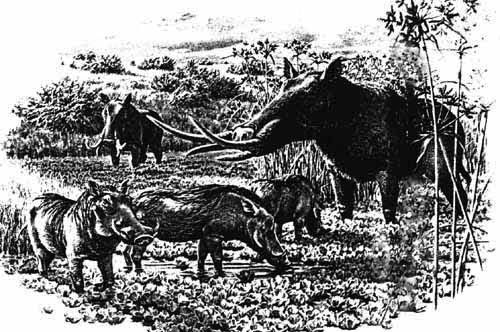
Afrochoerus purposefully portrayed here as
originally conceived when first discovered, i.e. erroneously sporting the tusks
of a prehistoric elephant (© Hodari Nundu/deviantart.com)
I first came upon the following crypto-case many
years ago when browsing through Dr Bernard Heuvelmans's book Les Derniers
Dragons d'Afrique (Plon: Paris, 1978), and it has fascinated me ever since.
Recently, I obtained some additional, previously-undisclosed information
concerning it, and which turned out to be something of a conundrum in itself.
Consequently, it is high time that I finally presented the remarkable story
behind one of the most intriguing and potentially significant examples on
record of an apparently lost specimen of possible cryptozoological relevance.
So here it is – the story, that is, not the specimen itself, sadly!
It all began in an Ethiopian ivory market, one of
many in this country's capital, Addis Ababa, back in the opening years of the 20th
Century (when Ethiopia was still called Abyssinia). In 1904, Baron Maurice de Rothschild and French zoologist Henri
Neuville were visiting this particular ivory market during an East African
expedition when they noticed a very odd-looking tusk on a stall owned by some
ivory merchants from India. Although in excellent condition, supposedly of
modern age (i.e. not fossilised, though possibly several centuries old), and superficially
similar to an elephant tusk but with a very dark patina, in terms of length it
only measured 0.56 m (22 in) in a straight line and only 0.74 m (29 in) following its curve, so it was smaller than most elephant
tusks of comparable proportions that they had previously sold. In addition, it bore
a series of longitudinal, regularly-spaced, narrow grooves or corrugations on
what appeared to be its upper side and a single long but very broad groove on
its apparent underside, instead of being smooth-surfaced like regular elephant
tusks. Consequently, it had not attracted interest from potential buyers.
Three different views of the mystery
tusk purchased in Addis Ababa by Rothschild and Neuville, as
depicted in their 1907 paper documenting it
The ivory merchants were unable to provide any
information regarding this odd tusk's original geographical provenance or from
what type of animal it had been obtained. Indeed, they considered it not to be
a tusk at all, but rather some form of horn. Nevertheless, intrigued by its
strangeness, and no doubt encouraged by its lower-than-normal price, Rothschild
and Neuville duly purchased it. Moreover, while still in East Africa, Neuville was informed by some Somali hunters and
camel herders that tusks like this one came from an aquatic, hippopotamus-sized
creature of great strength, whose tusks curved downwards to the ground, and which
inhabited certain very large East African lakes. According to them, one of
these lakes is what is now known as Lake Abaja (formerly called Lake
Margherita) where they claimed to have seen a living specimen, and another such
lake is situated on the border of Kenya and Uganda.
Following their return to Europe, Rothschild and
Neuville's unusual zoological purchase was exhibited at three separate
scientific meetings. Namely, the Société Philomathique of Paris on 14 January
1905; the Zoological Society of London on 14 November 1905 (where it was
presented by Lord Walter Rothschild, distantly related to Maurice de
Rothschild, who was a lifelong zoological researcher and prodigious collector of
wildlife specimens that he housed at his own personal natural history museum at
Tring in Hertfordshire); and the Academy of Sciences, Paris, on 11 December
1905. (Oddly, a short notice in the Zoological Society's Proceedings
documenting the tusk's exhibition there claimed that two such tusks, not one,
had been obtained by Rothschild and Neuville and had been exhibited at the
Society.)
Rothschild and Neuville then prepared an extensive
scientific paper documenting their anomalous tusk, which was published on 15
October 1907 in
the French journal Archives de Zoologie Expérimentale et Générale (4th
Series), was over 50 pages long, and was aptly entitled 'Sur une Dent d'Origine
Énigmatique'. In it, they compared the tusk closely with a range of others,
including those of elephants, hippos, walruses, and wild pigs, as well as a large
selection of freak, malformed elephant tusks housed at London's Natural History Museum and elsewhere. However, Rothschild
and Neuville claimed that not only externally but also in terms of its internal
grain structure as seen when viewed in cross-section, it differed markedly from all
of them, and even from known fossil species of tusked mammal – to such an
extent, in fact, that they considered it plausible that this unique specimen
did indeed derive from some still-undiscovered animal species, exactly as
claimed by the Somalis.
Line illustration of the
Rothschild-Neuville mystery tusk, from their 1907 paper documenting it
Although referred to for the sake of convenience as
a tusk both here in the present ShukerNature blog article and also in the
Rothschild-Neuville paper, this enigmatic object was technically a tusk
section, not a complete tusk, having been sectioned some way between its tip
and its base, with the latter not being present. From their examination of it,
Rothschild and Neuville considered that had it been present in its entirety, it
would have been almost semi-circular in shape, and that the section preserved was
probably derived from a right-hand tusk. Intriguingly, the tip showed no sign
of having been sharpened, whereas elephants tend to sharpen their tusks' tips
on hard objects that they encounter. From the trace of the pulp cavity
remaining, the authors considered it likely that their perplexing tusk had
exhibited continuous growth in life, like elephant tusks, rather than like
normal teeth that do not grow continuously through life.
The Rothschild-Neuville mystery tusk was totally
devoid of enamel (moreover, it occurs only at the onset of tusk development in
elephants, whereas a thick layer is present in hippo tusks; enamel occurs at
the tip in walrus tusks, though this tends to be worn off as the animal matures).
However, there was a layer of cement, which, although not particularly thick,
was very extensive (a cement layer replaces the enamel layer in elephant tusk
development). As for its anomalous grooves, superficially similar structures
are also borne upon the surface of hippo tusks, but their arrangement is very
different from that of the Rothschild-Neuville mystery tusk's grooves. This is
also true of the grooves that sometimes occur on wild pig tusks, and those
present on various teratological tusks from elephants that were examined by the
authors. Several distinctive traits can be found in diseased examples of
elephant tusks, but none of those traits was exhibited by their mystery tusk, which
appeared to be perfectly healthy, thus eliminating another possible explanation
of it. For further morphological and histological details, please consult the
meticulous description in their original paper.
A couple of hippopotamus tusks, the
upper one revealing the grooves on its upper side, the lower one revealing
those on its underside (© Dr Karl Shuker)
Having assessed all of their mystery tusk's
characteristics, Rothschild and Neuville concluded that it compared more
closely with elephant tusks than with those of any other mammal, but that even
with these it also exhibited notable differences. Consequently, their preferred
hypothesis was that it had therefore originated from a species of large mammal
still unknown to science but probably most closely related to proboscideans (Proboscidea
is the taxonomic order containing elephants).
Notwithstanding this exciting possibility, however,
the Rothschild-Neuville mystery tusk rapidly sank into zoological obscurity
following their paper's publication in October 1907, with only Heuvelmans's
aforementioned documentation of it in his 1978 book briefly raising its profile.
And yet with modern-day advances in microscopical, chemical, and genetic
analyses readily available, surely a re-examination of this specimen utilising
these techniques might unlock the secret of its original owner's still-cryptic
taxonomic identity? Quite possibly, if only this mystery tusk's current
whereabouts were known.
Les Derniers Dragons d'Afrique, 1978 (front cover illustration ©
Alika Lindbergh/Plon)
French cryptozoologist Michel Raynal was in direct,
frequent correspondence with Heuvelmans for many years, and I recently learnt
from him that Rothschild and Neuville had deposited their mystery tusk at France's National Museum of Natural History in Paris and that it had been accorded its own accession
number. However, he had been told by Heuvelmans about 20 years ago (Heuvelmans
died in 2001) that the tusk could not be found there by the museum staff when
he (Heuvelmans) had requested sight of it, not even when he had given them its
correct accession number. So it had probably been lost many years earlier. But
what was Heuvelmans's opinion concerning the possible identity of the
mysterious creature from which the Rothschild-Neuville tusk had originated?
This is where the story becomes even more intriguing, because Heuvelmans
expressed two very different opinions concerning this issue – one publicly,
another one privately.
The more conservative (relatively speaking) of the
two is the opinion that he expressed publicly, in his book Les Derniers
Dragons d'Afrique (1978). Here he
suggested that the unrevealed tusk-bearer may be an unknown species of
proboscidean. In his classic book On the Track of Unknown Animals
(1958), Heuvelmans had referred to a cryptic aquatic proboscidean, the
so-called water elephant, which I have
also reviewed in various of my own writings, particularly in my book In Search of Prehistoric Survivors (1995) and most recently on my ShukerNature
blog (click here).
Said to inhabit certain Congolese lakes (Lord Walter
Rothschild had collected reports appertaining to this cryptid there and also in
Tanzania as well as South Africa, as noted in the Rothschild-Neuville paper), and
sighted on two separate occasions during the first decade of the 20th
Century by French explorer M. Le Petit, the water elephant, as its name suggests,
allegedly spends much of its time submerged, only emerging onto land during the
evening. It is readily distinguished from normal elephants morphologically too,
via its very elongate, ovoid head and its extremely short, tapir-like trunk.
However, it is also said to lack tusks. If so, while again distinguishing it
from normal elephants, by definition this characteristic also eliminates it
from consideration as the originator of the Rothschild-Neuville mystery tusk.
Artistic representation of the
Congolese water elephant (© Markus Bühler)
Nevertheless, following publication of the Rothschild-Neuville
paper, Le Petit was urged by Paris's National Museum of Natural History to pursue
reports of a similar creature supposedly inhabiting Lake Chad in West Africa. Moreover,
according to an article penned by Prof. Emile Trouessart in the 21 January
1911 issue of the French
periodical La Nature, Le Petit would be accompanied by noted French
zoologist Dr Emile Gromier, and the suggestion was that both the West African
water elephant and the unknown originator of the Rothschild-Neuville mystery
tusk may be a living deinothere.
Deinotheres were very large and highly unusual
proboscideans known only from fossils, and characterised by their lower jaw's
downward-curving pair of tusks. A deinothere had been discounted by Rothschild
and Neuville in their paper as a plausible identity for their tusk's originator,
but Heuvelmans did not discount a relatively small, amphibious,
scientifically-undetected modern-day version out of hand when documenting the
water elephant and the Rothschild-Neuville tusk in his books. As for the
planned expedition to Lake Chad: I have been unable to discover whether Le
Petit and Gromier ever did go there – but even if they did, they certainly
didn't find a deinothere.
Reconstruction of a deinothere (©
Dmitry Bogdanov/Wikipedia)
Heuvelmans's second, privately-expressed opinion as
to what creature the Rothschild-Neuville mystery tusk may have come from is even
more radical than an undiscovered species of probiscidean. In a couple of
emails sent to me by Michel Raynal during June 2014, Michel stated:
"In Heuvelmans's dossier on the tooth
in Lausanne [the site of his Centre de Cryptozoologie], I noticed that there is
an article on Afrochoerus, making me think that Heuvelmans believed that
the "owner" of this tooth was more or less related to this fossil
suid…
"Heuvelmans
seemed to believe that it was a living Afrochoerus (he even told me, when I
visited his "centre de cryptozoologie" in the 1980s, "je sais ce que
c'est" = I know what it is).
"However, Afrochoerus
tusks are somewhat different."
They are indeed! In fact, the tusks of this African
fossil pig once yielded a very notable controversy of their own.
Dating from the Pliocene epoch, Afrochoerus nicoli
was formally described in 1942 by celebrated palaeontologist Dr Louis Leakey from
the famous Olduvai fossil deposits in Tanzania, with substantial additional finds excavated there
in subsequent years. Its most striking features were the tusks originally
uncovered with it, which were disproportionately long, and in early reconstructions,
portraying it with these huge tusks pointing forward, it resembled a bizarre hybrid
of wild pig and mastodont!
Erroneous restoration of Afrochoerus
as an elephant-tusked giant warthog alongside modern-day warthogs (picture
source unknown to me)
In fact, this was quite prophetic, because palaeontologists
now know that these tusks weren't suid (pig) tusks at all, but were in reality
from Stegotetrabelodon – a genus of fossil gomphothere elephant! What
had happened was that Afrochoerus had been based upon cranial remains of
a bona fide fossil suid called Metridiochoerus compactus, the giant
warthog, that had been discovered in close proximity to some tusks from Stegotetrabelodon,
but which had been mistakenly assumed to be all from the same animal. In short,
Afrochoerus – the extraordinary 'elephant pig' - was a non-existent
composite, whereas the real tusks of M. compactus are nothing more than
slightly larger versions of those possessed by modern-day warthogs, and project
sideways, not forwards.
Accurate reconstruction of Metridiochoerus
(© Nobu Tamura/Wikipedia)
Consequently, although he apparently did not
realise it, by favouring Afrochoerus as the identity of the Rothschild-Neuville
tusk's owner at the time that he did, Heuvelmans was still supporting a proboscidean
candidate (albeit a different one from the deinothere option), because the
tusks to which he was comparing the latter mystery tusk were actually elephant
tusks, not pig tusks.
But could this mystery tusk have derived from
something other than a proboscidean? When I inspected the illustrations of it
in the Rothschild-Neuville paper, images of walrus tusks immediately came to
mind, even though the authors had discounted this possibility in their paper. True,
there are certain discrepancies. The underside of walrus tusks have a single
wide groove (just like the mystery tusk), but the upper side typically bears only
a series of very fine longitudinal cracks of varying lengths. Also, walrus
tusks are generally long and fairly straight, whereas if Rothschild and
Neuville were correct in assuming that in its entirely their tusk would have
been almost semi-circular in shape, this would also argue against a walrus tusk
as its identity. So too does the dark brown patina exhibited by their tusk.
A batch of confiscated
illegally-trafficked walrus tusks and tusked walrus skulls as well as some
polar bear pelts (© US Fish and Wildlife Service)
However, I have seen photos of walrus tusks that do
bear deep longitudinal grooves. Moreover, when I recently consulted Paolo
Viscardi, the natural history curator at London's Horniman Museum, who also favours a walrus tusk as the best candidate for this
enigmatic specimen, he stated:
"Walrus
tusks can also be quite strongly curved and if they [Rothschild and Neuville] were
extrapolating the curve and complete length based on pulp cavity extent beyond
the sawn region, they may have been wildly out if they didn't have Walrus in
mind, since Walrus cavity space is less extensive than what we see in something
like an Elephant or Hippo."
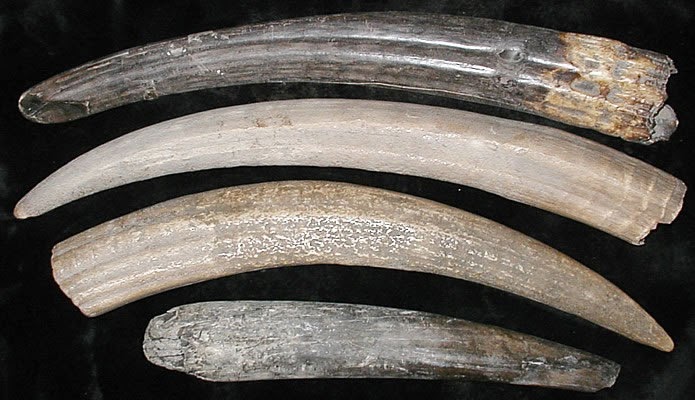
Moreover, although the authors stated that it was
not a fossil tusk, fossil walrus tusks do sometimes have a dark patina.
Walrus tusks, including fossil
specimens displaying a very dark patina (click here for image source)
But how would a walrus tusk have reached the ivory
market of Addis
Ababa anyway,
bearing in mind that walruses only occur in the Arctic Ocean and the subarctic zones of the Atlantic and Pacific Oceans? Fellow Rothschild-Neuville tusk researcher Matt Salusbury, author of
the book Pygmy Elephants (2013) in which this specimen is briefly
referred to, suggested in an email to me of 30 June 2014 that whalers and immigrants
from Scandinavia all en route to South Africa just prior to the tusk's
appearance in Addis Ababa may have brought it with them.
Intriguingly, in South Africa's Orange Free State there are ancient bushman cave paintings that
portray an unidentified creature bearing a remarkable resemblance to a walrus,
and which has been colloquially dubbed the jungle walrus. The most famous one
(portrayed below), which appeared in Rock-Paintings in South Africa (1930)
by George William and Dorothea Bleek, can be found in a cave in Brakfontein
Ridge, which was at one time (and perhaps still is?) contained within the
grounds of a farm called 'La Belle France'. Just an imaginary beast, or a bona
fide cryptid with possible relevance to the Rothschild-Neuville tusk?
The mysterious 'jungle walrus' as
depicted in a cave painting at Brakfontein Ridge, South Africa
Of course, as noted earlier here, if only the Rothschild-Neuville
tusk could be scientifically examined utilising the plethora of modern-day techniques
readily available nowadays, its secrets would soon be teased out and laid bare.
Yet as also noted earlier here, it was apparently lost long ago somewhere
within the labyrinthine interior of its final resting place, the National
Museum of Natural History in Paris – or was it?
Matt Salusbury has informed me (click also here) that he is currently
pursuing the tantalising possibility that the tusk may not have been mislaid
but simply mislabelled, and is hoping to have its accession number rechecked and
also those of comparable specimens there, such as walrus tusks, to determine
whether this most mystifying specimen is actually hiding in plain sight - not lost
at all, therefore, merely overlooked. He is also the accession logs at
London's Natural History Museum, the Zoological Society of London, and the Tring Natural History Museum, too just in case the tusk was transferred from Paris to any of these English repositories. I wish Matt
every success in his exciting undertaking, and very much hope to be able to
announce here soon that the Rothschild-Neuville mystery tusk has indeed
resurfaced – which would be a major success for contemporary cryptozoology. So
watch this space!
Line drawings from Heuvelmans's 1978
book based upon the photo of three views of the mystery tusk that appeared in
the Rothschild-Neuville paper of 1907 (© Plon)






 Posts
Posts