Dr KARL SHUKER

Zoologist, media consultant, and science writer, Dr Karl Shuker is also one of the best known cryptozoologists in the world. He is the author of such seminal works as Mystery Cats of the World (1989), The Lost Ark: New and Rediscovered Animals of the 20th Century (1993; greatly expanded in 2012 as The Encyclopaedia of New and Rediscovered Animals), Dragons: A Natural History (1995), In Search of Prehistoric Survivors (1995), The Unexplained (1996), From Flying Toads To Snakes With Wings (1997), Mysteries of Planet Earth (1999), The Hidden Powers of Animals (2001), The Beasts That Hide From Man (2003), Extraordinary Animals Revisited (2007), Dr Shuker's Casebook (2008), Karl Shuker's Alien Zoo: From the Pages of Fortean Times (2010), Cats of Magic, Mythology, and Mystery (2012), Mirabilis: A Carnival of Cryptozoology and Unnatural History (2013), Dragons in Zoology, Cryptozoology, and Culture (2013), The Menagerie of Marvels (2014), A Manifestation of Monsters (2015), Here's Nessie! (2016), and what is widely considered to be his cryptozoological magnum opus, Still In Search Of Prehistoric Survivors (2016) - plus, very excitingly, his four long-awaited, much-requested ShukerNature blog books (2019-2024).

Dr Karl Shuker's Official Website - http://www.karlshuker.com/index.htm

IMPORTANT: To view a complete, regularly-updated listing of my ShukerNature blog's articles (each one instantly clickable), please click HERE!

IMPORTANT: To view a complete, regularly-updated listing of my published books (each one instantly clickable), please click HERE!

IMPORTANT: To view a complete, regularly-updated listing of my Eclectarium blog's articles (each one instantly clickable), please click HERE!

IMPORTANT: To view a complete, regularly-updated listing of my Starsteeds blog's poetry and other lyrical writings (each one instantly clickable), please click HERE!

IMPORTANT: To view a complete, regularly-updated listing of my Shuker In MovieLand blog's articles (each one instantly clickable), please click HERE!

IMPORTANT: To view a complete, regularly-updated listing of my RebelBikerDude's AI Biker Art blog's thematic text & picture galleries (each one instantly clickable), please click HERE!

Search This Blog


PLEASE COME IN, I'VE BEEN EXPECTING YOU...

PLEASE COME IN, I'VE BEEN EXPECTING YOU...
WELCOME TO SHUKERNATURE - ENJOY YOUR VISIT - BEWARE OF THE RAPTOR!


Showing posts with label The Lost Ark. Show all posts

Saturday, 16 September 2017

MY INTERVIEW FOR 'THE X FACTOR' - NO, NOT 'THAT' ONE!

Publicity photograph of me with cast of a fossil dinosaur footprint, as featured in my X Factor interview (© Dr Karl Shuker)

Several years before a certain music talent show of the same name first appeared on British television (in 2004, to be exact) and subsequently elsewhere around the world, a superb full-colour partwork magazine published by Marshall Cavendish Limited and devoted to mysteries of many kinds (but particularly strong on cryptozoology) was appearing each fortnight in shops throughout the UK and beyond. Eventually running to 96 issues, this excellent magazine's title was The X Factor.

During its run, The X Factor published a number of cryptozoology-themed articles written by me, and also some interviews that I conducted with various fellow cryptozoologists and forteans. One of those interviews was with veteran British mystery cat investigator Trevor Beer (click here to read a transcript of it), another one was with mokele-mbembe seeker Prof. Roy Mackal (click here for a transcript). And in an enjoyable role-reversal, I was also interviewed myself for The X Factor, by CFZ founder Jonathan Downes, this interview subsequently appearing in issue #67.

Back-cover X Factor advertisement for issue #67, which contained CFZ founder Jonathan Downes's interview with me - click picture to enlarge it for reading purposes (© Marshall Cavendish Limited – reproduced here on a strictly educational, non-commercial Fair Use basis for review purposes only)

The X Factor was a singularly authoritative, fact-filled publication, in many ways the natural successor to an equally significant, earlier partwork, The Unexplained, which was originally published during the early 1980s. Yet whereas the latter has been republished many times and in a number of different formats, The X Factor has never reappeared, tragically, in spite of its considerable popularity, so its contents are nowadays not as readily obtainable. As a result, I have been contacted on numerous occasions down through the years by correspondents and other readers lacking the X Factor issue in question (or the entire series), asking whether there was any possibility of reading Jon's interview with me that featured in issue #67, way back in 1999.

So now, finally, in answer to those many requests, I have scanned the full interview and am presenting the relevant three pages herewith – please click each one to expand it for reading purposes. NB – these pages are © Marshall Cavendish Limited/Jonathan Downes/Dr Karl Shuker, and are reproduced here on a strictly educational, non-commercial Fair Use basis for review purposes only.


My three-page interview in issue #67 of The X Factor ( © Marshall Cavendish Limited/Jonathan Downes/Dr Karl Shuker, and are reproduced here on a strictly educational, non-commercial Fair Use basis for review purposes only)

Finally: Caveat lector – this interview was conducted back in 1999, since when I have read very extensively on the subject of the bigfoot in the USA, and have corresponded with many US bigfoot investigators and alleged observers, as a result of which I am nowadays far less sceptical than I previously was concerning this cryptid's reality there.

Holding the cast of a bigfoot print discovered in Washington State, USA, during the early 1980s, and sent to me by veteran bigfoot researcher Prof. Grover Krantz (© Dr Karl Shuker)


Wednesday, 7 September 2016

RECALLING SHUKER'S LORICIFERAN – MY VERY OWN MINI-BEAST


Caroline Gast's exquisite illustration of Pliciloricus enigmaticus, a close relative of Shuker's loriciferan P. shukeri (public domain)

Eleven years ago, I was very honoured to receive what must surely be the greatest personal accolade for any zoologist – a new species of animal was named after me. The creature in question is Shuker's loriciferan Pliciloricus shukeri – but how and why did this come about, and what exactly is a loriciferan anyway?

Although these creatures are only tiny in size, from a taxonomic standpoint the discovery of loriciferans was one of the most significant events of the entire 20th Century, because they added a totally new phylum to the officially recognised roster of animal life. Excerpted and expanded from my book The Encyclopaedia of New and Rediscovered Animals (2012), here is their fascinating history, including the scientific debut in 2005 of P. shukeri.

My three books on new and rediscovered animals (© Dr Karl Shuker)


Loricifera - a Prediction Come True
Giving one's name to an uncommonly ugly form of animal larva may not be everyone's idea of obtaining scientific immortality, but it is nonetheless an effective way to achieve this - especially when that larva's species is so utterly different from all others that a completely new phylum has to be created to accommodate it.

Its story began in 1961 when, as a student at Washington's National Museum of Natural History, Robert P. Higgins predicted the existence of a remarkable little creature unlike any known to science at that time. By a sadistically ironic twist of fate, in May 1974 he actually found a real-life specimen of his hitherto-hypothetical creature - but failed to recognise it for what it was! Instead, he deemed it to be nothing more than a larval priapulid worm.

The following year, however, another specimen was found, this time by Danish zoologist Dr Reinhardt Møbjerg Kristensen, from the University of Copenhagen. Yet as bad luck would have it, the tiny animal was destroyed during its preparation for transmission electron microscopy. Happily, between 1976 and 1979 Dr Kristensen discovered some larvae, in shell gravel obtained from depths of 330-365 ft outside western Greenland's Godhavn Harbour. And finally, in April 1982, an adult turned up - completely by accident.

Ventral view of adult female loriciferan Nanaloricus mysticus (After R. M. Kristensen, 1983, 'Loricifera, a new phylum with Aschelminthes characters from the meiobenthus', Z. Zool. Syst. Evolutionsforsch., 21(3): 163–180)

Kristensen had obtained a huge sample of shell gravel from a depth of 83-100 ft during field work at the Marine Biological Station in Roscoff, France, and was in a hurry to examine the minute creatures living between the gravel particles, as this was his last day there before leaving for Denmark again. Consequently, instead of employing the usual sophisticated but somewhat protracted techniques for dislodging animals from the particles, lack of sufficient time spurred him to use a cruder but much quicker method - simply washing the gravel in freshwater.

The change in salt concentration experienced by the tiny marine organisms in the gravel shocked them into loosening their grip on its particles, and they could then be collected in the surrounding water. Among the creatures obtained in this way was an adult of Higgins's postulated animal form, plus others from every stage in its life history. Shortly afterwards, specimens belonging to a slightly different species were obtained from Greenland gravel samples, using this same technique.

By now, Kristensen and Higgins had learnt about each other's interest in these mysterious minute creatures, and had teamed up to work on them. They discovered that the individual (a larva) collected by Higgins in 1974 was indeed of the same group, but sufficiently different from Kristensen's species to warrant separation within a new genus and family. As for the creatures in toto, true to Higgins's expectations they required a brand new phylum. In 1983, Kristensen named it Loricifera, and formally described its first species, the Roscoff one, which he christened Nanaloricus mysticus.

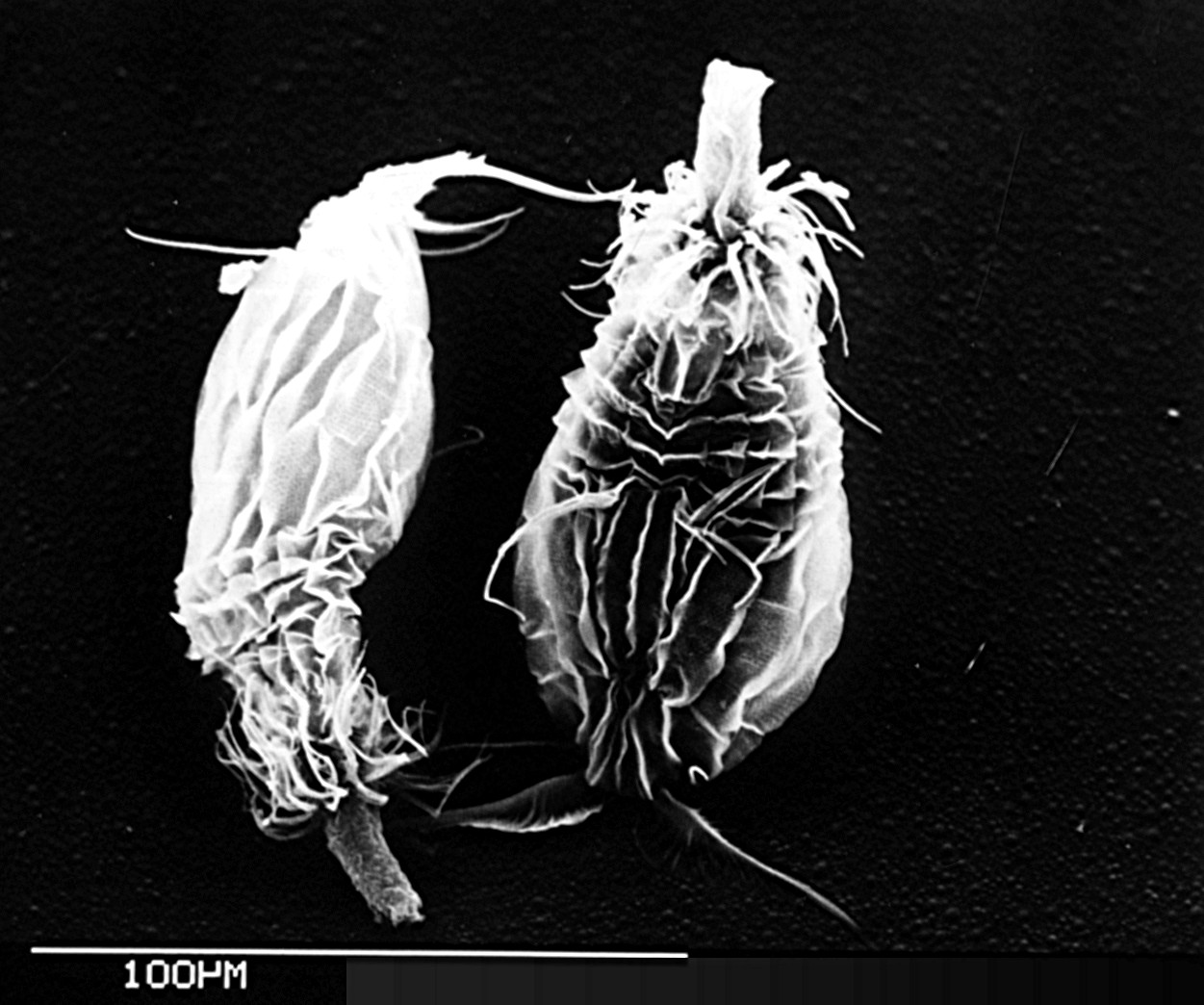
Scanning electron micrograph of two Nanaloricus mysticus Higgins larvae; scale bar = 100 μm (© Dr Reinhardt M. Kristensen)

A tiny creature, no more than 0.01 in long, with a fairly squat body and a head section bearing a collar of radiating spines, it leads a sedentary existence - quite unlike its free-swimming larva, whose striated, pear-shaped body has a rear pair of flipper-like appendages. Anatomically, the species combines features from several different phyla, but is characterised by a unique mouth, consisting of a long tube that can be retracted completely within the creature's body in a manner not previously recorded from any other type of animal.

As for Higgins, although he did not have the honour of describing the first real-life species of his conjectured creature he was given an unusual consolation prize - ever afterwards, the basic larval type produced by loriciferans would be officially referred to in zoological parlance as the Higgins larva. Higgins's reaction to this accolade was to comment: “I'm very pleased of course, even though it is such an ugly creature”. Twenty-two years after his student prognostication, his hypothetical animal was hypothetical no longer.

Incidentally, in 1986 Higgins was able to describe the species to which his lost specimen had belonged; its scientific name is Pliciloricus enigmaticus, and it was just one of eight new species that Higgins and Kristensen described within a single paper. The other seven species were: P. dubius, P. gracilis, P. orphanus, P. profundus, Rugiloricus carolinensis, R. cauliculus, and R. ornatus. In 1988, Kristensen described a notably important species, P. hadalis - the first loriciferan recorded from fine sediment (red clay), from a depth (27,082 ft) great enough to be included within the hadal bathymetric zone, and from the western Pacific.

Shuker's loriciferan Pliciloricus shukeri; scale bar = 200 μm (© Dr Reinhardt M. Kristensen)

Loriciferans possess five distinct body regions - the mouth cone, consisting of a small terminal mouth; the head (introvert), containing the brain; the neck; and a trunk portion that is in turn divided into the thorax and the abdomen. The abdomen is surrounded by a series of plates yielding a corset-like or girdle-like arrangement known as the lorica (from which they derive their zoological name, and also the vernacular name 'girdle wearers'), which is variously cuticular or highly folded in form. On their head, they bear several whorls of protective spines called scalids (earning them a second, rarely-used vernacular name - 'brush-heads'), and because adult loriciferans can withdraw their head into their neck, and their neck in turn into their trunk, when they do so it means that their head is then entirely protected by the lorica laterally and the scalids dorsally (which stick outwards). Although they do possess a body cavity, it is not a true one lined completely by mesoderm tissue (i.e. a coelom), but is one that is only partly mesoderm-lined (i.e. a pseudocoelom). They entirely lack a circulatory system and a respiratory system, but they do possess a straight-through gut from proximal mouth to distal anus, and also a well-developed nervous system. The sexes are separate (males and females), each of which possesses a single pair of gonads.

Morphologically, loriciferans share affinities with two phyla of superficially worm-like creatures - the priapulids and the kinorhynchs, and have been traditionally grouped with them in a clade known as Scalidophora. More recently, however, molecular studies have promoted a closer taxonomic affinity between Loricifera and Nematomorpha (the latter phylum containing the horsehair worms).

In February 1992, I was delighted and honoured to learn from Dr Kristensen that in due course he would be naming a new species of loriciferan after me (at that time, he had nearly 70 undescribed species in his collection!), in recognition of the very significant contribution made to the zoological literature by my first book on new and rediscovered animals – The Lost Ark: New and Rediscovered Animals of the 20th Century (1993). He later informed me that 'my' loriciferan was currently the most interesting species known, because it is neotenous, i.e. its Higgins larval stage becomes sexually mature precociously, developing an ovary, so the post-larval stage is reduced. Also, it was the first loriciferan species known to possess a double secondary organ, and was markedly different from all previously-described Pliciloricus species, thereby requiring the diagnosis of the genus Pliciloricus to be amended accordingly.

Schematic diagram of the adult, type specimen of P. shukeri from Heiner and Kristensen, 2005 (© Drs Iben Heiner and Reinhardt M. Kristensen)

Three specimens of Shuker's loriciferan (one 210-μm-long adult, serving as the holotype or type specimen, and two smaller Higgins larvae, serving as paratypes) had been collected at BIOFAR (Benthic Investigation of the Faroe Islands) Station 627 on the Faroe Bank by the German research vessel Valdivia in 1990, and their species was formally described by Kristensen and fellow loriciferan researcher Dr Iben Heiner in 2005, when it was duly christened Pliciloricus shukeri. Quoting from their paper, the etymological derivation of this species’ name is as follows:

The name of this species epithet is in honor of Dr. Karl Shuker, a prominent expert in cryptozoology. The new species is dedicated to Dr. Shuker for his outstanding book “The Lost Ark, New and Rediscovered Animals of the 20th Century”. In this book, the discovery of Loricifera received much credit as one of the major events of the 20th Century.

The full reference to the paper in which P. shukeri is formally named and described, and which should be accessed for the entire, highly-detailed morphological description of 'my' species, is:

HEINER, I. and KRISTENSEN, R.M. (2005). Two new species of the genus Pliciloricus (Loricifera, Pliciloricidae) from the Faroe Bank, North Atlantic. Zoologischer Anzeiger, 243(3): 121-138.

(The other new loriciferan species described by them in the above paper was P. leocaudatus, the 'lion-tailed loriciferan'.)

Schematic diagram of one of the Higgins larva paratypes of P. shukeri from Heiner and Kristensen, 2005 (© Drs Iben Heiner and Reinhardt M. Kristensen)

Currently (as of August 2017), 37 species of loriciferan in nine genera have been described, but at least a hundred more have been discovered and are currently awaiting description. Indeed, with delicious irony in view of their only very recent arrival in the annals of zoological discovery, based upon the findings of studies conducted so far the loriciferans appear to be one of the most abundant groups of meiofauna in the deep sea (meiofauna being tiny organisms inhabiting the spaces between sediment particles and smaller in body size than macrofauna but bigger than microfauna), they have also been shown to occur in mud on shallower water, and they may actually be one of the dominant meiofauna groups .

Moreover, in April 2010 the existence of a trio of loriciferan species inhabiting the sediments at the bottom of the L'Atalante basin in the Mediterranean Sea, over 10,000 ft deep, was formally documented in a paper (click here to access it) authored by a team of researchers that once again included Drs Kristensen and Heiner, and which was published in the scientific journal BMC Biology. This revelation was of great zoological notability, because these three loriciferan species (respectively constituting a new Pliciloricus species, a new Rugiloricus species, and a new Spinoloricus species) were the first multicellular organisms known to spend their entire lives in an anoxic or anaerobic (oxygen-free) environment.

They can achieve this remarkable feat because they utilise hydrogenosomes (or similar organelles) rather than mitochondria for providing energy. Less than 0.04 in (1 mm) long, these very specialised loriciferans undergo their life cycles in the total absence not only of oxygen but also of light.

Light microscopy image of the new species of anoxic Spinoloricus loriciferan, stained with Rose Bengal; scale bar = 50 μm (© Roberto Danavaro et al., 2010/Wikipedia CC BY 2.0 licence)

Despite having been formally known to science for over three decades now, the loriciferans have clearly lost none of their capacity to surprise the zoological world!

My sincere thanks to Dr Reinhardt M. Kristensen for most kindly making available to me for use in my writings his illustrations included here – and, above all else, for doing me the immense honour of naming a new species after me, something that I'd always dreamed about since a very small child but never expected to happen. Sometimes, dreams really do come true.

And who knows, perhaps one day a second, closely-related, but presently-unfulfilled dream of mine will also come true – that someone will also name a new species after my late mother, Mary Shuker (without whose love, guidance, and encouragement I would never have achieved anything, including writing The Lost Ark and my other books), so that her name will very deservedly live on, and that she will therefore continue to be remembered when I am no longer here to do so.  God bless you Mom, I love you and miss you so much.

Shuker's loriciferan (© Dr Reinhardt M. Kristensen)


Friday, 13 February 2015

ARNOLD'S GIANT TORTOISE AND THE HOLOLISSA OF SEYCHELLES - LONG FORGOTTEN, BUT NO LONGER GONE


Aldabra giant tortoise (left) and hololissa (right) at Cotswolds Wildlife Park, showing shell differences (© Dr Karl Shuker)

The New World giant tortoises famously inhabiting the Galapagos Islands off Ecuador in the Pacific Ocean were once rivalled for size by several huge Old World species native to the Indian Ocean's granitic Seychelles group, the coral atoll of Aldabra, the Mascarene islands, and Madagascar. Of these, only the Aldabra giant tortoise Aldabrachelys [=Dipsochelys] gigantea [=dussumieri, =elephantina] is traditionally thought to have survived into the present day, the remainder having been killed for their meat during the 1700s and 1800s - or so it was thought, until Arnold's giant tortoise and the hololissa unexpectedly reappeared in modern times.

There has been much debate concerning the precise number of giant tortoise species native to the Seychelles. Four are currently recognised (although some researchers deem them merely to be subspecies of a single species), one of which was formally described in September 1982, by Dr Roger Bour from France's National Museum of Natural History. He based his description upon three old taxiderm specimens (two at the above museum, the third at the British Museum). They possessed various skeletal modifications that seemed to be adaptations to browsing, and originated from the granitic Seychelles islands. Bour named their species Dipsochelys [now Aldabrachelys] arnoldi, but as there did not seem to be any giant tortoises (other than Aldabra's) in the Seychelles today, he naturally assumed that it was extinct - belatedly recognised as a distinct species, yet irretrievably deceased.

Aldabra giant tortoises (© Dr Karl Shuker)

Imagine, then, his surprise when, while still preparing his paper, Bour was shown some photos by film producer Claud Pavard (who had taken them in August 1981) depicting two living giant tortoises that seemed to belong to his supposedly extinct species A. arnoldi. Nor was this the only surprise. The tortoises, males and very old, were living in semi-captivity at a sugar estate, but not in the Seychelles - instead, on Mauritius! Naturally, Bour hoped to visit Mauritius, to ascertain conclusively these potentially significant specimens' identity.

And that is where this most promising saga seemed to come to an abrupt end. During my preparation of my book The Lost Ark, published in 1993 and the first in my trilogy of volumes documenting new and rediscovered animals from 1900 onwards, I was unable to locate a single publication carrying any further news regarding these tortoises, and none of my zoological colleagues and correspondents had any details (sadly, I never succeeded in eliciting a reply from Dr Bour himself), though they were all as intrigued by it as I was. Happily, however, the mystery was finally solved in May 1992, when I learnt from British Museum herpetologist Dr Nick Arnold (after whom A. arnoldi had been named) that Dr Bour had indeed visited the two Mauritius specimens, but had found that they were not representatives of A. arnoldi after all.

The Lost Ark: New and Rediscovered Animals of the 20th Century (HarperCollins: London, 1993) (© Dr Karl Shuker)

Moreover, Dr Ian Swingland, Founding and Research Director of the Durrell Institute of Conservation and Ecology (DICE), informed me that giant tortoises reared in captivity sometimes have shells that have become distorted in shape, due to the way in which these animals have been fed. In some cases, therefore, it is possible that they may even resemble the shells of quite unrelated species, and this is presumably what had happened in the case of the two Mauritius specimens, which were probably individuals originating from Aldabra. Captivity-induced distortion of shell shape can cause problems for tortoise taxonomists too, especially if they are dealing with specimens whose life histories are unknown (and which, therefore, may have been reared in captivity).

Of course, one objection that could immediately have been raised in relation to this entire episode is the fact that supposed specimens of A. arnoldi were discovered not in the Seychelles, but instead in Mauritius. As it happens, however, this objection can be effectively countered - because a number of giant tortoises from the Seychelles are known to have been introduced there after that island's own indigenous species had been exterminated during the 1700s. In particular, the French explorer Marion de Fresne transported five such specimens in 1776 from the Seychelles to his military barracks on Mauritius. What was assumed to be the last of this quintet died there in 1918, but there may have been others too, whose records have failed to survive to the present day.

A pair of Aldabra giant tortoises mating - intriguingly, the top specimen has a markedly flat-backed shell, resembling the saddle-backed shell of Arnold's giant tortoise (public domain)  

In any event, what did seem clear at the time of writing The Lost Ark was that none of the long-lost species of Seychelles giant tortoise had been resurrected after all. During 1995, however, another discovery was made - one that added a new and much more dramatic chapter to this long-running saga of mistaken and incognito identities.

In January of that year, the Nature Protection Trust of Seychelles (NPTS) learnt of two very large, and very old, male tortoises living in the garden of a Seychelles hotel. When examined by Dr Justin Gerlach and K. Laura Canning, chief scientists with the NPTS, they were found to exhibit pronounced flaring, flattening, and scalloping of the carapace, especially over the hind legs - characteristics that distinguished them from the Aldabra giant tortoise but corresponded closely with those of Arnold's supposedly long-extinct species.

Arnold's giant tortoise (© Editha@emys-home.de /Wikipedia)

Enquiries revealed that these and one other male specimen had been purchased in 1994 from an old local man, in whose family they had been throughout living memory. The third had died in December 1994, but its skeleton was preserved and donated to the NPTS's scientific collections. Cranial studies subsequently determined that it was indeed distinct from the Aldabra species. Genetic studies were also set in motion, to bypass any possible misclassification based solely upon morphological characteristics - which can, as already ably demonstrated with the earlier episode of the Mauritius specimens, be very deceptive.

By early 1997, several additional specimens of unusual giant tortoise had been discovered in various Seychelles localities and examined by Gerlach. Moreover, whereas some of these resembled Arnold's giant tortoise, eight others closely recalled a second supposedly long-vanished species - the hololissa Dipsochelys [now Aldabrachelys] hololissa. Previously, this latter species had been known only from two shells found in 1810, described in 1877, and destroyed in the 1940s by German bombing raids during the London Blitz. It formerly inhabited various granitic islands of the Seychelles, where it grazed vegetation on the edges of streams and marshes, but had vanished in the wild by 1840.

Hololissa at Prague Zoo (© travelviaitaly/Wikipedia)

In March 1997, Dr Les Noble conducted genetic tests at Aberdeen University on blood samples taken by Gerlach from a large selection of live Seychelles giant tortoises, including the controversial ones. These tests showed that three distinct groups could be identified, revealing that eight of the specimens were hololissas, two were Arnold's giant tortoises, and the remainder were Aldabra giants. But this was still not the end of the story.

A year later, Blackpool Zoo in England announced that Darwin, the Aldabra giant tortoise that had been living there for the past 25 years, was not a member of the Aldabra species after all. While closely scrutinising photos of recently-discovered living specimens of the hololissa, staff at the zoo were astonished to discover that they looked just like Darwin. Anxious to learn more, they duly contacted Gerlach, who visited the zoo, examined Darwin, and confirmed that he was indeed a living hololissa. This presumably explains why he has never successfully mated with Beagle, the female Aldabra giant tortoise that accompanied him when he arrived at Blackpool in 1972 - because they belong to separate species.

Hololissa at Cotswolds Wildlife Park (© Dr Karl Shuker)

Similarly, I subsequently learnt from the Cotswold Wildlife Park, also in England, that one of their supposed Aldabra giant tortoises had also been unmasked as a hololissa. Moreover, by the end of 1999 at least 12 living hololissa individuals and 18 living individuals of Arnold's giant tortoise had been revealed in various locations around the world, including a very impressive specimen at Prague Zoo in the Czech Republic.

Snapped in 1905 when its subject was still alive on Mauritius, a vintage black-and-white photograph still exists of what is now believed by some researchers to have been a hololissa, taken there from its native Seychelles homeland in 1764. Living in the Court House Garden on Mauritius, this venerable individual was therefore at least 140 years old at the time of being photographed, but was probably much older, because no-one knows how old it already was at the time of its transportation there from the Seychelles.

Possible hololissa on Mauritius, vintage 1905 photograph (public domain)

All of which invites speculation as to how many other incognito specimens of hololissa and Arnold's giant tortoise may still be awaiting identification elsewhere. By the end of 1997, the NPTS had introduced several specimens of hololissa and Arnold's giant tortoise to Silhouette Island (third largest of the central Seychelles islands) in order to initiate captive breeding programmes for both of these recently-revived species and thus ensure their continuing survival, and it continues to search for more possible examples in captive collections worldwide.

Officially known as the NPTS Seychelles Giant Tortoise Conservation Project, its patron is veteran wildlife film maker and broadcaster David Attenborough. Its long-term goal is to increase the numbers of both species in order to permit reintroduction to secure reserve sites within the Seychelles group - thereby restoring in viable form two remarkable endemics to their native island homeland after more than 150 years of 'official' non-existence.

Child riding Aldabra giant tortoise at Mount Kenya Wildlife Conservancy, readily demonstrating just how large these tortoises are (Wikipedia/public domain)

All that now remains to be accomplished in order for this tale of tortoise resurrection to be complete is for the fourth species of Seychelles giant tortoise – D. [now Aldabrachelys] daudinii, Daudin's giant tortoise – to be rediscovered. Known only from the Seychelles island of Mahé and named in honour of French zoologist François Marie Daudin (1776-1803), it was formally described and named in 1835, but officially became extinct in 1850.

Judging from the recent success in revealing hitherto-unrecognised living specimens of the hololissa and Arnold's giant tortoise, however, who can say with absolute certainty that there are no incognito A. daudinii individuals out there somewhere too, alive and well but in blissful ignorance of the fact that their species is officially long-extinct?! To be continued…?

This ShukerNature article is expanded and updated from my book The Encyclopaedia of New and Rediscovered Animals (2012).


Monday, 9 December 2013

CRYPTOZOOLOGY AND THE BIRTHDAY PRESENT THAT CHANGED MY LIFE

My much-read, greatly-treasured original copy of the Paladin 1972 abridged paperback reprint of On the Track of Unknown Animals (© Paladin/Dr Karl Shuker)


Today is my birthday, the first one that I have ever known without any family since the passing away of my dear mother, Mary Shuker, exactly 36 weeks ago on Easter Monday.

Yet on this poignant day of reflection and remembrance for me, I still fondly recall a birthday present bought for me by Mom a very long time ago but which changed my life forever, literally…

As a zoologist, media consultant, and author specialising in cryptozoology, it is supremely ironic that my introduction to this enthralling subject was anything but promising.

It all began one day during the early 1970s when, aged around 13, I walked into the department store Boots in the town of Walsall in the West Midlands, England, and spotted a copy of the Paladin abridged paperback edition (1972 reprint) of Dr Bernard Heuvelmans's classic book On the Track of Unknown Animals. Picking it up, I opened it at random, and my eyes alighted upon the following sentence, on p. 199, concerning a South American subterranean cryptid called the minhocão:

"Senhor Lebino also related that in the same district, a Negro woman, who was going one morning to draw water, found the pool destroyed and saw an animal 'as big as a house' crawling away on the ground."

"An animal as big as a house! How ridiculous!", I thought to myself, and promptly replaced the offending book on the shelf.

That hasty action could well have ended my cryptozoological career before it had even begun, cruelly stifled at birth. Happily, however, Fate decreed otherwise. My mother, who was with me, had seen that I had been reading this particular book, albeit briefly, so while I was looking elsewhere in Boots she secretly purchased it as a surprise birthday present for me in December of that same year. When I opened the parcel and saw which book was inside, I remembered what I had read before, and viewed it with suspicion, but as soon as I began reading it properly, from the beginning, I was of course totally hooked. In no time, I had read it from cover to cover on so many occasions that I could virtually recite great chunks of it.

Eager to learn more about undiscovered animals, I began collecting every newspaper cutting, magazine article, and book that I could find on the subject. And when, while studying zoology at university, I became friends with a fellow student who actually owned the unabridged 1958 hardback edition of On the Track..., containing several short chapters that had been omitted from my abridged paperback version, and who kindly permitted me to take his book to the nearest photocopier, I felt as euphoric as if I had been handed the Holy Grail!

My copy of the original 1958 hardback English edition, which I finally purchased more than a decade after receiving the paperback edition from Mom as a birthday present (© Rupert Hart-Davis)

How I wished then that I could make a career out of cryptozoology, but, like most zoology students starting university, I anticipated pursuing a traditional professional life as a research scientist.

And indeed, I went on to obtain both a BSc (Honours) degree in pure zoology and also a PhD in zoology and comparative physiology. However, I had always enjoyed writing, and during my spare time I had by now also amassed a formidable private archive of cryptozoological material. So instead of continuing with mainstream zoological research following my PhD, I decided instead to plunge into the uncertain waters of freelance journalism - specialising in cryptozoology and other areas of so-called 'fringe' science.

My copy of the original two-volume French edition of On the Track of Unknown Animals, entitled Sur la Piste des Bêtes Ignorées and published in 1955 (© Librairie Plon)

Some of my early cryptozoological friends and colleagues outside Britain jokingly said that I seemed to spring up from nowhere, and I can appreciate that this may well have been how it looked to them. However, I can assure everyone that, in the time-honoured showbusiness tradition with such matters, it took me quite a long time to become an overnight success!

It began with a number of articles and letters of mine published in various British newspapers, and regular cryptozoological commissions from a British magazine (sadly now defunct) called The Unknown. Following this, I experienced my first success abroad, with a selection of articles accepted for publication in Fate by its then editor, Jerome Clark. My long-running 'Alien Zoo' column in Fortean Times began soon afterwards (and still appears today), as well as regular articles in many other magazines too.

My copy of the four-volume, revised and corrected 1982 edition of Sur la Piste des Bêtes Ignorées (© Famot)

In 1987, I was amazed and ecstatic when my very first book synopsis, proposing an international survey of feline cryptids, was swiftly accepted by a well-respected London publishing firm, Robert Hale. Even before the ink was dry on its contract, I had already begun writing the book, which was published in June 1989 as Mystery Cats of the World - achieving great success, staying in print for several years, and bringing my name to widespread attention at last. Two years later saw the publication of a second book of mine by Robert Hale - Extraordinary Animals Worldwide, reviewing a diverse range of animal anomalies.

I had also been researching and preparing another book for quite a long time (although initially only as a hobby), on a subject that had never been covered in book form before - new and rediscovered animals of the 20th Century. In 1993, however, five years of exhaustive work on this pioneering project climaxed with its publication by HarperCollins, as The Lost Ark - which I successively updated in subsequent years to yield two fully-revised, much-expanded sequels – The New Zoo (2002), and The Encyclopaedia of New and Rediscovered Animals (2012).

My copy of the revised 1995 edition of On the Track of Unknown Animals (© Kegan Paul International)

Twenty years have somehow raced by almost unseen and unrealised by me since the publication of The Lost Ark, and the current tally of books written by me stands at 20, plus another 12 for which I have acted as consultant and/or contributor, as well as countless articles and blog posts, and my continuing editorship of the Journal of Cryptozoology (click here and here for a complete listing of my books and those for which I have acted as consultant/contributor).

And they all owe their existence to that unassuming birthday present bought for me by Mom all those years ago. Today, it is battered, tattered, stapled, and sellotaped together to within an inch of its life, almost read into oblivion by me over the years. Indeed, I eventually purchased a second, near-pristine copy for my cryptozoological bookshelves in my study. But my original copy remains one of my most treasured possessions, safely housed within a bookcase in my bedroom alongside other much-loved books from my childhood and early teenage years.

Holding two books that influenced me greatly during my formative years, both of them bought for me by Mom (© Dr Karl Shuker)

Thank you, little Mom, for being my rock, the foundation upon which I have built my entire life, and, by giving me this humble little book as a birthday present over 40 years ago, propelling me along a hitherto-unsuspected but inspirational path - opening my eyes to the fascinating world of mystery animals that led to my lifelong career in cryptozoological writing and research, and which in turn has given me so much happiness and engaged my continuing interest for such a very long time.

How I wish that you were here today, to wish me a happy birthday and to give me a birthday card like you've always done every year of my life. You often joked that I'm an incorrigible hoarder, but occasionally it can be of great benefit, and today was one such occasion. I've hoarded quite a few of the birthday and Christmas cards that we've sent to each other over the years, so today I found some birthday cards that you'd written and given to me in earlier years, and I've put a couple of them up on the mantelpiece here, where I always placed yours in previous times.

The wonderful birthday card that Mom gave to me on my 11th birthday in 1970 - knowing that I liked cats and that my favourite colour was blue, she knew how much I'd love this card, and I've treasured it ever since - thanks Mom (© Dr Karl Shuker)

So even though you can't be here with me today, I still have a birthday card from you – two, in fact – to look at and remind me with great joy and thankfulness of when you were here, of all the many happy birthdays that we spent together down through the years, and how very lucky and truly blessed my life has been with you in it as my mother.

Mom and a giant ground sloth statue at Crystal Palace, 2010 (© Dr Karl Shuker)