Even though celebrated American naturalist-artist John James Audubon (1785-1851) produced some of the most spectacular paintings of North American wildlife ever created, he has also stirred up a degree of controversy among ornithologists, because his artwork includes depictions of certain birds that cannot be identified with any species known to present-day science. Most of these feathered mysteries are small, relatively nondescript perching birds, but there is one big (indeed, very big) exception – Washington’s eagle.
Today, science recognises the existence of just two species of eagle in the USA – the bald eagle
Haliaeetus leucocephalus (a sea eagle), and the golden eagle
Aquila chrysaetos (a true eagle). According to Audubon and a number of contemporary writers, however, there was – and may still be? – a third, much larger, visibly distinct species, referred to variously as the great eagle, great sea eagle, bird of Washington, Washington eagle, and Washington’s eagle. Said to possess an enormous 3.1-m wingspan, it hardly seems the kind of bird that could be readily overlooked or forgotten, and yet it is nowadays conspicuous only by its absence from present-day bird books. So whatever happened to Washington’s eagle, and could this cryptic bird be of especial relevance to cryptozoology?
 John James Audubon, painted in 1826 (John Syme)
It was Audubon who first brought this majestic but mystifying raptor to widespread attention, after he and his Canadian fur-dealer companion aboard a trading vessel on the Upper Mississippi observed one such bird flying overhead on a cold February day in 1814. His companion informed him that it was a rare bird called the great eagle, which he had previously seen only in the Great Lakes region, and after viewing it attentively Audubon was convinced that it was a species new to science, native to America’s northern realms.
During the next few years, Audubon made four other sightings, which included observing at close range on some cliffs bordering Kentucky’s Green River a pair at their nest with two young – but to his great disappointment he missed the opportunity to shoot any of them. (This was, of course, the pre-conservation era of the 1800s, when Audubon’s overriding desire was to obtain a specimen in order to paint it for his increasingly impressive folio of North American bird illustrations.) Then, just two years after spying the nesting birds, came his fateful encounter close to the village of Henderson, Kentucky, with an adult individual scavenging at a pig slaughter. Audubon had a gun with him, took careful aim, and duly bagged his long sought-after specimen of the noble Washington’s eagle.
After parcelling up its corpse, Audubon ran with it excitedly to the nearby home of his friend, experienced hunter Dr Adam Rankin, who, after examining it, claimed never to have seen such a bird before, even though he had lived in the area for many years. Both men studied the corpse in depth, which proved to be that of a male specimen. Furthermore, while it was still freshly-killed, Audubon penned the following extensive morphological description of this remarkable eagle:
"The male bird weighs 14 ½ avoirdupois [pounds], measures 3 ft. 7 in. in length, and 10 ft. 2 in. in extent. The upper mandible dark bluish black. It is, however, the same colour for half its length, turning into yellow towards the mouth, which is surrounded with a thick yellow skin. Mouth blue; tongue the same; cere greenish-yellow; eye large, of a fine chestnut colour, iris black, the whole protected above by a broad, strong, bony, cartilaginous substance, giving the eye the appearance of being much sunk. Lores lightish blue, with much strong recumbent hair; upper part of the head, neck, back, scapulars, rump, tail coverts, femorals, and tail feathers, dark coppery glossy brown; throat, front of the neck, breast, and belly, rich bright cinnamon colour; the feathers of the whole of which are long, narrow, sharp-pointed, of a hairy texture, each dashed along the center with the brown of the back; the wings, when closed, reach within an inch and a half of the tail feathers, which are very broad next to the body. Lesser coverts rusty iron grey, forming with that colour and elongated oval, reaching from the shoulders to the lower end of the secondaries, gradually changing to the brown of the back as it meets the scapulars. The secondaries of the last middle tint. Primaries brown, darkest in their inner veins, very broad and firm; the outer one 2 ½ in. shorter than the second, the longest 24 in. to its root, about a half an inch in diameter at the barrel. The under wing coverts iron grey, very broad, and forming the same cavity that is apparent in all of this genus with the scapulars, which are also very broad. Legs and feet strong and muscular: the former one and a half inches in diameter; the latter measuring, from the base of the hind claw to that of the middle toe, 6 ½ in. Claws strong, much hooked, the hind one 2 in. long, the inner rather less, all blue black and glossy. Toes warty, with rasp-like advancing hard particles, covered with large scales appearing again on the front of the leg, all of dirty strong yellow. Leg feathers brown cinnamon, pointed backwards."
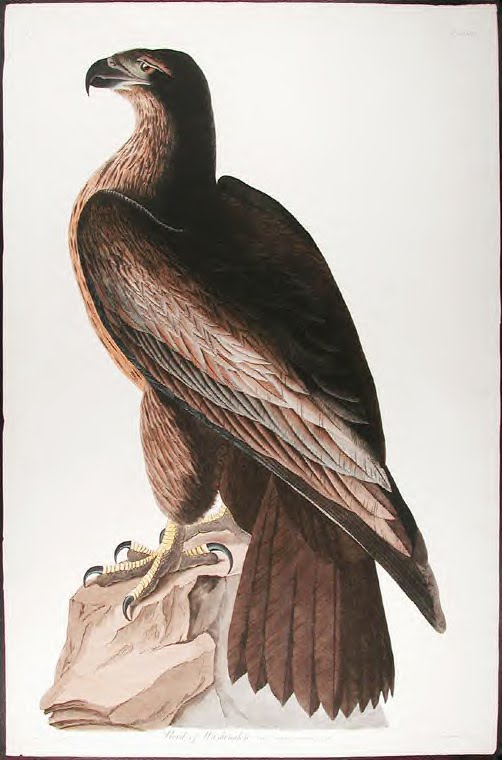
He then utilised this specimen as the subject of a magnificent, meticulously-executed, life-sized painting depicting its species, which he formally dubbed
Falco [now
Haliaeetus]
washingtonii, the bird of Washington or Washington’s eagle, in honour of America’s first president, George Washington.
 Washington's eagle without background (John James Audubon)
According to Audubon’s account and painting, Washington’s eagle resembled in superficial outward appearance an immature bald eagle (i.e. predominantly brown in colour, lacking its species’ characteristic white head and tail until it has attained maturity). However, it exhibited certain very distinct differences from the latter.
 All-brown, immature bald eagle (John James Audubon)
Washington’s eagle’s cere (a soft, fleshy swelling on the beak’s upper basal region, containing the nares or nostrils) did not correspond in appearance with any known version reported from the bald eagle. The uniform scutellation (scaling) on Washington’s eagle’s tarsi is not seen in any developmental stage of the bald eagle. And Washington’s eagle’s size was bigger – far bigger – than that of any specimen of bald eagle ever documented. Audubon claimed that his specimen measured 3 ft 7 in (109 cm) long, and sported a wingspan of 10 ft 2 in (3.1 m), which significantly exceeds the measurements of any known species of North American raptor, including the golden eagle.
 Golden eagle (John James Audubon)
Faced with these distinctions, the ornithological world initially accepted Washington’s eagle as a valid species, including it in several authoritative publications. Moreover, several other notable persons (respected Boston naturalist Dr Lemuel Hayward and ornithologist Thomas Nuttall among them) reported their own Washington’s eagle sightings and those of additional eyewitnesses too. Hayward actually captured one such eagle, but after keeping it alive for a considerable time he supposedly killed his hapless prisoner with mercury in order to send its body to what he referred to at that time as the ‘Linnaeum Museum’ (presumably the museum of London’s Linnaean Society?); according to another report, the museum did receive the bird’s body, then later auctioned it off, but its subsequent fate is unknown.
Eyewitnesses even stated that the flight and feeding behaviour of Washington’s eagle differed from those of the bald eagle. Thus, when hunting, Washington’s eagle allegedly flew in wider circles than the bald eagle, and whereas the latter swoops down directly after spotting prey, Washington’s eagle would descend in spirals before finally diving. Also, although the bald eagle is often seen stealing fish from another native piscivorous bird of prey, the osprey, Washington’s eagle was never reported indulging in this kleptoparasitic practice. And whereas the bald eagle usually builds its massive nests in trees, Washington’s eagle built ground nests on rocky cliffs near water, even in wooded localities.
 Adult bald eagle (John James Audubon)
Nevertheless, even before Audubon’s death in 1851, the first shadows of doubt had begun to be cast upon the authenticity of his great sea eagle. In particular, claims were aired that the morphological differences specified by him for it were contentious, and that his measurements were in error. Ultimately, Washington’s eagle became totally discredited, at best synonymised with the bald eagle’s northern subspecies and at worst dismissed as a mythical species or even a deliberate hoax perpetrated by Audubon. But is this attitude justified?
Worth noting here is that a few museum specimens (such as Hayward’s above-mentioned ‘Linnaeum Museum’ example, one at the New England Museum, one at the Cleveland Academy of Science, and one at Boston’s Museum of Natural History) have been claimed, but none of them, not even Audubon’s own specimen, seems still to survive, or at least be traceable. A specimen was also reputedly housed at Philadelphia’s Peales Museum, but this was presumably destroyed when the museum later burnt down.
Four mutually-exclusive options seem to be on offer with regard to the zoological identity of Washington's eagle:
1) It may be a hoax, plain and simple.
2) It may be based upon nothing more than normal but misidentified immature bald eagles and/or golden eagles.
3) It may involve some exceptionally (or even abnormally) large immature bald eagles and/or golden eagles.
4) It may truly represent a species distinct from all those currently accepted by science.
Shocking as it may sound, Audubon is known to have form for creating fraudulent species (he invented no fewer than 30 hoax mammals, birds, fishes, and invertebrates supported via fake descriptions and sketches that he supplied to unsuspecting fellow naturalist Constantine S. Rafinesque specifically to prank him, and which he succeeded in doing as Rafinesque duly described all of them in his own writings), and also for painting others that have not been exposed as hoaxes but which are unrepresented by any physical specimens, the latter including several species of song bird. So could Washington's eagle be his greatest triumph in this shadowy field? In my book
Karl Shuker's Alien Zoo (2010), I included details and Audubon's original paintings of three very contentious birds - the Blue Mountain warbler, the carbonated swamp-warbler, and the small-headed flycatcher, all seemingly parulids but whose existence is entirely unsubstantiated outside Audubon's work.
But what if Washington's eagle was real? In his excellent blog Biofort, wildlife author-teacher Scott Maruna of Jacksonville, Illinois, has republished online his very comprehensive review of the Washington’s eagle saga (previously published by him as a paper in two American ornithological journals,
Meadowlark and
The Ohio Cardinal), in which he meticulously examines the pros and cons for considering Washington’s eagle to be a genuine species in its own right. These can be summarised as follows.
Beginning with its uniform tarsal scutellation: one critic boldly stated that Audubon’s painting was inaccurate and mistakenly claimed that Audubon’s description had been written years
after his painting had been prepared, and must therefore have been based upon his own inaccurate depiction. In reality, of course, Audubon’s description was penned shortly after the eagle had been killed, and hence well
before his painting had been prepared. Another critic opined that the uniform scutellation in Audubon’s painting was merely an optical illusion created by the angle at which the bird had been portrayed. Again, however, this argument is dismissed by Audubon’s substantiating written description. In addition, the greenish-yellow colour of Washington’s eagle’s cere does not match the bright primrose-yellow colour of the bald eagle’s; nor does its long thin shape as painted by Audubon correspond with the squat cere of the latter species.
As for Audubon being mistaken about the bird’s size: when creating his spectacular, painstakingly-detailed life-size paintings of birds, Audubon used a complex double grid system to guarantee precision of dimensions, with one grid placed directly behind the mount and an identical one for his folio, thereby corresponding the respective shape and size of subject and image exactly. So unless he deliberately misrepresented his Washington’s eagle’s dimensions (and there seems no good reason why he would do this, as this would inevitably compromise the scientific worth of all of his other bird paintings), we must assume that its mighty size was genuine.
 Immature bald eagle (Walter Siegmund/Wikipedia)
One of the most popular explanations on offer is that Audubon simply did not recognise that his and all other Washington’s eagles were merely immature bald eagles and/or golden eagles. Yet Audubon’s diaries clearly differentiate between the various eagle types, consistently referring to all-brown immature bald eagles as ‘brown eagles’, and Washington’s eagles as ‘s. eagles’ (sea eagles). The latter designation shows that Audubon also readily differentiated Washington’s eagle from the golden eagle (which is a species of true eagle, whose extended leg feathers instantly distinguish it from sea eagles – a characteristic with which Audubon would certainly have been acquainted, because he had painted the golden eagle).
 Golden eagle (Tony Hisgett from Birmingham, UK/Wikipedia)
Moreover, Audubon was very familiar with all-brown immature bald eagles, which he had seen on countless occasions (and again also painted), and was fully aware that they mature into the well-known white-headed adult form (unlike some of his contemporaries, who had mistakenly deemed the all-brown immature form and the white-headed adult to represent two separate species). He even remarked in one diary that the sea eagles (Washington’s) that he had seen were roughly one quarter larger than the brown eagles (immature bald eagles). This is significant because, intriguingly, all-brown immature bald eagles can be very slightly rangier than their white-headed adult counterpart due to marginally greater contour wing feather length. So for him to note how much larger than immature bald eagles was Washington’s eagle only emphasises its great size. By comparison, adult bald eagles are 70-102 cm long (Audubon’s specimen of Washington’s eagle was 109 cm long), and boast a wingspan of up to 2.44 m (Audubon’s eagle’s wingspan was 3.1 m). (Even adult golden eagles, moreover, are only up to 1 m long, with an average wingspan of just over 2 m.)
 Adult bald eagle, 19th-Century painting
In addition, female bald eagles are roughly 25 per cent larger than males, thus making the size of Audubon’s eagle even more noteworthy. For although it was huge in bald eagle terms (regardless of sex), it was, according to Audubon, a male – which, if true, suggests that female Washington’s eagles would be quite enormous!
A related aspect that discounts an immature bald eagle as a likely candidate for Washington’s eagle is the fact that Audubon (in the company of others) witnessed a nesting pair of the latter birds with two young. Very occasionally, a bald eagle will breed while still sporting immature all-brown plumage. However, for two such plumage-perplexed oddities to meet, mate, and rear young together is so unlikely as to be unworthy of serious consideration – especially when such freaks would of course need to be not only aberrantly-plumaged but also exceptionally large, thereby compounding the implausibility of this proposal. As for the hunting and flying idiosyncrasies of Washington’s eagle, witnessed by observers other than just Audubon, these offer yet another challenge to any bald eagle-related identification.
So could it really be that Washington’s eagle was indeed a valid, giant species of eagle, native to northern North America? Even if this were true, it was already so rare in Audubon’s time that it must surely have died out soon afterwards – otherwise it would still be reported today. And with the handful of alleged preserved specimens all lost or of presently unknown location and therefore unavailable for scrutiny via modern-day taxonomic analytical techniques, there seems no way now in which this riddle can ever be conclusively resolved – unless, that is, Washington’s eagle is, in fact, still alive and still being reported today.
 Giant eagle (Gymnogene/deviantART.com)
If we turn to the annals of cryptozoology, modern-day reports in North America of huge eagles (as distinct from other reports of giant vulturine or condor-like birds, with naked heads and ring-necks) have indeed been filed. Scott Maruna noted in a sequel to his Washington’s eagle paper that surviving Washington’s eagles may conceivably be the source of such reports originating in particular from Pennsylvania’s Black Forest region – Washington’s eagle having been documented a century earlier from the Great Lakes area north of Pennsylvania. And in the remote coastal areas of northern and western Alaska, containing localities rarely if ever visited by humans, even such a sizeable bird form as this could persist, undisturbed and unseen, for generations. Could it even be that the legendary Amerindian thunderbird originated at least in part from doubtlessly awe-inspiring sightings of Washington’s eagles?
Needless to say, of course, this is all highly speculative (especially with no apparent palaeontological support for such a bird). And yet...every so often, a report comes along that makes me wonder, what if?
One such report was placed online by Maruna, and recounted a sighting of a huge raptor one winter’s morning in 2004 by William McManus and his wife, spied across a small meadow between their cabin home (located roughly 24 km north of Stillwater, Minnesota) and a river channel, as it perched in a dead tree. They immediately discounted any bald eagle, adult or immature, and also a golden eagle, on account of the sighted bird’s dark brick-red colour, and also because of its size, which they estimated to be well over 3 ft (1 m) tall. After viewing it for some 2 hours at a distance of only 60 m or so, they moved nearer but the bird flew away, revealing itself to be indeed an eagle (and not a condor, as they had begun to wonder), with an eagle’s head and neck, and an enormous wingspan far exceeding a bald eagle’s. After seeing Audubon’s painting of his Washington’s eagle in Maruna’s blog, McManus believed that this is what he and his wife saw that day.
 California condor Gymnogyps californianus, North America's only native species of modern-day condor (John James Audubon)
This communication received two interesting responses posted in Maruna’s blog. One, posted by Kurt N on 24 October 2006, stated that he had seen at the Hawk Mountain bird observatory in Pennsylvania a photo taken there in or around 1993 that depicted a large unidentified eagle that was clearly no bald or golden eagle but had elicited speculation that it was some kind of sea eagle. And in a post of 9 January 2007 (later removed), a reader with the username of dogu4 mentioned that a couple of years earlier (2005), a bush pilot and some passengers flying over a remote stretch of western Alaska claimed to have seen a gigantic bird.
As dogu4 also noted pertinently:
"If there were ever an area where it [Washington’s eagle] could have survived as a small population un-noticed, the coastal areas out along the edges of the Y-K Delta would fit the description as far as inaccessibility and remoteness, not to mention the abundance of sea-life, rookeries and breeding grounds for a multitude of relatively un-disturbed populations of birds and sea-mammals. And the incredible solitude."
An equally thought-provoking report reached me in November 2009, courtesy of a longstanding correspondent called Mark, from Birmingham, Alabama, who emailed me with news of an intriguing report aired a month or so earlier on an episode of the popular North American late-night radio talk show entitled ‘Coast To Coast AM’, presented by George Noory. Apparently, on two separate occasions during the course of this particular episode, which focused upon cryptozoology, a man aged in his 40s called in, claiming a remarkable sighting made by him and two ex-army friends while in a harbour around the Aleutian Islands off western Alaska.
The caller stated that while standing not far away from some telegraph poles, they saw that perched on top of one of them was what he referred to as a gigantic bald eagle. He mentioned that there were other, normal-sized bald eagles flying around it and that it was therefore very easy to estimate its size – 10 ft (3 m) or so tall. This seems far too large, but perhaps the caller was thinking of wingspan rather than height? In any event, he told host Noory that he and his two friends looked at each other in amazement, hardly believing what they were seeing. Referring to it as a gigantic bald eagle implies that it had a white head. Yet, as already discussed here, only adult bald eagles have this, but immature, all-brown bald eagles are just as big and eyecatching, so we cannot say for sure that the Alaskan mega-eagle was white-headed simply because it was likened to a bald eagle. What we can say, however, is that if it was all-brown, it would bear much more than a passing resemblance to that most enigmatic of northern USA mystery birds, Washington’s eagle.
So if any eagle-eyed (pun intended!) reader heard this ‘Coast To Coast AM’ episode, I’d be delighted to receive any additional information concerning the above caller report that you could send in.
 Could there really be a type of eagle even bigger than the golden eagle but unrecognised by science living in North America?
Most recently of all, beginning on 17 March 2011 with one that was forwarded by
Fortean Times to me, I received a series of detailed emails from Mike E. Richburg of West Columbia in South Carolina, USA, in which he described what he believes to have been a truly enormous eagle that he spied approximately 20 years earlier in his home state near the Combahee River. A letter from Mike (using the pseudonym Mike Richards) in which he reported his sighting was subsequently published in
FT (June 2011).
 Mike's letter as published in Fortean Times #276 (June 2011)
But now, combining all of the much more comprehensive accounts contained in his various emails to me and presented here as a ShukerNature world-exclusive (with his kind permission for me to do so and fully credited to him under his real name), this is Mike's full description of what he saw:
"I witnessed a very, very large bird (6-7 ft. tall) that looked almost exactly like a Golden Eagle except for its extraordinary size. The avian flew off with a small deer in its grasp. Its wingspan was wider than one lane of US HWY 21. It lifted the deer from the roadway and cleared the treetops with three cycles of its wings.
"The deer's neck was clearly visibly broken, and not just a little bit. It had clearly very recently happened. I have spent much of my life outdoors, hunting, fishing, hiking, camping, etc, and have seen deer in all manner of states and speak from a position of knowledge on the deer itself. I am also quite clear on the size and age of the deer, and stand firmly by my 50 lb estimate. Also not included was what first caught my eye, the movement of spooked (alerted) deer far ahead in the roadway. I saw the flashes of white on their hind ends as they bounded briefly about in the roadway, in an obvious attempt to get the heck out of there, apparently as afraid of this thing as I was. I am sure there are many more small details that may or may not be important.
"Also, one thing that really stuck out to me about the whole thing is when the bird looked up. It didn't look at my vehicle. It looked straight at me. In my face. We made eye contact, which totally freaked me out, and convinced me that the creature was very intelligent. This has always stuck out as being very impressive to me. It looked straight into my eyes. Still kinda creeps me out.
"In addition, I will inform you that I think about what I saw almost daily, and frequently dream about it. I often wake up when the animal looks at me. I still feel afraid of it. I was so afraid at the time of the sighting, it is hard to explain. Let's just say I knew a human would be no match for this thing.
"I could actually see the wind created by the flapping motion of the bird's wings affect the vegetation (bushes, grass, etc) on the side of the road. This was most noticeable on the second cycle of the wings, which was the first "full cycle" while still low over the roadway. This effect was very similar to the "wave" of air created by a passing truck that can be seen in tall grass on the roadside. Also of note was the great ease in which the bird took flight with the deer in tow. Much like a Hawk with a mouse, or an Eagle with a 3 lb rabbit. It looked very easy for the bird, and I am sure it was not the first time he flew away with very large prey.
"I have extensively researched both the Haast's Eagle [Harpagornis moorei, the giant eagle of New Zealand that officially died out in c.1400 AD] and Washington's Sea Eagle, both thought to be extinct. I believe what I saw was similar to both in appearance with some differences worth noting. The bird I saw clearly had a yellowish beak, most depictions of Washington's Eagle report a dark beak. The overall coloration however, was not that dissimilar. The underbelly coloration was similar to Haast's eagle, but appeared to be a different pattern. The overall size of the bird I saw was also even larger than either of these great birds. The bird I saw was very, very Eagle like, as I previously stated, looking almost exactly like a Golden but much larger. Its feathers were also a little more "ruffled" or out of place, for the most part, except for the head itself where the feathers clung closely and neatly, giving a "smooth' appearance. This greatly contrasted with the "rough" look of the rest of the bird, which started at the neck.
"The bird I saw also had very impressive legs. The top of the leg was very large and apparently muscular. Comparable to a great dane with feathers. The lower legs looked very much like tree trunks, and were very noticeably stout. The feet themselves were also very impressive and noticeable, not as yellow as I would have thought, more like dirty dishwater grey and had the look of leather that was excessively cracked and peeled. There ain't no lizard in the bird I saw. It was 100% Eagle, and could have lifted prey much larger.
"As I have stated in the summary attachment, it was in the roadway directly in front of me at close range. I had a very good look at it."
 Haast's eagle attacking giant moas (John Megahan/PLoS Biology/Wikipedia)
Here is Mike's summary attachment, which I received from him on 18 April 2011:
"I wanted to thank you again for your interest in my encounter with a giant eagle type bird in SC in about 1990. Although I am not much of an artist, I took a shot at drawing what I saw that morning, and have enclosed the illustration with this correspondence. Albeit crude and somewhat primitive, it provides a visual aide. If the average picture is worth a thousand words, then this one ought to be worth a million. This is how the animal looked when it raised its head and looked at me, at which time I finally realized what I was looking at. The bird flared out his wings slightly and gave me a very intimidating glare, as if to say that the deer was his and he was ready to defend it. It was a very fierce and menacing look. Of particular interest was the very robust, stout girth of the body and the very wide stance. His right leg was on the deer’s neck and the left on the hind end. His eyes also seemed very large, even for such a large animal. The bird also had very noticeably large feet. I did not notice the great length of the beak until he turned. Here is a brief list of observable physical attributes.
"Size of animal:
"6-7 ft from highest part of wings to roadway as pictured. Please note that highest part of wings was tilted toward vehicle, and wingtips pointed away from vehicle and noticeably laying on road, as were the tail feathers. Exact height of animal if upright is unknown.
"Width of wingspan was undeterminable until bird turned around and took flight, was then estimated at least 16 ft, and probably around 18 ft. Broadness of each wing estimated at least 4-5 ft from leading edge to trailing edge.
"Very wide girth and very wide stance. Distance between legs at least 2.5-3 ft.
"Very large feet with large visible talons.
"Color of animal:
"Overall color was dark brown to charcoal gray.
"The underside of the wings appeared lighter in color with white “spots” that were actually not round, but square-ish and rectangular and “L” shaped.
"The underside of the tail which the bird presented to me after turning around was also much lighter in color as it got closer to the bird. Tips of tail feathers were dark on underside as well as the top.
"Yellow beak.
"Yellow to gold eyes.
"Grayish looking feet with black talons."
 Mike's drawing of the bird that he saw (Mike E. Richburg)
In a subsequent email, sent to me on 3 May 2012, Mike included two further descriptive accounts, both of which offered some important additional insights into the appearance and nature of the giant eagle that he had encountered:
"I awoke from a dream this morning with the proverbial light bulb over my head. I have now realized why the bird's feet looked like they did. In a word, it was mud. To fully understand why I am so sure, one must appreciate the geography of the area. This is a flat almost featureless coastal plain, except for the Carolina Bays (a unique unexplained phenomenon in their own right), that was once the sea floor. Fresh water is in abundance, but everywhere there is water, and in a lot of places there is not, there is also a very greasy black to charcoal gray mud. This is the only kind of mud around and there is plenty of it. This mud, of course, dries to a lighter shade of gray. The bird had to drink fresh water, and to do that I am 100% sure he would have had to stand in that kind [of] mud, or fly at least 50 miles. I am now very confident what I saw was half dried mud that was flaking off, thus explaining the coloration and extreme texture on the bird's feet.
"Several years after the sighting I confided in a friend and told him what I had seen. The conversation turned to the pattern under the wings and my curiosity about it. I insisted that it must be for camouflage purposes, to help conceal the large animal. In my attempt to describe the pattern I took some white spray paint to a piece of plywood I had. One thing lead to another, and with the help of some other colors, I had quickly made a rough imitation of the pattern over the whole side of the 4’ x 8’ sheet of plywood. A debate about the effectiveness of the camo ensued immediately.
"To settle the debate we tried a very unscientific study, by placing the plywood in different surroundings, and stepping back to take a look. It did not work against a clear sky, nor around a stand of Pine trees and a few other places. To make a long story short it sucked in everyplace we put it except for one. When we placed the wood up in an Oak tree behind my house it became virtually undetected. There were other hard wood trees around, behind and in front of the wood. There were Persimmon, Gum, Sparkleberry, Maple etc. It became astonishingly clear that the white “blocks” closely imitated the small “bits” of sky one can see when looking up thorough the trees.
"I had hoped to conduct the same experiment again just to send you pics, but I was much younger then and the chances of me climbing 30’ up in a tree with a 4’ x 8’ sheet of plywood are slim to none, and I think I just saw Slim leaving town.
"Conclusions: The camouflage system is very area specific and only works well in growths of deciduous trees, where it excels in the extreme. Noteworthy is the fact that this is also where the bird was seen. This pattern works very well half way up a mature 50’-70’ tree, where the bird might likely hunt from at times. The pattern was so effective that a deer, much less the average person, would never detect the presence of the great bird unless the bird moved or made noise, even with its wings open and just above its prey. In fact, if the bird was on a large branch next to the trunk of the tree, much like a large Owl might sit, it would be virtually invisible even with the wings fully opened, as long as it was facing towards its prey. I believe the bird would in fact hunt this way due to its many advantages. Humans hunt deer from tree stands in similar fashion to gain these same advantages. The predator's scent is not at ground level, better vision, etc. It would only make sense that this creature would use these advantages as well."
The combined accounts from Mike quoted here constitute the most extensive eyewitness description of an unidentified giant eagle in North America that I have ever read, added to which is his hand-drawn illustration. Although not identical, this mysterious mega-eagle certainly recalls the equally mystifying Washington's eagle, and makes me wonder anew as to whether such a form was not only truly distinct from all other North American species of eagle but still survives on this continent today, albeit assuredly in very small numbers, yet very effectively camouflaged, thus preserving the secrecy of its existence from all but a scant few, highly fortunate observers.
Alternatively, is it conceivable that the individual birds documented in this ShukerNature post, including the specimen upon which Audubon established his Washington's eagle species, in reality constitute freak, over-sized specimens of the golden eagle, possibly exhibiting genetically-induced gigantism?
Of particular interest is Mike's statement that the eagle carried off a small deer whose weight was estimated by him to be approximately 50 lb (22.7 kg). Adult male golden eagles living in the wild weigh around 3.6 kg (7.9 lb) on average, and adult females living in the wild weigh around 5.1 kg (11 lb) on average, though females weighing up to 6.8 kg (15 lb) have been confirmed. Golden eagles are normally able to lift and carry off prey roughly half their own weight – which would be around 1.8 kg (4 lb) for an adult male, and 2.6 kg (5.5 lb) for an adult female, though prey victims up to 4 kg (8.8 lb) in weight have been recorded. Yet even this is far short of the 22.7 kg (50 lb) weight claimed by Mike for the deer abducted by the giant eagle seen by him. So either Mike over-estimated the deer's weight, or there are some phenomenally powerful - as well as gargantuan - eagles out there.
Whatever the explanation for such birds may be, the fact remains that eagles much bigger than science believes they have any right to be may indeed exist in the USA – such birds could even have inspired the age-old Native American legends of thunderbirds, as documented in my book
In Search of Prehistoric Survivors (1995) - and that in itself is something well worth investigating further.
 Wooden figurine of giant eagle attacking stag (Dr Karl Shuker)
UPDATE: 28 June 2020
Today, on his Strangeark Facebook group, American cryptozoologist Chad Arment brought to attention a newly-published article, authored by Matthew R. Halley, that casts severe doubt upon the authenticity of Washington's eagle. Having trawled extensively through multiple archives and transcripts to check the timelines associated with Audubon's supposed procurement of the specimen painted by him and subsequent claims made by him concerning it, and having also compared Audubon's painting with various other eagle illustrations existing during that same period, Halley concludes that Washington's eagle is a hoax, with Audubon's painting of it the product of plagiarism and invention. Click
here to read this very thought-provoking paper, which, especially if substantiated by further findings, threatens to set fire, albeit metaphorically, to one of cryptozoology's most magnificent mystery birds as effectively as the flames from its coruscating nest did with Egypt's legendary phoenix.
FURTHER READING
Scott Maruna, “
Substantiating Audubon’s Washington Eagle”, biofort.blogspot.com, posted 14 Oct 2006.
Scott Maruna, “
Of Washington Eagles, Ivory-bills and ‘Thunderbird’ Sightings”, biofort.blogspot.com, posted 18 Oct 2006.
Scott Maruna, “
Witness Claims a Washington Eagle Sighting”, biofort.blogspot.com, posted 23 Oct 2006.
Kenneth C. Parkes, "Audubon's Mystery Birds",
Natural History, vol 94(4), pp. 88-93 (April 1985).
'Mike Richards' [=Mike E. Richburg], "Giant Bird",
Fortean Times, #276, p. 74 (June 2011).
C.W. Webber,
Wild Scenes and Song-Birds (Leavitt & Allen: New York, 1858).
Neal Woodman, "Pranked by Audubon: Constantine S. Rafinesque's Description of John James Audubon's Imaginary Kentucky Mammals",
Archives of Natural History, vol 43(1), pp. 95-108 (2016).
 Adult bald eagle (Eric Frommer/Wikipedia)




 Posts
Posts