Are
Delcourt's giant gecko and New
Zealand's mythical
kawekaweau one and the same? (© Markus Bühler)
The largest
species of gecko known to exist today in New Zealand is Duvaucel's
gecko Hoplodactylus duvaucelii, which attains a total length (snout-tip
to tail-tip) of up to 12 in.
Just over a
century ago, however, a much more sizeable species may have still survived here
- if the evidence presented by a unique and truly extraordinary taxiderm
specimen is anything to go by – and may even still do so today. I documented
this fascinating case within my book The Encyclopaedia of New and Rediscovered Animals (2012) as
follows:

Duvaucel's gecko Hoplodactylus duvaucelii
(© Jennifer Moore/Wikipedia - CC BY 3.0 licence)
The history of this mysterious taxiderm mega-lizard began
sometime between 1833 and 1869, because that was the period during which France's Marseilles Natural History Museum had received a
specimen of a very unusual lizard from an unrecorded locality. As a mounted
taxiderm exhibit, it was subsequently put on open display at the museum -
where, for many years, it remained in full view of countless numbers of
visitors, not to mention generations of museum scientists and many others who
passed through from elsewhere. Yet, unbelievably, never once in all that time
did anyone realise, or even suspect, that it belonged to a dramatically new
species - one that had never been recorded by science!
The decades rolled by, but still the ignored lizard's true
identity remained undisclosed and uninvestigated - until as recently as 1979,
when this strange specimen attracted the curiosity of the museum's herpetology
curator, Alain Delcourt. Eager to learn more about it, Delcourt took some
photographs, and along with the specimen's measurements he sent them for identification
to a number of reptile experts around the world.

New Caledonian giant forest gecko Rhacodactylus
leachianus (© Alfeus Liman/Wikipedia – free use permitted with copyright
holder attribution)
They ultimately reached Canadian biologist Dr Anthony P.
Russell, who in turn showed them to Villanova University herpetologist
Dr Aaron M. Bauer. Russell and Bauer recognised that the specimen was clearly a
gecko, but of grotesquely gigantic proportions, measuring fractionally over 2
ft in total length. (This is 54 per cent larger than the world's
next biggest species of modern-day gecko, the New Caledonian giant forest gecko
Rhacodactylus leachianus.) It was a short-headed, bulky-bodied creature,
with sturdy legs and a long pointed tail, and was handsomely marked along its
back with dark reddish-brown, longitudinal stripes overlying its
yellowish-brown background colouration. In overall appearance, it compared
fairly closely with geckos of the genus Hoplodactylus - except, once
again, for its huge size.
The existence of this enigmatic lizard finally became known to
the world at large in 1984, when Bauer's investigations of its possible origin
led him to New Zealand. And in 1986
its species was formally described by Bauer and Russell, who named it Hoplodactylus
delcourti - in recognition of Delcourt's laudable action in rescuing this
long-neglected form from more than a century's worth of zoological obscurity.

Delcourt's giant gecko, the only known specimen,
viewed ventally (left) and dorsally (right) (© International Society of
Cryptozoology and Dr Aaron Bauer – reproduced here on a strictly educational,
non-commercial Fair Use basis only)
Its identification as a Hoplodactylus species had
provided an important indication to its likely origin, because this genus's
species are mostly limited to New Zealand, thus implying
very strongly that this was also the home of the giant H. delcourti.
Extra support for this conclusion came from Bauer's investigations here,
because he learnt that Maori legends spoke of a strange New Zealand creature called
the kawekaweau or kaweau. No-one had previously succeeded in identifying this
mysterious animal with any known species inhabiting New Zealand, but various
reports from the 19th Century described alleged encounters with such creatures.
One of the most detailed of these accounts, documented in 1873
by W. Mair, reported the killing of a kawekaweau three
years earlier in North Island's Waimana Valley by a Urewera
Maori chief. He had informed Mair that it was a large forest-dwelling lizard
about 2 ft long, as thick
as a man's wrist, and brown in colour with red longitudinal stripes. This
description is a near-perfect match with that of Delcourt's giant gecko.

Dorsal view of the model of Delcourt's giant gecko
featuring in the exhibition 'The Dear Departed' that was presented in 2000 by
Lille Natural History Museum (© Lamiot-Wikipedia - CC BY-SA 4.0 licence)
Bauer and Russell thus believe that the kawekaweau and H.
delcourti may indeed be one and the same. Sadly, however, there seems
little hope that this can ever be conclusively tested, because it is almost
certain that H. delcourti has been extinct for many years. How ironic,
that a species as striking as this one should vanish into oblivion while a
specimen was actually on public display for many years at a renowned natural
history museum.
Or has it really vanished? Wellington's Dominion
newspaper reported on 11 September
1984 that Wellington resident Dave
Smith allegedly saw one on the western portion of North Island in the 1960s!
Also, following a New Zealand radio programme broadcast on 23 March 1990
in which this species' remarkable history was recounted by James
Mack, assistant curator of New Zealand's National Museum, the museum was
contacted by several people who claimed to have spied living specimens
of H. delcourti in recent times. The eyewitness accounts included three
independent, reliable sightings all made at the same locality near Gisborne, on
North Island's eastern
coast.

Drawing
of a kawekaweau eating a weta (© Hodari Nundu)
These, and various other reports, were followed up by
herpetologist Anthony Whittaker and government scientist Bruce Thomas, but
without success. Nevertheless, Whittaker believes that this species might still
survive in the remote East Cape Forests. Perhaps, after all, there will come a
time when Delcourt's giant gecko will be known from more than just a single,
long-forgotten taxiderm exhibit.
And that is where I concluded my coverage of this enigmatic
species and specimen within my book on new and rediscovered animals; but during
the years since then, I have uncovered some very intriguing additional,
relevant information, so here it is.

Tuatara
(public domain)
The kawekaweau
is not the only extra-large mystery lizard on record from New Zealand. Most famous
are the taniwha – New Zealand's very own
dragons. Looking somewhat like gigantic gecko lizards, or even colossal
tuataras Sphenodon punctatus (those primitive superficially lizard-like
reptiles endemic to New Zealand but belonging to an otherwise exclusively
prehistoric reptilian lineage known as the rhynchocephalians), and bearing a
row of long sharp spines along the centre of their back, taniwha are still
seriously believed in even today by the Maori people, and are said to have formidable
supernatural powers.
In 2002,
a major highway in New Zealand had to be
rerouted because of Maori claims that it would otherwise intrude upon the abode
of a taniwha. Even more recently, in 2012,
a similar objection arose in relation to the planned $2.6 billion
construction of a tunnel in Auckland, with
protestors claiming that this would disturb a taniwha that lived under the
city.

Taniwha
carving (public domain)
Auckland
notwithstanding, these formidable creatures normally inhabited dark, secluded
localities on land, as well as in large freshwater pools, and sometimes in the
sea too, and were reputedly able to tunnel directly through the earth, often
causing floods or landslides as a result. Each taniwha was allied to a specific
Maori tribe that it protected as long as it received a fitting level of respect
and veneration, but it would often attack and devour members of other tribes.
Also present in
Maori traditions are the ngarara – giant lizard-like land dragons seemingly
resembling monitor lizards (even though these are not known to be native to New Zealand). Various
ngarara could assume the form of a beautiful young woman (as could some
taniwha).

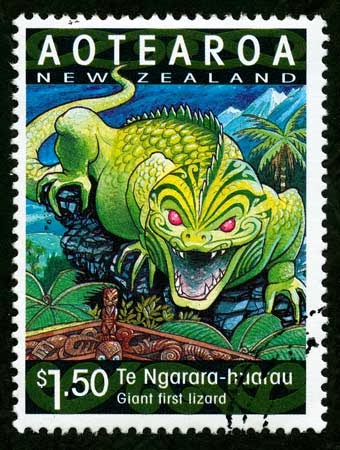
Ngarara
portrayed upon a postage stamp issued by New Zealand in 2000 (© New Zealand
postal services, reproduced here on a strictly educational, non-commercial Fair
Use basis only)
Yet another
giant mystery lizard of New Zealand is the kumi.
Although occurring chiefly in Maori folklore, a real-life example was
reportedly encountered near Gisborne in 1898 by a Maori bushman. He claimed
that it was around 4.5 ft long, and that
it clambered up into a rata tree, leaving behind some footprints on the ground,
which were apparently seen by other observers too.
Could it be that
in distant ages, giant lizards really did exist here, a land famous for its
absence of terrestrial carnivores prior to humankind's introduction of rats,
cats, and dogs? Certainly there was a vacant ecological niche for such an
animal form, but without physical evidence of any erstwhile presence, such as
preserved or skeletal remains, this intriguing line of speculation must remain
exactly that – speculation.

Front view of the
model of Delcourt's giant gecko featuring in the exhibition 'The Dear Departed'
that was presented in 2000 by Lille Natural History Museum
(© Lamiot-Wikipedia - CC BY-SA 4.0 licence)
All of which
brings us back very appositely to Delcourt's giant gecko, because, very
remarkably, there is actually no – or next to no – tangible evidence to confirm
that it ever did (let alone still does) exist in New Zealand. Indeed, this anomalous
paucity of physical remains for H. delcourti here is such that certain
researchers have aired the view that perhaps the zoological world has been
wrong all along, that in reality the provenance of the enigmatic taxiderm
specimen residing at Marseilles Natural History Museum that is the only known
representative of this very notable species was not New Zealand at all, but
somewhere else entirely.
The leading researcher
proffering this thought-provoking scenario is Dr Trevor H. Worthy, who has
written and co-authored several scientific papers and other works relating to
the lizards of New Zealand, past and
present. In The Lost World of the Moa: Prehistoric Life of New Zealand
(2002), co-authored with Dr Richard Holdaway, he noted that the taxiderm
specimen of H. delcourti has been provenanced to New Zealand only upon
the basis that the genus to which it belongs, Hoplodactylus, is known
only from New Zealand, pointing out that not a single fossilised bone confirmed
as being from this species has ever been discovered in the huge collections of
palaeontological material obtained from South and North Islands (and despite
much of this material dating from the late Pleistocene-Holocene time period).

Discovery and description of H. delcourti
as documented in the now-defunct International Society of Cryptozoology's spring
1988 ISC Newsletter (© ISC/reproduction courtesy of J. Richard Greenwell)
True, two fossil
items have been uncovered that were tentatively referred to H.
delcourti by Bauer and Russell when they formally described and named this
species in 1986, but Worthy is by no means convinced that such referrals were
justified.
One of these items,
found among a collection of tuatara remains, was a lower jaw comparable in size
to that of tuataras but possessing spaces for teeth to be attached in sockets
(the pleurodont condition, as found in lizards but not in tuataras). This had
been obtained from Earnscleugh Cave in central Otago, South Island, during the
1800s, and was mentioned in passing within a paper authored by Captain F.W.
Hutton that appeared in vol. 7 of the Transactions of the New Zealand
Institute in 1874 (not 1875, as often erroneously claimed). Hutton speculated
in a later, 1898 paper (see below) that it "may, provisionally, be
supposed to belong to the extinct kumi, or ngarara, of the Maoris". Based
upon Hutton's brief verbal description of its morphology and size (the former
excluding the tuatara from consideration as noted above, yet the latter
exceeding that of any lizard species known to exist in New Zealand today),
Bauer and Russell deemed it possible that this potentially significant item was
from a specimen of H. delcourti, but regrettably it has apparently since
been lost, because according to Worthy it does not seem to be present in the
collections of Otago or Canterbury Museums where the fossils procured from this
cave are preserved. Consequently, it cannot be re-examined today.

Side view of the
model of Delcourt's giant gecko featuring in the exhibition 'The Dear Departed'
that was presented in 2000 by Lille Natural History Museum (© Lamiot-Wikipedia
- CC BY-SA 4.0 licence)
Happily, however,
the second item, also uncovered in Earnscleugh Cave and documented in vol. 31
of the Transactions of the New Zealand Institute by Hutton in 1898 (not
1899, as often erroneously claimed), does still survive, and is housed in
Canterbury Museum. It consists of a small (0.55-in-long) rib-like bone that Hutton
referred to as "a supposed rib of the kumi, or ngarara". Bauer and
Russell interpreted it as the cloacal bone of a gecko (but without physically
examining it); if so, this would make it large enough to be consistent with H.
delcourti as the species from which it originated. Conversely, Worthy does
not believe that other taxonomic identities for it can be eliminated from
consideration, stating:
The bone is not referable to any class of vertebrates with
certainty; it could be one of the several vestigial bones in a rat, duck, or
tuatara, and considering that thousands of bones have been obtained from the
site (Earnscleugh Cave) from these animals, but not a single other gecko bone,
its referral to H. delcourti is most unlikely to be correct.

Head of the model
of Delcourt's giant gecko featuring in the exhibition 'The Dear Departed' that
was presented in 2000 by Lille Natural History Museum (© Lamiot-Wikipedia - CC BY-SA 4.0 licence)
More recently,
in the multi-contributor volume New Zealand Lizards (2016), edited by Dr
David G. Chapple, Worthy contributed a chapter entitled 'A Review of the Fossil
Record of New Zealand Lizards', in which he again examined and discussed the
stark absence of verified H. delcourti material, summarising this
perplexing situation very succinctly as follows:
…there are
now many thousands of fossil bones sampling palaeofaunas of all regions of New Zealand, including sites accumulated by
predation by owls, falcons and other raptors, by pitfall into caves and which
accumulated in sand dunes, swamps or lakes. The remains of many herpetofaunal
species have been recovered from these sites in virtually all areas of New Zealand. Bones of tuatara are abundant
and widespread. Not one bone of a gecko similar in size to a tuatara, as would
be those of H. delcourti, has been found. But bones of a gecko the size
of H. duvaucelii, New Zealand's largest extant gecko species,
and of giant skinks, some much larger than any extant species, arc widespread.
Therefore, if H. delcourti did derive from New Zealand, it must have existed in very
localised habitats that have not yet been explored by palaeontologists. More
likely, it was not a New Zealand animal and originates from a
small island in New Caledonia, where other members of the group
exist.

Dr Alain
Delcourt holding the taxiderm specimen of H. delcourti that he brought
to scientific attention in 1979 (Photo found on numerous websites online, e.g. here;
© owner unknown to me – reproduced here on a strictly educational,
non-commercial Fair Use basis only)
Worthy failed to
specify, however, that there are a number of small isles lying off the two much
larger, principal islands constituting New Zealand that definitely fall
into his category of "very localised habitats that have not yet been
explored by palaeontologists". Could it be, therefore, that the single
recorded H. delcourti specimen originated from one of these
smaller offshore NZ islands? To my mind, it certainly seems more parsimonious to
assume that, as a Hoplodactylus species, Delcourt's giant gecko should
have a provenance somewhere within New Zealand than beyond it, i.e. on
an island of New Caledonia, or elsewhere.
In addition, if this
species were rare or very rare anyway, the chances that fossil remains of it
will even exist, let alone be discovered, will necessarily be much less likely
than for more common, widely-distributed species. Also of note here is that if Worthy's
assertion that H. delcourti was probably not native to New Zealand is correct,
then its striking resemblance to the Maoris' mythical kawekaweau is a truly extraordinary
and very formidable coincidence.

Drawing
of a kawekaweau in a tree (© Hodari Nundu)
At least 150 years have
passed since the type – and still the only known – specimen of H. delcourti
was collected somewhere in the wild, but the many mysteries that have enshrouded
it ever since still seem as impenetrable today as they did back then. Where was
it collected, and by whom, is it one and the same as the mythical kawekaweau,
why have no additional specimens or remains (modern-day or fossilised) ever
been procured, and could there still be living specimens awaiting discovery
somewhere out there?
Perhaps one day we shall
have answers to some or even all of these questions. Until then, however, we
have only Marseilles's long-ignored taxiderm exhibit to remind us of this most
mystifying chapter in herpetological history – and just like all such exhibits,
it is remaining resolutely reticent.

Rodrigues
giant day gecko Phelsuma gigas, sculpture by Nick Bibby (Photo © Dr Karl
Shuker)
NB – Some gecko coverages
state that the world's largest modern-day gecko species was actually the
now-extinct Rodrigues day gecko Phelsuma gigas, once native to the
Mascarene island of Rodrigues and various tiny offshore islets but last
collected in 1842. However, although its snout-tip-to-vent length could exceed
that of the only known specimen of H. delcourti (14.6 in), its total length (i.e. from snout-tip to tail-tip)
was less.
This ShukerNature blog
article is adapted and updated from my account of Delcourt's giant gecko contained
within my book The Encyclopaedia of New and Rediscovered Animals.




 Posts
Posts