Dr KARL SHUKER

Zoologist, media consultant, and science writer, Dr Karl Shuker is also one of the best known cryptozoologists in the world. He is the author of such seminal works as Mystery Cats of the World (1989), The Lost Ark: New and Rediscovered Animals of the 20th Century (1993; greatly expanded in 2012 as The Encyclopaedia of New and Rediscovered Animals), Dragons: A Natural History (1995), In Search of Prehistoric Survivors (1995), The Unexplained (1996), From Flying Toads To Snakes With Wings (1997), Mysteries of Planet Earth (1999), The Hidden Powers of Animals (2001), The Beasts That Hide From Man (2003), Extraordinary Animals Revisited (2007), Dr Shuker's Casebook (2008), Karl Shuker's Alien Zoo: From the Pages of Fortean Times (2010), Cats of Magic, Mythology, and Mystery (2012), Mirabilis: A Carnival of Cryptozoology and Unnatural History (2013), Dragons in Zoology, Cryptozoology, and Culture (2013), The Menagerie of Marvels (2014), A Manifestation of Monsters (2015), Here's Nessie! (2016), and what is widely considered to be his cryptozoological magnum opus, Still In Search Of Prehistoric Survivors (2016) - plus, very excitingly, his four long-awaited, much-requested ShukerNature blog books (2019-2024).

Dr Karl Shuker's Official Website - http://www.karlshuker.com/index.htm

IMPORTANT: To view a complete, regularly-updated listing of my ShukerNature blog's articles (each one instantly clickable), please click HERE!

IMPORTANT: To view a complete, regularly-updated listing of my published books (each one instantly clickable), please click HERE!

IMPORTANT: To view a complete, regularly-updated listing of my Eclectarium blog's articles (each one instantly clickable), please click HERE!

IMPORTANT: To view a complete, regularly-updated listing of my Starsteeds blog's poetry and other lyrical writings (each one instantly clickable), please click HERE!

IMPORTANT: To view a complete, regularly-updated listing of my Shuker In MovieLand blog's articles (each one instantly clickable), please click HERE!

IMPORTANT: To view a complete, regularly-updated listing of my RebelBikerDude's AI Biker Art blog's thematic text & picture galleries (each one instantly clickable), please click HERE!

Search This Blog


PLEASE COME IN, I'VE BEEN EXPECTING YOU...

PLEASE COME IN, I'VE BEEN EXPECTING YOU...
WELCOME TO SHUKERNATURE - ENJOY YOUR VISIT - BEWARE OF THE RAPTOR!


Showing posts with label mermaids. Show all posts

Friday, 25 January 2019

CELEBRATING TEN YEARS OF SHUKERNATURE, VIA ITS ALL-TIME TOP TEN ARTICLES


My ShukerNature blog's official banner, very kindly designed for me by Mark North (© Dr Karl Shuker)

Yes indeed – this week is a very momentous occasion in the history of my ShukerNature blog, because it was exactly 10 years ago this week, on 20 January 2009 to be precise, that I uploaded onto it my very first (albeit very short) article (click here to access it), and the rest, as they do say, is history.

So what better way to celebrate ShukerNature's tenth anniversary than to present (in what is its 652nd article) a clickable listing of its all-time top ten articles, as determined by their respective total number of visitor hits received. And here they are, with their total hit counts as of right now included in brackets following their links:


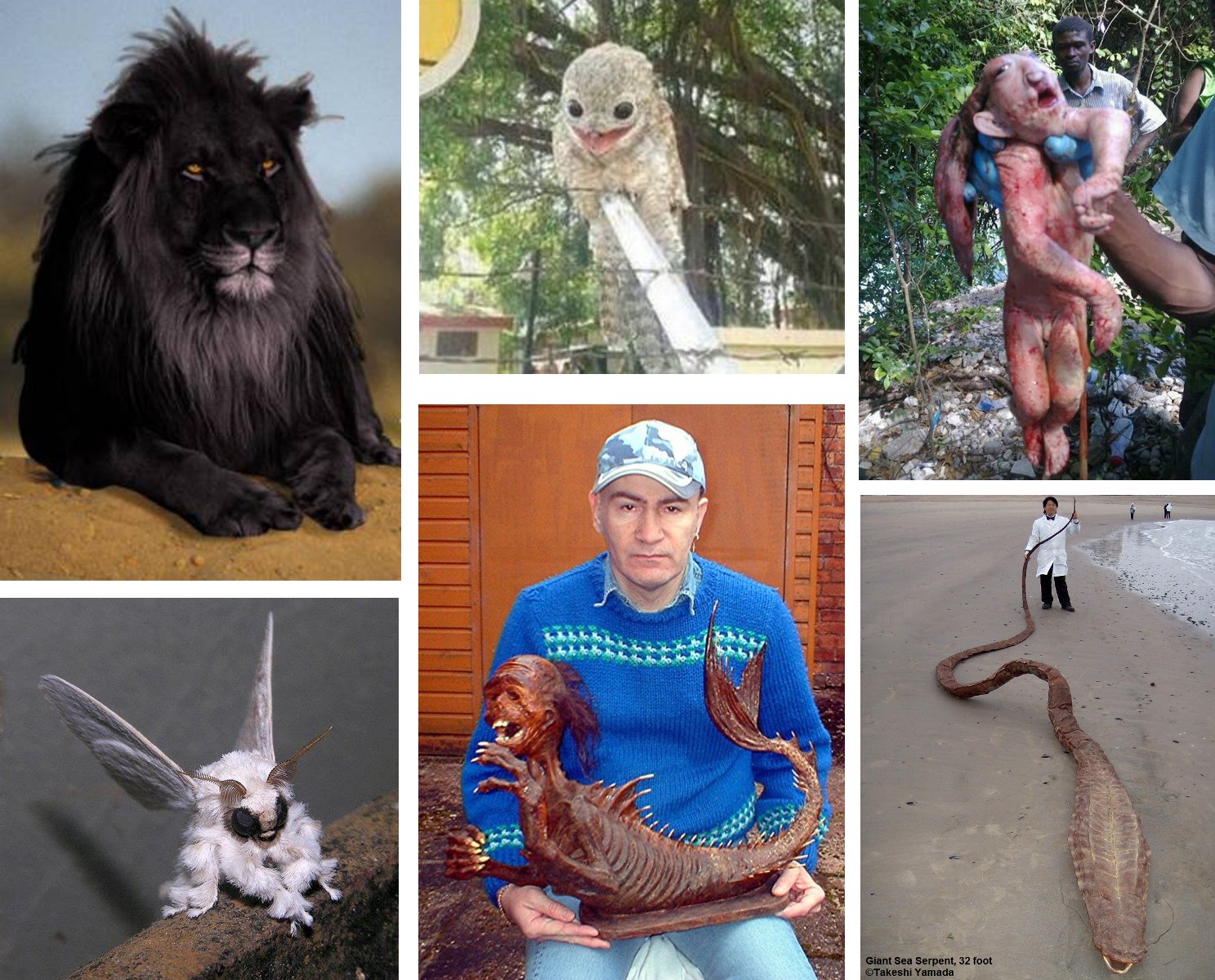
Judging from the subjects covered by the above articles, melanistic mystery cats seem to be of considerable interest to ShukerNature readers, as no fewer than three of the top ten articles (out of a total of no fewer than 652) are devoted to the investigation of such creatures and, in particular, alleged photos of such. Intriguing images also form the basis of a further four, purportedly portraying such diverse entities as an unexpectedly fluffy moth, a bizarre bird with a gargantuan gape, a monstrously huge grasshopper, and a grotesque being likened to an incongruous human-rabbit hybrid but likely to have been something much less extraordinary yet far more tragic.

Stir into this singular mix some truly bizarre beasts conjured forth into tangible existence by the creative genius of a celebrated master in manipulation and design, plus the perennially-popular saga of merfolk, and never forgetting a remarkable amphibian whose memorable external appearance has earned for it from the ever-imaginative media an even more memorable monicker, and the result is a listing of fascinating subjects that could not be found together anywhere else online, only here on ShukerNature, along with 642 other no less enthralling and entertaining topics too.

Subjects covered in some of my top ten ShukerNature blog articles (mermaid photo (© Dr Karl Shuker; Venezuelan poodle moth © Arthur Anker; giant sea serpent gaff photo © Takeshi Yamada; © of the other photos unknown to me but presented here on a strictly non-commercial Fair Use basis only)

So here's hoping that they will continue to be of interest to readers for a long time to come, and that I will be able to continue adding further ones to their elite company.

Finally, I'm happy to say that my long-awaited, long-promised ShukerNature book will be published during this coming spring, containing an exceedingly varied selection of my blog's articles in expanded, updated form, fully illustrated throughout in colour, and supplemented by a very extensive bibliography of sources consulted by me during their preparation. Look out here on ShukerNature for further updates as I receive them.

The original and extremely beautiful artwork specially prepared for the front cover of my forthcoming ShukerNature book by renowned artist Anthony Wallis (© Dr Karl Shuker/Anthony Wallis)


Monday, 26 February 2018

THE MERMAID OF HARALDSKAER - THE FISHY TALE OF A FISHY TAIL (AND SKELETON!) DISPLAYED AT THE DANISH NATIONAL MUSEUM


The mermaid of Haraldskaer's skeleton, exhibited at the Danish National Museum, Copenhagen, in 2012 (© Danish National Museum – reproduced here on a strictly educational, non-commercial Fair Use basis, for review purposes only)

Only a few days after watching, and greatly enjoying, Guillermo del Toro's wonderful fantasy movie The Shape of Water, concerning a captured amphibious humanoid (click here to read my review of it), earlier today I was asked on Facebook whether I knew anything about the subject of a striking photograph currently doing the rounds on social media sites, including the Fortean Times Appreciation Group on FB. Happily, I knew quite a lot about it, so here is the remarkable history of the mermaid of Haraldskaer.

The photograph in question is the one that opens this present ShukerNature blog article of mine, and shows what seems on first sight to be the skeleton of a mermaid. The photo had been shared on the Fortean Times Appreciation FB group from another such group, Pictures in History, where some brief details of its supposed origin and nature had been provided, and which are as follows.

Allegedly, this skeleton is that of a mermaid that had been found at Haraldskaer in mainland Denmark by a farmer while ploughing his field. And according to a more detailed description presented alongside it at the Danish National Museum in Copenhagen where the mermaid of Haraldskaer was first displayed, in 2012, it was about 18 years old, with long thick hair and long sharp canines, and also had a purse that contained a shark's tooth, a snake's tail, a mussel shell, and a flower (just like any self-respecting mermaid would be expected to keep inside her purse). Its species is claimed to be Hydronymphus pesci, believed extinct since the end of the 17th Century, and apart from a missing left hand the skeleton is complete, much more so than the only other known H. pesci skeleton, apparently held at the Hermitage Museum in St Petersburg, Russia, which lacks a tail. Moreover, this species is believed to belong to the Asian lineage of merfolk, thereby making the finding of specimens in Europe especially rare.

Close-up of the tail of the Haraldskaer mermaid skeleton (© Danish National Museum – reproduced here on a strictly educational, non-commercial Fair Use basis, for review purposes only)

Altogether a fascinating history, but, needless to say, entirely fictitious. In fact, as Danish zoologist and cryptozoological researcher Lars Thomas has kindly informed me, the Haraldskaer mermaid skeleton, complete with shark-inspired tail, was manufactured by Mille Rude, a Danish artist, for a special exhibition staged at the Danish National Museum, Copenhagen, during 2012. Rude took her inspiration from the very famous real discovery in 1835 of Haraldskaer Woman - the naturally-preserved body of a young woman found in Haraldskaer Bog, and dating back to approximately 490 BC (pre-Roman Iron Age).

In 2013, the mermaid skeleton was displayed at the Art Museum in Vejle on the east coast of the Jutland peninsula, constituting western Denmark, and a year later it was aptly exhibited in the manatee enclosure at Odense Zoo in central Denmark (manatees are popularly deemed to be the inspiration for mermaid sightings). In 2016, its perambulations took it to the Maritime Museum in Elsinore, Denmark, where it remains on display today. So far, so straightforward, but this is cryptozoology, albeit featuring in this instance an unequivocal cryptozoological gaff (an artificially constructed specimen). Consequently, nothing is ever that straightforward, as will be revealed a little later here.

Humorous 19th-Century illustration of a beautiful mermaid clearly less than impressed by the decidedly homely appearance of her supposed real-life inspiration, a manatee (public domain)

Meanwhile: One of the most famous tourist attractions in Denmark is Erik Eriksen's charming bronze statue of the eponymous character in Hans Christian Andersen's delightful 1837 fairytale The Little Mermaid. Eriksen's sculpture, measuring just 50 in high and weighing 385 lb, was officially unveiled  on 23 August 1913, residing on permanent display thereafter upon a rock at the edge of Copenhagen's harbour. Since then, it has been visited, posed alongside, and photographed by millions of tourists from all over the world, including my mother and myself back in 1979, and is officially classed as a National Treasure of Denmark

For much of 2010, however, this fish-tailed icon was temporarily absent from her accustomed site at the harbour side when she starred instead in the Danish Pavilion at the 2010 World Expo, held in Shanghai, China, remaining there from late March to 20 November. So forlorn and forsaken was the rocky prominence upon which she had sat for generations, gazing wistfully across the waters, however, that a plan, or, to be precise, a prank, was hatched to replace her there, if only for a very short time, but with something equally fishy – in every sense.

Erik Eriksen's statue of the Little Mermaid (© Dr Karl Shuker)

And so it was that on Maundy Thursday 2010, the skeleton of a mermaid duly appeared in the statue's stead, sitting in a similar pose on a plaster replica of her rock but placed very near to hers, and heralded with the somewhat macabre announcement to the media that the Little Mermaid had returned. After residing there for two hours, during which time it had attracted considerable attention and photo-snapping from locals and tourists alike, the skeleton was removed (to ensure that the fickle Danish weather did not damage it) and taken to the Natural History Museum of Denmark, in Copenhagen, where it was on public display throughout the Easter holiday period. But what is the true nature of this very striking specimen?

It is, of course, another gaff – this time consisting of a human skeleton down to and including its hips, plus the tail of a swordfish Xiphias gladius. Its creation and the prank of placing it briefly on show at the harbour during the Little Mermaid's Chinese leave of absence was the brainchild of  Hanne Strager, at that time the head of exhibitions at the Natural History Museum of Denmark, in Copenhagen, and it certainly attracted immense interest – and not just in spring 2010. It had actually been created a few years earlier at the museum, to feature in an exhibition there devoted to legendary creatures, and had been specifically structured to mimic the pose adopted by the Little Mermaid statue. But what has any of this to do with the Haraldskaer mermaid skeleton? I'm glad that you asked.

The Natural History Museum of Denmark's mermaid skeleton gaff, posed upon a plaster replica of the Little Mermaid statue's rock (© Natural History Museum of Denmark, Copenhagen – reproduced here on a strictly educational, non-commercial Fair Use basis, for review purposes only)

Photographs of the Haraldskaer mermaid skeleton have been circulating widely online for some years, and far more so, unfortunately, than the facts behind them, so that these pictures have incited (and continue to incite) much speculation as to whether the skeleton is actually genuine. Not only that, in an all-too-familiar trend seen on the Net with unusual images, they have even inspired various entirely new, but equally fictitious histories for it.

Consequently, I have seen some sites claiming that the skeleton has been the subject of much controversy since being discovered in Poland(!), and even in Indonesia – one site affirming that it had been discovered in Surabaya, on the island of Java. Worst of all, however, is that all of the media reports that I have read concerning it, even those from ostensibly respectable sources, have either been incomplete or decidedly ambiguous, inasmuch as they have implied that the Haraldskaer mermaid skeleton (created by Rude) and the mermaid skeleton placed briefly on the plaster replica of the Little Mermaid statue's rock (and whose creation was overseen by Strager) are one and the same, when in reality they are entirely different, albeit extremely similar specimens. Hence I wish to thank Lars Thomas most sincerely for revealing to me the true situation, and thereby assisting me to bring to a close the exceedingly curious and hitherto highly-confused case of the two mermaid skeletons, and also to Richard S. White and Markus Bühler for arousing my suspicions regarding the online sources consulted by me when originally preparing this blog article. Indeed, it now means that this article of mine may well be the only account presently online that provides an accurate, non-conflated coverage of these two gaffs.

A popular expression is that you can't keep a good man (or woman) down. Neither, it would seem, can you keep a good mermaid (or two) down; nor, at the risk of mixing metaphors further, can the internet let sleeping mermaids lie – not even ones that never existed to begin with!

My mother Mary Shuker and I visiting the Little Mermaid in 1979 (© Dr Karl Shuker)


Friday, 29 December 2017

'MYSTERY CREATURES OF CHINA: THE COMPLETE CRYPTOZOOLOGICAL GUIDE', BY DAVID C. XU - A LANDMARK IN THE LITERATURE OF UNKNOWN ANIMALS


The exquisite artwork on the front cover of David C. Xu's wonderful book (© David C. Xu/Coachwhip Publications)

December 2017 may seem rather early for anyone to put forward a major contender to receive in a year's time the accolade of Best Cryptozoology Book of 2018, but in my opinion the truly exceptional work by David C. Xu to which this present ShukerNature blog post is devoted, and which is officially published at the beginning of next month by Coachwhip Publications, more than justifies being nominated for such an honour.

When David very kindly asked me a while ago if I would pen a foreword to his book on Chinese cryptozoology, I was delighted to do so, because Sinian mystery beasts have always fascinated and frustrated me in equal amounts – fascinated by those select examples recorded in Western-language publications, and frustrated by the certain knowledge that there were many additional examples hidden from my investigative capabilities as I do not read or speak any of China's native tongues.  And my latter suspicion was more than confirmed by the incredible diversity of such latter beasts that David's book revealed to me as I read through it in advance of preparing my foreword.

So now, as an exclusive pre-publication taster of what to expect in this incredible, thoroughly engrossing volume, and with David's kind permission, here is my foreword to his book, reproduced in full:

I consider myself very fortunate to possess at least a working knowledge of several different European languages, which has enabled me to research and bring to international cryptozoological attention via my writings a considerable number of fascinating but hitherto-obscure cryptids that had never previously been documented in any English-language publication.

However, there is one massive geographically-based archive of cryptozoological information that until now has remained largely unattainable for me, due simply to the frustrating fact that I have no comparable knowledge or experience of any of the languages indigenous to that vast country in question – the latter country being, of course, China. True, down through the ages, a number of English-language books have chronicled some of the most famous and spectacular of its mythological fauna – such as the Chinese dragons (long, etc), Chinese phoenix (fenghuang), Chinese unicorn (qilin), celestial stag, and winged hua fish. A smaller number of cryptids have also been highlighted internationally, in particular the yeren or Chinese wildman, the blue tigers of Fujian, the aquatic monsters of Lake Tianchi, and the bizarre 'hippoturtleox' of Tibet. Nevertheless, to adapt one of Sir Isaac Newton's most quoted of quotations, to me these are little more than just a few pebbles or seashells lying on the beach, perhaps a little smoother or prettier than some others, but with the great ocean of Sinian cryptozoology lying all undiscovered before me – but not any more!

Thanks to the superb book before you now, the vast and previously-concealed, unseen menagerie of Chinese mystery beasts is enshadowed and encrypted no longer, its fascinating panoply of scientifically unknown animals laid bare at last to an international readership that has waited so long for a knowledgeable guide adept in English to lead it into these secret creatures' enthralling domain.

Having been wholly immersed in cryptozoology from both an investigative and a chronicling standpoint for over 30 years, whenever I read any new such book nowadays I expect to be (and generally am) already familiar with the majority of mystery beasts presented within it – but not this time! To my surprise but total delight, page after page in this extremely comprehensive volume unfurled extraordinary cryptids that I had never previously encountered – confirming my long-held suspicion as outlined earlier here that China's crypto-chronicles held all manner of treasures formerly hidden from me by virtue of my inability to read any Sinian language. And I have no doubt whatsoever that countless other readers similarly limited linguistically will experience the same thrill of discovery as I did when first reading this book, and am still doing when re-reading it.

After all, where else could a non-Chinese cryptozoological reader readily encounter (and especially all within the same single volume) such captivating creatures as cyan lake goats and aquatic oxen, coffin beasts and mountain crashers, elusive water monkeys (one of my favourite 'new' cryptids) and blood-sucking blanket beasts, the tamarisk children and the water man-bear, false-eyed ungulates, and wolf-pack interlopers, a bewilderment of mystery big cats and an extraordinary diversity of man-beasts all meticulously disentangled and delineated, relict chilotheres and living chalicotheres (or at least some mystifying cryptids very like them in appearance), vanishing three-humped camels (another particular favourite of mine) and colour-changing deer, living dragons and latter-day unicorns (not so mythological after all, it would seem), giant birds and birds with four wings, a veritable plethora of putative prehistoric survivors, and even a supposed flying centipede, plus many, many more. Some are undoubtedly more folkloric than factual, but in every instance their case makes compelling reading.

The history of each cryptid is chronicled comprehensively, followed by an equally detailed assessment of the various possible identities on offer for it, and concluding with a very valuable bibliography of sources. There is also a very considerable number of illustrations, including some very eyecatching reconstructions of what many of the cryptids under consideration here may look like, based at least upon eyewitness descriptions.

Today, thanks to the ease with which specialised books on mystery animals that would once have struggled to find a mainstream publisher can now appear in print due to POD technology, e-readers, and other advances, cryptozoology is experiencing a veritable Golden Age within the publishing world, with more titles appearing – and staying – in print than at any other time in this subject's history. In short, crypto-readers nowadays can all too easily find themselves in the previously unexpected but thoroughly delightful position of being spoilt for choice when deciding which book(s) to buy. So here, as a gift from me to you, is a personal recommendation – buy this book, and I absolutely guarantee that you will not be disappointed.

True, I have to confess that when I first read its subtitle I had to suppress an instinctive inward shudder, because I have seen the phrase "Complete…Guide' or similar appear so often in book titles across a vast range of subjects, only for a reading of the books to reveal all too readily how inappropriate and grandiose was the application of such a title to them – but not in this instance. David Xu must be very heartily congratulated, because he has prepared a truly exemplary work of cryptozoological scholarship and erudition, one that in my opinion can stand alongside any of the greatest works on mystery beasts ever published, and, in terms of its specific subject, one that has absolutely no peers or competitors of any kind. It is, quite simply, unique, one of a kind, a cryptozoological sui generis – there really is nothing else like it in existence, and its comprehensiveness is such that I consider it highly unlikely that there ever will be.

So, if you're looking for a fascinating, entirely original cryptozoological book to read (and I am obviously assuming that you have already purchased and read all of mine!), then this is the book for you – it really is as simple as that.

David's book can be ordered here on Amazon's USA site and here on Amazon's UK site – if you do so, I guarantee that it will be one of the most spellbinding cryptozoological books that you will ever read, because it is a monumental landmark in the literature of unknown animals.

The back cover of David's book, containing more information concerning its contents (© David C. Xu/Coachwhip Publications)


Wednesday, 6 September 2017

DREAMCHILD AND VAMPIRES AND HOBBITS, OH MY! [an Eclectarium of Doctor Shuker crosspost]


'Kong: Skull Island' publicity poster and film still (© Jordan Vogt-Roberts/Legendary Pictures/Tencent Pictures/Warner Bros. Pictures)

I've viewed quite a number of fantasy-themed movies lately, some new, some vintage, some exceedingly obscure, but most of them offering various degrees of cryptozoological/zoomythological content and relevance. So be sure to click the link below to read my mini-reviews of these films, first published on my Facebook wall but now preserved together in my Eclectarium:

The Eclectarium of Doctor Shuker: DREAMCHILD AND VAMPIRES AND HOBBITS, OH MY!

An adult female graphorn with her calf - from 'Fantastic Beasts and Where to Find Them' (© David Yates/Heyday Films/Warner Bros. Pictures)


Tuesday, 25 August 2015

MY 500TH SHUKERNATURE POST! – PRESENTING THE TOP TEN SHUKERNATURE POSTS OF ALL TIME: FROM BLACK LIONS AND MERMAIDS TO POODLE MOTHS AND PENIS SNAKES!


Subjects documented in six of my all-time Top Ten ShukerNature blog posts (mermaid photo © Dr Karl Shuker; Venezuelan poodle moth photo © Arthur Anker; giant sea serpent gaff photo © Takeshi Yamada; © of the other photos unknown to me)

Welcome to my 500th ShukerNature blog post! To mark this momentous occasion, I have pleasure in presenting for your entertainment and interest the following equally momentous list – the Top Ten ShukerNature posts of all time, based upon hit counts. And here they are, each one with its own clickable direct link to the post itself.

Posted: 12 June 2012
Hits count: 1,155,307

Posted: 1 August 2012
Hits count: 209,972

#3: MYSTERY OF THE VENEZUELAN POODLE MOTH – HAVE YOU SEEN THIS INSECT??
Posted: 22 August 2012
Hits count: 114,688

Posted: 16 August 2012
Hits count: 92,565

Posted: 3 August 2012.
Hits count: 76,659

Posted: 1 October 2012
Hits count: 58,418

Posted: 26 January 2014.
Hits count: 44,933

#10: GIANT ANACONDAS AND OTHER SUPER-SIZED CRYPTOZOOLOGICAL SNAKES
Posted: 20 September 2013
Hits count: 42,213

Analysing this list, several intriguing if not readily explainable facts swiftly emerge.

First and foremost, melanistic cats – most especially black lions – clearly hold an abiding fascination for ShukerNature readers. The popularity of my all-time #1 blog post, exposing various online black lion photographs as photo-manipulated hoaxes, is truly, outrageously, and – above all else – inexplicably phenomenal! What on earth is it about black lions that should have generated well over 1 million hits for this particular post since I uploaded it just over 3 years ago, far more than any other ShukerNature post, and continuing to add to that count by the thousands each week?

Collectively, ShukerNature's 500 posts have garnered a total hits count of just over 5.1 million, which means that this one single post has contributed more than 20% of that total all by itself! Nor does it end there. A follow-up post of mine exposing a further black lion photo as yet another hoax also makes the all-time Top Ten ShukerNature posts list (coming in at #8), and my examination of the highly contentious issue of whether black pumas exist is at #5.

Equally perplexing is why four of the ten posts in this all-time Top Ten list originated from the very same month, August 2012, bearing in mind that I have been posting on ShukerNature from 20 January 2009 right up to the present day, and on a regular basis throughout that sizeable time span too. What was/is so special about that specific month, therefore, particularly as the four posts in question from it deal with four entirely different subjects? True, the poodle moth was attracting tremendous online interest at the time of my post, so that would definitely have helped focus attention upon it here on my blog too. And the term 'penis snake', as invented by the media for it, no doubt explains why a large but hitherto highly-obscure species of aquatic amphibian lacking limbs and lungs has received such a high hits count on here.

Certainly, there is no doubt that photos of weird animals that have gone viral online prove popular subjects for ShukerNature posts, especially those posts that investigate what the creatures portrayed in such photos are and whether such photos are genuine or fake. The success of my two black lion posts exemplify this trend, as do those dealing respectively with the poodle moth, the potoo, the alleged half-human half-rabbit hybrid, and the many bizarre beasts created by Takeshi Yamada.

As for the two remaining posts in this list, dealing with merfolk and giant snakes respectively, these are perennially popular cryptozoological subjects. Consequently, their presence should come as no surprise.

Looking back one last time at this all-time Top Ten list, there is no doubt that I could never have predicted which of my 500 ShukerNature posts would have made the cut. And when uploading the first of my black lion posts back in June 2012, a post that took no more than half an hour to prepare, I never dreamed even for an instant that it would become the runaway ShukerNature success story that it has done and still is, seemingly destined never to be overtaken by any other post on this blog of mine, regardless of its subject, and continuing to increase its count by significant amounts on a daily basis.

But what about the other nine posts in this list? Will they still be in the Top Ten when or if a 1000th ShukerNature post is uploaded one day? Who can say? If I've derived nothing else from this list, I have definitely learnt from it to expect the unexpected – which only serves to increase my passion for preparing further ShukerNature posts in the future, as well as my fervent hope that you will continue to enjoy reading and re-reading them. So here's to the next 500, and thank you all as ever for your continuing encouragement and interest in my researches and writings!

Subjects documented in the remaining four of my all-time Top Ten ShukerNature blog posts (photo-manipulated black puma photo © Dr Karl Shuker; giant python photo © Colonel Remy van Lierde; penis snake photo © Matt Roper; © of photo-manipulated black lion photo unknown to me)


Saturday, 23 May 2015

TOPKAPI'S MUMMIFIED CROCODILE BOY AND AMERICA'S MONKEYFIED ALLIGATOR MEN - A CURIOUS QUARTET OF GENUINE FAKES!


Postcard depicting Jake the Alligator Man (© Marsh's Free Museum)

On 1 March 1992, Turkish archaeologists publicly announced the discovery of an extraordinary Egyptian mummy in the vaults of Istanbul's famous Topkapi Palace Museum during some recent restoration work there. It was concealed inside a wooden sarcophagus (whose form confirmed it as having originated in ancient Egypt), and when carefully unwrapped it was found to consist of the upper parts of a young boy fused to the lower half of a crocodile!

The explanation for this bizarre specimen is still unknown. Some researchers have speculated that the boy may have been killed and partially eaten by the crocodile while bathing (or after accidentally falling) in Egypt's Nile River – and that in order for him to possess a complete body with which to pass into the afterlife, his parents arranged for his reptilian murderer to be killed and for the section of its body corresponding to the devoured portion of their son's to be attached to the boy's remains. However, this theory seems no less grotesque than the mummy itself!

Photocopy of a photograph - click to enlarge - depicting Topkapi's mummified crocodile boy being examined by the museum's Assistant Director of Restoration and Conservation, Behçet Erdal – from a report dated 1 March 1992 in the Turkish newspaper MeydanMeydan – photocopy courtesy of Paul Sieveking/Fortean Times via Izzet Goksu)

A more plausible possibility is that the pseudo-conjoined mummy was deliberately created as a sacred artefact or offering by worshippers of Sebek (aka Sobek), ancient Egypt's crocodile-headed god of rivers and lakes. It may even have been produced as a clever fraud for exhibition purposes – in modern times, such specimens are popularly referred to as gaffs; if so, this would make it one of the earliest gaffs ever recorded.

Line drawing from 1885 of Sebek, ancient Egypt's crocodile-headed deity (public domain)

As yet, I have not succeeded in discovering whether this unique specimen is on public display at Topkapi. So if anyone reading this ShukerNature blog article can provide me with some relevant details, I'd be very grateful.

Similar monstrosities were once very popular in carnivals and sideshows, especially in America, and at least one such creation still is today. Known as Jake the Alligator Man and constituting the upper half of a monkey skeleton skilfully attached to the lower half of a small alligator, this famous specimen has been on display for many years at Marsh's Free Museum [http://www.marshsfreemuseum.com/] – a thoroughly fascinating, highly-recommended exhibition of wonders and curiosities in Long Beach, Washington (not California, as often erroneously claimed) – and is said to be more than 75 years old.

Jake the Alligator Man (© imhavingfun42/Wikipedia)

Indeed, every year for almost a decade now there has been an official Annual Jake the Alligator Man 75th Birthday Party held in Long Beach. A short YouTube video of Jake on display at Marsh's Free Museum can be viewed here.

Incidentally, a much more common variant on this particular gaff theme is of course the so-called 'Feejee mermaid' (named after the famous specimen exhibited by American circus showman Phineas T. Barnum in 1842), which consists of the upper half of a monkey sewn to the lower half of a large fish.

19th-Century engraving of Barnum's Feejee mermaid (public domain)

Jake was purchased by the founders of Marsh's Free Museum in 1967 from an antique store in California, for the princely sum of $750, and was allegedly created by a New York-based firm known as Nelson Supply House. Jake subsequently featured in a series of highly entertaining albeit fictitious reports published by the American tabloid Weekly World News and beginning on 9 November 1993, which claimed that it had been found alive in a Florida swamp!

The headline from the first in the series of Jake the Alligator Man reports from Weekly World NewsWeekly World News)

More recently, a man named Josh brought a similar gaff into the curiosities shop Obscura featured in the Science Channel TV show Oddities, and sold it to the shop's proprietors for $450. A YouTube video of this interesting episode, uploaded by Science Channel on 1 June 2011 and showing the gaff in close-up detail, can be viewed here.

The Oddities alligator man (© Science Channel)

I also know of a third American alligator man specimen, but, sadly, its present whereabouts are apparently unknown (or at least to me). I have on file a copy of a report from 1996 written by Chris L. Murphy from the organisation Progressive Research, based in British Columbia, Canada. In his report, Chris documented his recollections of what appears to have been an outstanding alligator man, which he encountered while visiting the little town of Seaside, in Oregon, during the summer of 1976. Going into a large general store in the centre of the town, he discovered that it contained a free museum, and exhibited in that museum, housed inside a glass case, was a remarkable specimen labelled as an Alligator Boy. In his report, Chris described it as follows:

"The creature in the case was human looking to about its navel, and the rest of its body was that of an alligator. The human part was "upright," fairly erect as I recall. I studied the creature for a long time and reasoned that it was the body of a child, say about two years old, that had been fused onto the body of a small alligator. The child's body was "mummy-like" in appearance but still had considerable detail. I recall especially its hair, which was very fine and white, very much like the hair one would find on a child of this age, except for the color.

"The process used to fuse the bodies was certainly very exacting. The smooth skin of the child melded in with the scaly alligator skin very gradually, making the creature appear very realistic. I carefully studied the head, hands (which were very small), arms and other parts of the body and reasoned that it would be very difficult to fake something of that nature. In other words, I believe the human portion of the creature was the body of a real child. Unfortunately, there was no literature on the exhibit, and I did not take a photograph of it."

Chris revisited Seaside in or around 1993, intending to photograph the alligator boy, but when he arrived in town he discovered that the general store and its in-house museum were gone, replaced by a clothing store. When Chris spoke to a couple concerning the store and its alligator boy, the man informed him that he'd lived in Seaside most of his life and remembered this specimen well, but stated that some time before the store had closed down, it had been robbed and the alligator boy stolen from it.

A second postcard depicting Jake the Alligator Man (© Marsh's Free Museum)

Another Seaside resident, the proprietor of a jewellery store there, informed Chris that there was an alligator man on display at a free museum in Long Beach, Washington (Jake the Alligator Man at Marsh's Free Museum, obviously) and wondered whether this could be the same specimen as the one that had vanished from Seaside's erstwhile store-museum. Anxious to pursue this potential lead, on his way back home to British Columbia Chris stopped by in Long Beach and visited its alligator man. However, he could see straight away that this was a totally different specimen, its body held at an angle, not erect, and, at least in Chris's opinion, of inferior workmanship to the Seaside specimen that he had seen back in 1976. Moreover, he was able to chat with the museum's owner in Long Beach, who confirmed that he had purchased Jake in California (and a decade before Chris had seen the Seaside specimen anyway), and was unaware of any comparable gaffs anywhere else.

Having not seen the Seaside specimen personally, I am reluctant to discount Chris's opinion that it incorporated the head and upper body portion of a real human child, but it does seem more likely that these constituents of this gaff were actually derived from a monkey. Having said that, however, gaffs can be inordinately sturdy (especially if well-constructed), and hence are sometimes extremely old – dating back to times when, whereas albeit entirely abhorrent today, the prospect of such a macabre exhibit having been purposefully created would have been neither unthinkable nor impossible, as exemplified by Topkapi's mummified crocodile boy.

Meanwhile: whatever happened to the Seaside alligator boy? (Not only is it not Jake the Alligator Man, it is not the specimen sold on Oddities either, because the latter's body was not erect in posture but instead was held at an angle, just like Jake's.) Does it still exist today, and, if so, where is it? And are there still other alligator man gaffs also out there? If you know of any, or have any information concerning the presently lost Seaside specimen, please post details here on ShukerNature – thanks again!

Two Turkish newspaper reports from 1 March 1992 - click to enlarge - concerning the Topkapi mummified crocodile boy, one from Meydan, the other from Hürriyet Daily NewsMeydan/(© Hürriyet Daily News - photocopies courtesy of Paul Sieveking/Fortean Times via Izzet Goksu)


UPDATE: 24 May 2015 - CURIOUSER AND CURIOUSER...

After reading my above blog article and perusing the two photographs of Topkapi's mummified crocodile boy, longstanding crypto-correspondent Hodari Nundu was intrigued by the presence of a crocodile's head and apparent upper body portion within the sarcophagus but at the opposite end to the mummy's human head, and he wondered if in reality the mummy was actually composed of the head and upper body portion of a boy fused at the posterior edge of the boy's upper body portion to the posterior edge of the upper body portion of a crocodile, with its neck and head still present too. In other words, is it a veritable amphisbaena in mummified form, i.e. consisting of a single body with a head at each end (the boy's head at one end of the body, the crocodile's at the other)? If so, this would make the mummy even more bizarre than it already appeared to be. 

Yet according to both of the Turkish newspaper reports, as well as a subsequent report in the UK's prestigious Sunday Times newspaper for 8 March 1992, it was definitely the lower body portion of a crocodile that was fused to the boy's upper body portion (the Sunday Times report even referred specifically to the mummy incorporating the crocodile's tail). Also worth recalling is the mention in the Turkish reports of the theory that perhaps the boy's parents had arranged for the portion of the boy eaten by the crocodile (which was obviously his lower body portion, because his upper portion and head are incorporated into the mummy) to be replaced by the corresponding body portion of the crocodile (hence the crocodile's lower body portion) in order for their son to possess a whole body with which to pass into the afterlife.

Consequently, two different explanations for this ostensible contradiction come to mind. Either the crocodile head and upper body portion are not actually attached to the mummy but are merely lying on top of its crocodilian lower body portion and tail, thereby obscuring them from view in the photographs (the crocodile head and upper body portion presumably therefore having also been placed inside the sarcophagus, rather than merely being discarded, after the composite mummy had been produced and laid in there); or the Turkish newspaper reports (and thence that of the Sunday Times, which most likely obtained its information from Turkish media sources) were in error, and that in reality the mummy is indeed a crocodile-human amphisbaena in terms of its composition and construction.

Also today, on my 'Animal Discoveries and Curiosities' Facebook group's page, Hodari posted the following data:

"I did find some stuff online, including a Turkish news report from 2007 according to which the mummy would soon be put in display at the Topkapi Palace Museum. The story states that the mummy’s age has not been determined even though it was submitted to the carbon 14 test; the age of the boy when he died was between seven and eight. According to the director of the Topkapi museum, the legend says that the boy was the son of an Egyptian dignitary who fell into the Nile and was eaten by a crocodile. The reptile was then killed with the boy still inside, and mummified. However, at least two sources state that more than one half child half crocodile mummies have been found throughout Egypt, and that the Topkapi “specimen” is only one of several. Which I find strange since one would expect such rarities would be better known. One of the sources does include a possible explanation; Harpocrates (the child-like aspect of the god Horus) is often represented as stepping or standing on top of a crocodile, which represents the chaotic and malignant forces of the universe, so according to them, the child emerging from the crocodile would have a similar meaning."

Thanks, Hodari! Occurring in late Greek mythology as developed in Ptolemaic Alexandria, Egypt, and adapted from the ancient Egyptian child-god Horus, Harpocrates was a child-deity, the god of silence and secrecy. He was variously portrayed in art forms standing in human form upon the back of a crocodile, or emerging from the jaws of a crocodile, or possessing either the entire lower body portion and tail of a crocodile or the tail alone of a crocodile.

Following up these leads, I have just discovered online a photograph of a drachm coin originating in Alexandria and dating from the time of the Roman emperor Trajan (reigned 98-117 AD) that depicts Harpocrates with the tail of a crocodile:

Crocodile-tailed Harpocrates on Trajan-dated drachm coin from Alexandria, Egypt (© Aeqvitas.com)

And here is a depiction of a crocodile-bodied Harpocrates on a silver ring in the collections of the University of Michigan's Kelsey Museum of Archaeology at Ann Arbor (click here for full details):

Close-up of silver ring depicting Harpocrates with a crocodile's body (© Christopher A. Faraone, Ann Arbor, Kelsey Museum of Archaeology)

Could it be, therefore, that Topkapi's mummified crocodile boy was intentionally created as a physical representation of Harpocrates? 

With all of these new developments and findings to hand, I am now even more eager than before to obtain further information concerning this unique specimen, so that its true nature can be confirmed. So if you have any details, please post them here - thanks very much!


2ND UPDATE: 17 July 2018 - THE TOPKAPI CROCODILE GIRL!

My above-proposed 'amphisbaena' identity for the Topkapi crocodile boy has been proved correct. On 7 July 2018, Turkey's Hürriyet Daily News published an exclusive, revelatory article concerning Topkapi Palace's enigmatic crocodile boy mummy, and included the first detailed, close-up photograph of it to be released publicly, which was snapped on 6 July. (Versions of this report later appeared in various British newspapers - click here to read London's The Sun report of 9 July, as it contains an excellent presentation of the photograph.) The article revealed that the mummy's human portion was indeed attached to the upper body portion and head of a crocodile (not its lower portion and tail), so was, as I suggested earlier here, a veritable amphisbaena. Moreover, it was not from a boy after all, but had instead been derived from a girl, and no ordinary girl either – nothing less, in fact, than a princess, albeit a currently unidentified one, hailing from ancient Egypt. The mummy had been brought from Egypt to Turkey during the reign (1861-1876) of Ottoman Sultan Abdülaziz. It was kept at Yildiz Palace in Istanbul (which was the sultan's official residence at that time), until, after one of the palace servants used it to play a joke upon another worker there, Ottoman Sultan Abdul Hamid II (r.1876-1909) duly 'exiled' the mummy to the older palace of Topkapi, where it has remained ever since. My thanks to Hodari Nundu for bringing to my attention today the Hürriyet Daily News article.
 
This ShukerNature blog article is a greatly-expanded, fully-updated version of a short account of mine that originally appeared in my book The Unexplained: An Illustrated Guide to the World's Natural and Paranormal Mysteries (1996).