Dr KARL SHUKER

Zoologist, media consultant, and science writer, Dr Karl Shuker is also one of the best known cryptozoologists in the world. He is the author of such seminal works as Mystery Cats of the World (1989), The Lost Ark: New and Rediscovered Animals of the 20th Century (1993; greatly expanded in 2012 as The Encyclopaedia of New and Rediscovered Animals), Dragons: A Natural History (1995), In Search of Prehistoric Survivors (1995), The Unexplained (1996), From Flying Toads To Snakes With Wings (1997), Mysteries of Planet Earth (1999), The Hidden Powers of Animals (2001), The Beasts That Hide From Man (2003), Extraordinary Animals Revisited (2007), Dr Shuker's Casebook (2008), Karl Shuker's Alien Zoo: From the Pages of Fortean Times (2010), Cats of Magic, Mythology, and Mystery (2012), Mirabilis: A Carnival of Cryptozoology and Unnatural History (2013), Dragons in Zoology, Cryptozoology, and Culture (2013), The Menagerie of Marvels (2014), A Manifestation of Monsters (2015), Here's Nessie! (2016), and what is widely considered to be his cryptozoological magnum opus, Still In Search Of Prehistoric Survivors (2016) - plus, very excitingly, his four long-awaited, much-requested ShukerNature blog books (2019-2024).

Dr Karl Shuker's Official Website - http://www.karlshuker.com/index.htm

IMPORTANT: To view a complete, regularly-updated listing of my ShukerNature blog's articles (each one instantly clickable), please click HERE!

IMPORTANT: To view a complete, regularly-updated listing of my published books (each one instantly clickable), please click HERE!

IMPORTANT: To view a complete, regularly-updated listing of my Eclectarium blog's articles (each one instantly clickable), please click HERE!

IMPORTANT: To view a complete, regularly-updated listing of my Starsteeds blog's poetry and other lyrical writings (each one instantly clickable), please click HERE!

IMPORTANT: To view a complete, regularly-updated listing of my Shuker In MovieLand blog's articles (each one instantly clickable), please click HERE!

IMPORTANT: To view a complete, regularly-updated listing of my RebelBikerDude's AI Biker Art blog's thematic text & picture galleries (each one instantly clickable), please click HERE!

Search This Blog


PLEASE COME IN, I'VE BEEN EXPECTING YOU...

PLEASE COME IN, I'VE BEEN EXPECTING YOU...
WELCOME TO SHUKERNATURE - ENJOY YOUR VISIT - BEWARE OF THE RAPTOR!


Showing posts with label secretary bird. Show all posts

Tuesday, 30 March 2021

SINGING THE PRAISES OF OUR NATIONS' FEATHERED AMBASSADORS

 
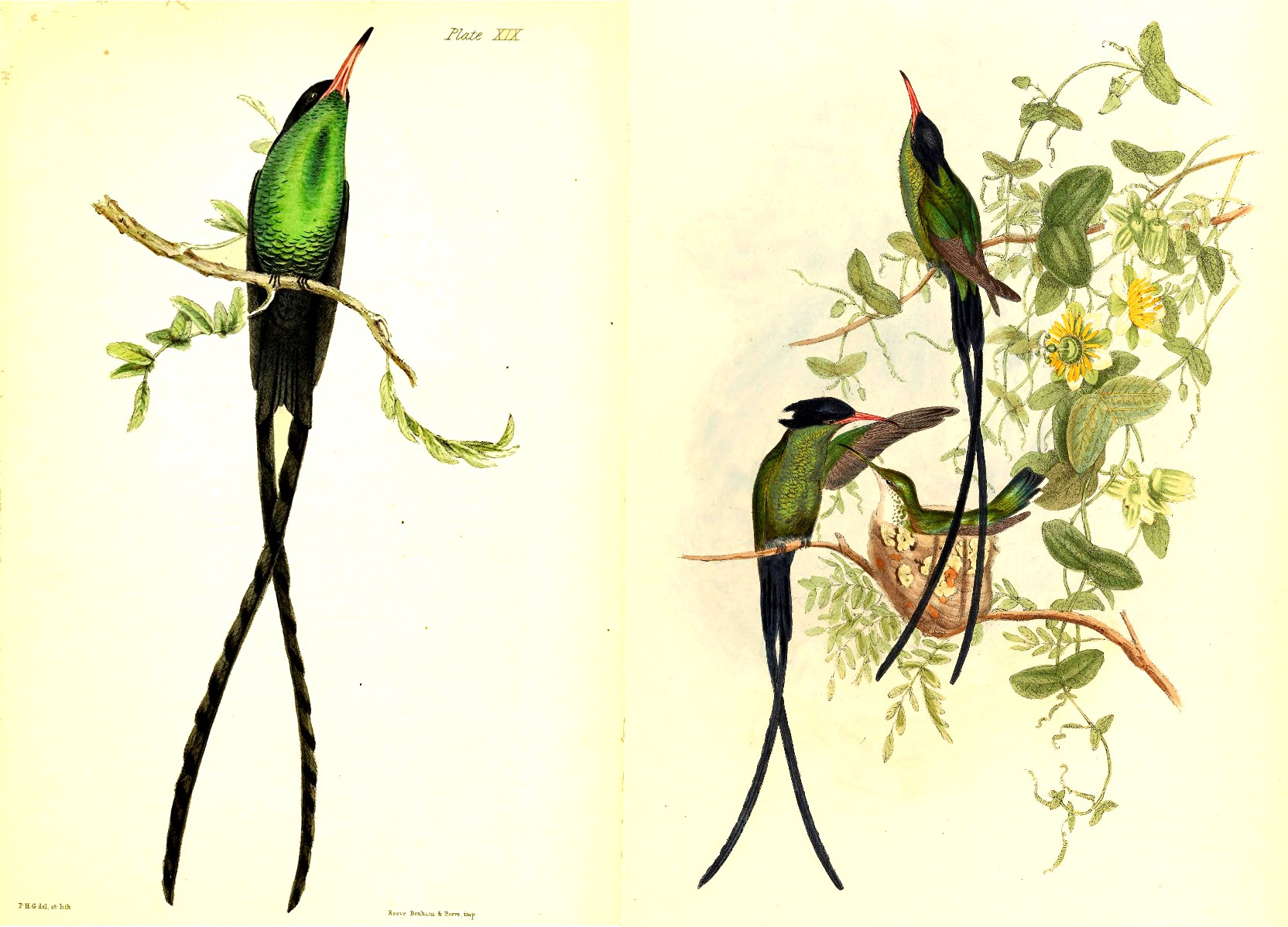
A male doctor bird, Jamaica's national bird, in Philip Henry Gosse's book The Birds of Jamaica, 1849 (public domain) / Doctor birds (two males, one female), in John Gould's tome A Monograph of the Trochilidae, or Family of Humming-birds, Vol. 2, 1861 (public domain)

Despite being a nation intimately associated with birdwatching and a love of all things ornithological in general, the United Kingdom, most surprisingly, is one of the very few nations on Earth that does not have an official national bird. True, several years ago a countrywide poll was held to decide which species should serve as our own representative, and revealed as its winner the robin Erithacus rubecula – a friendly, familiar species beloved of gardeners and Christmas card illustrators, and which has traditionally if unofficially occupied that very same role for untold years anyway. However, even this newsworthy poll failed to convince the powers-that-be to elect the robin formally as our nation's feathered ambassador, and so, at least for now, the wait continues. Elsewhere around the world, conversely, is a vast array of national birds, chosen for many different reasons as their respective country's much-loved avian symbol – from its links to its country's beliefs or culture, or as an eyecatching example of its rich biodiversity, to the longstanding admiration that it has inspired among those people sharing its homeland, or even as a means of highlighting its modern-day rarity and need for conservation. So here, to demonstrate this eclectic variety, is a global twitching tour, highlighting some of the most distinctive national birds with fascinating facts explaining why they are so memorable.

 
European robin, painted by Frederick W Frohawk, 1907 (public domain)

Birds of prey have always been greatly admired as symbols of power, strength, intelligence, wisdom, and keen vision, so it is hardly surprising that they have also been popular choices as national birds. Perhaps the most famous example in this capacity is the bald eagle Haliaeetus leucocephalus, the national bird of the USA. One of the world's several species of fish-eating eagle, and named after the adult bird's characteristic white-plumed head (it is brown in juveniles), the bald eagle was officially adopted as the USA's feathered representative on 20 June 1782, when the design of the Great Seal of the United States portraying a bald eagle grasping in its talons 13 arrows representing the 13 founding states plus an olive branch signifying peace was formally adopted by the Continental (Philadelphia) Congress, containing delegates from those states.

 
Bald eagle, hand-coloured engraving, 1840 (public domain)

Another country with a tradition of eagle imagery is Germany, and it too has an eagle as its generally-recognised national bird, but this time the golden eagle Aquila chrysaetos. Indeed, the magnificent plumage and stately poise of this species is so imposing that several other countries have also adopted it in this role, including Afghanistan, Armenia, Egypt, Mexico, and Scotland, although in Egypt and Scotland it is presently still in an unofficial capacity, rather like our robin. Moreover, the African fish eagle Haliaeetus vocifer, a close Old World relative of the bald eagle and sporting a very striking brown and white plumage, is so well-regarded on its native African continent that it is the official national bird of no fewer than four different nations – Namibia, South Sudan, Zambia, and Zimbabwe.

 
Golden eagles (Wikipedia – public domain)

One of the most spectacular yet also one of the rarest of all eagles is the Philippine eagle Pithecophaga jefferyi. Originally dubbed the monkey-eating eagle as it is large and powerful enough to prey upon sizeable monkeys here, it was subsequently renamed the Philippine eagle and formally installed as its country's national bird on 4 July 1995 by the then president Fidel V. Vamos. This was done in a bid to raise awareness regarding its critically endangered status, a result of longstanding habitat destruction, especially via widespread deforestation. Less than 1,000 individuals are currently thought to exist.

 
Philippine eagle, by Henrik Grönvold, 1910 (public domain)

Other powerful birds of prey declared as national birds include the harpy eagle Harpia harpyja in Panama, the white-tailed sea eagle or erne Haliaeetus albicilla (Poland), and the gyrfalcon Falco rusticolus (Iceland). Vultures may not seem the most photogenic or behaviourally refined of species to serve as national birds, yet they too clearly have their supporters, because the griffon vulture Gyps fulvus is the national bird of Serbia, and the mighty-pinioned Andean condor Vultur gryphus serves in this role for a quartet of major South American nations (Bolivia, Chile, Colombia, and Ecuador). Smaller raptorial species are not overlooked either, with the peregrine Falco peregrinus representing Angola and the United Arab Emirates, the European kestrel F. tinnunculus Belgium, and the saker falcon F. cherrug Hungary and Mongolia.

 
Andean condor, 1800s engraving (public domain)

As for owls, back in classical times the little owl Athene noctua was the sacred bird of Athena, the Greek goddess of wisdom, so in modern-day times it is the national bird of Greece. And the Aruba burrowing owl A. cunicularia arubensis represents the Caribbean island of Aruba. Perhaps the strangest of all birds of prey is the secretary bird Sagittarius serpentarius, named after its straggly crest that has been fancifully likened to an untidy sheaf of quills that a secretary from bygone times might have placed behind one of his ears. This bizarre-looking species somewhat incongruously combines a hawk-like body with the lengthy legs of a stork, and is famed for its snake-killing abilities in its native Sudan where it is commemorated as that country's national bird.

 
19th-Century painting of a secretary bird, from Dictionnaire Histoire Naturelle by Charles Orbigny (public domain)

Waterbirds are another popular choice for national birds. The mute swan Cygnus olor represents Denmark, and the whooper swan C. cygnus Finland, whereas more colourful feathered symbols include the American flamingo Phoenicopterus ruber for the Bahamas, the scarlet ibis Eudocimus ruber for Trinidad and Tobago, and the magnificent frigate bird Fregata magnificens (noted for the breeding male's vivid scarlet, greatly-inflatable throat pouch) for not only the Pacific island nation of Kiribati but also the twin-island Caribbean nation of Antigua and Barbuda. Its smaller but no less distinctive relative the great frigate bird F. minor does the honours for Nauru, and on account of their extraordinarily prehistoric appearance when seen high overhead in flight, frigate birds are regularly mistaken by unknowledgeable observers for living pterodactyls!

 
Adult male magnificent frigate bird, painting from The Birds of North America, 1903 (public domain)

Their impressive, imposing stature and noble mien no doubt explains why cranes and storks also include several national birds among their assemblage. Most celebrated of these is the blue crane Grus paradisea (aka the paradise or Stanley crane), representing South Africa. Its cultural links to this country include a longstanding tradition among the Xhosa people here, whereby the honour bestowed upon a man who had distinguished himself in battle was to be decorated with blue crane plumes placed in his hair by a chief during a special ceremony known as ukundzabela. Other African nations with a crane as their official symbol include Uganda (its national bird is the grey crowned crane Balearica regulorum) and Nigeria (the black crowned crane B. pavonina). The white stork Ciconia ciconia, a species beloved throughout Europe as the traditional bringer of babies according to fairytales and folklore, is the national bird in both Belarus and Lithuania, whereas the hammerhead or hamerkop Scopus umbretta, an odd stork-like but pelican-related species native to much of sub-Saharan Africa and Madagascar, is the national bird of Gambia, and is widely if erroneously claimed to induce lightning. And speaking of pelicans: the brown pelican Pelecanus occidentalis represents the Caribbean nation of St Kitts and Nevis.

 
Blue, paradise, or Stanley crane, from A Monograph of the Cranes, 1897, by Frans Ernst Blaauw (public domain)

Many species of tropical bird have dazzling, multicoloured plumage exhibiting truly extravagant displays of feathered flamboyance, so it is little wonder that some of the most beautiful examples have been adopted by their homelands as national birds. Count Raggi's bird of paradise Paradisaea raggiana, for instance, in which the adult male boasts a fiery explosion of long scarlet plumes with which to tempt and entreat dowdy brown females to mate with him when he dances before them during the breeding season, is the national bird of Papua New Guinea, whose tropical rainforests are home to many of the world's 40-odd bird of paradise species.

 
19th-Century painting of an adult male Count Raggi's bird of paradise, by John Gould (public domain)

Another series of bird species with feathers of the fantastically fabulous kind constitutes the peafowl and pheasants. The blue peacock's famous eye-spotted tail-train when unfurled and held vertically to entice what he hopes are suitably bedazzled peahens is said to owe its distinctive ocellated patterning to the Greek goddess Hera (or Juno in equivalent Roman retellings). Distraught when the messenger god Hermes slew her loyal hundred-eyed watchman Argus at the behest of Zeus, she placed Argus's eyes in the train of the peacock, and adopted it thereafter as her sacred bird. No doubt, therefore, she would be pleased to know that this very familiar species, Pavo cristatus, is honoured as India's national bird. Turning to pheasants, the green pheasant Phasianus versicolor claims comparable prestige in Asia as Japan's national bird, as does the Himalayan monal Lophophorus impejanus for Nepal, the Siamese fireback Lophura diardi for Thailand, and the confusingly-named grey peacock-pheasant Polyplectron bicalcaratum for Myanmar (the last-mentioned species is so-called because although it is a pheasant, it has spotted plumage whose markings recall the ocelli in the peacock's train).

 
Himalayan monal, from A Century of Birds From the Himalaya Mountains, 1831 (public domain)

Parrots were always going to be sought after as national birds by tropical countries fortunate enough to be home to these vividly-plumed perennial favourites among aviculturalists and ornithologists alike, and sure enough, several species have indeed gained that exalted status. The largest, and gaudiest, is undoubtedly the scarlet macaw Ara macao, an animate tricolor of red, blue, and gold, representing Honduras but native to much of northern South America too. Several Caribbean island nations have their very own endemic amazon parrot species – large, brightly-coloured, and found nowhere else – so for reasons of national pride in their avifauna and also to highlight that these species are endangered in many cases, they have duly declared them as their national birds, as with the St Lucia parrot Amazona versicolor for St Lucia, the St Vincent parrot A. guildingii for St Vincent and the Grenadines, and the imperial parrot A. imperialis for Dominica. Nor should we forget the near-threatened Grand Cayman parrot A. leucocephala, the national bird of the Cayman Islands but also found in Cuba and the Bahamas.

 
St Lucia parrot, painted by Joseph Smit, Proceedings of the Zoological Society of London, 1875 (public domain)

The pink-plumaged hoopoe Upupa epops with huge black-and-white wings that bestow upon it the extraordinary guise of a giant butterfly when seen in flight is Israel's national bird, and is intimately linked with biblical lore and legends. According to one such story, hoopoes once bore crests of solid gold, but they were so persecuted by hunters seeking their precious head plumes that they beseeched King Solomon to save them. So in response to their plea, he very kindly transformed their crests into normal feathers, which of course were of no interest to the hunters, and which they have thus borne ever since.

 
A family of hoopoes, painted by John Gould, 1837 (public domain)

Hoopoes are closely related to kingfishers, rollers, hornbills, and motmots, many of which are brilliantly-plumaged and as a consequence include several national birds among their number, such as the lilac-breasted roller Coracias caudatus for Botswana (and also unofficially for Kenya), the rhinoceros hornbill Buceros rhinoceros for Malaysia, the turquoise-browed motmot Eumomota superciliosa for El Salvador and Nicaragua, and the grey-headed kingfisher Halcyon leucocephala for Cape Verde. Superficially similar to the Old World hornbills due to their comparably top-heavy beaks, but less closely related to them zoologically speaking, are the New World toucans, with the keel-billed toucan Rhamphastos sulfuratus serving Belize as its national bird.

 
Rhinoceros hornbills, in Daniel Giraud Elliot's A Monograph of the Bucerotidæ, or Family of the Hornbills, 1882 (public domain)

However, the epitome of tropical birds as far as breathtakingly gorgeous plumage is concerned must surely be the trogons. Again distantly related to kingfishers, rollers, and hoopoes, and native to Africa, Asia, and Latin America, these typically thrush-sized birds resemble living jewels when spot-lit by shafts of bright sunlight filtering through the leafy canopy in their jungle domain. Inevitably, therefore, several of them have been adopted as national birds, such as the Hispaniolan trogon Priotelus roseigaster in Haiti, the Cuban trogon P. temnurus in Cuba itself, and the bar-tailed trogon Apaloderma vittatum in Malawi. However, the trogon par excellence – indeed, a leading contender for the world's most beautiful species of bird – is the aptly-named resplendent quetzal Pharomachrus mocinno of Guatemala, whose history, both natural and national, makes fascinating reading.

 
Bar-tailed trogon, by John G. Keulemans, 1892 (public domain)

According to the ancient traditions of the Aztec nation, which formerly inhabited what is today Mexico (and which in turn formerly included present-day Guatemala within its borders), one of their principal deities, the sky god Quetzalcoatl, would sometimes appear to them in the form of a great airborne feathered serpent with bright emerald-coloured plumes. Today, it is believed that this curious legend arose from real-life observations by the Aztecs of the resplendent quetzal, because during the breeding season the green-plumaged male, which is normally no more than 1 ft long, grows a pair of exceptionally lengthy, elongate tail plumes, also green, but each measuring up to 3 ft long – and when it flies, these two streamer-like feathers extend horizontally behind it and undulate, so that it bears more than a passing resemblance to an extraordinary plumed snake in flight. Such a famous bird of legend has made an immense cultural impact upon Guatemala, one of several Central American countries where this spectacular bird exists (as well as in present-day Mexico) – so much so, in fact, that not only is it Guatemala's national bird but it has given its name to this country's currency too (100 centavos = 1 quetzal since the year 1925), as well as appearing upon both its national flag and its official coat of arms, and also upon its bank notes and many of its postage stamps.

 
Late 1800s chromolithograph portraying a pair of quetzals (public domain)

Also deserving of mention here is a veritable 'quetzal in miniature' that is itself a national bird – the doctor bird Trochilus polytmus, hailing from Jamaica. Indigenous to that island nation, this iridescent green-plumaged hummingbird is characterised by the male's pair of extremely long ribbon-like tail feathers, which make a humming sound as it flies. There is speculation that because these feathers resemble the long silk tail-coats worn by doctors in olden days, this is why the species is called the doctor bird.

 
Delightful short video of two male doctor birds boldly perching on visitors' fingers as they drink sugar water from bottles (© Conley Salmon/YouTube – inserted here on a strictly non-commercial Fair Use basis for educational/review purposes only)

Of course, not all national birds are chosen for their dramatic appearance or links to mythology. Quite a few have been specifically selected for their basic 'everyman' appeal and popularity, familiar to everyone and loved by all. Italy has as its national bird the Italian sparrow, a cheeky little upstart that is abundant and instantly recognisable everywhere here. Long the subject of controversy as to its precise taxonomic status because it appears intermediate in form between the Spanish sparrow Passer hispaniolensis and the house sparrow P. domesticus, it was formerly thought to be a hybrid of these two. Nowadays, however, it is often deemed to be a separate, valid species in its own right, albeit one that may indeed have originated via hybridisation between the two afore-mentioned species, and has been dubbed P. italiae, because this is where it predominantly occurs.

 
A pair of Italian sparrows, by John Gould, from The Birds of Europe, 1837 (public domain)

Other well known but visually modest avian groups with national birds among their membership are the wagtails (the white wagtail Motacilla alba being Latvia's national bird), the crows (Bhutan's is the common raven Corvus corax), swallows (the European or barn swallow Hirundo rustica represents both Austria and Estonia), thrushes (the common blackbird Turdus merula for Sweden, the redwing T. iliacus for Turkey), doves (mourning dove Zenaida macroura for the British Virgin Islands, zenaida dove Z. aurita for Anguilla, Grenada dove Leptotila wellsi for Grenada), and finches (Sinai rosefinch Carpodacus synoicus for Jordan).

 
Adult male Sinai rosefinch, painted by Nicolas Huet, 1838 (public domain)

But perhaps the last word on national birds should be reserved for the most poignant example – namely, the species that represents the Mascarene nation of Mauritius in the Indian Ocean. For alone of all such birds, it is no longer in existence, having been slaughtered for its meat more than three centuries ago, only for it afterwards to become an icon in its former island homeland. Today, its instantly recognisable form can be seen everywhere in Mauritius – decorating picture postcards, appearing in advertisements, reproduced as toys of every conceivable composition, and serving as the number one choice for countless visually-inspired souvenirs. And the name of this extinct, exterminated superstar? What else could it be? Raphus cucullatus – the dodo.

 
Dodo, 17th-Century Dutch illustration, colour-corrected (public domain)


Saturday, 31 October 2015

MEET THE MONSTROUS MAKALALA - A TANZANIAN TERROR BIRD?


Reconstruction of the makalala's possible appearance in life (© Markus Bühler)

Here's something suitable for Hallowe'en from the cryptozoological chronicles – a monster bird with a taste for flesh...human flesh.

No one doubts that the tallest species of bird alive today is Struthio camelus, the ostrich - no-one, that is, except for the Wasequa people (most probably an alternative, kiSwahili name for the Zigua - see Pat the Plant's very informative comments posted at the end of this ShukerNature blog article - thanks Pat!), who inhabit an unspecified interior region of mainland Tanzania 8-9 days' journey from the coast of Zanzibar (the Zigua do live directly inland from Zanzibar).

According to a report by a Count Marschall (Bulletin de la Société Philomatique, 1878-9), as recently as the 1870s these people averred that their territory harboured a monstrous bird even taller than the 8-ft-high ostrich, equipped with very long legs, the head and beak of a bird of prey (which it puts to good use when feeding on carrion from animal carcases), and the ability to take to the air in sustained, powerful flight. Also, each of its wingtips bears hard plates composed of a horny, compact substance, and when it strikes its wings together they produce a very loud noise, earning this bird its local name - makalala ('noisy').

Marschall claimed that the makalala is said by the Wasequas to be very fierce, but can be killed if the correct strategy is employed. Engaging upon an extremely hazardous version of 'playing possum', the would-be assassin has to lie on the ground and feign death, until the makalala approaches close enough to seize the supposed human carcase - whereupon the latter must reanimate himself instantly and deliver the fatal blow before the makalala can rectify its mistake!

A second reconstruction of the makalala's possible appearance in life (© Tim Morris)

So far, this could all be discounted as fanciful native folklore - but physical remains of the makalala may have been recorded too. Marschall mentioned a Dr Fischer, who saw in Zanzibar an object that he identified unhesitatingly as a rib from some form of gigantic bird. Narrowing from one end to the other, this alleged rib had a width of 8 in at its widest end, and was just under 1 in at its narrowest end. Unfortunately, Marschall did not record whether Fischer sent it to a scientific institution for conclusive identification and retention.

However, Marschall did record another possible source of makalala remains - because he noted that native chiefs placed makalala skulls on their heads, using them as helmets! Could any of these bizarre examples of protective headgear still be owned today by Wasequa tribesmen?

Thanks to my afore-mentioned correspondent Pat, I now have a copy of a second makalala document from the same time period - namely, the published account by the Dr Fischer alluded to by Marschall in his own report. He was Dr Gustav A. Fischer, and his account of the makalala was part of a much longer report co-authored in German with Dr A. Reichenow, which was published in 1878 within the Journal für Ornithologie. Interestingly, in his own account Fischer described the makalala as being very shy (rather than very fierce as claimed for him by Marschall in his report), and stated that he was reluctant to believe that the rib-like structure came from a bird (whereas Marschall claimed that Fischer readily identified it as such), but otherwise the two descriptions correspond well with one another.

Assuming, against all the odds, that the makalala is real - that the frightening scenario of a carnivorous bird taller than the ostrich surviving into historical times somewhere in mainland Tanzania's interior is not a grotesque fantasy but a sober fact - what could it be? Several interesting, albeit mutually-exclusive lines of speculation compete for attention.

The first of these to be discussed here was kindly brought to my attention by German cryptozoologist Markus Bühler. Breeding throughout much of sub-Saharan Africa, sporting an immense wingspan of up to 10.5 ft (even greater spans have been claimed but presently not verified), standing up to 5 ft tall, and weighing as much as 20 lb, the well known marabou stork Leptoptilos crumenifer (syn. crumeniferus) is certainly an extremely impressive, potentially formidable bird. Indeed, when specimens are scavenging from a carcase, they will sometimes even ward off vultures once the latter birds of prey have torn chunks of flesh from the carcase with their hooked beaks (which marabous lack). Even so, it seems unlikely that such a familiar species could have somehow been converted by local myth and superstition into a mystery bird.

The marabou stork (© DickDaniels/Wikipedia CC BY-SA 3.0 licence)

However, as Markus pointed out, during the Pliocene, Africa was also home to an even bigger species of marabou stork, L. falconeri, Falconer's marabou. Like L. crumenifer, it was widespread across northern and eastern Africa but stood around 6.5 ft tall (taller than an adult human of average height) and weighed up to 44 lb (as heavy as a small child). In comparison to L. crumenifer, Falconer's marabou exhibited a slight reduction in wing size, therefore possibly being more terrestrial than its modern-day relative, but it was still fully able to fly. As birds often look much bigger than they actually are, due to their plumage and pneumatic internal system adding substantial volume to their forms, this already-huge species would have been truly monstrous in appearance, added to which its possibly greater terrestrial lifestyle means that it may possibly have been able to kill and eat bigger creatures than L. crumenifer.

Based upon fossil evidence, Falconer's marabou stork had become extinct by the end of the Pliocene 2.5 million years ago, but if it had somehow survived into historical times (with what would be its more recent fossils not having been uncovered so far), there is no doubt that it could have been a thought-provoking makalala candidate (albeit one lacking the raptorial beak claimed by the Wasequas for the makalala). Even the latter's supposed wing-clapping sounds might in reality have been a confused memory of the beak-clapping sounds often produced by storks, and which would have been very loud if made by Falconer's marabou. However, there is currently no scientific evidence that the latter species did survive into historical times.

Another very large and intriguing species of bird that once inhabited Africa is Eremopezus eocaenus, which, as its name indicates, lived during the Eocene (specifically the late Eocene, between 36 and 33 million years ago). Its fossil remains, which have been obtained from Jebel Qatrani Formation deposits around the Qasr el Sagha escarpment, north of the Birket Qarun lake near Faiyum in Egypt, indicate that this was a very large, flightless, and quite possibly predatory bird, probably as tall as a small emu or large rhea but bulkier in form. Its taxonomic position has incited much debate, and it has yet to be confidently allied with any existing avian lineage, but the enigmatic Eremopezus does possess certain interesting and quite specific anatomical similarities with the secretary bird – a highly distinctive African species that will feature a little later in this discussion of potential makalala identities.

Could Eremopezus itself, however, be linked to the latter mystery bird? It seems implausible that this species could have lingered on into the present day or given rise to modern-day descendants without some geographically intervening remains have been found somewhere between Egypt and Tanzania's portion of East Africa. Then again, the fossil record is famously incomplete.

Height comparison of Homo sapiens alongside a selection of terror bird species (from left to right) Kelenken guillermoi, Phorusrhacos longissimus, and Titanis walleri, plus the diatrymid Gastornis parisiensis (public domain)

With flagrant disregard for zoogeographical dictates, the makalala readily recalls the phorusrhacids or terror birds. These were an aptly-named taxonomic group of huge flesh-eating birds known predominantly (but not exclusively) from the New World, and which attained their awesome zenith with a truly gigantic, spectacular species from Argentina's Patagonia region called Kelenken guillermoi.

Sporting a massive 28-inch-skull armed with an enormous hooked beak, this 10-12-ft-tall horror died out approximately 15 million years ago during the mid-Miocene, whereas Titanis walleri (originally thought to have been 10-12 ft tall too until further finds led it to be downsized to a still-daunting 5-6 ft) not only reached North America but lived there in Texas and Florida until as least as recently as 2.5 million years ago, making it the youngest terror bird species currently known. However, these fearful birds were flightless, as their wings were vestigial. Moreover, although confirmed terror bird fossils have been discovered in the Americas and also Antarctica, the only known fossil evidence for their erstwhile existence in Africa is a single femur from an individual that had lived during the early or early-to-mid-Eocene (i.e. between 52 million years and 46 million years ago) in what is today southwestern Algeria. In 2011, this mysterious species was named Lavocatavis africana.

Red-legged seriema Cariama cristata (© Dr Karl Shuker)

Even so, could the makalala be an undiscovered modern-day species? There is one notable precedent for such speculation, because some zoologists consider it plausible that a living, flying species of phorusrhacid-related bird is already known from Africa – namely, that strange, stork-like bird of prey called the secretary bird Sagittarius serpentarius. Although it is commonly classed as an aberrant accipitrid based upon molecular analyses, egg albumen comparisons have suggested in the past a closer taxonomic allegiance between this species and a pair of South American birds known as seriemas - which constitute the last surviving members of a phorusrhacid-allied taxonomic family.

The secretary bird (© Brian Ralphs/Wikipedia CC BY 2.0 licence; photo cropped)

In any event, the secretary bird affords a compelling correspondence to the makalala's morphology (albeit on a rather more modest scale). Standing up to 4.5 ft tall on notably long, crane-like legs, and endowed with strong wings that support a powerful, soaring flight, plus the head and hooked beak of a bird of prey, the secretary bird constitutes a very acceptable makalala in miniature. Furthermore, when attacking snakes (an important part of its diet) it frequently shields itself from potentially fatal strikes with its outstretched wings, which are equipped with horny tips - i.e. claws on the tips of its 'finger bones' (phalanges), instantly recalling those of the makalala.

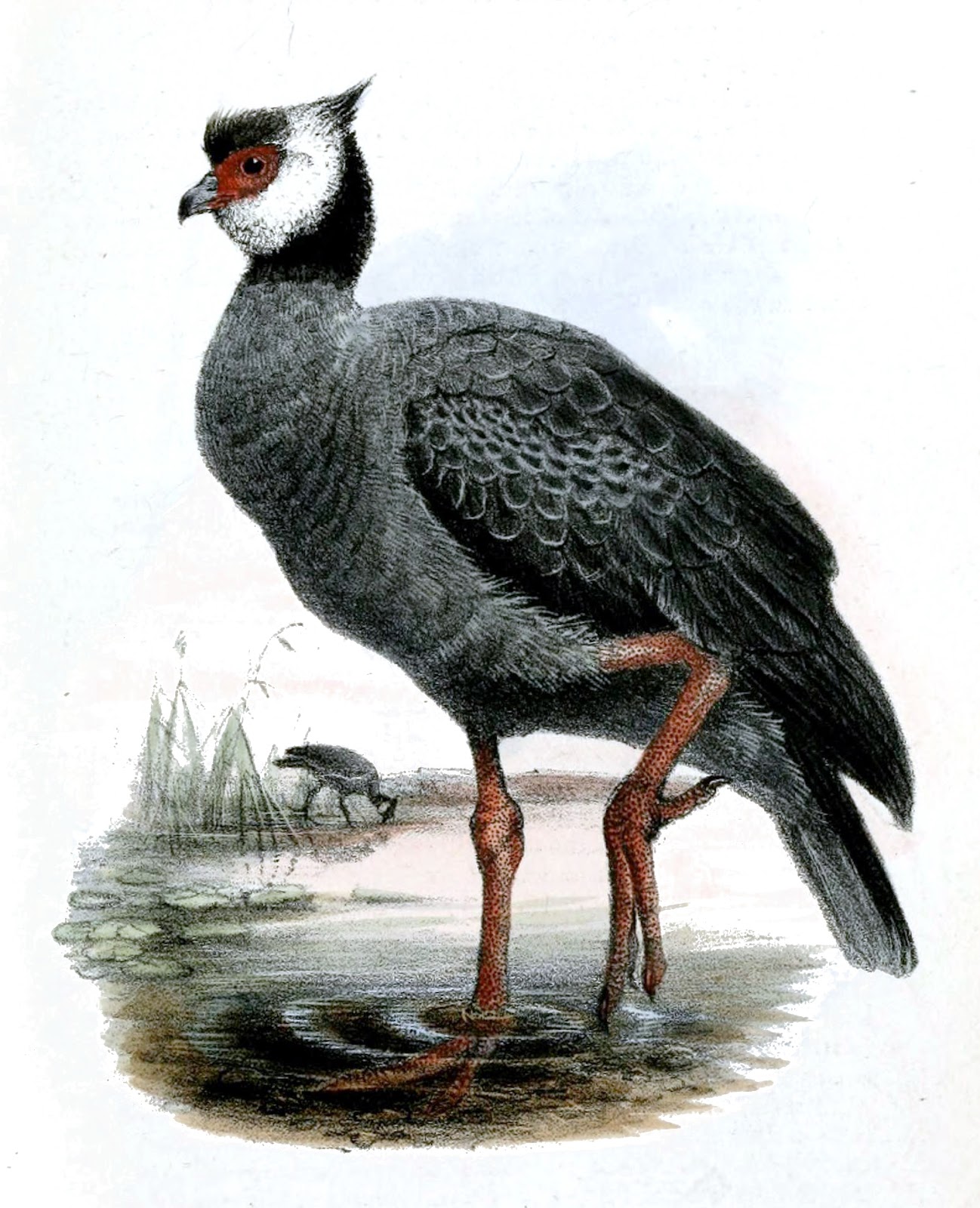
This last-mentioned correspondence is particularly telling, because there are very few species of bird alive today that are equipped with these wingtip claws. Indeed, other than the secretary bird, the only ones presently known are the three species of crane-allied birds called finfoots or sun-grebes, plus three vaguely grouse-like relative of waterfowl known as screamers, native to South America, and including the black-necked screamer Chauna chavaria, the cross-sectional shape of whose wing spurs is such that they are particularly noisy when clapped together. In addition, a strange pheasant-like bird known as the hoatzin Opisthocomus hoazin, again from South America, produces curiously reptile-like offspring able to crawl along tree branches by virtue of two large, mobile claws on each wing, but these are lost as the chicks mature. Over the years, the hoatzin has been classified with numerous different avian groups, including the galliforms, cuckoos, touracos, mousebirds, waders, sand-grouses, and many others, but it is currently deemed to represent the oldest living avian lineage, discrete from all others alive today.

Illustration of the black-necked screamer, by Joseph Wolf, 1864 (public domain)

Certain other birds, like the jacanas or lily-trotters, the spur-winged goose Plectropterus gambensis, the spur-winged plover Vanellus spinosus, and a pair of Antarctic endemics called sheathbills, possess horny spurs on their wings, used in combat - but these are variously sited on the 'wrist bones' (carpals) or 'hand bones' (metacarpals), not upon the finger tips.

Out of all of these species, moreover, only one - the secretary bird - is predominantly carnivorous. Could the makalala, therefore, be some form of extra-large secretary bird - not necessarily as tall as the Wasequas state (their fear of it could certainly have inflated their estimate of its height), but much bigger than today's single known species? If so, a suitable scientific name for it, based upon its morphological description given above, would be Megasagittarius clamosus - 'the noisy, giant secretary bird'.

Staying with the secretary bird line of speculation, is it conceivable, alternatively, that the makalala was a false secretary bird, i.e. some other raptorial species, possibly another accipitrid (the eagles, hawks, and Old World vultures), that had assumed via convergent evolution a form outwardly comparable to Sagittarius? Although this is just another suggestion with no tangible evidence to support it directly, there is actually an interesting confirmed precedent for such an ostensibly unlikely premise.

In 1989, Drs Alan Feduccia and Michael R. Voorhies formally described a remarkable new species of North American fossil accipitrid from the late Miocene whose tarsometatarsal structure was nearly identical morphologically to that of the secretary bird. Indeed, the convergence was so striking that they christened this species Apatosagittarius terrenus, which translates as 'terrestrial false secretary bird', because they considered it likely that just like the true secretary bird, it had exhibited a predominantly terrestrial hunting lifestyle. In fact, it was only because the tarsometatarsus bore some attached phalanges whose structure was very different from those of the secretary bird that Feduccia and Voorhies were able to confirm that Apatosagittarius was not a true secretary bird, but was merely an anatomical impersonator.

The shoebill - close-up of its head revealing its immense hooked beak, and a beautiful shoebill illustration from 1901 (© Dr Karl Shuker/public domain)

Finally, a sizeable bird native to western Tanzania but possibly venturing eastward occasionally into the region supposedly inhabited by the makalala is the shoebill Balaeniceps rex. Once deemed to be an aberrant stork but nowadays considered to be more closely related to pelicans, this highly distinctive species stands up to 5 ft tall, sports a very impressive 8.5-ft wingspan, is famed for its enormous hooked beak, and has such a positively prehistoric appearance when seen in flight that it has been proposed by some zoologists as the identity of supposed living pterosaurs spasmodically reported from various regions of East and Central Africa - click here for a ShukerNature blog article on this subject.

However, the shoebill's wings do not possess horny tips, so it could not make the loud wing-claps characterising the makalala. In addition, being principally piscivorous it doesn't scavenge carcases, it is shy of humans, and as its overall appearance is so singular that it seems unlikely the Wasequa would confuse such an unmistakeable species with anything else or convert it into a much larger, quite different mystery bird, this would seem to rule out the shoebill from further consideration concerning the makalala - unless, of course, there is a still-undiscovered species of giant shoebill out there...?

With a life-sized model of the North American terror bird Titanis walleri (© Dr Karl Shuker)

All of the lines of speculation discussed above – with identity contenders ranging from marabou storks, shoebills, and terror birds to secretary birds, false secretary birds, and even the anomalous Eremopezus – are certainly absorbing and thought-provoking, but even if any of them is valid, it is scarcely likely to yield a living makalala, sadly. After all, a bird as large and as visually distinctive as this one would surely be hard-pressed indeed to remain undiscovered by science for long, regardless of the geographical locality involved - yet there do not appear to be any post-19th-Century reports of its existence.

Consequently, even if the makalala was a reality in the 1870s, presumably it no longer survives - but that does not mean that its former existence cannot be verified. As noted earlier, among the valued possessions and relics of present-day Wasequas there may still be one or more of the revered helmets worn by long-departed chiefs. Should one of these tribal heirlooms pass into the hands of an ornithologist, the lucky recipient could well find himself holding a bona fide makalala skull!

The above ShukerNature blog article is excerpted from my long-awaited updated edition of In Search of Prehistoric Survivors – coming soon…

And staying with monstrous birds, be sure to click here to read my ShukerNature article about the seriously scary giant marabou 'stork of doom' pictured below that was still alive in southeast Asia as recently as the late Pleistocene, approximately 18,000 years ago.

Leptoptilos robustus, the spectacular if flightless giant marabou stork of Flores, and one of the diminutive real-life hobbits (Flores Man Homo floresiensis) that lived in its formidable shadow (© Hodari Nundu)


For a comprehensive coverage of the terror birds' evolution and fossil history, check out my book The Menagerie of Marvels, which features on its front and back covers a spectacular pair of terror birds depicted by acclaimed artist Anthony Wallis – thanks Ant!