Dr KARL SHUKER

Zoologist, media consultant, and science writer, Dr Karl Shuker is also one of the best known cryptozoologists in the world. He is the author of such seminal works as Mystery Cats of the World (1989), The Lost Ark: New and Rediscovered Animals of the 20th Century (1993; greatly expanded in 2012 as The Encyclopaedia of New and Rediscovered Animals), Dragons: A Natural History (1995), In Search of Prehistoric Survivors (1995), The Unexplained (1996), From Flying Toads To Snakes With Wings (1997), Mysteries of Planet Earth (1999), The Hidden Powers of Animals (2001), The Beasts That Hide From Man (2003), Extraordinary Animals Revisited (2007), Dr Shuker's Casebook (2008), Karl Shuker's Alien Zoo: From the Pages of Fortean Times (2010), Cats of Magic, Mythology, and Mystery (2012), Mirabilis: A Carnival of Cryptozoology and Unnatural History (2013), Dragons in Zoology, Cryptozoology, and Culture (2013), The Menagerie of Marvels (2014), A Manifestation of Monsters (2015), Here's Nessie! (2016), and what is widely considered to be his cryptozoological magnum opus, Still In Search Of Prehistoric Survivors (2016) - plus, very excitingly, his four long-awaited, much-requested ShukerNature blog books (2019-2024).

Dr Karl Shuker's Official Website - http://www.karlshuker.com/index.htm

IMPORTANT: To view a complete, regularly-updated listing of my ShukerNature blog's articles (each one instantly clickable), please click HERE!

IMPORTANT: To view a complete, regularly-updated listing of my published books (each one instantly clickable), please click HERE!

IMPORTANT: To view a complete, regularly-updated listing of my Eclectarium blog's articles (each one instantly clickable), please click HERE!

IMPORTANT: To view a complete, regularly-updated listing of my Starsteeds blog's poetry and other lyrical writings (each one instantly clickable), please click HERE!

IMPORTANT: To view a complete, regularly-updated listing of my Shuker In MovieLand blog's articles (each one instantly clickable), please click HERE!

IMPORTANT: To view a complete, regularly-updated listing of my RebelBikerDude's AI Biker Art blog's thematic text & picture galleries (each one instantly clickable), please click HERE!

Search This Blog


PLEASE COME IN, I'VE BEEN EXPECTING YOU...

PLEASE COME IN, I'VE BEEN EXPECTING YOU...
WELCOME TO SHUKERNATURE - ENJOY YOUR VISIT - BEWARE OF THE RAPTOR!


Showing posts with label sea scorpion. Show all posts

Tuesday, 6 April 2021

SOLVING THE RIDDLE OF THE SEA SCOPIUM - A FISHY TALE FROM EAST SUSSEX

 
Life restoration model of a Eurypterus sea scorpion, exhibited in the Smithsonian Institution's Hall of Fossils (© Ryan Somma/Wikipedia – CC BY-SA 2.0 licence)

The eurypterids or sea scorpions of prehistory are unquestionably among the most extraordinary, physically spectacular creatures known exclusively from the fossil record. They consist of a long-extinct group of arthropods – that incomparably diverse assemblage of invertebrates united morphologically (but no longer taxonomically within a single phylum) by their jointed limbs.  Including among their number the largest and most spectacular of all arthropods, attaining a total length of up to 8 ft in one species (Jaekelopterus rhenaniae), the sea scorpions were only distantly related to modern-day scorpions, as they were much more closely allied to the horseshoe crabs. They had reached their zenith of evolutionary of development by the late Silurian Period (approximately 420 million years ago) and had disappeared entirely from the fossil record by the close of the Permian (around 170 million years later), victims of the mass extinction that occurred at that time.

Most sea scorpions were generally elongate - commencing with a broad prosoma (the combined head and thorax) whose rounded head sported a distinctive pair of laterally-sited compound eyes and elongated mouth, and whose short thorax bore six pairs of limbs. One pair, the chelicerae, were jaw-parts (which attained an exceptional degree of development in Pterygotus species, resembling pincer-like grasping organs). The others were true legs (which in some species were so stout that they may have enabled these particular forms to walk on land).

Of those true legs, the most posterior pair was much larger and flatter than the rest, terminating in oval plates or paddles - undoubtedly constituting the principal swimming organs, but possibly serving as anchors too, or as scoops for digging up mud on the sea bottom where these creatures may have rested or hidden themselves. These wider legs earned the sea scorpions their scientific name - 'eurypterid' translates as 'broad wing', alluding to the wide paddles.

 
Examples of pterygotid eurypterids, size not to scale (© Junnn11/Wikipedia – CC BY-SA 4.0 licence)

The abdomen or opisthosoma was divided into two morphologically distinct sections. The forepart, known as the mesosoma, consisted of seven squat segments. The posterior part or metasoma consisted of five tapering cylindrical segments, the last of which bifurcated into two lobes - between which, concluding the sea scorpion's morphological roll-call, arose a long pointed spine (or, in some species, a short flat plate) called the telson or tail.

During their evolution, the sea scorpions adapted to living in brackish waters too, and even entered freshwater. Indeed, based upon some exceptional eurypterid fossils unearthed during the 1980s at East Kirkton in West Lothian, Scotland, palaeontologists believe that certain sea scorpions might even have been terrestrial. And if their lineage has persisted into the present day, 245 million years of intervening evolution could have engineered many other changes too, yielding creatures quite different in form and lifestyle from their Permian predecessors.

But what has all of the above information on sea scorpions to do with the mystery creature under consideration in this present ShukerNature article? In reality, nothing at all, were it not for a very confusing similarity of names, which, until I investigated it, had prevented the true nature of the creature in question from being recognised for what it truly is. Happily, all will now be revealed, in the curious case of the East Sussex sea scopium.

 
Exquisite vintage illustration of a Eurypterus remipes sea scorpion from 1858 (public domain)

I was first alerted to the mystifying sea scopium by way of a short but tantalising newspaper report, written by reporter John Ogden, that appeared in my local evening newspaper, the Sandwell Express and Star (Wolverhampton), on 2 May 1986, p. 2. It concerned a TV programme that had been screened the previous evening, 1 May.

Channel 4, a British television station, had broadcast a little-known true-life film that had been made in 1972 and was entitled The Moon and the Sledgehammer. Its subject was the Pate family, whose home was situated deep in some woods near Newhaven in East Sussex, southern England, and whose patriarch was Old Man Pate.

In this film, Old Man Pate recollected seeing a marine creature that he referred to as a 'sea scopium'. According to his description, it "looks like an old ship's sailing cloth in the water...They're black...It's got a head like a frog, but it's all goldy colour round, and its eyes stick out a bit, bulge fashion...It was about 7-8 ft under the water".

 
From my archives, the Sandwell Express and Star newspaper cutting of 2 May 1986 that had first brought the sea scopium to my attention - please click its picture to enlarge for reading purposes (© John Ogden/Sandwell Express and Star, Wolverhampton - reproduced here on a strictly non-commercial Fair Use basis for educational/review purposes only)

Pate had considered pulling it out of the sea to observe it more closely, but when he saw its large mouth, and realised that it was looking at him, he changed his mind. Afterwards, however, he regretted this, and in the film he announced plans to build a semi-submersible boat in which to look for the creature again. But what might it have been? Surely not a living sea scorpion??

Although the term 'sea scopium' naturally evokes images of eurypterids, there is a much simpler explanation available here. Pate's account recalls a fish called the sea scorpion – Myoxocephalus scorpius. Up to 2 ft long and black when fully mature, also referred to as the shorthorn sculpin, and a member of the taxonomic family of fishes known as cottid sculpins, this is a large-mouthed, frog-faced lurker among stones and seaweed on rocky seafloor with mud or sand.

This species is found in the English Channel, and the Atlantic north of Biscay, as well as the Arctic basin including the Siberian and Alaskan coasts. True, its head is not golden, but in the film Pate stated that the sun was shining down through the water, so this no doubt gave the creature's head a golden sheen. Exit the 'sea scopium' from any further cryptozoological consideration.

 
Dorsal view of a sea scorpion of the shorthorn sculpin kind (© Genet/Wikipedia – CC-BY-SA 3.0 licence)

Many years ago, in a report describing a new 3-ft-long species of Mixopterus sea scorpion, Norwegian palaeontologist Prof. Johan Kiaer recalled the thrill of its discovery:

I shall never forget the moment when the first excellently preserved specimen of the new giant eurypterid was found. My workmen had lifted up a large slab, and when they turned it over, we suddenly saw the huge animal, with its marvelously shaped feet, stretched out in natural position. There was something so lifelike about it, gleaming darkly in the stone, that we almost expected to see it slowly rise from the bed where it had rested in peace for millions of years and crawl down to the lake that glittered close below us.

No doubt cryptozoologists share a similarly dramatic dream – to haul up a living sea scorpion from the depths of the oceans or even from the muddy bottom of a very large freshwater lake. Certainly, there have been some claims of this nature made down through the years in relation to various unidentified aquatic mystery beasts. And who knows – somewhere out there, perhaps there really are some post-Permian, present-day eurypterids, indolently lurking in scientific anonymity? Yet if the terminological tangle disentangled here that had hitherto hindered the delineation of these palaeontological sea scorpions from their modern-day piscean namesake is anything to go by, however, this prospect seems no more likely than the resurrection of Kiaer's fossilised specimen from its rocky bed of Silurian sandstone.

My sincere thanks to longstanding friend and crypto-colleague Sally Watts for kindly making available to me for personal viewing a copy of The Moon and the Sledgehammer after I'd mentioned reading the above newspaper cutting referring to its sea scopium.

 
Lateral view of the shorthorn sculpin aka sea scorpion (public domain)


Friday, 12 August 2016

DREDGING UP SOME LIVING TRILOBITES?


Large-scale model of the 'Dudley bug' trilobite Calymene blumenbachii (© Dr Karl Shuker)

One of the best-known groups of fossil animal are the trilobites ('three-lobed'), this name deriving from the distinctive three-lobed structure of their body, which consists of the cephalon (head shield), the thorax, and the pygidium (tail shield). Ranging in size from a dinner plate down to a pea, they are famed for their segmented body form, numerous pairs of limbs, and extremely well-developed compound eyes.

Global but exclusively marine in distribution, this taxonomic class of arthropods was one of the earliest, with the first-known representatives in the fossil record dating back approximately 540-520 million years to the early Cambrian Period (though it is suspected that there may well have been earlier forms as yet unrepresented by documented fossils dating as far back as 700 million years, to the pre-Cambrian).

Beautiful illustration of trilobites from Système Silurien du Centre de la Bohême, by Joachim Barrande, 1852 (public domain)

Bearing in mind how zoologically familiar they are today and how their taxonomic identity as arthropods is indisputable, it may come as something of a surprise to learn that the first trilobite fossils to attract notable scientific attention, during the 1700s, incited considerable controversy as to what type of creature they represented, resulting in some exceedingly bizarre notions being aired in all seriousness.

They were initially deemed to be ancient, three-lobed clam-like seashells (and were duly dubbed Concha triloba), because these particular trilobite fossils showed only the animals' dorsal side (thereby concealing the fact that trilobites actually possessed legs – lots of legs, in fact!).

Sentimentally priceless - a diverse selection of trilobite casts on a matrix slab bought for me by my late mother Mary Shuker during our first, very happy visit to Lyme Regis, Dorset (© Dr Karl Shuker)

Not everyone agreed with this identification, however, and offered various alternative but equally erroneous suggestions. The normally authoritative British zoologist Dr George Shaw (1751-1813), for instance, proposed that trilobites were fossil caterpillars, while some contemporaries opined that they were archaic centipedes, or (less preposterous) crustaceans.

The matter remained contentious until American palaeontologist Charles D. Walcott resolved it in a very convincing manner – by skilfully and painstakingly using a hacksaw to open up no fewer than 3,500 fossils of curled-up trilobites, thereby revealing the presence of their jointed legs, and, in turn, these hitherto-baffling beasts' true nature as arthropods.

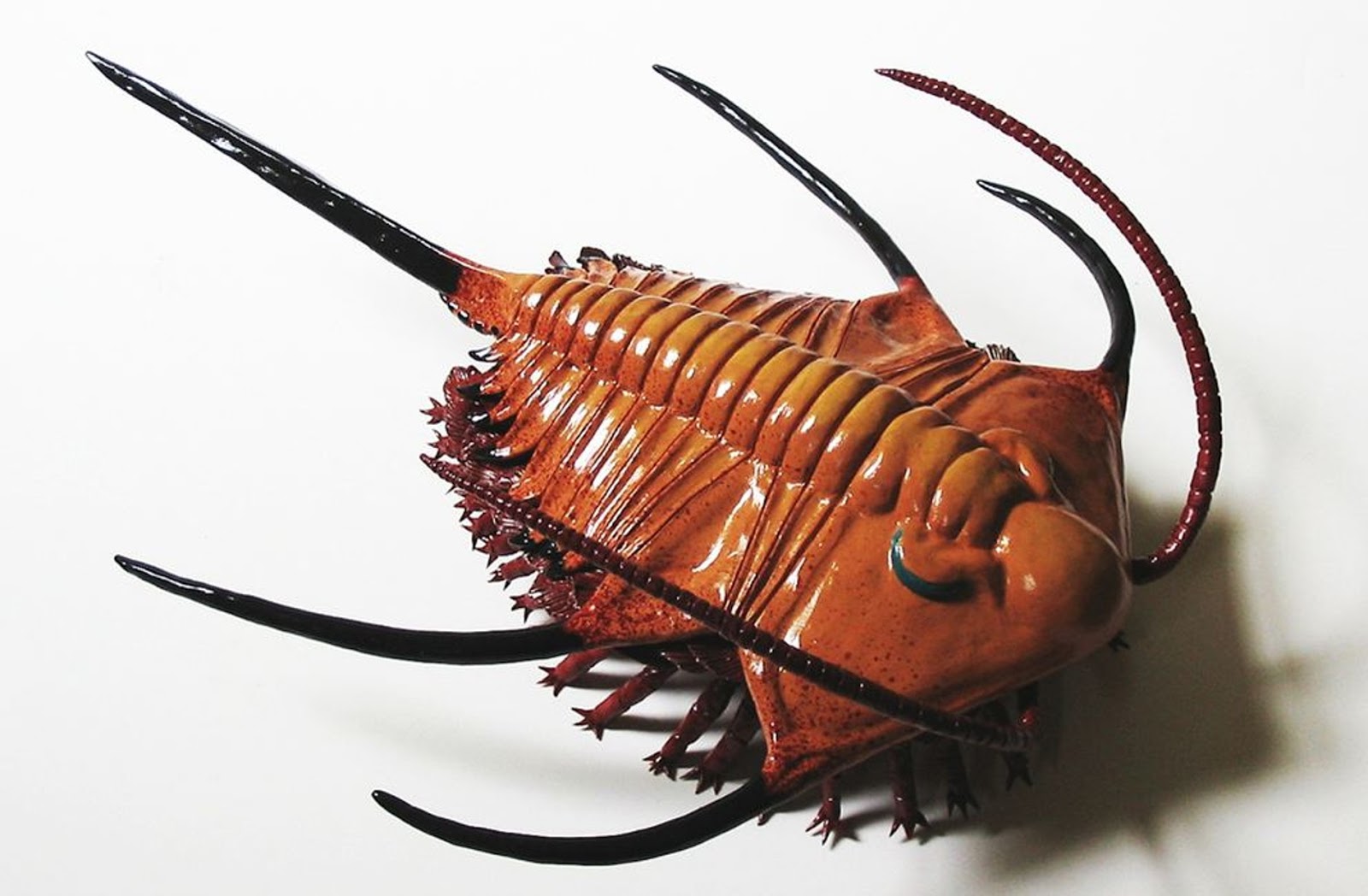
Spectacular, life-like model of Bristolia bristolensis, a notably long-spined species of early Cambrian trilobite from the southwestern USA (© Andrew 'Trilobite' Scott – click here for a ShukerNature exclusive showcasing many other examples of Andrew's stunning artwork)

During the lengthy course of their evolution, the trilobites became exceedingly successful, yielding a vast diversity of species (some 17,000 are currently recognised) as well as body forms and lifestyles before decreasing markedly in the Devonian, and finally dying out completely around 252 million years ago (in the mass extinction that occurred at the end of the Permian) – or did they? There is no well-established reason why they should have done.

As a zoologist living in the West Midlands, England, I am very aware that one particular trilobite species, Calymene blumenbachii from the Silurian Period, is so abundant in the fossiliferous limestone quarries of Wren's Nest in the West Midlands town of Dudley that it is popularly known as the Dudley bug or Dudley locust, and even appears on the Dudley County Borough Council's official coat-of-arms. Naturally, therefore, I've been a fan of trilobites ever since childhood, and my fossil collection contains several specimens, but my interest in cryptozoology would subsequently yield an additional reason for my being fascinated by them.

Dudley bug trilobite, from James Geikie's Outlines of Geology, 2nd rev. edit, 1883 (public domain)

In the mid-1980s, I purchased veteran American cryptozoologist Prof. Roy P. Mackal's classic book Searching For Hidden Animals (which had originally been published in 1980 in the U.S.A., but not until 1983 in the U.K.), and was delighted to find that it documented a wide range of lesser-known cryptids.

However, one chapter that obviously attracted my particular interest was tantalisingly entitled 'Living Trilobites?'. It included a discussion as to whether any representatives of these archaic arthropods might have survived the Permian mega-death and persisted in benthic anonymity on the ocean floor into the present day.

Prof. Roy P. Mackal and the UK hb 1st edition of his book Searching For Hidden Animals (© Prof. Roy P. Mackal/Cadogan Books)

As Mackal noted, many trilobites were shallow coastal dwellers (especially the later ones), yet no living trilobites from such localities have ever been discovered. Consequently, the only hope for modern-day survival is if "some forms adapted to a deeper, more obscure environment and there found refuge" - or if some that were already so adapted simply persisted. Should this scenario have indeed taken place, it could explain why no Cenozoic trilobite fossils have ever been found - because these would not be readily discovered or accessed on the ocean floor. But what about obtaining living specimens there?

Until reading Mackal's book, I hadn't been aware that the very first global marine research expedition, the voyage of HMS Challenger from 21 December 1872 to 26 May 1876, seriously believed that living trilobites might be dredged up from the ocean bottom. But although countless specimens that included representatives of over 4,000 hitherto-unknown animal species were indeed procured there, none of them were trilobites. Or, as worded in the authoritative Encyclopaedia Britannica's eleventh edition, published in 1911, the "faint hope" of finding such creatures was not realised.

HMS Challenger portrayed in an engraving from 1858 (pubic domain)

In reality, however, a few years before this expedition had even set out on its epic voyage of zoological discovery, a claim had been made that a living trilobite had already been obtained, and from a depth of 1,200 fathoms (7,200 ft). Moreover, this claim was actually believed for a time before the creature's true, non-trilobite identity was revealed. Another veteran cryptozoological chronicler, Willy Ley, who briefly reported the case in one of his many articles, didn't provide further details, but as noted by Mackal the timing and morphological similarities strongly suggests that the discovery in question was actually that of a certain Antarctic species of isopod crustacean (the taxonomic group which includes woodlice and sea slaters) that is astonishingly trilobite-like in outward appearance.

Brought to scientific attention in 1830, its first officially recorded specimen had actually been found inside the gut of a marine fish examined by American naturalist Dr James Eights while visiting the South Shetland Islands between Patagonia and Antarctica during the so-called 'Expedition of 1830'. Emphasising its remarkable morphological convergence, in 1833 Eights formally christened this memorable new species Brongniartia [now Ceratoserolis] trilobitoides. And it was indeed initially mistaken for one of these prehistoric arthropods by some observers, but it sports two pairs of antennae (a crustacean characteristic), whereas trilobites only had one.

Ceratoserolis trilobitoides from James Eights's 1833 description paper (public domain)

Other modern-day creatures that have often been mistaken for living trilobites are chitons and water pennies. Chitons (or polyplacophorans, to give them their formal zoological name) constitute a taxonomic class of molluscs characterised by their very distinctive shells, which are composed of eight separate but slightly overlapping plates, and afford these animals a superficially segmented appearance dorsally.

If a chiton is turned over, however, its ventral body surface is seen to be non-segmented and only possessing a single, typically-molluscan foot, in contrast to the many limb pairs possessed by trilobites. As for water pennies, these trilobite imposters are the larval stage of certain aquatic freshwater psephenid beetles, belonging to the genus Mataeopsephus.

19th-Century engraving of chitons (public domain)

Also superficially trilobite-like in outward dorsal appearance are both the larvae and the larval form-retaining adult females of lycid (net-winged) beetles belonging to the genus Platerodrilus, and which are therefore known colloquially as trilobite beetles (click here for a ShukerNature article featuring these distinctive insects). Native principally to tropical rainforests in India and southeastern Asia, some of them are brightly coloured.

Finally, the juvenile stage of those famous 'living fossils' known as xiphosurans or horseshoe crabs is termed a trilobite larva, once again because of its superficial similarity to genuine trilobites. Horseshoe crabs, incidentally, are the closest living relatives of another taxonomic group of iconic fossil arthropods – the eurypterids or sea scorpions.

Exquisite illustration by Ernst Haeckel from 1904 featuring trilobites, horseshoe crabs, and sea scorpions (© public domain)

Back in the 1980s, a bizarre story emanating from Australia briefly hit the news headlines, claiming that some trilobites had been found inhabiting Perth's storm drains. Not surprisingly, however, this was soon exposed as a hoax, featuring an old tyre that had been cut into the shape of a trilobite.

A fossil trilobite species of familiar, non-extreme morphology (public domain)

Numerous deepsea collecting expeditions have been launched since Challenger, but none has ever procured any living trilobites, and yet some tantalising indirect (or, to be precise, ichnological) evidence for such creatures may have been recorded, which Mackal described as follows:

...in 1967, I was invited by Ralph Buchsbaum, professor of zoology at the University of Pittsburgh, to give a seminar on our researches at Loch Ness. During the social hour after the presentation one of his colleagues told me about experimental photography of the sea bottom that was in progress. He stated that photographs of fresh tracks identical to the Cruciana [sic – Cruziana], the fossilized trilobite tracks, had been obtained. He expressed the hope that traps could be lowered to catch whatever was making these highly suggestive tracks. As far as I know the nature of these tracks was never determined and nothing was ever trapped, because of a subsequent loss of funding for the project. The business of identifying sea-bottom trails and tracks is a tricky one and to infer living trilobites from a track is even more tricky. A marvelous collection of sea-bottom tracks and trails is presented in a book entitled The Face of the Deep by B. C. Heezen and C. D. Hollister. Only a tiny fraction of aquatic animal tracks have been identified, so that fertile ground for new discoveries is indeed abundant...Underwater photography of the ocean floor...appears to be a promising tool for future cryptozoological expeditions.

Cruziana from Portugal (public domain)

Cruziana is a famous trace fossil taking the form of elongate, bilobed burrows that are roughly bilaterally symmetrical. As noted in a 2010 Lethaia paper by Dr Stephen Donovan, many examples are believed to be the tracks or trails yielded by trilobites while deposit-feeding, but certain others are deemed not to be, because they were present in freshwater environments (where no trilobite fossils have so far been found) and/or were of Triassic date, by which time all trilobites were supposed to have died out. But were these ostensibly anachronistic tracks actually made by surviving post-Permian trilobites for which direct fossil evidence has simply not been found as yet?

Incidentally, two other types of trace fossil believed to have been created by trilobites are Rusophycus and Diplichnites. The former fossils are excavations featuring little or no forward movements, and have therefore been interpreted as traces left by trilobites while resting or in defence/protection mode. In contrast, the latter fossils are believed to be traces left by trilobites while walking upon the sediment surface.

Rusophycus trace fossil from Ordovician Period (public domain)

Mackal ended his living trilobites chapter on a somewhat pessimistic note, concluding: "While not impossible, it is most improbable that living trilobites still exist". After that, this fascinating prospect appeared to have vanished from the modern world just as surely, it would seem, as the trilobites themselves – which is why I was so startled, but delighted, by a certain comment allegedly made by a well-respected current scientist more recently.

On 24 June 2004, Yahoo! News released online a report concerning the receipt of a $600,000 start-up grant from the private Alfred Sloan foundation for a proposed 10-year international survey of the oceans' depths, at an estimated total cost of US $1 billion, to be funded by governments, companies and private donors, and officially dubbed the Census of Marine Life (CoML). As part of this grand-scale project, scientists led by researchers from the University of Alaska planned to use robot submarines and sonar to track down life forms in the Arctic Ocean's chilling deepwater domain, and expectations were that by the end of its decade-long course, the survey could easily have doubled the number of species known from this particular ocean.

Three-dimensional reconstruction of Drotops armatus, a very spiny species of Devonian trilobite from Morocco (public domain)

All very worthy indeed, but what caught my eye amid all of these statements was one attributed in the news report to none other than Dr Ron O'Dor, chief scientist of the multi-nation CoML. According to the report, whose exact wording is quoted here as follows, Dr O'Dor "speculated that Arctic waters might hide creatures known only from fossils, such as trilobites that flourished 300 million years ago". It would seem, therefore, that the notion of finding living trilobites has not been entirely discounted by scientists after all.

Happily, the CoML did indeed take place, this very ambitious project ultimately featuring scientists from more than 80 different nations, and releasing the world's first-ever census in 2010 – but no living trilobites were listed. Nevertheless, there is a notable precedent well worth mentioning here.

Pilina, a fossil monoplacophoran outwardly resembling modern-day Neopilina (public domain)

The monoplacophorans are a primitive taxonomic class of molluscs, whose youngest fossil species date from around 380 million years ago. On 6 May 1952, however, trawling off Mexico's western coast at a depth of almost 12,000 ft in dark, muddy clay, the Danish research ship Galathea hauled up 10 complete specimens and three empty shells of a small, seemingly unremarkable mollusc superficially resembling a limpet but which proved upon scientific examination to be a living monoplacophoran. This hitherto-unknown species was formally named Neopilina galatheae, since when further specimens of it, and of several additional modern-day species too, have been obtained (see my Encyclopaedia of New and Rediscovered Animals, 2012, for full details).

Structurally, these living monoplacophorans are very different internally from their archaic fossil ancestors, so if living trilobites do exist, these too are likely to be highly evolved species. Nevertheless, the discovery of Neopilina and kin readily demonstrates that it is by no means impossible for invertebrates deemed by their fossil record to have died out in very far-distant prehistoric ages to be represented, in fact, by living species that have simply evaded scientific detection.

A classic late-1800s illustration of living trilobites by Heinrich Harder (public domain)

This ShukerNature blog article is adapted from my forthcoming book Still In Search Of Prehistoric Survivors.


Sunday, 16 February 2014

CONTEMPLATING THE CON RIT


Tim Morris's excellent reconstruction of the con rit as a giant marine crustacean, based upon my proposed identity for it in my 1995 book In Search of Prehistoric Survivors (© Tim Morris)

When it debuted in his classic tome In the Wake of the Sea-Serpents (1968), Dr Bernard Heuvelmans's bold classification of sea serpents into no less than nine well-defined types was widely hailed within the cryptozoological community as a milestone in cryptid research, and it is still widely referred to today. However, the validity of certain of those sea serpent types has subsequently been challenged by various other researchers, due to revelations that cast doubt upon or totally discredit those types' proposed taxonomic identities.

Perhaps the most controversial of Heuvelmans's nine sea serpent types is his many-finned sea serpent Cetioscolopendra aeliani, for which he nominated a living species of armoured, scaly archaeocete as its identity. Unfortunately, however, long before he had even categorised his types, palaeontologists had already revealed that scales found in association with certain specimens of fossil archaeocete (a primitive group of prehistoric cetaceans) did not originate from them (as had initially been assumed following their discovery, and which had inspired Heuvelmans's identification of the many-finned as an armoured, scaly archaeocete), but belonged instead to various other creatures. In other words, there are no verified specimens of armoured archaeocete in the fossil record, thereby greatly reducing the likelihood of any modern-day species existing.

But if many-finned sea serpents truly exist, what else could they be? In my 1995 book, In Search of Prehistoric Survivors, I proposed a very different identity, one that I still consider plausible, but regarding which, sadly, certain incorrect claims have been made in various subsequent online and hard-copy sources of cryptozoological data. Consequently, I felt that it was high time to refute these erroneous claims once and for all, by revealing online precisely what I did propose regarding this sea serpent type's identity in my Prehistoric Survivors book. So here is the relevant section, quoted below in full:

Another mystery beast that has been linked to the concept of surviving eurypterids [the section of my book immediately preceding this one had presented various cryptids that had been proposed by some investigators as living eurypterids – sea scorpions] is the so-called 'sea millipede'. In 1883, the headless, putrefying carcass of a remarkable, armour-plated sea monster was found washed ashore at Hongay in Vietnam's Along Bay. It was observed by several local Annamites, including an 18-year-old youth called Tran Van Con, who actually touched the body. Thirty-eight years later, he recalled this incident to Dr A. Krempf, Director of Indochina's Oceanographic and Fisheries Service.

The carcase was 60 ft long and 3 ft wide, and was composed of numerous identical segments - so hard in texture that they rang like sheet metal when one of the locals hit them with a stick. Each segment was dark-brown dorsally, light-yellow ventrally, measured 2 ft long and 3 ft wide, and bore a pair of 2 ft 4 in lateral spines. The terminal segment bore two additional spines, directed backwards like a pair of spiny tails. The stench from the decomposing carcass was so intense that the locals soon towed it out to sea where it sank, and they referred to the creature itself as con rit - 'millipede'.

When contemplating this animal's possible identity in his book In the Wake of the Sea-Serpents (1968), Heuvelmans briefly considered and rejected the sea scorpions as a candidate, together with crustaceans - favouring instead a hypothetical, highly-specialized form of evolved armoured archaeocete, which he dubbed Cetioscolopendra aeliani ('Aelian's centipede whale'), the many-finned sea serpent. A number of sightings are on file describing elongate sea monsters seemingly bearing numerous lateral fins or projections, which the ancient writer Aelian referred to as marine centipedes. I agree entirely with Heuvelmans that the con rit is unrelated to the sea scorpions, but I also have grave doubts that it is an archaeocete.

As already noted, the concept of armoured archaeocetes is no longer in favour [I had included in an earlier section of my book the pertinent revelation that I refer to at the beginning of this ShukerNature post]; and in any case, even within his own selection of 'many-fins' Heuvelmans includes examples that simply cannot be mammalian. The most prominent of these is the 150-ft-long monster spied for about 30 minutes by a number of sailors on deck aboard HMS Narcissus on 21 May 1899, after the ship had rounded Algeria's Cape Falcon. In an interview concerning their sighting, a signal man made the following telling statement:

"The monster seemed to be propelled by an immense number of fins. You could see the fins propelling it along at about the same rate as the ship was going. The fins were on both sides, and appeared to be turning over and over. There were fins right down to the tail. Another curious thing was that it spouted up water like a whale, only the spouts were very small and came from various parts of the body."

Unless the numerous fins are in reality a pair of undulating lateral membranes extending the entire length of the creature's body - which does not seem likely from the above description - then the Narcissus sea serpent is neither a mammal nor any other form of vertebrate. Clearly, its fins were locomotory organs (creating by their propulsive movements the spouts of water noted by the signal man), not rigid spines like those reported from the carcass of the con rit. Consequently, my own feeling is that, in life, each pair of the con rit's spines had sheltered a pair of soft-bodied limbs beneath - but which, together with the remainder of this beast's soft tissues, had rotted away during decomposition, leaving behind only the hard dorsal cuticle. All of which is totally in accord with what one would expect from a crustacean: multiple locomotory limbs, hard dorsal armour that does not rot once the creature has died, and a soft body that very rapidly (and odiferously!) rots upon death.

The only major problem is the con rit's immense length - far beyond anything recorded so far by science from a known modern-day (or fossil) crustacean. It is well-known that the spiracular system of respiration utilized by insects (involving a vast internal ramification of minute breathing tubes) prevents them from attaining the gigantic proportions beloved by directors of science-fiction movies. However, crustaceans breathe via gills, and their bodies are buoyed by the surrounding water. Hence the evolution of a giant aquatic crustacean is not wholly beyond the realms of possibility and, to my mind, offers the only remotely feasible explanation to Vietnam's anomalous con rit or sea millipede.

Many years ago, in a report describing a new 3-ft-long species of Mixopterus sea scorpion, Norwegian palaeontologist Professor Johan Kiaer recalled the thrill of its discovery:

"I shall never forget the moment when the first excellently preserved specimen of the new giant eurypterid was found. My workmen had lifted up a large slab, and when they turned it over, we suddenly saw the huge animal, with its marvelously shaped feet, stretched out in natural position. There was something so lifelike about it, gleaming darkly in the stone, that we almost expected to see it slowly rise from the bed where it had rested in peace for millions of years and crawl down to the lake that glittered close below us."

No doubt cryptozoologists share a similarly dramatic dream - to haul up a living eurypterid from the depths of the oceans or even from the muddy bottom of a large freshwater lake. And somewhere out there, perhaps there really are some post-Permian, present-day sea scorpions, indolently lurking in scientific anonymity. Based upon the evidence offered up so far, however, this prospect seems no more likely than the resurrection of Kiaer's fossilized specimen from its rocky bed of Silurian sandstone.

It is perfectly clear from my above account that 'sea millipede' and 'sea centipede' are merely colloquial, non-taxonomic names for this cryptid, and that the identity for the con rit that I proposed in my Prehistoric Survivors book was a crustacean - and NOT either a marine centipede (as wrongly claimed re my book in a number of websites), or a marine millipede (as wrongly claimed re my book in some other websites, as well as in a recent book, The Cryptozoologicon, Volume 1, co-authored by Dr Darren Naish and published in 2013 – Darren has promised to include a correction in the book's planned second volume).

To my mind, the con rit is one of the most fascinating if enigmatic marine cryptids on record, but with no modern-day sightings on file (at least not to my knowledge), whether it still does – or indeed ever did – exist remains as much a mystery today as the creature itself.


Saturday, 11 January 2014

EXPOSING ONLINE FAKES AND FRAUDS OF THE CRYPTOZOOLOGICAL KIND – A SHUKERNATURE TOP TEN LISTING

A monstrous discovery? (©  Alan E. Friswell)

The internet is the natural home of some very unnatural creatures – fakes, frauds, and the falsely identified. Many of them attract only fleeting, transient attention before being soundly exposed and permanently discredited. However, there is also a hardcore set whose members simply refuse to die – being revived time and time again by unsuspecting novice researchers who are bewitched by their superficial strangeness and fail to realise that their faux nature has been unveiled on numerous previous occasions. So here, in no particular order, are ten of the most noteworthy (and notorious) examples, all of which I have investigated at one time or another and have either personally exposed the truth behind them or have discovered who else has done so.


#1 - A LIVING SEA SCORPION?

(© Crawley Creatures / inclusion here strictly on Fair Use/non-commercial basis only)

And where better to begin than with this extremely striking photograph? As can be seen, it portrays someone holding what appears on first sight to be a recently-dead eurypterid or sea scorpion, which, if genuine, would be an astonishing discovery, bearing in mind that the most recent confirmed specimens died out during the Permian-Triassic mass extinction approximately 252 million years ago. I have seen the following report accompanying this photo on several Facebook group and individual pages, but its earliest online appearance seems to be on the Paranormal Geeks Radio website on 13 April 2013. Here's the report:

"In 1971 farmer Ted Litton caught this weird animal alive in his artificial pond in Lilac, TX, & got his pic in the paper. 8 hours later his farm was besieged by Army soldiers wearing decontamination suits. They drained the pond, leaving an odd, spheroid cavity in the bottom. Litton says the Army dismissed his beast as a freak of nature yet they confiscated it, promising him 5 grand (which never materialized).”

Needless to say, however, as I discovered when subjecting this photograph to a Google Image search, the reality soon proved to be very different. In fact, the eurypterid was a prop, an animatronic model, to be precise, produced for the BBC television series Sea Monsters (2003) by the award-winning special-effects design company Crawley Creatures, based in the UK. Here is a link to their website that shows this exact-same photograph:

http://www.crawley-creatures.com/Gallery.aspx?Job=76

As for the eurypterid model, it represents the Ordovician genus Megalograptus, which is one of the earliest eurypterids on record.


#2 – THE NORTH AMERICAN BLACK PANTHER FROM SOUTH AFRICA

(© Kevin Richardson / inclusion here strictly on Fair Use/non-commercial basis only)

Since the beginning of October 2013, the above photograph has been circulating widely online, appearing not only in a number of Facebook groups but also on a wide variety of websites, many of which claim that the black panther (i.e. melanistic leopard) that it depicts was recently photographed in the wild somewhere in North America. It is precisely where that has incited controversy, with a number of different States variously cited, including Oklahoma, Louisiana, Georgia, Tennessee, and Texas. Once again, however, after subjecting the photo to a Google Image search I swiftly uncovered its true provenance, which proved to be South Africa. Indeed, as I discovered from the following online article, dated 20 March 2013, which contains and originated this photo:


the animal in question is a black panther named Coal, one of two (both born in 2003) present in captivity and in the care of conservationist Kevin Richardson at the Dinokeng Nature Reserve in Gauteng, South Africa. Clearly, therefore, person(s) unknown had subsequently utilised the photo in fake reports claiming that it had been snapped in North America. (Also worth noting, incidentally, is that the grass in this photo is an African species, not a North American one.)


#3 – THE HUMAN-DOG HYBRID

(© Patricia Piccinini / inclusion here strictly on Fair Use/non-commercial basis only)

This extraordinary photograph has been the subject of much online speculation since as far back as 2005, and has even featured in various YouTube videos. Lurid claims that its subjects were bona fide human-canine hybrids are widespread, and also that it is a skilfully-produced Photoshop creation. In reality, neither of these is correct, because what it really is…is a very remarkable sculpture, as revealed in the following link:


As explained there, the sculpture is entitled 'The Young Family', and was created by Australian artist Patricia Piccinini in 2002. It was manufactured from silicone, polyurethane, leather, plywood, and human hair, measures 80 x 150 x 110 cm, and is part of a larger work entitled 'We Are Family'.


#4 – THE WORLD'S LARGEST TORTOISE?

(© Kadokawa Pictures / inclusion here strictly on Fair Use/non-commercial basis only)

This memorable photograph recently reappeared in the following online article, dated 25 September 2013:

but it has been circulating online in similar accounts for quite a while prior to that (I have found web reports of it dating back as far as August 2012). The article claims that this mega-tortoise, measuring 30 ft long and weighing well over 2380 lb, had been discovered in a Brazilian stretch of the Amazon River after killing local farmers' livestock, and was around 529 years old. As anyone familiar with Japanese 'monster' films would soon confirm, however, the photo is merely a still from the popular movie Gamera the Brave, produced in Japan by Kadowara Pictures in 2006 – as verified by the following French website page:


#5 – BLACK LION 'FAUX-TOGRAPHS'

(?© martincito1/tumblr.com)

Four separate photographs of alleged black lions have been circulating online for more than 2 years, and as I have documented in my books Mystery Cats of the World (1989) and Cats of Magic, Mythology, and Mystery (2012), several unconfirmed sightings of such animals have been reported from various regions of Africa, but no verified specimen has ever been documented. So what were the animals in the online photos? As I revealed in two exclusive ShukerNature investigations:


and


three of these four black lion photographs were photoshopped versions of original images depicting normal, tawny-coloured lions. And the fourth black lion photo was a photoshopped version of an original image of a rare white lion – I successfully tracked down all four of the original images online.


#6 – MULTI-HEADED COBRAS

(original source/copyright holder unknown to me)

Another popular, perennial subject represented online by a wide variety of fake images is the multi-hooded (and –headed) cobra. Claimed in some reports to constitute living nagas or Indian snake deities, they were, as I soon revealed in another ShukerNature investigation:


to be nothing more than clever Photoshop creations. Indeed, there is even a video on YouTube that provides a step-by-step guide on how to create your very own multi-hooded cobra 'faux-tograph'.


#7 – THE GIANT SEA SERPENT OF TAKESHI YAMADA

(© Dr Takeshi Yamada / inclusion here strictly on Fair Use/non-commercial basis only)

This very spectacular photo has incited much discussion online in recent years – which is very strange, bearing in mind that even the most cursory Google Image search will rapidly reveal that the 32-ft-long sea serpent depicted in it is in reality a very adept creation of master monster-maker Dr Takeshi Yamada. Indeed, as I revealed in the following ShukerNature article:


it is just one of many fascinating examples of so-called rogue taxidermy produced over the years by Yamada. Others include a chupacabra snail, a vampire monkey, a Mongolian death worm, a whip-tailed tree octopus, and an eight-legged spider dog!


#8 – EXPLAINING A VERY FISHY SEA SERPENT - A SHUKERNATURE EXCLUSIVE!

(© Alan E. Friswell)

In stark contrast to Yamada's example, this eyecatching sea serpent photograph has greatly perplexed many people (and continues to do so), judging from the contradictory claims and comments concerning it that have appeared in online discussions and even in YouTube videos. Its portrayed location has been variously stated to be a beach in Hawaii, South Australia, and the Philippines. Moreover, no-one has been able to identify the creature that the photo depicts, but some bizarre suggestions have been offered, including an oarfish – which looks nothing like it! Happily, however, this photo poses no such problems for me – because, as now exclusively revealed here on ShukerNature, I just so happen to know who created it! None other than a good friend of mine, expert monster/dinosaur model-maker Alan E. Friswell, as he revealed to me in October 2013:

"I drew this sea serpent in photoshop in 2009, to accompany an article that I wrote for the CFZ [Centre for Fortean Zoology] blog page."

Evidently, therefore, it had subsequently been lifted by person(s) unknown and passed off by them as a real, unidentified creature. This is exactly how so many online cryptozoological hoaxes arise. Someone like Alan innocently creates a fictitious beast as artwork, but then other persons deliberately pass it off as a genuine animal. Indeed, this is precisely what happened with some of the black lion photos too, and also with the next case in our listing.


#9 – ARACHNOPHOBES BEWARE - THE ANGOLAN WITCH SPIDER

(© Paul Santa Maria / inclusion here strictly on Fair Use/non-commercial basis only)

This dramatic photograph must have sent shivers down the spine of many an arachnophobic viewer since it first appeared online more than 2 years ago. It often appeared with an account describing it as an Angolan witch spider. Here's one version of that account:

"It's a new spider called the Angolan witch spider. They migrated from South America [very odd, since Angola is in Africa!]. They primarily eat dogs and cats. In Texas this abnormally large spider was found on the side of this home. It took several gun shots to kill it."

When I first saw the photo a year or so ago, I readily identified its subject as a wolf spider, albeit one of wholly implausible size. And sure enough, a little online detective work on my part soon traced the truth behind the terror, as fully documented in the following website account:

http://www.hoax-slayer.com/angolan-witch-spider.shtml

It reveals that the photograph was produced via Photoshop as a joke by artist-musician Paul Santa Maria, who uploaded it onto his Facebook page, where it remained for just a few hours before he took it down again. But that was still sufficient time for it to be copied by someone onto their own page, from where it soon went viral. The bogus account of it being an Angolan witch spider was attached to it by person(s) unknown – and the rest, as they say, is history.


#10 – THE RAINBOW OWL IS A HOOT!

(copyright holder unknown to me)

A year ago, several correspondents alerted me to the above photograph and an accompanying report, circulating on Facebook and elsewhere online, concerning what was claimed to be a rare but remarkable species of owl. It is known as the rainbow owl on account of its gaudy, multicoloured plumage, and according to the report it is native to the USA and China (an oddly discontinuous zoogeographical distribution, to say the least!) but was hunted into near-extinction during the early 20th Century due to coveters of its beautiful feathers. Moreover, it has an unusually melodious call, and is so attracted to music and human singing that researchers seeking it in the field know that they will greatly increase their chances of finding specimens if they bring along a portable stereo. The author of this intriguing report was one Dr Claudia Weatherfield of the University of Toldeo.

Needless to say, as someone with a longstanding ornithological interest yet who had no prior knowledge whatsoever of any such species, I was instantly suspicious. And rightly so, as it turned out, because some online investigations soon led me to the following webpages contained on two websites devoted to exposing hoaxes, and which fully justified my concern:

http://www.snopes.com/photos/animals/rainbowowl.asp

http://urbanlegends.about.com/od/animalkingdom/ss/Rainbow-Owl.htm

They revealed that there is no University of Toldeo; nor any Claudia Weatherfield working even at the similarly-named University of Toledo. The photograph was clearly a computer-modified version of some other image, and sure enough the original photo proved to be of a barred owl Strix varia - a common North American species unadorned by any rainbow-hued plumage.


Who knows – perhaps now, finally, all of these tenacious phoneys will be laid to rest forever…but with their exceptional history and capacity for resurrection, I wouldn't bet on it!

Another photograph of Dr Takeshi Yamada's incredible 32-ft sea serpent (© Dr Takeshi Yamada / inclusion here strictly on Fair Use/non-commercial basis only)