Dr KARL SHUKER

Zoologist, media consultant, and science writer, Dr Karl Shuker is also one of the best known cryptozoologists in the world. He is the author of such seminal works as Mystery Cats of the World (1989), The Lost Ark: New and Rediscovered Animals of the 20th Century (1993; greatly expanded in 2012 as The Encyclopaedia of New and Rediscovered Animals), Dragons: A Natural History (1995), In Search of Prehistoric Survivors (1995), The Unexplained (1996), From Flying Toads To Snakes With Wings (1997), Mysteries of Planet Earth (1999), The Hidden Powers of Animals (2001), The Beasts That Hide From Man (2003), Extraordinary Animals Revisited (2007), Dr Shuker's Casebook (2008), Karl Shuker's Alien Zoo: From the Pages of Fortean Times (2010), Cats of Magic, Mythology, and Mystery (2012), Mirabilis: A Carnival of Cryptozoology and Unnatural History (2013), Dragons in Zoology, Cryptozoology, and Culture (2013), The Menagerie of Marvels (2014), A Manifestation of Monsters (2015), Here's Nessie! (2016), and what is widely considered to be his cryptozoological magnum opus, Still In Search Of Prehistoric Survivors (2016) - plus, very excitingly, his four long-awaited, much-requested ShukerNature blog books (2019-2024).

Dr Karl Shuker's Official Website - http://www.karlshuker.com/index.htm

IMPORTANT: To view a complete, regularly-updated listing of my ShukerNature blog's articles (each one instantly clickable), please click HERE!

IMPORTANT: To view a complete, regularly-updated listing of my published books (each one instantly clickable), please click HERE!

IMPORTANT: To view a complete, regularly-updated listing of my Eclectarium blog's articles (each one instantly clickable), please click HERE!

IMPORTANT: To view a complete, regularly-updated listing of my Starsteeds blog's poetry and other lyrical writings (each one instantly clickable), please click HERE!

IMPORTANT: To view a complete, regularly-updated listing of my Shuker In MovieLand blog's articles (each one instantly clickable), please click HERE!

IMPORTANT: To view a complete, regularly-updated listing of my RebelBikerDude's AI Biker Art blog's thematic text & picture galleries (each one instantly clickable), please click HERE!

Search This Blog


PLEASE COME IN, I'VE BEEN EXPECTING YOU...

PLEASE COME IN, I'VE BEEN EXPECTING YOU...
WELCOME TO SHUKERNATURE - ENJOY YOUR VISIT - BEWARE OF THE RAPTOR!


Showing posts with label jaguarundi. Show all posts

Friday, 27 December 2024

DEADLY DEER-PUMAS, LITTLE LIONS, GIANT JAGUARUNDIS, AND MORE! – LESSER-KNOWN MEXICAN MYSTERY CATS, PART 2 (OF 3)

 
One long-recognized and three currently-unrecognized Mexican felids – (top left) the puma; (top right) the mazamiztli; (bottom left) Montezuma's wolf-puma; (bottom right) the tlalmiztli (© Hodari Nundu)

In Part 1 of my ShukerNature blog article on lesser-known Mexican mystery cats (please click here to read it, and also click here to read my earlier ShukerNature article documenting Mexico's best-known mystery cat, the onza), I documented the mystifying ruffed cat, some skins of which were actually procured by American zoologist and cryptozoologist Ivan T. Sanderson while visiting Mexico, only for them to be destroyed when the building in which they had been deposited by him for safe-keeping was flooded – isn't that always the way with cryptozoological specimens?!

Now, here in Part 2 I am casting my metaphorical nets much wider, to take in no fewer than five additional feline cryptids from this self-same North American country, most of which were brought to my attention by Mexican palaeo-artist and cryptozoological enthusiast Hodari Nundu on Facebook, where we have been friends for many years. In addition, Hodari has very kindly permitted me to include in this present article a number of his wonderful illustrations – thanks Hodari!

So, without further ado, let's commence our survey of these five additional feline cryptids of Mexico, beginning with the mazamiztli or deer-cat.


THE MAZAMIZTLI

On 22 and 23 January 2024, Hodari posted on his Facebook page some fascinating details regarding a third Mexican mystery cat, seemingly distinct from both the onza and the ruffed cat.

Hodari noted that in his 1570s magnum opus Historia Natural de la Nueva España, dealing with the wildlife of what is nowadays Mexico, Spanish naturalist Francisco Hernández de Toledo wrote about an intriguing, unidentified beast referred to locally as the mazamiztli. This name is a combination of two others, both of Nahuatl (imperial Aztec) origin – maza ('deer') and miztli ('puma'). Hernández stated that it was called by this compound name due to its combining various deer traits and puma traits, but unfortunately he did not elaborate further.

 
Hodari's exquisite artistic rendition of the mazamiztli based upon descriptions of it in historical documents (© Hodari Nundu)

However, a second author, the 16th-Century Franciscan missionary priest and Aztec scholar Friar Bernardino de Sahagún, did provide additional details. He stated that the mazamiztli is the size and colour of deer, and also possesses paws and (in males) antlers like deer, but it sports the very sharp claws and fangs of a puma, and it does not eat grass like deer. Instead, it walks among deer and when hungry it seizes one of these unsuspecting creatures, disembowels it with its claws, and eats its entrails. Apparently, the mazamiztli looks so similar to real deer that it can only be distinguished by them via its foul smell (so presumably it hunts downwind of them to conceal its scent?).

 
A mazamiztli seeking to stealthily infiltrate a herd of deer before selecting one of them as its next prey victim (© Hodari Nundu)

Recalling that the onza is itself supposedly gracile like deer, might this cat and the mazamiztli simply be one and the same? However, the onza has its own, separate Nahuatl name, cuitlamiztli ('wolf-puma') – but see also Part 3 of my article for further, potentially conflicting details regarding this name.

Having said that, the mazamiztli seems irresistibly like a feline version of the South American maned wolf Chrysocyon brachyurus, whose very elongate limbs and extra-large ears make it look remarkably deer-like in superficial appearance.

 
The surprisingly deer-like maned wolf (© Markus Bühler)

Consequently, I have wondered if what we are dealing with here is a sexually dimorphic feline species, i.e. with the onza aka cuitlamiztli conceivably being one sex of this species and the mazamiztli being the other, visibly different sex. Certainly, males are often noticeably larger or burlier than females in a number of different cat species. However, Fr Bernardino's inclusion of antlers as a male mazamiztli characteristic argues against this creature being real rather than folkloric.

It would be very interesting if more information regarding this Mexican mystery beast is unearthed in the future, and it is very encouraging to know that serious researchers such as Hodari are actively perusing historical manuscripts that have not previously attracted specific cryptozoological attention. Who knows what other discoveries may be made in this way?


THE LEONCILLO

And as if three Mexican mystery cats were not extraordinary enough, I also received in January 2024 some information concerning a potential fourth one!

It took the form of a short account posted on 8 January beneath my ShukerNature blog article on the onza (click here) by a reader based in Mexico. The reader did not reveal their name, but affirmed their long fascination regarding the onza and then provided some thought-provoking information concerning not only this cat but also a smaller, separate feline form that they termed the leoncillo.

The older members of the reader's Jalisco-inhabiting family have spoken about this animal, which they liken to a diminutive lion with a small mane. The reader showed their uncle a picture of an Asiatic lion, which famously has a much smaller, sparser mane than African lions and is smaller in stature too, and the uncle replied that this is exactly what the leoncillo looks like. Moreover, even its name translates as 'little lion'.

 
Two male Asiatic lions in Sanjay Gandhi National Park, Borivali, Mumbai Lion Safari (© supersujit/Wikipedia – CC BY-SA 2.0 licence)

Could this creature be one and the same as the ruffed cat? I gave the latter crypto-cat that name in the apparent absence of any known local name for it, but perhaps its local name is leoncillo. Alternatively, might the leoncillo genuinely be a fourth Mexican mystery cat in its own right?

Yet although Mexico is a very large country, with plenty of remote mountainous areas, could it truly harbour no fewer than a quartet of mystery cats? Without any physical evidence to examine for at least three of them (or maybe all four if, as I suggested a while back, the alleged Rodriguez onza specimen wasn't a true onza after all, but merely a puma that looked like one), at this point we simply can't say. In any case, as will now be revealed, the Mexican mystery cat count doesn't even stop at four...


THE TLALMIZTLI

In his afore-mentioned 1570s magnum opus Historia Natural de la Nueva España, dealing with the wildlife of what is today Mexico, Spanish naturalist Francisco Hernández de Toledo has been revealed by Hodari to have written about not one but two Mexican mystery cats. One is the mazamiztli, but the other is very different, the tlalmiztli.

Providing details on his Facebook page on 26 January 2024, Hodari notes that this unidentified felid was said by Hernández to be smaller than a domestic cat but with a face like a lion, and despite its small size was very ferocious. Hernández also stated that a specimen of what he felt likely to have been this same mysterious species had been sent from Isla Margarita (in modern-day Venezuela) to the King of Spain but, tragically, it had died during the long sea voyage to Spain. Once again, it resembled a very small lion.

 
Artistic representation of the tlalmiztli's likely appearance in life (© Hodari Nundu)

Hodari speculated that it may have possibly been the jaguarundi Herpailurus yagouaroundi, a lithe, slender, low-slung, and very long-tailed wild cat slightly larger than a domestic cat, which is native to much of South America (including Venezuela) and Central America, with its range stretching up as far north as northern Mexico in North America, with occasional specimens documented in the USA. To my mind, however, it looks if anything more like a miniature lioness than a lion as far as potential leonine comparisons are concerned. Another possible identity candidate suggested for it by Hodari is a kinkajou Potos flavus, that small golden-furred Latin American procyonid related to raccoons and coatis.

 
Vintage colour engraving from 1849 of a kinkajou (public domain)

I am reminded of the leoncillo, the maned lion-like Mexican mystery cat that I've documented earlier here, but this was not said to have been smaller than a domestic cat. So, just like the latter animal and also the mazamiztli, the tlalmiztli currently remains an anomaly.

Incidentally, worth noting here is that the jaguarundi is most closely related to the puma (aka cougar and mountain lion) Puma concolor. Indeed, some authorities actually classify it as Puma yagouaroundi, and  these two species collectively form a sister clade to the Old World cheetah Acinonyx jubatus, a species that as recently as the Pleistocene possessed gracile puma-like New World relatives, housed in the genus Miracinonyx. In fact, a surviving Miracinonyx cheetah, specifically Truman's cheetah M. trumani (which officially became extinct 12,000 years ago), is one identity that has been proposed in the past for the onza.

 
Artistic representation of the possible appearance in life of Truman's cheetah (© Sheatherius/Wikipedia – CC BY-SA 4.0 licence)


THE TIRICUATE

On 13 December 2024, I received from Hodari via Facebook a message containing some information regarding yet another Mexican mystery cat. This one is called the tiricuate. It is said to inhabit the area around Lake Chapala, Mexico's largest lake, in the state of Jalisco, and Hodari speculates that this cat may derive its name from 'tilcuate', a name often applied by the locals to a snake. It is described as a black arboreal cat sporting a very long tail, and it attacks people, hence it is quite feared.

Hodari once saw a taxiderm specimen of a cat resembling a giant jaguarundi (see below). Consequently, he wonders if that specimen and the tiricuate may be related.

 
Grey/black phase of the jaguarundi (© Cédric Gravelle/Wikipedia – CC BY 2.5 licence)

As is well known, the jaguarundi exists in two discrete colour phases, both of which can occur within a single litter. One of these phases is bright red to dull brown and is known as the eyra (it was once mistakenly thought to be a separate species in its own right), the other is ash-grey to black in colour. This latter version certainly resembles the tiricuate based upon Hodari's description, and jaguarundis are indeed arboreal.

So whereas a normal-sized jaguarundi is too small to pose a threat to humans, perhaps an extra-large variety does also exist – one that is big enough, and savage enough, to be capable of attacking people?


A GIANT TAXIDERM JAGUARUNDI?

Following my request to Hodari for details concerning the intriguing taxiderm specimen of a cat resembling a giant jaguarundi that he had once seen in Mexico, I received the following in-depth account of it from him via Facebook on Christmas Day 2024:

Let's see. This happened in the early 2000s – most likely between 2000 and 2003. Sadly I didn't have a camera and of course smartphones weren't a thing yet so I am relying on my memory for this, but my memory is quite good for creature related experiences. The place was a town in Jalisco (my home state) called Mazamitla (from Nahuatl, "place where deer are hunted with arrows" – you might recognize the word mazatl, deer, because of the mazamiztli).

Anyway this is a town about 124 km south of Guadalajara. People from the city often visit it on weekends or holidays to rest and enjoy nature: it is located in a mountainous region which is largely covered on pine forests. I went there with my family on vacation. It is not uncommon for hotels or restaurants in Jalisco to have taxidermied animals but usually it is deer's heads or various birds so I was taken by this cat I saw on a restaurant, the name of which unfortunately I can't remember. It was one of those countryside restaurants so common in Jalisco (I imagine in much of Mexico) that sell sheep and goat meat dishes that you'd be hard pressed to find in the city.

 
Hodari's reconstruction of how in life the giant jaguarundi-like cat that he observed as a taxiderm specimen in a restaurant at Mazamitla during the early 2000s may have looked (© Hodari Nundu)

The cat was mounted at a certain height so that it looked like it was perched near the ceiling waiting to pounce. The mount was quite good and naturalistic. I immediately identified it as a jaguarundi based on the following traits:

- Plain brown coat, richer and darker than a puma's.

- Lack of the puma's distinctive black and white muzzle markings.

- short rounded ears.

- shorter, wider face overall.

- shorter limbs compared to the body than in a puma.

- long, rectangular shaped torso without the characteristic higher rump of the puma (due to long jumping legs).

- Fur had a sort of grizzled or agouti-patterned appearance so that even though the animal's color was plain, the individual hairs must have been tipped or streaked with light and dark bands. This is very common in jaguarundi but not so much in puma.

Having worked as a zookeeper in a park that kept jaguarundi, I was very familiar with them, and my brain wanted to identify this as a jaguarundi because it definitely leaned more towards it than towards puma, but the problem was the size. Even assuming the skin could be somewhat stretched (which wasn't evident to me at the time as the mount looked natural with no obvious distortions), it still would have been a c. 30 kg cat in life which is far superior to the size of any jaguarundi (but comparable in size to the prehistoric Puma pumoides, which is believed to have been closer to jaguarundi than to puma [and is known from fossil remains uncovered in Argentina]).

 
Puma pumoides hunting Argyrolagus, a polydolopimorphid marsupial (© Hodari Nundu)

Unfortunately like I said I had no camera or smartphone back then, nor was I able to find out more about the specimen. I would assume that it was hunted somewhere in the vicinity since the mounted animals you see in these sorts of place usually are. Also there's a rich tradition of mystery cat sightings in Jalisco, most of which are thrown under the catch all moniker of onza. Many Jaliscan biologists and photographers will tell you that the onza is the jaguarundi, but this doesn't explain the wild disparity in size between the regular jaguarundi and the cats reported to be large enough to attack people, and described as in between the jaguarundi and puma in size, or even puma-sized but with different proportions. I have collected a few sighting reports from people in my region and most of them are adamant that the onza is not the puma, and that it is too big to be jaguarundi.

My hypothesis is that there's a third form of acinonychine cat [i.e. in addition to the puma and the jaguarundi] in Jalisco (and possibly elsewhere since Mazamitla is close to the border with neighboring state Michoacán) that is more closely related to the jaguarundi (or at least LOOKS to be), and is sized between the jaguarundi and puma. It is consistently reported from mountain areas which means:

- it might be a form of jaguarundi evolving larger size as a response to the decline of larger predators like puma and jaguar.

- it might be a form of jaguarundi that evolved larger size as a response to colder climate in higher altitudes.

- it might be a relic of the Pleistocene, a larger acinonychine that hasn't been properly identified yet and which (as is known from other Mexican endémics) may have been more widespread during glacial periods but is now isolated in cold regions in mountain ranges.

As such it might be a new species, subspecies, or even a giant jaguarundi population stretching the size range of the species beyond what we thought possible. After all, the jaguarundi still is poorly known.

 
Vintage 19th-Century illustration of the eyra, the jaguarundi's red/brown colour phase (public domain)

Any of the above options regarding the identity of extra-large jaguarundis would be exciting. So too would the rediscovery of the taxiderm specimen seen by Hodari in that Mazamitla restaurant, but whether after two decades it is still there can only be determined if the restaurant in question can be identified, visited (if still in existence), and, if this specimen is indeed still there, photographed and asked questions about its origin and history. If a sample of its fur could also be procured (but only with the owner's permission, naturally), that would be of great value scientifically, as a basis for conducting comparative trichological studies. Consequently, if (so many 'ifs'!) anyone reading this blog article of mine is thinking of visiting Mazamitla, be sure to look out for a restaurant there containing such a specimen!

Incidentally, as Hodari describes its pelage colour as brown, it would appear to have been a specimen of the jaguarundi's eyra (red/brown) colour phase – always assuming, of course, that it were indeed a normal (albeit extra-large) jaguarundi. For in addition to his above-quoted description, Hodari has also mentioned to me that its head was bigger and its tail shorter than those of a normal jaguarundi, and that he has sought to depict these distinguishing features in his illustration of it.


In the time-honoured tradition of saving the best – or at least the most mysterious – to the last, be sure to check out the third, final part of this article when I post it on ShukerNature later this week, because its subject is so strange that although apparently feline in superficial appearance it may prove to be something very different indeed taxonomically from any bona fide felid. I'm referring of course to Montezuma's wolf-puma, so don't miss it!

 
Portrait of Montezuma (=Moctezuma) II, attributed to Antonio Rodriguez (1636-1691) (public domain)


Saturday, 2 September 2017

THE ONZA HERESY - UNMASKING A MYSTERY CAT FROM MEXICO?


The Rodriguez onza (© International Society of Cryptozoology – permission to reproduce in my writings granted to me in perpetuity by J. Richard Greenwell, ISC Secretary)

For zoologists, the year 1986 opened in a decidedly dramatic manner - with the apparent procurement on 1 January of a legendary creature whose existence had been denied by science for centuries. That evening, Mexican ranger Andres Rodriguez Murillo surprised a very large cat close to his home in the valley behind Parrot Mountain, in Mexico's Sinaloa State. Fearing that it was a jaguar about to attack him, he shot it, but when he examined its body he found that it was neither a jaguar Panthera onca nor a puma Puma concolor - the only other large felid 'officially' existing in Mexico.

It did resemble a puma superficially, but its limbs were longer and its body was more slender, giving it a cheetah-like outline; in addition, its ears were unusually big, and the inner surfaces of its forelimbs bore dark markings not possessed by pumas. As Rodriguez had little knowledge of wildlife, he contacted an expert hunter by the name of Manuel Vega to come over and identify it for him. When Vega arrived, he felt sure that he recognised the cat - identifying it as an onza, the fabled third large cat of Mexico.

The puma (top) and the jaguar (bottom) – Mexico's two official large cats (public domain)

The onza's existence within the rugged mountainlands of the Sierra Madre Occidental is supported by more than 300 years' worth of local eyewitness accounts (even including the testimony of visiting missionaries and Jesuit priests) from Sinaloa and also Sonora. Yet these had always been dismissed by zoologists as reports of poorly-seen or misidentified pumas.

Conversely, back in the 18th Century accounts of this controversial creature appeared in the works of several of Mexico's learned Jesuit scholar-priests. They recorded that the onza is greatly feared by ranchers and peasants, and is said to be an unusually aggressive animal, far more dangerous than either the burly jaguar or the diffident puma, but far more elusive too.

My very first book, Mystery Cats of the World (1989) (© Dr Karl Shuker)

However, it may be that the onza's history can be traced back even further than this. According to Spanish conquistador Bernal Diaz del Castillo, in 1519 the famous zoo owned by the Aztec king Montezuma contained two types of 'lion' (puma). One was the normal puma, but the other was a much more mystifying cat that supposedly resembled a wolf. As wolves have noticeably longer legs than pumas, was this unidentified animal the onza? Further details concerning the onza's early history are given in my book Mystery Cats of the World.

Some 20th-century accounts of alleged onzas had actually been supported for a short time by complete specimens, though in every case these were somehow lost or destroyed. In spring 1926, for example, hunter-cowboy C.B. Ruggles trapped and killed a supposed onza southeast of Yaqui River in Mexico's Sonora State. After taking some photos of its carcase, and noting that it had very skinny hindquarters, with dark spots on the inner side of its limbs, Ruggles discarded it. A few years later, American naturalist J. Frank Dobie reported shooting an onza caught in traps set on Mexico's Barrancas de la Viboras; regrettably, its skin was subsequently devoured by bugs.

Clell and Dale Lee posing with their hunting dogs alongside the carcase of the Shirk onza (© International Society of Cryptozoology – permission to reproduce in my writings granted to me in perpetuity by J. Richard Greenwell, ISC Secretary)

In 1938, while in the company of renowned hunters Dale and Clell Lee from Arizona, Indiana banker Joseph Shirk shot an onza on Sinaloa's La Silla Mountain; photos show that, as with all of the others, it resembled an extremely gracile, long-limbed puma with big ears and unusual limb markings. Although much of its carcase was discarded, its skull was retained - only to vanish without trace when sent to a museum whose name, frustratingly, does not appear to have been placed on record. The dead body of a large unidentified felid that may well have been an onza was taken to Texas University in the late 1950s, but this cannot be traced either.

J. Richard Greenwell, at that time the secretary of the International Society of Cryptozoology (ISC), who had a particular interest in the onza, succeeded in locating two onza skulls - one from a specimen shot in 1938 on La Silla Mountain by R.R.M. Carpenter while accompanied by Dale and Clell Lee (thus providing a remarkable parallel to the history of the Shirk specimen), the other from an onza shot by Jesus Vega (father of Manuel Vega) in much the same area sometime during the mid-1970s (this skull is now owned by rancher Ricardo Urquijo).

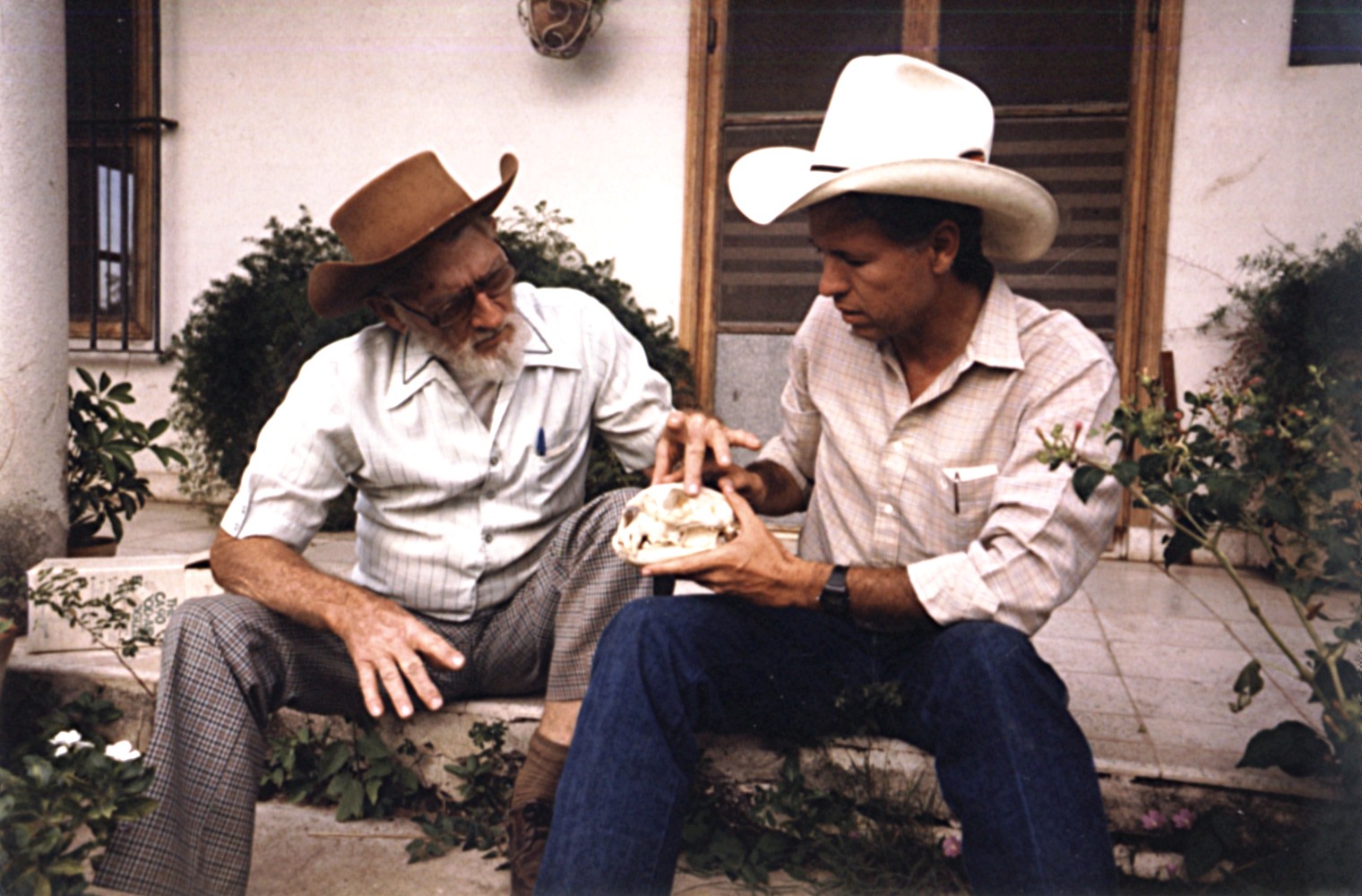
Robert E. Marshall and Ricardo Urquijo with the Vega onza skull (© International Society of Cryptozoology – permission to reproduce in my writings granted to me in perpetuity by J. Richard Greenwell, ISC Secretary)

Additionally, another onza investigator, Arizona hunter Robert E. Marshall, was successful in obtaining the incomplete skull (its lower jaw was missing) of an onza shot during the 1950s at Los Frailes, Sinaloa. Marshall was also the author of The Onza – published in 1961, it was the first book devoted to this cryptid; a second, Onza! The Hunt For a Legendary Cat, written by Neil B. Carmony, was published in 1995. Both make fascinating reading, and I highly recommend them to anyone interested in cryptozoology.

Around the time of the shooting of the Rodriguez specimen in January 1986, an onza was allegedly captured alive, and held for several days in captivity at a ranch in northern Sonora, where it was supposedly photographed too. Tragically, however, when no-one showed any interest in it, its owner shot it and threw its body away. As for the photographs, these have yet to make a published appearance. And in early 1987, yet another onza was reportedly shot in Sinaloa, this time by a wealthy Mazatlan businessman; but, true to form, its remains were not preserved.

Robert E. Marshall's book The Onza (© Robert E. Marshall/Exposition Press – reproduced here on a strictly educational, non-commercial Fair Use basis only)

In short, with the exception of three skulls, physical remains of onzas have displayed a disconcerting tendency to disappear beyond the reach of scientists. The Rodriguez specimen, however, changed all of that - for instead of destroying its remains, the ranchers contacted Richard Greenwell. Following a complex series of interchanges, the precious specimen was transported to the Regional Diagnostic Laboratory of Animal Pathology, belonging to Mexico's Ministry of Agriculture and sited in Mazatlan, Sinaloa.

There it was painstakingly studied and dissected by a biological team headed by American puma researcher Dr Troy Best, who had been working alongside Greenwell during his earlier onza investigations. After the dissection, extensive samples of skeletal material, tissues, and blood were taken for examination and analysis in various U.S. research institutions, in a bid to uncover the onza's taxonomic status. Several different taxonomic identities have been offered over the years, but the principal four are as follows.

Neil B. Carmony's book Onza! (© Neil B. Carmony/High-Lonesome Books – reproduced here on a strictly educational, non-commercial Fair Use basis only)

The most exciting possibility is that it could be a currently undescribed species - one that quite conceivably descended from the typical puma, but later diverged from it to fill the ecological niche left vacant by the extinction approximately 11,000 years ago of Miracinonyx trumani - an extraordinary felid now known to have been a true American cheetah (it was first classed as a cheetah-like puma). Indeed, German felid specialist Dr Helmut Hemmer initially mooted that the onza may actually be a surviving representative of Truman's cheetah, but after studying casts of two onza skulls and comparing them with fossil material from M. trumani, he changed his mind. However, regardless of whether it is even related to (let alone synonymous with) Truman's cheetah, if the onza is indeed a valid species in its own right it should be distinguishable from the puma via the biochemical and genetic analyses conducted by those researchers studying the Rodriguez specimen (see below).

Another intriguing, frequently-raised possibility is that the onza is a naturally-occurring hybrid of puma and jaguar (i.e. either a pumajag or a jaguma). No evidence for this identity was obtained, however, from examination of the Rodriguez specimen. In any case, hybrids of this type that have been bred in captivity bear no resemblance to onzas, appearing visibly intermediate between puma and jaguar instead.

Artistic representation of a Truman's cheetah attacking a pronghorn (© Hodari Nundu)

Two rather more conservative but still-interesting identities remain. The onza may simply be a mutant, non-taxonomically distinct form of the puma, the result of a genetic aberration that has yielded an uncommonly slim, leggy variety. If so, could it even be that an atavistic phenotype-influencing gene surviving from the period of shared ancestry by pumas and cheetahs but suppressed in normal pumas is somehow expressing itself in onza specimens, i.e. is responsible for 'onzaism' in pumas? If we take the Rodriguez specimen as a bona fide onza, the onza's gracility is, indisputably, a natural facet of its appearance (rather than starvation-induced emaciation), because this specimen was found to possess adequate amounts of body fat. Genetically-induced onzaism may be confined to Mexico due to genetic drift; then again, as I noted in my 1989 mystery cats book, onza-like cats have also been reported from South America, so if the onza is indeed a freak non-taxonomic variety of puma, perhaps the mutant onza-inducing gene (should it exist) is more widely distributed among the global puma population after all. If not a genetic freak, the onza could be a separate subspecies of puma, kept apart from the Mexican puma Puma concolor azteca by behavioural differences and dissimilar habitat preferences. If the last-mentioned identity were the correct one, however, then once again (as with the possibility that it is a separate species) we would expect the onza to be distinguishable biochemically and genetically from other pumas. But is it?

Early biochemical tests had failed to uncover any characteristics differentiating the Rodriguez specimen from pumas, which would seem to suggest that onza and puma are very closely related. Yet this conclusion stems from a fundamental assumption that, although widely accepted in the zoological (and especially the cryptozoological) community, has never actually been confirmed. Namely, that the onza specimen whose tissues provided these biochemical results, i.e. the Rodriguez specimen, really was an onza!

Illustration of a pair of pumas (© William M. Rebsamen)

However, is it conceivable that Manuel Vega had been mistaken, and that this animal had merely been a malformed or infirm puma that only outwardly resembled a genuine onza? After reflecting upon this disturbing possibility for some time, in January 1998 I heretically aired it within an onza article of mine published in the British monthly magazine All About Cats – and it seems that my suspicions may indeed have been justified.

Only a few months after my article had appeared in print, the much-delayed volume of the ISC's scientific journal Cryptozoology covering the years 1993-1996 was finally published, and contained a report by a research team featuring Prof. Stephen O'Brien, an expert in feline molecular genetics. The team's report revealed that after conducting comparative protein and mitochondrial DNA analyses using tissue samples taken from the Rodriguez onza and from specimens of known North American cat species, the results obtained for the Rodriguez onza were found to be indistinguishable from those of North American pumas. Of course, this does not necessarily mean that all onzas are pumas, but how savagely ironic it would be for the most celebrated supposed onza specimen not to have been an onza after all.

Cutting from the Arizona Daily Star (Tucson) newspaper dated 1 October 1938, featuring the then newly-snapped photograph of Clell and Dale Lee with the Shirk onza - the first onza photo ever published in the USA (© International Society of Cryptozoology – permission to reproduce in my writings granted to me in perpetuity by J. Richard Greenwell, ISC Secretary)

On 15 April 1995, an alleged male onza was shot behind Parrot Mountain, this time by rancher Raul Jiminez Dominguez. Later that same day, after having been frozen, the onza's corpse was examined by two biologists from the Universidad Nacional Autonoma de Mexico, who took tissue samples away with them for electrophoretic analysis. The remainder of its carcase was preserved and dissected at Mazatlan for future study. Frustratingly, no further information has been made public concerning this specimen, but let us continue to hope that it will eventually provide a precise, unequivocal answer to the longstanding question of the onza's taxonomic identity.

Meanwhile, Mexico's feline enigma seems destined to remain a cryptozoological controversy - a far cry indeed from its popular yet sadly premature image as an erstwhile mystery cat whose reality is no longer in doubt.

Drawing of the onza (© Hodari Nundu)

Finally: please be aware that certain early 20th-Century animal encyclopaedias contain photographs of jaguarundis Puma yagouaroundi labelled as onzas (confusingly, this species is indeed sometimes termed an onza in certain Mexican states, including Jalisco). Nevertheless, anything less like the very large, long-limbed onza of cryptozoology than the much smaller, short-limbed jaguarundi of mainstream zoology would be difficult to imagine.

Having said that: in 2016, Mexican Facebook friend and artist Hodari Nundu revealed that he once saw in Jalisco a dead specimen of what he refers to as a 'giant' jaguarundi. And he subsequently learnt of a possible second location for such specimens, but he has refrained from publicly identifying this location in order to keep these cats safe if any do indeed exist there, noting only that it is a very long distance from Jalisco. This indicates that if other extra-large jaguarundis do occur in Mexico, they may be relatively widespread. Moreover, if they are of this species' dark-grey/black colour phase, such cats may even explain reports here of mystery 'black panthers'.

Jaguarundi, grey colour phase (© Bodlina/Wikipedia – CC BY 3.0 licence)


This ShukerNature blog article is adapted from my book The Encyclopaedia of New and Rediscovered Animals – the most comprehensive book ever published on the subject of such creatures.