Dr KARL SHUKER

Zoologist, media consultant, and science writer, Dr Karl Shuker is also one of the best known cryptozoologists in the world. He is the author of such seminal works as Mystery Cats of the World (1989), The Lost Ark: New and Rediscovered Animals of the 20th Century (1993; greatly expanded in 2012 as The Encyclopaedia of New and Rediscovered Animals), Dragons: A Natural History (1995), In Search of Prehistoric Survivors (1995), The Unexplained (1996), From Flying Toads To Snakes With Wings (1997), Mysteries of Planet Earth (1999), The Hidden Powers of Animals (2001), The Beasts That Hide From Man (2003), Extraordinary Animals Revisited (2007), Dr Shuker's Casebook (2008), Karl Shuker's Alien Zoo: From the Pages of Fortean Times (2010), Cats of Magic, Mythology, and Mystery (2012), Mirabilis: A Carnival of Cryptozoology and Unnatural History (2013), Dragons in Zoology, Cryptozoology, and Culture (2013), The Menagerie of Marvels (2014), A Manifestation of Monsters (2015), Here's Nessie! (2016), and what is widely considered to be his cryptozoological magnum opus, Still In Search Of Prehistoric Survivors (2016) - plus, very excitingly, his four long-awaited, much-requested ShukerNature blog books (2019-2024).

Dr Karl Shuker's Official Website - http://www.karlshuker.com/index.htm

IMPORTANT: To view a complete, regularly-updated listing of my ShukerNature blog's articles (each one instantly clickable), please click HERE!

IMPORTANT: To view a complete, regularly-updated listing of my published books (each one instantly clickable), please click HERE!

IMPORTANT: To view a complete, regularly-updated listing of my Eclectarium blog's articles (each one instantly clickable), please click HERE!

IMPORTANT: To view a complete, regularly-updated listing of my Starsteeds blog's poetry and other lyrical writings (each one instantly clickable), please click HERE!

IMPORTANT: To view a complete, regularly-updated listing of my Shuker In MovieLand blog's articles (each one instantly clickable), please click HERE!

IMPORTANT: To view a complete, regularly-updated listing of my RebelBikerDude's AI Biker Art blog's thematic text & picture galleries (each one instantly clickable), please click HERE!

Search This Blog


PLEASE COME IN, I'VE BEEN EXPECTING YOU...

PLEASE COME IN, I'VE BEEN EXPECTING YOU...
WELCOME TO SHUKERNATURE - ENJOY YOUR VISIT - BEWARE OF THE RAPTOR!


Showing posts with label mngwa. Show all posts

Tuesday, 23 March 2021

IS THIS MYSTERIOUS PAINTING A PORTRAIT OF THE NUNDA?

Close-up of an extremely distinctive big cat that looks very like native descriptions of a Tanzanian mystery felid known as the nunda or mngwa, as depicted in a mysterious painting recently encountered and purchased by longstanding Facebook friend Maxine Pearson (© Maxine Pearson)

In a previous ShukerNature blog article (click here to access it), I documented one of the most ferocious mystery beasts ever recorded – an East African mystery big cat (morphologically but not necessarily taxonomically) that was reported from coastal Tanzania during the first half of the 20th Century, and known variously as the nunda or mngwa. It was blamed for the bloodthirsty slaughter of several locals during two separate outbreaks of killings, but was never captured. A few fur samples were obtained, but tragically they were not retained for formal scientific examination. According to eyewitness descriptions, however, this rapacious cryptid was described as being a cat the size of a donkey, and leaving behind leopard-like footprints the size of a lion's, but readily delineated from both leopards and lions by virtue of its most unusual pelage. This was said to be grey in colour and brindled in pattern, i.e. marked with streaks and possibly some spotting too, as brindled animals often exhibit spots among the streaks and stripes.

No known species of cat fits this description in toto. The nearest is the grey, sometimes spotted morph of the African golden cat Caracal (=Profelis) aurata, but at only twice the size of a typical domestic cat, this species is far smaller than the nunda, and surely therefore could not inflict the terrible wounds or attack humans with such overwhelming ferocity as described for the nunda. However, veteran cryptozoologist Dr Bernard Heuvelmans speculated that perhaps the nunda constituted a hitherto-undiscovered giant version of this species, which would be a truly belligerent beast to encounter.

 
My three books on mystery cats (© Dr Karl Shuker)

Tellingly, moreover, as I pointed out in my mystery cat books, locals have claimed that despite its huge size, the nunda does not roar like a Panthera big cat (lion, tiger, leopard, jaguar), but actually purrs, like what are collectively known taxonomically as the small cats, and which include the African golden cat among their number. In addition, the African golden cat is so notoriously elusive that it has actually been dubbed by mammalogists as Africa's least known felid (click here for more details), so of all cats native to this continent, it may well possess the greatest potential for unveiling unexpected, unsuspected attributes.

Over the years, a number of artists have sought to depict Tanzania's monstrous mystery cat, of which the following example is probably the best known:

 
Cryptozoological artist William Rebsamen's vivid representation of an attacking nunda (© William M. Rebsamen)

Very recently, moreover, what may be a hitherto-undocumented and truly spectacular painting of a nunda was discovered in the most unexpected of circumstances. Now, by kind permission of its discoverer (and purchaser), longstanding Facebook friend Maxine Pearson, here for your cryptozoological consideration via this ShukerNature world-exclusive is that truly remarkable and extremely beautiful painting, together with the sparse details currently available regarding it. Consequently, Maxine and I very much hope, kind readers, that you will be able to assist us in uncovering further information relating to it.

I first learned of this painting's existence on Sunday 21 March 2021, when I received a short message on Facebook from Maxine, enclosing the close-up of the cat in the painting that opens this present ShukerNature article, plus a close-up of the artist's signature, and the following information:

Jon Downes [of the Centre for Fortean Zoology, based in Devon, UK] said he thinks this may be a mngwa. I just got it from some charity auction. It's in oils. The painter's name [is] below although I don't know him. Any thoughts?

When I looked at the close-up photograph of the cat, I was certainly very intrigued, and could readily see why Jon thought that it might be a mngwa (aka nunda – I prefer the latter name, as it's easier to say!), and I replied to Maxine stating this. I asked if she could provide me with any additional details regarding the painting and any further photographs of it, which she very kindly did. I'm incorporating the most significant of those photos (which she snapped using her Samsung mobile phone) throughout this article, and here are the additional details:

Maxine lives in London, but the auction at which she won this painting was held next to the garrison at Eastbeach, Shoeburyness, in southeast Essex, England, by a Southend-based animal charity named Charlie Boys Angels (see details concerning it given at the end of this ShukerNature article), of which she is a member. Charlie Boys Angels helps homeless people with dogs, and as one of its means of raising funds for this very deserving cause it holds an auction every month. After winning the painting with a bid for £15, Maxine received it from Charlie Boys Angels about a week ago, and was quite surprised to discover how large it was, measuring approximately 4 ft across by just under 3 ft tall. The identity of the person who donated this painting to the auction is currently unknown, but Maxine has promised to ask the charity if they know, so I may be able to add this detail here at a later date.

 
Close-up of the artist's signature, visible at the bottom right-hand corner of the painting - click photo to enlarge it for viewing purposes (© Maxine Pearson)

Also currently unknown is the identity of the artist who painted it. As seen in the above close-up photograph of the artist's signature, his/her surname may be 'Peters', and the "'05" inscription next to it indicates that it was painted in 2005. However, Maxine is not totally certain that Peters is indeed what the signature reads as, and even if it is, Peters is a very common name, meaning that without additional information it would be exceedingly difficult to track the artist down. I have tried both a Google Image search and a Tineye Reverse Image search in the hope of discovering this painting online, but without success.

Interestingly, as seen here, when the painting is photographed in its entirety the colouration of the cat varies depending upon the painting's location. When Maxine photographed it by a window, the light from the window shining upon it rendered the cat very dark, so that it almost resembled a black panther (i.e. melanistic leopard), with its markings not particularly distinct. When the painting was placed on the floor, however, away from the direct light shining through the window, the cat was much lighter, with grey fur and very distinctive markings, and Maxine informed me that this latter appearance is the painting's normal one.

 
Maxine's painting when photographed by a window (© Maxine Pearson)

 
Maxine's painting when photographed on the floor (© Maxine Pearson)

So what could Maxine's mystifying cat be? Its build and face are those of a big cat, by which I mean a species belonging to the genus Panthera, and most closely resemble a leopard's or jaguar's. Its coat colouration and pattern, conversely, are fundamentally different from those of a leopard or jaguar. Instead of sporting the leopard and jaguar pelage's typical golden background colouration, Maxine's cat is uniformly grey. And instead of displaying the leopard's familiar rosette markings (also exhibited by the jaguar, but which additionally sports a central spot within each rosette that is lacking in the leopard's coat pattern), the pelage of Maxine's cat consists of a heavy mottling of single polka dots, not arranged into rosettes, but which in places merge together to yield streaks and short stripes, especially on the limbs and dorsal region.

Close-up of the painted cat's limbs, revealing merged spots (© Maxine Pearson)

I noted earlier here that the only known African cat that possesses a pelage similar to that of Maxine's mystery cat is the spotted grey morph of the African golden cat – a polymorphic species that exists in a range of different coat colours and patterns, including unspotted red, gold, grey, and black, plus spotted red, gold, and grey. Although most common and widely distributed in West Africa, it is now known to exist in Central and East Africa too.

For morphological comparison purposes, here are two African golden cat skins, the left-hand one representing its spotted grey morph, the right-hand one its spotted golden morph.

 
The skin of a spotted grey specimen of African golden cat (left) and the skin of a spotted golden specimen of African golden cat (right) (public domain)

And here is a close-up of the fur patterning of Maxine's mystery cat as depicted in the painting:

Close-up of the depicted mystery cat's fur patterning (© Maxine Pearson)

As you can see, there is certainly a resemblance.

To see what a spotted grey specimen of the African golden cat looks like in life, click here to view a photograph of one such animal that was snapped using a trail cam during a study of this elusive species' ecology and conservation by Laila Bahaa-el-din as part of her 2015 PhD in the School of Life Sciences at the University of KwaZulu-Natal in Durban, South Africa. And click here to download the entire paper containing this photo. You will see straight away, however, that whereas their coat colour and patterning are similar, the golden cat's head is very different in both shape and markings to that of Maxine's cat, which, as already noted here, is leopardine or jaguarine.

 
Close-up of the leopard-like or jaguar-like face of the mottled mystery cat depicted in Maxine's enigmatic painting (© Maxine Pearson)

Equally, it is its unique combination of leopard/jaguar-like head and grey mottled pelage that distinguishes this portrayed cat from any felid on record from anywhere outside Africa too.

So how do we explain this painting? Is it an attempt by someone with cryptozoological knowledge to depict the likely appearance in life of the nunda? Or might it portray some exceedingly rare, freak version of the leopard or jaguar, both of which are well known for the great variation of their coat colour and patterning? Yet I have never seen an example of either in which the rosettes have broken up into single or merged spots (although I have seen in both species the opposite extreme, where the rosettes have merged to yield an extraordinarily beautiful, striking pelage adorned with stripes and swirls greatly resembling that of the cheetah's rare king cheetah variant). Another option is that it constitutes some exotic big cat hybrid, of which a wide range have been bred in captivity. I know of a female jaglion (jaguar x lioness hybrid) named Jahzara, born at Bear Creek Wildlife Sanctuary in Ontario, Canada, on 9 April 2006, whose pure-bred jaguar father Diablo was melanistic and she has inherited his dark coat, but her markings are still rosettes, not polka dots (click here for full details). Or is it simply a portrayal of a fantasy felid, not based upon any real specimen but originating entirely from the artist's own imagination? At this stage, we simply do not know, but it is certainly most intriguing that the cat that it depicts should so closely recall a documented mystery cat from the same continent.

If anyone reading this ShukerNature article has any knowledge concerning this painting's origin and/or artist, or any thoughts that they would like to offer regarding the possible identity of the cat depicted in it, please post them below this article – Maxine and I would be very interested to read them!

My sincere thanks indeed to Maxine Pearson for so very kindly sharing her wonderful discovery and photographs of it with me, and for permitting me to document it here.

 
A close-up of the flank markings of Maxine's mystery cat as depicted in the painting (© Maxine Pearson)


CHARLIE BOYS ANGELS: Here is a description of what this very worthy charity is all about, quoted from their official Facebook page (click here to visit it):

Charlie Boys Angels support homeless and vulnerable individuals with their animals in the Southend and surrounding areas of Essex by providing essential items, access to free veterinary treatment and support to find pet friendly accommodation.

This page was set up to help us get our name out there and the fantastic work that we do and is dedicated in memory of a beautiful white staffie called Charlie Boy, let us tell you his story...

Charlie Boy and his owner were sadly made homeless back in November 2016 and it was around this time that this group was founded to help him with a skin complaint. Tragically in January 2017, they were both attacked on the street Charlie Boy jumped up to protect his owner and was fatally stabbed, he died a short time later.

After his death, our group and the local community was filled with heartfelt memorials for this brave boy who had sacrificed his life for his human so it was then that it was decided that we would continue our work in his memory to help others just like them who are homeless and vulnerable with their animals and also those without.

We provide:

- Animal items such as food, blankets, treats, collars, leads, coats, toys, flea & worm treatment etc.

- Clothing items such as Jackets, Jumpers, Hats & Scarves, Gloves etc.

- Help to find pet friendly accommodation

- Help towards the cost of vet treatment

- Foster Care in Emergency Situations

We want to prevent this tragic incident from ever happening to anyone else in the future and so far we have achieved this, making sure that everyone we work with are safe and have everything they need to look after their companions.

4 years into our work, we have now joined in partnership with the Aspirations Program whose mission is to empower individuals on their journey of recovery from the harmful effects of active addiction – working together to make a difference to people’s lives.

We do not receive any government grants and rely solely on support from the public and fundraising to help us continue the work that we do and keep our vet treatment free and accessible to those who need it the most. We have our current Facebook pages including our fundraising page.

We will add link into the comments below for ease.

We also have our wish lists on Amazon, again we will place a link below. Please share this post as it’s extremely difficult to arrange fundraising at this time due to current restrictions.

If you wish to kindly make a donation towards the work we do, you can do so by Bank Transfer directly to the below details as unfortunately we no longer have access to a PayPal account – all donations are so greatly appreciated.

Account Name: Charlie Boys Angels

Sort Code: 20-19-97

Account Number: 90007625

Reference: Donation

 Thank you most sincerely for reading this – Karl.


Monday, 28 July 2014

THE MPISIMBI – A NOW-EXTINCT KING CHEETAH STRAIN IN EAST AFRICA?

Painting of the king cheetah's type specimen as imagined in life, from PZSL, 1927 (public domain)


How tragic it is that such wonderful creatures have no concept, no awareness, of just how beautiful and magical they are.
Then again, perhaps they do - after all, they are cats...

Karl Shuker - Re king cheetahs, posted on his Facebook wall, 31 July 2010


Many mysterious African animals once thought to be legendary or wholly imaginary monsters solely confined to the realms of native folklore and superstition have ultimately been found to be real (albeit elusive) creatures that have successfully eluded formal scientific recognition until modern times. The mountain gorilla, okapi, giant forest hog, and pygmy hippopotamus were all dismissed as myths by Western science until the 20th Century. So too was another bizarre beast - the leopard-hyaena or nsui-fisi...until 1926.


UNMASKING THE NSUI-FISI

This was when a short letter penned by Major A.C. Cooper from Salisbury (now Harare) in Rhodesia (now Zimbabwe) was published by The Field, alongside his photograph of an extraordinary cat skin. Cooper believed the skin to be from a crossbreed of leopard and cheetah, which had been trapped at Macheke, about 62 miles southeast of Salisbury, but he was astonished by the exceptionally ornate markings adorning its golden-yellow coat, which were unlike those of any cat previously recorded by science. Upon its flanks and upper limbs they consisted of graceful curved stripes and abstract blotches, whereas a series of longitudinal stripes ran from its neck and shoulders along the entire length of its back to the upper portion of its tail, and a succession of thick black stripes encircled the remainder of its tail. Also of note were its non-retractile claws (a cheetah characteristic), and a mane-like ruff round its neck.

Back view of a king cheetah, revealing its very eyecatching longitudinal dorsal stripes (© Steve Jurvetson-Wikipedia-Flickr)

This wonderful creature matched traditional tribal descriptions of a strange monster termed the nsui-fisi (‘leopard-hyaena’), which was fervently claimed by Rhodesian natives to be the rare, exotic progeny of liaisons between leopards and hyaenas, as it was said by them to be as lithe, swift, and cunning as a leopard but boldly barred like the striped hyaena Hyaena hyaena. Such an identity was zoologically impossible, of course, but the fact remained that Cooper's mysterious big cat was still unexplained.

Not surprisingly, it soon attracted the attention of felid specialist Reginald Pocock, from the British Museum (Natural History), who identified it from Cooper's photograph as an aberrant leopard. (Interestingly, during the early years of the 20th Century, cats just like it had apparently been well known to locals in the Mazoe area of Rhodesia's northern region, where they were referred to as Mazoe leopards.) Once he was able to examine the skin itself, however, he swiftly changed his mind, recognising it to be from a cheetah - albeit one with dramatically different coat markings from the familiar polka-dot pelage of the normal cheetah Acinonyx jubatus. In 1927, Pocock announced that the skin represented a new species, which, due to its regal appearance and vaguely leonine mane, he dubbed Acinonyx rex - the king cheetah.

King cheetah (© Steve Jurvetson-Wikipedia-Flickr)

During the next few years, several other king cheetah skins were obtained - all from a triangle of terrain enclosing eastern and southern Zimbabwe, northern South Africa, and eastern Botswana - but as the number of skins increased, it became evident that some of these were intermediate in appearance between normal cheetahs and the first king cheetah, documented by Major Cooper. In other words, there was no longer a clear morphological demarcation line between spotted cheetahs and the striped king cheetah. This could mean only one thing - the king cheetah was not a distinct species in its own right after all. Instead, it was merely a freak mutant variety of the normal cheetah - which Pocock conceded in 1939.

As a result, interest in the king cheetah waned, and after a time reports of such specimens rarely emerged. Indeed, by the 1970s some zoologists had begun to fear that this handsome striped strain had died out, but during the 1970s a king was filmed living with normal cheetahs in the Kruger National Park.

The 1970s Kruger-inhabiting king cheetah individual, as featured on the front cover of leading king cheetah researcher Lena Bottriell's definitive book, King Cheetah (1987)

Today, there is no doubt that the king cheetah is indeed alive and well, with several specimens having been born within litters of normal spotted cheetahs in captivity in South Africa.


THE GENETICS OF A KING

Since its scientific discovery, there has been a great deal of conflict concerning the king cheetah's taxonomic status. At first it was believed to be a hybrid of leopard and cheetah, then a valid species, and ultimately a mutant form of the normal cheetah. In May 1981, however, the de Wildt Cheetah Breeding and Research Centre of Pretoria's National Zoological Gardens was able to examine this issue in a thorough manner, when a king cheetah was unexpectedly born to a pair of normal cheetahs here. A few days later, moreover, a second king was born, this time to the sister of the first king's mother.

Two normal spotted cheetahs

These fortuitous events duly initiated a programme of monitored breeding conducted at the centre, in order to determine the genetic basis of the king cheetah phenotype. By 1986, it had become clear that a recessive mutant allele was responsible, equivalent to the recessive allele producing the blotched tabby coat pattern in domestic cats. In other words, only cheetahs with two copies of the 'king' allele are kings. Cheetahs with one copy of the king allele and one of the normal (wild-type) spotted allele, or cheetahs with two copies of the spotted allele and none of the king allele, are normal spotted cheetahs.

Moreover, in a paper published by the journal Science in September 2012, a team of American genetics researchers from several different institutes revealed that they had identified the specific gene responsible for the king cheetah's striped coat pattern and the blotched coat pattern in domestic tabby cats. Both are caused by a recessive mutation in a gene dubbed Taqpep by the researchers.

Close-up of a king cheetah's fur, revealing its blotched-tabby-homologous pelage markings (© Wegmann/Wikipedia)

And so, one mystery concerning the king cheetah is a mystery no more - but there are others that still await a solution, and none is more fascinating than the following example.


UNMASKING THE MPISIMBI?

What makes the king cheetah so memorable in addition to its incredibly beautiful coat is its extremely limited distribution. Many freak mutations of coat colour or patterning in mammals are spontaneous, i.e. they can arise abruptly in any population of a given species, regardless of geographical location. Yet whereas the typical spotted cheetah occurs in southern, eastern, central, northern, and western Africa, king cheetahs have never been reported conclusively outside southern Africa – or have they?

There are two possible and potentially extremely significant exceptions to this widely-assumed rule (and three, if we consider some remarkable evidence that I lately uncovered for the erstwhile presence of at least one king cheetah specimen in the wild not anywhere in Africa, but instead in Asia, and which in 2013 I formally documented in Vol. 2 of the Journal of Cryptozoology, whose logo, very aptly, is a king cheetah – click here for further details).

A young king cheetah (© DannyBlue/Deviantart)

The first possible exception to the king cheetah's strict zoogeographical limitation to southern Africa is a king cheetah skin that in 1988 turned up in the West African country of Burkina Faso. It supposedly came from a specimen that had been shot by a poacher in the northern end of the Singou Total Fauna Reserve. Some researchers wonder whether this mystifying skin is one that in reality originated in southern Africa but which later travelled northwest via itinerant poachers or other skin traders. Alternatively, however, could a 'king' strain of cheetah have spontaneously arisen in West Africa?

As for the second putative exception to the rule of the king cheetah being exclusively southern African in distribution, this is one that has never been publicly revealed – until now. It features an extremely obscure East/Central African mystery beast known as the mpisimbi

King cheetah head (above) and normal spotted cheetah head (below)

In 1927, Chambers’s Journal published a fascinating article on East and Central African mystery beasts entitled ‘On the Trail of the Brontosaurus and Co.’. It was written by ‘Fulahn’, the pen-name of Captain William Hichens - a man whose name should already be familiar to mystery cat aficionados. For he was none other than the Native Magistrate at Lindi, Tanzania, during the 1920s and 1930s who investigated a succession of particularly gruesome murders there attributed by the local people to a giant brindled mystery cat known as the nunda or mngwa (click here for a ShukerNature blog post devoted to this feline cryptid).

Most of the cryptids documented by Hichens in his Chambers's Journal article are relatively famous ones, with one notable exception. Contained within his account are a couple of tantalising lines that have fascinated and frustrated me in equal measures for many years:

"But such are the mystery animals. There are others – the mpisimbi, the leopard-hyaena, which eats sugar-cane, and which I have hunted many a weary night without success;"

Despite numerous searches, I have never been able to uncover any additional information concerning this enigmatic creature. So what exactly is the mpisimbi?

King cheetahs (© David Pepper-Edwards)

The above-quoted lines offer no morphological description whatsoever of the mpisimbi. Conversely, its name’s English translation – ‘leopard-hyaena’ - is very intriguing, because it corresponds precisely with the English translation of the king cheetah’s native South African name, nsui-fisi. Moreover, Hichens’s unusual claim that the mpisimbi eats sugar-cane adds further to a putative link between the mpisimbi and the king cheetah, because in a second article, published under his own name a year later in Wide World Magazine, Hichens stated: “The Nsuifisi, or striped cheetah...was also reputed to be a raider of grain and sugar-cane”.

Of course, as Hichens went on to discuss, because cheetahs are carnivores it seems improbable that they would raid grain-plots. And even though hyaenas are notorious scavengers with an extremely catholic diet, they are not known to attack standing crops, but they will certainly devour cooked grain, vegetables, and even boiled flour.

King cheetah (© AKovacs23/Photobucket)

Such considerations and qualifications, however, are not significant with regard to the cryptozoological mystery under review here. What is significant is that both the mpisimbi and the nsui-fisi were claimed, rightly or wrongly, by the native tribes in their respective, separate areas of Africa to consume the very same unexpected foodstuff – sugar-cane.

Is it conceivable, therefore, that the mpisimbi and the nsui-fisi are indeed one and the same creature – namely, the king cheetah? If so, it suggests that at some time in the distant past, striped cheetahs did exist in East and/or Central Africa – although, with no modern-day reports of such beasts on file, even if they once did exist there they seemingly no longer do. Put another way: whatever it may have been, tragically the mpisimbi is now apparently extinct.

King cheetahs (© David Pepper-Edwards)

Of course, sceptics may well claim that this is all supposition, but the presence of those brief lines regarding the mpisimbi in Hichens’s article means that the possibility of mpisimbi and king cheetah synonymity, however remote it may seem, cannot be discounted.

Moreover, who can say whether, in the future, a king cheetah or two will not spontaneously arise in the East African population of the normal spotted cheetah? That is, after all, what spontaneous mutations do!

At present, however, the mystery of the mpisimbi's zoological identity remains yet another enigma in the eventful history of Africa's extraordinary striped cheetah - the once (and future?) king.

Diagrammatic representation of the king cheetah's ornate pelage patterning (© Tim Morris)

For plenty of fascinating additional information concerning king cheetahs and other exotic cheetah varieties (including woolly cheetahs, blue-spotted cheetahs, black cheetahs, and unspotted cheetahs or cheetalines, be sure to check out my two dedicated crypto-cat books – Mystery Cats of the World (Robert Hale: London, 1989) and  Cats of Magic, Mythology, and Mystery (CFZ Press: Bideford, 2012).


Sunday, 16 September 2012

NANDI BEARS AND DEATH BIRDS - MY TOP TEN DEADLIEST MYSTERY BEASTS !!


Nandi bear by sunset (Markus Bühler)

Not all mystery beasts on record are shy, reclusive creatures that take great pains to avoid humankind at all cost. Some, conversely, are actively belligerent, ferocious animals that have reputedly attacked and killed people with impunity, or at the very least, if confronted, possess all manner of ingenious but equally devastating ways of dispatching their foolhardy antagonists.

Here, then, in no particular order is my own personal listing of the world's top ten deadliest cryptids – lethal life-forms that only the most brash, or rash, field cryptozoologist is likely to consider pursuing...at their peril!


NANDI BEAR

The year was 1925. A six-year-old girl had been mysteriously abducted from her village in the Nandi region of Kenya by a greatly-feared monster known locally as the chimiset, and Captain William Hichens of the Intelligence and Administrative Services of East Africa had been instructed by the Kenyan government to investigate. Science did not - and still does not - recognise the existence of the chimiset, but it is an all-too-familiar creature to the native Nandi people, and also to European settlers here, who call it the Nandi bear on account of its bear-like head.

Consequently, Hichens took the matter seriously, and set up camp near to a small forest-clad kopje (boulder hill) from where the chimiset reputedly emerged periodically. One night, Hichens was asleep in his tent, with his mongrel hunting dog, Mbwambi, tied to a pole outside, when suddenly:

"...the whole tent rocked; the pole to which Mbwambi was tied flew out and let down the ridge-pole, enveloping me in flapping canvas. At the same moment the most awful howl I have ever heard split the night. The sheer demoniac horror of it froze me still...I heard my pi-dog yelp just once. There was a crashing of branches in the bush, and then thud, thud, thud, of some huge beast making off. But that howl! I have heard half a dozen lions roaring in a stampede-chorus not twenty yards away; I have heard a maddened cow-elephant trumpeting; I have heard a trapped leopard make the silent night miles a rocking agony with screaming, snarling roars. But never have I heard, nor do I wish to hear again, such a howl as that of the chimiset. A trail of red spots on the sand showed where my pi-dog had gone. Beside that trail were huge footprints, four times as big as a man's, showing the imprint of three huge clawed toes, with trefoil marks like a lion's pad where the sole of the foot pressed down. But no lion ever boasted such a paw as that of the monster which had made that terrifying spoor."
Although Hichens pursued these tracks, which did indeed lead to the kopje, and spent at least a week searching the forest for whatever had made them, he did not succeed in his quest - but in view of his dog's dreadful fate, that may not have been such a bad thing!

The Nandi bear may well comprise more than one type of animal. As revealed by cryptozoologist Dr Bernard Heuvelmans in his pioneering book On the Track of Unknown Animals (1958), accounts of several wholly distinct animals appear to have been erroneously assigned by earlier authors at one time or another to this formidable mystery beast - involving spotted hyaenas, unusually large baboons, honey badgers, aardvarks, even the occasional murderous witchdoctor. However, there may also be one or two genuinely unknown species involved.

Some Nandi bear reports describe hyaena-like beasts, but far larger than any known to exist today, and sporting a dark shaggy pelage quite unlike that of the spotted hyaena Crocuta crocuta, which is the world's largest modern-day hyaena species. Also, the Nandi bear is far more aggressive than typical contemporary hyaenas. Prior to the close of the Pleistocene epoch, a mere 10,000 years ago, however, Africa was known to harbour a terrifying species called the short-faced hyaena Procrocuta brevirostris. Although related to the small modern-day brown hyaena Hyaena brunnea, it was characterised by its enormous lion-sized stature, and also by its short bear-like muzzle and active hunting behaviour (in marked contrast to the carrion-sustaining lifestyle typifying today's hyaenas). If such a creature as this has persisted into the present day within the dense little-explored forests of Kenya's Nandi region, we may not need to seek further for the Nandi bear's identity.
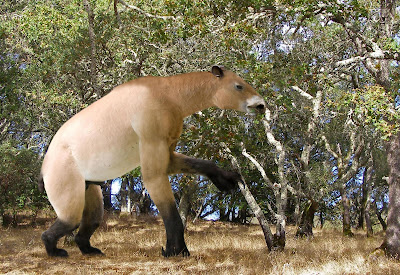
Is the Nandi bear a living chalicothere? (Philip72/Wikipedia)

Moreover, Pleistocene Africa was also home to a bizarre type of ungulate known as a chalicothere, which resembled a horse-sized hyaena in general outline, and possessed sharp claws instead of hooves typical of other ungulates. Although chalicotheres were herbivores, a brief sighting of such a creature could well convince a native hunter or anyone else not well-versed in zoological taxonomy that they had encountered a giant hyaena. Accordingly, several zoologists have seriously entertained the idea that perhaps a species of African chalicothere survived beyond the Pleistocene into modern times, giving rise to reports of Nandi bears.

One intriguing item of Nandi bear lore that supports this identity is the claim by Kenyan residents that this mystery beast was once quite common here but was almost exterminated in the 1890s by a plague of rinderpest that swept across most of Africa, devastating livestock and wild buffaloes. Rinderpest, of course, principally kills ungulates, not carnivores - a fact cited by sceptical scientists as evidence that the Nandi bear is a native fantasy. Yet if this animal is a species of chalicothere, it could indeed be susceptible to rinderpest.

And if, like some other ungulates, including bull elephants, hippos, Cape buffaloes, and peccaries, chalicotheres display bouts of savage unpredictable aggression (vegetarian lifestyle notwithstanding), we can easily comprehend why the Nandi bear is so greatly feared.

For additional details on ShukerNature re the Nandi bear, click here.


ARTRELLIA (PAPUAN DRAGON)

After spending many hard hours on the trail of wallabies and other animals for food through the jungles bordering the Binatori River, the young Papuan hunter was weary. Consequently, he was very pleased to spy an extremely large, fallen tree trunk lying on the ground nearby, half-hidden in the lush green undergrowth. Hurrying over, he sat down in aching relief upon its supporting, welcoming bole - but not for very long. Seconds later, his sturdy seat began to move, raising itself - and him - off the ground in a violent surge of energy. Leaping off in alarm, the hunter turned round - and was horrified to discover that the 'tree trunk' was actually a gigantic lizard! And as he gazed, motionless with fear, the lizard reared up onto its hind legs like a veritable dragon, standing more than 10 ft high, with its long tail splayed out behind, and its huge crocodile-like jaws open wide, revealing a brimming armoury of dagger-like teeth - and a long orange-yellow tongue, which flicked rapidly like living fire!

Faced with this towering monstrosity, the hunter did what any self-respecting person would do in similar circumstances - he fled with all speed, back along his hunting trail to the safety of his home village, Giringarede, not even glancing back to see whether his saurian aggressor was following him. Happily, it was not - or, at least, not swiftly enough, because he reached his village safely, and lived long enough to tell the dramatic tale of his escape to his children, and to theirs. He was one of the lucky ones - not everyone survives an encounter with what the tribes inhabiting Papua New Guinea (the eastern half of New Guinea) call the artrellia, and what cryptozoologists call the Papuan dragon.

With a total area of approximately 342,000 square miles, New Guinea is the world's second largest island after Greenland, and contains immense expanses of tropical jungle and swamplands only sparsely explored by scientists and western travellers. Not surprisingly, therefore, cryptozoologists believe that it holds considerable promise as a locality for major zoological discoveries in the future - a belief fuelled by reports of several mysterious creatures still unrecognised or unidentified by science.

One of the most spectacular of these cryptic creatures is the artrellia, which the local people describe as a gigantic crocodile-like lizard or dragon, up to 30 ft long, capable of climbing trees, breathing fire, and liable to kill and eat any humans who chance upon it amid its dense jungleland domain. Nor are artrellia reports confined to native testimony.

A number of British, American, and Japanese soldiers stationed in Papua during World War II reported seeing huge lizards estimated by them to be 15-20 ft long prowling the forests. Similarly, in 1960, David Marsh, Port Moresby's district commissioner, revealed that he had made two giant lizard sightings in western Papua during the early 1940s.

In 1980, an international scientific expedition called 'Operation Drake' visited Papua New Guinea, and its leader, renowned explorer Lieutenant-Colonel John Blashford-Snell, was particularly interested by native testimony and accounts regarding the artrellia, including the incident recalled at the beginning of this article.

After bribing local hunters to capture an artrellia and bring it to him, he was delighted when they succeeded in doing precisely that - enabling its species to be formally identified at last. It was a monitor lizard, specifically Salvadori's monitor Varanus salvadorii, also called the tree dragon, which is the world's longest known species of lizard, and has been confirmed to attain lengths of up to 15.5 ft.

Salvadori's monitor – the real artrellia?
Having said that, the specimen obtained for Blashford-Snell was hardly a monster, measuring only a little over 6 ft long. When its body was examined, however, it was found to be just a youngster, a juvenile specimen, so its potential maximum adult size could only be guessed at. Needless to say, its flickering orange-yellow tongue would certainly have been sufficient to inspire local claims that it breathed fire like a dragon. In addition, as revealed by one of its common names, this species does climb trees, and large monitors are indeed known to rear up and even run for a short time on their hind legs - all of which corresponds well with native accounts of the greatly-feared artrellia.

During this same expedition, moreover, one team member had a close, albeit brief, encounter with an artrellia that appeared to be rather more akin to the legendary giant specimens spoken of by the tribespeople. English zoologist Ian Redmond had been sitting quietly by a waterhole in a creek bed below the level of the forest floor in the Fly River region of Papua when he heard a series of heavy crunching footsteps coming ever closer across the forest's leaf-covered ground, sounding like human steps and not at all like the lighter, rapid scurrying noise that one would expect from a lizard.

Thinking that it was a colleague playing a joke on him, Redmond refused to look round at first, but when his curiosity finally got the better of him he did turn round - and saw an exceedingly large monitor lizard looking at him over a log close by. He couldn't see the whole lizard, just its head and shoulders - but they were as big as a horse's! And as Salvadori's monitor does not have a disproportionately large head and shoulders, how big must the rest of this lizard have been? Redmond bent down to reach for his camera, but as he did so the lizard moved away, and he did not see it again.

The famous gigantic Komodo dragon Varanus komodoensis of Indonesia, up to 10 ft long, is proof enough that huge - and occasionally man-eating - monitor lizards do exist. And amid the vast unexplored rainforests of New Guinea, extra-large specimens of Salvadori's monitor could readily thrive, avoided by native people, rarely spied by western visitors, and occupying much the same top predator niche here that their Komodo relatives occupy on their eponymous Indonesian island home.


NUNDA (MNGWA)
A mystery beast inciting immense terror among local people sharing its homeland is the mngwa or nunda - Swahili for 'strange one'. Aptly named and reputedly indigenous to the coastal forests of mainland Tanzania, this unidentified creature is said to be an enormous and singularly ferocious grey cat, larger than a lion and further differentiated from all known species of African cat by its peculiar brindled fur.

During the 1920s, there was a spate of savage killings claimed to be the work of a nunda, in which several people in the Tanzanian coastal village of Lindi were attacked and their bodies horrifically mangled. As with the Nandi bear rampage described earlier, Captain William Hichens investigated, but although he did not succeed in spying a nunda, he did examine the body of one of its victims, and found a matted clump of strange brindle-grey fur clenched in his fist, as if he had torn it out while attempting to fight off his feline assailant.
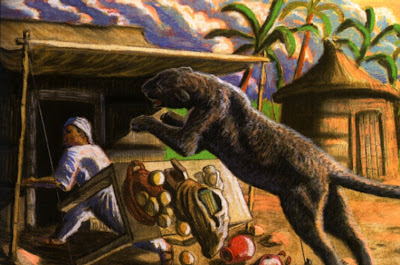
A nunda attack (William Rebsamen)
Another European investigator, Patrick Bowen, observed some nunda pawprints, which resembled those of a leopard but were as large as a lion's. Cryptozoologists have proposed that the nunda may be a giant form of golden cat Profelis aurata, an extremely savage species with very varying fur colour and patterns, which might conceivably account for the nunda's odd brindled pelage.

For a more detailed ShukerNature blog post re the nunda, click here.


HIDE

Several seemingly unknown species of extra-large jellyfishes have been reported over the years, but these have usually been fairly typical in shape, if not in size. However, there is one very macabre mystery beast on record that may well be a scientifically-unknown representative of one of their more specialized, deepwater forms.

This is the singularly eerie creature spied in 1953 by an Australian diver while testing a new type of deep-sea diving suit in the South Pacific. As revealed by Eric Frank Russell in his book Great World Mysteries (1957), the diver had been following a shark, and was resting on the edge of a chasm leading down to much deeper depths, still watching the shark, when an immense, dull-brown, shapeless mass rose up out of the chasm, pulsating sluggishly, and flat in general outline with ragged edges.

Despite appearing devoid of eyes or other instantly-recognizable sensory organs, this malign presence evidently discerned the shark's presence somehow, because it floated upwards until its upper surface made direct contact. The shark instantly gave a convulsive shudder, and was then drawn without resistance into the hideous monster's body. After that, the creature sank back down into the chasm, leaving behind a very frightened diver to ponder what might have happened if that nightmarish, nameless entity had not been attracted towards the shark!

In the past, a deep-sea octopus has been put forward as a possible identity for this disturbing creature, but in reality, as I first revealed in my book From Flying Toads To Snakes With Wings (1997), a deep-sea jellyfish is a much more plausible candidate. To begin with, all octopuses have tentacles, but a number of jellyfishes (including various known deep-sea species) do not. However, all jellyfishes are armed with nematocysts (sometimes on their body surface as well as upon their tentacles), which in some species, as noted earlier, can elicit paralysis or indescribable pain. Accordingly, if the amorphous creature observed by the diver was equipped with a plentiful supply of these, the immediate paralysis of the shark could be readily explained.

In addition, although the shark's killer lacked such obvious sensory organs as eyes (this is true of all jellyfishes), its ability to detect the shark can again be explained via the jellyfish identity. This is because these animals possess primitive sensory structures receptive to water movements. Hence the creature would have been able to detect the water disturbances created by the shark's swimming. How fortunate it was, therefore, that, by choosing to watch the shark, the diver had remained stationary!
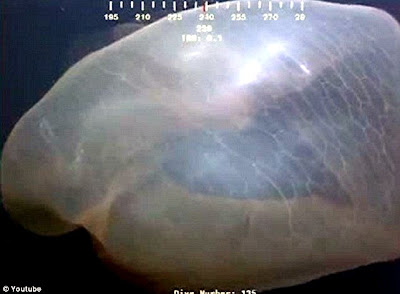
Deepstaria enigmatica, a bizarre, flattened species of deep-sea jellyfish (http://2.bp.blogspot.com)
Deep-sea jellyfishes similar (though not identical) to the above-described creature encountered by the diver may explain Chilean legends of a grotesque sea monster termed the hide, documented by Jorge Luis Borges in his famous work The Book of Imaginary Beings (1969). According to Borges, the hide is an octopus that resembles in shape and size a cowhide stretched out flat, with countless eyes all round its body's perimeter, and four larger ones in the centre. It lives by rising to the surface of the sea and swallowing any animals, or people, swimming there.

As this description makes no mention of tentacles, it seems highly unlikely that such a beast (assuming that it really does exist) could be any form of octopus. In any event, octopuses only have a single pair of eyes, not a whole series around the edge of their body and two pairs of principal eyes. Conversely, many jellyfishes possess peripheral sensory organs called rhopalia, which incorporate simple light-sensitive eyespots or ocelli.

Moreover, although no jellyfish has true eyes, some - such as the common moon jellyfish Aurelia aurita - have four deceptively eye-like organs visible in the centre of their bell (which are actually portions of their gut, known as gastric pouches). In short, a jellyfish candidate provides a far more realistic answer to the question of the hide's identity than an octopus.

In May 2012, a hitherto scarcely-known and somewhat amorphous, sheet-like species of deep-sea jellyfish known as Deepstaria enigmatica hit the global headlines when a specimen was filmed by underwater cameras during a deep-water drilling operation near the U.K. It is usually found at depths of 5000 ft in the south Atlantic Ocean. Who knows what other, and conceivably much more deadly, relatives lurk within the uncharted chasms of our planet's deepest waters?


ETHIOPIAN DEATH BIRD

Just before Ethiopia was invaded by Italy in 1935, archaeologist Byron de Prorok took part in an expedition to the southern Ethiopian province of Walaga, where, as noted in his book Dead Men Do Tell Tales (1943), he was shown a dreaded cavern called Devil's Cave. Here, according to native tradition, live flocks of a small but terrible blood-drinking bat known as the death bird, which emerge at night and surreptitiously drink the blood of local goatherds while they sleep until they eventually die and are replaced by new goatherds.

Does an unknown species of Old World blood-drinking bat lurk in Ethiopia's Devil's Cave?
As the only sanguinivorous bats known to science are the three species of vampire, all of which are found only in the New World, de Prorok did not believe these stories - until he was taken to the goatherds' camp nearby, where he saw that all of the herders had wounds on their arms resembling small puncture wounds. He also saw one herder close to death - little more than a skin-clothed skeleton surrounded by blood-stained rags.

Over 70 years have passed since then and the death bird's identity is still a mystery, but with sizeable areas of Ethiopia scarcely explored due to civil unrest, it is likely to remain so for the foreseeable future.


MONGOLIAN DEATH WORM

Also known to the nomadic inhabitants of the southern Gobi desert as the allghoi khorkhoi ('intestine worm') because of its supposed resemblance to a living intestine, the death worm is said to be up to 5 ft long, dark red in colour with brown spots, and has pointed projections at both ends of its body. Spending much of the year hidden beneath the desert sands, it emerges only during the two hottest months (June and July), but is avoided by humans and even camels, because it can kill instantly, and via two wholly different means.

This deadly mystery beast can allegedly squirt a highly virulent, corrosive venom, which presumably acts by burning its way through the victim's flesh into the bloodstream like a potent acid. It can also kill much more mysteriously, by touch. Indeed, its lethal power can even be transmitted via metallic objects - as fatally discovered by a visiting geologist many years ago, when he accidentally prodded a death worm with a metal rod.

If true, this suggests that the worm can kill by electrocution, and must therefore be able to generate electricity, like the electric eel and certain other fishes. At present, however, despite a number of expeditions in search of this macabre mystery beast led by Czech explorer Ivan Mackerle during the 1990s, and several others by additional field investigators in more recent years, the death worm's reality has yet to be formally confirmed.
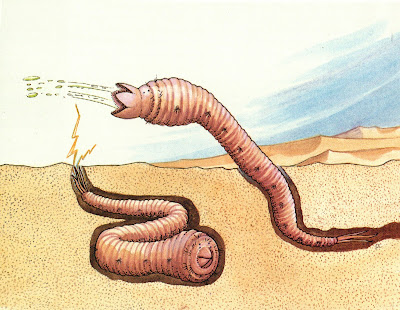
Mongolian death worm, shocking and spitting (Philippa Foster)
In terms of its morphology, it most closely resembles an extra-large worm-lizard or amphisbaenian. If this is indeed its identity, however, the death worm's lethal talents may be nothing more than folklore, because all currently-known species of amphisbaenian are harmless.

For a more detailed ShukerNature blog post re the Mongolian death worm, click here.


MAMBA MUTU

Native villagers in Burundi, in eastern Africa, especially those living alongside the Lukuga River and on the shores of Lake Tanganyika, live in considerable fear of a still-unidentified water beast known to them as the mamba mutu. Their descriptions call to mind a weird monster, half-human and half-fish, which kills people and sucks their bodies dry of blood - a kind of vampire mermaid.
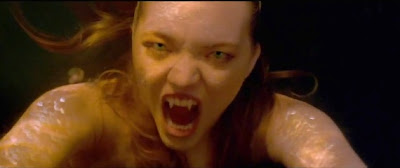
A vampire mermaid (keventertainment.files.wordpress.com)

When such reports as these were analysed by Spanish investigator Carlos Bonet in 1995, however, he proposed a more sober explanation - suggesting that an unknown species of extra-large, flat-skulled otter may be responsible. A popular alternative identity on offer is that the mamba mutu is merely a lake-dwelling manatee, transformed by fearful native superstition from a shy inoffensive herbivore into a lurking monstrous blood-sucker.


WAHEELA

According to those few travellers intrepid enough to traverse the remote forest and tundra constituting the borderland of eastern Alaska and Canada's Yukon Territory, this forbidding terrain is home to a truly formidable beast termed the waheela - justifiably feared by the local Amerindians for its terrifying ability to decapitate a human with just a single bite!

One of these cryptids was encountered and shot at twice by a hunter friend of cryptozoologist Ivan T. Sanderson called Frank while tracking along a tributary of the Nahanni Valley in the Northwest Territories during the 1940s or 50s. However, the creature merely moved off, apparently unharmed.

In general appearance, the waheela allegedly resembles a huge snow-white wolf, but its head is proportionately wider and its limbs shorter, its coat is notably long and dense, its feet are very splayed, its ears are surprisingly small, and its tail is extremely thick. In addition, whereas true wolves hunt in packs, waheelas are solitary creatures.
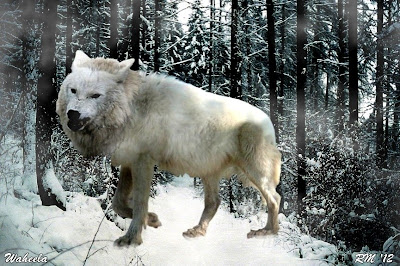
Waheela reconstruction (Randy Merrill)
Although this mystery beast does not seem to resemble anything known to modern-day zoology, it does bear a remarkable resemblance to the amphicyonids or bear-dogs. These very large, sturdy bear-like carnivores but with wolf-like heads supposedly died out several million years ago in North America, but in the inhospitable tundra terrain rarely explored or traversed by humans, perhaps a relict species, adapted for existence in this bleak habitat, has survived, and is still occasionally spied by the more intrepid Inuit or western tracker.


CROWING CRESTED COBRA

Many strange reptiles have been reported, and some officially recorded and recognised, from Africa since European zoologists first began to explore this vast, fauna-rich continent - but few are more bizarre, elusive, or dangerous than the crowing crested cobra, reports of which have emerged from many parts of Africa, but particularly its eastern and central regions.

Known by many local names, one of its most common ones is 'inkhomi' – 'the killer', which it has earned as a result of its tendency to conceal itself on sturdy overhanging branches, waiting for an unwary human to walk underneath, whereupon this highly aggressive, exceedingly venomous snake is said to lung down and swiftly inflict a lethal bite with its deadly fangs.

Despite its wide distribution, the crowing crested cobra's description is markedly consistent - a very lengthy, greatly-feared serpent greyish-black or buffish-brown in colour, but instantly distinguished from all others by its scarlet face, the remarkable bright-red coxcomb-like crest projecting forwards on its head, a pair of red facial wattles (in the male), and the amazing ability to crow, just like a farmyard rooster!
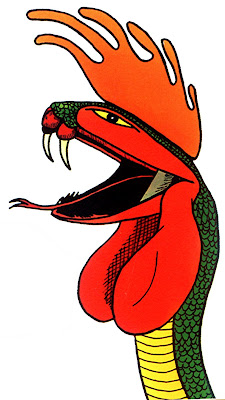
Crowing crested cobra (Dr Karl Shuker)

Nevertheless, however similar to the legendary cockatrice this monstrous snake may seem, countless eyewitnesses claim to have seen it, and there are even some preserved partial specimens on record. In 1944, Dr J.O. Shircore published a report describing what he claimed to be the bony skeleton of the fleshy coxcomb and part of the neck (containing several vertebrae) from a crowing crested cobra, which he personally owned. Sadly, however, these cryptozoologically-priceless relics current origin is unknown - like so many other such specimens, they have probably been discarded without ever having been submitted to a scientific establishment for formal examination.

In May 1959, John Knott apparently ran over one of these extraordinary serpents while driving home in his Land Rover from Binga in the Kariba region of what is nowadays Zimbabwe. Measuring 6.5-7 ft long and mortally wounded but still alive, the snake was dark in colour and bore a very conspicuous crest on its head. Sometimes, old black mambas Dendroaspis polylepis have crests, consisting of incompletely sloughed skin, which may have given rise to some reports of crowing crested cobras. However, the crest of Knott's snake was distinctly formed, perfectly symmetrical in shape, and containing five internal prop-like structures that enabled it to be erected. Understandably, the prospect of attempting to capture a very large, severely-injured snake belonging to a wholly unfamiliar species and bring it back home for identification did not appeal to Knott, who drove off after observing it closely. Once again, therefore, conclusive evidence for this creature's existence was lost.

Perhaps the most extraordinary attribute of the crowing crested cobra is its famed ability to crow. Even so, it is now known that some snakes are able to give voice to more than the limited range of sibilant hissing traditionally associated with these limbless reptiles. Indeed, during the 1980s, a scientific team in Borneo was very startled to encounter a bright blue subspecies of cave-dwelling racer snake that emitted an extremely loud yowling miaow, just like a cat! Clearly, therefore, a crowing serpent is not beyond the realms of possibility.


ROPEN

The caves on the island of Rambutyo (also spelled Rambunzo), sited off the eastern coast of Papua New Guinea, are reportedly home to a modest-sized but highly intriguing cave-dwelling cryptid with wings known as the ropen (‘demon flyer’). With a wingspan of 0.9-1.2 m, and sporting a long toothy beak and an even longer tail terminating in a diamond-shaped flange, descriptions of the ropen collected from the local people strongly recall an early fossil pterosaur known as Rhamphorhynchus.

Also claimed to exist on the island of Umboi, situated between eastern Papua New Guinea and the large island of New Britain, it is greatly feared despite its relatively modest dimensions. This is because it is said to be attracted from its cave by the smell of rotting flesh, and has been known to attack funeral parties and dig up newly-buried corpses.
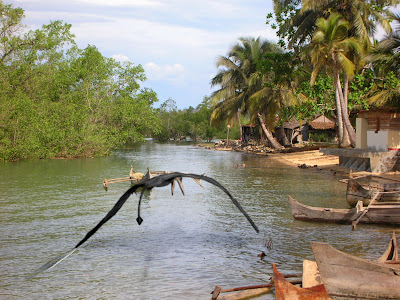
Ropen = CGI mock-up (monster.wikia.com)
The ropen should not be (but very frequently is) confused with a much bigger mystery beast known correctly as the duah. Although it too is superficially pterosaurian, it has a long neck, a bony crest, and enormous leathery wings said to span up to 6.1 m, making it more similar in overall appearance to later, more advanced pterosaurs like Pteranodon.

The duah has been reported from mainland Papua New Guinea during the 1990s by various missionaries as well as the local people here. They claim that its underside glows when it flies overhead at night.

In On the Track of Unknown Animals, Heuvelmans closed one chapter with the memorable statement: "The trail of unknown animals sometimes leads to Hell". In view of the devilishly deadly company of cryptids reviewed here, he may have had a point!
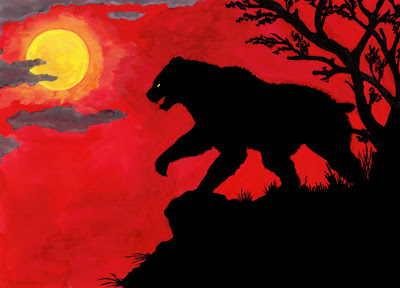
Nandi bear silhouette (Markus Bühler)