Dr KARL SHUKER

Zoologist, media consultant, and science writer, Dr Karl Shuker is also one of the best known cryptozoologists in the world. He is the author of such seminal works as Mystery Cats of the World (1989), The Lost Ark: New and Rediscovered Animals of the 20th Century (1993; greatly expanded in 2012 as The Encyclopaedia of New and Rediscovered Animals), Dragons: A Natural History (1995), In Search of Prehistoric Survivors (1995), The Unexplained (1996), From Flying Toads To Snakes With Wings (1997), Mysteries of Planet Earth (1999), The Hidden Powers of Animals (2001), The Beasts That Hide From Man (2003), Extraordinary Animals Revisited (2007), Dr Shuker's Casebook (2008), Karl Shuker's Alien Zoo: From the Pages of Fortean Times (2010), Cats of Magic, Mythology, and Mystery (2012), Mirabilis: A Carnival of Cryptozoology and Unnatural History (2013), Dragons in Zoology, Cryptozoology, and Culture (2013), The Menagerie of Marvels (2014), A Manifestation of Monsters (2015), Here's Nessie! (2016), and what is widely considered to be his cryptozoological magnum opus, Still In Search Of Prehistoric Survivors (2016) - plus, very excitingly, his four long-awaited, much-requested ShukerNature blog books (2019-2024).

Dr Karl Shuker's Official Website - http://www.karlshuker.com/index.htm

IMPORTANT: To view a complete, regularly-updated listing of my ShukerNature blog's articles (each one instantly clickable), please click HERE!

IMPORTANT: To view a complete, regularly-updated listing of my published books (each one instantly clickable), please click HERE!

IMPORTANT: To view a complete, regularly-updated listing of my Eclectarium blog's articles (each one instantly clickable), please click HERE!

IMPORTANT: To view a complete, regularly-updated listing of my Starsteeds blog's poetry and other lyrical writings (each one instantly clickable), please click HERE!

IMPORTANT: To view a complete, regularly-updated listing of my Shuker In MovieLand blog's articles (each one instantly clickable), please click HERE!

IMPORTANT: To view a complete, regularly-updated listing of my RebelBikerDude's AI Biker Art blog's thematic text & picture galleries (each one instantly clickable), please click HERE!

Search This Blog


PLEASE COME IN, I'VE BEEN EXPECTING YOU...

PLEASE COME IN, I'VE BEEN EXPECTING YOU...
WELCOME TO SHUKERNATURE - ENJOY YOUR VISIT - BEWARE OF THE RAPTOR!


Showing posts with label king cheetah. Show all posts

Wednesday, 6 December 2017

DELINEATING THE DARKER SIDE OF LEOPARDS - ARE SOME MYSTERY CATS PSEUDO-MELANISTIC?


Chromolithograph from the PZSL, 3 March 1885, depicting the first Grahamstown pseudo-melanistic leopard as it would probably have looked in life, based upon its pelt's appearance (public domain)

To date, my very first book, Mystery Cats of the World, originally published in 1989 and now long out of print (but not out of copyright, incidentally), has yet to be republished. Regrettably, however, considerable chunks of its content can be found in uncredited and sometimes extensively plagiarised form on the Net within a number of websites. Consequently, unless readers of those particular sites are already familiar with my book, they will probably be entirely unaware that it is the original source of such material.

To redress at least a portion of this very unfortunate and frustrating situation, I am therefore presenting herewith the full text from my book concerning one of the most eyecatching but rarest categories of feline enigmas on record. Namely, pseudo-melanistic leopards, and their potential relevance to the identity of certain cryptozoological cats. My book was the first to document this very intriguing, thought-provoking subject in detail, including the discovery of pseudo-melanistic leopard specimens in both Asia and Africa, but once again its coverage has since been copied profusely online by others yet with very varying degrees of associated acknowledgement. I am also expanding its coverage, by incorporating some additional information and illustrations that I have encountered with regard to such cats during the period of almost 30 years that has passed since my book was published.


A MYSTERY FROM MALABAR

In certain parts of Asia, black panthers (i.e. melanistic specimens of the leopard Panthera pardus constituting a visibly distinctive morph resulting from the expression of the recessive non-agouti mutant allele of the agouti gene and described in more detail later here) are more common than the normal, spotted wild-type morph of the leopard. Conversely, pseudo-melanistic individuals from this continent are exceedingly rare, so much so in fact that I have only ever read of one confirmed specimen. It was originally documented in 1915 by H.O. Collins, as referred to fully below, within the Bulletin of the South California Academy of Science. Here is its noteworthy history.

Normal spotted wild-type version of the leopard (© JanErkamp/Wikipedia - CC BY SA 3.0 licence)

One of the magnificent and mysterious feline skins on record was purchased in December 1912 by Holdridge Ozro Collins from G.A. Chambers of Madras [now Chennai], India. Its predominant colour was an elegant glossy black and was described in 1915 by Collins as follows:

The wide black portion, which glistens like the sheen of silk velvet, extends from the top of the head to the extremity of the tail entirely free from any white or tawny hairs.

He goes on to say:

In the tiger, the stripes are black, of an uniform character, upon a tawny background, and they run in parallel lines from the center of the back to the belly. In this skin, the stripes are almost golden yellow, without the uniformity and parallelism of the tiger characteristics, and they extend along the sides in labyrinthine graceful curls and circles, several inches below the wide shimmering black continuous course of the back. The extreme edges around the legs and belly are white and spotted like the skin of a leopard....The skin is larger than that of a Leopard but smaller than that of a full grown Tiger.

The cat had been killed in Malabar, south-western India, earlier in 1912, and so unusual was its exceedingly handsome skin that Chambers had been totally unable to classify it, so that he wondered whether it could actually represent some hitherto unknown form of felid. To obtain an answer, Chambers had sent it to Madras's Government Museum for official identification. He subsequently received a letter from J.R. Henderson of the museum, who stated that, although the species was certainly leopard, it constituted a variety that he had never before seen. Collins also sought scientific advice concerning its status, and learnt from Dr Gerrit S. Miller Jnr, curator of the Smithsonian Institution's Division of Mammals in Washington DC, USA, that it was indeed a black leopard, but not of the normal melanistic type.

A normal melanistic leopard, aka black panther (© Qilinmon/Wikipedia - CC BY-SA 3.0 licence)

In fact, this remarkable skin was that of a pseudo-melanistic leopard, an extremely rare mutant known even today from only from a handful of specimens. In a normal melanistic leopard (i.e. black panther), its coat's background colour is abnormally dark, but its coat's rosettes are unchanged (so they can often still be spied in shadow-like form against its coat's dark background colouration, rather like a pattern on watered silk, when viewed at certain angles and in certain lighting conditions). Conversely, in a pseudo-melanistic leopard its coat's background colour is normal (orange-yellow) but is largely obliterated by abnormal fusion (nigrism) and multiplication (abundism) of the rosettes.

In extreme cases of pseudo-melanism, as demonstrated by Collins's specimen, this fusion and multiplication of the rosettes can be so extensive that virtually the entire upper body is covered in a solid mass of black colouration, with only occasional gaps present through which its coat's normal background colour is visible (appearing as orange streaks or spots). Faced with such a bizarre skin, it is little wonder that its owners had wondered whether it constituted a major zoological discovery.

King cheetah (© Steve Jurvetson/Wikipedia/Flickr - CC BY 2.0 licence)

Incidentally, less extreme occurrences of nigrism and abundism in the cheetah Acinonyx jubatus are responsible for the ornately striped and blotched pelage of a rare but very distinctive morph dubbed the king cheetah Acinonyx jubatus var. rex, which was once mistakenly thought to be a separate species from the normal spotted version. There are also a few visibly-comparable leopard counterparts to this cheetah variety on record, which I have duly referred to in my writings as king leopards. One Indian specimen, recorded as recently as 2012 from the Parambikulam forests in Kerala's Palakkad district, has sometimes been referred to online as a pseudo-melanistic leopard but its extent of abundism and nigrism is much less pronounced than that of the Malabar specimen or any of the Grahamstown specimens discussed below – instead, it is a classic king leopard.


A BEWILDERMENT OF BLACK LEOPARDS IN AFRICA

Surprisingly, and in stark contrast to the extremely abundant black panther of Asia, very few records exist of melanistic leopards in Africa. Considering that this latter continent has numerous localities whose habitats and climate correspond closely with those in Asia that support black panthers, the reason for this anomaly is quite obscure. In fact, the only areas from which true (i.e. non-agouti) melanistic leopards have been recorded with certainty are Ethiopia and Cameroon, plus the forests of Mount Kenya and Kenya's Aberdares mountains.

Yet, if we also take heed of the many unconfirmed reports of predominantly black, leopard-like cats from several other African regions, it would seem that African panthers of one form or another are (or were) more widespread - and varied - than science supposes.


SOUTH AFRICA'S MELANOTIC MYSTERY CATS

A mysterious felid of quite remarkable appearance was killed by a Mr F. Bowker during the early 1880s in a hilly, scrub-covered district 40 miles northeast of Grahamstown, in South Africa's Eastern Cape Province, and its flat skin was sent by him to German-born British zoologist Dr Albert Günther at London's Natural History Museum, where it remains today. Its coat's background colour was tawny, brightening to a rich orange gloss on the shoulders. Rosettes were virtually absent, being replaced mostly by numerous small separate spots, but these had coalesced dorsally to yield an unbroken expanse of black, stretching from its head right along to its tail base. In contrast to this specimen's richly hued upperparts, however, its underparts were principally white with large black spots, as in typical leopards, and it also bore the facial markings characteristic of this species. Its total length was 6 ft 7 in (including a 2.5- ft tail).

Dr Albert Günther (public domain)

Günther had initially entertained the possibility that this singular cat was actually a naturally-occurring leopard-lioness hybrid. However, as he reported on 3 March 1885 in the Proceedings of the Zoological Society of London (his report also containing the spectacular full-colour chromolithograph that opens this present ShukerNature blog article), Günther's detailed examination of its skin had ultimately revealed certain very specific but taxonomically significant features which, in combination with its already-noted leopard features, persuaded him that, despite its exotic colour scheme, its owner had indeed been nothing more than a leopard after all - albeit of a very spectacular pseudo-melanistic variety (and comparable with the Malabar specimen noted earlier in this ShukerNature blog article).

A year later, Günther received a second, even darker, glossier flat skin from a specimen of this same pseudo-melanistic variety, which had been shot at Collingham, approximately 20 miles from Grahamstown, and subsequently presented as a donation to London's Natural History Museum by its then-owner Reverend Nendrick Abraham (President of the Grahamstown Natural History Society). Utilising the detailed account contained in Abraham's accompanying letter, Günther formally documented this skin on 6 April 1886, once again in the Proceedings of the Zoological Society of London.
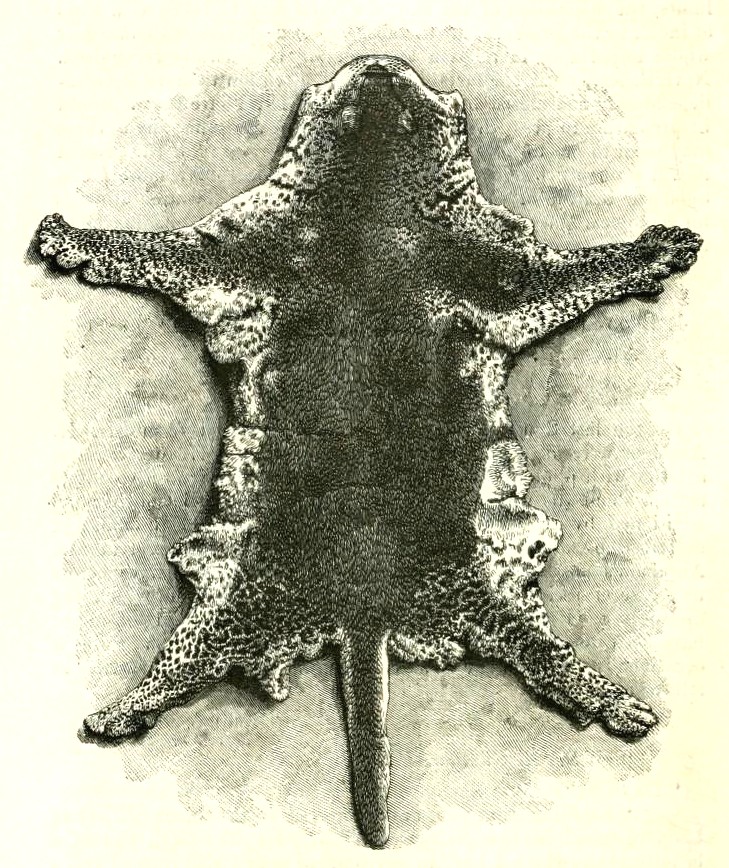
B/w photograph from the PZSL, 6 April 1886, of the flat skin from Abraham's Collingham-derived pseudo-melanistic leopard (public domain)

At least seven other, less striking pseudo-melanistic examples have been recorded (although, tragically, some of these no longer exist), including two pelts and sightings of two living specimens as reported by Abraham in his letter to Günther, but only from South Africa's Eastern Cape Province and none at all since the 20th Century's opening decade, as documented in 1987 by Dr Jack Skead (a former director of the Kaffrarian Museum in King William's Town) within a major review entitled Historical Mammal Incidence in the Eastern Cape. Skead's work was brought to my attention via some references to it in a CFZ Yearbook 1997 article on these exotic-looking leopards authored by Chris Moiser, who with fellow wildlife writer David Barnaby had viewed and photographed a mounted specimen at the Izoko South African Museum in Cape Town two years earlier.

In his PZSL report for 3 March 1885 concerning Bowker's pelt, Günther had dubbed this spectacular pseudo-melanistic leopard variety Felis leopardus [=Panthera pardus] var. melanotica. As a result, sometimes these extremely unusual felids are alternatively termed melanotic leopards.

As noted above, the Izoko South African Museum in Cape Town famously has on display a mounted specimen of a pseudo-melanistic leopard. In his CFZ Yearbook 1997 article, Chris Moiser revealed that this was purchased from a professional taxidermist based in Grahamstown in November 1898, and had apparently been shot 15.5 miles south of that town. Although somewhat faded with age nowadays, appearing brown rather than black, it is still visually arresting, as seen here:

The mounted pseudo-melanistic leopard on display at the Iziko South African Museum in Cape Town (© Lew Viergacht)

My sincere thanks to Lew Viergacht for so kindly making his two excellent photographs of this remarkable specimen available to me for inclusion in this ShukerNature blog article.


THE DAMASIA – DARK LEOPARD OR NEW SPECIES?

Well worth considering is whether a comparable variety could be the explanation for a still-unidentified African felid known as the damasia, which dwells - not surprisingly? - in Kenya's Aberdares [already documented in my book as the home of a controversial, diminutive form of spotted lion known as the marozi, as well as melanistic leopards, i.e. black panthers].

The damasia was referred to in a letter sent to The Field by G. Hamilton-Snowball and published on 9 October 1948, concerning his sighting of spotted lions on these mountains. In it, he also recalled that during the 1920s he had shot a creature that he had taken to be a leopard, albeit a very large, dark specimen. Yet when his Kikuyu attendants saw it, they announced that it was not a chui (leopard) but a damasia, and that a damasia was as different from a leopard as a simba (lion) was from a marozi. Apparently the damasia is well known to the Aberdares natives but is always mistaken by non-locals for a leopard.

Painting of a pair of marozis or Kenyan spotted lions, based upon a preserved skin and eyewitness descriptions (© William M. Rebsamen)

Tropical Africa's native tribes frequently classify animals by way of criteria very different from those used by scientists. Often an individual animal that is of a colour or size different from that of normal specimens of the same species, or an individual that is notably more aggressive than others of its own species, is given an entirely separate name by the natives and thought of as being of a form totally different from the more typical members of its species. Therefore it is certainly possible that, despite the Kikuyus' firm denial, the damasia really is just a dark-coloured (pseudo-melanistic?) leopard.

Since genuine black (melanistic) leopards are on record from the Aberdares, it would be interesting to learn whether the natives class them as leopard or damasia. Alternatively, considering that the Aberdares' primeval forests already house one mystery cat, in the form of the marozi, it is not inconceivable that they are hiding further zoological surprises too.


THE NDALAWO – BLACK-AND-GREY CRYPTO-CAT OF UGANDA

This Ugandan mystery carnivore was described by game warden Captain William Hichens in a Discovery article of December 1937 as follows: "...a fierce man-killing carnivore, the size and shape of a leopard, but with a black-furred back shading to grey below". A ndalawo skin was actually procured on one occasion but was sent out of the country before it could receive formal scientific attention. Consequently, its identity was never ascertained, and its whereabouts are now unknown.

African wildlife authority Captain Charles Pitman had previously recorded in his book A Game Warden Among His Charges (1931) that the ndalawo seemed to be a "partly melanistic leopard" (note the word 'partly', indicating that it was not a normal black panther), practically devoid of spots but displaying a few typical leopard markings on the extremities and round the lower jaw. This more detailed description is reminiscent of that cited by Günther for P. pardus var. melanotica; certainly, pseudo-melanistic leopards have paler underparts, unlike the uniformly-dark melanistic black panthers.

Second view of the mounted pseudo-melanistic leopard at the Iziko South African Museum (© Lew Viergacht)

Based upon pelage considerations alone, it is not implausible that the ndalawo may indeed prove to be a pseudo-melanistic leopard (albeit a less showy version than those from South Africa). However, there is more than just its pelage to consider: the ndalawo exhibits some rather unexpected traits for a mere leopard. For example, it allegedly hunts in threes or fours, and whilst hunting it gives voice to a most peculiar laugh. These traits are indicative of a hyaena.

Yet as Hichens pointed out, the ndalawo is very greatly feared as an exceedingly ferocious beast, whereas even the oldest woman in a native kraal is more than prepared to shoo away a hyaena that comes too close. If the ndalawo is a form of leopard, it is a very unusual one; in fact, out of all of the black mystery cats of Africa discussed here, the ndalawo is surely the one most likely to represent a hitherto unknown felid species.

Vintage sepia photograph of the Iziko South African Museum's mounted pseudo-melanistic leopard specimen as featured in The Mammals of South Africa, Vol 1 (1900), authored by the museum's then-director, W.L. Sclater, and showing how much darker it was a century ago than it is today, light-induced fading having taken its toll down through the intervening decades (public domain); my sincere thanks to Facebook friend Velizar Simeonovski for kindly bringing this illustration to my attention.


OTHER PSEUDO-MELANISTIC BIG CATS

Pseudo-melanistic specimens have also been confirmed from other big cat species, most notably the tiger P. tigris, with several examples recorded from Similipal and elsewhere in India (although these are often referred to incorrectly as melanistic specimens by the media), as documented by me in various publications (and also here on ShukerNature).

Exquisite painting of a pseudo-melanistic tiger in life as inspired by photographs of various pseudo-melanistic tiger pelts; produced specifically for me by William M. Rebsamen, it first appeared in an article of mine published by the now-defunct British monthly magazine All About Cats in its January-February 1999 issue, then again later that same year in my book Mysteries of Planet Earth (1999) (© William M. Rebsamen)

In addition, I once saw a close-up full-colour photograph of an exceedingly handsome pseudo-melanistic jaguar in captivity, but unfortunately I have no further details concerning this specimen.


AN ARTICLE OF MINE ON PSEUDO-MELANISTIC LEOPARDS

Finally: In addition to the above coverage directly excerpted and expanded from my Mystery Cats of the World book, I have also documented pseudo-melanistic leopards (albeit only briefly this time) in my second, more recent feline-themed book, Cats of Magic, Mythology, and Mystery (2011), as well as in a two-page article published by All About Cats in its May-June 1997 issue. Within that article, I was granted exclusive permission by David Barnaby and Chris Moiser to reproduce a colour photograph snapped by them in August 1995 during their viewing of the mounted specimen at the Iziko South African Museum, which I did. Regrettably, however, as with my writings about such cats, this photo has since turned up on various websites but without any accompanying credit given to David and/or Chris (hence in my opinion it seems unlikely that their permission for such sites to use it has been obtained, or even sought).

For those of you who may not have seen my All About Cats article, here it is – please click on each of its two scanned pages to enlarge it for reading purposes.

My two-page All About Cats article from May-June 1997 on the subject of pseudo-melanism and melanism in leopards and other big cats (© Dr Karl Shuker)


Wednesday, 3 May 2017

WHITHER THE WOOLLY CHEETAH?


The only known illustration of a woolly cheetah (Public domain)

Nowadays, the once-obscure, elusive king cheetah, a mutant morph of the normal cheetah Acinonyx jubatus famously adorned with an ornate patterning of stripes and blotches very different from the latter species' polka-dotted wild-type counterpart, is enjoying a well-earned scientific renaissance.

In marked contrast, however, a second, equally eyecatching cheetah form seems to have vanished without trace into the mists of scientific anonymity, after only the briefest of spells in the zoological limelight.

A king cheetah, famed for its exquisite and very elaborate markings, produced by a mutant gene allele (© Steve Jurvetson/Wikipedia – CC BY 2.0 licence)

On 19 June 1877, Philip L. Sclater, longstanding secretary of the Zoological Society of London, recorded in its Proceedings (i.e. the PZSL) the acquisition by London Zoo of a most unusual cat - male and apparently not fully grown - which he described as follows:

It presents generally the appearance of a cheetah (Felis jubatus) [the cheetah's old scientific name], but is thicker in the body, and has shorter and stouter limbs, and a much thicker tail. When adult it will probably be considerably larger than the Cheetah, and is larger even now than our three specimens of that animal. The fur is much more woolly and dense than in the Cheetah, as is particularly noticeable on the ears, mane and tail. The whole of the body is of a pale isabelline colour, rather paler on the belly and lower parts, but covered all over, including the belly, with roundish dark fulvous blotches. There are no traces of the black spots which are so conspicuous in all of the varieties of the Cheetah which I have seen, nor of the characteristic black line between the mouth and eye.

Evidently this brown-blotched felid appeared very different from the usual form - to the extent that Sclater stated that it was impossible to associate it with this. Instead, he proposed for it the temporary name of Felis lanea, the woolly cheetah. It had been obtained from Beaufort West, South Africa, and, as Sclater himself remarked: "It is difficult to understand how such a distinct animal can have so long escaped the observations of naturalists".

One other matter is also difficult to understand, and remains a source of confusion concerning this mystery cat. Sclater referred to its markings as 'blotches', but in the illustration that accompanied this report, the creature was depicted with numerous tiny spots!

The PZSL 1877 chromolithograph of the woolly cheetah that accompanied Sclater's report of it (Public domain)

A year later, on 18 June 1878, Sclater noted in the Society's Proceedings that he had received a letter from a Mr E.L. Layard, informing him that a second woolly cheetah was currently preserved in the South African Museum. Like the first, it had been procured from Beaufort West. It had been killed by Arthur V. Jackson who, like Layard himself, assumed that it was an erythristic (abnormally red) variant of the normal cheetah. At the end of this item, in answer to an enquiry by Layard, Sclater recorded that the claws of the London Zoo specimen were non-retractile.

Sharing Sclater's own bewilderment as to how so large and unusual an animal could have evaded scientific detection until then, many zoologists had grave reservations concerning his optimism that the woolly cheetah constituted a totally separate species. In 1881, English biologist Dr St George J. Mivart commented that the noted American zoologist Prof. Daniel G. Elliot regarded this felid simply as a variety of the known cheetah species (curiously, Mivart ascribed the presence of a stripe to one side – but not both sides – of the woolly cheetah's muzzle when describing this feline form in his book The Cat, a feature not mentioned by Sclater, and in any event highly abnormal, thereby confusing the issue even further).

Dramatis personae in the woolly cheetah saga: Philip L. Sclater (public domain), Dr St George J. Mivart (Wellcome Images/Wikipedia – CC BY 4.0 licence), and Prof. Daniel G. Elliot (public domain)

By then, London Zoo's specimen had died, and Elliot's opinion received support from the discovery by eminent mammalogist Oldfield Thomas of the then British Museum (Natural History) – now known as the Natural History Museum – that this cat's skull did not differ from that of any other cheetah.

On 4 November 1884, Sclater recorded in the PZSL a woolly cheetah skin sent to him by the Reverend G. Fisk, again obtained from Beaufort West. In comparison with the zoo specimen, this example was more distinctly spotted, less densely furred, and rather smaller in size. Reverend Fisk believed that these differences were due to the specimen being a female, an explanation accepted by Sclater, who felt that this new skin consolidated his opinion concerning the woolly cheetah's separate status. The rest of the scientific world, conversely, remained unconvinced, so that since then it has been regarded as merely an unusual variant of the typical cheetah species.

A normal, polka-dotted cheetah (public domain)

The woolly cheetah may indeed be nothing more surprising than an atypical colour morph – perhaps a partial albino, as suggested by king cheetah researcher Lena Bottriell and felid geneticist Roy Robinson, or an erythristic version, as opined by Jackson and Layard. At the same time, Sclater's more radical views can also be appreciated, because this cat form differs from the typical cheetah not only in colour and markings but also in fur density and even in relative limb length. Simple colour variants do not generally exhibit such pronounced differences as these from normal individuals of the same species. Its shorter limbs suggest a non-cursorial life - could it possibly have been a forest form?

It is worth noting that a 'lion-like forest cheetah' known as the kitanga was described in the 20th Century's early years to Major G. St J. Orde-Brown by the Embu natives of south-eastern Kenya (as recorded by Kenneth C. Gandar Dower in his book The Spotted Lion, 1937,  chronicling Dower's own searches for another of Africa's mystery cats, the elusive marozi). Moreover, according to correspondent Owen Burnham who lived there for many years, a comparable felid has occasionally been reported from the little-explored forests of Senegal, West Africa, where this region's subspecies of the typical cheetah, A. j. hecki, is extremely rare.

A pair of marozis or spotted lions (© William M. Rebsamen)

The possibility of a cheetah form becoming modified for life in this type of habitat is by no means implausible. On the contrary, even the normal spotted form is not an exclusive denizen of the savannahs. This was well demonstrated in March 1983, when Lise Campbell spied a single cheetah at a height of 2.5 miles in the vicinity of the Sirimon Track in the moorland zone of Mount Kenya. She had a second sighting later that day of what may have been the same animal, even higher, amidst the tufted high-altitude grass, and documented her observations in an East African Natural History Society Bulletin communication (May-June 1983).

As for the woolly cheetah: according to mammalogists Daphne Hills and Dr Reay Smithers in their Arnoldia Zimbabwe paper of 1980 (concerning the king cheetah), this odd form no longer occurs in Beaufort West. Presumably, therefore, it is extinct, and the chance to investigate further its precise taxonomic status similarly lost. Or is it? The Natural History Museum owns the skin of London Zoo's specimen – so now, with the ever-advancing techniques of DNA-based genetic analyses readily available to researchers, perhaps it may be possible to carry out some such tests upon small samples of this skin and finally reveal the precise genetic identity of the mystifying woolly cheetah.


This ShukerNature blog article is excerpted and expanded from my book Mystery Cats of the World.


Monday, 28 July 2014

THE MPISIMBI – A NOW-EXTINCT KING CHEETAH STRAIN IN EAST AFRICA?

Painting of the king cheetah's type specimen as imagined in life, from PZSL, 1927 (public domain)


How tragic it is that such wonderful creatures have no concept, no awareness, of just how beautiful and magical they are.
Then again, perhaps they do - after all, they are cats...

Karl Shuker - Re king cheetahs, posted on his Facebook wall, 31 July 2010


Many mysterious African animals once thought to be legendary or wholly imaginary monsters solely confined to the realms of native folklore and superstition have ultimately been found to be real (albeit elusive) creatures that have successfully eluded formal scientific recognition until modern times. The mountain gorilla, okapi, giant forest hog, and pygmy hippopotamus were all dismissed as myths by Western science until the 20th Century. So too was another bizarre beast - the leopard-hyaena or nsui-fisi...until 1926.


UNMASKING THE NSUI-FISI

This was when a short letter penned by Major A.C. Cooper from Salisbury (now Harare) in Rhodesia (now Zimbabwe) was published by The Field, alongside his photograph of an extraordinary cat skin. Cooper believed the skin to be from a crossbreed of leopard and cheetah, which had been trapped at Macheke, about 62 miles southeast of Salisbury, but he was astonished by the exceptionally ornate markings adorning its golden-yellow coat, which were unlike those of any cat previously recorded by science. Upon its flanks and upper limbs they consisted of graceful curved stripes and abstract blotches, whereas a series of longitudinal stripes ran from its neck and shoulders along the entire length of its back to the upper portion of its tail, and a succession of thick black stripes encircled the remainder of its tail. Also of note were its non-retractile claws (a cheetah characteristic), and a mane-like ruff round its neck.

Back view of a king cheetah, revealing its very eyecatching longitudinal dorsal stripes (© Steve Jurvetson-Wikipedia-Flickr)

This wonderful creature matched traditional tribal descriptions of a strange monster termed the nsui-fisi (‘leopard-hyaena’), which was fervently claimed by Rhodesian natives to be the rare, exotic progeny of liaisons between leopards and hyaenas, as it was said by them to be as lithe, swift, and cunning as a leopard but boldly barred like the striped hyaena Hyaena hyaena. Such an identity was zoologically impossible, of course, but the fact remained that Cooper's mysterious big cat was still unexplained.

Not surprisingly, it soon attracted the attention of felid specialist Reginald Pocock, from the British Museum (Natural History), who identified it from Cooper's photograph as an aberrant leopard. (Interestingly, during the early years of the 20th Century, cats just like it had apparently been well known to locals in the Mazoe area of Rhodesia's northern region, where they were referred to as Mazoe leopards.) Once he was able to examine the skin itself, however, he swiftly changed his mind, recognising it to be from a cheetah - albeit one with dramatically different coat markings from the familiar polka-dot pelage of the normal cheetah Acinonyx jubatus. In 1927, Pocock announced that the skin represented a new species, which, due to its regal appearance and vaguely leonine mane, he dubbed Acinonyx rex - the king cheetah.

King cheetah (© Steve Jurvetson-Wikipedia-Flickr)

During the next few years, several other king cheetah skins were obtained - all from a triangle of terrain enclosing eastern and southern Zimbabwe, northern South Africa, and eastern Botswana - but as the number of skins increased, it became evident that some of these were intermediate in appearance between normal cheetahs and the first king cheetah, documented by Major Cooper. In other words, there was no longer a clear morphological demarcation line between spotted cheetahs and the striped king cheetah. This could mean only one thing - the king cheetah was not a distinct species in its own right after all. Instead, it was merely a freak mutant variety of the normal cheetah - which Pocock conceded in 1939.

As a result, interest in the king cheetah waned, and after a time reports of such specimens rarely emerged. Indeed, by the 1970s some zoologists had begun to fear that this handsome striped strain had died out, but during the 1970s a king was filmed living with normal cheetahs in the Kruger National Park.

The 1970s Kruger-inhabiting king cheetah individual, as featured on the front cover of leading king cheetah researcher Lena Bottriell's definitive book, King Cheetah (1987)

Today, there is no doubt that the king cheetah is indeed alive and well, with several specimens having been born within litters of normal spotted cheetahs in captivity in South Africa.


THE GENETICS OF A KING

Since its scientific discovery, there has been a great deal of conflict concerning the king cheetah's taxonomic status. At first it was believed to be a hybrid of leopard and cheetah, then a valid species, and ultimately a mutant form of the normal cheetah. In May 1981, however, the de Wildt Cheetah Breeding and Research Centre of Pretoria's National Zoological Gardens was able to examine this issue in a thorough manner, when a king cheetah was unexpectedly born to a pair of normal cheetahs here. A few days later, moreover, a second king was born, this time to the sister of the first king's mother.

Two normal spotted cheetahs

These fortuitous events duly initiated a programme of monitored breeding conducted at the centre, in order to determine the genetic basis of the king cheetah phenotype. By 1986, it had become clear that a recessive mutant allele was responsible, equivalent to the recessive allele producing the blotched tabby coat pattern in domestic cats. In other words, only cheetahs with two copies of the 'king' allele are kings. Cheetahs with one copy of the king allele and one of the normal (wild-type) spotted allele, or cheetahs with two copies of the spotted allele and none of the king allele, are normal spotted cheetahs.

Moreover, in a paper published by the journal Science in September 2012, a team of American genetics researchers from several different institutes revealed that they had identified the specific gene responsible for the king cheetah's striped coat pattern and the blotched coat pattern in domestic tabby cats. Both are caused by a recessive mutation in a gene dubbed Taqpep by the researchers.

Close-up of a king cheetah's fur, revealing its blotched-tabby-homologous pelage markings (© Wegmann/Wikipedia)

And so, one mystery concerning the king cheetah is a mystery no more - but there are others that still await a solution, and none is more fascinating than the following example.


UNMASKING THE MPISIMBI?

What makes the king cheetah so memorable in addition to its incredibly beautiful coat is its extremely limited distribution. Many freak mutations of coat colour or patterning in mammals are spontaneous, i.e. they can arise abruptly in any population of a given species, regardless of geographical location. Yet whereas the typical spotted cheetah occurs in southern, eastern, central, northern, and western Africa, king cheetahs have never been reported conclusively outside southern Africa – or have they?

There are two possible and potentially extremely significant exceptions to this widely-assumed rule (and three, if we consider some remarkable evidence that I lately uncovered for the erstwhile presence of at least one king cheetah specimen in the wild not anywhere in Africa, but instead in Asia, and which in 2013 I formally documented in Vol. 2 of the Journal of Cryptozoology, whose logo, very aptly, is a king cheetah – click here for further details).

A young king cheetah (© DannyBlue/Deviantart)

The first possible exception to the king cheetah's strict zoogeographical limitation to southern Africa is a king cheetah skin that in 1988 turned up in the West African country of Burkina Faso. It supposedly came from a specimen that had been shot by a poacher in the northern end of the Singou Total Fauna Reserve. Some researchers wonder whether this mystifying skin is one that in reality originated in southern Africa but which later travelled northwest via itinerant poachers or other skin traders. Alternatively, however, could a 'king' strain of cheetah have spontaneously arisen in West Africa?

As for the second putative exception to the rule of the king cheetah being exclusively southern African in distribution, this is one that has never been publicly revealed – until now. It features an extremely obscure East/Central African mystery beast known as the mpisimbi

King cheetah head (above) and normal spotted cheetah head (below)

In 1927, Chambers’s Journal published a fascinating article on East and Central African mystery beasts entitled ‘On the Trail of the Brontosaurus and Co.’. It was written by ‘Fulahn’, the pen-name of Captain William Hichens - a man whose name should already be familiar to mystery cat aficionados. For he was none other than the Native Magistrate at Lindi, Tanzania, during the 1920s and 1930s who investigated a succession of particularly gruesome murders there attributed by the local people to a giant brindled mystery cat known as the nunda or mngwa (click here for a ShukerNature blog post devoted to this feline cryptid).

Most of the cryptids documented by Hichens in his Chambers's Journal article are relatively famous ones, with one notable exception. Contained within his account are a couple of tantalising lines that have fascinated and frustrated me in equal measures for many years:

"But such are the mystery animals. There are others – the mpisimbi, the leopard-hyaena, which eats sugar-cane, and which I have hunted many a weary night without success;"

Despite numerous searches, I have never been able to uncover any additional information concerning this enigmatic creature. So what exactly is the mpisimbi?

King cheetahs (© David Pepper-Edwards)

The above-quoted lines offer no morphological description whatsoever of the mpisimbi. Conversely, its name’s English translation – ‘leopard-hyaena’ - is very intriguing, because it corresponds precisely with the English translation of the king cheetah’s native South African name, nsui-fisi. Moreover, Hichens’s unusual claim that the mpisimbi eats sugar-cane adds further to a putative link between the mpisimbi and the king cheetah, because in a second article, published under his own name a year later in Wide World Magazine, Hichens stated: “The Nsuifisi, or striped cheetah...was also reputed to be a raider of grain and sugar-cane”.

Of course, as Hichens went on to discuss, because cheetahs are carnivores it seems improbable that they would raid grain-plots. And even though hyaenas are notorious scavengers with an extremely catholic diet, they are not known to attack standing crops, but they will certainly devour cooked grain, vegetables, and even boiled flour.

King cheetah (© AKovacs23/Photobucket)

Such considerations and qualifications, however, are not significant with regard to the cryptozoological mystery under review here. What is significant is that both the mpisimbi and the nsui-fisi were claimed, rightly or wrongly, by the native tribes in their respective, separate areas of Africa to consume the very same unexpected foodstuff – sugar-cane.

Is it conceivable, therefore, that the mpisimbi and the nsui-fisi are indeed one and the same creature – namely, the king cheetah? If so, it suggests that at some time in the distant past, striped cheetahs did exist in East and/or Central Africa – although, with no modern-day reports of such beasts on file, even if they once did exist there they seemingly no longer do. Put another way: whatever it may have been, tragically the mpisimbi is now apparently extinct.

King cheetahs (© David Pepper-Edwards)

Of course, sceptics may well claim that this is all supposition, but the presence of those brief lines regarding the mpisimbi in Hichens’s article means that the possibility of mpisimbi and king cheetah synonymity, however remote it may seem, cannot be discounted.

Moreover, who can say whether, in the future, a king cheetah or two will not spontaneously arise in the East African population of the normal spotted cheetah? That is, after all, what spontaneous mutations do!

At present, however, the mystery of the mpisimbi's zoological identity remains yet another enigma in the eventful history of Africa's extraordinary striped cheetah - the once (and future?) king.

Diagrammatic representation of the king cheetah's ornate pelage patterning (© Tim Morris)

For plenty of fascinating additional information concerning king cheetahs and other exotic cheetah varieties (including woolly cheetahs, blue-spotted cheetahs, black cheetahs, and unspotted cheetahs or cheetalines, be sure to check out my two dedicated crypto-cat books – Mystery Cats of the World (Robert Hale: London, 1989) and  Cats of Magic, Mythology, and Mystery (CFZ Press: Bideford, 2012).