During my time on Facebook, I've made many friends all over the world who share my interests in cryptozoology and animal mythology. One of these friends is Randi Allena Odom, from Texas, USA, to whom I recently recounted a very brief version of a traditional Irish folktale about a Celtic fairy hound. She liked it so much that she said she would love to read a full-length version of it if ever I decided to write one. Well, now I have done, so here, as an early Christmas present to you, Randi, is my story. I hope you enjoy it - Happy Christmas!
According to Irish mythology, one of the most formidable enchanted beasts occasionally met with in lonely rural locations is the fairy hound, or hound of the hollow hills, where the Faerie folk of Erin dwell. Gracile in form, and white in colour, but extremely large, often shaggy-coated, and always instantly distinguished from mortal, non-magical dogs by virtue of its bright red eyes and the red inner linings of its ears, even the mere sight of one of these ethereal creatures is said to bring bad luck. And to speak to or touch one means certain death – usually. Very rarely, however, a fairy hound will bring its human observer good fortune, if it is treated with sufficient courtesy and compassion – as was the case in the following traditional folktale, featuring both a fairy hound and a pooka, which has variants on record not only from Ireland but also from Cheshire and certain other regions of England. But what, may you ask, is a pooka? Let's just hope that you're never unlucky enough to meet one and find out...!
It had been a very long, arduous day, and the apprentice labourer was weary as he slowly trekked across the mist-shrouded moorlands, following the winding, shadowy road that would lead him back home, aching, hungry and earnestly yearning for the warmth, comfort, and security of his parents' little cottage. Whistling to himself to keep his spirits up as he continued on his way through this somewhat depressing, forbidding terrain, where strange shadows lurked all around him, and without warning a tree would abruptly loom out of the darkness up ahead like some frightful apparition, he suddenly heard what sounded like a dog, whining somewhere close by. He walked on a little further, and there, lying in some bushes at the side of the road, was what seemed on first sight to be a large red and white foxhound.
Having seen a number of footsore foxhounds in the past, which had been left behind by the pack when they had grown too weary to pursue their quarry any further, the youth called to it in a friendly voice, telling it that he'd take it back to the kennels but would first do something for its sore paws. True to his word, he scoured around and soon spotted some large dock leaves that he soaked in water from the stream running close by. Then he whistled to the dog, and called to it to come out of the bushes, so that he could treat its tender paws with the cooling wet leaves.
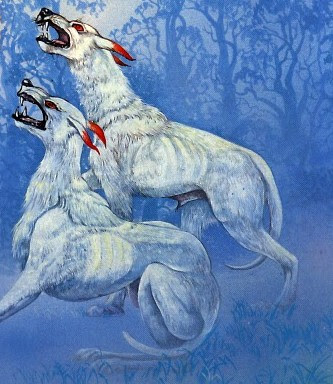 Celtic fairy hounds (Roger Garland)
Sure enough, up stood the dog and trotted out of the bushes towards him – but it was no foxhound. As large as a calf, with a shaggy pure-white coat, but red-lined ears and bright scarlet eyes that glowed like rubies, it was – as the terrified youth was only too readily aware – a fairy hound! Shaking with fear, he stood there, as still as a statue as the great dog padded right up to his side. All of the stories that had passed down through the generations in his family and in those of his friends and neighbours came flooding back. If you so much as see a fairy hound, you will experience bad luck, and if you should be foolish enough to speak to one or touch one, death will swiftly and assuredly follow. And yet, somehow, he sensed that it meant him no harm. Scarcely knowing what he was doing, or why, the youth spoke gently to the fairy hound, politely asking it to give him each of its paws in turn, so that he could bathe them.
The hound raised its huge head until its scarlet eyes were gazing directly into those of the youth, transfixing him for what seemed to him like an eternity yet was the merest moment in real time, and then, slowly, it raised its right front paw, and placed it heavily in his hands. At its first touch, the youth felt a strange sensation course through his body, like a living stream of electricity rippling and sparking beneath the surface of his skin. As if awakening from a dream, he shook his head, and then, after carefully inspecting the creature's paw, wrapped some wet leaves around it in a cooling bandage. As soon as he had done this, the fairy hound pulled its paw away, sniffed it for a moment, then gingerly placed it on the ground. The dock leaves were clearly working their own kind of magic, because the hound never flinched when it placed its full weight on the paw.
The youth expected to receive the hound's left front paw next, but the hound had other ideas. Instead, it turned sideways, and raised its right back paw towards him. So the youth knelt, and bandaged this paw with some more soaked dock leaves, then repeated his actions with its left back paw. When this was bandaged, the fairy hound turned to face the youth again, and as he looked down at its one remaining untreated paw – the left front paw – he realised that the hound was barely resting on it at all. Instead, it held it up just above the ground. Clearly, this was the most painful of its four paws, and when the youth knelt down to it, he immediately saw why.
Embedded in one of the paw's thick pads was a long curved thorn! Shocked, he looked up at the fairy hound, once again meeting its bright scarlet stare. Surely he dare not attempt to pull a thorn from the paw of a fairy hound? To do so would certainly inflict pain upon it, and that in turn would surely be more than sufficient to bring about his own death. But scarcely had these thoughts materialised within his petrified mind than the hound raised its wounded paw and delicately placed it in his open hand. As if sensing his hesitation, it then licked the thorn and nuzzled his hand with its large, icy-cold nose before gazing directly into his eyes again.
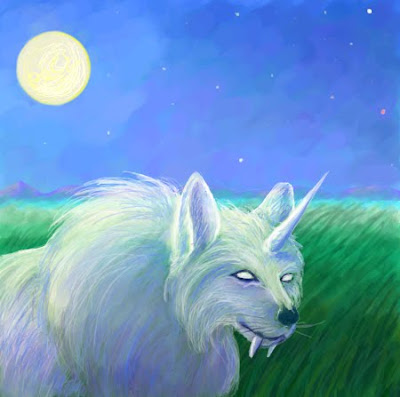 'Hound Wraith' - a very different, unicorned fairy hound (Heather L. Kidd
)
Drawing a deep breath, and trying hard to hide the fear in his voice, the youth softly spoke to the fairy hound, telling it that he would try his best to remove the thorn but warned that its paw might hurt for a moment while he was doing so. Taking a second deep breath, and focusing his attention entirely upon the thorn in the hope of remaining as calm as possible, the youth gripped it tightly between thumb and finger, and then, in a swift fluid movement, withdrew it from the pad of the creature's paw with Androclesian skill.
The fairy hound jerked its leg back, and the youth heard what sounded like the faintest rumble emanating from its chest, like the onset of thunder on a humid summer evening, as it attempted to pull its paw from his grasp. At the same moment, however, with his other hand the youth deftly placed a dripping-wet bandage of dock leaves upon the pad, and immediately he felt the hound relax, leaving its paw within his hand. After holding the leaves against the wounded pad for a few moments, the youth then removed them and replaced them with some more, which he bound in place.
The fairy hound placed its paw on the ground, and, as before, the dock leaves had evidently proven effective, because it discovered that it could place its full weight upon the paw without discomfort. For one last time, the fairy hound looked up at the youth, capturing his eyes with its own, and then it slowly wagged its long white tail from side to side, several times, before turning away. Remembering how he had been told by his elders to be respectful at all times to the Faerie folk, he bid it a polite "Goodnight, Sir", and he saw it wag its tail again as it departed into the mist.
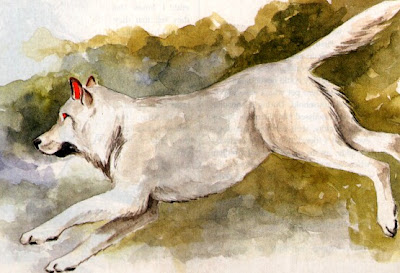 Fairy hound (C Martin)
Scarcely believing that he had survived such an extraordinary encounter with a fairy hound, the youth hurried on along the road leading home, hoping to leave this deserted, lonely terrain before it became completely dark. Happily, he did so, and although he made the same journey each evening in the weeks to come, nothing else eventful took place – until one night, just before Christmas.
The youth had worked even later than usual that particular evening, so it was already almost dark while he was still walking along the road across the moorlands - which, as a result, seemed more oppressive and threatening than ever. Even so, he smiled when he reached the area of low-lying bushes where, a few weeks earlier, he had treated the fairy hound's paws. Although he had never seen it again, he frequently thought about it, but he had never told anyone about his encounter, just in case to do so would anger the Faerie folk.
Suddenly, something large moved amid the shadows covering the road up ahead, and for a moment the youth thought that the fairy hound had returned. But as he drew nearer, he saw something very different – and even more frightening! At first, it looked like a small black pony, but as he looked at it, the creature began to grow bigger, and bigger. In moments, the 'pony' was the size of a horse, and as it turned his head towards him, the youth cried out in terror - because the head was no longer that of a horse. Instead, it now resembled a goat's, bearing a pair of long twisted horns, and with glittering emerald-hued eyes that glowed malevolently like green fire. This was neither a pony nor a horse – it was a pooka!
 A pooka (Ceara Finn)
An evil shape-shifting supernatural being, a pooka often assumes the guise of a pony that is sometimes merely mischievous, chasing after humans in gleeful delight, or slyly luring them across the moors until they are hopelessly lost if they try to capture or ride it. On other occasions, however, if someone succeeds in mounting it, the pooka will instantly ride off at speed and plunge into a river or lake, drowning its hapless rider (click
here for a separate ShukerNature post retelling this Irish legend). And if it should transform into a goat-headed monstrosity like the beast now confronting the terrified youth, death is inevitable.
Leering at him with a vile grimace that revealed an abundance of sharp white teeth, the pooka reared up onto its hind legs, and flailed its razor-sharp hooves at the youth's face. Backing away, he stumbled, losing his footing in his fear as this huge black beast of nightmare come to life reared again, its hooves ready to slash him to ribbons.
Suddenly, however, a huge white shadow hurled itself out of the darkness and directly onto the pooka's back. Gazing at it in amazement, the youth saw that it was none other than the fairy hound! Equally astonished, the pooka turned away, throwing its neck back as it attempted to discover what was attacking it. The fairy hound's mighty jaws bit deeply into the pooka's neck and shoulders as the latter beast sought to shake its assailant off, and the silence was shattered by an ear-splitting cacophony of shrieking neighs from the pooka and baying growls from the fairy hound.
 Never underestimate a fairy hound!
The pooka, weakening from the fairy hound's unabated onslaught, dropped to the ground, and sought to dislodge its attacker by rolling over and upon it. To avoid being crushed, the fairy hound duly released its hold upon the pooka's neck, and leapt off – at which point the pooka instantly transformed into a large black owl and flew swiftly away across the moors.
By now, the petrified youth had staggered back up onto his feet again, and there in front of him stood the fairy hound, seemingly none the worse for its battle with the pooka. It looked up at him with its bright scarlet eyes, and wagged its long tail from side to side.
The youth was about to thank it for saving him from the pooka, but just in time he remembered how his wise old grandmother had told him when he was still a child that although you must always be very respectful to the Faerie folk, you must never thank them aloud, even if they have helped you or have been kind to you in some way.
And so, just as he had done during their previous meeting, the youth nodded courteously to the great dog before him, and then bid it a polite "Goodnight, Sir". The fairy hound turned away, and in seconds was lost to sight amid the darkness and shadows of the night, and the youth continued on his way back home, well aware of how exceptionally fortunate he had been that evening, and looking forward even more than before to the Christmastime holidays with his family that awaited him there.
 A pack of fairy hounds in pursuit of a wrongdoer


 Posts
Posts