The
enigmatic Cambodian 'stegosaur' glyph at Ta Prohm, Angkor
Wat, with the external decorative plate motif clearly visible encircling its
circle's outer perimeter (© John and Lesley Burke)
Mystery
creatures, and evidence in support of their existence, can turn up in the most
unlikely places, but few can be as unexpected, surely, as Cambodia's centuries-old
carving of an alleged stegosaurian dinosaur!
Stegosaurs
constituted a taxonomic suborder of ornithischian ('bird-hipped') dinosaurs
that existed from the mid-Jurassic Period to the early Cretaceous Period, i.e.
approximately 170-120 million years ago. They lived predominantly in North America, Europe, and China, but at least
one species is known from Africa, and possibly
one from India too.
Herbivorous and quadrupedal, the most famous morphological attributes of the
stegosaurs were the double (occasionally single) row of very large, flat,
upright plates running down the centre of their back, and the arrangement of
long spikes (the so-called thagomizer) borne upon their tail. Proportionately,
their head was very small relative to the rest of their body. Indeed, in the
most famous genus, North America's Stegosaurus,
their brain was only the size of a walnut whereas their body was the size of a
van!
Whereas the last
confirmed stegosaurs died out over 100 million years ago, one of Cambodia's
most beautiful edifices, the jungle temple of Ta Prohm, was created a mere 900
years or so ago, and forms part of the Angkor Wat temple complex, which
collectively is internationally famous for being the largest religious monument
in the world. Dedicated to the Hindu deity Vishnu by the Khmer King Suryavarman
who built it during the early 12th Century, Angkor Wat did indeed begin as
a Hindu temple, for the Khmer Empire and in what was then its capital,
Yasodharapura, now Angkor, but by the end
of that century it had been transformed into a Buddhist temple.

Ruined
temples and giant overgrown tree roots at Ta Prohm, Angkor
Wat (public domain)
Like other
temples from this time period and Angkor Wat complex, Ta Prohm is intricately
adorned with images from Hindu and Buddhist mythology as well as many
depictions of animals. These latter include numerous circular glyphs each
containing the carving of some local creature - but Ta Prohm also has one truly
exceptional glyph unique to itself. Near to one of this temple's entrances is a
circular glyph containing the carving of a burly quadrupedal
beast ostensibly bearing a row of upright plates along its back - an image
irresistibly reminiscent of a stegosaurian dinosaur!
This anomalous
carving is very popular with local guides, who delight in baffling Western
tourists by asking them if they believe that dinosaurs still existed as
recently as 900 years ago and then showing this glyph to them. Could it
therefore be a modern fake, skilfully carved amid the genuine glyphs by a
trickster hoping to fool unsuspecting tourists? Or is it a bona fide 900-year-old sculpture? Having spoken to a number of people who have visited
Angkor Wat and have viewed this glyph close-up at Ta Prohm, I am assured by all
of them that it looks of comparable age to the other glyphs surrounding it,
with no visible indications that it has been carved any more recently than any of
the others there.
So how can this very
intriguing, seemingly anachronistic depiction be explained? Some
cryptozoologists cite it as proof that a stegosaurian lineage must have
survived into modern times somewhere in this vicinity but has remained
undiscovered by science (the notion that this carving may portray a living
stegosaur appears to have been first promoted during the late 1990s, in a
couple of books on Angkor Wat written by Michael Freeman and Claude Jacques).
Others have suggested that perhaps it was inspired by the temple's architects
having seen some fossilised stegosaur remains. And there also is the option
that it is a stegosaur only by accidental design, i.e. that its plates are not
a physical component of the creature, but merely background decoration inside
the circle containing it, and that to associate them with the animal is therefore
a mistake. Let's consider each of these possibilities.

The
Cambodian stegosaur glyph in close-up (© John and Lesley Burke)
If we ignore its
plates, the rest of the creature does not actually look much like a stegosaur
as depicted in palaeontological restorations, certainly not as depicted in
modern restorations (i.e. in contrast to those dating from several decades ago,
but which are still the ones commonly brought to mind by laymen who may not be
familiar with up-to-date versions in palaeontological publications). In
particular, its apparent lateral cranial horns are decidedly non-stegosaurian,
and the stegosaurs' distinctive, characteristic thagomizer is conspicuous only by its
absence in this glyph. Also contrasting with fossil stegosaurs are its
relatively large head and short tail – the reverse condition to that more
commonly exhibited by the former dinosaurs.
Then again, if a
stegosaurian lineage has indeed somehow persisted into modern times, such differences
from fossilised stegosaurs as those noted above are certainly not so radical
that they could not have arisen during the 100 million years or so of
continuing evolution that will have occurred from the early Cretaceous to the
present day. One only has to compare, for instance, the relatively
unspecialised range of mammals or birds existing during the early Cretaceous to
the vast morphological diversity of mammalian or avian forms alive today to see
just how extensively evolution can modify outward morphology during that
particular period of time.
However, if
anything as dramatic as a living stegosaur does indeed exist (or has done until
very recently) anywhere within the area of Cambodia, one might reasonably
expect rather more pictorial evidence of such existence than a single small carving
tucked away amidst a myriad of other animal carvings. Yet I am not aware of any
comparable design anywhere else in Asian art. To my knowledge, there is no
suggestion of stegosaurian creatures in Cambodian mythology or folklore either,
nor, indeed, in that of any other corpus of Asian traditions (thus contrasting
very markedly, for example, with the extensive native beliefs associated with
the mokele-mbembe in the Congo). And there is
certainly no documented physical evidence for such a creature's reality – no
preserved plates, skeletal remains, etc, described in any publication that I
have ever encountered or seen any mention of during my researches.

Fossil
skeleton of a Late Jurassic Chinese stegosaur, Tuojiangosaurus (© Ayca
Wilson/Wikipedia CC BY 2.0 licence)
Moreover, even
fossil stegosaur remains so far disinterred in Asia are restricted
to China (predominantly)
and India (very
controversially – much of these proved upon closer inspection to be derived
from plesiosaurs instead!). This in turn reduces the likelihood that the
'stegosaur' glyph was carved 900 years ago by a local sculptor who had previously
seen fossil remains of such a creature, unless (and which is certainly not
impossible but unlikely) the sculptor had visited China and had seen such remains there?
Yet even if it
does not represent a living contemporary (or a prehistoric fossil) stegosaur,
might it conceivably depict some still-undiscovered modern-day animal that
superficially resembles a stegosaur? If so, however, there do not appear to be
any local sightings or lore on record concerning it
Another option
is that it may be some local mythological creature (though I am unaware of any
from this region of the world that match its appearance). Certainly, there is a
varied mixture of the factual and the fictitious among the fauna depicted at
Angkor Wat.

Scaly(?)
ridge-backed mystery beast – a stylised pangolin? – depicted directly below the
stegosaur glyph at Ta Prohm (© John and Lesley Burke)
Directly below
the stegosaur glyph, for instance, is one portraying a mystifying unidentified
quadruped with cross-hatching on its body that may be meant to represent
scales, plus a distinct series of dorsal ridges that in this instance are
definitely part of the animal. Its somewhat pointed head is reminiscent of that
of a pangolin or scaly anteater, which could also explain the cross-hatching.
Yet unless the
depiction as a whole is very stylised (particularly its dorsal ridges), it does
not closely resemble a pangolin (or indeed any other real, whole creature) in other
morphological respects. However, as suggested elsewhere by German cryptozoologist Markus Bühler, might it represent the head of a wild pig? There is certainly a degree of resemblance. Alternatively, it may be some type of mythological entity.

Oriental
demon depicted directly below the putative pangolin glyph at Ta Prohm (© John
and Lesley Burke)
Directly
below that glyph, moreover, is one that portrays a typical Oriental demon, grinning
maniacally at anybody spotting it there.
To my mind,
however, by far the simplest and most plausible explanation for the enigmatic
stegosaur glyph is that its resemblance to one of those plate-backed dinosaurs
is an artefact – i.e. it is simply some form of local present-day known creature
that has been carved with a plate-like decorative motif in the background, but
which in turn has been wrongly associated directly with the creature. The
reason that I favour this explanation is that such a motif can also be seen
surrounding other carved animals of several different types enclosed within
their respective glyph circles at Angkor Wat. These include birds, a water
buffalo, deer, monkeys, and even mythological demons, as noted above (and in certain of these glyphs, moreover, the motif bears a resemblance to lotus leaves).

The
stegosaur glyph (arrowed) in situ with other animal glyphs, including a water
buffalo directly above it, an unidentified animal directly below it, and a
mythological demon directly below that - click picture to enlarge it (© John and Lesley Burke)
Although the
plates surrounding the alleged stegosaur do seem somewhat more well-defined (but
might this indicate some very selective modern-day enhancement by a hoaxer
seeking to enhance its superficial stegosaur appearance?), their general shape
and size are much the same as those surrounding other carved animals. In
addition, this same plate motif is also present encircling the outer perimeter
of the glyph circles enclosing the carved animals, including that of the 'stegosaur',
as readily seen in the photograph opening this present ShukerNature blog
article.
Looking closely
at the latter creature, its head in particular is shaped very like that of a rhinoceros,
as has also been commented upon elsewhere by Markus
Bühler and various others. Even its 'cranial horns' resemble the long pointed
ears of such mammals. Conversely, its back seems more arched than is true of
rhinos, but this discrepancy could merely be due to stylising, or once again
may simply be a design artefact, the creature having been depicted in this
unnatural, hardly life-like pose (for a rhino) simply in order for it to fit
more readily inside its circular setting.

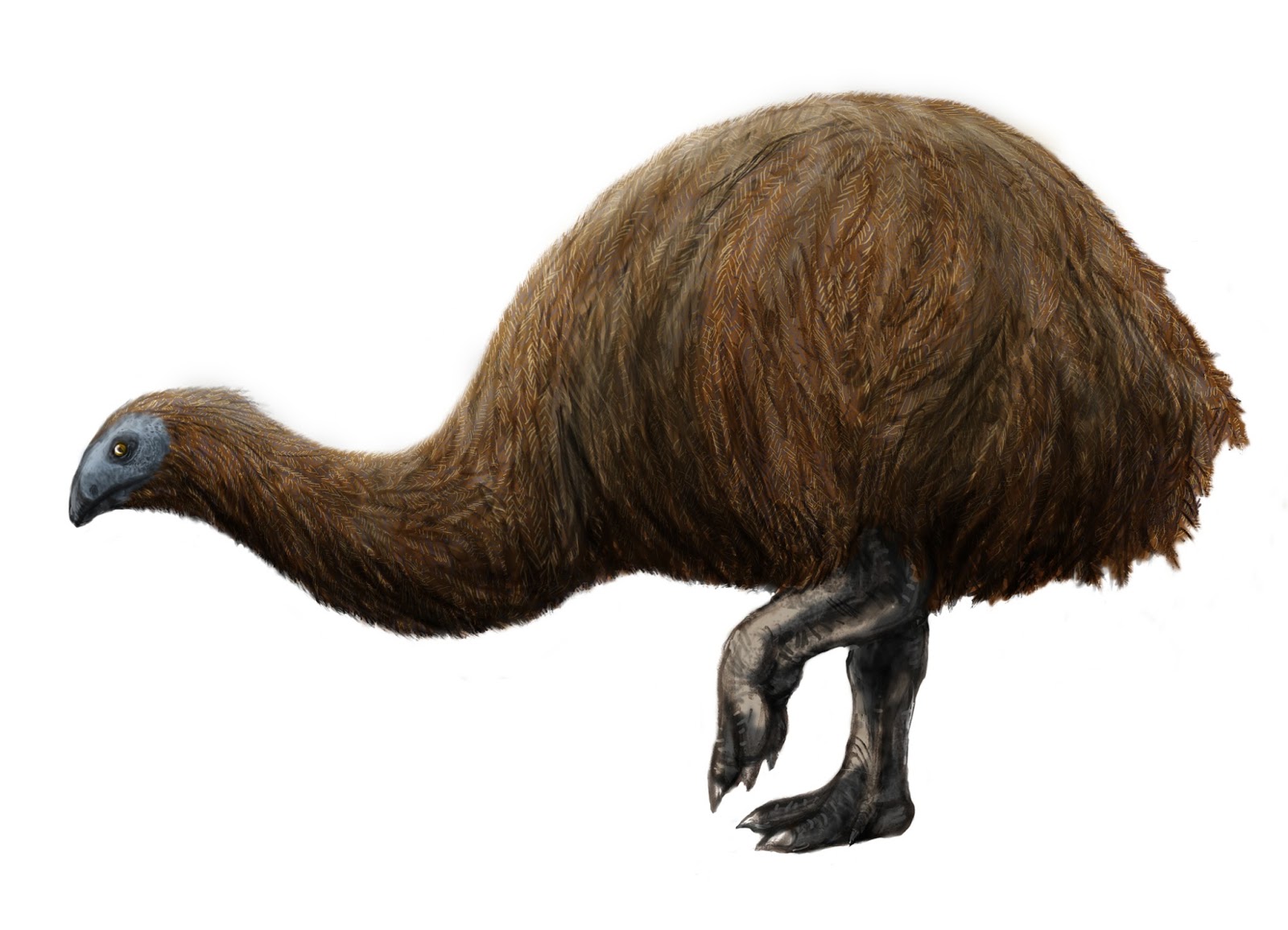
The
Cambodian 'moa' carving at Angkor
Wat (public domain)
Incidentally, adapting
the shape of an animal during its depiction in order to fit it more snugly within
a designated space for it is an option that I have already explored elsewhere
on ShukerNature (click here) in relation
to a second anomalous Angkor Wat carving - the so-called Cambodian moa.
Returning to
rhinos and the suspect stegosaur: on the latter creature's body are indications
of the skin pleats exhibited by Asian rhinos of the genus Rhinoceros (i.e.
the great Indian R. unicornis and the Javan or scaled R. sondaicus, the
latter of which definitely still existed in Cambodia 900 years ago,
with the former possibly doing so too). Even the creature's lack of a nasal
horn is not an obstacle to identifying it as a rhino of this genus, because
female Javan rhinos are sometimes hornless.

19th-Century
chromolithograph of a very short-horned Javan rhinoceros exhibited at London
Zoo in 1877, showing its skin pleats (public domain)
Another line of
speculation that has been proposed by some investigators is that the creature
actually represents a very stylised portrayal of some form of lizard,
suggestions having included a chameleon (though there is none in southeast
Asia) or one of the several species of southeast Asian agamid known as mountain
horned dragons Acanthosaura sp. However, any similarities between the
carving and such reptiles seem far less apparent (if indeed present at all) to
me than those readily visible between the carving and a stylised and/or
modified-to-fit rhinoceros. Equally, whereas an even better fit for the
creature's 'cranial horns' than the pointed ears of a rhino would be the horns
of a wild ox, the rest of the creature's depiction is a better fit for a rhino
than for an ox.
Of course, we
shall never know for sure the intended taxonomic identity of the supposed
stegosaur in this perplexing carving. However, it does seem much more likely to
be a stylised depiction of some local known species rather than anything more
radical. After all, it surely couldn't have been based upon a sighting of a
real-life stegosaur...could it?

Life-sized
model of a Stegosaurus (© Dr Karl Shuker)
My sincere thanks to John and Lesley Burke for
specifically seeking out and photographing for me the 'stegosaur' glyph at Ta
Prohm in Angkor Wat during their visit to Cambodia in 2001.

This ShukerNature blog article is excerpted and
enlarged from my forthcoming book Still In SearchOf Prehistoric Survivors…coming very soon.

If the Cambodian stegosaur were
indeed real… - 'Angkor's Way' (© Michael J. Smith)




 Posts
Posts