Dr KARL SHUKER

Zoologist, media consultant, and science writer, Dr Karl Shuker is also one of the best known cryptozoologists in the world. He is the author of such seminal works as Mystery Cats of the World (1989), The Lost Ark: New and Rediscovered Animals of the 20th Century (1993; greatly expanded in 2012 as The Encyclopaedia of New and Rediscovered Animals), Dragons: A Natural History (1995), In Search of Prehistoric Survivors (1995), The Unexplained (1996), From Flying Toads To Snakes With Wings (1997), Mysteries of Planet Earth (1999), The Hidden Powers of Animals (2001), The Beasts That Hide From Man (2003), Extraordinary Animals Revisited (2007), Dr Shuker's Casebook (2008), Karl Shuker's Alien Zoo: From the Pages of Fortean Times (2010), Cats of Magic, Mythology, and Mystery (2012), Mirabilis: A Carnival of Cryptozoology and Unnatural History (2013), Dragons in Zoology, Cryptozoology, and Culture (2013), The Menagerie of Marvels (2014), A Manifestation of Monsters (2015), Here's Nessie! (2016), and what is widely considered to be his cryptozoological magnum opus, Still In Search Of Prehistoric Survivors (2016) - plus, very excitingly, his four long-awaited, much-requested ShukerNature blog books (2019-2024).

Dr Karl Shuker's Official Website - http://www.karlshuker.com/index.htm

IMPORTANT: To view a complete, regularly-updated listing of my ShukerNature blog's articles (each one instantly clickable), please click HERE!

IMPORTANT: To view a complete, regularly-updated listing of my published books (each one instantly clickable), please click HERE!

IMPORTANT: To view a complete, regularly-updated listing of my Eclectarium blog's articles (each one instantly clickable), please click HERE!

IMPORTANT: To view a complete, regularly-updated listing of my Starsteeds blog's poetry and other lyrical writings (each one instantly clickable), please click HERE!

IMPORTANT: To view a complete, regularly-updated listing of my Shuker In MovieLand blog's articles (each one instantly clickable), please click HERE!

IMPORTANT: To view a complete, regularly-updated listing of my RebelBikerDude's AI Biker Art blog's thematic text & picture galleries (each one instantly clickable), please click HERE!

Search This Blog


PLEASE COME IN, I'VE BEEN EXPECTING YOU...

PLEASE COME IN, I'VE BEEN EXPECTING YOU...
WELCOME TO SHUKERNATURE - ENJOY YOUR VISIT - BEWARE OF THE RAPTOR!


Showing posts with label giant fish. Show all posts

Thursday, 19 March 2015

BOTHERSOME BEITHIRS AND OTHER FRESHWATER MYSTERY EELS?


Delightful depiction of Nessie as a giant eel (© Richard Pullen)

I have already discussed on ShukerNature the prospect that certain serpentiform sea monsters might be still-undiscovered giant marine eels – Dr Bernard Heuvelmans's 'super-eel' category of sea serpent (click here). Similarly, a number of freshwater mystery beasts reported from Britain and elsewhere in the world may also conceivably be unusually large eels - a thought-provoking possibility previously visited on ShukerNature in relation to reports from ancient times of supposed giant blue eels inhabiting India's Ganges River (click here), and now revisited in the following selection of additional eye-opening examples.


NEVER BOTH A BEITHIR

The Loch Ness monster (LNM) may well be Scotland's best known freshwater mystery beast, but it is not this country's only one. Far less familiar yet no less intriguing in its own way is the beithir. In 1994, a correspondent to the English magazine Athene published two fascinating articles containing various modern-day beithir sightings. During early 1975, he encountered a fisherman near Inverness who claimed that he and four others once sighted a beithir lying coiled in shallow water close to the edge of a deep gorge upstream of the Falls of Kilmorack. When it realised that it had been observed, however, it thrashed wildly about before finally swimming up the gorge near Beaufort Castle and disappearing. The fishermen estimated its length at around 10 ft.

Four months later, the Athene correspondent learnt of another sighting, this time offshore of Eilean Aigas, an island in the River Beauly, Highland. He was also informed by a keeper at Strathmore that during the 1930s his wife's parents had seen beithirs moving overland at Loch a' Mhuillidh, near Glen Strathfarrar and the mountain of Sgurr na Lapaich. After discussing these reports with various zoological colleagues, he considered that the beithir was probably an extra-large variety of eel – fishes that are well known for their ability to leave the water and move overland to forage when circumstances necessitate, and even to sustain themselves out of water for protracted periods.

The European eel, painting from 1837 (public domain)

Indeed, the Athene correspondent was informed by a Devon farmer that during the extremely harsh winter of 1947, his mother had been badly frightened to discover a number of eels alive and well in the farm's hayloft, where they had evidently been sheltering since the freezing over of the nearby river some time earlier. The rest of the family came to see this wonder, including the farmer himself (then still a boy), and his father confirmed that they were indeed eels, and not snakes (as his mother had initially assumed).


IS NESSIE A EUNUCH EEL?

The LNM (always assuming that it actually exists, of course!) has been labelled as many things by many people – a surviving plesiosaur, an unknown species of long-necked seal, and a wayward sturgeon being among the most popular identities proffered over the years. However, some eyewitnesses and zoological authorities – notably the late Dr Maurice Burton – have favoured a giant eel, possibly up to 30 ft long.

Under normal circumstances, the common or European eel Anguilla anguilla does not exceed 5 ft, and even the conger eel Conger conger (one of the world's largest eel species, rivalled only by certain moray eels) rarely exceeds 10 ft. However, ichthyological researchers have revealed that growth in eels is more rapid in confined bodies of water (such as a loch), in water that is not subjected to seasonal temperature changes (a condition met with in the deeper portions of a deep lake, like Loch Ness), and is not uniform (some specimens grow much faster than others belonging to the same species).

Collectively, therefore, these factors support the possibility that abnormally large eels do indeed exist in Loch Ness. Moreover, sightings of such fishes have been claimed by divers here. Also of significance is the fact that eels will sometimes swim on their side at or near the water surface, yielding the familiar humped profile described by Nessie eyewitnesses. And a 18-30-ft-long eel could certainly produce the sizeable wakes and other water disturbances often reported for this most famous – and infamous – of all aquatic monsters.

The conger eel (public domain)

Consequently, I would not be at all surprised if the presence of extra-large eels in Loch Ness is conclusively demonstrated one day. However, I cannot reconcile any kind of eel with the oft-reported vertical head-and-neck (aka 'periscope') category of LNM sightings, nor with the land LNM sightings that have described a clearly-visible four-limbed, long-necked, long-tailed animal.

Yet regardless of what creature these latter observations feature (assuming once again their validity), there is no reason why Loch Ness should not contain some extra-large eels too. After all, any loch that can boast a volume of roughly 1.8 cubic miles must surely have sufficient room for more than one type of monster!

In recent years, the giant eel identity for Nessie has been modified by some cryptozoological researchers to yield a creature as remarkable in itself as any bona fide monster – namely, a giant eunuch eel.  It has been suggested that Nessie may be a gigantic, sterile or eunuch specimen of the common eel – one that did not swim out to sea and spawn but instead stayed in the loch, grew exceptionally long (25-30 ft), lived to a much greater age than normal, and was rendered sterile by some currently-undetermined factor present in this and other deep, cold, northern lakes.

This is undeniably a fascinating, thought-provoking theory, but Dr Scott McNaught, Professor of Lake Biology at Central Michigan University, has stated that even if such eels did arise, they would tend to grow thicker rather than longer. Nevertheless, giant eels remain a distinct possibility in relation to some of the world’s more serpentiform lake monsters on record.


MONSTER EELS IN THE MASCARENES

The concept of giant freshwater eels is by no means limited to Britain. For example: a number of deep pools in the Mascarene island of Réunion, near Mauritius, in the Indian Ocean, are supposedly inhabited by gigantic landlocked eels.

In a letter to The Field magazine, published on 10 February 1934, Courtenay Bennett recalled seeing during the 1890s when Consul at Réunion a dead specimen that had been caught in one such pool, the Mare à Poule d'Eaux, which is said to be very deep in places. It was so immense that "steaks as thick as a man's thighs were cut" from its flesh.

Mare à Poule d'Eaux (© http://www.chat-reunion.com)

According to native testimony, moreover, during the heavy winter rains the giant eels could apparently be seen circling along the sides of this lake, searching for a way out. Being so exposed, however, they were prime targets for local hunters, who would catch them using a harpoon and a rope hitched round a tree. Their flesh would then be sold for food in a neighbouring village.


EXTRA-LARGE EELS IN JAPAN?

Several of Japan's biggest lakes are associated with accounts of freshwater eels reputedly much larger than typical specimens on record from these localities. A concise coverage of such creatures appeared in a detailed article concerning Japanese giant mystery fishes that was written by Brent Swancer and posted on 30 April 2014 to the Mysterious Universe website (click here to access the full article) and reads as follows:

Various locations in Japan have had reports of huge eels far larger than any known native species.

Workers doing construction on a floodgate on the Edo river reported coming across enormous eels measuring 2 meters (6.6 feet) long. According to the account, four of the eels were spotted and some of the workers even attempted to capture one, as the eels appeared to be rather lethargic and slow moving. They were unsuccessful as they did not have the equipment to properly catch one. Upon returning to the scene later on with the tools they needed, they found that the mysterious giant eels were nowhere to be seen.

Another account comes from Lake Biwa, which is in Shiga Prefecture, and is the largest freshwater lake in Japan. In the 1980s, there were several reports of giant eels inhabiting the lake.

One such sighting was made by a large group of people aboard one of the lakes many pleasure boats. Startled ferry passengers reported seeing several very large eels swimming at the surface far from shore. The eels were described as being around 3 meters (around 10 feet) long, and a silvery blue color. The eels appeared to be leisurely gliding along beside the boat and were observed for around 15 minutes before moving off out of sight.

A fisherman on the same lake reported actually hooking and reeling in an eel that was reported to be around 8 feet in length. In this case, the eel was kept and eaten. Another fisherman on the lake reported seeing a similarly sized eel rooting through mud in shallow water near the shore.

Japan's Lake Biwa, as seen from Higashiamagoidake (public domain)

Interestingly, the giant blue eels of Lake Biwa readily recall comparably-described mystery beasts from India's Ganges River as reported by several early chroniclers (click here for my earlier-mentioned ShukerNature coverage of these latter cryptids).


GIANT EELS IN OHIO?

Although giant eels are a popular identity for water monsters, of both the marine and freshwater variety, because the size of eels is notoriously difficult to gauge accurately in the wild due to their sinuous movements and usual lack of background scale for precise length estimation this means that eyewitness reports of giant specimens are normally difficult to take seriously – which is why the following account is so significant. On 3 February 2015, Facebook friend Chris R. Richards from Covington, Washington State, USA, posted on the page of the Facebook group Cryptozoology the following hitherto-unpublished report of a huge freshwater eel that he and his father had personally witnessed during the 1990s:

I believe whole heartily in giant eels. I saw one as long as my canoe back in the later nineties. They could result in sea monster claims. Hocking River Ohio. Directly off the side of the canoe in clear water near upper part of river. At first thought it was a tree with algae in water, then saw the head and realized the "algae" was actually a frill. The animal was thicker than my arm. The head was at the front of the 15ft Coleman canoe and the tail end trailed behind my back seat. At the time this was amazing to both my father and I. Only later did I come to fully appreciate how amazing this sighting was. I got to see it the longest as we slowly passed it and I was in the back of the boat. [The eel was] 12 to 15 ft.

The frill was presumably the eel's long, low dorsal fin, which runs along almost the entire length of the body in freshwater anguillid (true) eels. What makes this report so exciting is that there is an unambiguous scale present in it – the known length of the canoe, alongside which the eel was aligned, thereby making its total length very easy to ascertain.

American eel (public domain)

The only such species recorded from Ohio is the common American eel Anguilla rostrata, which officially grows up to 4 ft long. Consequently, judging from the scale provided by the canoe, the eel seen by Chris and his father was 3-4 times longer than this species' official maximum size.

Assuming their report to be genuine (and I'm not aware of any reason to doubt it), there seems little option but to assume, therefore, that bona fide giant freshwater eels do indeed exist, at least in the Ohio waterways, which is a remarkable situation and clearly of notable cryptozoological interest.

Reconstruction of the possible appearance of the Ganges giant blue mystery eel (© Dr Karl Shuker)


Friday, 24 October 2014

CAVEAT LECTOR – LET THE READER BEWARE OF FAKE CRYPTOZOOLOGICAL NEWS STORIES ON SATIRE WEBSITES

A 4.3-metre-long female great white shark caught and photographed in the shark nets off Zinkwazi beach, South Africa, on 31 August 2009 (as reported here), which was subsequently rebranded as a 15-ton giant prehistoric shark caught alive and photographed off Pakistan in 2014 according to a fabricated report recently featured on a satire website (photograph's copyright owner unknown to me)

Even though it commonly occurs, something that is by no means widely realised is the appearance on certain websites of cryptozoological news reports that initially seem to be extremely significant and exciting but which in reality are invariably and completely fictitious.

The 'certain websites' that I am referring to here are so-called satire news sites, of which there are a sizeable number, and which to the casual eye appear to be genuine, factual news websites, but whose entire content, regardless of subject matter, is actually pure fiction (although the images used in them have sometimes originated in earlier, unrelated factual stories on genuine news websites). To be fair, I freely concede that most of these sites do include a small but readily visible disclaimer, usually at the top or bottom of their front page, which when clicked states categorically what they are and what their stories are.

Unfortunately, however, these disclaimers are frequently overlooked by readers, as a result of which many fake stories of a cryptozoological nature that have originated on satire websites subsequently make regular and repeated appearances on bona fide cryptozoological sites and social website pages. Posted there by crypto-enthusiasts unfamiliar with satire sites, they often generate a great deal of conjecture and confusion until their true nature is revealed by more experienced web-surfers.

One satire website that has produced quite a few crypto-themed reports during the course of its existence is World News Daily Report (click here), whose disclaimer reads as follows:

"World News Daily Report is a news and political satire web publication, which may or may not use real names, often in semi-real or mostly fictitious ways. All news articles contained within worldnewsdailyreport.com are fiction, and presumably fake news. Any resemblance to the truth is purely coincidental, except for all references to politicians and/or celebrities, in which case they are based on real people, but still based almost entirely in fiction."

Yet in spite of its disclaimer's presence and unequivocal wording, a number of this satire website's fun stories have nonetheless attracted serious albeit misguided attention in various mainstream sites and social pages devoted to cryptozoology and anomalies or controversies of nature. These stories include the following list (NB - list updated by me on 17 December 2014):

* Mysterious Remains of a Whale Found in a Field in Utah.
Click here
5 December 2014.

* Smithsonian Admits to Destruction of Thousands of Giant Human Skeletons in Early 1900's.
Click here
3 December 2014.

Mexican Drug Smugglers Eaten Alive by Giant Squids After Boat Sinks Near Coast of California.
Click here
26 November 2014.

* Ireland: Archaeologists Discover Remains of New Humanoid Species.
Click here
18 November 2014.

Jurassic Plant Brought Back to Life After 200 Million Years.
Click here
12 November 2014.

Pterodactyl Sighting in New Guinea Terrorizes Villagers, Alarms Authorities
Click here
27 October 2014.

Archeologists Unearth Giant Human Remains Near Stonehenge.
Click here
1 October 2014

* 15-Ton Prehistoric Shark Captured Off Coast Of Pakistan.
Click here
23 September 2014.

Scotland: Nessie Sighting Brings Surge Of Enthusiasm In Favor Of Scottish Independence.
Click here
15 September 2014

Indonesia: Ape Man Creature Shot Down In Borneo Jungle.
Click here
14 September 2014

Giant Man-Eating Catfish Finally Caught In Mekong River.
Click here
28 August 2014

New York: 600-Pound Alligator Shot Down in Central Park.
Click here
5 August 2014.

Russia: Mammoth Embryo Brought Back to Life.
Click here
13 July 2014.

Nepal: Frozen Caveman Discovered in Himalaya.
Click here
12 June 2014.

Pet Jerboa Crosses Europe to Reunite With Family.
Click here
9 April 2014.

M’Bokolokolo Creature Sighted in Nigeria.
Click here
26 March 2014.

* 200 Million Years Old Dinosaur Egg Hatches in Berlin Museum.
Click here
20 February 2014.

Indonesia: Tiger Rhinos Almost Extinct, According to Experts.
Click here
13 January 2014.

* Thailand: Snakegirl Attracts Crowds of Pilgrims and Tourists.
Click here
6 January 2014.

Giant Lobster Invades Beach House in Canada.
Click here
21 December 2013.

Malawi: Rare Specimen of Duckhorse Sighted During Safari.
Click here
11 December 2013.

New Specie [sic] of Centipedes Discovered Near Fukushima [radiation-mutated circular centipede with no head or posterior end!].
Click here
2 December 2013.

China: Tiger Squirrel Wreaks Havoc in Small Village.
Click here
1 December 2013.

Chinese Scientists Clone Pig with Wings.
Click here
29 November 2013.

3-Meter Tall Squirrel Killed by Army After Bloody Rampage.
Click here
26 November 2013.

Climbers Encounter Sasquatch in Colorado.
Click here
18 November 2013.

So if you've previously read any of these reports and presumed that they described major breakthroughs in cryptozoological or mainstream zoological discovery – think again!

Finally: for a useful annotated listing of notable satire websites and other prominent online sources of faux journalism, click here.


UPDATE: 12 August 2017

Today, I rechecked all of the above articles, and discovered that only six of them are still online, so I have now identified them with a red asterisk (*) at the beginning of their titles. However, I did also note that there are plenty of newer ones on that site... 

Contrary to satire news reporting, Nessie did not make any appearance at the time of the recent vote for Scottish independence – judging from this delightful illustration, her attention was clearly elsewhere! (© Jane Cooper)


Wednesday, 23 April 2014

SOME FISHY FINDINGS REGARDING THE MONSTERS OF RUSSIA'S LAKE LABYNKYR


The burbot – does this unusual fish hold the key to the monsters of Lake Labynkyr?

Almost 9 miles long, 2.5 miles wide, and up to 260 ft deep in one particular section, Lake Labynkyr in far-eastern Russia's Yakutia (Sakha) Republic is not only a large but also a very remote body of icy-cold freshwater. It is not frequently visited by outsiders, but those hardy local hunters that have braved its location's inhospitable climate have sometimes returned home with stories of formidable aquatic monsters inhabiting its chilly depths - stories that date back as far as the 19th Century but which have received increasing public and scientific attention since the 1950s.

Lake Labynkyr (© LosApos.com)

Some tell of a dark-grey beast with an enormous mouth that has allegedly devoured their dogs when they have leapt into the lake to retrieve shot ducks. Others speak of a black, long-necked, snorting creature with a snake-like head that preys upon geese and reindeer. In my book In Search of Prehistoric Survivors (1995), I noted that according to Anatoly Pankov, a chronicler of mysterious happenings in this part of the world, sometime during the 1950s one such creature supposedly raised its neck above the lake's surface in full view of a team of geologists and lunged upwards to snare a flying bird between its jaws while also being watched by a number of astonished reindeer hunters.

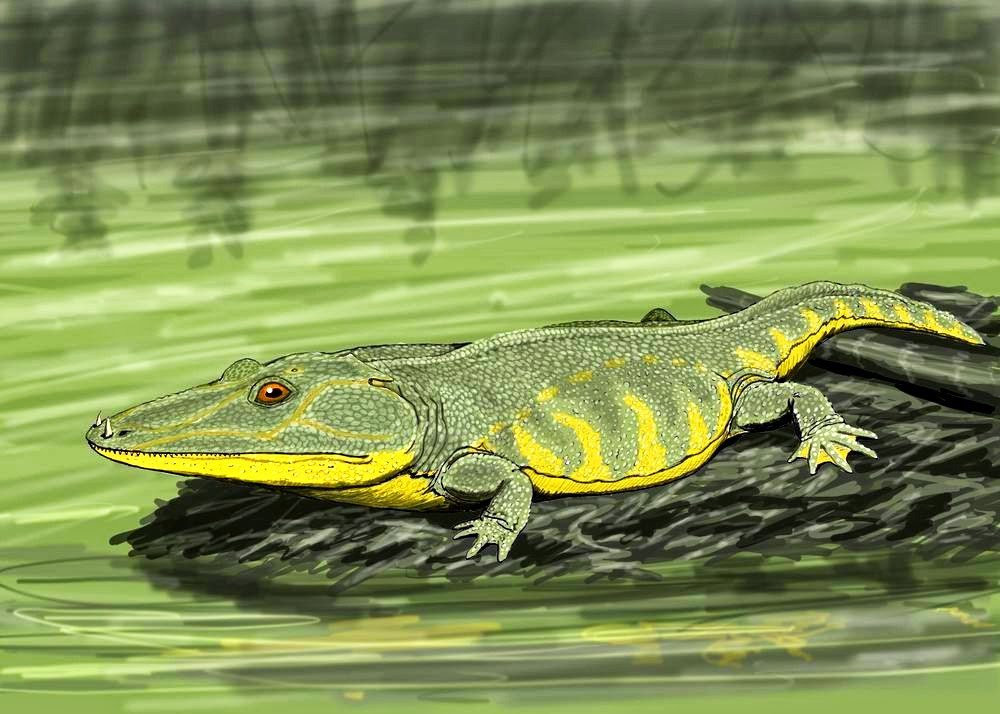
In 1962, Dr Sergei Klumov suggested that an unknown species of amphibian may exist here - a possibility also contemplated by Soviet geologist Dr Viktor Tverdokhlebov, who visited Lake Labynkyr during Russia's Stalinist era. A relict reptile was an alternative candidate proffered by Tverdokhlebov, but he was unable to put either option to the test, as he did not report any sightings of monsters there. Nor did any team members from a Russian expedition that visited in 1963, or an Estonian team in 1964. Yet the legend of mystery beasts lurking beneath its water surface continues.

Modern reconstruction of Mastodonsaurus - a very big and notably large-mouthed amphibian from the Middle Triassic Period (public domain)

Thanks to the intriguing findings of a team that visited this mysterious lake last month, however, the true nature of its supposed monsters may be very different from the accounts and theories noted above, but no less interesting either.

The team in question was composed of divers from the Russian Geographic Society and the Diving Sport Federation of Russia. Their mission had three separate goals – to collect samples for formal scrutiny and analysis by scientists investigating the long-suspected possibility that an underwater link exists between Lake Labynkyr and the equally mysterious Lake Vorota, almost 20 miles away; to break the world record for the deepest under-ice dive; and to look out for Labynkyr's fabled monsters. By the end of their visit, the team had accomplished both of their first two goals, and had also obtained some thought-provoking findings of great relevance to their third.

As documented by the Siberian Times on 21 April 2014, team member Lyudmila Emeliyanova, an Associate Professor of Biogeography, revealed that during a previous visit here (in 2009):

"It was our fourth or fifth day at the lake when our echo sounding device registered a huge object in the water under our boat.

"The object was very dense, of homogeneous structure, surely not a fish nor a shoal of fish, and it was above the bottom. I was very surprised but not scared and not shocked, after all we did not see this animal, we only registered a strange object in the water. But I can clearly say - at the moment, as a scientist, I cannot offer you any explanation of what this object might be."

And that was not all - further sonar readings of this same kind were subsequently recorded by her equipment:

"I can't say we literally found and touched something unusual there but we did register with our echo sounding device several seriously big underwater objects, bigger than a fish, bigger than even a group of fish."

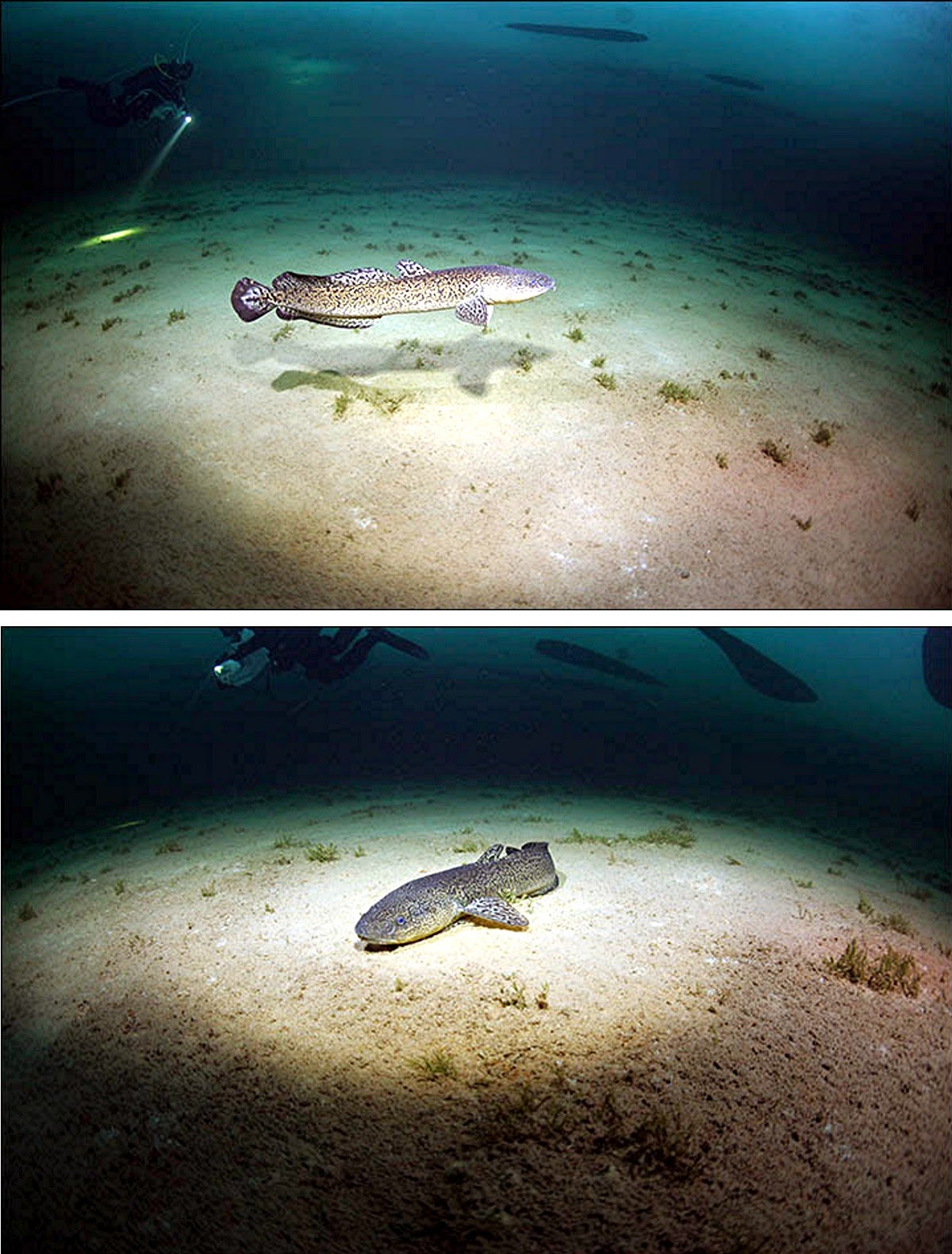
In contrast, the largest life forms detected in the lake during this latest visit, and which were photographed by team member Alexander Gubin, were fishes up to 4 ft long that the team referred to as dogfishes – which is something of a mystery in itself.

Two photographs of 'dogfishes' encountered during the Russian team's visit to Lake Labynkyr in March 2014 (© Alexander Gubin/Siberian Times)

For whereas the term 'dogfish' is normally applied to various relatives of sharks, I was readily able to identify the fishes in Gubin's photographs as being something totally different.

Namely, a cod-related freshwater species known as the burbot Lota lota. So, could 'dogfish' be a colloquial name used in Russia for the burbot?

(Top) A burbot (© Achim R Schloeffel/Wikipedia); (Bottom) One of the Russian team's 'dogfishes' (© Alexander Gubin/Siberian Times)

Carnivorous by nature, this very distinctive species – the world's only freshwater gadiform - is known to attain a total length of up to 4 ft. However, larger specimens may conceivably exist in this large but little-disturbed lake.

Untroubled by any large-scale threat of predation by other animals or persecution by humans, and encouraged to attain an exceptionally large size by the lake's chilling temperature in the same way that fishes and invertebrates famously do in the freezing waters off Antarctica, perhaps undiscovered mega-burbots are the real monsters of Labynkyr.


For more information on Russian lake monsters, check out my book Karl Shuker's Alien Zoo (CFZ Press: Bideford, 2010).


Sunday, 22 November 2009

A LAKE IS A LAKE IS A LAKE...ISN'T IT?

Taimen


Some months ago, Richard Freeman in his blog was perplexed about the location of a certain Tibetan lake said to house monsters, which I was able to resolve by revealing that for reasons still unknown to me it has been referred to by a variety of different names, of which Lake Wembo is just one.

As it happens, moreover, there is another Chinese 'monster' lake that is mystifying me for a similar reason - over the years, its name has inexplicably changed, causing some confusion at first as to whether the two names did indeed refer to the same body of water. I refer to what was originally called Lake Hanas, but which in more recent years is now repeatedly called Lake Kanasi. Has the name officially changed, or it is merely a question of a different transliteration from Chinese to English being adopted (as with Peking to Beijing, for instance)? If anyone has any info, I'd love to receive it.

Meanwhile, for anyone who may not know about the fascinating monsters of Lake Hanas/Kanasi, here is what I wrote about them in 2002 within my book The New Zoo: New and Rediscovered Animals of the Twentieth Century (which will be republished in 2011 in a new, expanded, updated edition):


"THE MONSTER FISHES OF CHINA'S LAKE HANAS

"Officially, the largest specimen of freshwater fish on record is a 15 ft European catfish Silurus glanis, caught in Russia's Dniepper River sometime prior to the mid-1800s (though this species as a whole is generally shorter than the pa beuk, officially deemed to be the world's largest freshwater fish). As a consequence, the lake-dwelling fishes reported in July 1985 by no less an authority than China's eminent biologist Prof. Xiang Lihao, from Xinjiang University, attracted appreciable scientific interest.

"In July, the professor and a party of students arrived at a large but remote body of water called Lake Hanas, situated in northwestern China's Xinjiang Autonomous Region, in order to examine its potential as the site of a future nature reserve. On 24 July, one of the students observing the lake from a watchtower built two years earlier noticed several huge reddish-coloured objects moving at the water's surface. When the professor and students scrutinised them closely through binoculars, they discovered to their astonishment that they were enormous salmon-like fishes, whose heads, tails, and spiny dorsal rays could all be clearly discerned. Just how enormous they were, however, was not revealed until the next day.

"That morning, while again being observed through binoculars by Xiang Lihao, one of the fishes very obligingly aligned itself in parallel with a stretch of the bank extending between two trees. Armed not only with binoculars this time but also with a camera, the professor took some photos, then measured the distance between the trees. Using this measurement, he was able to calculate from the photos that the fish was at least 33 ft long!

"A large salmon known as the taimen Hucho taimen is indeed known from several rivers in northern China, but this species' maximum recorded length is a mere 6.5 ft - far short of the Lake Hanas monsters. Worth noting is that giant red fishes in this lake have been reported for decades by local villagers, but as the lake had not previously attracted scientific attention such reports had not been widely circulated. Now, with an eyewitness of Prof. Xiang Lihao's scientific standing, there should be no question concerning their existence or authenticity as giant fishes. So unless they are abnormally huge taimen, the Lake Hanas fishes must surely comprise a spectacular new species, requiring formal description and study."


An updated account of these creatures will appear in my new, updated New Zoo.