Dr KARL SHUKER

Zoologist, media consultant, and science writer, Dr Karl Shuker is also one of the best known cryptozoologists in the world. He is the author of such seminal works as Mystery Cats of the World (1989), The Lost Ark: New and Rediscovered Animals of the 20th Century (1993; greatly expanded in 2012 as The Encyclopaedia of New and Rediscovered Animals), Dragons: A Natural History (1995), In Search of Prehistoric Survivors (1995), The Unexplained (1996), From Flying Toads To Snakes With Wings (1997), Mysteries of Planet Earth (1999), The Hidden Powers of Animals (2001), The Beasts That Hide From Man (2003), Extraordinary Animals Revisited (2007), Dr Shuker's Casebook (2008), Karl Shuker's Alien Zoo: From the Pages of Fortean Times (2010), Cats of Magic, Mythology, and Mystery (2012), Mirabilis: A Carnival of Cryptozoology and Unnatural History (2013), Dragons in Zoology, Cryptozoology, and Culture (2013), The Menagerie of Marvels (2014), A Manifestation of Monsters (2015), Here's Nessie! (2016), and what is widely considered to be his cryptozoological magnum opus, Still In Search Of Prehistoric Survivors (2016) - plus, very excitingly, his four long-awaited, much-requested ShukerNature blog books (2019-2024).

Dr Karl Shuker's Official Website - http://www.karlshuker.com/index.htm

IMPORTANT: To view a complete, regularly-updated listing of my ShukerNature blog's articles (each one instantly clickable), please click HERE!

IMPORTANT: To view a complete, regularly-updated listing of my published books (each one instantly clickable), please click HERE!

IMPORTANT: To view a complete, regularly-updated listing of my Eclectarium blog's articles (each one instantly clickable), please click HERE!

IMPORTANT: To view a complete, regularly-updated listing of my Starsteeds blog's poetry and other lyrical writings (each one instantly clickable), please click HERE!

IMPORTANT: To view a complete, regularly-updated listing of my Shuker In MovieLand blog's articles (each one instantly clickable), please click HERE!

IMPORTANT: To view a complete, regularly-updated listing of my RebelBikerDude's AI Biker Art blog's thematic text & picture galleries (each one instantly clickable), please click HERE!

Search This Blog


PLEASE COME IN, I'VE BEEN EXPECTING YOU...

PLEASE COME IN, I'VE BEEN EXPECTING YOU...
WELCOME TO SHUKERNATURE - ENJOY YOUR VISIT - BEWARE OF THE RAPTOR!


Showing posts with label penis snake. Show all posts

Friday, 25 January 2019

CELEBRATING TEN YEARS OF SHUKERNATURE, VIA ITS ALL-TIME TOP TEN ARTICLES


My ShukerNature blog's official banner, very kindly designed for me by Mark North (© Dr Karl Shuker)

Yes indeed – this week is a very momentous occasion in the history of my ShukerNature blog, because it was exactly 10 years ago this week, on 20 January 2009 to be precise, that I uploaded onto it my very first (albeit very short) article (click here to access it), and the rest, as they do say, is history.

So what better way to celebrate ShukerNature's tenth anniversary than to present (in what is its 652nd article) a clickable listing of its all-time top ten articles, as determined by their respective total number of visitor hits received. And here they are, with their total hit counts as of right now included in brackets following their links:


Judging from the subjects covered by the above articles, melanistic mystery cats seem to be of considerable interest to ShukerNature readers, as no fewer than three of the top ten articles (out of a total of no fewer than 652) are devoted to the investigation of such creatures and, in particular, alleged photos of such. Intriguing images also form the basis of a further four, purportedly portraying such diverse entities as an unexpectedly fluffy moth, a bizarre bird with a gargantuan gape, a monstrously huge grasshopper, and a grotesque being likened to an incongruous human-rabbit hybrid but likely to have been something much less extraordinary yet far more tragic.

Stir into this singular mix some truly bizarre beasts conjured forth into tangible existence by the creative genius of a celebrated master in manipulation and design, plus the perennially-popular saga of merfolk, and never forgetting a remarkable amphibian whose memorable external appearance has earned for it from the ever-imaginative media an even more memorable monicker, and the result is a listing of fascinating subjects that could not be found together anywhere else online, only here on ShukerNature, along with 642 other no less enthralling and entertaining topics too.
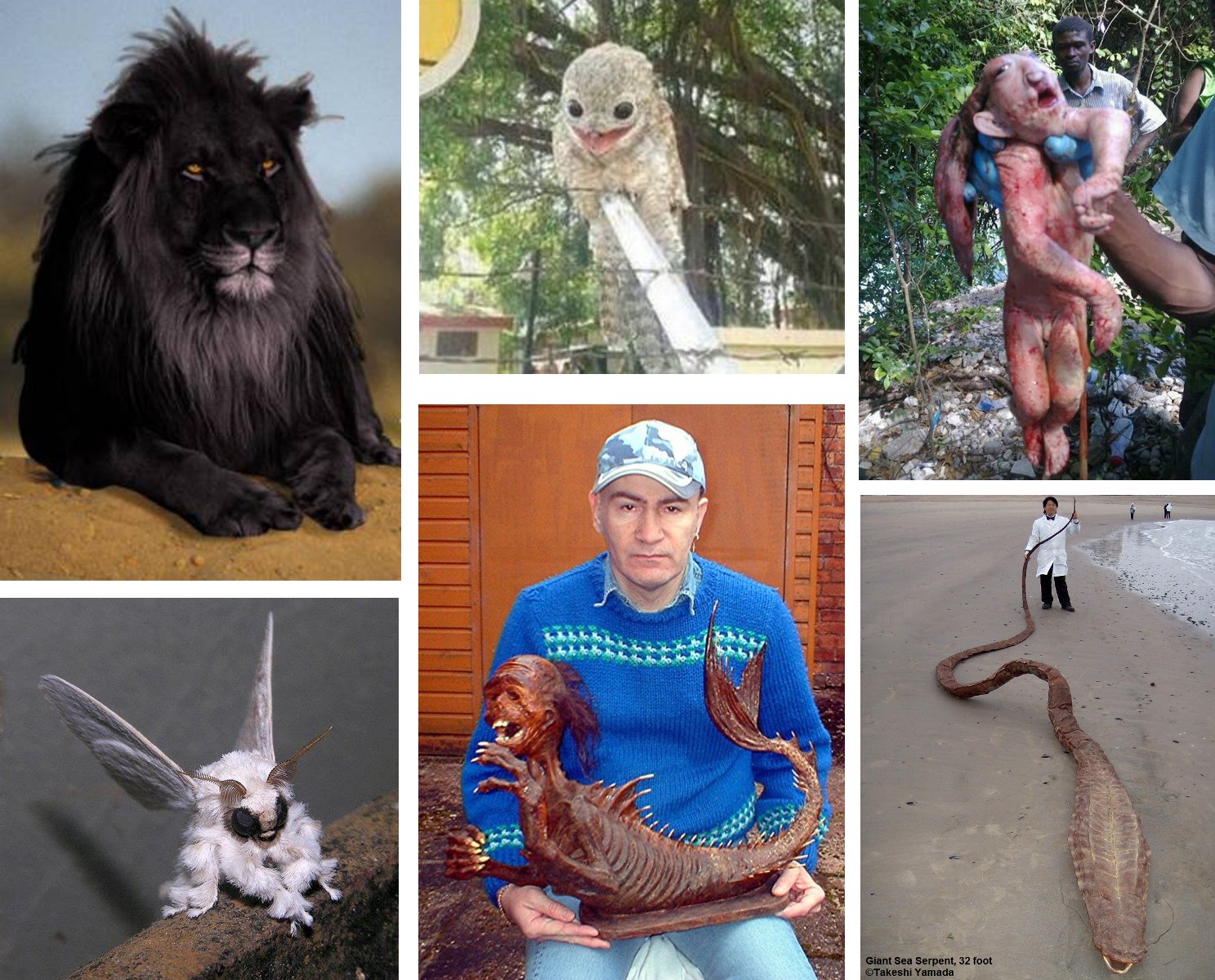
Subjects covered in some of my top ten ShukerNature blog articles (mermaid photo (© Dr Karl Shuker; Venezuelan poodle moth © Arthur Anker; giant sea serpent gaff photo © Takeshi Yamada; © of the other photos unknown to me but presented here on a strictly non-commercial Fair Use basis only)

So here's hoping that they will continue to be of interest to readers for a long time to come, and that I will be able to continue adding further ones to their elite company.

Finally, I'm happy to say that my long-awaited, long-promised ShukerNature book will be published during this coming spring, containing an exceedingly varied selection of my blog's articles in expanded, updated form, fully illustrated throughout in colour, and supplemented by a very extensive bibliography of sources consulted by me during their preparation. Look out here on ShukerNature for further updates as I receive them.

The original and extremely beautiful artwork specially prepared for the front cover of my forthcoming ShukerNature book by renowned artist Anthony Wallis (© Dr Karl Shuker/Anthony Wallis)


Tuesday, 25 August 2015

MY 500TH SHUKERNATURE POST! – PRESENTING THE TOP TEN SHUKERNATURE POSTS OF ALL TIME: FROM BLACK LIONS AND MERMAIDS TO POODLE MOTHS AND PENIS SNAKES!


Subjects documented in six of my all-time Top Ten ShukerNature blog posts (mermaid photo © Dr Karl Shuker; Venezuelan poodle moth photo © Arthur Anker; giant sea serpent gaff photo © Takeshi Yamada; © of the other photos unknown to me)

Welcome to my 500th ShukerNature blog post! To mark this momentous occasion, I have pleasure in presenting for your entertainment and interest the following equally momentous list – the Top Ten ShukerNature posts of all time, based upon hit counts. And here they are, each one with its own clickable direct link to the post itself.

Posted: 12 June 2012
Hits count: 1,155,307

Posted: 1 August 2012
Hits count: 209,972

#3: MYSTERY OF THE VENEZUELAN POODLE MOTH – HAVE YOU SEEN THIS INSECT??
Posted: 22 August 2012
Hits count: 114,688

Posted: 16 August 2012
Hits count: 92,565

Posted: 3 August 2012.
Hits count: 76,659

Posted: 1 October 2012
Hits count: 58,418

Posted: 26 January 2014.
Hits count: 44,933

#10: GIANT ANACONDAS AND OTHER SUPER-SIZED CRYPTOZOOLOGICAL SNAKES
Posted: 20 September 2013
Hits count: 42,213

Analysing this list, several intriguing if not readily explainable facts swiftly emerge.

First and foremost, melanistic cats – most especially black lions – clearly hold an abiding fascination for ShukerNature readers. The popularity of my all-time #1 blog post, exposing various online black lion photographs as photo-manipulated hoaxes, is truly, outrageously, and – above all else – inexplicably phenomenal! What on earth is it about black lions that should have generated well over 1 million hits for this particular post since I uploaded it just over 3 years ago, far more than any other ShukerNature post, and continuing to add to that count by the thousands each week?

Collectively, ShukerNature's 500 posts have garnered a total hits count of just over 5.1 million, which means that this one single post has contributed more than 20% of that total all by itself! Nor does it end there. A follow-up post of mine exposing a further black lion photo as yet another hoax also makes the all-time Top Ten ShukerNature posts list (coming in at #8), and my examination of the highly contentious issue of whether black pumas exist is at #5.

Equally perplexing is why four of the ten posts in this all-time Top Ten list originated from the very same month, August 2012, bearing in mind that I have been posting on ShukerNature from 20 January 2009 right up to the present day, and on a regular basis throughout that sizeable time span too. What was/is so special about that specific month, therefore, particularly as the four posts in question from it deal with four entirely different subjects? True, the poodle moth was attracting tremendous online interest at the time of my post, so that would definitely have helped focus attention upon it here on my blog too. And the term 'penis snake', as invented by the media for it, no doubt explains why a large but hitherto highly-obscure species of aquatic amphibian lacking limbs and lungs has received such a high hits count on here.

Certainly, there is no doubt that photos of weird animals that have gone viral online prove popular subjects for ShukerNature posts, especially those posts that investigate what the creatures portrayed in such photos are and whether such photos are genuine or fake. The success of my two black lion posts exemplify this trend, as do those dealing respectively with the poodle moth, the potoo, the alleged half-human half-rabbit hybrid, and the many bizarre beasts created by Takeshi Yamada.

As for the two remaining posts in this list, dealing with merfolk and giant snakes respectively, these are perennially popular cryptozoological subjects. Consequently, their presence should come as no surprise.

Looking back one last time at this all-time Top Ten list, there is no doubt that I could never have predicted which of my 500 ShukerNature posts would have made the cut. And when uploading the first of my black lion posts back in June 2012, a post that took no more than half an hour to prepare, I never dreamed even for an instant that it would become the runaway ShukerNature success story that it has done and still is, seemingly destined never to be overtaken by any other post on this blog of mine, regardless of its subject, and continuing to increase its count by significant amounts on a daily basis.

But what about the other nine posts in this list? Will they still be in the Top Ten when or if a 1000th ShukerNature post is uploaded one day? Who can say? If I've derived nothing else from this list, I have definitely learnt from it to expect the unexpected – which only serves to increase my passion for preparing further ShukerNature posts in the future, as well as my fervent hope that you will continue to enjoy reading and re-reading them. So here's to the next 500, and thank you all as ever for your continuing encouragement and interest in my researches and writings!

Subjects documented in the remaining four of my all-time Top Ten ShukerNature blog posts (photo-manipulated black puma photo © Dr Karl Shuker; giant python photo © Colonel Remy van Lierde; penis snake photo © Matt Roper; © of photo-manipulated black lion photo unknown to me)


Friday, 3 August 2012

THE TRUTH ABOUT BRAZIL'S AMAZING 'PENIS SNAKE' - NOT A SNAKE, AND CERTAINLY NOT A...


One of the recently-captured specimens of Atretochoana eiselti (Matt Roper)

During the past 24 hours, the world media has been full of stories concerning the supposed discovery in Brazil of a 'new species' of 'blind snake' that 'resembles a human penis'. As is so often the case with media reports describing unusual, little-known animals, however, the truth is very different - as I shall now reveal in an attempt to set the facts straight regarding this beast once and for all.

In reality, although it is indisputably a most amazing and very distinctive form it is not a new species, it is not a snake, and its claimed afore-mentioned resemblance is very much in the eye of the beholder – or, to put it another way (so to speak!): if the relevant portion of my body looked like this creature, I'd be seriously worried!

Vermiform, eyeless, grey in colour, and each measuring approximately 3 ft long, six specimens of the aquatic species in question were found at the bottom of the Madeira River during the draining of a portion of it by engineers in November 2011 for a new hydroelectricity dam in the northern Brazilian state of Rondonia. According to biologist Juliano Taban who works for the company constructing the dam, all six were captured for initial observation. Sadly, however, one of them died, but three of the others were released back into the river shortly afterwards, with the remaining two being retained for further scientific study and formal taxonomic identification, news regarding which was only made public this week. So what exactly did these sizeable but very peculiar creatures turn out to be?

In fact, they belonged to a species of limbless amphibian known as a caecilian - but no ordinary one. On the contrary, this particular caecilian constituted one of the most extraordinary herpetological discoveries of the 20th Century when officially described and named back in 1968. In my recent book The Encyclopaedia of New and Rediscovered Animals (Coachwhip: Landisville, 2012), I documented this highly significant yet scarcely-known species' uniquely surprising history as follows:

A 19th-Century colour engraving of a caecilian, Siphonops

"Caecilians [constitute] a taxonomic order of entirely limbless species, many of which greatly resemble earthworms. Most are predominantly subterranean, fossorial species (although there are also some aquatic river-dwelling forms), and are rarely seen above-ground unless flushed out during rainfall. They inhabit wet tropical localities in Africa, Asia, and South America, feed principally upon insects and worms, and most are relatively small, but a few extra-large species also exist, growing up to 4 ft long and superficially similar in outward appearance to snakes.

"One feature that all species share is a pair of lungs – or at least they did until 1968, or, to be exact, 1995; as will be seen, the history of the following ground-breaking species is nothing if not complicated. It began in 1968, when a notably large preserved specimen of caecilian originating from an unspecified location in South America became the type (and for a long time thereafter the only) specimen of a new species, which was formally christened Typhlonectes eiselti by Kansas University herpetologist Dr Edward H. Taylor in a major monograph entitled The Caecilians of the World.

"Measuring 27.5 in long, this new species’ unique specimen was an adult female housed in the collections of Vienna’s Naturhistoriches Museum, but Taylor’s official description of it had been unusually brief, and concentrated primarily upon its external morphology. Not until the early 1990s did it attract any further scientific attention, even though it was on full public display inside a glass exhibition case at the museum during the intervening years. When it was finally re-examined, however, by zoologist Dr Ronald A. Nussbaum from Michigan University and Bristol University caecilian specialist Dr Mark Wilkinson, they closely investigated its internal form, which duly revealed a very remarkable and hitherto-unsuspected surprise – this large, enigmatic, but previously neglected caecilian was lungless.

"Indeed, their discovery meant that T. eiselti was now the largest species of lungless tetrapod known to science, and was sufficiently removed from all other caecilians to require them to publish a major redescription of it, which appeared in 1995. Moreover, in their paper, they also created a new genus for it, renaming this radically disparate species Atretochoana eiselti, which highlighted the fact that even its choanae (internal nostrils) were sealed. It also totally lacked any pulmonary blood vessels. Clearly, therefore, this caecilian respired entirely through its skin (cutaneous respiration is also carried out by other caecilians, but only as a supplement to normal pulmonary respiration). Its cranium exhibited fundamental differences from that of other caecilians too. If only there were other examples of this extraordinary species to examine, but where to look? The provenance within South America of its one and only specimen was unknown.

"Happily, in 1998, after 30 long years, a second specimen was finally recorded – documented by Wilkinson and three co-researchers – which was confirmed to have originated from a river in Brazil, but its precise location was unknown. Measuring 31.7 in (80.5 cm), it was longer than the first one but otherwise very similar in form. And that is where the remarkable history of A. eiselti comes to an end, at least for now, as no further specimens have been discovered.

"What has been discovered, meanwhile, is a second species of lungless caecilian, and whereas A. eiselti is aquatic, this new one is land-based. Found in the scrub of Guyana’s Iwokrama Forest and described online in late 2009 (in hard-copy format in 2010), when it was formally named Caecilita iwokramae, it is the only member of a new genus and is much smaller than A. eiselti, its holotype only measuring 4.4 in long."

My book containing the above account concerning A. eiselti (Dr Karl Shuker)

Thanks to those engineers' discovery at the bottom of the Madeira River last November, however, A. eiselti has now been formally rediscovered and is no longer such an enigma. Yet, inevitably, its zoologically-imposing twin status as both the world's biggest species of caecilian and the world's largest species of lungless tetrapod have been entirely overshadowed by the media's obsession with promoting phallic comparisons relating to it. As a result, this once-obscure species can now boast a number of newly-coined common names worthy of screenwriter Talbot Rothwell – double-entrendre maestro for Britain's famous and much-loved series of 'Carry-On' comedy films - at his most inspired, ranging from floppy snake and penis worm to man-aconda! (Incidentally, the term 'penis worm' has also been applied to an entirely unrelated group of animals, Priapulida, an invertebrate phylum whose members, the priapulids, are again somewhat phallic in shape.)

Amusing though these may be, I sincerely hope that in the future the media will treat this rediscovered marvel rather more seriously, and accord it the scientific respect that it so richly deserves after having languished so long in virtual anonymity. So, to quote 'Carry On' veteran Kenneth Williams's most famous catch-phrase: "Stop messing about!"

Some of the recently-captured specimens of Atretochoana eiselti (Juliano Taban/Divulgação)