Dr KARL SHUKER

Zoologist, media consultant, and science writer, Dr Karl Shuker is also one of the best known cryptozoologists in the world. He is the author of such seminal works as Mystery Cats of the World (1989), The Lost Ark: New and Rediscovered Animals of the 20th Century (1993; greatly expanded in 2012 as The Encyclopaedia of New and Rediscovered Animals), Dragons: A Natural History (1995), In Search of Prehistoric Survivors (1995), The Unexplained (1996), From Flying Toads To Snakes With Wings (1997), Mysteries of Planet Earth (1999), The Hidden Powers of Animals (2001), The Beasts That Hide From Man (2003), Extraordinary Animals Revisited (2007), Dr Shuker's Casebook (2008), Karl Shuker's Alien Zoo: From the Pages of Fortean Times (2010), Cats of Magic, Mythology, and Mystery (2012), Mirabilis: A Carnival of Cryptozoology and Unnatural History (2013), Dragons in Zoology, Cryptozoology, and Culture (2013), The Menagerie of Marvels (2014), A Manifestation of Monsters (2015), Here's Nessie! (2016), and what is widely considered to be his cryptozoological magnum opus, Still In Search Of Prehistoric Survivors (2016) - plus, very excitingly, his four long-awaited, much-requested ShukerNature blog books (2019-2024).

Dr Karl Shuker's Official Website - http://www.karlshuker.com/index.htm

IMPORTANT: To view a complete, regularly-updated listing of my ShukerNature blog's articles (each one instantly clickable), please click HERE!

IMPORTANT: To view a complete, regularly-updated listing of my published books (each one instantly clickable), please click HERE!

IMPORTANT: To view a complete, regularly-updated listing of my Eclectarium blog's articles (each one instantly clickable), please click HERE!

IMPORTANT: To view a complete, regularly-updated listing of my Starsteeds blog's poetry and other lyrical writings (each one instantly clickable), please click HERE!

IMPORTANT: To view a complete, regularly-updated listing of my Shuker In MovieLand blog's articles (each one instantly clickable), please click HERE!

IMPORTANT: To view a complete, regularly-updated listing of my RebelBikerDude's AI Biker Art blog's thematic text & picture galleries (each one instantly clickable), please click HERE!

Search This Blog


PLEASE COME IN, I'VE BEEN EXPECTING YOU...

PLEASE COME IN, I'VE BEEN EXPECTING YOU...
WELCOME TO SHUKERNATURE - ENJOY YOUR VISIT - BEWARE OF THE RAPTOR!


Showing posts with label spotted lion. Show all posts

Sunday, 6 August 2017

RECALLING LONDON ZOO'S LIJAGUPARD - THE SUBJECT OF A (VERY) CROSSBRED CONTROVERSY


Frederick W. Frohawk's exquisite illustration of the London lijagupard (public domain)

In my previous ShukerNature blog article (click here), I drew attention to a very remarkable, and extremely sizeable, feline hybrid – Cubanacan the litigon, the result of a successful mating between a lion and a tigon (tiger x lioness hybrid), who was formerly exhibited at Alipore Zoo in Kolkata, India. Now, here is another truly extraordinary episode appertaining to big cat crossbreeding.

It began just over a century ago - with the arrival at London Zoo in mid-April 1908 of a singularly mysterious felid that resembled a slim, gracile lioness but was elegantly dappled with large brown rosettes recalling those of the Himalayan snow leopard Uncia uncia! Its owner was J.D. Hamlyn, a London-based animal dealer, who asserted that it had been captured in the Congolese jungles and represented a wholly new species (dubbed a Congolese spotted lion) - a statement that naturally attracted a great deal of media publicity. It was even portrayed in a beautiful drawing prepared by English zoological artist Frederick W. Frohawk, which opens this present ShukerNature article.

However, London Zoo's superintendent, cat expert Reginald I. Pocock, was sceptical of such grandiose claims, and dismissed this feline enigma as a leopard x lion hybrid (leopon). A fortnight later, it was removed from London to Glasgow, having been purchased via auction at Aldridges on 2 May 1908 by Glasgow-based circus and menagerie owner Edward H. Bostock for the very handsome sum of 1,030 guineas. Tragically, it died just over a year later, in August 1909 - reputedly killed by a lion that broke through into its cage from a neighbouring enclosure - and was later exhibited as a mounted taxiderm specimen in standing pose (very closely resembling its pose in Frohawk's drawing) at France's National Museum of Natural History in Paris.

Even in death, however, this enigmatic felid, which had been named Uneeka - on account of its truly remarkable, virtually unique zoological identity (as I'll reveal shortly) - continued to be surrounded by controversy. For as astutely pointed out by Pocock on 2 November 1912 in a letter to The Field (and in which his scepticism concerning the above-noted 'official' claim that Uneeka had been killed by a lion was only too evident): "That this story was of a piece with the original account of the hybrid given out when it first appeared on the market [i.e. that it was an entirely new species procured in the Congo] may be inferred from the condition of the dressed skin, which had no sign of a tear or scratch upon it in London shortly after the alleged tragedy". So if Uneeka had not been killed by a lion after all, how had this contentious animal met its death? More than a century later, there is still no confirmed answer to that question.

Reginald I. Pocock, a legendary name in British zoology (Wikipedia - reproduced here on a strictly educational, non-commercial Fair Use basis only)

Conversely, by mid-May 1908 Pocock had already uncovered the early history of this controversial cat, and its extraordinary identity was duly exposed.

At the turn of the century, a male jaguar had mated with a leopardess at Chicago's Lincoln Park Zoo, the result of which was a litter of three jagupards (aka jaguleps), one male and two females. All three of these hybrids were later sold to a travelling menagerie, but whereas the male was killed by a lion, his two sisters grew to adulthood, and both of them mated with a lion. Remarkably, these matings were viable, yielding several cubs in or around 1904 - and it was one of these that subsequently found its way to London Zoo, deceitfully billed as a new species.

Bearing in mind that this amazing animal was the complex product of genetic intermingling between three different species of big cat - lion Panthera leo, leopard P. pardus, and jaguar P. onca - it is little wonder that it seemed so exotic in appearance and engendered such confusion. After all, it isn't every day that a lijagupard (aka lijagulep) turns up in London - or anywhere else, for that matter!


UPDATE: 19 February 2018

Today, I posted a new ShukerNature blog article on the subject of Uneeka the lijagupard, specifically showcasing a long-forgotten photograph of her in the living state that I recently uncovered. It is the only such photograph known to me, and as far as I am aware it has never before been included in any zoological publication - click here to view this exciting picture and to read my new article about Uneeka.


This ShukerNature blog article is excerpted and expanded from my book Cats of Magic, Mythology, and Mystery, which contains detailed histories of a wide range of feline hybrids, including ligers and tigons, litigons, liligers, and titigers, leopons and lipards, jaglions, pumapards, jagupards, and many others too.


Wednesday, 3 May 2017

WHITHER THE WOOLLY CHEETAH?


The only known illustration of a woolly cheetah (Public domain)

Nowadays, the once-obscure, elusive king cheetah, a mutant morph of the normal cheetah Acinonyx jubatus famously adorned with an ornate patterning of stripes and blotches very different from the latter species' polka-dotted wild-type counterpart, is enjoying a well-earned scientific renaissance.

In marked contrast, however, a second, equally eyecatching cheetah form seems to have vanished without trace into the mists of scientific anonymity, after only the briefest of spells in the zoological limelight.

A king cheetah, famed for its exquisite and very elaborate markings, produced by a mutant gene allele (© Steve Jurvetson/Wikipedia – CC BY 2.0 licence)

On 19 June 1877, Philip L. Sclater, longstanding secretary of the Zoological Society of London, recorded in its Proceedings (i.e. the PZSL) the acquisition by London Zoo of a most unusual cat - male and apparently not fully grown - which he described as follows:

It presents generally the appearance of a cheetah (Felis jubatus) [the cheetah's old scientific name], but is thicker in the body, and has shorter and stouter limbs, and a much thicker tail. When adult it will probably be considerably larger than the Cheetah, and is larger even now than our three specimens of that animal. The fur is much more woolly and dense than in the Cheetah, as is particularly noticeable on the ears, mane and tail. The whole of the body is of a pale isabelline colour, rather paler on the belly and lower parts, but covered all over, including the belly, with roundish dark fulvous blotches. There are no traces of the black spots which are so conspicuous in all of the varieties of the Cheetah which I have seen, nor of the characteristic black line between the mouth and eye.

Evidently this brown-blotched felid appeared very different from the usual form - to the extent that Sclater stated that it was impossible to associate it with this. Instead, he proposed for it the temporary name of Felis lanea, the woolly cheetah. It had been obtained from Beaufort West, South Africa, and, as Sclater himself remarked: "It is difficult to understand how such a distinct animal can have so long escaped the observations of naturalists".

One other matter is also difficult to understand, and remains a source of confusion concerning this mystery cat. Sclater referred to its markings as 'blotches', but in the illustration that accompanied this report, the creature was depicted with numerous tiny spots!

The PZSL 1877 chromolithograph of the woolly cheetah that accompanied Sclater's report of it (Public domain)

A year later, on 18 June 1878, Sclater noted in the Society's Proceedings that he had received a letter from a Mr E.L. Layard, informing him that a second woolly cheetah was currently preserved in the South African Museum. Like the first, it had been procured from Beaufort West. It had been killed by Arthur V. Jackson who, like Layard himself, assumed that it was an erythristic (abnormally red) variant of the normal cheetah. At the end of this item, in answer to an enquiry by Layard, Sclater recorded that the claws of the London Zoo specimen were non-retractile.

Sharing Sclater's own bewilderment as to how so large and unusual an animal could have evaded scientific detection until then, many zoologists had grave reservations concerning his optimism that the woolly cheetah constituted a totally separate species. In 1881, English biologist Dr St George J. Mivart commented that the noted American zoologist Prof. Daniel G. Elliot regarded this felid simply as a variety of the known cheetah species (curiously, Mivart ascribed the presence of a stripe to one side – but not both sides – of the woolly cheetah's muzzle when describing this feline form in his book The Cat, a feature not mentioned by Sclater, and in any event highly abnormal, thereby confusing the issue even further).

Dramatis personae in the woolly cheetah saga: Philip L. Sclater (public domain), Dr St George J. Mivart (Wellcome Images/Wikipedia – CC BY 4.0 licence), and Prof. Daniel G. Elliot (public domain)

By then, London Zoo's specimen had died, and Elliot's opinion received support from the discovery by eminent mammalogist Oldfield Thomas of the then British Museum (Natural History) – now known as the Natural History Museum – that this cat's skull did not differ from that of any other cheetah.

On 4 November 1884, Sclater recorded in the PZSL a woolly cheetah skin sent to him by the Reverend G. Fisk, again obtained from Beaufort West. In comparison with the zoo specimen, this example was more distinctly spotted, less densely furred, and rather smaller in size. Reverend Fisk believed that these differences were due to the specimen being a female, an explanation accepted by Sclater, who felt that this new skin consolidated his opinion concerning the woolly cheetah's separate status. The rest of the scientific world, conversely, remained unconvinced, so that since then it has been regarded as merely an unusual variant of the typical cheetah species.

A normal, polka-dotted cheetah (public domain)

The woolly cheetah may indeed be nothing more surprising than an atypical colour morph – perhaps a partial albino, as suggested by king cheetah researcher Lena Bottriell and felid geneticist Roy Robinson, or an erythristic version, as opined by Jackson and Layard. At the same time, Sclater's more radical views can also be appreciated, because this cat form differs from the typical cheetah not only in colour and markings but also in fur density and even in relative limb length. Simple colour variants do not generally exhibit such pronounced differences as these from normal individuals of the same species. Its shorter limbs suggest a non-cursorial life - could it possibly have been a forest form?

It is worth noting that a 'lion-like forest cheetah' known as the kitanga was described in the 20th Century's early years to Major G. St J. Orde-Brown by the Embu natives of south-eastern Kenya (as recorded by Kenneth C. Gandar Dower in his book The Spotted Lion, 1937,  chronicling Dower's own searches for another of Africa's mystery cats, the elusive marozi). Moreover, according to correspondent Owen Burnham who lived there for many years, a comparable felid has occasionally been reported from the little-explored forests of Senegal, West Africa, where this region's subspecies of the typical cheetah, A. j. hecki, is extremely rare.

A pair of marozis or spotted lions (© William M. Rebsamen)

The possibility of a cheetah form becoming modified for life in this type of habitat is by no means implausible. On the contrary, even the normal spotted form is not an exclusive denizen of the savannahs. This was well demonstrated in March 1983, when Lise Campbell spied a single cheetah at a height of 2.5 miles in the vicinity of the Sirimon Track in the moorland zone of Mount Kenya. She had a second sighting later that day of what may have been the same animal, even higher, amidst the tufted high-altitude grass, and documented her observations in an East African Natural History Society Bulletin communication (May-June 1983).

As for the woolly cheetah: according to mammalogists Daphne Hills and Dr Reay Smithers in their Arnoldia Zimbabwe paper of 1980 (concerning the king cheetah), this odd form no longer occurs in Beaufort West. Presumably, therefore, it is extinct, and the chance to investigate further its precise taxonomic status similarly lost. Or is it? The Natural History Museum owns the skin of London Zoo's specimen – so now, with the ever-advancing techniques of DNA-based genetic analyses readily available to researchers, perhaps it may be possible to carry out some such tests upon small samples of this skin and finally reveal the precise genetic identity of the mystifying woolly cheetah.


This ShukerNature blog article is excerpted and expanded from my book Mystery Cats of the World.


Friday, 25 March 2011

TARZAN AND THE NANDI BEAR

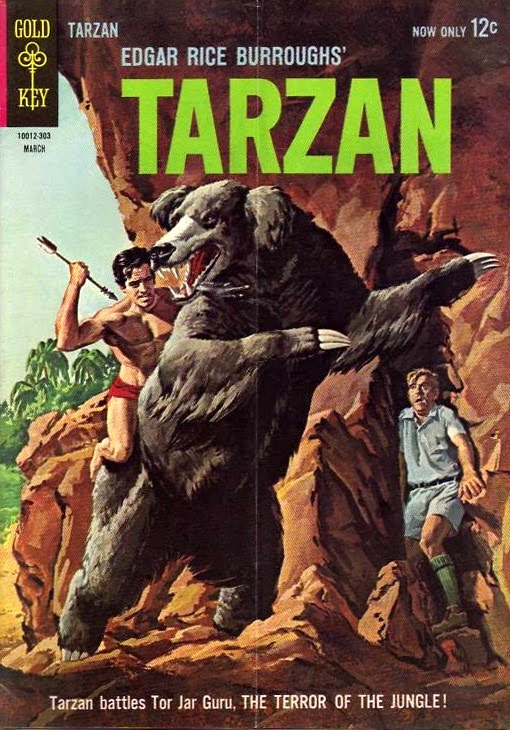
Front cover of Tarzan comic, March 1963, depicting Nandi bear (Gold Key)


A few days ago, Swedish correspondent Håkan Lindh briefly mentioned to me that he had once owned an issue of a Tarzan comic published by Gold Key during the 1960s that had featured a battle between Tarzan and a chemosit – one of the many names given to an East African cryptid most commonly known as the Nandi bear. In response to my request for further details, on 21 March 2011 Håkan posted the following fascinating account on my Facebook page:

"The issue where Tarzan fights the Nandi bear was published by Gold Key in March 1963. The story was simply called The Hunting of the Beast, but the beast was located to live in Nandi, and Tarzan also meets a proto-cryptozoologist that refer to it as "Nandi bear". It also looks a lot similar to a sloth bear.

"Tarzan was one of the comics that made me interested in cryptozoology, he seemed to stumble on lost valleys filled with dinosaurs and cavemen all the time, and even the hope for me to find something similar gave me hours of fun. :-)

"I also remembered that Tarzan at least once fought a spotted lion like the marozi, but I can´t remember if it was meant to show that particular cryptid. Hogarth draw that issue, but I lost it already in my teens so I can´t even remember the title of that adventure.


"Comics set in the jungle seems to have a fair share of cryptozoological connections. The Phantom found a living stegosaur in Africa, Mandrake caught a living Basilisk in South America (after proving a disputed photo was no hoax), and Tarzan had the whole of Pal-Ul-Don with its dinosaurs and tailed humans and apemen.

"And further away from the jungle, other comics, from Johnny Hazard, Donald Duck, Tintin, Mandrake etc found more living dinosaurs and plenty of yetis.

"So comics were indeed a lovely way to get introduced to cryptozoology if you were a kid in the sixties-seventies. :-) "

The Nandi bear featured extensively in Dr Bernard Heuvelmans’s classic tome On the Track of Unknown Animals (1958), and when I documented it almost 40 years later in one of my own books, In Search of Prehistoric Survivors (1995) I was able to include some accounts additional to and in some cases most-dating those discussed by Heuvelmans. By and large, however, this notoriously complicated and confusing cryptid seems lately to have gone out of fashion, as it were, with few (if indeed any) contemporary reports and little coverage in recent cryptozoological works.


Nandi bear, image #1 (Markus Bühler)

Having said that, here is what I wrote about it in my capacity as the cryptozoological contributor to the authoritative single-volume encyclopedia Chambers Dictionary of the Unexplained (2007):

“NANDI BEAR

“Ferocious man-eating African cryptid that in reality may be a composite beast, ‘created’ by the erroneous lumping together of reports describing several totally separate animals, known and unknown

“It is little wonder that pioneering cryptozoologist Dr Bernard Heuvelmans called it “an East African Proteus”, because few (if any) other terrestrial cryptids have been likened to so many different animals as the infamous man-devouring Nandi bear of Kenya’s Nandi district. Some eyewitnesses have likened this bloodthirsty creature to a bear, even though there are no known species of bear to be found anywhere in sub-Saharan Africa. Others have favoured a hyaena, albeit an extra-large, exceptionally hairy and ferocious version. Then there is the giant baboon counterpart, and even a grotesque variant likened by its one and only observer to a weird anteater (assuredly based upon an unexpected night-time encounter with an aardvark?). Not surprisingly, therefore, when attempting to disentangle these diverse strands in his book On the Track of Unknown Animals (1958), Heuvelmans sensibly proposed that the most likely explanation for such dramatic variation in descriptions of the Nandi bear is that the latter is actually a non-existent composite – i.e. ‘created’ by the erroneous lumping together of descriptions of several very different, totally separate animals.

“The ‘true’ Nandi bear, the cryptid whose descriptions most closely resemble a bear and which is sometimes called the chemosit (‘devil’), is, in Heuvelmans’s view, based upon sightings of very large, old, all-black specimens of the ratel or honey badger Mellivora capensis. Despite being a member of the weasel family, the ratel is remarkably ursine in overall appearance, especially when, in advanced years, its silver dorsal colouration darkens to black and thus matches the rest of its coat colour. It can also be exceedingly aggressive – so much so that not even a lion will dare attack it. Another version, conversely, known in Kenya’s Lower and Middle Tana River regions as the koddoelo, is much more baboon-like, but is considerably larger than any known species living today, as it allegedly measures 1.8 m long, and stands 1.08 m high at the shoulder. Extremely savage, it will attack humans on sight, has very large canine teeth and powerful forelegs. As recently as 650,000 years ago, a gorilla-sized baboon, Theropithecus oswaldi, did exist in Kenya, which, combining the gorilla’s stature with the ferocity of a baboon, would have indeed been a terrifying beast for any human to encounter. And if it has survived into the present-day, it would make an exceedingly convincing candidate for the koddoelo.

“As for the giant hyaena-like version of the Nandi bear, often termed the kerit or gadett (‘brain-eater’), but also sometimes chemosit: several separate candidates are on offer here. Some shot specimens have proven to be abnormally red-furred individuals of the spotted hyaena Crocuta crocuta; and unexpected encounters with the rare, heavily-maned brown hyaena Hyaena brunnea, capable of putting on a frighteningly belligerent display if threatened, have also been offered to explain Nandi bear reports. However, neither of these proposed solutions can explain the discovery of Nandi bear footprints that are hyaena-shaped yet as large as those of lions, or the shooting of two still-unidentified dark-furred beasts with rearward-sloping backs in the Nandi district during the late 1950s by Douglas Hutton that were later dismissed as ‘giant forest hyaenas’ (whatever they are!). A similar beast, with a lion-sized head, rearward-sloping back, long shaggy brown hair, and twice the size of a spotted hyaena, was shot in 1962 by the father of Nandi-born hunter Jamie McLeod. Tragically, however, its body was not preserved – especially as, very coincidentally, McLeod actually referred to it as a giant forest hyaena, even though science does not officially recognise any such species.

“The recent (geologically-speaking) prehistoric history of Kenya, conversely, does recognise a species that, if still alive today, would correspond perfectly with a hyaenid Nandi bear, as proposed by British cryptozoologist Dr Karl Shuker in his book In Search of Prehistoric Survivors (1995). Known as the short-faced hyaena Pachycrocuta brevirostris, it sported the typical sloping hyaenid outline but was the size of a lion, with enormous canine teeth, and was a more active hunter than its smaller, predominantly scavenging modern-day relatives. Such a creature could readily carry out the horrific attacks claimed for the Nandi bear by local people, and would certainly resemble the mystifying ‘giant forest hyaenas’.

“Alternatively (or perhaps even in addition to this), a second postulated prehistoric survivor that has been considered by various authors in relation to the Nandi bear is some form of chalicothere. These bizarre ungulates (hoofed mammals) had longer forelegs than hind legs, yielding a rearward-sloping back that gave them a surprisingly hyaenid outline, and in spite of their ungulate affinities possessed claws instead of hooves, which they used for digging up roots. A living chalicothere would certainly fit the description given by a number of Nandi bear eyewitnesses, and pictures of chalicothere reconstructions have even been identified by tribespeople here as the chemosit. Rinderpest seriously depleted the numbers of many ungulate species in Africa during the late 1800s, and according to native tribes the once-common Nandi bear also plummeted at this time, suggesting that it too may have succumbed to this disease – even though rinderpest does not normally kill carnivorous species, only ungulates. If, however, at least one type of Nandi bear is a reclusive species of chalicothere (i.e. a harmless but superficially hyaena-like ungulate, only occasionally seen by startled eyewitnesses and a victim of rinderpest), whereas the kills attributed to it are actually the work of genuine hyaenas, this would explain why its numbers have fallen in modern times and how an ungulate could be (albeit erroneously) blamed for the rapacious killing of humans. Indeed, with virtually no Nandi bear reports in recent years, it is possible that this most feared yet elusive of African cryptids may have already died out – lost to science before its controversial, confused identity was ever resolved.”


Chalicothere depicted upon a Russian postage stamp

As far as I am aware, the Tarzan comic mentioned by Håkan is the only one ever to feature the Nandi bear – or, specifically, the chemosit – in a starring role. Consequently, although Håkan has very kindly tracked down and emailed to me an electronic version of it (though, sadly, I haven’t been able to open it so far, as I do not know how to open files with the .cbz extension), I would very much to obtain a physical, hard-copy version too.

Meanwhile, as can be seen from the image opening this present Shukernature article – and which thus corroborates Håkan’s earlier comment - the comic’s front cover depicts the Nandi bear as being very ursine, and also extremely large!

I am now wondering whether anyone has a copy of this comic that, if they no longer want, they could possibly donate to me, or at least post here or send me a photocopy from it (for non-commercial, research purposes only) of one or more of Hogarth’s images of the Nandi bear. If you do, please post details here - and who knows, it may even help to incite a media-driven public revival of interest in this once-prominent but nowadays far-too-long-forgotten mystery beast!


Nandi bear, image #2 (Markus Bühler)


My sincere thanks as ever to Håkan for alerting me to this intriguing crypto-related comic and for sharing with me his own findings regarding it.

In addition, he has succeeded in tracking down an illustration of a page from the above-mentioned comic pitting Tarzan against a spotted lion. However, as can be readily seen from that illustration, reproduced below, although the lion in question is heavily spotted it is not a marozi. For whereas the latter mystery cat is relatively small, with only a very sparse mane even in the male, the lion in the comic is much bigger and has a full-sized mane.


Page from comic pitting Tarzan against a spotted lion (Gold Key?)


POSTSCRIPT

On 27 March 2011, I downloaded the free program CDisplay (at: http://download.cnet.com/CDisplay-Image-Display/3000-18488_4-10162238.html), which opens the .cbx format version of the 'Tarzan and the Nandi Bear' comic sent to me by Håkan. Intriguingly, I've now discovered that in the Nandi bear story, this cryptid is referred to as a chalicothere, yet it is depicted throughout as unquestionably ursine!

Also, click here to view the entire Tarzan-Nandi bear comic online!

UPDATE

On 23 April 2011, I visited Hay-On-Wye, the famous 'town of books' situated on the Welsh-English border, and containing more than 30 secondhand bookshops. One of these, Rose's Books, is devoted exclusively to children's books, and while browsing there I noticed a copy of the official Tarzan annual for 1967 (see photo below), published by World Distributors in conjunction with the popular television series from that same time period, starring Ron Ely as Tarzan. And, flicking through it, what should I find inside but the entire Nandi bear story (complete with its original title), reprinted exactly as it had appeared in the original March 1963 comic.