Dr KARL SHUKER

Zoologist, media consultant, and science writer, Dr Karl Shuker is also one of the best known cryptozoologists in the world. He is the author of such seminal works as Mystery Cats of the World (1989), The Lost Ark: New and Rediscovered Animals of the 20th Century (1993; greatly expanded in 2012 as The Encyclopaedia of New and Rediscovered Animals), Dragons: A Natural History (1995), In Search of Prehistoric Survivors (1995), The Unexplained (1996), From Flying Toads To Snakes With Wings (1997), Mysteries of Planet Earth (1999), The Hidden Powers of Animals (2001), The Beasts That Hide From Man (2003), Extraordinary Animals Revisited (2007), Dr Shuker's Casebook (2008), Karl Shuker's Alien Zoo: From the Pages of Fortean Times (2010), Cats of Magic, Mythology, and Mystery (2012), Mirabilis: A Carnival of Cryptozoology and Unnatural History (2013), Dragons in Zoology, Cryptozoology, and Culture (2013), The Menagerie of Marvels (2014), A Manifestation of Monsters (2015), Here's Nessie! (2016), and what is widely considered to be his cryptozoological magnum opus, Still In Search Of Prehistoric Survivors (2016) - plus, very excitingly, his four long-awaited, much-requested ShukerNature blog books (2019-2024).

Dr Karl Shuker's Official Website - http://www.karlshuker.com/index.htm

IMPORTANT: To view a complete, regularly-updated listing of my ShukerNature blog's articles (each one instantly clickable), please click HERE!

IMPORTANT: To view a complete, regularly-updated listing of my published books (each one instantly clickable), please click HERE!

IMPORTANT: To view a complete, regularly-updated listing of my Eclectarium blog's articles (each one instantly clickable), please click HERE!

IMPORTANT: To view a complete, regularly-updated listing of my Starsteeds blog's poetry and other lyrical writings (each one instantly clickable), please click HERE!

IMPORTANT: To view a complete, regularly-updated listing of my Shuker In MovieLand blog's articles (each one instantly clickable), please click HERE!

IMPORTANT: To view a complete, regularly-updated listing of my RebelBikerDude's AI Biker Art blog's thematic text & picture galleries (each one instantly clickable), please click HERE!

Search This Blog


PLEASE COME IN, I'VE BEEN EXPECTING YOU...

PLEASE COME IN, I'VE BEEN EXPECTING YOU...
WELCOME TO SHUKERNATURE - ENJOY YOUR VISIT - BEWARE OF THE RAPTOR!


Showing posts with label albino. Show all posts

Friday, 12 July 2024

AN OYSTER-SCALED ODDITY FROM BRAZIL

Is this what Lerius's big white Brazilian lizard looked like? (created using Magic Studio)
 
One of the earliest mystery beast reports emanating from the Americas came from the pen of French pastor and explorer Jean Lerius (aka Jean de Lery), writing about the notable encounter in his very informative, highly influential book History of a Voyage to the Land of Brazil, Also Called America (1578), which formally documented a wide range of South American animals for the first time by a European. He was in the company of Admiral Nicolas Durand de Villegagnon, who in 1555 had unsuccessfully attempted to establish a French Protestant colony on an island in the bay of Rio de Janeiro, Brazil.

My opalescent iguana sculpture met beneath a milky moon (© Dr Karl Shuker)

Approximately two years later, in or round 1557, Lerius and two other members of the company were trekking through a forest in the interior of Brazil with some local Tupinamba Indian guides but armed only with swords or bows and arrows when, while passing through a deep valley there, they abruptly encountered at a distance of only thirty paces or so a very large reptilian creature of extremely distinctive appearance, squatting on top of a hill in the heat of noon, with one of its forefeet raised.

 
Another mock-up of what Lerius's big white Brazilian lizard may have looked like (modified from an iguana photograph © Carlos Andrés Reyes/Wikipedia – CC BY 2.0 licence) 

 Lerius described it as a lizard bigger than the body of a man, measuring 5-6 ft long, yet its most eyecatching feature was not its size but rather its extraordinary tegument. For according to Lerius, this unfamiliar animal was entirely covered in rough white scales that resembled oyster shells (and presumably, therefore, were opalescent, or nacreous, i.e. resembling mother of pearl?).

 
A second Magic Studio-created representation of this pallid mystery reptile

The astonished, petrified group of men and this albino-like reptilian apparition stared at one another for around 15 minutes, all remaining totally immobile despite being directly exposed to the extreme heat of the mid-day sun, until the creature suddenly let forth a very loud groaning sound before turning away and swiftly vanishing from sight through the foliage covering the hill. Needless to say, the men made no attempt to follow the monster, making their way instead along their original course, leading them far away from that hill and its dreadful denizen.

 
A white shade of crypto-herpetological pale?  (created using Magic Studio)

The fact that this sizeable lizard was resting on top of a hill during the extreme mid-day heat clearly suggests that like lizards so often do, it was sunbathing, absorbing the sun's radiant heat for thermoregulatory purposes. This is because lizards are ectothermic, i.e. poikilotherms, which are unable to regulate their body temperature via internal homoiothermic mechanisms in the manner that endothermic mammals and birds do.

 
Albino American alligator, (© Sherrif2966/Wikipedia – CC BY-SA 4.0 licence)

What is far less clear, conversely, is this reptile's precise taxonomic identity, as no lizard of that size and pallid appearance is known from Brazil or, indeed, from anywhere else, today. Might it have been albinistic, as I tentatively labelled it a little earlier here, or possibly leucistic? Leucistic American alligators Alligator mississipiensis with shiny white scales but black eyes are well known, for example, as are other reptile specimens of similar form, as well as true albino specimens with pink eyes. Perhaps it was a leucistic or an albinistic iguana, whose size had been over-estimated by an evidently shocked Lerius. Or might Lerius have been incorrect in labeling it a lizard – could it have actually been a white alligator?

 
White  American alligator (public domain)

 I know of no other reports alluding to this singularly distinctive reptile, so the riddle of what it was seems destined to remain forever unsolved – like so many others in the fascinating if frustrating chronicles of cryptozoology.

 
Title page of the Latin translation of Lerius's book, History of a Voyage to the Land of Brazil, Also Called America (public domain)


Saturday, 18 July 2015

DEBUNKING A TRIO OF QUASI-COLOURED MOCK PYTHONS


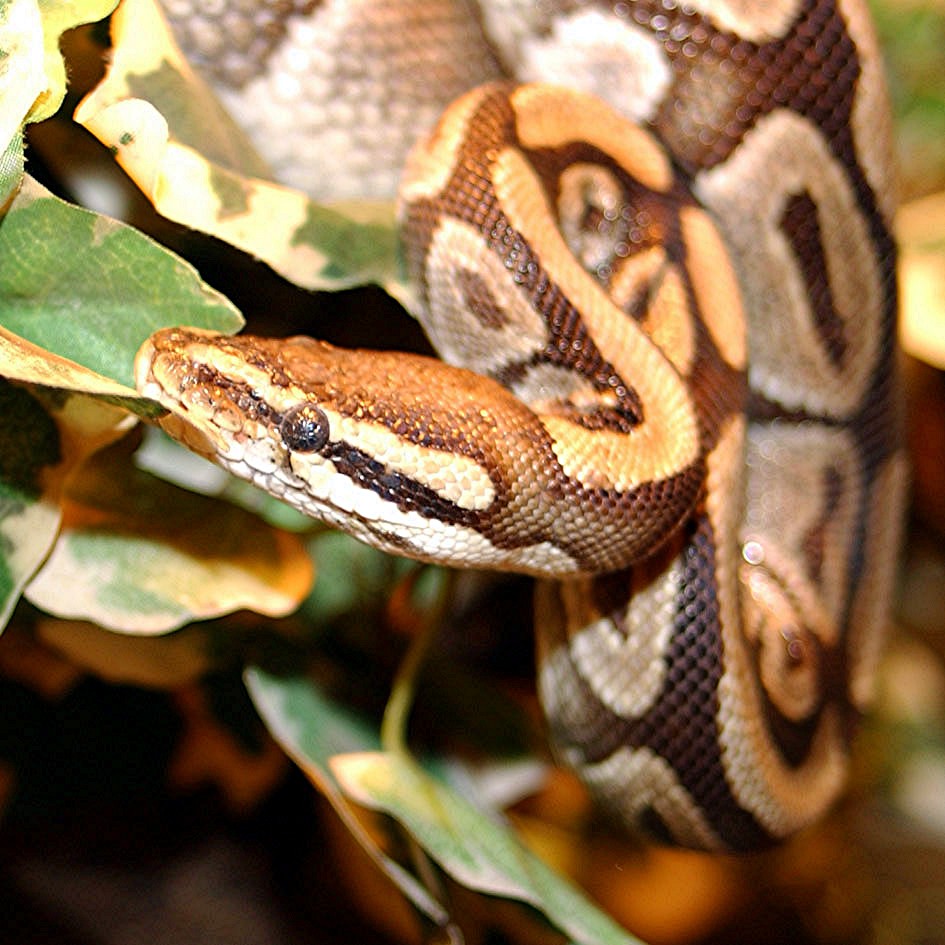
Photograph of a supposed green and white ball python, found by me on Pinterest (see below for © of original photograph)

Having a longstanding interest in animal colour morphs, I knew that something was very wrong – distinctly off-colour, in every sense – when, while browsing on the image-sharing/-hosting website Pinterest a couple of days ago in search of some unusual animal photographs to pin to my recently-created Pinterest board devoted to cryptozoology, animal mythology, and (un) natural history, I came upon the remarkable picture opening this present ShukerNature blog article. (Click here to view my Pinterest board - but you'll need to sign into Pinterest's site once you've clicked this link before it will let you see my board.)

For although I knew that a dazzling range and vast number of colour morphs have been developed for many snake species (including various pythons and boas) commonly sold in the pet trade (such selectively-bred forms being referred to as designer snakes), I felt pretty sure that these did not include a green and white variety for the African ball python Python regius (aka the royal python), regardless of what my eyes were seeing when looking at this particular photograph. (I know that a morph dubbed 'green' does exist, but in reality it is merely khaki, not grass-green like the specimen in this photo.) Anxious not to lose it, however, I swiftly pinned it to my Pinterest board, and then did what I always do as standard practice nowadays whenever confronted by a strange or unexpected animal picture – I conducted a Google image search for it online, in the hope of tracing its origin.

A normal, wild-type specimen of the ball python (public domain)

But all that I could find, pages and pages of them, were links to this self-same image on dozens of other Pinterest pages as well as many pages on other image-sharing/-hosting websites too, such as Tumblr and Flickr, yet with no clues whatsoever as to where it had originated. I didn't even come upon a single comment from any of these numerous image-sharers that queried whether these pythons of a very different colour were genuine. (Then again, if it's on the internet it must be true! lol)

Something that I did find, however, was that this photo of a green-and-white ball python was not one of a kind, because during my search I discovered two equally unlikely variations upon its crazy colour scheme.

The same photograph as the one opening this ShukerNature blog article, and again common on image-sharing/-hosting websites, but in which the green hue has been replaced by a pink hue (see below for © of original photograph)

That is to say, I found some copies of exactly the same photo but in which the green hue had been replaced by pink, and some other copies in which it had been replaced by lilac – both of them once again being shared ad infinitum on Pinterest, Flickr, Tumbr, etc, but also once again with no clues as to where either of these variants had originated, and no challenges to their serpentine subjects' authenticity.

The same photograph as the one opening this ShukerNature blog article, and again common on image-sharing/-hosting websites, but in which the green hue has been replaced by a lilac hue (see below for © of original photograph)

The fact that I had now uncovered three different colour versions of the very same photograph meant either that two of these versions were fakes, photo-manipulated by person(s) unknown from the third, or that all three were fakes, photo-manipulated from a true-to-life original version that I had yet to locate online. I favoured the latter possibility, because, as already noted, I was not aware of any comparable yet genuine green, pink, or lilac colour morphs existing for the ball python, and after checking a number of websites devoted to ball python morphs I found no evidence whatsoever that any of the three did indeed exist. Clearly, therefore, there was a fourth, original, unmodified version of the photo out there somewhere, currently unseen by me, and which would prove to be the original version – but what might the snake in it look like, what would its true colouration be?

When I had first seen the green version, it had struck me straight away that, ignoring its markings' bizarre colouration and focusing instead upon their form and paleness, the snake recalled the ball python's very abundant golden colour morph. This particular colour morph has been developed by selective captive breeding in a number of other constrictor species too, perhaps most famously in the Burmese python P. bivittatus. Golden specimens of this latter species are exceptionally popular, very highly-prized pets due to the enhancement of their already beautiful appearance by way of the huge and extremely impressive body size for which this species is renowned (and which, again, is actively selected for when captive-bred by the pet trade).

A xanthistic Burmese python (© Dr Karl Shuker)

Genetically speaking, this golden morph is xanthistic, i.e. it occurs due to the expression of a certain specific mutant gene allele that causes a specimen possessing this allele to produce an excess of yellow pigmentation; sometimes the specimen's normal red pigment for its species is lacking and has been replaced entirely by yellow pigment. Despite this, however, in the pet trade xanthistic snake specimens are often confusingly called albinos (yet, genetically, this term should only be used to describe pure-white specimens with pink eyes, such specimens being caused by different gene alleles from those responsible for xanthism). The most sought-after xanthistic pythons of all are ones that lack both red and black pigmentation, resulting in exceptionally handsome specimens that seem almost to emit a golden glow when viewed under certain levels of illumination, and are known technically as amelanic xanthistic pythons.

Consequently, I decided to conduct another Google image search, but this time using the specific search phrase 'albino ball python' – and sure enough, after scouring through countless photos of such snakes, I finally came upon one that, except for the snake's colour in it, was identical to the green, pink, and lilac versions that I'd previously encountered online. There could be no doubt – this particular photograph of a normal, real-life golden ball python was the original that had been photo-manipulated very professionally if anonymously by agent(s) unknown. And here, as absolute proof, is that original, undoctored photograph.

Golden (or so-called 'albino') ball python (© Nat Turner/all rights reserved – fair use only here on ShukerNature; click here to access Nat's webpage containing full  technical details for this photograph)

This photograph had been snapped without flash by American photographer Nat Turner on 22 May 2004, it depicts what Nat describes as a large female specimen, and it had been posted by him onto his Flickr site, which is where I found it. Moreover, it is one of several photos by Nat that seem to depict the same specimen, and which are all contained in an online Flickr album of his entitled 'Snakes'.

The quasi-coloured mock pythons beloved and believed in by so many online image sharers were no more – a trio of counterfeit serpents duly debunked and discarded, yet another case of photo-manipulation chicanery summarily expunged from the archives of valid zoological anomalies.

A specimen of the ball python's black-eyed leucistic ('snow') morph (© The Urban Zoo – be sure to click here to visit their excellent pet-store website)

Incidentally, another very popular python morph that is sometimes termed albino in the pet trade, but which once again is very different genetically, is the snow python. For although it does possess the albino mutant gene allele, it also possesses the axanthic mutant gene allele, whose effect is the exact opposite of the xanthic version, because it does not increase yellow pigmentation but reduces it instead. The combined effect of these two alleles' expression is an ethereal-looking snake that is pure-white all over like a bona fide albino specimen, but has blue or black eyes, instead of pink ones like an albino.

Finally: it may seem scarcely believable but it is not unknown for park rangers and others to witness occasionally the astonishing spectacle of an enormous Burmese python locked in mortal combat with a mighty American alligator in the Florida Everglades. Such titanic battles occur because this huge non-native ophidian species has successfully established breeding populations here following pet specimens having escaped and/or been deliberately released during the 20th Century. And because both are top reptilian predators, whenever they encounter one another neither one of them is willing to back down.

Battle of the reptilian behemoths – a naturalised python versus an adult American alligator (public domain)


Tuesday, 10 February 2015

SURREAL SYNCEPHALI – A TRIPLICATE LAMB FROM HUNGARY, AND RIPLEY'S DOUBLE-BODIED DONKEY


Engraving of an extraordinary triple-bodied, single-headed lamb that reputedly existed in Hungary in 1620

Many years ago, a correspondent sent me a photocopy of the remarkable engraving that opens this present ShukerNature article. It depicts what was allegedly a living lamb with three fully-formed bodies united by a single head. According to the caption included in the engraving, this extreme developmental monstrosity (the study of such freaks is known as teratology, which translates as 'the study of monsters') had been seen in Klausenburg, Hungary, during July 1620. (Incidentally, I have never been able to trace the original source of this engraving, so if anyone reading my article has any information concerning it, I'd welcome all details. Also: Klausenburg was technically part of Transylvania during the 1600s, which in turn was assimilated into Hungary before eventually becoming part of present-day Romania.)

A developmental monstrosity born with a single head but two bodies is known technically as a syncephalus or monocephalus, and is basically a pair of incompletely-separated (conjoined) twins in which, during embrogeny, the head (cephalic) portion of the originally-single embryo has not differentiated into two separate heads but has instead remained as a solitary undivided unit, thus developing into only a single head, whereas the body portion of the originally-single embryo has split into two halves with each half developing into a body. (Less common and more deleterious to survival is the reverse derivation of a syncephalus, in which a pair of separate twins originally develop but the heads of the two twins subsequently fuse during embryogeny with one head becoming reabsorbed into the other.) There is, however, a great deal of variation on record with regard to the degree of body-portion splitting occurring, so that in some cases the two bodies remain joined together rather than separating from each other – as seen with the following syncephalic lamb, illustrated in an early engraving of unknown origin (at least to me).

Engraving of a syncephalic lamb displaying incomplete separation of its two bodies

Examples of syncephaly have been recorded from many different animal species, including our own Homo sapiens. However, because of internal anatomical complications, not to mention the physiological strain of a single head attempting to maintain full neurological control and metabolic functioning of two bodies, syncephalic individuals possessing totally discrete bodies rarely survive for very long following birth. (In contrast, bicephalic or dicephalous individuals, possessing a single body but two heads, do sometimes survive to maturity, especially in certain creatures such as terrapins and snakes – click here for more information concerning two-headed snakes.)

Consequently, the concept of a surviving syncephalic lamb that possessed not just two but three completely separated bodies seemed too surreal, let alone too implausible, to warrant even the most cursory of considerations. So I simply filed away the engraving in one of my folders of teratological material and forgot all about it – until last Friday, 6 February 2015. For that was when I paid a visit to a very special attraction and saw something there that totally challenged my previous assumptions concerning syncephalic animals and their likelihood of surviving for any notable length of time following birth – and, in turn, made me think again about that anomalous triplicate lamb from Hungary.

Robert Ripley, founder of the Ripley's Believe It Or Not! franchise (public domain/Wikipedia)

The attraction in question was Ripley's Believe It Or Not! Odditorium London (click here to visit its official website). Situated on the corner of London's Piccadilly Circus, this is a spectacular six-storey exhibition centre that is packed throughout with bizarre curiosities and interactive displays celebrating the famous books, TV shows, and newspaper strips documenting all manner of incredibly weird yet wonderful people, animals, buildings, creations, and much much more that were originally compiled, collected, and drawn by entrepreneur-cartoonist Robert Ripley (1890-1949) for his countless publications.

Experiencing some Mesozoic mayhem at Ripley's Believe It Or Not! Odditorium London (© Dr Karl Shuker)

As a zoologist, it was obviously the various –and extremely varied – animal attractions that particularly interested me, and I was certainly not disappointed in the array on display. There are many Ripley's Believe It Or Not! Odditoriums worldwide, especially in the USA (but with London's being the largest one of all), and they have become synonymous with teratological animals. There was certainly a goodly selection here in London (some of which were actual taxiderm specimens, others models of real specimens), including several two-headed creatures, animals with extra (supernumerary) limbs (a condition known as polymelia), and other equally curious caprices.

One such creature was a rooster with three separate legs that had been found in 1998 in England (exact location not specified), and was on display alongside a five-legged lamb (its right hind limb was a double leg), again from England and found during the early 1990s.

A three-legged rooster and a five-legged lamb – two polymelic animals at Ripley's Believe It Or Not! Odditorium London (© Dr Karl Shuker)

The two-headed lamb standing close by had been born in Shandong, China, in 2006, and both of its heads were fully functioning, with separate personalities.

Ripley's two-headed lamb from Shandong, China (© Dr Karl Shuker)

Just behind it was a pair of conjoined ('Siamese') piglets, joined back-to-back but with separate necks and heads (thus constituting a lesser version of the controversial rachipagus condition, in which conjoined twins are joined dorsally from the back of their heads down the entire length of their backs). These conjoined piglet twins were apparently similar in form to a pair possessed by the eminent Russian tsar Peter the Great (1672-1725), who famously owned a sizeable collection of scientific curiosities (click here for more information concerning this).

The conjoined piglets at Ripley's Believe It Or Not! Odditorium London (© Dr Karl Shuker)

Just inside the entrance to the odditorium was a taxiderm specimen of an adult black-and-white Friesian cow, which looked totally normal – until I realised that a fully-formed fifth leg complete with hoofed foot was growing outwards and upwards from between its shoulders! This bizarre teratological condition is called notomelia, and indicates that during this cow's embryogeny a supernumerary, aberrantly-located limb bud had developed. Alternatively, but more dramatically, as an example of what could be termed pseudonotomelia it is possible that the cow had originated as a pair of twins but that one of these two twins had subsequently degenerated and had been almost totally reabsorbed into the other one during their embryonic development, with only the single limb providing external evidence of the absorbed twin's former existence as a separate entity. (A very similar instance of notomelia, featuring a male Friesian calf, was published in the July 2014 issue of the Canadian Veterinary Journal.)

Ripley's notomelic Friesian cow possessing a dorsally-sited supernumerary leg, plus the heads and forequarters of a small white two-headed calf (© Dr Karl Shuker)

Here's another two-headed calf that was on display:

Two-headed calf at Ripley's Believe It Or Not! Odditorium London (© Dr Karl Shuker)

And here's an albino alligator, complete with ruby-red eyes:

Albino alligator at Ripley's Believe It Or Not! Odditorium London (© Dr Karl Shuker)

There were also a number of life-sized models of famous human curiosities. At one extreme was a model of Alypius, a dwarf from Alexandria during ancient Egyptian times, who was only 43 cm (17 in) tall, and whose fitting punishment for committing treason was imprisonment inside a parrot cage!

Model of Alypius at Ripley's Believe It Or Not! Odditorium London (© Dr Karl Shuker)

And at the other extreme, standing in front of a full-sized American mastodon skeleton that only served to emphasise his truly exceptional stature, was a full-sized model of Robert Wadlow (1918-1940), immortalised in the record books as the world's tallest man. Suffering from pituitary-induced gigantism, when he died aged just 22 years old he was already a little over 8 ft 11 in tall, and was still growing. Indeed, had he grown just under one inch more, he would have been the only confirmed 9-ft-tall human ever recorded. Standing alongside this real-life giant's model, even at a respectable 5 ft 10 in tall I still felt totally overshadowed by him, and overawed too.

Standing alongside the life-sized model of Robert Wadlow at Ripley's Believe It Or Not! Odditorium London (© Dr Karl Shuker)

Equally eyecatching was a full-sized bust of a man exhibiting hypertrichosis, also known as werewolf syndrome as persons displaying this condition of extreme hairiness were once believed by the superstitious to be lycanthropes.

Bust of a man exhibiting hypertrichosis at Ripley's Believe It Or Not! Odditorium London (© Dr Karl Shuker)

Also well worthy of attention was the conical, elongated skull of an ancient Peruvian, its extreme shape having resulted from the practice prevalent then and there of using tightly-wrapped cloth, boards, and rope to distort the shape of a child's growing skull via rigorous binding.

Manually-distorted conical skull of an ancient Peruvian at Ripley's Believe It Or Not! Odditorium London (© Dr Karl Shuker)

Yet despite all of these wonders and marvels, the specimen that startled me most at Ripley's Believe It Or Not Odditorium London was not actually on physical display there. Instead, it appeared – and even then only very fleetingly – on  a video being played in loop format on a screen close to most of the teratological animal specimens. The video showed a selection of teratological animals that were on display at various odditoriums around the world, and also included some footage of certain of these animals when they were still alive. Watching this video, I was astonished when a couple of seconds of film was shown of a living, seemingly adult, and clearly perfectly healthy syncephalic donkey, which consisted of a single head to which were connected two completely separated, fully-formed bodies!

By the time that my mind had registered this astonishing image, the video had moved on to showing other specimens, so I waited until it looped back to the beginning and then looked out for the donkey footage. After studying it intently when it reappeared, there was no doubt in my mind about what I had seen. It was indeed as I'd thought it to be on first viewing, both in form and in condition, though even now I struggle to comprehend how such a creature could survive to maturity – two independent four-legged bodies linked to a single controlling head.

After then waiting for the footage to come round a third time, when it did so I snapped a photo of this amazing donkey-in-duplicate, which although of poor quality would serve as a visual record of it for my files, and I vowed to investigate the matter further when I returned home. After all, if such a creature could truly exist and survive to adulthood, even the ostensibly impossible triplicate-bodied syncephalic lamb of Hungary suddenly seemed less implausible.

My photographic record of the syncephalic donkey as featured in the video shown at Ripley's Believe It or Not! Odditorium London (© Dr Karl Shuker/Ripley's Believe It or Not! Odditorium London)

And sure enough, my online researches have indeed confirmed the donkey's reality. Named Rascal, he was a miniature donkey owned by farmer Paul Springer whose farm is situated near Mineral Point, Wisconsin, USA. Paul's longstanding interest in teratological livestock has led him over the years to purchase a number of specimens that exhibit some anatomical peculiarity but are otherwise healthy and not suffering in any way, and allow them to live out a full, happy life on his farm instead of being slaughtered by their original owners either for their meat or simply because they were different.

Paul's first purchase was a six-legged calf called Boldegard during the 1970s, who went on to enjoy a long 14-year life on Paul's farm, followed by a range of other animals with extra legs, additional horns, two heads, or, in Rascal's case, one head and two bodies. Following their eventual deaths, half a dozen of the most striking individuals have been sold by Paul to the Ripley's Believe It Or Not! franchise for exhibition in various of their odditoriums. So it is possible that Rascal is on display in one of them, somewhere in the world. Consequently, if any of my readers have seen him, and can send me details, I'd very much like to receive them here – many thanks indeed in advance!

How uplifting it is to read of Paul Springer's compassion for all of the out-of-the-ordinary creatures that he has rescued from certain premature death. When asked in a media interview (WSAW.com 15 November 2009) what compelled him to rescue and care for animals with abnormalities, his answer was as inspirational as it was direct:

"There's something about them that maybe I feel sorry for. I give them a life. Most people will put them down and sell them. I am proud of them. People who see them, it gives them a chance to realize that everything isn't [normal], whether it be human beings or pigs or people or cats or dogs, we're not all born normal. Just because somebody has a handicap, they shouldn't be shunned. They should be given every chance, and love and attention that's possible."

Amen to that!

Rascal when alive (© Paul Springer)


Monday, 21 April 2014

WHITHER THE LOST WHITE EAGLES OF EUROPE AND AMERICA?


On Easter Monday 2013, 
my dear mother, Mary Shuker, passed away. 
So today, on Easter Monday 2014, 
I am dedicating this ShukerNature blog post to her.
God bless you, little Mom - 
I shall always love you, miss you, 
and wish that you were here with me still.


Computer-created representation of a white eagle in mountain darkness (© Dr Karl Shuker)

To misquote Oscar Wilde: To lose one white eagle may be regarded as a misfortune. To lose both looks like carelessness.

In the annals of ornithology, only two types of white eagle have been reported – one in Europe, and one in North America. Both, however, are long vanished, not only from our planet but also from contemporary records. Indeed, even their erstwhile existence is known from only the most sparse and fragmentary details, and has been largely forgotten for centuries - until now. I first learned of these birds from their tantalisingly short entries in Extinct Birds (2012) by Julian P. Hume and Michael Walters, and was determined to find out more about them. Consequently, after having spent much time painstakingly tracing and collating it, I now have pleasure in documenting here the very scattered, disparate history of what appear to have once been a pair of real and extremely impressive but highly mysterious raptors, of unconfirmed taxonomic status, which were lost to the world before any physical trace of their former presence had been obtained for scientific examination.

The earliest documentation of the European white eagle appears to occur in the writings of the 13th-Century German Dominican friar and Catholic bishop Albertus Magnus. His words were reiterated three centuries later in a couple of brief references in the year 1555.  The first of these was by Swiss naturalist Conrad Gesner (1516-1565), who documented it on p. 199 of his Avium Natura (1555), the bird tome in his celebrated five-volume, 45,000-plus-page encyclopaedia Historiae Animalium (published 1551-1558). He referred to it as Aquila alba sive Cygne ('the white or swan eagle'), and Aquila alba subsequently became its official binomial name in taxonomic nomenclature. Similarly, French naturalist Pierre Belon (1517-1564) referred to this bird as the 'aigle toute blanche' ('all-white eagle') on p. 89 of his L'Histoire de la Nature des Oyseaux (1555). Following Gesner's lead, Italian naturalist Ulisse Aldrovandi (1522-1605) termed it Aquila alba seu cycnea on p. 231 of his Ornithologiae, hoc est de Avibus Historia (1599).

An illustration of the European white eagle from 1790

On p. 63 of his Onomasticon Zoicon: Plerorumque Animalium Differentias et Nomina Propria Pluribus Linguis Exponens (1668), Somerset-born natural history writer Walter Charleton (1619-1707) called it the white eagle. And it was Aquila alba to Poland's Reverend Gabriel Rzaczynski (1664-1737) on p. 299 of his tome Historia Naturalis Curiosa Regni Poloniae (1721), who also referred to it as Aquila Cygnea Aldrovandi in a subsequent publication of 1745 entitled Auctarium Historiae Naturalis Regni Poloniae Magnique Ducatus Lituaniae Annexarumque Provinciarum in Puncta. Five years later, Jacob T. Klein summarised it on p. 42 of his Historiae Avium Prodromus cum Praefatione de Ordine Animalium in Genere (1750). In 1760, French zoologist Mathurin J. Brisson (1723-1806) documented Aquila alba on p. 424 of his tome Ornithologia, sive Synopsis Methodica Sistens Avium Divisionem in Ordines, Sectiones, Genera, Species, Ipsarumque Varietates. Acclaimed French naturalist Georges-Louis Leclerc, Comte de Buffon (1707-1788) also alluded to white eagles in his multi-volume magnum opus Histoire Naturelle (1749-1788).

English ornithologist John Latham (1740-1837) documented this raptor in three separate publications – calling it the white eagle on p. 36 of his famous treatise A General Synopsis of Birds (1781), applying to it the taxonomic binomial name Falco cygneus on p. 14 of his Index Ornithologicus (1790), and commenting upon what he believed its status to be in his General History of Birds (1822). Meanwhile, on p. 257 of his own version (published in 1788) of Linnaeus's pioneering taxonomic work Systema Naturae, German naturalist Johann F. Gmelin (1748-1804) had christened it Falco albus (but as the genus Falco was subsequently limited to falcons, this was later reverted to Aquila alba by other writers).  In 1809, English zoologist George Shaw (1751-1813) dubbed it Falco cygneus after Latham on p. 76 of the bird volume in his sixteen-volume series General Zoology (1809-1826).

And this seems to be the full (or at the very least the major) extent of the European white eagle's formal documentation in the scientific literature – but what did these various accounts actually say about it? Sadly, the answer to that question is…very little indeed. Moreover, as was typical back in those far-distant days, each work did little (if anything) more than simply regurgitate what had been published in the previous ones. So here is a summary of the sparse, salient details gathered from these sources.

Gesner's illustration of the golden eagle

Albertus Magnus stated that the European white eagle preys upon rabbits, hares, and sometimes fishes too, and that it inhabits the Alps, as well as the rocks bordering the Rhine, where, according to the Rev. Gabriel Rzaczynski, it builds its nests. Brisson stated that it is as large as the familiar golden eagle Aquila chrysaetos, but is entirely white - as white as snow. Rzaczynski noted that it has a 9-ft wingspan, and likened its white plumage to that of a swan. He also claimed that a specimen had been killed in Poland and its body shown to the country's monarch, John II Casimir Vasa ((but its subsequent fate is apparently unknown). Due to its fish-eating proclivities, Aldrovandi suggested that it may be more closely related to the osprey than to any eagle (but there are a number of eagle species famed for their piscivorous behaviour).

All of the European white eagle's early chroniclers presumed it to be a valid, distinct race in its own right. However, Buffon deemed all white eagles to be nothing more than varieties of the golden eagle. Conversely, although he included Buffon's opinion in his own coverage of the European white eagle within his 1781 publication, Latham decided to follow Brisson's stance in categorising it as a separate species – but by 1822 he had changed his mind, labelling it as merely a colour variety of the golden eagle after all.

Not that it mattered much by then anyway, except in a strictly academic sense, because sightings of the European white eagle were no longer being reported. Indeed, in his 1809 bird volume, Shaw had already noted that "it does not appear to be known to modern naturalists". Tragically, this pallid-plumed, winged prince of the alpine mountains had gone, forever. No records exist regarding the reason for its disappearance, but such a spectacular bird would unquestionably have been a major target for hunters, seeking to add its immaculate form to their trophies (a comparable fate befell the white tiger in India). If, as does seem likely, it existed as a discrete, self-perpetuating population of a distinct colour morph of the golden eagle, presumably either albinistic or (more probably) leucistic, and therefore the physical expression of a recessive mutant allele, it would not have been common to begin with, so would have been unable to withstand persecution for any notable length of time. Occasionally, a freak partially-white specimen of the golden eagle is reported today, usually in North America, but not from any self-perpetuating white population.

A partially-white (leucistic) golden eagle sighted in Colorado in July 2008 (© Constance Hass - inclusion here strictly on Fair Use/non-commercial basis only)

I am not aware of any preserved specimens of the European white eagle, and the present ShukerNature post is the most comprehensive documentation of this hitherto all-but-forgotten mystery bird ever written.

As for America's equivalent: This is – or was – the Louisiana white eagle Aquila candidus, also known as the conciliating eagle. It was originally documented by Antoine-Simon le Page du Pratz (1695?-1775) in his tome Histoire de la Louisiane (1758). Although born in Europe, this noted ethnographer, historian, and naturalist had lived in Louisiana from 1718 to 1734, where he had befriended the leaders of the Natchez nation there and had also learned their language. On p. 75 of his work, he referred to a white eagle that was smaller and rarer than the golden eagle, but more handsome, being almost entirely white – only the tips of its wings' quills were black. These quills were purchased at high prices by the Natchez people, who valued them greatly and apparently used them to compose the fan section of their symbol of peace, known as the calumet or pipe of peace (a very long reed ornamented with feathers).

On p. 197 of the second (bird) volume in his two-volume treatise Arctic Zoology (1785), documenting the mammals and birds of North America, Welsh naturalist Thomas Pennant (1726-1798) merely paraphrased Du Pratz's documentation of the Louisiana white eagle. So too did Latham in his 1781 tome. On p. 258 of his version of Linnaeus's Systema Naturae, Gmelin accorded this raptor the taxonomic binomial name Falco candidus, whereas in 1809 George Shaw dubbed it Falco conciliator on p. 77 of the bird volume in his General Zoology.

Hand-coloured engraving from 1840 of an adult bald eagle

But what was this enigmatic bird, which, just like its European equivalent, has long since disappeared, both physically and figuratively? Its last notable mention was by English ornithologist Hugh E. Strickland (1811-1853), who included it in his posthumously-published book Ornithological Synonyms (1855). Here he listed its name as a synonym of the bald eagle Haliaeetus leucocephalus, and questioned the accuracy of du Pratz's original account of it. Yet other zoological descriptions included by du Pratz in his book were accurate, so why shouldn’t his account of the Louisiana white eagle have been too? French naturalist Charles-Nicholas-Sigisbert Sonnini de Manoncourt (1751-1812) speculated that the Louisiana white eagle and the European white eagle were one and the same form, but du Pratz claimed that the former raptor was smaller than the golden eagle, whereas according to Brisson the European white eagle was the same size as the golden eagle. If these claims were correct, this indicates that the two white eagles were distinct from one another.

Worth noting is that a few confirmed specimens of white or mostly white bald eagle have been documented in modern times, but not a small, self-perpetuating population of them, which seems to have been true with the Louisiana white eagle. Certainly, Du Pratz did state that this latter raptor was rare; and in view of how valuable its feathers were, it may well have gone the same way as other birds whose handsome plumes attracted similarly unwelcome attention - such as the New Zealand huia (click here for more details) and the Hawaiian mamo, for instance.

Whatever the answer, the world is surely a poorer place without the sight of a magnificent white eagle soaring skyward among the lofty peaks of some stark mountain, like a pale feathered phantom whose mighty pinions bear it ever higher toward that great Empyrean above.

Nor are they the only mystery eagles on record. Remind me, another time, to recall for you the tiger eagle of Latvia, or the fierce eagle of Astrakhan, or the Macarran eagle of South America. And don't forget to click here for my extensive ShukerNature documentation of Washington's eagle – the most controversial lost eagle of all.


UPDATE: 3 April 2017

Facebook friend and crypto-correspondent Bob Deis (co-editor of the awesome book Cryptozoology Anthology: Strange and Mysterious Creatures in Men's Adventure Magazines) very kindly brought to my attention today an additional mention of the North American white eagle that I hadn't previously encountered. It consists of a short account by American ornithologist and artist John Cassin in his book Illustrations of the Birds of California, Texas, Oregon, British and Russian America (1856). After reiterating the information provided by du Pratz in his own volume, Cassin then suggested that perhaps:

If not an albino [eagle], there is a possibility that it is a species of a group of white hawks, of rather large size, which are principally found in South America, and one species of which (Buteo Ghiesbreetii Dubus,) is known to inhabit Mexico. The latter would agree very well with Du Pratz's description, so far as it goes.

The species alluded to above by Cassin is nowadays known as the white hawk Pseudastur albicollis, currently classified as a member of the buzzard/hawk subfamily Buteoninae, whose northernmost subspecies, P. a. ghiesbreghti, is indeed native southern Mexico as well as upper Central America. Moreover, apart from black portions of its wings and tail, it is entirely white, thereby certainly drawing comparison with the mysterious North American white eagle as described by du Platz, and its smaller size is initially reminiscent of his description of the latter mystery bird too, although with a mere 22-in confirmed maximum length the white hawk is much smaller than any typical North American eagle.

The white hawk, subspecies ghiesbreghti (© Autosafari/Wikipedia - CC BY 2.5 licence)

Consequently, although there are certain morphological similarities, and perhaps in earlier times it may conceivably have ranged as far north as the southern USA states, the notable size discrepancy between the known white hawk and the unknown white eagle casts a not inconsiderable shadow of doubt over Cassin's suggestion that the former raptor could be the taxonomic identity of the latter one, as it seems difficult to believe that eyewitnesses would deem a barely 2-ft-long hawk to be an eagle. In my opinion, therefore, the mystery of what is, or was, the North American white eagle ultimately remains unresolved.

Beautiful painting of an adult bald eagle in soaring flight (© William Rebsamen)