Dr KARL SHUKER

Zoologist, media consultant, and science writer, Dr Karl Shuker is also one of the best known cryptozoologists in the world. He is the author of such seminal works as Mystery Cats of the World (1989), The Lost Ark: New and Rediscovered Animals of the 20th Century (1993; greatly expanded in 2012 as The Encyclopaedia of New and Rediscovered Animals), Dragons: A Natural History (1995), In Search of Prehistoric Survivors (1995), The Unexplained (1996), From Flying Toads To Snakes With Wings (1997), Mysteries of Planet Earth (1999), The Hidden Powers of Animals (2001), The Beasts That Hide From Man (2003), Extraordinary Animals Revisited (2007), Dr Shuker's Casebook (2008), Karl Shuker's Alien Zoo: From the Pages of Fortean Times (2010), Cats of Magic, Mythology, and Mystery (2012), Mirabilis: A Carnival of Cryptozoology and Unnatural History (2013), Dragons in Zoology, Cryptozoology, and Culture (2013), The Menagerie of Marvels (2014), A Manifestation of Monsters (2015), Here's Nessie! (2016), and what is widely considered to be his cryptozoological magnum opus, Still In Search Of Prehistoric Survivors (2016) - plus, very excitingly, his four long-awaited, much-requested ShukerNature blog books (2019-2024).

Dr Karl Shuker's Official Website - http://www.karlshuker.com/index.htm

IMPORTANT: To view a complete, regularly-updated listing of my ShukerNature blog's articles (each one instantly clickable), please click HERE!

IMPORTANT: To view a complete, regularly-updated listing of my published books (each one instantly clickable), please click HERE!

IMPORTANT: To view a complete, regularly-updated listing of my Eclectarium blog's articles (each one instantly clickable), please click HERE!

IMPORTANT: To view a complete, regularly-updated listing of my Starsteeds blog's poetry and other lyrical writings (each one instantly clickable), please click HERE!

IMPORTANT: To view a complete, regularly-updated listing of my Shuker In MovieLand blog's articles (each one instantly clickable), please click HERE!

IMPORTANT: To view a complete, regularly-updated listing of my RebelBikerDude's AI Biker Art blog's thematic text & picture galleries (each one instantly clickable), please click HERE!

Search This Blog


PLEASE COME IN, I'VE BEEN EXPECTING YOU...

PLEASE COME IN, I'VE BEEN EXPECTING YOU...
WELCOME TO SHUKERNATURE - ENJOY YOUR VISIT - BEWARE OF THE RAPTOR!


Showing posts with label Homo erectus. Show all posts

Saturday, 14 November 2020

OVER TO THE ORANG KARDIL – SUMATRA'S 'OTHER' ORANG PENDEK?

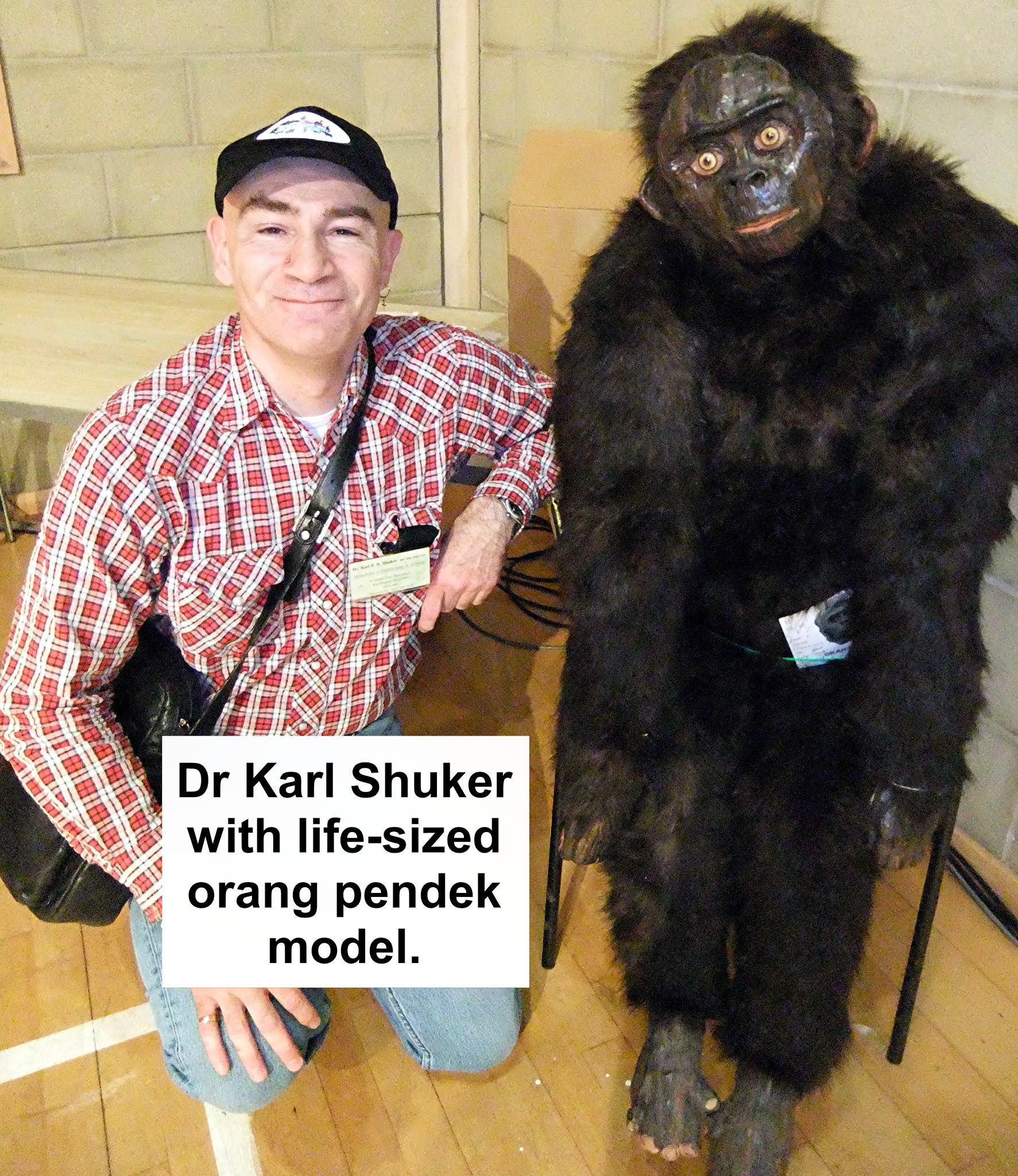
Alongside a life-sized representation of the orang pendek created for the CFZ (© Dr Karl Shuker / CFZ)

Once upon a long ago in the wonderful world of cryptozoology, only a single type of diminutive Indonesian mystery man-beast was widely reported – the orang pendek ('short man') or sedapa of Sumatra, in this southeast Asian country's Greater Sundas island group, reported by locals and Westerners alike for well over a century. Physically represented by unidentifiable hair samples and wholly distinct footprint casts, this reddish-furred, bipedal, tailless entity is usually said to stand a mere 3-4.5 ft tall.

Plaster cast of an alleged orang pendek footprint, revealing its very distinctive form (© Dr Karl Shuker)

Suggested identities on offer for the orang pendek have ranged from a terrestrial form of orang utan or gibbon to a bona fide human species, possibly even a relict representative of our own species' predecessor, Homo erectus. So far, so simple (relatively speaking).

An orang utan standing upright in the wild (© Tom Low/Wikipedia – public domain)

Then in 2003, the first skeletal remains of what, after much contention, is nowadays accepted by most researchers to have been a bona fide diminutive human species (rather than merely stunted, freak Homo sapiens) were found on the small island of Flores in Indonesia's Lesser Sundas group. Formally dubbed Homo floresiensis but known colloquially as Flores Man or the hobbit, it is believed to have only stood around 3.5 ft tall, and to have become extinct at least 50,000 years ago – or did it?

Replica skull of Flores Man aka the hobbit (© Dr Karl Shuker)

Researchers began hearing native folklore and stories concerning the ebu gogo, described not only as very short human entities but also as still very much alive in the wilder, more remote regions of Flores. If such beings really do exist, might they be living, modern-day representatives of Homo floresiensis? Some cryptozoological investigators have taken this line of speculation even further, by linking Flores Man with the Sumatran orang pendek, even though the latter seems taller and more ape-like, not to mention zoogeographically separate. But then came news of an additional component to the Indonesian man-beast/mini-human mystery that makes matters even more complex and potentially confusing.

A reconstruction of the orang pendek as a hairy ape-like biped (© Randy Merrill)

As publicised recently in a number of online articles and reports (click here to access one of them), Sumatra may also be home to a second, fundamentally different man-beast from the orang pendek, one which, moreover, is very reminiscent of the ebu gogo and, in turn, Flores Man. Known as the orang kardil (aka orang kardill), according to native testimony this entity is definitely some form of human, not ape, hunting aggressively with spears and even deemed to have killed villagers on occasion, but is even shorter in stature than the orang pendek.

Reconstruction of the possible appearance and stature of the ebu gogo compared with an average human (© Connor Lachmanec)

Consequently, is it possible that a truly miniature Indonesian species of human has existed at one time or another not just on Flores, due to its savage nature has infiltrated traditional Indonesian folklore under various local names such as ebu gogo and orang kardil, and may even still survive today in remote regions of Flores, Sumatra, and perhaps elsewhere in this multi-island country too? All of this is total conjecture, of course, but less than 20 years ago even Flores Man's own existence was entirely unknown to science.

Orang pendek, orang kardil, ebu gogo – are such entities more than just a briefly-glimpsed face in the forest? (© William M. Rebsamen)


UPDATE - 14 November 2020

Just a few hours after I uploaded my above article onto ShukerNature and posted links to it in my various Facebook groups, CFZ cryptozoologist Richard Freeman, who has led CFZ expeditions seeking the orang pendek in Sumatra, posted the following fascinating account regarding the orang kardil in my 'Beasts of Legend, Myth & Fantasy' FB group:

"Our late guide Sahar Dimus said that his father and a friend had encountered the Orang-kardill in 1981. The pair had been in a remote part of what is now Kerinci Sablat National Park trading rice for goods in isolated villages. One evening whilst camping in the jungle and cooking rice a tiny man like creature with long hair on the head but a naked body emerged from the rainforest and tried to steal the rice. Sahar's father's friend killed it with a parang (similar to a machete). Then more of the creatures ran out of the forest armed with bamboo spears and killed the man. They did not attack Sahar's father. Sahar said there had been no recent sightings of orang-kardill though there were many of orang-pendek. On my last Sumatran trip a large group of witnesses were gathered in Sahar's village close to Gunung Tuju. All had seen orang-pendek and / or its tracks but none had seen orang-kardill or had heard of any recent sightings. They were quite clear that the two were different."

Thank you so much for making this greatly-welcomed information available, Rich!


 2ND UPDATE - 15 November 2020

Earlier today, Indonesian Facebook friend Ben Haryo informed me of a third spelling for this entity's native name - 'orang kerdil'. He also informed me that the term:

"...means "dwarf" in our Indonesian language. We believe they exist as a race of very reclusive tribe of diminutive human-like creatures, but more human than spirits. Their counterparts are Tuyul who are not humans but evil genies."

Thanks very much, Ben, for these very valuable additional details!


Thursday, 9 August 2012

THE STRANGE STORY OF THE SINGLE SATYR

Replica of Greek satyr bust from c.400 BC (Dr Karl Shuker)

A few months ago, I spotted in a charity shop the very unusual artefact depicted above at the beginning of this ShukerNature blog post; and after recognising what it was, I lost no time in purchasing it for the princely sum of just £5. It is a replica of a Greek stone bust dating from c.400 BC, which portrays the head of a satyr.

Today, the popular image of a satyr is that of a semi-human semi-goat entity, with hairy goat-legs and hoofed feet, a pair of short curly horns, and a very inconspicuous goat-tail.

'Satyr Among Roses' (Jade Bengco)

In classical Greek mythology, conversely, the satyr was originally represented with the long, profusely-haired tail of a horse, with pointed donkey-like ears rather than horns, a flattened nose, and the legs and feet of a normal human.

Lovers of wine, nymphs, and playing music with their panpipes, satyrs were disciples of a minor demi-god of fertility called Silenus, and, just like him, they were also enthusiastic followers of Dionysus, the Greek god of wine. As Silenus was commonly portrayed as an elderly man of typically inebriated aspect, old satyrs were duly referred to as sileni (young ones were known as satyrisci).

'Drunken Silenus', a 2nd-Century-AD Roman marble statue in the Louvre, Paris (public domain)

During Roman times, however, the image of the satyr became conflated and ultimately synonymised with that of a rustic Roman nature deity called Faunus. He was half-human, half-goat, as were his followers, known as fauns (though originally they were described as half-human, half-deer).

Statue of Faunus at the Fountain of Neptune in Florence, Italy, sculpted by Bartolomeo Ammanati (public domain)

Since then, satyrs and fauns have generally been treated as one and the same type of mythical entity. But just how mythical – or otherwise – are satyrs?

As described time and again in mythology and folklore, satyrs were infamously lewd and lustful, never happier than when, fuelled by copious quantities of wine, they were in lecherous pursuit of some hapless nymph to ravish.
Satyr statue by Frank (Guy) Lynch in Sydney Botanic Gardens, Australia, visited by me during autumn 2006 (Dr Karl Shuker)

In my book The Unexplained (1996), I documented a remarkable cryptozoologically-relevant link between these priapic satyrs of classical legend and certain forms of elusive man-beast being reported today – with the emphasis very definitely upon priapic. Here is what I wrote:

"In Greek mythology, satyrs were semi-humans with the hairy legs, hooves, tail, and short horns of goats - but did they have a basis in reality? This unexpected prospect was raised in a stimulating paper published in the scientific journal Human Evolution in 1994 by Dr Helmut Loofs-Wissowa from the Australian National University's Faculty of Asian Studies.

"In ancient classical art, satyrs were frequently portrayed with a prominently erect penis - even when engaging in non-sexual activity. Indeed, it was this characteristic that earned them their reputation for sexual licentiousness. However, Dr Loofs-Wissowa believes that this is all fallacious - that in reality, the satyrs were displaying a physiological condition known as the penis rectus, in which the penis assumes a horizontal position even when flaccid. Among modern humans, this condition is only recorded from the bushmen of South Africa, but it is often portrayed in prehistoric cave art, including some Upper Palaeolithic examples from Europe, in which the figures exhibiting the penis rectus condition are hairy humanoids."


"There are two very intriguing aspects concerning this. One is that anthropologists have argued that these hirsute figures are representations of Neanderthal Man Homo neanderthalensis, which is believed to have died out at least 30,000 years ago. The other is that sightings of hairy troll-like humanoids are often reported in many parts of Asia, and these are believed by some scientists to be relict, modern-day Neanderthals, eluding formal scientific discovery. Of particular note here is that eyewitness descriptions of these mystifying entities have often alluded to the odd fact that they seem to have permanently erect penises, apparent even when spied indulging in non-sexual activity such as eating or walking. This suggests that they are in reality displaying the penis rectus condition.

"Combining all of this information, Loofs-Wissowa suggests that the penis rectus condition is clearly a marker in human palaeontology, i.e. indicating the identity of Neanderthals. And, as a direct consequence, he boldly proposes that satyrs might actually have been latter-day Neanderthals. He notes that many features attributed to satyrs in artistic representations differentiate them from modern humans but ally them to Neanderthals. These include their hairy body, upturned nose, prominent eye ridges, round head, strong neck - and, most noticeable of all, their exhibition of the penis rectus condition, hitherto wrongly identified as an overtly visual indication that satyrs possessed a hyperactive sex drive.

"A very novel idea, but it still leaves unexplained the small matter of the satyrs' hooves and tail, not to mention their horns..."

Statue of a satyr unearthed at Pompeii, Italy (Dr Karl Shuker)

Not all cryptozoologists, however, agree that satyrs may represent relict Neanderthals. In their book The Field Guide to Bigfoot, Yeti, and Other Mystery Primates Worldwide (Avon Books: New York, 1999), Loren Coleman and Patrick Huyghe propose an alternative but equally thought-provoking option. They suggest that man-beasts exhibiting this distinctive penile condition represent a category of man-beast entirely separate from Neanderthals. They term it the Erectus Hominid, as they believe this man-beast may constitute a surviving representative of one of our own species' ancestors, Homo erectus:

"The Erectus Hominid is probably the least known of the world's mystery hominids. The reason for this is simple: most of the beings in this class have in the past been misidentified as Neanderthal. The Erectus Hominid is human-sized to about six feet tall. Its body is also within the standard human range with a slight barrelling of the chest. They are partially to fully hairy, with head hair longer than their body hair. The males of the class normally display a semi-erect penis."

Whatever the identity of satyrs in European mythology may be, however, there is an intriguing yet generally overlooked reason for their unbridled libido and debauched passion for seducing nymphs – the same reason why I entitled this ShukerNature blog post 'Sex and the Single Satyr'. Remarkably, there is no reference anywhere in the annals of classical mythology to female satyrs!

'Nymphs and Satyr', painted by William-Adolphe Bouguereau (1825-1905)

By definition, therefore, all satyrs were doomed to remain single, celibate, and sexually frustrated – unless they could achieve some lascivious success with the local dryads (wood nymphs) and oreads (mountain nymphs). Equally, such illicit liaisons offered the only opportunity for satyrs to procreate, producing new generations of satyrs, albeit ones that were increasingly diluted by the nymphs' genetic input.

Statue of an infant faun at Glastonbury, Somerset (Dr Karl Shuker)

Eventually, satyrs simply vanished from folklore and traditions, but, faced with such an uncertain, unpredictable pathway to reproductive success, it is hardly surprising really that they became extinct!

Satyr frolicking with nymphs, painted by Claude Lorrain (public domain)