Dr KARL SHUKER

Zoologist, media consultant, and science writer, Dr Karl Shuker is also one of the best known cryptozoologists in the world. He is the author of such seminal works as Mystery Cats of the World (1989), The Lost Ark: New and Rediscovered Animals of the 20th Century (1993; greatly expanded in 2012 as The Encyclopaedia of New and Rediscovered Animals), Dragons: A Natural History (1995), In Search of Prehistoric Survivors (1995), The Unexplained (1996), From Flying Toads To Snakes With Wings (1997), Mysteries of Planet Earth (1999), The Hidden Powers of Animals (2001), The Beasts That Hide From Man (2003), Extraordinary Animals Revisited (2007), Dr Shuker's Casebook (2008), Karl Shuker's Alien Zoo: From the Pages of Fortean Times (2010), Cats of Magic, Mythology, and Mystery (2012), Mirabilis: A Carnival of Cryptozoology and Unnatural History (2013), Dragons in Zoology, Cryptozoology, and Culture (2013), The Menagerie of Marvels (2014), A Manifestation of Monsters (2015), Here's Nessie! (2016), and what is widely considered to be his cryptozoological magnum opus, Still In Search Of Prehistoric Survivors (2016) - plus, very excitingly, his four long-awaited, much-requested ShukerNature blog books (2019-2024).

Dr Karl Shuker's Official Website - http://www.karlshuker.com/index.htm

IMPORTANT: To view a complete, regularly-updated listing of my ShukerNature blog's articles (each one instantly clickable), please click HERE!

IMPORTANT: To view a complete, regularly-updated listing of my published books (each one instantly clickable), please click HERE!

IMPORTANT: To view a complete, regularly-updated listing of my Eclectarium blog's articles (each one instantly clickable), please click HERE!

IMPORTANT: To view a complete, regularly-updated listing of my Starsteeds blog's poetry and other lyrical writings (each one instantly clickable), please click HERE!

IMPORTANT: To view a complete, regularly-updated listing of my Shuker In MovieLand blog's articles (each one instantly clickable), please click HERE!

IMPORTANT: To view a complete, regularly-updated listing of my RebelBikerDude's AI Biker Art blog's thematic text & picture galleries (each one instantly clickable), please click HERE!

Search This Blog


PLEASE COME IN, I'VE BEEN EXPECTING YOU...

PLEASE COME IN, I'VE BEEN EXPECTING YOU...
WELCOME TO SHUKERNATURE - ENJOY YOUR VISIT - BEWARE OF THE RAPTOR!


Showing posts with label Soay beast. Show all posts

Tuesday, 29 December 2020

STUPENDOUS SEA TURTLES - MORE THAN JUST A MARITIME MYTH?

Skeleton of Archelon (public domain)

Do the vast oceans of our planet conceal great sea turtles far larger than any that are officially known to exist there?

In this present ShukerNature article, I survey a number of very intriguing cases that provide tantalising intimations that this may indeed be possible. 

A meeting with a mega-turtle - might this scary scenario actually happen one day? (© Hodari Nundu)

The largest species of sea turtle ever known to have existed was Archelon ischyros, which lived some 70 million years ago during the Late Cretaceous Period in the seas around what is now North America.

The largest specimen on record measured over 13 ft long and roughly 16 ft across from flipper to flipper.

Leathery turtle on beach (public domain)

In comparison, the largest species known to exist today, the leathery (leatherback) turtle Dermochelys coriacea, attains a maximum recorded length of a 'mere' 9.8 ft, but averages only 6-7 ft.

However, reports of substantially larger sea turtles are also on file – veritable behemoths, in fact, which if their existence were ever scientifically confirmed would rival even the mighty Archelon itself.


FATHER-OF-ALL-THE-TURTLES

In his classic if highly controversial tome In the Wake of the Sea-Serpents (1968), Belgian cryptozoologist Dr Bernard Heuvelmans postulated the existence of a number of hypothetical creatures to explain hundreds of reports of sea serpents from around the globe. One of them was what he termed the 'Father-of-All-the-Turtles' – a name originally given by native Sumatran fishermen to a traditional sea deity in which they vehemently believe, and which allegedly assumes the guise of a gargantuan marine turtle.

Father-of-All-the-Turtles (© Tim Morris)

Alternative sea serpent classification systems subsequently devised by other cryptozoologists have also included this category, and there are several notable eyewitness accounts on file indicating that a turtle of truly immense size may indeed have been encountered in various far-flung maritime localities.


GIANT TURTLES IN ANTIQUITY AND MEDIEVAL TIMES

Perhaps the earliest report dates back as far as the 3rd Century AD. This was when Roman scholar Claudius Aelianus (popularly known merely as Aelian), writing in his 17-volume treatise De Natura Animalium, referred to the existence in the Indian Ocean of turtles so colossal in size that their huge shells – said to be as much as 23.5 ft in circumference – were sometimes used by the native people as roofing material! Modern-day sceptics have claimed that if such shells truly existed, they must have been fossils. And it is certainly true that portions of fossilised shells from the land-living prehistoric giant tortoise Megalochelys [=Colossochelys] atlas have been unearthed in the rich deposits of Nepal's Siwalik Hills. Yet fossil shells would surely have been too brittle and much too heavy for roofing purposes.

Megalochelys [=Colossochelys] atlas reconstructions (© Vjdchauhan/Wikipedia – CC BY-SA 3.0 licence)

Writing in his own magnum opus, Geography, which he completed in 1154 AD, Muhammad al-Idrisi, a notable Moroccan Islamic traveller, cartographer, and archaeologist, referred to comparably immense turtles, up to 20 cubits (33 ft) long, living in the Sea of Herkend, off the west coast of Sri Lanka, whose females contained up to a thousand eggs. Although he never personally visited Asia, he collated considerable amounts of detailed information from Islamic explorers and merchants, and recorded on Islamic maps. Having said that, however, turtles generally lay no more than a hundred eggs at a time, not a thousand, so perhaps some such reports were exaggerated (which may also account for the huge size claimed for these Herkend turtles?).


CHRISTOPHER COLUMBUS AND ANNIE L. HALL

Possibly the most famous eyewitness of a reputed mega-chelonian was none other than New World discoverer Christopher Columbus. In early September 1494, along with several of his crew, he witnessed an extraordinary creature likened to a whale-sized turtle with a visible pair of flippers and a long tail that kept its head above the water surface while swimming by as his vessels were sailing east along the southern coast of what is now the Dominican Republic, occupying the right-hand half of the Caribbean island of Hispaniola.

Posthumous painting allegedly depicting Christopher Columbus, by Sebastiano del Piombo, 1519; no confirmed paintings of Columbus are currently known (public domain)

On 30 March 1883, while aboard the schooner 'Annie L. Hall' in the North Atlantic's Grand Banks, Captain Augustus G. Hall and his crew spied what they initially took to be an upturned vessel but which, when they approached to within 25 ft of it, proved to be an enormous turtle. By comparing its dimensions with those of their vessel, they were able to estimate its total length as being at least 40 ft, its width as 29.5 ft, and its height from its carapace's apex to its plastron or under-shell's most ventral point as 29.5 ft. Even its flippers were immense – each one approximately 20 ft long. Not surprisingly, the captain deemed it inadvisable to attempt capturing this shell-bearing leviathan!


TURTLES OF A (VERY) DIFFERENT COLOUR!

During the 1950s, two ultra-giant turtles were reported that were highly distinctive due not only to their great size but also to their very unusual colouration. One of these was an alleged 14-ft-long yellow turtle witnessed on 8 March 1955 by L. Alejandro Velasco while stranded on a raft off Colombia's Gulf of Urabá. Its claimed length is greater than that of the largest leathery turtle on record.
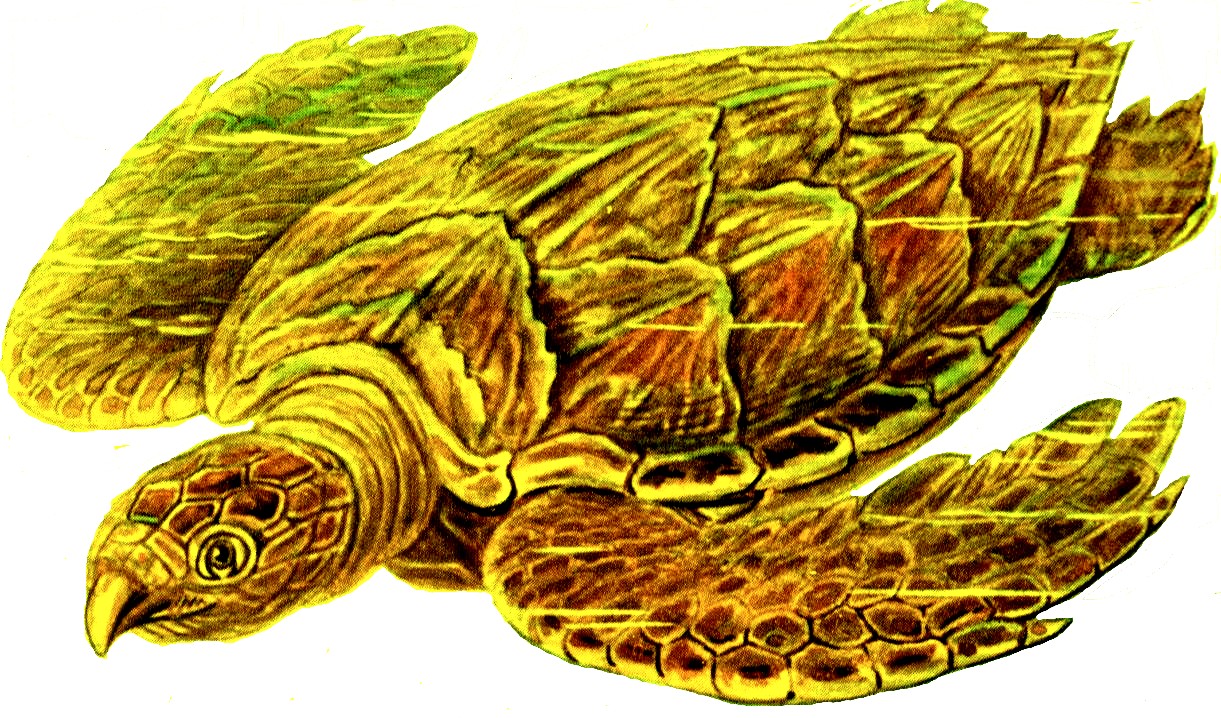
Using a hawksbill turtle as its basis, a species native to the waters off Colombia, might the mysterious Colombian yellow sea turtle have looked something like this? (© Dr Karl Shuker)

The other was a 44-ft-long pure-white turtle with 14-ft flippers that was sighted south of Nova Scotia, Canada, in June 1956 by crew on board the cargo steamer 'Rhapsody'. According to their account, this huge creature could raise its head 8 ft out of the water.


ENCOUNTERING THE SOAY BEAST

Perhaps the most famous and controversial modern-day sighting of an alleged giant sea turtle occurred just a few years later, off the Scottish Inner Hebridean island of Soay. On 13 September 1959, while fishing here for mackerel, holidaying engineer James Gavin and local fisherman Tex Geddes were very startled to observe an extremely large sea creature swimming directly towards their boat, its head and back readily visible above the sea surface, until it was no more than 60 ft away.

According to their description, documented in a major Illustrated London News report of 4 June 1960, the head of this remarkable beast was definitely reptilian and resembled a tortoise's, with lateral eyes and a rounded face plus a horizontal gash for a mouth when closed, but it was as big as a donkey's, and the neck was cylindrical. The exposed portion of its back was humped in shape, and running down the centre was a series of triangular-shaped spines or serrations, like the teeth of a saw. The animal was so close that when it opened its mouth to breathe, emitting a very loud whistling roar, they could see the red lining inside, and what looked like loose flaps of skin hanging down from the roof, but there were no teeth.

Sketches of Soay Beast's alleged appearance, from Illustrated London News, 4 June 1960 ((© Illustrated London News – reproduced here on a strictly non-commercial Fair Use basis for educational/review purposes only)

After remaining in sight for five minutes, their extraordinary visitor dived forward and vanished beneath the water surface, then emerged again almost a quarter of a mile away, before disappearing completely as they watched it. Moreover, the crews of two lobster boats, fishing north of Mallaig on the Scottish mainland, also spied this mysterious creature, much to their alarm!

Due to its mid-dorsal serrations, British zoologist Dr Maurice Burton wondered whether it may have been an escapee iguana, but the remainder of the Soay beast's description does not correspond with such an identity at all, and much more readily recalls a chelonian. Moreover, certain terrapins even possess dorsal serrations, though terrapins are of course freshwater species, not marine.


COULD UNDISCOVERED MEGA-TURTLES EXIST TODAY?

Reading through the above reports, various objections to the possibility of giant turtles existing undiscovered by science soon come to mind, but are they insurmountable? For instance: all known species of sea turtle have only short tails, so the long tail of the specimen sighted by Columbus and his crew is unexpected. Yet there are no sound anatomical or physiological reasons why a long-tailed species might not exist. In any case, it may be that at least part of the tail's length was an optical illusion, caused by the wake created as it swam by.

The odd colours of the two specimens reported during the mid-1950s pose another problem. However, perhaps the yellow colouration of the Colombian individual was merely due to reflected sunlight, or it might have been a rare xanthic (yellow mutant) individual. Equally, the white 'Rhapsody'-spied turtle may conceivably have been an albino or leucistic specimen – such individuals have been reported from many reptilian species, even ones as large as crocodiles and alligators. Indeed, a scan through Google will soon turn up a number of spectacular photographs of leucistic sea turtle specimens, confirming that such creatures can indeed arise (click here to see them). Having said that, some hawksbill turtles Eretmochelys imbricata can appear golden-brownish in colour, and even some non-leucistic green turtles Chelonia mydas look quite pale. Nevertheless, they do not attain the huge sizes claimed for the Colombian and 'Rhapsody' specimens respectively.

Exquisite vintage illustration of a leathery turtle by Ernst Haeckel, 1902 (public domain)

The cold-water regions in which the 'Rhapsody' specimen and the Soay beast were sighted argues on first sight against their being reptiles. However, the leathery turtle is famed for its ability to withstand coldwater temperatures, and of particular note in relation to the Soay case is the remarkable but fully-confirmed fact that in August 1971 a leathery turtle was caught near Mallaig!

If mega-turtles do truly exist, they must be at least predominantly pelagic in occurrence, otherwise they would have been seen far more frequently. Yet even if this is so, surely they would have been observed on land at some point, coming ashore to lay their eggs? Possibly – then again, there are countless small, remote, uninhabited tropical islands and island groups that have never been visited by humans. Indonesia, for instance, consists of over 17,500 islands, and more than 7,100 constitute the Philippines.

Alongside the model of a gigantic sea turtle hatchling at Birmingham Sea Life Centre, 2013 (© Dr Karl Shuker)

So perhaps it is beneath the coastal sands of tiny isles such as these, emerging at night for just a few hours only once every 2-3 years and far removed from prying human eyes or from other potential sources of danger to their precious offspring, where these shy reptilian giants (so adept when at sea but so vulnerable when on land) entrust their precious eggs and, while depositing them, their own lives too, before returning once more to the safety of their vast maritime domain.

Who knows? One day, possibly, an intrepid adventurer may visit one of these anonymous specks of land and there encounter a trail of huge flipper prints left behind by some great chelonian Man Friday.

Olive ridley sea turtles Lepidochelys olivacea ashore on a Mexican beach (© Claudio Giovenzana/Wikipedia – CC BY-SA 3.0 licence)

This ShukerNature blog article is excerpted and adapted from my book Mirabilis: A Carnival of Cryptozoology and Unnatural History.


Monday, 20 April 2009

OTTER KINGS TO EARTH HOUNDS - IN SEARCH OF BRITAIN'S LESSER-KNOWN MYSTERY BEASTS

Grace Connolly was a recently-married young woman who lived in the townland of Creevelea, at the northwestern corner of Glenade Lake, just inside County Leitrim's border with County Sligo, in Ireland. One bright morning in September 1722, Grace went down to the lake, to bathe and perhaps also to wash clothes. Tragically, however, she did neither, for while there she was attacked and killed by a water monster that rose up out of the lake's depths.


Carving of the dobhar-chú on Grace Connolly's tombstone (Dave Walsh)

When her husband, Terence McGloughlan (in keeping with Gaelic custom, Grace had retained her maiden name after marrying him), discovered Grace's body lying at the lake's edge later that day, he was half-crazed with grief. However, his grief turned to fury when he saw that his wife's assassin was actually lying asleep across her prone form. It was a dobhar-chú - a mysterious, elusive beast of Irish folk tradition, also known as a king otter or master otter, because it superficially resembled a normal otter but was much bigger, with powerful hound-like limbs.

Terence lost no time in slaying the monster, but its death cries alerted its equally formidable mate, which emerged from the lake and pursued Terence, who fled on horseback. Eventually, however, he ambushed the avenging dobhar-chú and slew it.

Needless to say, this could be readily discounted as just another traditional Irish folk story - were it not for the stark fact that Grace Connolly's grave exists. And carved upon her tombstone is a detailed depiction of her cryptozoological nemesis - the dobhar-chú.

This still-unidentified mystery beast is just one of many strange, enigmatic beasts reported over the years - and centuries - from the British Isles, thereby demonstrating that Nessie and various pantheresque or puma-resembling big cats are not the only mystery creatures associated with our green and pleasant lands.

MASTERING THE MASTER OTTER

The mystery of the dobhar-chú or master otter is particularly intriguing, thanks to the existence of Grace Connolly's tombstone and the portrait depicted upon it. As revealed in my books Mysteries of Planet Earth (1999) and The Beasts That Hide From Man (2003), both of which contain a detailed account of this remarkable case, Grace's grave can be found in Conwall Cemetery, in the town of Drummans, forming part of the approach to the Valley of Glenade from the coastal plain of north County Leitrim and south County Donegal, and not far from Bundoran.

Grace's name, and that of her husband, together with the year of her death, are still legible, as is the remarkable carved image of the dobhar-chú. The creature is depicted lying down with its head and neck flung backwards so as to lie flat along its back, thus representing it in its death throes, because a spear-like weapon (gripped at its upper end by a human fist) is piercing the base of its neck and re-emerging below its body. The creature itself curiously combines the short head and tiny ears, large paws, and long heavy neck of an otter with the long limbs and powerful thighs, deep-chested body, and lengthy curved tuft-tipped tail of a hound-like dog.

As true otters are very familiar beasts in Ireland, it would seem unlikely that this is merely a badly-executed portrayal of a normal otter. Yet if it is an accurate depiction, then the creature that it illustrates would appear to be unknown to science. Even more intriguing is that whereas this carving represents a creature killed back in 1722, a very similar beast has also been reported from this same area of Ireland in much more recent times.

Immediately to the west of County Sligo is County Mayo, off whose western coast is a small isle called Achill Island, containing a lake known as Sraheens Lough. During May 1968, several observers independently reported seeing a strange creature either running on land near to the lake or emerging directly from it. The mystery beast was said to be 8-10 ft long, roughly 2.5 ft high, and shiny black or very dark brown in colour, with a small head but a long neck and tail, and four powerful legs on which it rocked from side to side as it ran. A modern-day dobhar-chú? Perhaps - but until a specimen is (if ever) obtained, this mystifying mammal will continue to linger with leprechaun-like evanescence amid the twilight limbo between Celtic folklore and contemporary fact.

WHEN A SEA MONSTER SET FORTH FROM THE FIRTH OF TAY?

It's not every day that you see a sea serpent - and certainly not one that is actually making its way laboriously on land, along a major road, in full view of passing traffic. Yet that is what at least two eyewitnesses may well have seen, judging from their independent yet closely corroborating statements. The first of these was Maureen Ford, driving with some friends along the A85 towards Perth at 11.30 pm on 30 September 1965. Suddenly, as she neared Perth, she saw what she subsequently described as "a long grey shape [which] had no legs but I'm sure I saw long pointed ears", by the roadside yet only a few yards from the banks of the River Tay, which enters close by into a North Sea inlet - the Firth of Tay.

At 1.00 am the very next morning, this bizarre beast was seen again, but on the opposite side of the road, to which it had apparently crossed meanwhile. Its eyewitness this time was Robert Swankie, driving along the same road but in the opposite direction from Ford, i.e. away from Perth and on towards Dundee. As he drove along, however, his vehicle's headlights abruptly exposed an extraordinary sight - a weird creature with a 20-ft-long body that was "...humped like that of a giant caterpillar" (i.e. undulating vertically), and a head over 2 ft long, bearing a pair of pointed ear-like appendages. The creature was moving very slowly, making "...a noise like someone dragging a heavy weight through the grass".

Swankie wanted to stop, in order to obtain an even closer look at this scientifically-unidentified animal, but there was a car close behind him, so he deemed it best to carry on driving; however, he did subsequently report his sighting to the police. Suggestions that perhaps it had all simply been a trick of the light have since been discounted by cryptozoological investigators, pointing out that if this had indeed been true, why then had Swankie not seen monsters elsewhere on his journey?

After all, there was nothing special, optically speaking, about the particular stretch of road along which he and Ford had independently, and on opposite sides, spied an elongate mystery beast - one which, moreover, closely recalls many sightings of comparably serpentiform sea serpents and also lake monsters, including the equally inexplicable horse-eels of Lough Nahooin and elsewhere in Ireland. And optical illusions in any event do not normally feature an accompanying soundtrack of dragging noises.

Perhaps therefore, some highly elusive, still-unrecognised water beast did indeed emerge from the sea that evening under the cover of darkness, to make a rare, short foray overland, but by sheer chance had been spotted separately by two late-night travellers.

TEGGIE OF BALA LAKE

Also called Llyn Tegid, Bala Lake is Wales's largest lake, and, thanks to Teggie, its resident monster, it has also lately become its most famous, cryptozoologically speaking. In recent times, a number of sightings have been claimed here, featuring a reclusive creature variously likened to a crocodile or to the long-necked Nessie-type beasts more famously reported from Scotland. For example, while fishing from a small boat on the lake in March 1995, Paul and Andrew Delaney, visiting from London and unaware of Teggie reports, peered in great surprise at a small head that appeared at the lake's surface only 80 yards or so away, then proceeded to raise itself on a long slender neck until it was about 10 ft above the surface. This and other reports prompted an investigation of the lake later that same year by a Japanese TV crew, who obtained a sonar trace of a very large, unidentified object moving swiftly under the water, but failed to film Teggie, who remains steadfastly aloof.

THE EARTH HOUND OF BANFFSHIRE


The earth hound (William Rebsamen)


One of Britain's most macabre mystery beasts must surely be the earth hound or yard pig of Banffshire, northern Scotland, which allegedly lives in or near graveyards and digs inside coffins to feed upon corpses. Alexander Fenton and veteran Scottish cryptozoological chronicler David Heppell have uncovered a number of fascinating accounts regarding this creature.

One such account, written in 1917 by a Mr A. Smith, documents the description of an earth hound by a gardener who had dug up and killed it about half a century earlier, while ploughing some haughs (alluvial flats) close to a churchyard. According to the gardener, it was brown in colour rather like a rat, but had a long hound-like head, and a tail bushier than a rat's. This same specimen was later seen by a second eyewitness, who stated that it was:

"...something between a rat and a weasel, and about the size of a ferret, head very like that of a dog...the tail was not very long. At a casual glance it would be mistaken for a rat, but was quite unlike on close examination."

An earth hound killed in c.1915 near Mastrick, again near a churchyard, was said to have mole-like feet, white tusks, and prominent pig-like nostrils. Even as recently as spring 1990, Fenton was soberly informed of the earth hound by a Banffshire friend. Yet surely, if such a creature truly existed on Scotland, there would be specimens of it in museums by now - unless the very unsavoury nature of its lifestyle has effectively warded off attempts to seek out and preserve specimens of this weird animal?

CENAPRUGWIRION

Among the least-known yet most mystifying of British cryptozoological beasts is a curious 1-ft-long lizard-like reptile supposedly inhabiting burrows in and around Abersoch in North Wales. Known as the cenaprugwirion or genaprugwirion (sometimes translated as 'daft flycatcher'), it is readily distinguished from all species of native lizards not only by its length but also by its combination of an orange-sized head, dewlap (skin flap) beneath its chin, large mobile eyes, long fly-catching tongue, and mud-brown colour. Apparently once common here, it is rarely reported nowadays, which is a great tragedy, because this tantalising creature bears more than a passing resemblance to one of the world's most remarkable reptiles - the tuatara Sphenodon punctatus of New Zealand.

Tuatara (Dr Karl Shuker)

A veritable 'living fossil', the tuatara is the only modern-day representative of an otherwise long-extinct reptilian lineage known as the sphenodontids, and is found nowhere else in the world - officially. During the 19th Century, however, tuataras were commonly imported into Britain, and as they are not only well-suited to surviving Britain's climate but also have an extremely long lifespan (several decades), it has been suggested that perhaps some tuataras escaped into the Welsh countryside a century ago and established a viable colony, whose members were ultimately dubbed cenaprugwirions by the local people.

THE BEAST OF SOAY

Soay is a small unassuming island just south of Skye, largest of the Inner Hebridean isles. On 13 September 1959, however, the waters surrounding it witnessed an extraordinary incident - a decidedly close encounter between two fishermen and an incredible reptilian sea monster. Swimming to within 20 yards of the dinghy containing angler Tex Geddes and engineer James Gavin came a huge sea creature with a blunt tortoise-like head and gaping toothless mouth (through which they could plainly hear it breathing), red mouth lining, cylindrical neck, rounded face, and two large protruding eyes. Its body was scaly, burly, and the expanse visible above the sea surface was estimated by the two men to be 8-10 ft long. Overall, therefore, Soay's unwonted visitor may well have recalled a giant marine turtle - had it not been for the row of distinctive triangular spines running along the midline of its back, which bestowed upon it a disturbingly prehistoric appearance. Some zoologists sought to identify it as an escapee iguana, but there is even less resemblance between this lizard and the Soay beast than between the latter and a turtle. Happily, the bizarre creature posed no threat to its eyewitnesses, and was last spied by them swimming away towards the island of Barra.

EYEWITNESS REPORT - HOOKING THE HORNED MONSTER OF LOUGH DUBH

One of the most terrifying mystery beasts ever recorded within the chronicles of British cryptozoology was encountered by schoolteacher Alphonsus Mullaney and his young son, also called Alphonsus, while fishing one day after school in mid-March 1962 at Lough Dubh in County Galway, Ireland. As the shocked teacher later recalled to a Sunday Review reporter:


“Suddenly there was a tugging on the line. I thought it might be caught on a root, so I took it gently. It did not give. I hauled it slowly ashore, and the line snapped. I was examining the line when the lad screamed.

"Then I saw the animal. It was not a seal or anything I had ever seen. It had for instance short thick legs, and a hippo face. It was as big as a cow or an ass, square faced, with small ears and a white pointed horn on its snout. It was dark grey in colour, and covered with bristles or short hair, like a pig.”

After the two Mullaneys promptly fled, a party of brave locals with guns later returned, but no trace of the monster was found. However, as noted by lake monster author Peter Costello, far from basking in the resulting publicity of their amazing sighting the Mullaneys actively shunned all television interviews, and the father did everything to assist his son in blotting their very frightening experience from his young mind. Accordingly, Costello considers a hoax to be out of the question. As for the creature itself, of which no further sightings have been reported: it bears no resemblance to any other lake monster on file - or indeed, to any other beast of any kind - and therefore remains a total enigma.

UNSOLVED HISTORICAL CASES - THE WINGED SNAKE OF HYDE PARK AND HAMMERSMITH

Perusing old back issues of long-vanished British journals can be a surprisingly successful means of uncovering baffling yet fascinating cryptozoological reports - as evinced by the following still-unexplained account, which appeared in The Gentleman's Magazine on 20 April 1798. Penned by a correspondent identified only as 'SB', it concerned a surrealistic snake(?) allegedly sighted a few miles west of London at the beginning of August 1776:

“The strange object was of the serpent kind: its size that of the largest common snake; and as well as it could be discovered from so transient a view of it, resembled it by a kind of grey mottled skin. The head of this extraordinary animal appeared about the size of a small woman's hand. It had a pair of short wings very forward on the body, near its head; and the length of the whole body was about two feet. Its flight was very gentle; it seemed too heavy to fly either fast or high; and its manner of flying was not in an horizontal attitude, but with its head considerably higher than the tail; so that it seemed continually labouring to ascend without ever being able to raise itself much higher than seven or eight feet from the ground.”

Not long afterwards, the same magazine published a second account, by a pseudonymous correspondent identified only as 'JR', describing a supposed sighting by a friend of a similar (or even the same?) creature, this time encountered on the road between Hammersmith and Hyde Park Corner on the evening of 15 July 1797. Dark in colour, roughly 2 ft long, and "about the thickness of the lower part of a man's arm", it had very short wings placed near the head, and flew less than 7-8 ft above the ground, with its head raised above its body.

With no details supplied concerning the correspondents' identities, an outright hoax or a somewhat abstruse example of 18th Century satire cannot be discounted. Certainly, to the best of my knowledge Hyde Park and Hammersmith are not renowned nowadays for visitations from serpents of the winged variety, which is probably no bad thing!

THE WALKING FIR CONE OF DUMPTON PARK

It was on 16 April 1954 when Police Constable S. Bishop, while walking through Dumpton Park in Ramsgate, Kent, encountered a bizarre-sounding beast that he likened to "a walking fir-cone". Since then, nothing more has been heard of this novel creature, but PC Bishop's evocative description of it continues to tease and torment. What could it have been?

When I first read it, Bishop's description immediately conjured up images of pangolins. Also known as scaly anteaters, these extraordinary beasts, covered in huge brown scales, really do resemble animated pine or fir cones. However, they are wholly confined to tropical Asia and Africa, and due to their insectivorous diet are very difficult to maintain in captivity. Accordingly, they are rarely exhibited in zoos, and are seldom if ever kept as pets in the western world. Thus, despite being fir cone lookalikes, pangolins surely cannot be considered seriously as candidates for the Dumpton Park beast's identity.

More recently, however, a second identity was suggested to me that offers a greater degree of plausibility, yet does not compromise the fir cone similarity factor. John Mitchell from San Francisco had read my account of the Dumpton Park beast in my book From Flying Toads To Snakes With Wings (1997), and offered a most intriguing identity for consideration. Namely, the Australian stumpytail or shingleback skink Trachydosaurus rugosus - also called the pine-cone skink, because its large brown overlapping scales make this lizard look uncannily like a pine or fir cone on legs, as discovered by Mitchell when introduced to a pet specimen owned by a friend. Around 14 in long when adult, with a tail so closely resembling its head that it is difficult to distinguish one end of the creature from the other, the stumpytail is possibly the best-known lizard in Australia, due to its abundance and presence in or around a number of Australian suburbs. Moreover, its placid temperament and tough survival ability make this lizard a popular pet, frequently maintained by herpetological enthusiasts worldwide. Hence there is rather more potential for the Dumpton Park beast being an escapee stumpytail skink than an absconded pangolin.

As with all of the cryptic beasts documented here, however, in the absence of a specimen or even a good photo of one, any attempt at identification is fraught with difficulty - and especially so with those that seemingly bear little if any resemblance to animals currently known to science. Far too much hot air is generated within cryptozoological circles arguing vehemently but vainly about what a given mystery beast is and is not, instead of sensibly accepting that without a physical specimen to examine, all that we can have are theories and opinions, not facts. In the case of the animals surveyed here, although they are less famous than Nessie and Britain's mystery cats, they are no less fascinating, and certainly are no less deserving of further investigation, in the hope that one day theories and opinions regarding them can indeed be replaced by hard facts - the true goal of any serious cryptozoologist.