Dr KARL SHUKER

Zoologist, media consultant, and science writer, Dr Karl Shuker is also one of the best known cryptozoologists in the world. He is the author of such seminal works as Mystery Cats of the World (1989), The Lost Ark: New and Rediscovered Animals of the 20th Century (1993; greatly expanded in 2012 as The Encyclopaedia of New and Rediscovered Animals), Dragons: A Natural History (1995), In Search of Prehistoric Survivors (1995), The Unexplained (1996), From Flying Toads To Snakes With Wings (1997), Mysteries of Planet Earth (1999), The Hidden Powers of Animals (2001), The Beasts That Hide From Man (2003), Extraordinary Animals Revisited (2007), Dr Shuker's Casebook (2008), Karl Shuker's Alien Zoo: From the Pages of Fortean Times (2010), Cats of Magic, Mythology, and Mystery (2012), Mirabilis: A Carnival of Cryptozoology and Unnatural History (2013), Dragons in Zoology, Cryptozoology, and Culture (2013), The Menagerie of Marvels (2014), A Manifestation of Monsters (2015), Here's Nessie! (2016), and what is widely considered to be his cryptozoological magnum opus, Still In Search Of Prehistoric Survivors (2016) - plus, very excitingly, his four long-awaited, much-requested ShukerNature blog books (2019-2024).

Dr Karl Shuker's Official Website - http://www.karlshuker.com/index.htm

IMPORTANT: To view a complete, regularly-updated listing of my ShukerNature blog's articles (each one instantly clickable), please click HERE!

IMPORTANT: To view a complete, regularly-updated listing of my published books (each one instantly clickable), please click HERE!

IMPORTANT: To view a complete, regularly-updated listing of my Eclectarium blog's articles (each one instantly clickable), please click HERE!

IMPORTANT: To view a complete, regularly-updated listing of my Starsteeds blog's poetry and other lyrical writings (each one instantly clickable), please click HERE!

IMPORTANT: To view a complete, regularly-updated listing of my Shuker In MovieLand blog's articles (each one instantly clickable), please click HERE!

IMPORTANT: To view a complete, regularly-updated listing of my RebelBikerDude's AI Biker Art blog's thematic text & picture galleries (each one instantly clickable), please click HERE!

Search This Blog


PLEASE COME IN, I'VE BEEN EXPECTING YOU...

PLEASE COME IN, I'VE BEEN EXPECTING YOU...
WELCOME TO SHUKERNATURE - ENJOY YOUR VISIT - BEWARE OF THE RAPTOR!


Showing posts with label living fossils. Show all posts

Friday, 12 August 2016

DREDGING UP SOME LIVING TRILOBITES?


Large-scale model of the 'Dudley bug' trilobite Calymene blumenbachii (© Dr Karl Shuker)

One of the best-known groups of fossil animal are the trilobites ('three-lobed'), this name deriving from the distinctive three-lobed structure of their body, which consists of the cephalon (head shield), the thorax, and the pygidium (tail shield). Ranging in size from a dinner plate down to a pea, they are famed for their segmented body form, numerous pairs of limbs, and extremely well-developed compound eyes.

Global but exclusively marine in distribution, this taxonomic class of arthropods was one of the earliest, with the first-known representatives in the fossil record dating back approximately 540-520 million years to the early Cambrian Period (though it is suspected that there may well have been earlier forms as yet unrepresented by documented fossils dating as far back as 700 million years, to the pre-Cambrian).

Beautiful illustration of trilobites from Système Silurien du Centre de la Bohême, by Joachim Barrande, 1852 (public domain)

Bearing in mind how zoologically familiar they are today and how their taxonomic identity as arthropods is indisputable, it may come as something of a surprise to learn that the first trilobite fossils to attract notable scientific attention, during the 1700s, incited considerable controversy as to what type of creature they represented, resulting in some exceedingly bizarre notions being aired in all seriousness.

They were initially deemed to be ancient, three-lobed clam-like seashells (and were duly dubbed Concha triloba), because these particular trilobite fossils showed only the animals' dorsal side (thereby concealing the fact that trilobites actually possessed legs – lots of legs, in fact!).

Sentimentally priceless - a diverse selection of trilobite casts on a matrix slab bought for me by my late mother Mary Shuker during our first, very happy visit to Lyme Regis, Dorset (© Dr Karl Shuker)

Not everyone agreed with this identification, however, and offered various alternative but equally erroneous suggestions. The normally authoritative British zoologist Dr George Shaw (1751-1813), for instance, proposed that trilobites were fossil caterpillars, while some contemporaries opined that they were archaic centipedes, or (less preposterous) crustaceans.

The matter remained contentious until American palaeontologist Charles D. Walcott resolved it in a very convincing manner – by skilfully and painstakingly using a hacksaw to open up no fewer than 3,500 fossils of curled-up trilobites, thereby revealing the presence of their jointed legs, and, in turn, these hitherto-baffling beasts' true nature as arthropods.
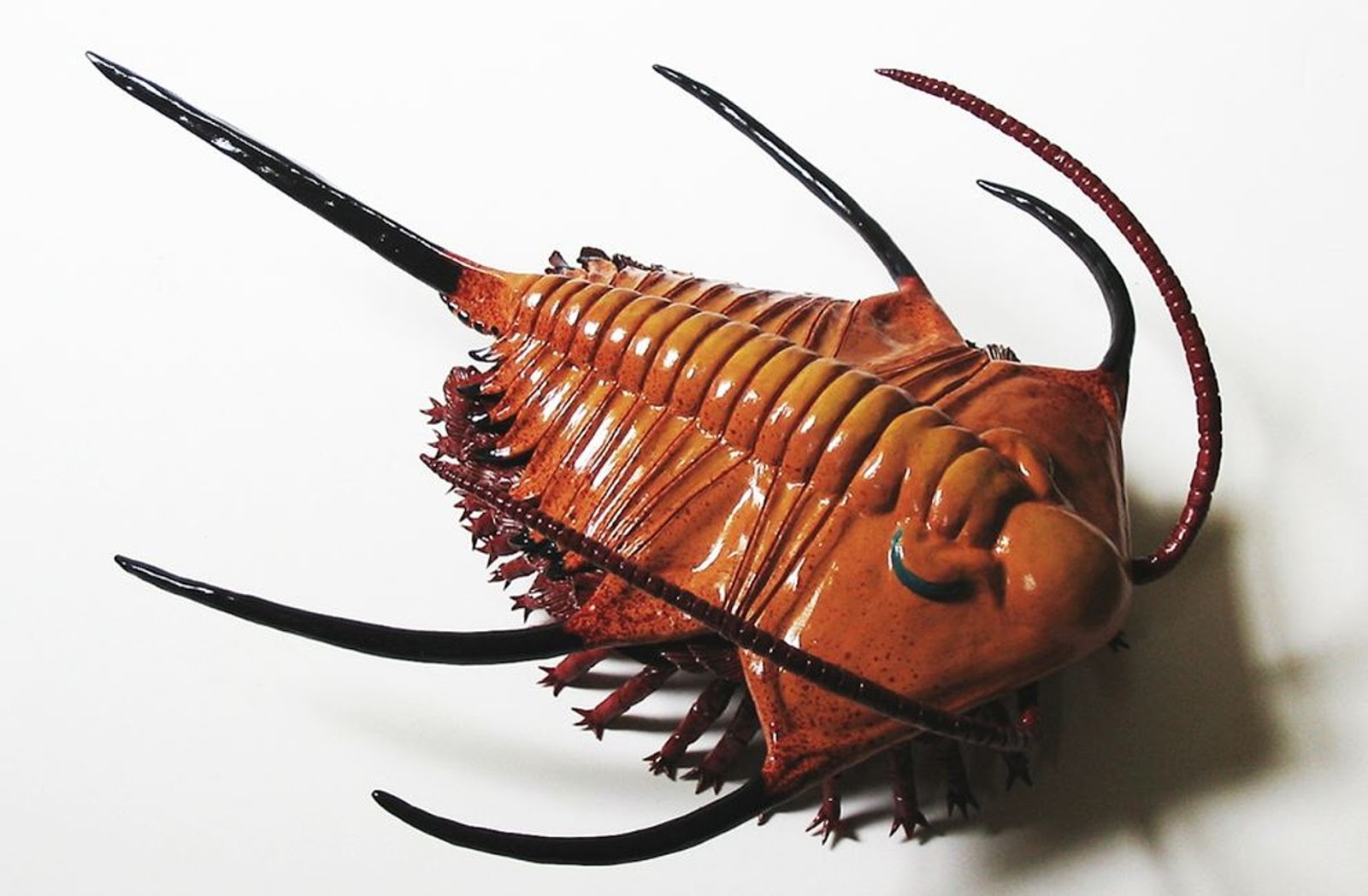
Spectacular, life-like model of Bristolia bristolensis, a notably long-spined species of early Cambrian trilobite from the southwestern USA (© Andrew 'Trilobite' Scott – click here for a ShukerNature exclusive showcasing many other examples of Andrew's stunning artwork)

During the lengthy course of their evolution, the trilobites became exceedingly successful, yielding a vast diversity of species (some 17,000 are currently recognised) as well as body forms and lifestyles before decreasing markedly in the Devonian, and finally dying out completely around 252 million years ago (in the mass extinction that occurred at the end of the Permian) – or did they? There is no well-established reason why they should have done.

As a zoologist living in the West Midlands, England, I am very aware that one particular trilobite species, Calymene blumenbachii from the Silurian Period, is so abundant in the fossiliferous limestone quarries of Wren's Nest in the West Midlands town of Dudley that it is popularly known as the Dudley bug or Dudley locust, and even appears on the Dudley County Borough Council's official coat-of-arms. Naturally, therefore, I've been a fan of trilobites ever since childhood, and my fossil collection contains several specimens, but my interest in cryptozoology would subsequently yield an additional reason for my being fascinated by them.

Dudley bug trilobite, from James Geikie's Outlines of Geology, 2nd rev. edit, 1883 (public domain)

In the mid-1980s, I purchased veteran American cryptozoologist Prof. Roy P. Mackal's classic book Searching For Hidden Animals (which had originally been published in 1980 in the U.S.A., but not until 1983 in the U.K.), and was delighted to find that it documented a wide range of lesser-known cryptids.

However, one chapter that obviously attracted my particular interest was tantalisingly entitled 'Living Trilobites?'. It included a discussion as to whether any representatives of these archaic arthropods might have survived the Permian mega-death and persisted in benthic anonymity on the ocean floor into the present day.

Prof. Roy P. Mackal and the UK hb 1st edition of his book Searching For Hidden Animals (© Prof. Roy P. Mackal/Cadogan Books)

As Mackal noted, many trilobites were shallow coastal dwellers (especially the later ones), yet no living trilobites from such localities have ever been discovered. Consequently, the only hope for modern-day survival is if "some forms adapted to a deeper, more obscure environment and there found refuge" - or if some that were already so adapted simply persisted. Should this scenario have indeed taken place, it could explain why no Cenozoic trilobite fossils have ever been found - because these would not be readily discovered or accessed on the ocean floor. But what about obtaining living specimens there?

Until reading Mackal's book, I hadn't been aware that the very first global marine research expedition, the voyage of HMS Challenger from 21 December 1872 to 26 May 1876, seriously believed that living trilobites might be dredged up from the ocean bottom. But although countless specimens that included representatives of over 4,000 hitherto-unknown animal species were indeed procured there, none of them were trilobites. Or, as worded in the authoritative Encyclopaedia Britannica's eleventh edition, published in 1911, the "faint hope" of finding such creatures was not realised.

HMS Challenger portrayed in an engraving from 1858 (pubic domain)

In reality, however, a few years before this expedition had even set out on its epic voyage of zoological discovery, a claim had been made that a living trilobite had already been obtained, and from a depth of 1,200 fathoms (7,200 ft). Moreover, this claim was actually believed for a time before the creature's true, non-trilobite identity was revealed. Another veteran cryptozoological chronicler, Willy Ley, who briefly reported the case in one of his many articles, didn't provide further details, but as noted by Mackal the timing and morphological similarities strongly suggests that the discovery in question was actually that of a certain Antarctic species of isopod crustacean (the taxonomic group which includes woodlice and sea slaters) that is astonishingly trilobite-like in outward appearance.

Brought to scientific attention in 1830, its first officially recorded specimen had actually been found inside the gut of a marine fish examined by American naturalist Dr James Eights while visiting the South Shetland Islands between Patagonia and Antarctica during the so-called 'Expedition of 1830'. Emphasising its remarkable morphological convergence, in 1833 Eights formally christened this memorable new species Brongniartia [now Ceratoserolis] trilobitoides. And it was indeed initially mistaken for one of these prehistoric arthropods by some observers, but it sports two pairs of antennae (a crustacean characteristic), whereas trilobites only had one.

Ceratoserolis trilobitoides from James Eights's 1833 description paper (public domain)

Other modern-day creatures that have often been mistaken for living trilobites are chitons and water pennies. Chitons (or polyplacophorans, to give them their formal zoological name) constitute a taxonomic class of molluscs characterised by their very distinctive shells, which are composed of eight separate but slightly overlapping plates, and afford these animals a superficially segmented appearance dorsally.

If a chiton is turned over, however, its ventral body surface is seen to be non-segmented and only possessing a single, typically-molluscan foot, in contrast to the many limb pairs possessed by trilobites. As for water pennies, these trilobite imposters are the larval stage of certain aquatic freshwater psephenid beetles, belonging to the genus Mataeopsephus.

19th-Century engraving of chitons (public domain)

Also superficially trilobite-like in outward dorsal appearance are both the larvae and the larval form-retaining adult females of lycid (net-winged) beetles belonging to the genus Platerodrilus, and which are therefore known colloquially as trilobite beetles (click here for a ShukerNature article featuring these distinctive insects). Native principally to tropical rainforests in India and southeastern Asia, some of them are brightly coloured.

Finally, the juvenile stage of those famous 'living fossils' known as xiphosurans or horseshoe crabs is termed a trilobite larva, once again because of its superficial similarity to genuine trilobites. Horseshoe crabs, incidentally, are the closest living relatives of another taxonomic group of iconic fossil arthropods – the eurypterids or sea scorpions.

Exquisite illustration by Ernst Haeckel from 1904 featuring trilobites, horseshoe crabs, and sea scorpions (© public domain)

Back in the 1980s, a bizarre story emanating from Australia briefly hit the news headlines, claiming that some trilobites had been found inhabiting Perth's storm drains. Not surprisingly, however, this was soon exposed as a hoax, featuring an old tyre that had been cut into the shape of a trilobite.

A fossil trilobite species of familiar, non-extreme morphology (public domain)

Numerous deepsea collecting expeditions have been launched since Challenger, but none has ever procured any living trilobites, and yet some tantalising indirect (or, to be precise, ichnological) evidence for such creatures may have been recorded, which Mackal described as follows:

...in 1967, I was invited by Ralph Buchsbaum, professor of zoology at the University of Pittsburgh, to give a seminar on our researches at Loch Ness. During the social hour after the presentation one of his colleagues told me about experimental photography of the sea bottom that was in progress. He stated that photographs of fresh tracks identical to the Cruciana [sic – Cruziana], the fossilized trilobite tracks, had been obtained. He expressed the hope that traps could be lowered to catch whatever was making these highly suggestive tracks. As far as I know the nature of these tracks was never determined and nothing was ever trapped, because of a subsequent loss of funding for the project. The business of identifying sea-bottom trails and tracks is a tricky one and to infer living trilobites from a track is even more tricky. A marvelous collection of sea-bottom tracks and trails is presented in a book entitled The Face of the Deep by B. C. Heezen and C. D. Hollister. Only a tiny fraction of aquatic animal tracks have been identified, so that fertile ground for new discoveries is indeed abundant...Underwater photography of the ocean floor...appears to be a promising tool for future cryptozoological expeditions.

Cruziana from Portugal (public domain)

Cruziana is a famous trace fossil taking the form of elongate, bilobed burrows that are roughly bilaterally symmetrical. As noted in a 2010 Lethaia paper by Dr Stephen Donovan, many examples are believed to be the tracks or trails yielded by trilobites while deposit-feeding, but certain others are deemed not to be, because they were present in freshwater environments (where no trilobite fossils have so far been found) and/or were of Triassic date, by which time all trilobites were supposed to have died out. But were these ostensibly anachronistic tracks actually made by surviving post-Permian trilobites for which direct fossil evidence has simply not been found as yet?

Incidentally, two other types of trace fossil believed to have been created by trilobites are Rusophycus and Diplichnites. The former fossils are excavations featuring little or no forward movements, and have therefore been interpreted as traces left by trilobites while resting or in defence/protection mode. In contrast, the latter fossils are believed to be traces left by trilobites while walking upon the sediment surface.

Rusophycus trace fossil from Ordovician Period (public domain)

Mackal ended his living trilobites chapter on a somewhat pessimistic note, concluding: "While not impossible, it is most improbable that living trilobites still exist". After that, this fascinating prospect appeared to have vanished from the modern world just as surely, it would seem, as the trilobites themselves – which is why I was so startled, but delighted, by a certain comment allegedly made by a well-respected current scientist more recently.

On 24 June 2004, Yahoo! News released online a report concerning the receipt of a $600,000 start-up grant from the private Alfred Sloan foundation for a proposed 10-year international survey of the oceans' depths, at an estimated total cost of US $1 billion, to be funded by governments, companies and private donors, and officially dubbed the Census of Marine Life (CoML). As part of this grand-scale project, scientists led by researchers from the University of Alaska planned to use robot submarines and sonar to track down life forms in the Arctic Ocean's chilling deepwater domain, and expectations were that by the end of its decade-long course, the survey could easily have doubled the number of species known from this particular ocean.

Three-dimensional reconstruction of Drotops armatus, a very spiny species of Devonian trilobite from Morocco (public domain)

All very worthy indeed, but what caught my eye amid all of these statements was one attributed in the news report to none other than Dr Ron O'Dor, chief scientist of the multi-nation CoML. According to the report, whose exact wording is quoted here as follows, Dr O'Dor "speculated that Arctic waters might hide creatures known only from fossils, such as trilobites that flourished 300 million years ago". It would seem, therefore, that the notion of finding living trilobites has not been entirely discounted by scientists after all.

Happily, the CoML did indeed take place, this very ambitious project ultimately featuring scientists from more than 80 different nations, and releasing the world's first-ever census in 2010 – but no living trilobites were listed. Nevertheless, there is a notable precedent well worth mentioning here.

Pilina, a fossil monoplacophoran outwardly resembling modern-day Neopilina (public domain)

The monoplacophorans are a primitive taxonomic class of molluscs, whose youngest fossil species date from around 380 million years ago. On 6 May 1952, however, trawling off Mexico's western coast at a depth of almost 12,000 ft in dark, muddy clay, the Danish research ship Galathea hauled up 10 complete specimens and three empty shells of a small, seemingly unremarkable mollusc superficially resembling a limpet but which proved upon scientific examination to be a living monoplacophoran. This hitherto-unknown species was formally named Neopilina galatheae, since when further specimens of it, and of several additional modern-day species too, have been obtained (see my Encyclopaedia of New and Rediscovered Animals, 2012, for full details).

Structurally, these living monoplacophorans are very different internally from their archaic fossil ancestors, so if living trilobites do exist, these too are likely to be highly evolved species. Nevertheless, the discovery of Neopilina and kin readily demonstrates that it is by no means impossible for invertebrates deemed by their fossil record to have died out in very far-distant prehistoric ages to be represented, in fact, by living species that have simply evaded scientific detection.

A classic late-1800s illustration of living trilobites by Heinrich Harder (public domain)

This ShukerNature blog article is adapted from my forthcoming book Still In Search Of Prehistoric Survivors.


Sunday, 2 March 2014

IN SEARCH OF PREHISTORIC SURVIVORS - HOW IT CAME TO BE, AND WILL BE AGAIN (CRITICS NOTWITHSTANDING!)


Of all of my 20 books, none has attracted such acclaim but also such controversy as In Search of Prehistoric Survivors. Next year will mark the 20th anniversary of its original publication in 1995, and having received countless requests from readers over the years for its republication (after having been out of print for a number of years now), I am happy to say that following a protracted period of time doing the rounds of prospective publishers, it was accepted for publication just over a year ago, and I am working upon it with a view to its achieving a timely 2015 reappearance.

Having said that, I am still uncertain as to whether to prepare a straight reprint of the text but with additional illustrations (courtesy of the many wonderful ones that have become available to me since 1995), or whether to update it – and, if I do, how extensive that update should be. Mindful of the book's enormous scope of cryptids (the only major group not represented in it are the man-beasts, and that itself was only for reasons of limited space), a major update would see the book's size grow dramatically, to the point where it might simply be financially unviable to produce it. So I need to reflect further upon that. Nevertheless, after having received so many enquiries, I can definitely confirm that Prehistoric Survivors will be returning, so watch this space!

Meanwhile, and after having given the matter much thought, I feel that it may be instructive to reveal precisely how this particular book of mine came to be, because ever since it appeared in 1995 there has been a degree of confusion and controversy in some quarters as to where I stand in relation to its theme and contents. Consequently, I hope that the following explanation (which I have already outlined privately to various colleagues down through the years but have never got around to disclosing publicly before) elucidates all of this satisfactorily.

In many ways, this book is the most unusual of any of mine, inasmuch as its final, published form was not how I had originally conceived it at all. Let me explain. Following the publication in 1991 of my second book, Extraordinary Animals Worldwide, I was planning a major book on herpetological cryptids – everything from alleged living dinosaurs, pterosaurs, and plesiosaurs, to mystery lizards of many kinds, giant snakes and crowing serpents, chelonian cryptids of all shapes and sizes, anomalous amphibians, and even a major section devoted to the possible origin of and inspiration for the world's plethora of legendary dragons.

A synopsis of this proposed book did the rounds of publishers (during which time, incidentally, my third book, The Lost Ark: New and Rediscovered Animals of the 20th Century, was published, in late 1993), with Blandford Press being particularly interested in it (and ultimately publishing it two years later). Mindful, however, of the enormous worldwide popularity of Steven Spielberg's blockbuster movie Jurassic Park at that time (the first film had been released in 1993), they suggested a fundamental change to the contents and slant of my book. Instead of confining it to herpetological mystery beasts, they proposed that I should expand its range of subjects to that of cryptids spanning the entire zoological spectrum, but concentrate exclusively upon those that have been suggested at one time or another by cryptozoologists to constitute prehistoric survivors.

It was certainly a most intriguing brief (albeit very different from my original concept), and one that I therefore decided to accept, even though – and I must emphasise this unequivocally here - I did not personally consider it likely that all of those cryptids truly were prehistoric survivors. But my personal opinion was irrelevant as far as the book's brief was concerned. What was required was for me to present for each cryptid a dossier of reports and native traditions, and then assess them in the context of whichever prehistoric creature(s) it had been likened to in the cryptozoological literature (with theories not appertaining to prehistoric survival receiving only minimal treatment, as they were not the focus of this study). So that is precisely what I did. Consequently, out went most of the mystery lizards and amphibians as well as the snakes and also the dragons section, and in came putative mammalian methuselahs like chalicotheres, thylacoleonids, amphicyonids, and sabre-tooths, alleged lingering avians like teratorns and Sylviornis, the giant carnivorous shark megalodon, and even some reputed eurypterid survivors.

A stunning cover design prepared by cryptozoological artist William Rebsamen for a proposed updated, retitled edition of In Search of Prehistoric Survivors (© William Rebsamen)

During the years that have followed, the concept of prehistoric survivorship – or what British palaeontologist Dr Darren Naish refers to as the Prehistoric Survivor Paradigm (PSP) - has received some harsh criticism from cryptozoological sceptics. And indeed, I am the first to concede that such survival becomes increasingly untenable the greater the span of time that exists between any modern-day cryptid and its most recent alleged fossil antecedents (i.e. its so-called ghost lineage, with the cryptid itself thereby constituting a Lazarus taxon). However, as my trilogy of books on new and rediscovered animals have disclosed time and again, some truly extraordinary, spectacular, and entirely unpredictable, unexpected zoological discoveries have been made in modern times.

And yes, these do indeed include some bona fide prehistoric survivors, taxa known only from fossils until living representatives were unveiled - e.g. the Chacoan peccary, mountain pygmy possum, Bulmer's fruit bat, kha-nyou, goblin shark, neoglyphean crustaceans, monoplacophoran molluscs, and of course the coelacanth. (And yes again, I am well aware that post-Mesozoic coelacanth fossils are now known, but these were only uncovered and recognised for what they were after the discovery in 1938 of the living Latimeria, when the unexpected resurrection of this ancient lineage of fishes no doubt acted as a significant spur to palaeontologists to seek post-Mesozoic coelacanth fossils that they now knew must exist if suitably preserved, and which would help to close up what could now be seen to be a very extensive and therefore anomalous ghost lineage for these fishes; so at its time of discovery, the modern-day coelacanth was definitely a valid prehistoric survivor.) Hence I remain reluctant to discount PSP out of hand.

Having said that, although I have often been accused of "believing" that a given cryptid is a particular type of prehistoric survivor, this is simply not true, for the simple reason that it is impossible to state definitely (although certain cryptozoologists habitually attempt to do so) what a given cryptid must be. Without tangible evidence to examine (and I am referring here to physical remains, not photographic evidence, which can be convincingly faked with alarming ease nowadays), all that can be done is pass a personal opinion as to how likely or unlikely a given identity appears to be. However, opinions are not facts, and should never be put forward, or be mistaken, as such. In short, therefore, I do not "believe" that any cryptid is any specific identity – I merely indicate what I personally consider to be likely (or unlikely) identities for it, nothing more.

Reviving this book has posed something of a dilemma for me, because doing so meant that its original brief (and also therefore my own misgivings regarding the plausibility of prehistoric survival for certain of its cryptids) would remain fundamental to its raison d'être. The only alternative would be for me to rewrite it completely, with an entirely altered slant, but the result of that would be not only a totally different but also a much more extensive book – so extensive, in fact, that I sincerely doubt whether it would be financially viable for any publisher to take on. Yet whatever one's own personal opinion may be concerning prehistoric survival in any capacity, the wealth of historical reports and cryptozoological coverage presented in its pages is such that it would be a tragedy for this book to remain out of print, especially when – as I have been made continually aware for many years – there is a very considerable demand among readers for it to reappear.

Consequently, now that I have outlined here how it came to be and why it is what it is, so that there can no longer be any confusion or contention regarding it, I am very happy to engage upon recalling back into existence what many people consider to be my finest cryptozoological volume. When complete, it may contain various updates and certainly some major new illustrations, but its basic context and content will otherwise remain unchanged.

Last, but definitely not least, I wish to thank most sincerely all of its numerous supporters for their kind words through all the intervening years, urging me to resurrect it - just like a veritable prehistoric survivor itself, in fact!

The eyecatching original cover design for In Search of Prehistoric Survivors, prepared by artist Kevin Maddison and featuring a very striking Queensland tiger or yarri (albeit one with enlarged canines like placental felids, rather than with enlarged incisors like thylacoleonids!), but which the publisher ultimately rejected in favour of the plesiosaur flipper cover – ah, well... (© Kevin Maddison)


Tuesday, 8 November 2011

PLATASTERIAS LATIRADIATA - THE LIVING FOSSIL THAT NEVER WAS

Platasterias latiradiata - dorsal view

Fifty years ago saw the remarkable elevation of a hitherto-obscure invertebrate species to the rank of a veritable living fossil - but was it? The following fascinating episode from the zoological chronicles is excerpted from my book The Encyclopaedia of New and Rediscovered Animals, due to be published next month.

The most familiar members of the phylum Echinodermata are the starfishes, which have traditionally been divided into two subclasses - Euasteroidea (the true starfishes), housing all of the modern-day species; and Somasteroidea, known only from fossil species dating back to the early Ordovician Period, some 488-478 million years ago. (More recently, Somasteroidea has been elevated from a sub-class to a class in its own right by some workers.) During the 1960s, however, Somasteroidea experienced a most unexpected (albeit only temporary) renaissance.

The seeds for this had been sown some years earlier, when Prof. H. Barraclough Fell, from New Zealand's Victoria University, had become very interested in the obscure species Platasterias latiradiata from Mexico's Pacific coast, described in 1871 but still virtually unknown. After studying the meagre amount of published data concerning its structural anatomy, he began to wonder whether it really was a true starfish after all, because it seemed to exhibit certain features more comparable to those of somasteroids than eusasteroids - including petal-shaped arms whose skeletal components resembled rod-like structures called virgalia (possessed by somasteroids but not by euasteroids).

Yet to satisfy himself totally, Fell needed to examine a specimen of this enigmatic echinoderm - which immediately posed a problem, as earlier enquiries to museums in Mexico had failed to elicit one. Undaunted, he contacted Alisa M. Clark, Curator of Echinoderms at the British Museum (Natural History), and promptly received a portion of an arm from a preserved Platasterias. From his study of this vital material, he felt sure that the arm's ventral skeleton was indeed constructed from virgalia-like rods, and other anatomical features likewise seemed to substantiate a somasteroid identity for it.

Thus, in December 1961 Fell announced that Platasterias was a living somasteroid, thereby resurrecting an entire subclass of echinoderms from 400 million years of extinction. In 1962, he published details of his structural analysis of Platasterias and his conclusions in several scientific journals, which attracted appreciable zoological interest.

By 1966, however, doubts regarding the somasteroid affinities of Platasterias had begun to be voiced. In particular, Dr F. Jensenius Madsen, of Copenhagen's Zoological Museum, opined that the virgalia of somasteroids were not so significant as previously thought. The skeleton of euasteroids is composed of numerous bone-like knobs called ossicles, and Madsen considered virgalia to be nothing more than ventrolaterally-sited versions of these, thereby reducing their taxonomic value. Leading on from this, he postulated that Platasterias was merely a somewhat aberrant member of the starfish genus Luidia, and that its distinctive petal-shaped arms were simply an adaptation for life on an unsteady sandy seafloor. His opinion swiftly gained support from other researchers (notably Dr D.B. Blake) investigating ossicle structure in starfishes; so by the early 1970s Platasterias was not only reclassified as a euasteroid, but was also renamed, becoming Luidia latiradiata - thereby jettisoning the subclass Somasteroidea back into Ordovician obscurity.

Platasterias latiradiata - ventral view

Tuesday, 27 July 2010

COAST OF SKELETONS, DESERT OF DREAMS


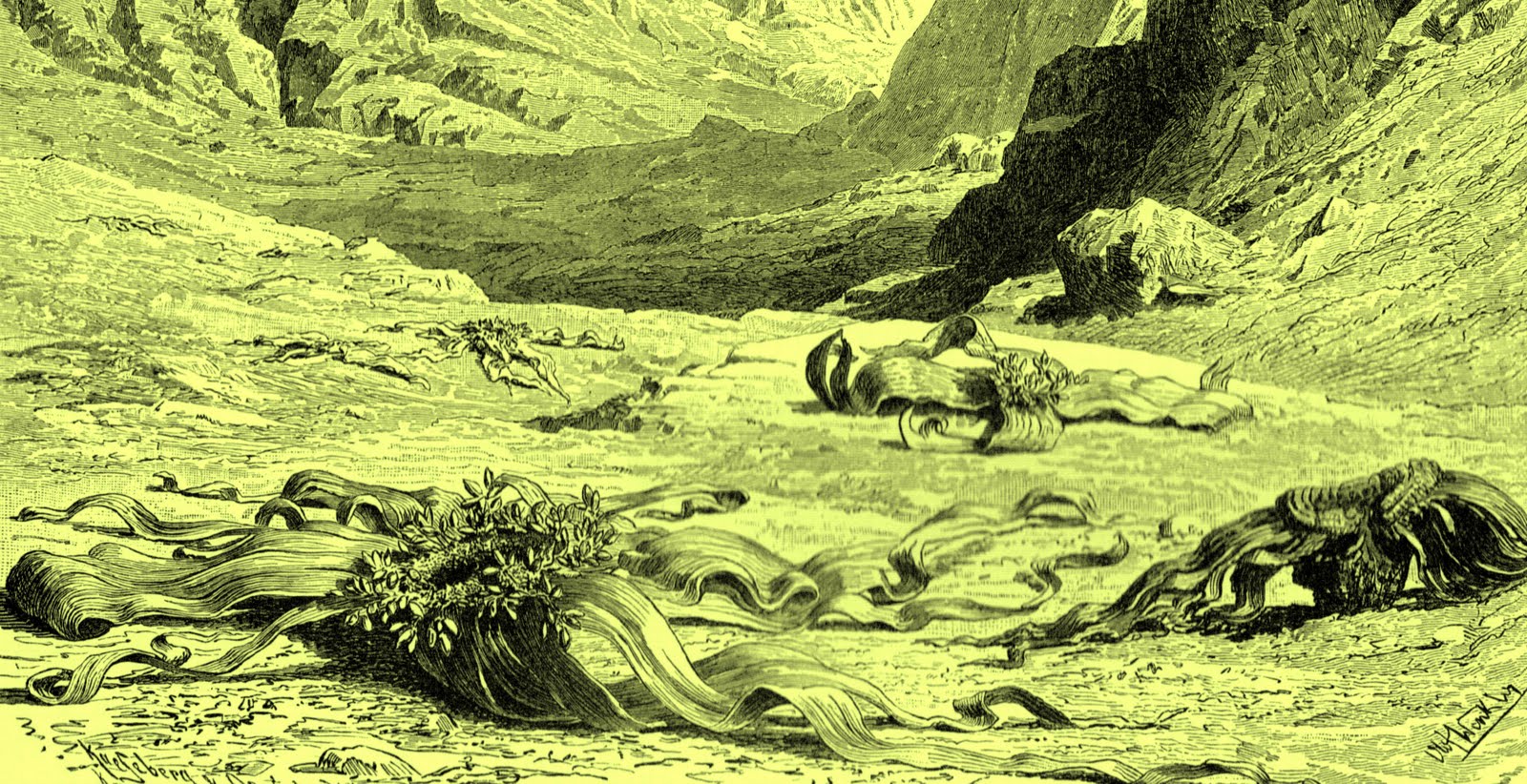
Welwitschia mirabilis engraving


Imagine a cold, barren, ghostly desertland whose fog-enshrouded coastline is littered with the sun-bleached wrecks of beached ships and the skeletons of dead sailors, whose sandy dunes not only move stealthily like stalking lions but also roar like them, whose pebbles unexpectedly split apart to reveal bright jewel-like flowers, whose ancient bizarre trees grow not upwards but lengthwise, extending enormous leathery leaves across the ground like alien ribbons, where elephants surf the sand dunes, and where slinking jackals and menacing hyaenas flit like sinister shadows around a long-abandoned oil rig that time and the elements have transformed into a towering edifice of rust and decay. This eerie, surrealistic vista may seem like the bleak landscape of a disturbed dream, but in fact it is an accurate portrayal of one of the world's most amazing regions - the Skeleton Coast, in southwest Africa.

Stretching over 400 km along the edge of northwestern Namibia and occupying more than 1.6 million hectares in area, the Skeleton Coast is bounded to the north by the Kunene River, to the south by the Ugab River, and is bisected horizontally by the Hoanib River. This remote, inhospitable territory was officially proclaimed a National Park in 1971, and in 1998 travel through it by tourists was formally permitted for the first time. Having said that, access to the northern half is still highly restricted, as this area is designated a natural wilderness, and adjoins Kaokoland, home to the nomadic, traditionalist Himba people. However, the southern half has swiftly become a very popular tourist attraction - for good reason. The Skeleton Coast offers strange, sometimes uncanny sights unique in the world.

Sandwiched between the Atlantic Ocean and the Namib Desert, it is chilled by the Benguela Current, travelling north from the frozen wastelands of Antarctica. Further cooling is provided by a dense night mist, which rolls 80 km or more inland every 10 days or so and condenses into a thick dew - but whose opaque treachery has lured many an unwary maritime vessel to its doom. Bearing silent testimony to this are the numerous disintegrating hulks of wrecked ships, fishing boats, even a downed bomber aircraft, and the whitened skeletons of their dead crew, resting for all eternity amid the sand - which earned this region its memorable name, coined by a local journalist during the 1930s.

Perhaps the most famous of such sights is the rotting fuel tank of the Dunedin Star, a British cargo vessel that was beached here in November 1942, and whose rescue resulted in a tugboat called the Sir Charles Elliott running onto the rocks and a Ventura bomber that dropped supplies subsequently nose-diving into the sea (its engine can still be seen here too). Other victims of the Skeleton Coast down through the years include the Montrose (wrecked here in 1973), the Suiderkus (beached in 1976), the Benguela Eagle (1975), and the steamer Eduard Bohlen (1909), as well as the fishing vessels Winston, Karimona, and Atlantic Pride. And long before any of these set sail, untold numbers of diamond seekers, anxious to gather the sparkling gems littering the sands of this ghostly terrain, paid with their lives when their boats were wrecked here.

Yet had they succeeded in landing safely, diamonds would not have been the only wonders to dazzle their senses. Had they explored the Hoarusib Canyon, for instance, they would have encountered an array of yellow-white, clay-constituting formations that resemble ethereal fairytale castles or weird exotic temples. They would also have marvelled at the 'living, talking' sand dunes known as barchans. Crescent in shape, and created by southwesterly winds in locations where there is little sand, these geological anomalies can travel up to 3 m a year, and as they move, they emit a rumbling basso-profundo roar.

But however spectacular its geological idiosyncrasies may be, they are no more so than its biological surprises. Bearing in mind that the Skeleton Coast embodies a veritable contradiction in terms, comprising a cold desert, it is little wonder that its wildlife is very definitely weird as well as wonderful. Take, for instance, its flowering 'pebbles'.

Look on the ground here, and you may well see what seem at first to be small, round, greyish-white rocks or stones, virtually covered in sand. A closer inspection, however, will reveal that these 'rocks' are actually pairs of succulent leaves - the water-storing leaves of Lithops, an amazing plant aptly dubbed the living stone. Expertly camouflaged, it escapes the attention of herbivorous animals during the dry season, but when the rainy season comes an incredible transformation occurs. Suddenly, the 'stone' seems to split apart - in reality, a stalk has grown up between its two leaves - and a large, bright, daisy-like flower blossoms. All too soon, however, the rainy season ends, the flower dies, and Lithops once more assumes its alter ego, as a pseudo-pebble amid a barren land of real ones.

Even more extraordinary, however, is the living fossil plant exclusive to this outlandish realm. Known formally as Welwitschia mirabilis, this ancient species is technically a conifer tree, but anything less like a tree yet nonetheless a plant would be difficult to imagine. To offset the harsh, inhospitable nature of this region, Welwitschia does not grow vertically to any extent - its trunk rarely exceeds 1 m. Instead, it sends out two enormous leaves that resemble thick leather ribbons, twisting and writhing across the sands, fraying at their edges but never shed and growing up to 5 cm every year, throughout the plant's life - and Welwitschia can live as long as 2000 years!

Never found more than 50 km inland from the Skeleton Coast's shore, Welwitschia utilises numerous tiny rootlets to absorb water stored in stream gravel after storms, and also obtains water from fog, condensing upon its pore-covered leaves. The plant's water and food supplies are all stored in a single massively thick root, up to 3 m long and resembling a gargantuan woody carrot, which anchors it firmly in the desert's soil.

As for its animal life, the Skeleton Coast can and does offer the eco-tourist an unparalleled spectacle of delights. Its mammals include prowling lions, elegant giraffes, burly black rhinoceroses, playful elephants that have been filmed surfing gleefully down the sand dunes, and graceful antelopes such as gemsbok and springbok that frequent the region's gravelly plains alongside stately ostriches. Equally noteworthy are its vivid diversity of waders and waterfowl, its ospreys, flamingos, ghost crabs scuttling sideways over the beaches, nocturnal gecko lizards that obtain water by licking dew off their eyes, and suitably-named headstander beetles that stand on their heads to catch precious drops of condensed fog, which trickle down their wing cases into their gaping mouths.

Perhaps the spookiest sight, however, are the phantoms that lurk in the shadows of a now-derelict oil-drilling rig, sited between the Huab River and the Koichab River. Some of these phantoms periodically take wing, revealing themselves to be cormorants, flying back and forth with fishes in their long beaks. Other, ground-based spectres prove to be jackals and heavily-maned brown hyaenas, scavenging for food. Most eyecatching of all, however, must surely be the Skeleton's Coast enormous breeding colony of Cape fur seals at Cape Cross, said to be the largest such colony in the world, containing 80,000-100,000 seals.

Bleak and barren it may be, but lifeless and dull the Skeleton Coast is certainly not, as testified by the ever-increasing numbers of tourists anxious to explore a land that is like no other on Earth - a land where the ghosts of the past and the wildlife of the present combine to guarantee a plentiful supply of sightseers in the future.