Dr KARL SHUKER

Zoologist, media consultant, and science writer, Dr Karl Shuker is also one of the best known cryptozoologists in the world. He is the author of such seminal works as Mystery Cats of the World (1989), The Lost Ark: New and Rediscovered Animals of the 20th Century (1993; greatly expanded in 2012 as The Encyclopaedia of New and Rediscovered Animals), Dragons: A Natural History (1995), In Search of Prehistoric Survivors (1995), The Unexplained (1996), From Flying Toads To Snakes With Wings (1997), Mysteries of Planet Earth (1999), The Hidden Powers of Animals (2001), The Beasts That Hide From Man (2003), Extraordinary Animals Revisited (2007), Dr Shuker's Casebook (2008), Karl Shuker's Alien Zoo: From the Pages of Fortean Times (2010), Cats of Magic, Mythology, and Mystery (2012), Mirabilis: A Carnival of Cryptozoology and Unnatural History (2013), Dragons in Zoology, Cryptozoology, and Culture (2013), The Menagerie of Marvels (2014), A Manifestation of Monsters (2015), Here's Nessie! (2016), and what is widely considered to be his cryptozoological magnum opus, Still In Search Of Prehistoric Survivors (2016) - plus, very excitingly, his four long-awaited, much-requested ShukerNature blog books (2019-2024).

Dr Karl Shuker's Official Website - http://www.karlshuker.com/index.htm

IMPORTANT: To view a complete, regularly-updated listing of my ShukerNature blog's articles (each one instantly clickable), please click HERE!

IMPORTANT: To view a complete, regularly-updated listing of my published books (each one instantly clickable), please click HERE!

IMPORTANT: To view a complete, regularly-updated listing of my Eclectarium blog's articles (each one instantly clickable), please click HERE!

IMPORTANT: To view a complete, regularly-updated listing of my Starsteeds blog's poetry and other lyrical writings (each one instantly clickable), please click HERE!

IMPORTANT: To view a complete, regularly-updated listing of my Shuker In MovieLand blog's articles (each one instantly clickable), please click HERE!

IMPORTANT: To view a complete, regularly-updated listing of my RebelBikerDude's AI Biker Art blog's thematic text & picture galleries (each one instantly clickable), please click HERE!

Search This Blog


PLEASE COME IN, I'VE BEEN EXPECTING YOU...

PLEASE COME IN, I'VE BEEN EXPECTING YOU...
WELCOME TO SHUKERNATURE - ENJOY YOUR VISIT - BEWARE OF THE RAPTOR!


Showing posts with label sea monsters. Show all posts

Tuesday, 20 August 2024

HIDING FROM THE HIDE? EERIE DEEPSEA ENCOUNTERS WITH ABYSSAL ABOMINATIONS

 
A photo-still from Encounter In The Abyss by Richard Svensson, depicting the nameless horror from the underwater abyss about to encapsulate the stricken shark while the terrified diver stood motionless, on a ledge at the abyss's edge, watching in petrified fascination  (© Richard Svensson)

The decidedly creepy cryptozoological report of a deadly underwater mystery beast documented by me here today is one of my all-time personal favourites, which I've included in several of my books and articles down through the years, and also previously on ShukerNature (click here). Now, thanks to a wonderful new animated short that brings the eerie encounter vividly to life for the very first time (full details at the end of the present blog article), I decided that it was time to revisit this terrifying denizen of a deepwater abyss and provide some additional information, so here it is.

In 1953, while testing a new type of deep-sea diving suit in the South Pacific, an Australian diver named Christopher Loeb encountered a Lovecraftian horror from the ocean’s unpenetrated depths. In my book From Flying Toads To Snakes With Wings (1997) and also in my previous ShukerNature coverage of it, I provided a much-abbreviated paraphrased version of Loeb's report, but here now is his full first-person account, as originally provided by Eric Frank Russell in his own book Great World Mysteries (1967:

All the way down I was followed by a fifteen foot shark which circled around full of curiosity but made no attempt to attack. I kept wondering how far down he would go. He was still hanging around some thirty feet from me, and about twenty feet higher, when I reached a ledge below which was a great, black chasm of enormous depth. It being dangerous to venture farther, I stood looking into the chasm while the shark waited for my next move.

Suddenly the water became distinctly colder. While the temperature continued to drop with surprising rapidity, I saw a black mass rising from the darkness of the chasm. It floated upwards very slowly. As at last light reached it I could see that it was of dull brown colour and tremendous size, a flat ragged edged thing about one acre in extent. It pulsated sluggishly and I knew that it was alive despite its lack of visible limbs or eyes. Still pulsating, this frightful vision floated past my level, by which time the coldness had become most intense. The shark now hung completely motionless, paralyzed either by cold or fear. While I watched fascinated, the enormous brown thing reached the shark, contacted him with its upper surface. The shark gave a convulsive shiver and was drawn unresisting into the substance of the monster.

I stood perfectly still, not daring to move, while the brown thing sank back into the chasm as slowly as it had emerged. Darkness swallowed it and the water started to regain some warmth. God knows what this thing was, but I had no doubt that it had been born of the primeval slime countless fathoms below.

Moreover, this may not be a unique report, for as revealed here by the online Encyclopaedia of Cryptozoology website:

According to Russian sources, at least two other sightings of the amorphous sea monster have been reported in local newspapers. Members of a Chilean hydrographic expedition to the South Pacific in 1968 told the press that they had seen an animal which resembled the Australian diver's "black mass," near an abyssal trench. A fatal encounter with such an animal allegedly occurred off Thailand in 2005, when a French scuba diver named Henri Astor told the press that he had observed a very large "strange brown mass" paralysing and killing a shoal of fish. Astor's unnamed companion allegedly disappeared after attempting to follow the entity.

 
Cirrothauma murrayi, a species of deepsea cirrate octopus (public domain)

In the past, a deepsea octopus has been offered as a possible identity for this disturbing creature, but as I discussed in detail within my book, a far more satisfactory candidate is a deepsea jellyfish, possibly akin to one of the known relatively shapeless types, such as Deepstaria enigmatica, which moves via peristalsis and lacks tentacles. This bizarre species remained undescribed by science until 1967, following its discovery by the famous French oceanographer Jacques Cousteau while exploring the deep waters of the central Pacific Ocean near Southwest Baker Island in a submarine called Deepstar 4000. It is known from the Pacific Ocean, Antarctica, and the Gulf of Mexico, but only at depths below 3,000 ft. Please click here and here to watch on YouTube a couple of short videos of this strange species filmed in its natual habitat.

Whereas all octopuses have tentacles, some deepsea jellyfishes do not. What they do have, however, are potent stinging cells called nematocysts on their bodies (and tentacles if they possess any), armed with venom that swiftly paralyses their prey. This would readily explain the immediate paralysis of the shark. Moreover, jellyfishes do not possess true eyes but they are equipped with sensory structures responsive to water movements. Consequently, the creature would have learnt of the shark’s presence by detecting its movements in the water. How lucky, then, that the diver had remained stationary!

 
Artistic representation of el cuero, the deadly Chilean hide (© Tim Morris)

Interestingly, Chilean legends tell of a very similar beast called el cuero or the hide, as it is likened in shape and size to a cowhide stretched out flat, with countless eyes around its perimeter, and four larger ones in the centre. As it happens, jellyfishes possess peripheral sensory organs called rhopalia that incorporate simple light-sensitive eyespots or ocelli.

Moreover, some jellyfishes also have four larger, deceptively eye-like organs visible at the centre of their bell. In reality, however, these organs are not eyes at all. Instead, they are actually portions of the jellyfishes' gut, known as gastric pouches, with the jellyfishes' horseshoe-shaped gonads sited directly underneath these pouches and also very visible (as in the familiar moon jellyfish Aurelia aurita).

 
Moon jellyfishes Aurelia aurita (© Tila Monto/Wikipedia – CC BY-SA 3.0 licence)

So perhaps the deadly hide is more than a myth after all, lurking like so many other maritime horrors reported down through the ages in the deep oceans' impenetrable black abyss, but only very rarely encountered by humankind – which in view of the dreadful fate that befell the hapless South Pacific shark in 1953 may be just as well!

And now, as noted above, this chilling cryptozoological vignette has been brought to vivid life by longstanding friend and awesome Swedish animator Richard Svensson, aka The Lone Animator, in a wonderful 3-minute mini-movie entitled Encounter In The Abyss, and available to watch for free on YouTube since 8 August 2024 – just click here. Don't miss it!

 
Thumbnail image on YouTube for Encounter In The Abyss by Richard Svensson (© Richard Svensson)


Friday, 30 June 2023

HAGGLING OVER THE HAFGUFA

 
The hafgufa, as depicted in a medieval manuscript, namely the British Library MS. Harley 3244, fol. 65r, 1236, c.1250, (public domain)

The hafgufa is a mysterious sea monster described in Konungs skuggsjá ('The King's Mirror'), which is a mid-13th-Century Old Norse manuscripts – but that is not all. It has actually been traced back as far as an account in a 2nd-Century-AD text from Alexandria, Egypt, entitled Physiologus, whose text is accompanied by illustrations of a whale-like creature termed the aspidochelone, depicted with its huge mouth wide open and fishes jumping into it.

According to The King's Mirror:

It is said of the nature of this fish [the hafgufa] that, when it goes to feed, it gives a great belch out of its throat, along with which comes a great deal of food. All sorts of nearby fish gather, both small and large, seeking there to acquire food and good sustenance. But the big fish keeps its mouth open for a time, no more or less wide than a large sound or fjord, and unknowing and unheeding, the fish rush in in their numbers. And when its belly and mouth are full, [it] closes its mouth, thus catching and hiding inside it all the prey that had come seeking food”

The hafgufa is also mentioned in various other Norse manuscripts from this same period. Moreover, a similar description for the aspidochelone is given as follows in Physiologus:

When it is hungry it opens its mouth and exhales a certain kind of good-smelling odor from its mouth, the smell of which, once the smaller fish have perceived it, they gather themselves in its mouth. But when his mouth is filled with diverse little fish, he suddenly closes his mouth and swallows them.

In the scientific age, there has been much speculation and dispute as to whether the hafgufa was based upon a real creature, and, if so, what that creature might be, with the consensus being that it was probably some kraken-like monster.

 
An aspidochelone from a French manuscript, c.1270, held at the J. Paul Getty Museum (public domain)

Now, however, this maritime mystery beast's true nature may at last have been revealed, thanks to the publicising of a remarkable mode of feeding behaviour practised by various rorqual whales.

Known as trap feeding and first scientifically recorded in 2010, various humpback whales Megaptera novaeangliae and Bryde's whales Balaenoptera brydei have been observed waiting motionless at the water surface in an upright position with their huge mouths wide open, into which shoals of fishes unsuspectingly swim to their doom, fatally mistaking the whales' gaping jaws for shelter, until the jaws close, engulfing them!

Moreover, this eyecatching activity has lately attracted worldwide attention thanks to an Instagram video clip of a Bryde's whale performing it that went vital after featuring in a 2021 BBC wildlife documentary (click here to view this clip).

According to the Norse manuscripts, as noted above, the hafgufa behaves in a similar manner, even actively attracting shoals of fishes to swim into its open mouth by emitting a specific perfume. And sure enough, when seeking to lure fishes into their mouths by regurgitating food, both the humpback and Bryde's whales produce a distinct smell.

A detailed study examining and comparing medieval Norse accounts of the hafgufa with modern-day reports of trap feeding by rorquals was published on 28 February 2023 in the journal Marine Mammal Science (click here to read it). The paper was co-authored by maritime archaeologist John McCarthy, from the College of Humanities, Arts and Social Sciences at Flinders University in Australia, who had become interested in this correlation after reading about the hafgufa in traditional Norse mythology.

Once again, therefore, it seems likely that an ostensibly fabulous monster of mythology can lay claim to a firm basis in mainstream zoological fact after all.

 
Another illustration of the hafgufa, this time from Ortelius's 1658 map of Iceland (public domain)
 

Friday, 9 June 2023

AN 'ELL OF AN EEL?

 
Just how big can moray eels get? A vintage illustration of the Mediterranean moray (aka Roman eel) Muraena helena (public domain)

Extra-large, even giant-sized, eels are frequently cited as potential identities for all manner of freshwater and maritime monsters around the world, including Britain's very own Nessie. Down through the years, I've documented a fair few of these reports, from such disparate, far-flung locations as North America, New Zealand, and the Mascarene Islands. Now, another location, Vietnam, can apparently be added to that list.

Longstanding Loch Ness Monster researcher Steve Feltham hosts a very interesting and informative public Facebook group entitled 'Steve Feltham, Nessie Hunter, Interactive Collective', which acts as a forum for sharing relevant information relevant to this pre-eminent cryptid. On 13 October 2022, group member Mike Gavan from New Zealand posted the following fascinating account of what may have been a truly gigantic eel encountered underwater off Vietnam by one of his friends:

I’ve just had a visit from an older friend of mine, Tim.

Tim was a deep sea diver in the 1970s, working from a bell at an average depth of 200 m [656 ft], his work was in the area of undersea recovery, maintenance for the oil industry world wide.

Around 1974, Tim was diving on a recovery job at 220 m [722 ft] off the coast of Nha Trang, Vietnam.

His job was to recover a length of special purpose ducting that had been lost overboard, he was to locate it, tie it and await a winch.

About 10 minutes into his dive from the bell Tim saw what he believed was part of the ducting and proceeded towards it, [but] as he got close enough to touch it he realised that it was not ducting!

"It was soft and felt like an eel or fish, the girth was around 6 ft, when I did actually touch it a large head looking like a snake or reptile appeared in my lamps, I contacted the top and asked if they were seeing what I was seeing as I had a camera attached to my dive suit, yes was the reply. ”Go to the bell now Tim, repeat, go to the bell now!” was their reply, I estimated the creature to be over 100ft, possibly 120-130 ft in length, I turned and headed bell asap, which wasn’t quickly due to my dive suit and gear, it was terrifying and I never looked back, I’ve seen giant sharks, strange lights etc but that snake thing was the weirdest thing I ever saw in my tenure as a deep sea diver!"

Tim is now 78 years old, honest and trustworthy & also sound of mind.

He lives on a back country farm of 4000 acres in solitude now.

This was relayed to me literally 2 hours ago.

The creature that immediately came to mind when I read this report was a moray eel or muraenid, of which there are over 200 species found in tropical and temperate waters worldwide, often in coastal regions, and are famously serpentine in appearance. However, the longest known species, the slender giant moray Strophidion sathete, is 'only' up to 13 ft long, a far cry indeed from the immense length cited by eyewitness Tim for the elongate entity that he allegedly encountered at very close range (and even allowing for possibly a sizeable degree of over-estimation on Tim's part due to the extreme shock and fear that he'd clearly experienced).

But could there be exceptional individuals far greater in size than any recorded by science existing incognito in our oceans, their huge dimensions buoyed by their liquid environment? If so, they would indeed be veritable monsters. I wonder what happened to the film that Tim's camera recorded of this creature, as viewed by his above-surface team? That would certainly be well worth a watch!

 
A vivid illustration from 1801 of Gymnothorax favagineus, the aptly-named leopard moray eel (public domain)
 

Tuesday, 2 August 2022

A FIFTH TRUNKO IMAGE EMERGES, ALMOST 100 YEARS AFTER TRUNKO ITSELF DID!

 
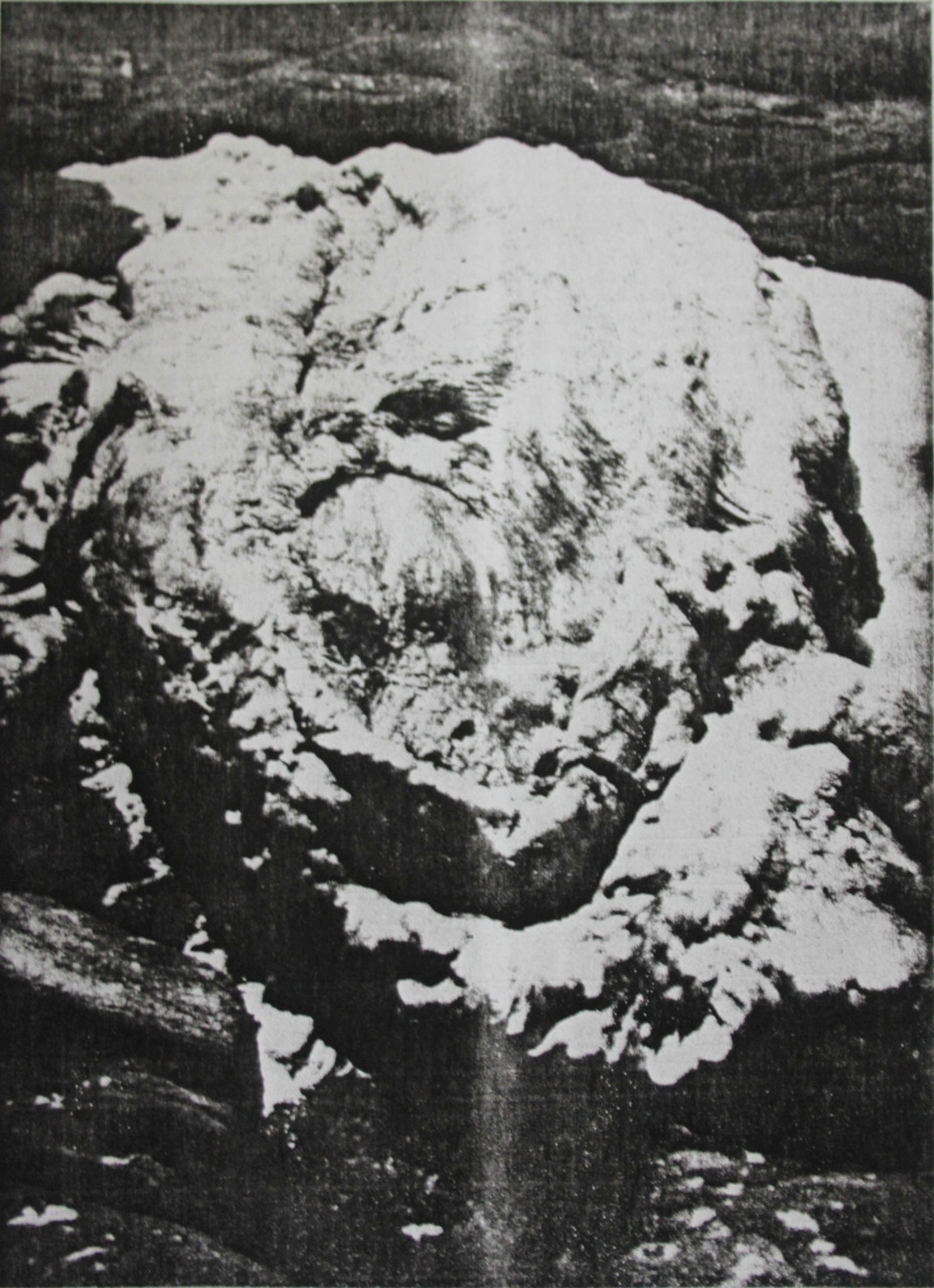
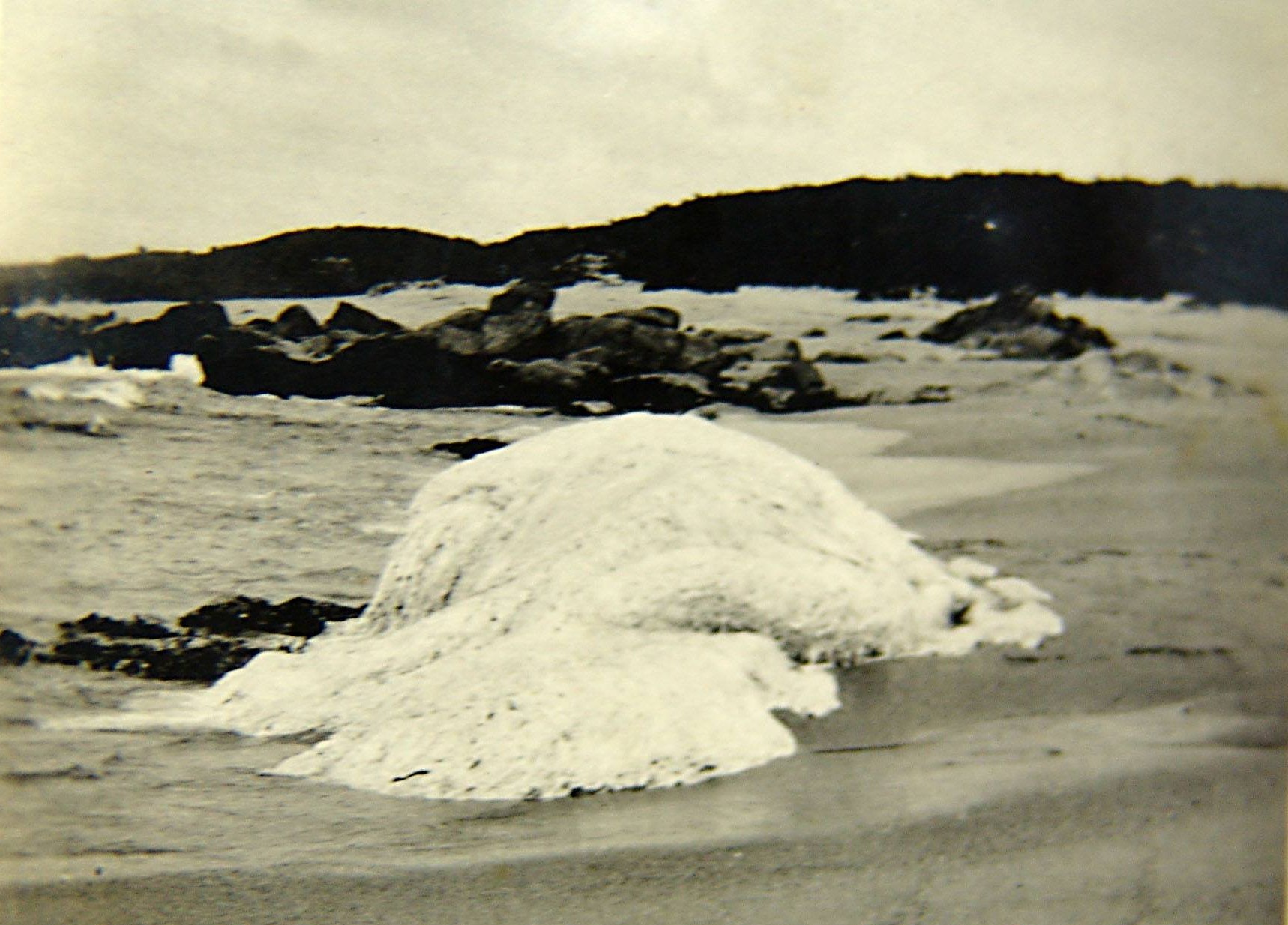
Higher-resolution close-up version of the fifth Trunko photograph to be made known to cryptozoologists (© owner unknown, but image dates from early 1920s, so now likely to be in public domain – reproduced here on a strictly non-commercial Fair Use basis for educational/review purposes only)

As ShukerNature readers will no doubt already know, Trunko is the name that within my 1996 book The Unexplained I light-heartedly coined (but which to my great surprise duly became globally accepted) for the hitherto nameless yet very enigmatic 'sea monster' carcase washed ashore on a beach at the coastal town of Margate, in what is now Kwa-Zulu Natal, South Africa, during November 1924 (or 1922, according to certain dubious claims), and characterised by its coating of snow-white 'fur' plus a long elephantine trunk-like projection.

Sadly, no tissue samples were taken from this strange specimen for formal scientific analysis before it was washed back out to sea and lost forever; nor, seemingly, were any photographs snapped of it. Consequently, Trunko appeared destined to remain perpetually unidentified, eternally unexplained, but nonetheless inspiring all manner of highly imaginative but often extremely eyecatching artistic representations of what it may have looked like in life – bizarre hairy marine pachyderms bearing no resemblance to anything ever known to have existed on Earth.

 
William Asmussen's vibrant representation of a living Trunko battling two killer whales, inspired by various eyewitness claims back in early 1920s (© William Asmussen)

Almost 90 years later, however, in September 2010, German cryptozoological co-researcher Markus Hemmler and I were very startled but delighted to discover no fewer than three Trunko photos, which had been snapped by a Mr A.K. Jones while this curious carcase had lain ashore.

One was featured on the Margate Business Association (MBA) website, the other two had been published in a Wide World Magazine article way back in August 1925 (click here and here to read my two world-exclusive ShukerNature articles that documented these extraordinary discoveries immediately after they had been made).

 
A.K. Jones's Trunko photograph that had appeared on the MBA website (originally © A.K. Jones, but image dates from early 1920s, so now likely to be in public domain – reproduced here on a strictly non-commercial Fair Use basis for educational/review purposes only)

Yet until now, all three had remained entirely unknown to the cryptozoological community.

Moreover, these photos were of sufficiently good quality for me to be able to recognise that this entity was a globster, i.e. a decomposed whale carcase from which the skeletal contents have fallen away, leaving behind a thick gelatinous matrix of collagen protein, still encased inside the whale's skin sac of rotting blubber, with the carcase's famous 'trunk' most likely an enclosed rib covered in fibrous tissue, and the carcase's white 'fur' being exposed connective tissue fibres.

 
A.K. Jones's two Trunko photograph that had appeared on the Wide World Magazine article of August 1925 (originally © A.K. Jones, but images date from early 1920s, so now likely to be in public domain – reproduced here on a strictly non-commercial Fair Use basis for educational/review purposes only)

After more than 80 years, the mystery of Trunko had finally been solved (for full details, see my extensive May 2011 Fortean Times article – the most comprehensive coverage of Trunko's convoluted history ever published, and subsequently republished in ShukerNature Book 1). But that was not all.

In March 2011, I learnt from Markus that a fourth Trunko photograph had been discovered, by Margate-based South African artist and Trunko researcher Bianca Baldi, in the archives of Margate Museum, which showed an amorphous blob that again confirmed Trunko's identity as a globster (click here to read my ShukerNature account of this dramatic find).

 
The fourth Trunko photograph (© owner unknown, but image dates from early 1920s, so now likely to be in public domain – reproduced here on a strictly non-commercial Fair Use basis for educational/review purposes only)

And now, most recently of all, on 19 April 2022 and courtesy yet again of the indefatigable Markus, I was made aware of a fifth Trunko photo. As with the previous quartet, it had been hiding in plain public sight for quite a while.

Markus had discovered that on 4 March 2015, Margate businessman Lencel Celliers had posted in a Facebook group entitled 'MARGATE, Natal, South Africa – NOSTALGIA', a clickable link to a then-online album of vintage Margate-based photographs on the website of a South African news/Information channel called eHowzit that included two Trunko photographs. One of these is the Jones image that had appeared on the MBA website, but the other is entirely new to cryptozoologists.

 
Lower-resolution full version of the fifth Trunko photograph to be made known to cryptozoologists (© owner unknown, but image dates from early 1920s, so now likely to be in public domain – reproduced here on a strictly non-commercial Fair Use basis for educational/review purposes only)

The album provided no details concerning who had snapped this latter photo (it is reproduced here, at the opening to this present ShukerNature article, on a strictly non-commercial Fair Use basis for educational/review purposes only). As can be seen, it depicts the by-now familiar Trunko form of a huge white globster, but, interestingly, it shows a large fan-shaped projection from the carcase that was not visible in previous Trunko photos but which may explain various previously-mystifying claims by some original Trunko eyewitnesses that the carcase had possessed a lobster-like 'tail' (lobster tails are indeed fan-shaped). In addition, the specific location depicted in this photo, where Trunko was stranded, is revealed to have been the principal Margate beach at Tragedy Bay.

Markus subsequently contacted Mr Celliers on FB for more information regarding this highly significant photo, and Celliers replied that he had obtained both of them from the Margate Museum "when it was still in existence in 2000". (He also provided a link to a Margate-themed YouTube video produced by him and uploaded on 21 July 2012 that includes these same two Trunko pictures – click here to view it.) Presently unable to identify with certainty which establishment Celliers was alluding to, however, Markus speculates that it may in fact be the Margate Art Museum, but if so, it is still in existence today.

 
Modern-day view of Margate's principal beach; click picture to enlarge for viewing purposes (© T866/Wikipedia – CC BY-SA 4.0 licence)

Consequently, Markus has now contacted this museum in the hope that it is indeed the correct one and can therefore provide some information concerning this fifth Trunko image.

My sincere thanks as always to Markus Hemmler for so kindly bringing this latest unearthed Trunko photo to my attention and for sharing with me his information concerning it.

 
My ShukerNature Book 1, whose front cover illustration includes a delightful rendition by artist Anthony Wallis of what Trunko might have looked like had it indeed been an exotic species unknown to science – ah, if only… (© Dr Karl Shuker/Anthony Wallis/Coachwhip Publications)


Saturday, 24 July 2021

KOCH'S MONSTROUS MISSOURIUM AND HORRID HYDRARCHOS - A PHENOMENAL PAIR OF FOSSILISED FRAUDS. Part 2: HYDRARCHOS, THE FAKE SEA SERPENT THAT MADE A SILLY MAN OUT OF SILLIMAN

 
Albert C. Koch's Hydrarchos (aka Hydrargos) – a classic engraving from a German journal, 1846, colourised (public domain)

As recently revealed in Part 1 of this 2-part ShukerNature blog article (click here to access it), the self-styled 'Dr' Albert C. Koch (in reality, he did not possess a doctorate) was one of many 19th-Century Phineas T. Barnum emulators at large in the USA, establishing dime museums filled with a riotous assemblage of factual and phoney specimens from the living and non-living worlds, and, if sufficiently successful, organising nationwide and sometimes even international tours displaying their most famous and fantastic exhibits. In the case of Koch, who was not merely an entrepreneur of this dubious variety but also a passionate amateur palaeontologist and fossil collector, after opening during 1836 one such museum in St Louis, Missouri, he successfully excavated a mastodon skeleton in Missouri's Benton County four years later, but that was far from all.

Once Koch had not only assembled this skeleton but also surreptitiously made it much bigger than it actually was by adding extra vertebrae and other bones to it from additional mastodon remains, he dubbed his monstrous multi-mastodon the Missourium, and audaciously claimed that it was nothing less than the fossilised remains of the biblical reptilian sea monster Leviathan. Moreover, after making this phoney mega-beast the central exhibit at his museum for a year, Koch decided in 1841 to sell his museum and go on tour with the Missourium. This he did, but after receiving a very lucrative offer for it from the world-famous palaeontologist Prof. Sir Richard Owen of London's British Museum in 1843 (who readily recognised that the Missourium was a fraudulent composite, not a single creature, but could also see that if dismantled, a complete genuine mastodon skeleton could be reassembled from its components), he promptly sold it to Owen.

 
Koch's monstrous Missourium, depicted in this 19th-Century engraving towering over an Asian elephant! (public domain)

However, this meant that Koch now needed a new, equally – if not even more – spectacular exhibit to tour with and earn him further money by drawing in the crowds of visitors anxious to cast their credulous eyes upon it. So, what did he do? He created not one but two gargantuan fossil sea serpents, bigger than any fossil creature ever recorded at that time!

In 1845, an immense skeleton that Koch had recently unearthed in Alabama, and which he claimed to be the near-complete fossilised remains of a prehistoric reptilian sea serpent, was exhibited by him in assembled form, mounted on stilts, in the Apollo Saloon's rooms on New York City’s Broadway.

 
Advertisement for the very first public exhibition of Hydrarchos (public domain)

Measuring at least 114 ft long (but see Koch's own inflated claim below), it consisted of a skull (including a pair of lengthy, tooth-brimming jaws), an exceedingly long, sinuous vertebral column that featured a lengthy curved neck held upright and an even longer horizontally-curved tail, some ribs in the creature's thoracic region, and parts of supposed paddle limbs, He charged interested spectators in America 25 cents to observe his antediluvian marvel, and 1 shilling to spectators in England once he began touring overseas with it.

Despite this specimen looking totally unlike his Missourium, Koch bizarrely stated that it too was the biblical Leviathan! And according to one broadsheet advertisement for its appearance at Niblo's Garden in New York City, he also claimed that when alive it must have measured 30 ft in circumference, and weighed at least 7,500 lb (I've seen one incredible claim that it weighed an outrageous 40,000 lb!).

 
A second classic engraving of Hydrarchos from a German journal, 1846, colourised (public domain)

As with the Missourium, Koch soon prepared a short booklet fully documenting his new reptilian revelation, which was published in 1845. Like before, it sported an unnecessarily lengthy, albeit informative title: Description of the Hydrarchos Harlani (Koch): A Gigantic Fossil Reptile: Lately Discovered by the Author, in the State of Alabama, March 1845 [I've omitted the remainder of its title, which stretched to a further 32 words!]. In it, he introduced his description of the Hydrarchos with the following emphatic pronouncement and dramatic dimensions:

This relic is without exception the largest of all fossil skeletons, found either in the old or new world. Its length being upwards of one hundred and fourteen feet, without estimating any space for the cartilage between the bones, and must, when alive, have measured over one hundred and forty feet, and its circumference probably exceeded thirty feet, reminding us most strikingly, of the various statements made by persons, in regard to having seen large serpents in different parts of the ocean, which were known by the name of Sea Serpents.

 
Reconstruction of Hydrarchos in life, based upon Koch's claims (© Tim Morris)

As with his Missourium booklet, Koch then went on to provide a lengthy, extremely detailed description containing all manner of unfounded conjectures and suppositions regarding the possible lifestyle and appearance in life of the Hydrarchos (such as sunbathing in rivers; possessing an extremely long neck that it held upwards in an arching curve like a swan to spy unwary prey walking upon the adjoining shore that it could then seize; and cannibalistically devouring younger specimens of its own kind). Ironically, conversely, he also included some accurate accounts of its genuine mammalian characteristics, such as its double-rooted teeth, even at times comparing it directly and favourably with cetaceans (of which Basilosaurus was of course one – see a little later here for Basilosaurus details), only for him then to dismiss them in favour of a reptilian identity for it!

Again as with his Missourium, Koch had given this elongate entity a formal scientific name, which was originally Hydrargos sillimanii, honouring eminent Yale College (now University) naturalist Prof. Benjamin Silliman (1779-1864), who believed in the existence of sea serpents, and had written a fulsome letter of 2 September 1845 to the editors of the New York Express newspaper authenticating Koch's Hydrargos.

 
Prof. Benjamin Silliman (public domain)

Here is what he wrote:

The Skeleton having been found entire, inclosed in limestone, evidently belonged to one individual, and there is the fullest ground for its genuineness. The animal was marine and carnivorous, and at his death was imbedded in that ancient sea where Alabama now is; having myself recently passed 400 miles down the Alabama river, and touched at many places, I have had full opportunity to observe, what many Geologists have affirmed, the marine and oceanic character of the country.

Most observers will probably be struck with the snake-like appearance of the skeleton. It differs, however, most essentially, from any existing or fossil serpent, although it may countenance the popular (and I believe well founded) impression of the existence, in our modern seas, of huge animals, to which the name of sea serpent has been attached.

 
A lesser-known Hydrarchos engraving, from 1845 (public domain)

Notwithstanding Silliman's misplaced faith in its authenticity, however, the true identity – or identities – of Koch's Hydrargos ultimately came to light when one of its numerous visitors, esteemed American anatomist Prof. Jeffries Wyman (1814-1874), exposed two major problems with it.

Firstly, its teeth and bones were mammalian, not reptilian, originating from a prehistoric form of very lengthy whale known as Basilosaurus (its reptilian-sounding moniker derives from the fact that when first named by zoologist Dr Richard Harlan (1796-1843), it was mistakenly assumed by him to have been a reptile). Secondly, just like the Missourium, its spinal column was composed of vertebrae obtained from more than one individual specimen (possibly as many as six, in fact, and procured by Koch from several different Alabama locations too), thereby explaining this creature's gigantic size. Indeed, as Basilosaurus attained a total length of 'only' 70 ft or so, Koch's 114-ft Hydrargos was larger than life in every sense!

 
A model of Basilosaurus (© Markus Bühler)

Once this became known, with the horrid Hydrargos, courtesy of Koch, having duly made a silly man out of Silliman, the latter highly-embarrassed scientist demanded that his name be removed forthwith from the binomial with which Koch had christened his bogus beast. Yet seemingly unfazed by its public unmasking as a fake, Koch simply gave his charlatan sea serpent a new binomial and continued exhibiting it on tour undeterred.

It was now known as Hydrarchos harlani, or simply the Hydrarchos colloquially, its new genus being only a slight modification of the old one, and its new species name, harlani, honouring another scientist. This time it was none other than the afore-mentioned Dr Richard Harlan, who had examined the very first known fossil vertebra of Basilosaurus and had given this archaic whale its misleadingly reptilian genus name in 1835. Moreover, being deceased by now, Harlan was in no position to challenge Koch's usage of his name when rechristening his spoof sea serpent.

 
Mounted Basilosaurus skeleton at Nantes Natural History Museum (© François de Dijon/Wikipedia – CC BY-SA 4.0 licence)

In 1848, English palaeontologist Dr Gideon A. Mantell (1790-1852) wrote an excoriating letter to the Illustrated London News denouncing both Koch and his lithic Leviathan, and fully explaining the latter's true nature as a composite Basilosaurus. At much the same time, however, Koch had sold it to Prussia's King Friedrich Wilhelm IV for a lifelong annual pension, so I doubt that Mantell's criticism unduly disturbed him.

In any case, once he had sold his original Hydrarchos specimen, Koch had returned to Alabama and unearthed a second Basilosaurus skeleton in February 1848. From this and other remains, he duly constructed a second Hydrarchos specimen, this one measuring 96 ft long, and then began touring in Europe all over again.

 
Hydrarchos advertisement flyer, 1840s (public domain)

Meanwhile, the new, royal owner of what had previously been Koch's original Hydrarchos gave it to Johannes Müller at Berlin's Royal Anatomical Museum, who, knowing of its true nature, arranged for it to be dismantled, with its components officially relabelled as Basilosaurus remains. Some of these were subsequently sold during the 1850s t0 the Teyler Museum in Haarlem, the Netherlands, via the fossil auction house Krantz, based in Bonn, Germany (but without their origin in Koch's Hydrarchos being revealed!).

Various other remains from it were donated by Müller to Berlin's Museum für Naturkunde. However, the vast majority were long thought to have been destroyed during World War II, but according to recent ongoing investigations this may not have been the case.

 
Hydrarchos as portrayed in Koch's own diary (public domain)

As for Koch's second Hydrarchos: when he finally tired of touring, Koch sold it to the new owner of his erstwhile St Louis museum, who in turn later sold it to a similar establishment in Chicago, Illinois. This was a mini-emporium packed full of curiosities and real specimens intermingled with fake ones, which was owned by Colonel E.L. Wood and duly known as Colonel Wood's Museum.

Here the Hydrarchos was soberly labelled as a specimen of Zeuglodon (a junior synonym of Basilosaurus), rather than as any legendary Leviathan or suchlike. Tragically, however, the entire museum and its contents were destroyed during the great fire that devastated Chicago in 1871.

 
The nemeses of Hydrarchos – Prof. Jeffries Wyman (left) and Dr Gideon A. Mantell (right) (both public domain)

An inevitable result of his escapades with the Missourium and the two Hydrargos/Hydrarchos specimens was that Koch's name became synonymous with fraud, and by the time of his death in 1867 all claims and finds made by him were routinely dismissed as unreliable by the scientific community. This trend continued for many decades, but based upon some intriguing, corroborating finds in later years by reputable researchers, a number of scientists have reassessed Koch's claims and now believe that some of them, especially ones relating to various human artefacts allegedly found by him in association with fossil mastodons and ground sloths in North America, may have been valid after all.

Even so, it seems highly unlikely that Koch will ever be fully rehabilitated by mainstream science. Thanks to his faked fossil exhibits, he may have acquired fame and fortune, but at the same time he lost the opportunity for scientific recognition that he had always craved – and which he might well have achieved, if only he had presented his notable finds of mastodon and Basilosaurus skeletons in a straightforward, honest manner, rather than wilfully distorting and misrepresenting their nature for purely lucrative, non-scientific purposes. Instead, his name seems forever destined to be irrevocably associated with hoax and fraud.

 
 Above: The section of John J. Egan's enormous painting 'Panorama of the Monumental Grandeur of the Mississippi Plain' that contains the white-trousered figure believed by some researchers to be Albert C. Koch, shown gesticulating towards some fossilised ground sloth remains (public domain); Below: an engraving of a fossil ground sloth skeleton whose corresponding form readily confirms the taxonomic identity of the remains in Egan's painting (public domain)

Finally: It is nothing if not curious that images of Albert C. Koch himself are exceedingly elusive, as I discovered when preparing this 2-part ShukerNature blog article. However, some researchers have claimed that Koch is the figure who is depicted wearing white trousers, and gesticulating towards some newly-unearthed fossil ground sloth remains (a feat that he did indeed accomplish in 1838), within one section of the enormous 348-ft-long painting 'Panorama of the Monumental Grandeur of the Mississippi Plain', which was produced by artist John J Egan in 1850.

Incidentally, some online commentators regarding this painting, and no doubt influenced by Koch's mastodon excavations, have misidentified the beast remains being gesticulated at in it as those of a mastodon. In reality, however, they are unequivocally from a ground sloth, whose skeleton is visibly very different from that of any mastodon.

 
Close-up of the section of Egan's painting containing the figure believed by some to be Koch (public domain)