Spectacular painting of the mokele-mbembe (William Rebsamen)
Time for another ShukerNature Top Ten!
Today, the only known living dinosaurs are of the avian variety – birds. However, the chronicles of cryptozoology are bulging with reports of mystery beasts that have been likened or potentially identified with other, supposedly long-vanished dinosaur forms. Here, then, in no particular order is my personal Top Ten of putative living dinosaurs of the non-avian, cryptozoological kind.
THE MOKELE-MBEMBE – A CONGOLESE WATER DRAGON, OR A DINOSAUR OF THE ISHTAR GATE?
According to the resident pygmies here, the vast, remote, and virtually inaccessible Likouala swamplands of the People's Republic of the Congo (formerly the French Congo) are home to a 27-ft-long amphibious 'water dragon' known as the mokele-mbembe ('one that capsizes boats'). They describe it as reddish-brown in colour, with a small head but very long neck and tail, an elephantine body, four sturdy limbs that leave behind large three-clawed footprints, and an appetite for the Landolphia gourds, which it browses upon like a reptilian giraffe, sometimes while still partly submerged in water. It is most frequently sighted by the native people in or near a very large body of freshwater known as Lake Tele.
The mokele-mbembe has been sought unsuccessfully by a number of Western expeditions since the 1980s, its most famous and tenacious seekers being now-retired Chicago University biochemist and spare-time cryptozoologist Dr Roy Mackal, and Scottish field cryptozoologist Bill Gibbons (via two Operation Congo expeditons and who has also sought similar beasts in Cameroon). Of particular interest is that when a range of animal images have been shown to the natives in an attempt to gain more information concerning the mokele-mbembe's appearance in the hope of identifying it, the images consistently claimed by alleged eyewitnesses to be closest to it have been ones depicting sauropod dinosaurs from prehistory, such as Diplodocus and Apatosaurus (formerly called Brontosaurus).
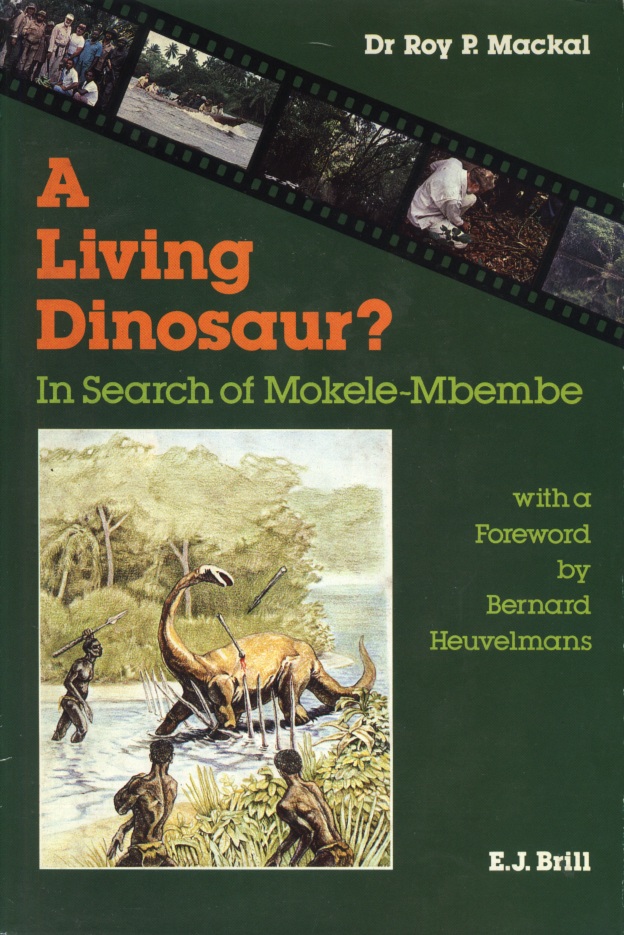
Roy Mackal's book documenting the mokele-mbembe and other Congolese 'neo-dinosaurs' (Dr Roy Mackal/E.J. Brill)
Indeed, Mackal and Gibbons both consider a species of living, modern-day sauropod, surviving undisturbed in the Likouala's secluded and relatively inaccessible, inhospitable terrain, to be a plausible identity for this elusive creature. Another popular suggestion is that it may be a very large monitor lizard with an exceptionally long, elongated neck, but no such form of monitor is known from either the present day or the fossil record. And whereas monitors are almost exclusively carnivorous, the mokele-mbembe is entirely herbivorous.
Adding veracity to its eyewitnesses' testimony, similar creatures (known by such names as badigui, amali, and n'yamala) have been recorded elsewhere in tropical Africa too - including the Central African Republic, Cameroon, and Gabon.
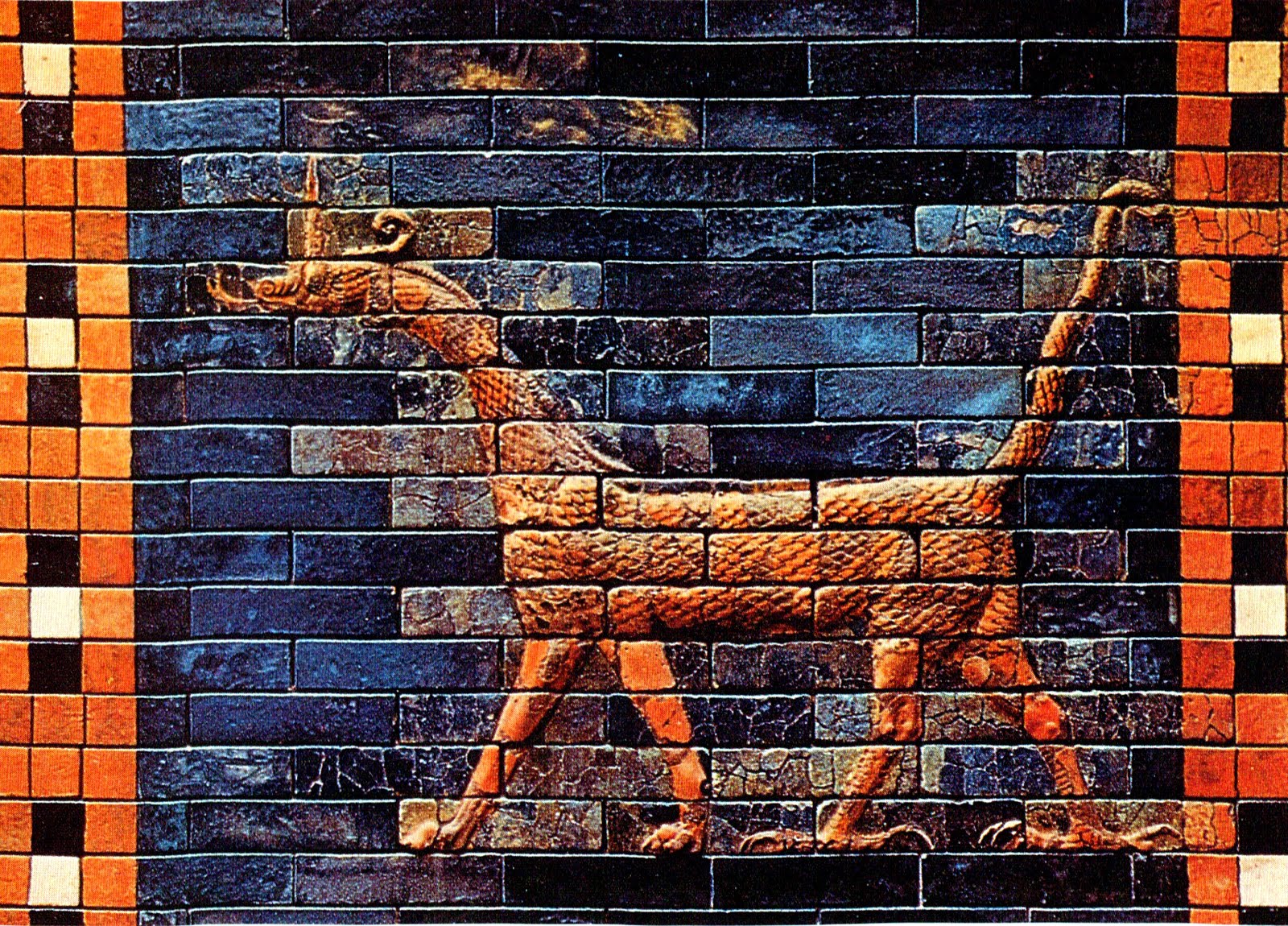
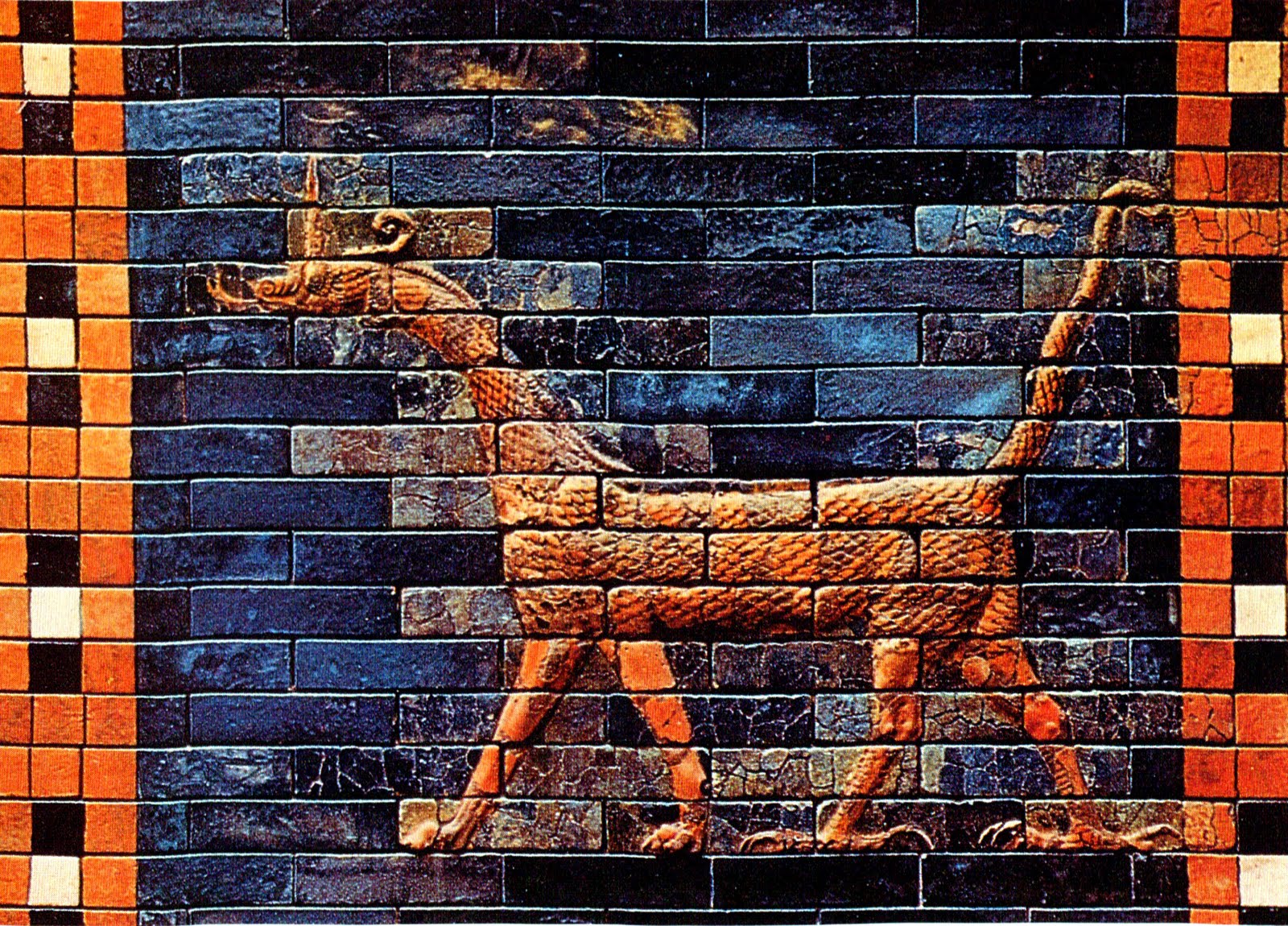
The mushussu or sirrush portrayed upon the Ishtar Gate of Babylon (Vorderasiatisches Museum, Berlin)
Perhaps the most intriguing aspect concerning the mokele-mbembe is how closely it resembles the Babylonian mushussu dragon as depicted on the Ishtar Gate. And it is known that early glazed bricks identical to those used in this gate's creation have been recorded from Central Africa - leading some naturalists to suggest that perhaps the early Babylonians visited this African region to obtain bricks for the gate, saw mokele-mbembes there, and upon their return to Mesopotamia their descriptions of this creature inspired the depictions of the mushussu on the gate. Boldest but most fascinating of all is the suggestion that at least one young mokele-mbembe may even have been transported back to Mesopotamia alive, explaining the so-called dragon that was worshipped in a temple by the Babylonians until killed by Daniel.
This is how Rex Gilroy, a veteran investigator of Australian mysteries, has referred in his book Mysterious Australia to two of this island continent's least-publicised but most fascinating mystery beasts - the kulta and the burrunjor.
According to ancient Central Australian aboriginal lore, the kulta inhabited the great swamps that existed long ago in the far north, browsing inoffensively upon the region's lush vegetation. It possessed a small head, an exceedingly long neck and tail, an enormously bulky body, and four sturdy legs. This description is irresistibly similar to that of the sauropod dinosaurs, such as Diplodocus and Apatosaurus. Yet the aboriginals have no palaeontological knowledge, so how are they able to describe so accurately a type of reptile that officially died out millions of years ago - unless at least one lineage did not die out, but persisted undisturbed in this remote locality right into historic times? Yet whatever it was, it is no longer - centuries ago the swamps dried up, and the kulta died out.
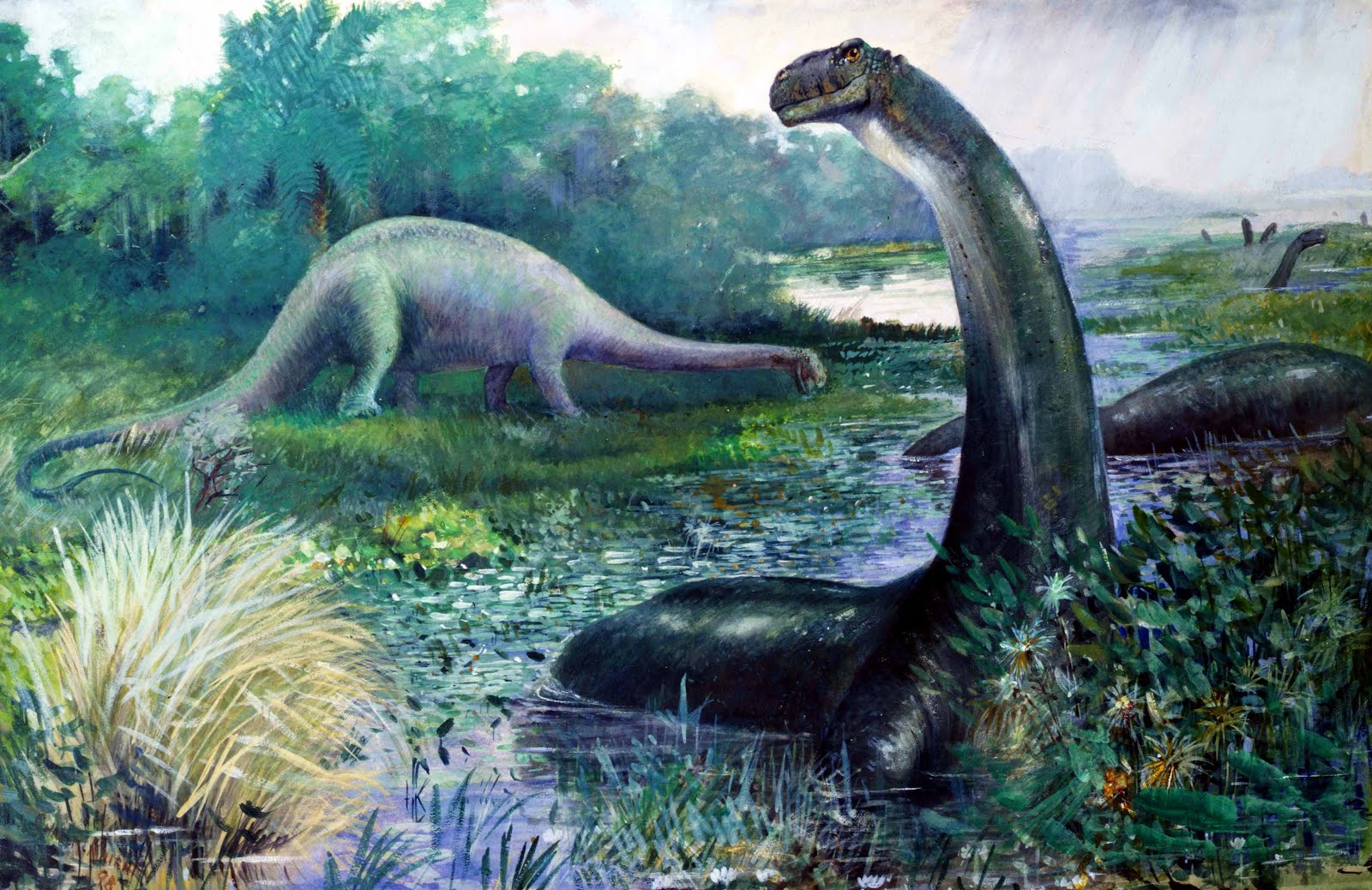
Is this what the kulta may look like? (Charles Knight)
Even more extraordinary, however, is the burrunjor, a terrifying tyrannosaur-lookalike named after Burrunjor - a remote expanse of Arnhem Land in northern Australia where, according to longstanding Aboriginal testimony, this huge reptilian monster is said to live. Here it is even depicted in local Aboriginal cave art, portrayed as a gigantic bipedal creature, and enormous unidentified tracks have been reported from this region.
Varanids (monitor lizards) will sometimes rear up and run for a time on their hind legs, and there are some notably large varanid species native to Australia. So could this be the true explanation for the burrunjor - or should we be seeking an animate anachronism thriving amid the primeval wildernesses of Arnhem Land?
EMELA-NTOUKA – THE CONGO'S 'KILLER OF ELEPHANTS'
The mokele-mbembe may well be the most famous Congolese 'neo-dinosaur', but it is not the only one. Sharing the latter’s inaccessible swamp-dwelling habitat in the People’s Republic of the Congo are several other mystifying creatures still awaiting formal identification by science, of which the most extraordinary must surely be the emela-ntouka (‘killer of elephants’). According to the local pygmies, this is a truly ferocious beast, reddish-brown in colour, hairless, and almost as large as an elephant itself, with massive legs, but able to submerge itself completely underwater. If an elephant attempts to cross a swamp or lake containing this formidable beast, the emela-ntouka will attack it savagely, disembowelling the hapless elephant with the long sharp ivory-like horn mounted on the emela-ntouka’s snout. It does not devour the elephant afterwards, however, as it is strictly herbivorous.
In the past, some cryptozoologists have attempted to identify the emela-ntouka as an unknown type of aquatic, swamp-dwelling rhinoceros. However, whereas the horn of all other modern-day rhinos is formed of compressed hair, the emela-ntouka’s is said to be solid ivory, just like the tusks of elephants. Also, it is described as having a very long, heavy tail, which is very different from the short, inconspicuous tail of all known living rhinos.

The emela-ntouka as depicted in Roy Mackal's book (David Miller/Dr Roy Mackal)
During his two separate 1980s expeditions to the Congo’s Likouala swamplands in search of the mokele-mbembe, Roy Mackal collected several reports and descriptions of the emela-ntouka too. These led him to speculate whether this remarkable beast could conceivably be an undiscovered, modern-day descendant of the ceratopsian dinosaurs, exemplified by such famous prehistoric stalwarts as Triceratops and Styracosaurus. Moreover, the one-horned Monoclonius would have borne a very close resemblance to the emela-ntouka, right down to the latter’s long heavy tail and its horn of bone, not compressed hair. Its only major difference is that whereas ceratopsians were known for the long bony frill protecting their neck, no such structure has been reported for the emela-ntouka.
Cryptozoological riddles can turn up in the most unlikely places, but few can be as unexpected as Cambodia's perplexing dinosaur carving. One of this country's most beautiful monuments is the jungle temple of Ta Prohm, created around 800 years ago, and part of the Angkor Wat temple complex. Like others from this time, it is intricately adorned with images from Buddhist and Hindu mythology, but it also has one truly exceptional glyph unique to itself. Near one of the temple's entrances is a circular glyph containing the carving of a burly, small-headed, quadruped beast bearing a row of diamond-shaped plates along its back - an image irresistibly reminiscent of a stegosaurian dinosaur!

The 'stegosaur' petroglyph at Angkor Wat (John and Lesley Burke)
This anachronistic animal carving is reputedly popular with local guides, who delight in baffling western tourists by asking them if they believe dinosaurs still existed as recently as 800 years ago and then showing this glyph to them. Could it therefore be a modern fake, skilfully carved amid the genuine glyphs by a trickster hoping to fool unsuspecting tourists? Or is it a bona fide 800-year-old artefact?

Angkor's Way - Michael J. Smith's spectacular artistic impression of cryptic, modern-day stegosaurs cared for by Cambodian monks (Michael J. Smith)
If so, perhaps it was inspired by the temple's architects having seen some fossilised dinosaur remains? After all, it surely couldn't have been based upon a sighting of a real-life stegosaur...could it?
Tasek Bera or Bera Lake is a very large, deep lake in the Malaysian state of Pahang, and according to the traditions of the local Semelai people it was (and still may be?) home to a number of huge water dragons whose scales were slate-grey when young but became golden as they matured. They had very long necks, serpentine heads bearing a pair of snail-like horns, sturdy bodies, and long tails. As they never emerged onto land, however, no-one had ever seen their limbs. These beasts' presence was confirmed by their loud, trumpeting cry.

Stewart Wavell's book, documenting Tasek Bera's dinosaurian 'water dragons'
As documented in his book, The Lost World of the East (1958), explorer Stewart Wavell paid two visits here during the 1950s to search for them, but he never saw one.
However, on one occasion he did hear a strident, twice-uttered staccato sound emanating from the centre of the lake that matched the native description of these creatures' cry. Was it just the trumpeting of an elephant – or the voice of a golden dragon?
Worthy of note is that reports of creatures very like the Congolese emela-ntouka have emerged from elsewhere in tropical Africa too. Zambia’s Lake Bangweulu is reportedly home to the single-horned chipekwe (‘monster’), with similar creatures also reported from Lake Mweru, Lake Tanganyika, and the Kafue swamps. The Democratic Republic of Congo (formerly Zaire) also has its own counterpart, dubbed the irizima, and there are even reports from as far west as Liberia.
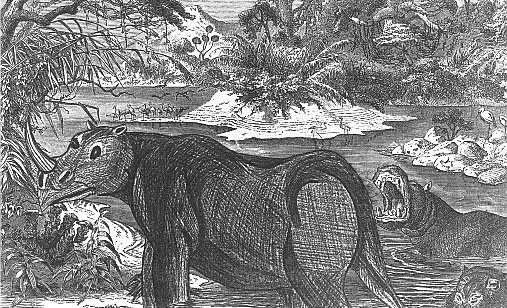
Do emela-ntouka counterparts exist far beyond the Likouala swamplands? (Dr Karl Shuker)
In 2004, a French mokele-mbembe seeker called Michel Ballot photographed a stunning wooden sculpture of what can only be an emela-ntouka-type beast while visiting a village in northern Cameroon. It clearly depicts the animal’s elephantine body, single snout-horn, and long hefty tail, as well as a pair of small frilly ears not previously alluded to in accounts of this cryptid.
Moreover, I have recently made a remarkable discovery of an entirely independent piece of native artwork that substantially corroborates the veracity of this sculpture, including the unusual ears. So look out for my revelation in a future ShukerNature article!
Although reports of sauropodian cryptids are less numerous from South America than they are from tropical Africa, they are by no means unknown.
When traveller Leonard Clark journeyed up Amazonia's Perene River in 1946, for example, he encountered several tribes of Indians east of the Ucayali who described to him gigantic long-necked beasts of plant-eating persuasion that recalled the giant sauropod Diplodocus.
In 1975, while holidaying in the Amazon, a Geneva businessman (name unknown) met Sebastian Bastos - a 75-year-old guide who, by a lucky coincidence, had been educated in Switzerland and was therefore able to converse fluently with him. During one conversation, Bastos stated that some of his Indian acquaintances had claimed that beasts of this type frequent certain deep water holes in the jungle's heartlands, and occasionally come out onto land at night. Their heads, necks, and backs are about 18 ft long, and the Indians take great pains to avoid them.
Frustratingly brief is a reference in Exploration Fawcett (1953) by lost explorer Lt-Colonel Percy Fawcett - alluding to still-unfamiliar beasts in the forests of Bolivia's Madidi, he noted:
"...some mysterious and enormous beast has frequently been disturbed in the swamps - possibly a primeval monster like those reported in other parts of the continent. Certainly tracks have been found belonging to no known animal - huge tracks, far greater than could have been made by any species we know."
Frustratingly brief is a reference in Exploration Fawcett (1953) by lost explorer Lt-Colonel Percy Fawcett - alluding to still-unfamiliar beasts in the forests of Bolivia's Madidi, he noted:
"...some mysterious and enormous beast has frequently been disturbed in the swamps - possibly a primeval monster like those reported in other parts of the continent. Certainly tracks have been found belonging to no known animal - huge tracks, far greater than could have been made by any species we know."
The mention of tracks suggests footprints - which favour dinosaurs over flippered plesiosaurs - but little else can be deduced from such a brief description.

Exploration Fawcett, documenting the lost explorer Lt-Colonel Percy Fawcett's South American expeditions (Arrow Books)
An earlier, slightly more detailed Fawcett-authored account on this same subject also exists – a letter by him that was published in London's Daily Mail on 17 December 1919. The relevant portion is as follows:
"A friend of mine, a trader in the rivers and for whose honesty I can vouch, saw in somewhere about Lat. 12 S. and Long. 65 W. [Bolivia-Brazil borderland] the head and neck of a huge reptile of the character of the brontosaurus. It was a question of who was scared most, for it precipitately withdrew, with a plunging which suggested an enormous bulk. The savages appear to be familiar with the existence and tracks of the beast, although I have never come across any of the latter myself...These swamps over immense areas are virtually impenetrable."
According to media reports from early 1995, a party of geology students investigating quartz deposits in the Sincora Mountain range of eastern Brazil had lately spied two strange dinosaur-like creatures bathing in the shallows of the Paraguaçu River passing through the Plain of Orobo. According to these eyewitnesses, the animals were each around 30 ft in total length, with a huge body, fearsome head, a long neck measuring approximately 6 ft, and an 8-ft tail.
In addition to the mokele-mbembe and the emela-ntouka, a third dinosaur-lookalike of the Likouala swamps is the mbielu-mbielu-mbielu. According to one of its alleged eyewitnesses - a young woman called Odette Gesonget, from the village of Bounila - this triple-named anomaly is a semi-aquatic creature "with planks growing out of its back". In a bid to identify it, Roy Mackal showed Gesonget several illustrated books depicting animals from the present day and also from the distant past - the picture that she unhesitatingly selected was that of the prehistoric plate-bearing dinosaur Stegosaurus. Comparable descriptions were offered, independently of one another, by natives encountered elsewhere during Mackal's Congolese travels too. Yet there is no suggestion from fossil evidence that stegosaurs exhibited any aquatic inclination.
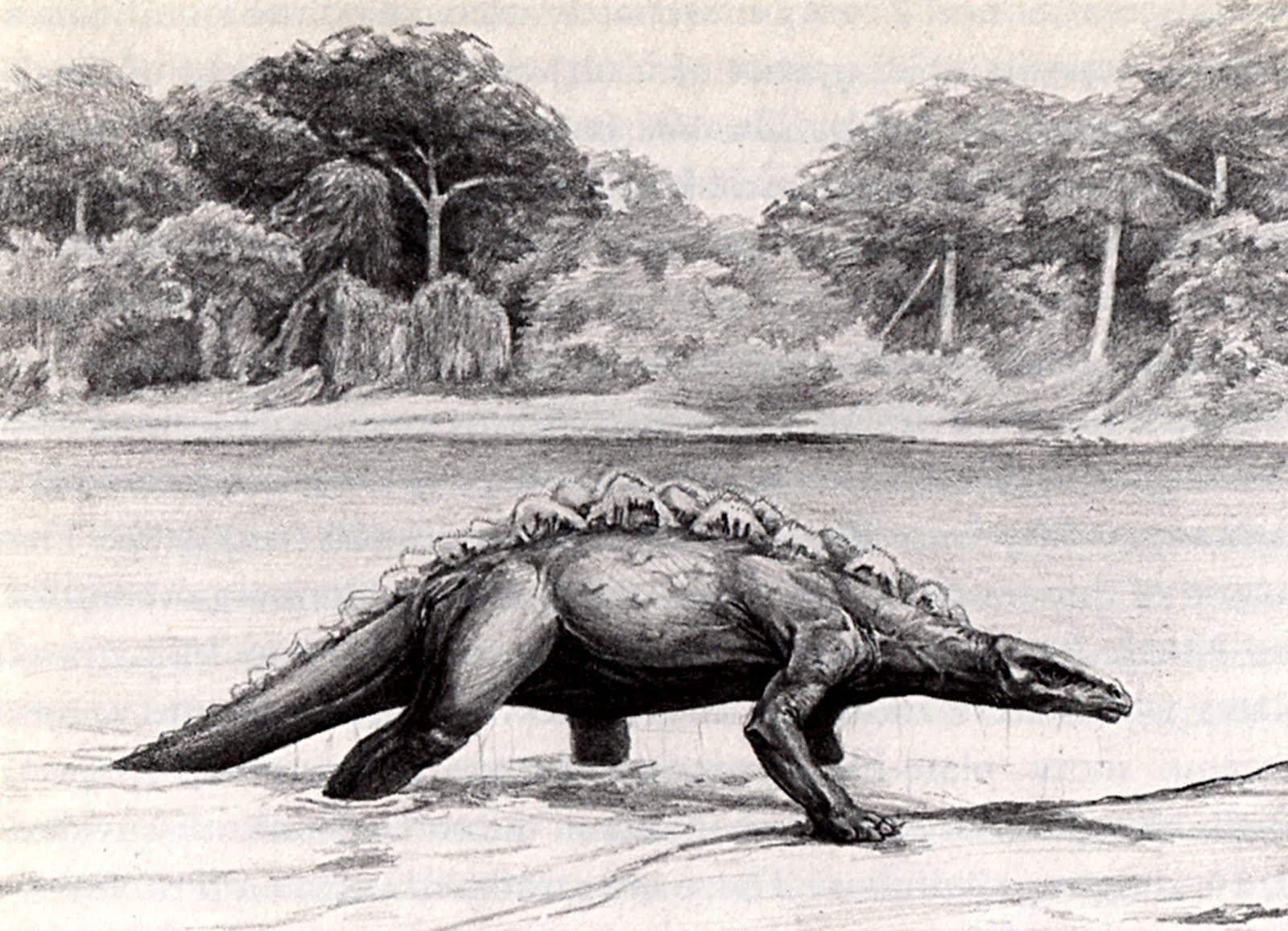
Reconstruction of the mbielu-mbielu-mbielu (David Miller/Dr Roy Mackal)
It is possible that this beast, whatever its taxonomic identity may be, is one and the same as another mystery animal from the Likouala swamplands - the nguma-monene, reported from the Mataba tributary of the Ubangi River. According to native descriptions, it resembles a colossal snake (at least 130 ft long!), but bears a serrated ridge along most of its body's length consisting of numerous triangular protrusions, and can walk upon land, with a low-slung body and forked tongue. Could this be a snake-like dinosaur, or, alternatively, a primitive reptile descended from the ancestral forms that gave rise to lizards and snakes?

Reconstruction of the nguma-monene (David Miller/Dr Roy Mackal)
Mackal favours a single, very large, and radically new species of monitor lizard as the most satisfactory explanation for both the nguma-monene and the mbielu-mbielu-mbielu. Nonetheless, the latter's stegosaurian suggestions are evidently difficult to dismiss absolutely - as he confessed in his book A Living Dinosaur? (1987): "For me, mbielu-mbielu-mbielu remains an enigma."
It’s always good to learn of a novel cryptid, and Chile’s Arica Beast is novel in every sense! As recounted in a number of media articles from 2004, several different motorists driving along the main road linking Iquique and Arica, through the Atacama Desert, have reported witnessing an extraordinary bipedal creature over 6 ft tall, with sharp teeth and three-toed footprints, which has been variously likened to a velociraptoresque dinosaur or even a ‘dinosaur kangaroo’!
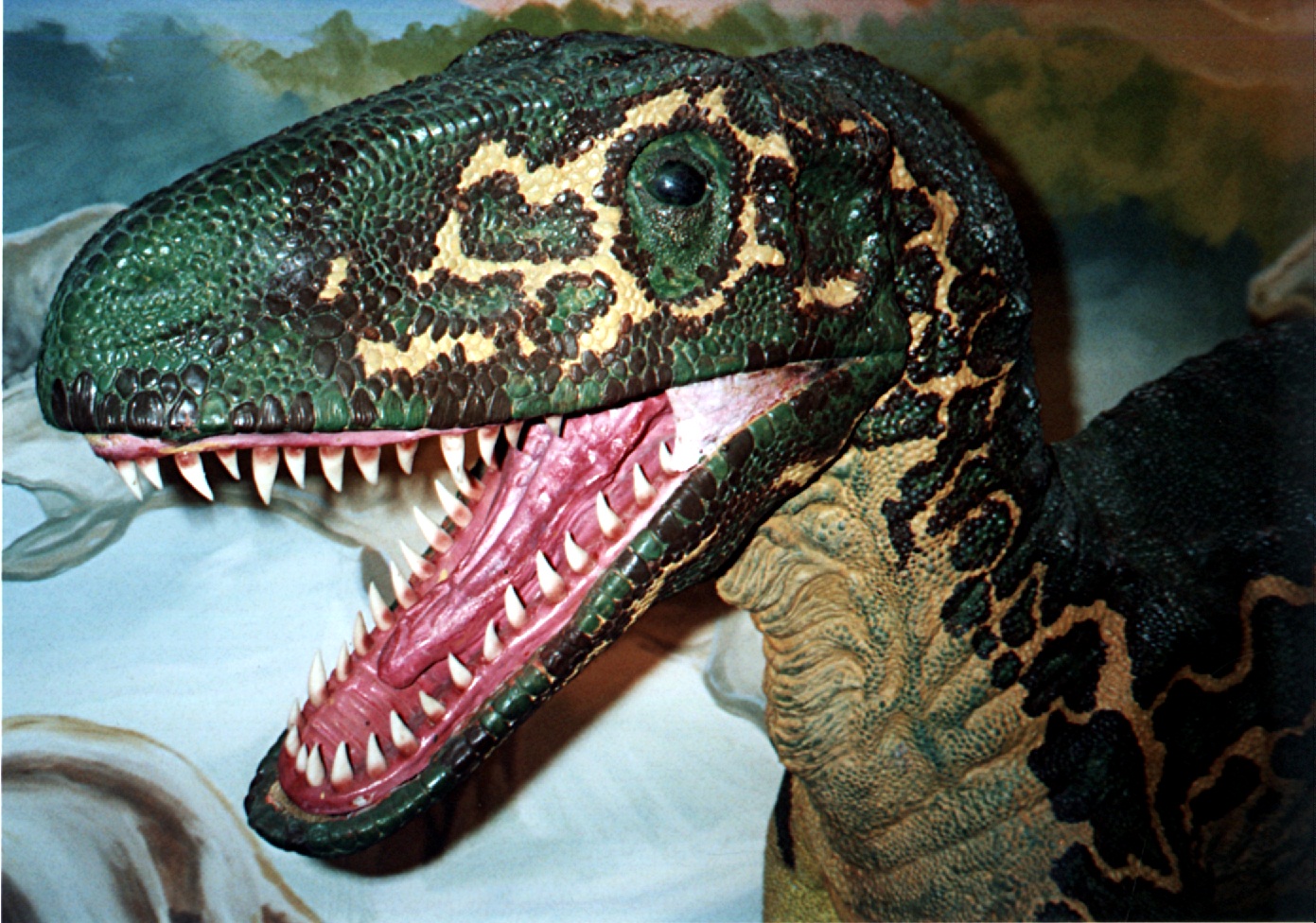
Bring me the head of the Arica Beast! (Dr Karl Shuker)
In the words of one eyewitness, Hernan Cuevas: “A weird animal looking like a dinosaur with two legs and huge thighs crossed the road in front of my car”. Not surprisingly, the local authorities were, and remain, very puzzled.
When Bill Gibbons conducted his initial expedition to Cameroon in November 2000, he discovered not only that this country apparently possessed its own version of the mokele-mbembe but also that it allegedly harboured an extraordinary horned mystery beast akin to but even more spectacular than the emela-ntouka.
Looking through pictures of living and fossil animals, the local Batu people and pygmies pointed to pictures of prehistory’s famous three-horned ceratopsian dinosaur Triceratops, and stated that a beast somewhat similar to that animal lived here. They called it the ngoubou, and claimed that it inhabited savannah areas to the west of the Boumba River. It is also known in the Sanga region near the Central African Republic. They stated that it was the size of an ox, sported a large frill around its neck (which differs slightly in the female), a beaked mouth, and bore several horns, but in a different manner from those of Triceratops.

Life-size reconstruction of Styracosaurus (Dr Karl Shuker)
This baffled the team, until one of the locals drew an image of what the ngoubou looked like, revealing that it bore a series of six horns around the edge of its frill, which, as team member John Kirk later realised, made it look irresistibly similar to a ceratopsian called Styracosaurus. As this particular fossil dinosaur was not depicted in any of the pictures shown to the native people by the team, they clearly had not been influenced in that way, thus making the correspondence all the more remarkable.
Of course, based upon current palaeontological beliefs, many of the creatures reported here display lifestyles very different from that of their purported prehistoric antecedents, especially with regard to the frequent claims by eyewitnesses that these neo-sauropodian, neo-ceratopsian, and neo-stegosaurian cryptids are amphibious. If, however, such mystery beasts are truly modern-day dinosaurs, this means that they have undergone 65 million years (or more) of continuous evolution from their fossilised antecedents, which may conceivably have engineered all manner of behavioural and ecological as well as morphological changes, so such lifestyle discrepancies or deviations would by no means be implausible or, indeed, unexpected.

Proudly wearing my Operation Congo 1985 t-shirt (Dr Karl Shuker)
Nevertheless, as with all cryptids it is unwise, pointless even, to speculate too specifically in relation to these mystery beasts' zoological identities without any physical, tangible evidence to examine. And, unfortunately, they all appear to exist amid some of the world's most inaccessible and inhospitable localities. Let us hope, therefore, that one day soon, a future expedition by Bill Gibbons or some other tenacious, enterprising explorer will return with this long-awaited proof of their reality, and then at last we shall know the true identity of at least one of this ShukerNature article's tantalising selection of anachronistic anomalies. The last of the dinosaurs, or merely the first of an entirely new flourish? Who can say?
For an extensive survey of putative living dinosaurs worldwide, check out my book In Search of Prehistoric Survivors (1995).




 Posts
Posts