Dr KARL SHUKER

Zoologist, media consultant, and science writer, Dr Karl Shuker is also one of the best known cryptozoologists in the world. He is the author of such seminal works as Mystery Cats of the World (1989), The Lost Ark: New and Rediscovered Animals of the 20th Century (1993; greatly expanded in 2012 as The Encyclopaedia of New and Rediscovered Animals), Dragons: A Natural History (1995), In Search of Prehistoric Survivors (1995), The Unexplained (1996), From Flying Toads To Snakes With Wings (1997), Mysteries of Planet Earth (1999), The Hidden Powers of Animals (2001), The Beasts That Hide From Man (2003), Extraordinary Animals Revisited (2007), Dr Shuker's Casebook (2008), Karl Shuker's Alien Zoo: From the Pages of Fortean Times (2010), Cats of Magic, Mythology, and Mystery (2012), Mirabilis: A Carnival of Cryptozoology and Unnatural History (2013), Dragons in Zoology, Cryptozoology, and Culture (2013), The Menagerie of Marvels (2014), A Manifestation of Monsters (2015), Here's Nessie! (2016), and what is widely considered to be his cryptozoological magnum opus, Still In Search Of Prehistoric Survivors (2016) - plus, very excitingly, his four long-awaited, much-requested ShukerNature blog books (2019-2024).

Dr Karl Shuker's Official Website - http://www.karlshuker.com/index.htm

IMPORTANT: To view a complete, regularly-updated listing of my ShukerNature blog's articles (each one instantly clickable), please click HERE!

IMPORTANT: To view a complete, regularly-updated listing of my published books (each one instantly clickable), please click HERE!

IMPORTANT: To view a complete, regularly-updated listing of my Eclectarium blog's articles (each one instantly clickable), please click HERE!

IMPORTANT: To view a complete, regularly-updated listing of my Starsteeds blog's poetry and other lyrical writings (each one instantly clickable), please click HERE!

IMPORTANT: To view a complete, regularly-updated listing of my Shuker In MovieLand blog's articles (each one instantly clickable), please click HERE!

IMPORTANT: To view a complete, regularly-updated listing of my RebelBikerDude's AI Biker Art blog's thematic text & picture galleries (each one instantly clickable), please click HERE!

Search This Blog


PLEASE COME IN, I'VE BEEN EXPECTING YOU...

PLEASE COME IN, I'VE BEEN EXPECTING YOU...
WELCOME TO SHUKERNATURE - ENJOY YOUR VISIT - BEWARE OF THE RAPTOR!


Showing posts with label sasquatch. Show all posts

Saturday, 17 July 2021

'THE BOY WHO SAW BIGFOOT' - BOOKING MY REDISCOVERY AT LONG LAST OF A CRYPTOZOOLOGY NOVEL LONG LOST!

 
The very evocative front cover of my Weekly Readers Books hardback edition of The Boy Who Saw Bigfoot, a novel written by Marian T. Place and first published in 1979 by Dodd, Mead & Company (© Marian T. Place/Dodd, Mead & Company/Weekly Readers Books – reproduced here on a strictly non-commercial Fair Use basis for educational/review purposes only)

Friends and colleagues, including loyal ShukerNature readers, will be very familiar with my succession of searches in recent times for various unusual books, magazines, records, and artefacts that I once fleetingly encountered many years previously but inexplicably failed to purchase and which have eluded all of my attempts since then to identify and very belatedly buy them. Happily, however, quite a few of these recent searches by me have finally ended in success, and the cryptozoologically-relevant example documented here is one of them.

It was during the evening of 7 April 2021 when I scored this particular "identified at last after all these years" successes. On that occasion, my search had been the latest one in a lengthy succession spanning a quartet of decades, seeking a very specific bigfoot-themed novel that for so long had seemed no less elusive than its cryptid subject! Here is the back-story to my quest for it.

One Bank Holiday Tuesday during the early 1980s, my family and I visited the Welsh seaside city of Newport for the day, where, while walking around the shops in its central area (by my early 20s, I'd long since lost interest in sitting on a beach!), Mom and I came across a big second-hand bookshop. Needless to say, I swiftly entered it and began a perusal of its wares, especially as this shop was totally new to me.

While doing so, I chanced upon a slender hardback book with a very attractive drawn illustration that wrapped around its entire front cover, spine, and back cover, and which was mainly brown with some green, featuring a bigfoot on the front. I opened it, but when I discovered that it was a children's novel rather than a work of non-fiction, I placed it back on the shelf, and eventually left the bookshop without buying anything – a rare event indeed for me!

 
A typical shopping street in Newport city centre, Wales (© Paula Rogers/Wikipedia – CC BY-SA 2.0licence)

Once back home, however, as so often happens with me, I began to wish that I'd bought the book after all, even if only as a novelty or souvenir, as it wasn't expensive and I'd never seen it before. Unfortunately, Newport was a very considerable distance away from where we lived, so there was no question of travelling all the way back there to buy it. I've only visited Newport once since then, several years later, and although the shop was still there, the bigfoot book had gone.

Regrettably, I hadn't taken notice of either its title or its author while looking at this book's cover, my attention having been focused upon its very striking wraparound illustration instead. Nevertheless, the memory of it has occasionally popped into my head during the subsequent four decades, as it did again on 7 April. However, after having failed on several previous occasions, this time I was determined to track down this long-vanished volume and identify it. And after scouring through untold lists of bigfoot-entitled books that night on ebay, Abebooks, Amazon, etc, I did indeed finally find it!

I did so by entering "bigfoot children's novel 1970s" in Google's Image Search (because I'd seen the book during the early 1980s, I guessed that it had probably been published in the 1970s – any earlier would have been most unlikely because bigfoot wasn't a well-known cryptid prior to the 1968 Patterson-Gimlin film). Sure enough, up popped a picture of the entire cover of a book, front and back, featuring a wraparound illustration that immediately clicked in my memory – that was it, that was the very same cover whose striking image had stayed with me all these years!

The book turned out to be The Boy Who Saw Bigfoot, a 96-page hardback novel aimed at young people, written by American children's authoress and bigfoot seeker Marian T. Place, who has also written various other bigfoot-themed novels for youngsters (as well as one non-fiction book), which was first published in 1979 by New York-based publisher Dodd, Mead & Company. I soon found for sale online a reasonably-priced good-condition copy of the Weekly Readers Books hardback edition featuring that same iconic cover illustration and published that same year, which I purchased straight away. It arrived safely from the States about a fortnight later. So after more than 40 years, I finally own this hitherto nebulous novel, and I now look forward to reading it at last. Finally: here is that very memorable wraparound cover that finally solved for me the longstanding mystery of the missing bigfoot book:

 
The very eyecatching full wraparound cover from my Weekly Readers Books hardback edition of The Boy Who Saw Bigfoot (© Marian T. Place/Dodd, Mead & Company/Weekly Readers Books – reproduced here on a strictly non-commercial Fair Use basis for educational/review purposes only)


Tuesday, 22 September 2020

A MISSING LINK DOUBLE-BILL - SAME TITLE, TWO VERY DIFFERENT CRYPTOZOOLOGY-LINKED MOVIES!

Publicity poster for Missing Link (1988) and front cover of official DVD for Missing Link (2019) (© David and Carol Hughes/Universal Pictures; (© Chris Butler/Annapurna Pictures/Laika/Universal Artists/AGC – both images are reproduced here on a strictly non-commercial Fair Use basis for educational/review purposes only)

Today, ShukerNature reviews two cryptozoology-themed movies with the same title – Missing Link – but dramatically different formats and approaches, as will be seen.


MISSING LINK (1988)

The full cover for the official VHS videocassette of Missing Link, the live-action movie released in 1988 (© David and Carol Hughes/Universal Pictures – reproduced here on a strictly non-commercial Fair Use basis for educational/review purposes only)

Directed and written by David and Carol Hughes, Missing Link is produced in the style of a wildlife documentary with a voiceover narration by actor Michael Gambon. It is set in Africa one million years ago, and follows a voyage of discovery across this continent by a lone adult male 'man-ape' belonging to the early hominin species Australopithecus robustus. He is seeking others of his own species after having fled from the direct ancestors of ours, Homo sapiens, when his entire family was viciously slaughtered by them, leaving him as the only remaining representative of his species in that area.

This very unusual movie is more than a little reminiscent of another one that I watched and reviewed here on ShukerNature not long ago, Jonathan Livingston Seagull, in that although there is not a great deal of plot, the cinematography (again the work of the Hugheses) is absolutely spectacular. Missing Link was filmed on location in various Namibian national parks filled with iconic African fauna such as lions, elephants, giraffes, gazelles, zebras, mongooses, wildebeests, and those veritable avian locusts the red-billed queleas, whose immense flocks swarm and swirl through the sky like living composite super-organisms.

The unnamed australopithecine is played by Peter Elliott, and the fur suit as well as the constructed head and face that transform him into the man-ape are very impressive indeed. Viewing this movie constantly reminded me of the much later TV documentary series Walking With Cavemen (first screened in 2003, it was a successor to the highly successful, ground-breaking Walking With Dinosaurs and Walking with Beasts series).

This memorable movie's unnamed, unconventional star – a lone surviving australopithecine ape-man (© David and Carol Hughes/Universal Pictures – reproduced here on a strictly non-commercial Fair Use basis for educational/review purposes only)

Certainly, Missing Link was indeed far ahead of its time, but its lack of any major storyline or dialogue (other than Gambon's occasional words) probably explained why it was not a commercial success when released, and why it is seemingly not available on DVD. (Following its cinema debut, it was released in VHS videocassette format, examples of which are occasionally listed for sale online, but these are usually quite pricey.)

This is a great shame, because Missing Link is very deserving of being seen, as a tragic testament to how our ancestors almost certainly contributed to these distant relatives' eventual extinction - unless the mysterious agogwe, séhité, kakundakari, and certain other diminutive hairy man-beasts reported across Africa in modern times are relict survivors?

Offering a taster of the dramatic wildlife vistas and compelling content of Missing Link, here is an official trailer for this very different but definitely must-watch movie.

  
MISSING LINK (2019)

Photographic still for Missing Link, the animated feature film released in 2019, with Dora the Yeti Elder seen at far right (© Chris Butler/Annapurna Pictures/Laika/Universal Artists/AGC – reproduced here on a strictly non-commercial Fair Use basis for educational/review purposes only)

Directed by Chris Butler, Missing Link is a delightfully droll animated crypto-classic originally released in early 2019, and tells the story of what is supposedly the very last sasquatch (a restrained but all the more hilarious vocal tour de force by Zach Galifianakis). Namely, a very sensitive male bigfoot named Susan (don't ask!), who hires adventurer Sir Lionel Frost (voiced with great aplomb by Hugh Jackman) to end his loneliness by transporting him to the Himalayas where he can be united with his nearest kin, the yetis. (Cryptozoological purists be warned: the yetis here are portrayed as having white fur, a traditional if mistaken representation, as according to local eyewitness reports these mystery man-beasts are actually brown- or red-furred.)

Along the way, they meet up with a former significant other of Sir Lionel, the feisty Adelina Fortnight (Zoe Saldana), and are pursued tenaciously by the evil henchmen of Frost's nemesis, the repressive, insane Lord Piggot-Dunceby (Stephen Fry). His obsessive goal is to prevent Frost's discovery of both Susan the bigfoot and the yetis of Shangri-La from ever becoming known to the world at large.

Speaking of which: my favourite character is the etiolated, secretive, and deliciously paranoid Yeti Elder, Dora, voiced with acerbic zeal by Emma Thompson. Also worth listening out for are Little Britain stars David Walliams as Lemuel Lint, Sir Lionel's former assistant, who barely escapes with his life from his ever-perilous role, and Matt Lucas as Mr Collick, the no-less neurotic assistant of Lord Piggot-Dunceby.

Publicity poster for Missing Link with the Loch Ness monster (© Chris Butler/Annapurna Pictures/Laika/Universal Artists/AGC – reproduced here on a strictly non-commercial Fair Use basis for educational/review purposes only) 

Full of the dry, quip-driven humour that always appeals to me, but with a hefty dollop of good old-fashioned visual slapstick thrown in too, Missing Link also includes many spectacularly eyecatching scenes (one of which features fellow cryptid Nessie, the Loch Ness monster!), but none more so than the splendorous ice palaces and hidden valley of the yetis. Watching this charming movie is without a doubt a very enjoyable and highly entertaining way to pass a birthday evening, so that is precisely what I did on my most recent birthday.

To prove my assertion, here is a very funny official trailer for Missing Link – and here is another one!

A version of this double-bill review of cryptozoology-linked movies can also be accessed here on my Shuker In MovieLand blog.


Wednesday, 21 February 2018

WHEN BIGFOOT CELEBRATED THANKSGIVING WITH THE PILGRIM FATHERS? A SHUKERNATURE PICTURE OF THE DAY


Painting of a Pilgrim Fathers Thanksgiving feast seemingly attended by a sasquatch! (Public domain image digitally photo-manipulated by person/s unknown to me)

It's been a while since I posted a ShukerNature Picture of the Day, but I recently saw online an eyecatching illustration that seemed ready-made for this purpose, so here it is, presented above.

Moreover, this nothing-if-not-memorable image has lately been reposted far and wide on social media sites and beyond, and has attracted much speculation as to whether it and the extraordinary event depicted by it might actually be real – so naturally I had to find out, and this is what I found.

As can be seen, it appears to be a painting of a very early American Thanksgiving celebration, featuring Pilgrim Father figures with their families, friends, and some visiting Native American representatives…plus one highly unexpected, additional attendee. Occupying centre stage, right at the heart of all of the activities and, judging from its expression, taking a keen, intelligent interest in everything, is a bigfoot (sasquatch), albeit one with somewhat orangutan-hued fur.

Needless to say, if this painting were genuine, dated back to some far-gone period in American history, and depicted a real incident, it would constitute an astonishing piece of evidence in support of the bigfoot's reality. However, being only too aware from my investigations of numerous previous examples of supposed visual proof for cryptid existence of how readily images can be digitally photo-manipulated using Photoshop and other such programs, I had little (if any) doubt that this was yet another such case, with the bigfoot image having been digitally added to some genuine pre-existing artwork. But to confirm my suspicions, I needed to uncover that artwork.

Happily, this task took very little time to accomplish, thanks to a successful Google Image-driven online search duly conducted by me. Consequently, I was soon gazing on my computer screen at that original, unmodified, and conspicuously bigfoot-lacking painting – and here it is:

'The First Thanksgiving 1621', painted by Jean Leon Gerome Ferris, sometime between c.1912 and c.1915 (public domain)

As captioned above, the painting in question is entitled 'The First Thanksgiving 1621', and had been produced sometime between c.1912 and c.1915 by Philadelphia-born American painter Jean Leon Gerome Ferris (1863-1930), who was best known for his series of 78 paintings depicting scenes from American history entitled 'The Pageant of a Nation'.

This is currently the largest series of American historical paintings produced by an artist working alone, rather than with assistants or as part of a collaborative artist group. The above painting is part of that series, and as confirmed by its title it portrays the very first Thanksgiving celebration to have taken place in North America, which occurred in 1621. This was a major three-day event that was held during the end of September or early October, and in the painting Ferris depicted the Pilgrim Fathers and their families sharing their feast with (un?)invited members from the Native American Wampanoag nation.

However, this famous artwork has attracted various criticisms concerning inaccuracies of depiction in it by Ferris relating to both the Pilgrim Father colonists and the Wampanoag figures. Apparently, the black costumes worn by the colonists in this painting are incorrect, inasmuch as back in 1621 the colonists would have been wearing brightly-coloured costumes, but without buckles, because those accoutrements did not come into fashion until much later during that century.

Equally, the Wampanoag did not wear elaborate feathered head-dresses like those that they are portrayed wearing here by Ferris, nor would they have sat on the ground, and there would have been more of them present at the feast than colonists, because they are known to have outnumbered the colonists 2:1.

Perhaps it is just as well, therefore, that the bigfoot's presence in this painting as seen in the version of it circulating online and investigated here on ShukerNature is due entirely to photo-manipulated fraudulence (and by person/s unknown) rather than in any way to Ferris – otherwise, painting purists may well have suffered a serious bout of collective, convulsive apoplexy!

Now you see it, now you don't – comparing the photo-manipulated, bigfoot-incorporating faked version of Ferris's painting (top) with the unmodified, bigfoot-lacking original version (bottom) (public domain)


Thursday, 8 December 2016

VOLUME 4 OF THE JOURNAL OF CRYPTOZOOLOGY IS NOW PUBLISHED


I'm very happy to announce that Vol. 4 of the Journal of Cryptozoology – currently the world's only peer-reviewed scientific journal devoted to mystery animals – is now published.

The four papers contained in this volume constitute a quartet of very different but equally interesting and significant contributions to cryptozoology. Namely:

An insightful examination by Paul Michael Donovan of the original occurrence and subsequent dispersal and gradual generalisation in meaning of a famous cryptid term – 'bunyip'.

An exhaustive and exceedingly valuable checklist compiled by Dr Charles G.M. Paxton and Adrian J. Shine of identities proposed over time for what must surely be the world's premier cryptid – the Loch Ness monster.

A very pertinent application of DNA analysis by Dr Haskell V. Hart to alleged cryptozoological (bigfoot) samples, a practical approach that I anticipate becoming ever more important in this field.

The presentation by Bruce A. Champagne of a very comprehensive, novel type proposal for water monsters.

The journal is now actively calling for submissions in relation to Vol. 5. These should be emailed directly to me. Before doing so, however, all contributors must ensure that their manuscripts have adhered to the journal's presentation style and requirements, as given in each volume's Instructions to Contributors section, and online in the journal's website (click here) - where this newest volume of the journal (and all of its earlier ones too) can be purchased directly. In addition, Vol. 4 can be purchased here on Amazon US, and here on Amazon UK.

Scale illustration of the possible appearance of the long-necked variety of bunyip (© Connor Lachmanec)


Friday, 2 December 2016

SHUKERNATURE EXCLUSIVES – THE ONLY STORE FOR OFFICIAL SHUKERNATURE MERCHANDISE


ShukerNature t-shirt (© Dr Karl Shuker/Zazzle)

Several years ago, I opened a store on Zazzle's website, but I didn't do a great deal with it – until now. Renaming it ShukerNature Exclusives, I've launched a wide selection of official ShukerNature blog merchandise and other cryptozoology-related items designed by yours truly (and with many other items on the way too) – from t-shirts, hoodies, jackets, and baseball caps to postcards, coasters, mugs, key-rings, bumper stickers, and much more besides, all attractively decorated with ShukerNature and other crypto motifs.

ShukerNature postcard (© Dr Karl Shuker/Zazzle)

So, with Christmas fast approaching and all of those gifts still to seek out, why not pay a visit to ShukerNature Exclusives? If you're a ShukerNature blog fan, and want to let the world know, just click here to browse through the only official ShukerNature merchandise available anywhere. Go on, you know you want to!

Ameranthropoides loysi t-shirt (© Dr Karl Shuker/Zazzle)


Friday, 4 September 2015

CRYPTO-SELFIES! IN THE PICTURE WITH SOME SERIOUSLY WEIRD – BUT WONDERFUL – WILDLIFE


With E.T. – how could I not take pity on this errant extraterrestrial and bring him back home with me? In any case, he must be happy here – he hasn't phoned home once, which is just as well, bearing in mind the cost of intergalactic telephone calls these days! (© Dr Karl Shuker)

Over the years, I've found myself sharing space in photographs – selfies, as they'd be called nowadays – with some exceedingly strange entities (and those are just my friends!). But seriously, browsing through my albums recently I came upon a considerable number featuring me alongside some truly weird – but indisputably wonderful – wildlife. So here, as one of my more light-hearted ShukerNature contributions, and the first of an occasional series, is a dozen of my most memorable crypto-selfies, annotated with a bountiful abundance of decidedly (ir)relevant information…

Alongside a black cheetah statue at Colchester Zoo, in Essex, England, which I visited in 2013; as noted in my books Mystery Cats of the World and Cats of Magic, Mythology, and Mystery, a few records of all-black (melanistic) cheetahs are indeed on file, including a specimen spied in the company of a normal cheetah by Lesley D.E.F. Vesey-Fitzgerald in Zambia during the first half of the 20th Century, and another one sighted in Kenya's Trans-Nzoia District by H.F. Stoneham in 1925 (© Dr Karl Shuker)

With one of the famous 19th-Century dinosaur statues at Crystal Palace Park in Bromley, London, which I visited in 2009; created by famous sculptor Benjamin Waterhouse Hawkins (1807-1894) and totally outdated now, this one is meant to be a Megalosaurus, but its reconstruction was guided by the popular yet erroneous belief current at that time that dinosaurs resembled giant lizards (© Dr Karl Shuker)

Holding a Brazilian were-pig skull – hailing from Rio de Janeiro, this is the skull of a wild boar that has been intricately decorated to resemble the supposed appearance of a Brazilian were-pig's head (© Dr Karl Shuker)

At Drayton Manor Park and Zoo, in Staffordshire, England, standing somewhat warily alongside a disconcertingly life-like, life-sized replica of North America's late Pliocene/early Pleistocene terror bird Titanis walleri, which may have stood up to 8 ft tall – check out my book The Menagerie of Marvels for an extensive chapter documenting the history of these flightless but fleet-footed and sometimes truly gargantuan carnivorous birds (© Dr Karl Shuker)

With an acklay – when I purchased this model at a market a few years ago, I had no idea what the creature was that it represented, but thanks to some knowledgeable sci-fi enthusiast friends on Facebook I soon learnt that it was an acklay, a huge non-sentient carnivore up to 11.5 ft tall, hailing from the planet Vendaxa in the Star Wars canon's universe (© Dr Karl Shuker)

Alongside a life-sized animatronic model of the feathered dinosaur Citipati at Bristol Zoo, England, in 2013; an oviraptorid theropod from Mongolia's Late Cretaceous period, Citipati was named after a pair of murdered meditating monks from Tibetan Buddhist folklore, it possessed a large toothless beak, and it stood as large as a present-day emu; in this particular reconstruction, it looks decidedly cassowary-like (© Dr Karl Shuker)

There I was, minding my own business walking round the small West Midlands, England, town of Cradley Heath, when, happening to step inside a sci-fi/comic shop, who should I encounter there but the Predator! I can only assume that my trusty leather biker jacket helped to conceal me from its thermal imaging capability long enough for me to get this photo snapped of me alongside it; if you're wondering why the photo is a little blurry, it's because the (ex) person taking it for me suddenly realised that unlike me he wasn't wearing anything to cloak his thermal image – I won't tell you what happened to him next, as I don't want to give you nightmares – suffice it to say that at least it kept the Predator occupied long enough for me to make my excuses and exit stage right! (© Dr Karl Shuker)

Face to face with a life-sized Tyrannosaurus rex model at a dedicated T. rex exhibition held at Birmingham Museum & Art Gallery in the West Midlands, England, during 2010 – it's not often that you get the chance to stare down a T. rex, although in this particular instance the only thing that I seemed to be staring down was its nostrils; Jurassic Park claimed that as long as you stood perfectly still, a T. rex would be unable to detect you, so what better time to put this claim to the test?? © Dr Karl Shuker)

Holding a cast of a 16-inch-long bigfoot (sasquatch) footprint discovered at Grays Harbor, in Washington State, USA, during 1982; I purchased this particular cast from veteran bigfoot researcher Prof. Grover Krantz during the early 1990s (© Dr Karl Shuker)

Sharing some quality time with a life-sized Moeritherium statue at London's Natural History Museum in 2014; this was a very early genus of proboscidean living during the Eocene epoch 37-35 million years ago in northern and western Africa, but dying out without giving rise to any modern-day elephant lineage; initially I was very puzzled that this statue's trunk seemed to have been rubbed so vigorously that much of its surface had lost its colour – why would this have happened? Then Facebook friend Adam Naworal reminded me that it was traditional to rub elephant statues for good luck, so that may well explain the otherwise anomalous case of the mutilated Moeritherium; fortunately, however, this doesn't seem to have traumatised him, as he seemed happy enough to be with me (© Dr Karl Shuker)

Alongside Singapore's iconic merlion fountain-statue in 2005; the merlion is a legendary lion-headed fish known worldwide as a symbol of Singapore, and it is epitomised by this magnificent 28-ft-tall statue created by sculptor Lim Nang Seng during 1971-1972, and relocated in 2002 to a promontory in Singapore's Merlion Park (© Dr Karl Shuker)

I hope that you've enjoyed this inaugural meander through my collection of crypto-selfies. Look out for further selections in future ShukerNature posts!


Saturday, 11 April 2015

EXPOSING THE 'DEAD BIGFOOT PHOTO' - THE BEAR FACTS AT LAST! - A SHUKERNATURE WORLD-EXCLUSIVE!


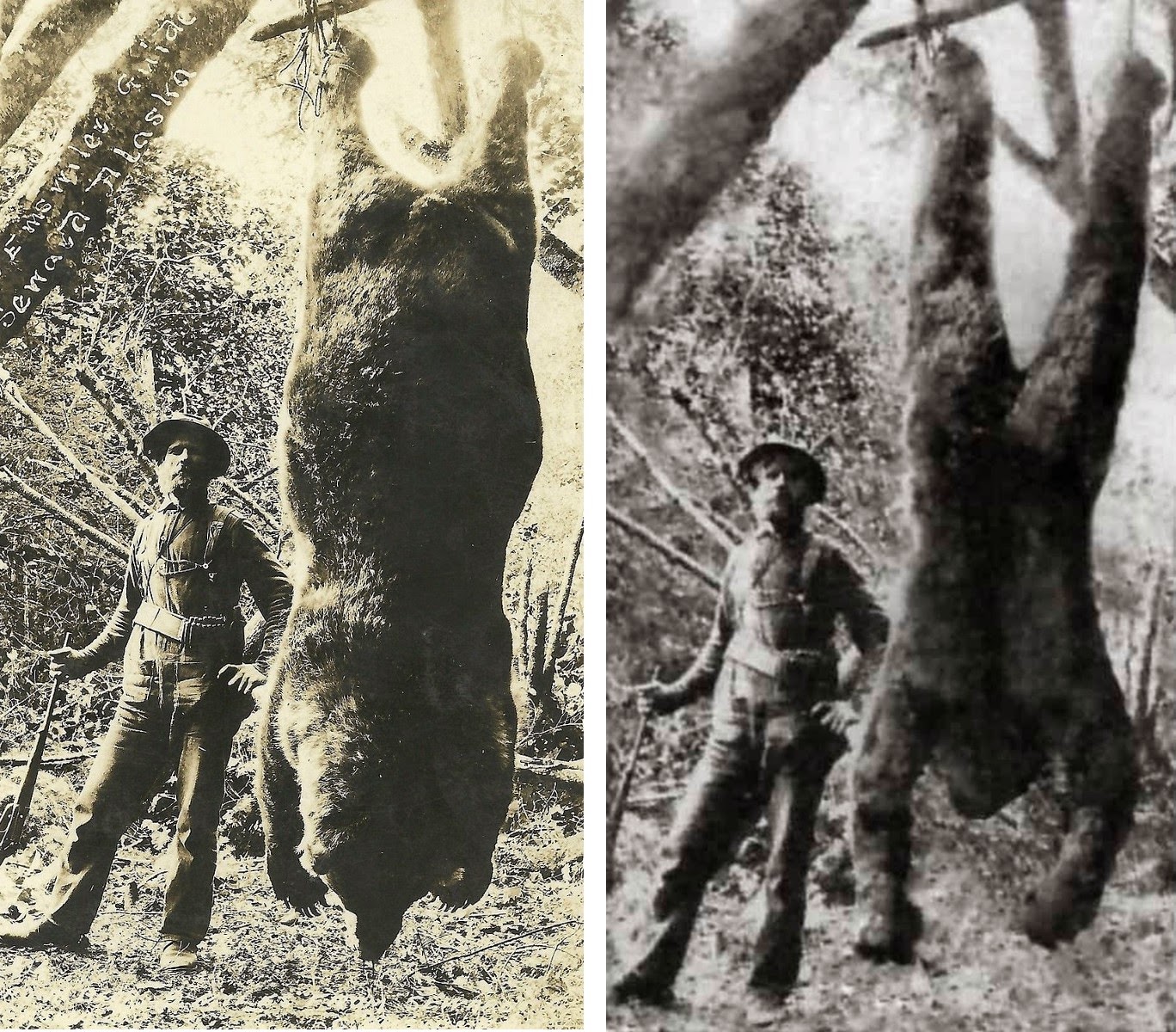
The infamous 'dead bigfoot photo' (origin unknown)

On 21 November 2006, after having received it from a reader with the user name 'captiannemo' [sic], who claimed to have found it online, Craig Woolheater posted on Cryptomundo the very intriguing photograph opening this present ShukerNature blog article, and which has since become popularly known as the 'dead bigfoot photo', together with a request for any information available concerning it.

In view of its very striking, tantalising image, the photo attracted much interest, and was subsequently reposted twice by Loren Coleman on Cryptomundo (16 and 22 April 2009) with further requests for information. It has also been featured on many other websites. Yet although numerous opinions have been aired as to what it depicts (a shot bigfoot, bear, gorilla?) and whether or not it is authentic or photo-manipulated, no conclusive evidence as to its true nature has ever been obtained and presented - until now!

Earlier today, Facebook cryptozoological colleague Tony Nichol brought the following vintage picture postcard to my attention:

Vintage picture postcard depicting a hunter and shot Alaskan grizzly bear (purchased on ebay and now owned by Dr Karl Shuker – all rights reserved)

With an example of it available for purchase on ebay's USA site, it depicted a shot grizzly bear, photographed in Seward, Alaska, alongside the hunting guide who shot it. The guide's name, as given in white writing running diagonally across the photograph's top-left section, was C Emswiler, a famous licensed Alaskan hunting guide whose full name was Charles Emswiler (thanks to Facebook friend Bob Deis for informing me of this). The AZO date stamp symbol code on the reverse of the postcard confirmed that the card dated from the time period 1904-1918 (noted by its ebay seller in their auction listing's description of it) - and as I could instantly see, its bear photograph was unquestionably the original image from which the bigfoot version had been created by photo-manipulation. After almost a decade, and as revealed here in this ShukerNature world-exclusive, the mystery of the 'dead bigfoot photo' is finally solved - except of course for discovering the identity of whoever created it from the vintage bear image.

To ensure that the latter does not become another 'missing thunderbird photo', however, I have actually now purchased the example of it available on ebay, and should be receiving it in the post shortly.

Perhaps I should also begin scanning ebay for the missing thunderbird photo ?!

Meanwhile, my sincere thanks go to Tony Nichol for kindly bringing the bear postcard to my attention, and, in so doing, enabling me to bring the lengthy reign of yet another cryptozoological pretender to its richly-deserved end.

The original bear photograph alongside the derived, photo-manipulated 'dead bigfoot photo' (bear photo owned by Dr Karl Shuker – all rights reserved)


UPDATE: 15 April 2015

Yesterday (14 April 2015) on Cryptomundo, Craig Woolheater announced that following my above revelation of the bear photograph that had served as the source from which the infamous 'dead bigfoot photo' had been created by photo-manipulation (a revelation that I had simultaneously posted on Cryptomundo), he had contacted 'captiannemo', the Cryptomundo user who had sent him the 'dead bigfoot photo' back in 2006, and had asked him whether he had created the latter image. In reply, 'captiannemo' confessed that he had indeed created it, and that the copy of the above bear photograph that he had used for this purpose had appeared in an article on grizzly bear hunting published in an issue of Field and Stream from the early 20th Century.

So now, not only the source photograph from which the 'dead bigfoot photo' had been created but also a confession regarding its preparation by its creator have been obtained and made public at last. Congratulations to Craig for extracting the confession - click here to read this historic account on Cryptomundo.


SECOND UPDATE – 16 April 2015

Curiouser and curiouser, as Alice would have said if this had happened in Wonderland! Just when it seemed that the tangled tale of the 'dead bigfoot photo' was finally disentangled, another knot of controversy has duly presented itself.

Yesterday evening (UK time), I received an email from Bill Munns, a much-celebrated cinematographic special-effects expert. His notable contribution to bigfoot investigation is his book When Roger Met Patty (2014), in which his extensive analysis of the famous Patterson-Gimlin film purporting to show a female bigfoot swiftly striding into and back out of view at Bluff Creek, California, on 20 October 1967 concluded that the alleged bigfoot (popularly nicknamed Patty, after Patterson) was not a man in a fur suit as many critics believe, but was a bona fide creature.

Bill had now analysed both the 'dead bigfoot photo' and its bear precursor, and to my great surprise he announced in his email to me that in his view not only the 'dead bigfoot photo' but also the bear photograph were hoaxes! He alerted my attention to an illustrated report that he had written, documenting his analysis and containing his reasons for believing both images to be hoaxes, which he had uploaded onto the Bigfootforums discussion website a short time before emailing me (click here to read his report).

Bill's report confirmed that the 'dead bigfoot photo' had resulted from not particularly good-quality photo-manipulation of the bear photograph. He then pointed out a number of lighting issues present in the bear photograph that made him believe that it was not a natural outdoors photograph, in spite of its apparent outdoors setting. He also brought to attention what he considered to be suggestions of retouching.

As I am certainly no expert in photographic analysis, and, even if I were, I seriously doubt whether I could match Bill's many years of accumulated experience working in his capacity in the Hollywood film industry, I cannot comment upon the lighting issues that he discusses – other than to wonder whether a photograph known (via the existence of my picture postcard depicting it) to date back almost a century could have been modified so expertly back then. Consequently, I expressed my concern about this in my reply to Bill's email, and in a second email to me, dated today, 16 April 2015, he agreed with me, noting that it would indeed have been a challenge to achieve at that time.

Also, I need to emphasise here that even if Bill's assessment of the bear photograph is accurate and that it is itself a hoax, it does not change anything in relation to its status as the original long-existing image from which the 'dead bigfoot photo' was created by 'captiannemo'. This is because, as already noted, my recently-purchased picture postcard containing the bear image confirms the image to be of vintage age, as the postcard's own production dates from the period 1904-1918, i.e. almost a century before the 'dead bigfoot photo' appeared on the scene. Don't forget too that 'captiannemo' stated in his confession of fakery re the 'dead bigfoot photo' that the copy of the bear photograph that he had used to create the bigfoot version from was one that had appeared in an article on grizzly bear hunting published by the periodical Field and Stream during the same time period as the postcard's publication. Speaking of which: it would be good if this particular article could be traced, thereby placing its own existence beyond any shadow of doubt and adding to the postcard's existence a second, independent publication source verifying that the bear photograph dates back at least as far as that early period of the 20th Century.

So to anyone reading this ShukerNature blog article who has access to an early run of Field and Stream: if you could check through it and locate the grizzly bear hunting article, I'd greatly welcome its precise publication details (and a scan of the article too if possible).

As far as the 'dead bigfoot photo' is concerned, however, all considerations regarding the bear photograph's authenticity are in any case wholly irrelevant (including the obvious fact that because the bear is positioned much closer to the camera than the hunter, the bear looks bigger than it actually is - a familiar optical illusion known as forced perspective). All that matters is that we know definitely that the 'dead bigfoot photo' was created from it via photo-manipulation, and is therefore a hoax (with the bear photograph known to have been in existence for almost a century at least).

Finally: just in case anyone was wondering whether the bear photograph had actually been created from the 'dead bigfoot photo' (thereby conveniently ignoring the bear photograph's confirmed very early production date) rather than the other way round, this ridiculous notion was swiftly scuppered as follows by Bill in his report:

First, the “dead bigfoot” photo can be verified as derived from the Bear photo because two sections of the Bear body were incorporated into the faked Bigfoot shape. And the lower resolution of the bigfoot body photo creates a source/derivitive connection that goes one way. Images can be made less sharp, but not more sharp, in the manner shown. Detail could not have been added to the bigfoot photo to achieve the bear photo. But the bear photo detail can easily be reduced to the level of the bigfoot photo.

My thanks to Bill Munns for alerting me to his analysis of the two photos and for discussing this fascinating matter with me.


THIRD UPDATE – 19 April 2015

On 16 April, I received the following trio of emails from Bill Munns, describing a discovery that he had just made online that had taken him very much by surprise, and leading him to draw a very different conclusion from his initial one as to the reasons for the lighting anomalies present in the bear photograph, and which he had drawn attention to via his Bigfootforums report. Here is his first email:

I was just doing a bit of research on trick photography, and came on this:


Apparently putting several image elements into one combination photo dates back to the mid 1800's, and frankly, I find the work quite astonishing, given I know darkroom procedures and can appreciate how painstaking the photo examples shown would be to create.

Needless to say, even if the bear photograph had indeed been manipulated, this discovery now provides a completely different motivation (i.e. from one of simply producing a hoax) for carrying out such an action, as Bill duly acknowledged in his second email:

Now that I've looked into vintage combination photography printing (the other email), I must wonder how widespread this process actually was for creating impressive photo scenes not conveniently photographed in one setting.

And again, in more detail, in his third email:

The more I reflect on this "combination printing", the more it seems to have been a respectable form of photographic art, with no intent to deceive, no hoaxing, just a way of creating imagery that could not be easily accomplished in one original photograph. If so, the bear could simply be one such example of recreating a real event that wasn't able to be preserved photographically when it actually occurred.

This seems an eminently sensible conclusion, and in my view is the most plausible explanation for the various anomalies perceived by Bill in the bear photograph.


FOURTH UPDATE - 24 April 2015

Today, my long-awaited, ebay-purchased, bear-depicting picture postcard finally arrived. Checking the reverse side revealed that its AZO date stamp symbol code consisted of four upward-pointing triangles, one in each corner of the square upon which a stamp would have been affixed had the postcard been written upon and posted (see picture below).

The reverse side of my ebay-purchased bear picture postcard, revealing its AZO date stamp symbol code ((c) Dr Karl Shuker)

This particular code proves that the postcard had been manufactured some time during the time period 1904-1918, thereby confirming its ebay seller's original claim, and that the bear photograph is indeed of vintage date.