Dr KARL SHUKER

Zoologist, media consultant, and science writer, Dr Karl Shuker is also one of the best known cryptozoologists in the world. He is the author of such seminal works as Mystery Cats of the World (1989), The Lost Ark: New and Rediscovered Animals of the 20th Century (1993; greatly expanded in 2012 as The Encyclopaedia of New and Rediscovered Animals), Dragons: A Natural History (1995), In Search of Prehistoric Survivors (1995), The Unexplained (1996), From Flying Toads To Snakes With Wings (1997), Mysteries of Planet Earth (1999), The Hidden Powers of Animals (2001), The Beasts That Hide From Man (2003), Extraordinary Animals Revisited (2007), Dr Shuker's Casebook (2008), Karl Shuker's Alien Zoo: From the Pages of Fortean Times (2010), Cats of Magic, Mythology, and Mystery (2012), Mirabilis: A Carnival of Cryptozoology and Unnatural History (2013), Dragons in Zoology, Cryptozoology, and Culture (2013), The Menagerie of Marvels (2014), A Manifestation of Monsters (2015), Here's Nessie! (2016), and what is widely considered to be his cryptozoological magnum opus, Still In Search Of Prehistoric Survivors (2016) - plus, very excitingly, his four long-awaited, much-requested ShukerNature blog books (2019-2024).

Dr Karl Shuker's Official Website - http://www.karlshuker.com/index.htm

IMPORTANT: To view a complete, regularly-updated listing of my ShukerNature blog's articles (each one instantly clickable), please click HERE!

IMPORTANT: To view a complete, regularly-updated listing of my published books (each one instantly clickable), please click HERE!

IMPORTANT: To view a complete, regularly-updated listing of my Eclectarium blog's articles (each one instantly clickable), please click HERE!

IMPORTANT: To view a complete, regularly-updated listing of my Starsteeds blog's poetry and other lyrical writings (each one instantly clickable), please click HERE!

IMPORTANT: To view a complete, regularly-updated listing of my Shuker In MovieLand blog's articles (each one instantly clickable), please click HERE!

IMPORTANT: To view a complete, regularly-updated listing of my RebelBikerDude's AI Biker Art blog's thematic text & picture galleries (each one instantly clickable), please click HERE!

Search This Blog


PLEASE COME IN, I'VE BEEN EXPECTING YOU...

PLEASE COME IN, I'VE BEEN EXPECTING YOU...
WELCOME TO SHUKERNATURE - ENJOY YOUR VISIT - BEWARE OF THE RAPTOR!


Showing posts with label mystery fish. Show all posts

Friday, 9 June 2023

AN 'ELL OF AN EEL?

 
Just how big can moray eels get? A vintage illustration of the Mediterranean moray (aka Roman eel) Muraena helena (public domain)

Extra-large, even giant-sized, eels are frequently cited as potential identities for all manner of freshwater and maritime monsters around the world, including Britain's very own Nessie. Down through the years, I've documented a fair few of these reports, from such disparate, far-flung locations as North America, New Zealand, and the Mascarene Islands. Now, another location, Vietnam, can apparently be added to that list.

Longstanding Loch Ness Monster researcher Steve Feltham hosts a very interesting and informative public Facebook group entitled 'Steve Feltham, Nessie Hunter, Interactive Collective', which acts as a forum for sharing relevant information relevant to this pre-eminent cryptid. On 13 October 2022, group member Mike Gavan from New Zealand posted the following fascinating account of what may have been a truly gigantic eel encountered underwater off Vietnam by one of his friends:

I’ve just had a visit from an older friend of mine, Tim.

Tim was a deep sea diver in the 1970s, working from a bell at an average depth of 200 m [656 ft], his work was in the area of undersea recovery, maintenance for the oil industry world wide.

Around 1974, Tim was diving on a recovery job at 220 m [722 ft] off the coast of Nha Trang, Vietnam.

His job was to recover a length of special purpose ducting that had been lost overboard, he was to locate it, tie it and await a winch.

About 10 minutes into his dive from the bell Tim saw what he believed was part of the ducting and proceeded towards it, [but] as he got close enough to touch it he realised that it was not ducting!

"It was soft and felt like an eel or fish, the girth was around 6 ft, when I did actually touch it a large head looking like a snake or reptile appeared in my lamps, I contacted the top and asked if they were seeing what I was seeing as I had a camera attached to my dive suit, yes was the reply. ”Go to the bell now Tim, repeat, go to the bell now!” was their reply, I estimated the creature to be over 100ft, possibly 120-130 ft in length, I turned and headed bell asap, which wasn’t quickly due to my dive suit and gear, it was terrifying and I never looked back, I’ve seen giant sharks, strange lights etc but that snake thing was the weirdest thing I ever saw in my tenure as a deep sea diver!"

Tim is now 78 years old, honest and trustworthy & also sound of mind.

He lives on a back country farm of 4000 acres in solitude now.

This was relayed to me literally 2 hours ago.

The creature that immediately came to mind when I read this report was a moray eel or muraenid, of which there are over 200 species found in tropical and temperate waters worldwide, often in coastal regions, and are famously serpentine in appearance. However, the longest known species, the slender giant moray Strophidion sathete, is 'only' up to 13 ft long, a far cry indeed from the immense length cited by eyewitness Tim for the elongate entity that he allegedly encountered at very close range (and even allowing for possibly a sizeable degree of over-estimation on Tim's part due to the extreme shock and fear that he'd clearly experienced).

But could there be exceptional individuals far greater in size than any recorded by science existing incognito in our oceans, their huge dimensions buoyed by their liquid environment? If so, they would indeed be veritable monsters. I wonder what happened to the film that Tim's camera recorded of this creature, as viewed by his above-surface team? That would certainly be well worth a watch!

 
A vivid illustration from 1801 of Gymnothorax favagineus, the aptly-named leopard moray eel (public domain)
 

Tuesday, 6 April 2021

SOLVING THE RIDDLE OF THE SEA SCOPIUM - A FISHY TALE FROM EAST SUSSEX

 
Life restoration model of a Eurypterus sea scorpion, exhibited in the Smithsonian Institution's Hall of Fossils (© Ryan Somma/Wikipedia – CC BY-SA 2.0 licence)

The eurypterids or sea scorpions of prehistory are unquestionably among the most extraordinary, physically spectacular creatures known exclusively from the fossil record. They consist of a long-extinct group of arthropods – that incomparably diverse assemblage of invertebrates united morphologically (but no longer taxonomically within a single phylum) by their jointed limbs.  Including among their number the largest and most spectacular of all arthropods, attaining a total length of up to 8 ft in one species (Jaekelopterus rhenaniae), the sea scorpions were only distantly related to modern-day scorpions, as they were much more closely allied to the horseshoe crabs. They had reached their zenith of evolutionary of development by the late Silurian Period (approximately 420 million years ago) and had disappeared entirely from the fossil record by the close of the Permian (around 170 million years later), victims of the mass extinction that occurred at that time.

Most sea scorpions were generally elongate - commencing with a broad prosoma (the combined head and thorax) whose rounded head sported a distinctive pair of laterally-sited compound eyes and elongated mouth, and whose short thorax bore six pairs of limbs. One pair, the chelicerae, were jaw-parts (which attained an exceptional degree of development in Pterygotus species, resembling pincer-like grasping organs). The others were true legs (which in some species were so stout that they may have enabled these particular forms to walk on land).

Of those true legs, the most posterior pair was much larger and flatter than the rest, terminating in oval plates or paddles - undoubtedly constituting the principal swimming organs, but possibly serving as anchors too, or as scoops for digging up mud on the sea bottom where these creatures may have rested or hidden themselves. These wider legs earned the sea scorpions their scientific name - 'eurypterid' translates as 'broad wing', alluding to the wide paddles.

 
Examples of pterygotid eurypterids, size not to scale (© Junnn11/Wikipedia – CC BY-SA 4.0 licence)

The abdomen or opisthosoma was divided into two morphologically distinct sections. The forepart, known as the mesosoma, consisted of seven squat segments. The posterior part or metasoma consisted of five tapering cylindrical segments, the last of which bifurcated into two lobes - between which, concluding the sea scorpion's morphological roll-call, arose a long pointed spine (or, in some species, a short flat plate) called the telson or tail.

During their evolution, the sea scorpions adapted to living in brackish waters too, and even entered freshwater. Indeed, based upon some exceptional eurypterid fossils unearthed during the 1980s at East Kirkton in West Lothian, Scotland, palaeontologists believe that certain sea scorpions might even have been terrestrial. And if their lineage has persisted into the present day, 245 million years of intervening evolution could have engineered many other changes too, yielding creatures quite different in form and lifestyle from their Permian predecessors.

But what has all of the above information on sea scorpions to do with the mystery creature under consideration in this present ShukerNature article? In reality, nothing at all, were it not for a very confusing similarity of names, which, until I investigated it, had prevented the true nature of the creature in question from being recognised for what it truly is. Happily, all will now be revealed, in the curious case of the East Sussex sea scopium.

 
Exquisite vintage illustration of a Eurypterus remipes sea scorpion from 1858 (public domain)

I was first alerted to the mystifying sea scopium by way of a short but tantalising newspaper report, written by reporter John Ogden, that appeared in my local evening newspaper, the Sandwell Express and Star (Wolverhampton), on 2 May 1986, p. 2. It concerned a TV programme that had been screened the previous evening, 1 May.

Channel 4, a British television station, had broadcast a little-known true-life film that had been made in 1972 and was entitled The Moon and the Sledgehammer. Its subject was the Pate family, whose home was situated deep in some woods near Newhaven in East Sussex, southern England, and whose patriarch was Old Man Pate.

In this film, Old Man Pate recollected seeing a marine creature that he referred to as a 'sea scopium'. According to his description, it "looks like an old ship's sailing cloth in the water...They're black...It's got a head like a frog, but it's all goldy colour round, and its eyes stick out a bit, bulge fashion...It was about 7-8 ft under the water".

 
From my archives, the Sandwell Express and Star newspaper cutting of 2 May 1986 that had first brought the sea scopium to my attention - please click its picture to enlarge for reading purposes (© John Ogden/Sandwell Express and Star, Wolverhampton - reproduced here on a strictly non-commercial Fair Use basis for educational/review purposes only)

Pate had considered pulling it out of the sea to observe it more closely, but when he saw its large mouth, and realised that it was looking at him, he changed his mind. Afterwards, however, he regretted this, and in the film he announced plans to build a semi-submersible boat in which to look for the creature again. But what might it have been? Surely not a living sea scorpion??

Although the term 'sea scopium' naturally evokes images of eurypterids, there is a much simpler explanation available here. Pate's account recalls a fish called the sea scorpion – Myoxocephalus scorpius. Up to 2 ft long and black when fully mature, also referred to as the shorthorn sculpin, and a member of the taxonomic family of fishes known as cottid sculpins, this is a large-mouthed, frog-faced lurker among stones and seaweed on rocky seafloor with mud or sand.

This species is found in the English Channel, and the Atlantic north of Biscay, as well as the Arctic basin including the Siberian and Alaskan coasts. True, its head is not golden, but in the film Pate stated that the sun was shining down through the water, so this no doubt gave the creature's head a golden sheen. Exit the 'sea scopium' from any further cryptozoological consideration.

 
Dorsal view of a sea scorpion of the shorthorn sculpin kind (© Genet/Wikipedia – CC-BY-SA 3.0 licence)

Many years ago, in a report describing a new 3-ft-long species of Mixopterus sea scorpion, Norwegian palaeontologist Prof. Johan Kiaer recalled the thrill of its discovery:

I shall never forget the moment when the first excellently preserved specimen of the new giant eurypterid was found. My workmen had lifted up a large slab, and when they turned it over, we suddenly saw the huge animal, with its marvelously shaped feet, stretched out in natural position. There was something so lifelike about it, gleaming darkly in the stone, that we almost expected to see it slowly rise from the bed where it had rested in peace for millions of years and crawl down to the lake that glittered close below us.

No doubt cryptozoologists share a similarly dramatic dream – to haul up a living sea scorpion from the depths of the oceans or even from the muddy bottom of a very large freshwater lake. Certainly, there have been some claims of this nature made down through the years in relation to various unidentified aquatic mystery beasts. And who knows – somewhere out there, perhaps there really are some post-Permian, present-day eurypterids, indolently lurking in scientific anonymity? Yet if the terminological tangle disentangled here that had hitherto hindered the delineation of these palaeontological sea scorpions from their modern-day piscean namesake is anything to go by, however, this prospect seems no more likely than the resurrection of Kiaer's fossilised specimen from its rocky bed of Silurian sandstone.

My sincere thanks to longstanding friend and crypto-colleague Sally Watts for kindly making available to me for personal viewing a copy of The Moon and the Sledgehammer after I'd mentioned reading the above newspaper cutting referring to its sea scopium.

 
Lateral view of the shorthorn sculpin aka sea scorpion (public domain)


Tuesday, 6 November 2018

BLACK-AND-WHITE ...AND WEIRD ALL OVER - SOLVING THE MYSTERY OF THE STRIPED MANTA RAYS


Magnificent painting portraying William Beebe's striped manta ray (© William M. Rebsamen)

In 1999, my book Mysteries of Planet Earth became the first cryptozoologically-oriented book to include a specific section on what must surely be one of the most strikingly beautiful mystery beasts ever reported, and its coverage was greatly enhanced by the inclusion of a spectacular full-colour painting of this animal - another first for it - prepared specially for my book by renowned cryptozoological artist William M. Rebsamen (and which also opens this present ShukerNature blog article). Neither of us realised at that time, however, that only a few years later I would actually witness just such an animal, and in a wholly unexpected manner. The following article – the most detailed that I have ever prepared on this particular subject and constituting a ShukerNature exclusive – contains not only all of the information that I included in my 1999 book but also various additional cases uncovered by me since then, including my own afore-mentioned observation. So where better to begin it than with that observation – and here it is.

On 20 July 2005, I was sitting in front of the television at home in the UK, flicking idly between channels, when I happened to click onto Channel 5, and within a few seconds beheld an extraordinary sight. The programme being screened was a documentary entitled 'Whale Shark: Journey of the Biggest Fish in the World'. However, the fish that I was staring at in amazement was anything but a whale shark. It was a giant manta ray Manta birostris - a huge, superficially nightmarish beast popularly dubbed a devil-fish (see also here) due to its mouth's pair of demonic, horn-resembling, laterally-sited cephalic fins, and its huge batwing-like pectoral fins, uniformly dark on top, white below...except that this particular manta's pectorals were most definitely not uniformly dark on top. Instead, they were dramatically adorned by a longitudinal series of white v-shaped chevrons, and also sported pure white wing tips. This spectacular vision soared gracefully through its underwater domain for a few moments before the camera moved on to other subaqueous delights, and it did not appear again.

Not having tuned in to this programme from the beginning, I had no idea where the striped manta had been filmed, but the very next section of the documentary stated that the whale shark star of the show had now reached the Mozambique Channel, apparently having travelled there from the Seychelles region of the Indian Ocean. So this may have been where the manta footage had been shot.

A typical, non-striped specimen of the giant manta ray, as depicted in an 18th/19th-Century illustration from Iconographia Zoologica (public domain)

What made this serendipitous sighting so notable was that for a great many years (right up to the time when I viewed the above-cited TV programme, in fact), mainstream zoology had tended not to recognise the existence of mantas other than the mundanely standard dark-dorsal, pale-ventral version. Yet there on screen was positive proof that at least one manta of a decidedly more flamboyant variety was indeed real. Nor was it unique. Several other specimens have been documented down through the decades, exhibiting a range of patterns, and spied in many different oceanic localities.

The earliest one that I have on record, and which remains the most famous (it was the subject of William Rebsamen's magnificent painting), was witnessed on 27 April 1923 by American naturalist William Beebe and several others while aboard his expedition vessel Noma, as it approached Tower Island in the Pacific Ocean's Galapagos archipelago. The manta ray briefly struck the side of the vessel and then sped swiftly away along the surface, providing its observers with an excellent view. According to Beebe, who later sketched it:

From tip to tip of wings it was at least ten feet, of somewhat the usual manta or devil-fish shape, except that the wings were not noticeably concave behind, and the lateral angles were not acute. The cephalic horn-like structures were conspicuous and more straight than incurved. In general the back was dark brown, faintly mottled, while the most conspicuous character was a pair of broad, pure white bands extending halfway down the back from each side of the head. The wing tips also shaded abruptly into pure white.

Documenting this dorsally-bicoloured manta in his book Galapagos: World's End (1924), Beebe considered that it may represent an unknown species.

Beebe's sketch of the striped manta ray observed by him off the Galapagos archipelago's Tower Island in 1923 (public domain)

In Vol. 12 of the now-defunct International Society of Cryptozoology's scientific journal Cryptozoology (covering the period 1993-1996), German researcher Gunter G. Sehm's paper on striped manta rays surveyed some other specimens. In 1924, fr example, a small manta was harpooned off the shore reef at Kiribati's Fanning Island (renamed Tabuaeran). Its dorsal surface was blue-black but also bore two large ash-coloured v-shaped chevrons that spanned the entire dorsum from left pectoral edge to right. In 1934 this specimen was deemed a new species and dubbed Manta fowleri, but its separate taxonomic status is no longer recognised.

In 1975, British Museum ichthyologist Alwyne Wheeler's book Fishes of the World contained a colour photograph of a manta ray that appeared to have some white striping on its right shoulder, although few details can be discerned because the picture had been taken side-on. A year later, a book by Pierre Fourmanoir and Pierre Laboute detailing the fishes native to the waters around New Caledonia and the New Hebrides included a colour photo of a manta ornately adorned with dorsal white banding and cephalic fins. In his paper, Sehm also included three hitherto-unpublished stills from a 30-second footage of film showing a manta with a pair of striking, laterally-sited, v-shaped dorsal markings, filmed off the coast of Mexico's Baja California by Sigurd Tesche, which had been broadcast by German TV on 28 December 1989 within a programme entitled 'Sharks: Hunters of the Seas'.

Correspondent Alan Pringle contacted me shortly after watching, on 7 November 1999, a BBC1 television programme 'Holiday Guide to Australia', to inform me that it had contained a snippet of film depicting a manta with two converging longitudinal dorsal white bands, filmed from above by a helicopter, as it swam above a reef in Australia's Great Barrier Reef.

A striped giant manta ray at Hin Daeng, Thailand, on 30 November 2005 (© Jon Hanson/Wikipedia – CC BY-SA 2.0 licence)

I learnt from fellow crypto-enthusiast Matt Bille that on 19 September 2003, yet another striped manta made an unexpected television appearance, this time in the American reality game show 'Survivor', when a manta ray sporting a very prominent pair of white shoulder markings, resembling filled-in triangles along the body, cruised fleetingly just under the clear waters off Panama's Pacific coast.

Not long after my own television sighting in July 2005, I was informed of two separate webpages each containing a colour photograph of a striped manta. One of these, which still appears here, shows a manta with symmetrical lateral chevrons resembling those of the Baja California individual, but it also has white rings around its cephalic fins, a pale patch at the dorsal tip of its left pectoral fin (its right cannot be seen dorsally), and what looks like a white dorsal tail surface. More photos of it have since appeared on Wikipedia and elsewhere online, confirming that it does have a white patch at the dorsal tip of its right pectoral fin too. It was photographed at Hin Daeng, off Thailand.

The other page (no longer directly online at http://www.accessnoaa.noaa.gov/images/monitor1.jpg but still accessible here - thanks to the Wayback Machine Internet Archive) – in a website run by America's National Oceanic and Atmospheric Administration (NOAA) - showed an ornately-marked specimen with very extensive white wing tips linked posteriorly by a pair of white converging arcs, as well as white cephalic fins. No details of where this photo was taken were given.

The striped manta ray photograph formerly directly visible online in America's NOAA site (© NOAA – reproduced here on a strictly non-commercial Fair Use basis for educational and review purposes only)

In short, a diverse spectrum of striped mantas is on record, with no two alike, but collectively confirming that dorsally bicoloured individuals do indeed exist. So how can they be explained? Interestingly, some of them, notably Beebe's specimen, the Fanning Island manta, and the Baja California example, have conspicuously shorter-than-typical tails, and also the shape of their pectorals do not exhibit such marked convexity of the front edge and concavity of the trailing edge as those of 'normal' mantas do, leading Sehm to consider the possibility that these represent a separate taxonomic form. Equally, however, sometimes genes linked to colour or body pattern also influence the size or shape of an individual (pleiotropic genes), so there is no guarantee that these morphological differences have independent significance.

Moreover, it is known that attacks by other fishes can leave white marks on the dark dorsal surface of a manta. In fact, its dark pigment can even be removed merely by rubbing the surface, creating pale patches. And the elasmodiver website's manta page states that the wing tips often fade to white. Worth noting, incidentally, is that back in the early 2000s this latter site was one of the very few mainstream sources that openly acknowledged the existence of striped mantas, stating at that time: "Dorsum black or dark often with symmetrical white patches forming a chevron across the shoulders".

Intriguingly, Sehm attempted to explain away the white wing tips of Beebe's specimen as an illusion, claiming that what Beebe and his colleagues saw was the white undersurface of the wing tips upraised, fooling the observers into thinking that the dorsal wing tips were white. However, I do not believe this interpretation - the NOAA website's manta unequivocally possesses white dorsal wing tips, as did the specimen that I watched in the whale shark film. Instead, judging from the elasmodiver website's comments, it may be that white-tipped mantas are aged specimens. However, so precise is the symmetry of the white markings on all specimens of striped manta, whether they be wing tip markings, shoulder markings, or chevrons, that this seems unlikely - as do, for the same reason, explanations invoking injury or rubbing as the source of such markings.

A striped manta ray at Hin Muang, Thailand on 30 November 2005 (© Jon Hanson/Wikipedia – CC BY-SA 2.0 licence)

In 2005, within a Fortean Times article of mine devoted to these mystery mantas, I expressed the view is that a mutant gene allele was most probably responsible, engendering on rare occasions these stunning and sometimes quite elaborate patterns in mantas - analogous, perhaps, to black-and-white specimens of blackbirds, black bears, crows, and other normally monochromatic species, and creating an additional vision of wonder and mystery amid the breathtaking splendour present beneath the surface of our planet's mighty seas.

Sure enough, thanks to observations and photographs taken of many additional specimens since then, the existence of striped manta specimens is nowadays not only universally accepted among ichthyologists but also, far from constituting a separate species, is deemed to be nothing more than an expression of individual non-taxonomic variation within the long-recognised giant manta species Manta birostris.

Unrelated to such considerations but still worth noting, however, is that in 2009, a second, somewhat smaller, and non-migratory manta ray species, the reef manta M. alfredi, was officially distinguished, named, and formally described – see my Encyclopaedia of New and Rediscovered Animals, 2012, for more details.

A reef manta ray at Manta Alley, near Komodo, Indonesia, in September 2010 (© Alexander Vasenin/Wikipedia – CC BY-SA 3.0 licence)

But this is not all. In autumn 2014, a mainstream ichthyological discovery was made public via a scientific paper that revealed an exceedingly significant but hitherto entirely unsuspected aspect concerning the true nature of striped mantas. Ironically, however, this crucial find has attracted relatively little attention, especially in cryptozoological circles. Indeed, as far as I am aware, the following documentation of it by me is the first time that this remarkable discovery has ever been referred to in such a capacity, even though it holds the key to these distinctive fishes' very existence.

Published by the Biological Journal of the Linnean Society on 1 September 2014, the paper in question (click here to read it in its entirety) was authored by Csilla Ari, from the University of South Florida's Hyperbaric Biomedical Research Laboratory, and revealed for the very first time that giant manta rays possess the ability to change colour and pattern at will. Ari's study showed that a manta's typical (or, as termed in the study, its baseline) colouration state (i.e. its dark dorsal surface) can change rapidly at feeding times, or if it encounters another manta ray in close proximity to itself, or during intense social interaction between itself and another manta ray. And the precise nature of this colour change is a very noticeable increase in the brightness of hitherto pale, inconspicuous shoulder and pectoral wing tip markings.

In other words, when faced with any of the situations listed above, a typical dorsally-dark manta can transform directly into a striped manta!

A striped manta ray encountered at South Point, Pulau Sipadan, off the Malaysian state of Sabah on Borneo, in February 2010 (© Bernard Dupont/Wikipedia – CC BY-SA 2.0 licence)

Here is the principal Results paragraph excerpted from Ari's paper, detailing this extraordinary manta metamorphosis with reference to various 'before' and 'after' photographs of the mantas (these photos can be viewed directly if the paper is accessed using the above link):

Captive manta rays were observed to undergo rapid changes (within a few minutes) in their body coloration. Specifically, white markings appeared and changed intensity on certain body regions (Fig. 1, 2, 3, 4; the two most representative specimens from each species are shown). The intensity of the white markings would increase rapidly to the ‘intense coloration state’ (Fig. 1D, E, F, G, H, 2D, E, F) more times during the day within a few minutes, and then return to the normal ‘baseline coloration state’. Changes in coloration were observed to occur in temporal proximity to a variety of situations, including at feeding times (Fig. 1H), whenever a new manta ray was introduced to the tank, and during intense social interaction between the two manta rays (Fig. 1G). Feeding occurred twice a day and the rapid coloration changes started shortly (5–10 min) before each feeding on both specimens. The ‘intense coloration state’ was most intense during feeding and slowly returned to the ‘baseline coloration state’ over a period of 20–30 min after the end of the feedings. In addition, rapid coloration changes were observed in association with intense social interaction; for example, when Manta 2 was introduced into the tank or when mantas were chasing each other rapidly and closely, which appeared to comprise courtship behaviour.

In short, the striped manta state was not even a permanent one. Consequently, it would appear that in most if not all cases, such mantas that have been reported and photographed in the past were nothing more than normal mantas exhibiting the temporary pattern and colour transformation ability that had been discovered for their species by Ari. (Incidentally, Ari also revealed that reef mantas possess this same ability.)

The mystery of the striped mantas is a mystery no longer. True, there may be occasional specimens that do exhibit such markings on a permanent basis as an expression of individual non-taxonomic variation, but in most cases such markings would seem to be merely a temporary feature, induced on a non-permanent basis by various fluctuating external stimuli.

Finally: even though we now know the secret of the striped mantas, it is still thrilling when one of these spectacular creatures turns up unexpectedly – and that is precisely what happened to me a second time just last night. I had been watching the 2016 Disney cartoon film Moana, whose storyline was inspired by traditional Polynesian mythology and featured the famous demi-god Maui, when suddenly, in a split-second segment right at the end of the film, an animated striped manta sporting a vivid pair of white shoulder bars and pectoral wing tips soared majestically through the water just beneath the surface. A fitting finale, assuredly, for a movie of magic and mythology to feature a maritime denizen so long associated with mystery and mystification.

My very own striped manta ray – a model of one that I purchased at London Zoo in September 2014 (© Dr Karl Shuker/London Zoo)


Saturday, 3 February 2018

BEWARE, BEWARE - THE FISH WITH HAIR!

Could certain 'fishes with hair' be fur seals? An engraving of a northern fur seal Callorhinus ursinus from 1865 (public domain)

During my 30+ years as a cryptozoological researcher and author, I have written hundreds of published articles on this fascinating subject. Many of these, however, have appeared in now-defunct British or continental European periodicals that never achieved international circulation, so they remain unseen by a sizeable proportion of my present-day global, online audience. Consequently, it seems worthwhile redressing this unfortunate, frustrating situation by reproducing here in ShukerNature a selection of those long-out-of-print articles of mine, in their original format. Moreover, those that I have duly chosen for this purpose, and which will be appearing as an intermittent series during the coming weeks and months, are specifically ones that document cryptozoological subjects not previously covered by me here.

So, without further ado, here is the first in this series, dealing with a diverse array of 'fishes with hair'. It originally appeared in the June 1996 issue of a long-discontinued monthly British magazine entitled Wild About Animals. The thoroughly charming illustration included in it was prepared by the very gifted artist Philippa Foster (nee Coxall), whose beautiful artwork has graced so many of my publications down through the years, and whose delightful new book, Lofty Abodes, I shall be reviewing in ShukerNature.

My June 1996 Wild About Animals article re 'fish with hair' - please click image to enlarge for viewing and reading purposes (© Dr Karl Shuker)

NB - Please note that these early articles of mine are being reproduced here for their historical interest; their content may be outdated in places. Updates and additional examples of furry fishes can be found in my 2003 book The Beasts That Hide From Man. Also, please click here for an even more recent, updated ShukerNature account concerning the true nature and taxonomic identity of Mirapinna esau.

Vintage American picture postcard depicting a mounted fur-bearing trout (public domain)


Tuesday, 15 August 2017

THE JAWS OF MEGALODON - SHARK OF NIGHTMARE...AND REALITY?


Artistic impression of a megalodon encounter (© William M. Rebsamen)

It was only ever going to be a matter of time before ShukerNature boldly went where it had never gone before, by confronting what may well be not only the most terrifying cryptid of all time but also the most controversial one – the cryptid that dare not speak its name, in fact, because that name is…Megalodon!

Yes indeed, one of the most contentious, divisive subjects in the entire field of cryptozoology must surely be the putative existence into modern times of the giant megalodon shark, judging at least from the many heated, turbo-charged exchanges that it has engendered down through the years. For what it's worth, and more than two decades on from when I first investigated the case, I personally think that this monstrous sea creature's present-day survival is an unlikely prospect, but it is certainly an inordinately interesting one to research, as I rediscovered when preparing its greatly-expanded, updated section within my newest book Still In Search Of Prehistoric Survivors (2016). So now, having adopted in that book the role of devil's advocate (as required per the brief issued by the publishers of its original edition, In Search Of Prehistoric Survivors), this is what I wrote:


The following lines were penned by Victorian naturalist Philip H. Gosse, and appeared in his book The Romance of Natural History (1860):

Half concealed beneath the bony brow, the little green eye gleams with so peculiar an expression of hatred, such a concentration of fiendish malice, of quiet, calm, settled villany, that no other countenance that I have ever seen at all resembles. Though I have seen many a shark, I could never look at that eye without feeling my flesh creep, as it were, on my bones.

This graphic description vividly expresses the galeophobic feelings of many people when confronted with sharks, especially the most feared species of all - Carcharodon carcharias, the great white shark. The world's largest living species of carnivorous fish (excluding plankton-eaters), it is known to attain a total length of up to 21 ft, but unconfirmed sightings of far bigger specimens have occasionally been recorded, mostly in tropical or sub-tropical waters. Could such sharks really exist - and, if they do, could they prove to be something even more terrifying than oversized great whites?

The great white shark (public domain)

In his book Sharks and Rays of Australian Seas (1964), Antipodean ichthyologist Dr David G. Stead documented an astonishing account that had been narrated to him back in 1918 by some fishermen at Port Stephens, New South Wales. They claimed that their heavily-weighted crayfish pots, each measuring 3.5 ft long and containing several crayfishes (each weighing several pounds), had been effortlessly towed away by a ghostly white shark of enormous size. Estimates given by the fishermen ranged from the length of the wharf on which they had been standing, which measured 115 ft, to, in the opinion of one of the men, "300 ft long at least"! Even though Stead discounted these gargantuan estimates as the product of fear, he was clearly impressed by their claim, stating in his book:

In company with the local Fisheries Inspector I questioned many of the men very closely, and they all agreed as to the gigantic stature of the beast...And bear in mind that these were men who were used to the sea and all sorts of weather, and all sorts of sharks as well...They affirmed that the water 'boiled' over a large space when the fish swam past. They were all familiar with whales, which they had often seen passing at sea, but this was a vast shark...these were prosaic and rather stolid men, not given to 'fish stories' nor even to talking at all about their catches. Further, they knew that the person they were talking to (myself) had heard all the fish stories years before!...The local Fisheries Inspector of the time, Mr Paton, agreed with me that it must have been something really gigantic to put these experienced men into such a state of fear and panic.

Surprise and shock at unexpectedly encountering an awesome Moby Dick of the shark world may well have helped to distort their assessment. Yet even if we accordingly allow a very generous margin of exaggeration, the result is still a creature of far greater size than one would expect for the great white shark. Perhaps the most telling aspect of this episode, however, is that the men were so shaken, after seeing whatever it was they saw, that they weighed anchors straight away, fled back to port, and refused to go out to sea again for several days. This is hardly the behaviour that one would expect from people who know that they will not earn any money if they do not go out to sea - unless their story is true, and they really were frightened by a monstrous shark.

Zane Grey (public domain)

An immense shark, sporting a square head, huge pectoral fins, a green-yellow body speckled with a few white spots (encrusted barnacles?), and measuring considerably more in total length than his 35-40-ft boat was spied in 1927 or 1928 by Zane Grey, while sailing off the French Polynesian island of Rangiroa (about 220 miles northeast of Tahiti) in the South Pacific's Tuamotu Archipelago. Grey was a famous, prolific writer of Western novels, but he was also a passionate angler and the author of eight angling books, including Tales of Tahitian Waters (1931), containing his account of his shark sighting.

Yet despite his experience in handling fishes of record-breaking size, Grey was unable to identify this immense specimen. A square head is certainly not reminiscent of a great white shark, of any size, but rather a whale shark Rhincodon typus. This harmless planktivorous species constitutes the world's largest fish of any type, with a maximum confirmed length of 41.5 ft (but likely to attain up to 50 ft), and it does have a very broad, massive head. Then again, read the next report...

In 1933, when about 100 miles northwest of Rangiroa aboard the S.S. Manganui, Grey's son, Loren, also caught sight of a gigantic shark, once again yellowish in colour but flecked with white, which revealed a great brown tail, plus a massive head that seemed to be at least 10-12 ft across, and a total body length estimated by Grey Jnr to be not less than 40-50 ft. However, he was convinced that it was not a whale shark. So what was it?

Whale shark at the Flower Garden Banks National Marine Sanctuary (public domain)

According to traditional beliefs of the Polynesian fishermen who work along the coasts of New South Wales, these waters are frequented by a frightening type of sea creature that they respectfully refer to as the Lord of the Deep. They liken it to a gigantic white shark, measuring about 100 ft in length. Is this what the Greys spied, and could this be what carried away the pots of the lobster fishermen in 1918?

In his book Shark! (1961), Thomas Helm documented his own (undated) encounter with a giant mystery shark. He and some other people were on board his 60-ft trawler in the Caribbean Sea when they spied a huge shark that he claimed was "not an inch less than thirty feet". He was able to estimate this accurately by comparing its length to that of his trawler; and he also noted that when it swam underneath, its pectoral fins were clearly visible on either side of the boat. He and the other eyewitnesses were unable to identify its species, but he stated that it "most closely resembled the [great] white shark".

During the 1970s, a Mrs T. Brinks and her keen sailor husband Dave were sailing their 40-ft boat about 100 miles west of Monterey Bay, California, when they encountered what looked like a great white shark but of huge proportions. When it swam alongside their vessel, they could see that in total length it equalled that of the boat. After a few moments, it veered to the west, swimming underneath their boat before disappearing (they actually felt the boat rise as it swam beneath it). The Brinkses later recalled their encounter with one of Mrs Brinks's work colleagues, Jon Ziegler, from Idaho, who presented the details in a letter published online by Strange Magazine in 2005.

More recently, in Season 3, Episode 7 (entitled 'Mega Jaws'), first screened on 18 March 2009, the cryptozoological TV show MonsterQuest unsuccessfully sought a giant black carnivorous shark occasionally sighted in the Sea of Cortez (Gulf of California), off Mexico's Baja California peninsula. Fisherman witnesses claim that it is 20-60 ft long, resembles a huge great white shark except for its dark colouration and massive tail, and have dubbed it El Demonio Negro ('the Black Demon'). Might it be a melanistic great white (a huge great white that was fairly dark dorsally and measured almost 20 ft long was hauled up out of the Sea of Cortez by commercial fishermen in April 2013, and parts of this sea are now known to serve as a great white shark nursery), or could it be something very different indeed?

Many ichthyologists are willing to consider the possibility that there are larger specimens of great white shark in existence than have so far been verified by science, but some cryptozoologists are far bolder. Their explanation for the Lord of the Deep is far more spectacular - a terrifying prehistoric resurrection, featuring a living leviathan from the ancient waters.

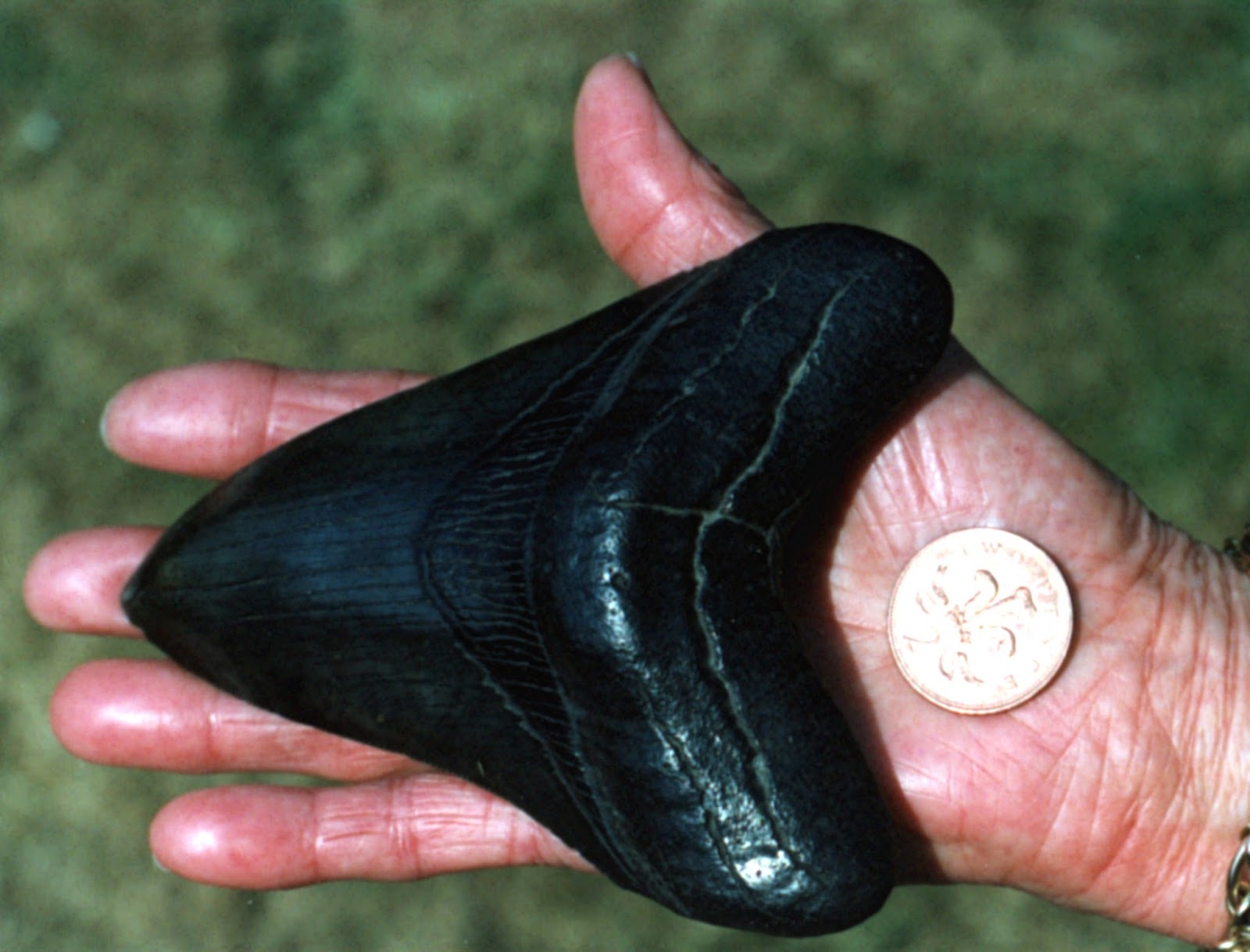
My mother Mary Shuker holding a fossil megalodon tooth with a 2 pence coin alongside it for scale purposes (© Dr Karl Shuker)

The great white shark once had an even bigger relative - the megalodon or megatooth shark C. megalodon ('big tooth'), sometimes placed in its own genus, Carcharocles. Named after its huge teeth, which were triangular in shape, up to 7.25 in high, and edged with sharp serrations, the megalodon was once believed to measure as much as 98 ft long, but this early estimate of its size was later shown to be incorrect, and was refined to a much more sedate yet still unnerving 43 ft. However, after various extra-large megalodon teeth, some almost 6 in long, were unearthed a while ago at the aptly-dubbed Sharktooth Hill near Bakersfield, California, ichthyologists conceded that certain specimens might have attained a total length of up to 55 ft.

The megalodon is presently known almost entirely from its huge teeth and some individual vertebrae. However, one notable exception is an associated vertebral column of approximately 150 individual centra (vertebra bodies) that range in state from fragmentary to nearly complete. In the major monograph Great White Sharks: The Biology of Carcharodon carcharias (1996), edited by Drs A. Peter Klimley and David G. Ainley, shark experts Drs Michael D. Gottfried, Leonard J.V. Compagno, and S. Curtis Bowman suggested on the basis of the previously-mentioned vertebral column's dimensions and other megalodon remains that in order to support its substantial dentition, the megalodon's jaws would have been "somewhat more robust, larger, and thicker, and with correspondingly more massive muscles to operate them" than those of the great white shark. In overall appearance, they proposed that the megalodon "would likely have had a streamlined, fusiform shape similar to, but more robust than, the [great] white shark and other lamnids, with more bulging jaws and a broader, blunter, and relatively more massive head".

If this reconstruction is accurate, might it explain the Greys' comments about the massive or square-shaped head of their respective giant mystery sharks? Moreover, it is believed that the fins of the megalodon were proportional to its larger size, and hence were bigger than those of the great white. Could this therefore explain the huge pectoral fins sported by the giant mystery shark sighted by Zane Grey?

Once believed to be an exclusively near-surface, continental shelf dweller in tropical and subtropical seas, the megalodon is now thought to have been sufficiently adaptable to have inhabited a wide range of environments, from shallow coastal waters and swampy coastal lagoons to sandy littorals and offshore deepwater abodes, exhibiting a transient lifestyle, and of near-cosmopolitan geographical distribution. Adult specimens, however, were not common in shallow-water habitats (thus explaining the relative rarity of modern-day Lord of the Deep and other super-sized great white lookalike sightings?), and mostly lurked offshore, but may have moved between coastal and oceanic habitats during different stages of the life cycle.

Alongside a life-sized recreation of megalodon jaws (© Dr Karl Shuker)

The megalodon first appeared in the fossil record around 16 million years ago during the mid-Miocene, and was undoubtedly one of the most formidable marine predators of all time. So why, according to mainstream zoology, did it become extinct (if, indeed, it did!)? As yet, there is no definitive answer to this key question. However, the cooling of the oceans that occurred during the late Pliocene and Pleistocene in conjunction with the Ice Ages (an occurrence not conducive to the megalodon's survival, as it favoured warmer, tropical waters), coupled with the resulting migration towards colder, high-latitude regions by the larger whales that constituted its preferred prey (megalodon tooth marks on the fossil bones of such cetaceans are well documented), is the scenario most favoured as the cause of this giant shark's apparent extinction. Also, during the Ice Ages a substantial volume of seawater became locked inside continental ice sheets, thereby resulting in a significant worldwide fall in sea levels, which is something else that was not compatible with megalodon survival, restricting the number of nursery sites available for its juveniles' safe maturation.

Yet in view of how adaptable the megalodon was in terms of the variety of marine environments that it could inhabit, might it have once again been sufficiently adaptable to withstand these changes? True, the fossil record does not contain ample evidence of its survival in regions where water temperatures had significantly declined during the Pliocene. Then again, as pointed out by Gottfried et al., this species may have existed in environments "...that have gone unrecognized due to preservational and/or collecting biases" – a significant but all-too-often ignored or neglected factor when making assumptions based upon the known fossil record.

Also, in view of the several exceedingly large whale species existing then, and still today (the whale hunting industry's depredations notwithstanding), the megalodon would not be short of suitable prey (big cetaceans, along with pinnipeds and fish too, are believed to have constituted its preferred diet). And what if, like the huge carnivorous sperm whale, it also sought out sizeable deepwater species such as giant squids, common in tropical as well as temperate seas, but for which, as is often true from deepwater habitats, there would be little if any readily available confirmation from the fossil record?

Megalodon tooth with two great white shark teeth and a metric ruler (© Kalan/Parzi/Wikipedia - CC BY-SA 3.0 licence)

Even if faced with competition from today's largest carnivorous cetaceans, might there still be enough suitable prey out there in the vast oceans to sustain a viable megalodon population? After all, even large migratory whales like the blue whale and grey whale still spend part of their year in sub-tropical waters; and during those periods that these cetaceans spend in more polar zones, megalodons could subsist instead upon big fishes like the basking shark, whale shark, and abundant smaller species existing in sizeable shoals, plus giant squids.

Irrespective of the precise reason(s) why it died out, the findings of a 2014 study by American researchers Drs Catalina Pimiento and Christopher F. Clements (published by the journal PLoS ONE) suggest that the megalodon most likely did so approximately 2.6 million years ago, during the late Pliocene (a few have opined that it may have persisted into the early Pleistocene). However, these dates fail to take into account a dramatic, highly controversial revelation that occurred at the close of the 1950s. Back in 1875, the British oceanographic survey vessel H.M.S. Challenger had hauled up two megalodon teeth from the manganese dioxide-rich red clay deposit at a depth of 14,000 ft on the sea bed south of Tahiti in the Pacific Ocean. When, in 1959, these teeth were dated by Russian scientist Dr Wladimir Tschernezky, the scientific world received a considerable shock. Knowing the rate of formation of the manganese dioxide layer covering them, he had measured the thickness of the layer - and from the results that he had obtained, he announced in a paper published on 24 October 1959 in the prestigious scientific journal Nature that one of the teeth was only 24,000 years old, and the other was a mere 11,000 years old.

In short, if Tschernezky's results were accurate, the megalodon shark was still alive at the end of the Pleistocene epoch 11,700 years ago. And if this is true, it would again lend credibility to speculation among some cryptozoologists that this incredible species may still be alive today. It is nothing if not intriguing, incidentally, that these two enigmatic teeth were obtained in much the same (Tahitian) locality as that of the giant sharks respectively encountered by the Greys. Just a coincidence?

HMS Challenger, 1858 engraving (public domain)

Having said that, there remains much contention among current ichthyologists and palaeontologists regarding Tschernezky's results. The main argument against them is that the teeth may have originally been reworked from older strata, as has been discussed earlier in this present book with respect to various alleged post-Mesozoic dinosaur and plesiosaur fossils. Also, there can be considerable variation in results obtained for the dating of manganese dioxide deposits, depending upon whether maximum or minimum deposition rates for them are being used, and such deposits also vary in relation to a number of fluctuating external factors such as the concentration in seawater of iron ions and photosynthesising plankton. Whether such variations can be so extreme as to yield a date as recent as only 11,000 years ago as opposed to one of at least 2.6 million years ago, conversely, has yet to be confirmed.

Also worthy of note here is the following statement from the earlier-cited paper by Pimiento and Clements:

In a very small proportion of simulations (1.5%), the inferred date of extinction fell after 0.1 Ma. In six simulations (0.06%) the inferred date of extinction fell after the present day (and thus the species could not be considered as extinct). However, because in the vast majority of the 10,000 simulations (>99.9%) the extinction time was inferred to have occurred before the present day, we reject the null hypothesis (that the species is extant) and the popular claims of present day survival of C. megalodon.

In short, although too small in number to be considered statistically significant, from the vast array of fossil samples utilised in their simulations a few modern-day inferred extinction dates did occur, as well as some with an inferred extinction date of under 100,000 years. How can these be explained and which specific samples were responsible, I wonder?

All in all, if they still exist it would be very interesting to see those two teeth that were dated so contentiously by Tschernezky back in the late 1950s subjected now to modern-day dating techniques. The most common method for Quaternary (Pleistocene and Holocene) remains – which these teeth would be if Tschernezky's age estimates for them of 24,000 and 11,000 years respectively are correct – is radiocarbon (carbon-14) dating, but it generally cannot date specimens older than around 60,000 years. However, a more recent and potentially much more useful technique, which has already been proved to be effective with fossil teeth, is electron paramagnetic resonance (EPR).

As noted in a 14 February 2014 Spectroscopy Europe online paper authored by Dr Mathieu Duval from the Centro Nacional de Investigación sobre la Evolución Humana (CENIEH) in Burgos, Spain, optimum time range application for EPR dating of tooth enamel lies between c.50,000 years and c.800,000 years. Moreover, in some specific conditions, the real time-range limits for EPR dating may be potentially pushed from present-day to around 2–3 million years. This means that EPR dating not only could demonstrate unequivocally whether Tschernezky's unexpectedly recent age estimates for these two very contentious megalodon teeth were correct, but also might still be able to provide an age for them even if they actually do date back to the time of the megalodon's official demise, i.e. approximately 2.6 million years ago – something that radiocarbon dating could not achieve.

A white fossil megalodon tooth (public domain)

One final comment regarding giant, ostensibly anachronistic shark teeth: in his authoritative work The Fishes of Australia Part 1: The Sharks, Rays, Devil-Fish, and Other Primitive Fishes of Australia and New Zealand (1940), Gilbert P. Whitley, then Curator of Fishes at the Natural History Museum in Sydney, Australia, stated:

Fresh-looking [megalodon] teeth measuring 4 by 3 1/4 inches have been dredged from the sea floor, which indicates that if not actually still living, this gigantic species must have become extinct within a recent period.

Unfortunately, he didn't provide further details concerning these bold claims. Fossil megalodon teeth are generally black or grey, less commonly brown and even gold, but white specimens are also known – and although they too are fossilised, these latter ones can look deceptively recent in appearance, so Whitley may have been mistaken. As for the teeth noted by him, sadly I have no knowledge of where they currently reside.

Megalodon vs the giant pliosaur Liopleurodon (© Hodari Nundu)

In summary: Dr Stead considered that the shark responsible for towing away the fishermens' lobster pots could have been a living megalodon, but just how likely is this terrifying prospect? I am well aware that by virtue of its very nature, the megalodon must surely appear to be one of this book's least likely creatures to survive in the present day. Having said that: if, as noted here, this monstrous carnivorous shark dined upon large whales, pinnipeds, fishes, and (especially) giant squids, moving up and down through the sea depths in search of its varied prey, its huge food requirements could surely be met. And if, as predicted from palaeontological studies, it only occasionally entered the oceans' surface waters as an adult, this might explain how in spite of its great size it has succeeded in eluding science, and why even fishermen in its general area of distribution only rarely catch sight of it.

Certainly, as someone who in 2008 flew from Santiago in Chile to Easter Island and, in so doing, spent no less than 4 hours travelling continuously across a seemingly limitless blue expanse of water with never so much as the tiniest speck of land in sight, yet knowing full well that this was in reality only a minute portion of the Pacific's full mid-oceanic extent, I feel qualified to offer the opinion that in such an unimaginably vast yet (for the greater part) only sparsely visited expanse of water relatively speaking, even creatures as huge as megalodons could surely exist just beneath the surface without ever being seen by humans for much if not all of their life. Here they could readily avoid the occasional cruiser or other sizeable sea vessel crossing the immense mid-ocean stretches of water upon which the various Pacific island groups are scattered like mere confetti, and only occasionally approach the shores of such islands where they may conceivably attract brief attention before travelling back out to the open seas once more.

We know that in Pliocene times megalodons occurred in coastal waters (albeit only rarely as adults), because the fossil record tells us so. But what if megalodons also lived in mid-oceanic stretches where any dead specimens either were consumed by other marine carnivores or became fossilised in locations where such remains can never be uncovered, such as the sea bottom – except, possibly, for a few anachronistic teeth dredged up by a research vessel?

Artistic impression of a megalodon pursuing two Eobalaenoptera whales (© Karen Carr-Wikipedia - CC BY-SA 3.0 licence)

And even if such a creature is spied once in a while when far out to sea, by some ocean-going tourists or bold fishermen venturing further out than usual from their coastal zone, what will they see? Just a triangular dorsal fin resembling a slightly larger-than-normal great white's, cutting silently through the water? Who would think to report that as anything special?

However, one could also argue that if the megalodon has indeed survived into the modern day, why was it not reported by whalers during the whaling age? Great white sharks were frequently attracted to harpooned, massively-bleeding whales, sometimes causing problems for whalers trying to land these huge, dying sea mammals or their carcases. How much greater a problem, therefore, would megalodons have posed? Yet I am not aware of any whaling records describing encounters with sharks that might have been megalodons.

As for smaller, juvenile megalodons, surely these would be hooked or entangled in netting from time to time, just like similar-sized adult great whites are? Yet again, however, there do not appear to be records of this, unless any such juveniles that may have been caught looked similar enough to adult great whites for anglers not to have considered them worthy of being brought to zoological attention?

Fossil whale vertebra bitten in half by a megalodon and bearing deep tooth-mark grooves from it (© Jayson Kowinsky/Wikipedia - CC BY 3.0 licence)

Also, if the megalodon still exists there would surely be big whales out there that have survived a megalodon attack yet carry the scars created by such a monster's huge teeth, but again I am unaware of any records of this. Then again, any whale surviving a megalodon attack would need to be very big indeed, and such individuals probably remain far out of sight in the open oceans, and those not surviving such an attack would be devoured by the victorious megalodon, with any remains simply sinking to the ocean floor.

Yet another anomaly if the megalodon is indeed still alive today is why no modern-day megalodon teeth have ever been found, bearing in mind that sharks shed numerous teeth every year, and that assemblages of shark teeth from other species have been procured from the sea floor. Then again, perhaps some modern megalodon teeth have been obtained, but, in view of how sought-after their fossil equivalents are by collectors (and expensive too!), have simply not been publicly revealed.

Having said all of this, there is a notable modern-day precedent for large sharks remaining hidden from science. In November 1976, a major new species of very large shark was accidentally captured by a research vessel anchored off the Hawaiian island of Oahu. Attempting to swallow one of the ship's parachute anchors, it had choked to death, despite its enormous mouth, which swiftly earned its species a very appropriate name - the megamouth shark Megachasma pelagios. Measuring up to 18 ft long, this very distinctive species has since been recorded from waters all around the world, and observations of living specimens fitted with tracking devices have revealed that it undergoes vertical migration - staying in the depths of the sea during the day, and rising to the surface only at night. This explains how such a large and widely-distributed shark species had successfully managed to evade scientific detection until as late a date as 1976.

Megamouth shark (© FLMNH Ichthyology/Wikipedia - CC BY-SA 4.0 licence)

In fact, a megamouth – or some other very large, formally undescribed species of deepwater shark – may actually have been seen and photographed by a scientific team a full 10 years earlier. On 15 August 1966, the San Mateo Times, a Californian newspaper, carried the following very intriguing report:

Undersea cameras of the Scripps Institute of Oceanogra­phy have photographed a colossal shark-like fish that is unfa­miliar and may prefer living in the darkest depths of the Pacific.

Scripps' Dr. John D. Isaacs, speaking at a weekend confer­ence, estimated the fish at 15-20 feet in length and three to six feet thick at its widest.

The species could not be determined, he said, because of the unmanned camera's limited field which only allowed pictur­ing the fish's gills and pectoral fin.

"It is probably a shark, but a shark the likes of which we have never seen before," he said. The fish was photographed at a depth of 6,OOO feet off San Clemente Island, which is about 75 miles south of Los Angeles.

Since the first megamouth was caught off Oahu in 1976, several have been washed ashore or documented in waters off California, lending further support to the possibility that the Scripps's mystery shark was a specimen of this very big species – always assuming, of course, that it wasn't a juvenile megalodon...?

Incidentally, crypto-sceptics have suggested that the megalodon could not exist as a deepwater species because it would require all manner of morphological specialisations, but in view of the fact that the only physical remains that we have of it are teeth and vertebrae, how can anyone say with certainty that it didn't – or doesn't – possess any such specialisations?

Bearing in mind, therefore, that a mere 40 years ago the megamouth was still unseen and undiscovered by science, the prospect for prehistoric persistence of the megalodon cannot be entirely denied out of hand – however much we may wish to banish from our minds the disturbing image of a rapacious, flesh-eating shark at least twice the size of the current record-holder for the great white, cruising anonymously beneath the surface of the Pacific in the 21st Century.

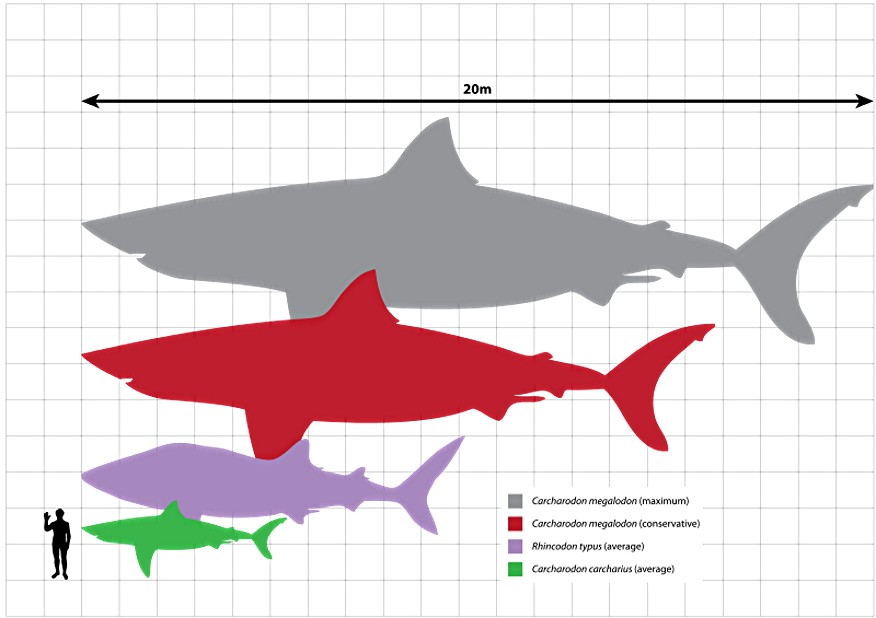
Megalodon shark (grey for maximum estimate, red for conservative estimate), whale shark (violet), great white shark (green), and human (black), to scale (© Scarlet23/Wikipedia - CC BY-SA 3.0 licence)

Last – and least – of all but requiring a mention here if only because of how much confusion it caused (and still causes) among viewers not well-versed in cryptozoology is the infamous 'mockumentary'/'docufiction' Megalodon: The Monster Shark Lives, which was first aired on the American TV network Discovery Channel in 2013, concerning the alleged modern-day survival of this giant shark species. The programme has an entry on Wikipedia that summarises its history very succinctly as follows:

The story, with only short disclaimers at the beginning and ending indicating that it is fictional, revolves around the loss of a pleasure boat and crew off the coast of South Africa and an ensuing investigation that points to an attack by a member of the species megalodon, a prehistoric shark thought to be long extinct. Its format is that of a documentary that includes accounts of "professionals" in various fields related to Megalodon. It follows a similar format to another docufiction aired by Discovery Channel, Mermaids: The Body Found.

The show, like Mermaids, came under equal criticism and scrutiny by both scientists and ordinary viewers due to the attempt to present fiction as a non-fiction documentary. Despite the disclaimers, some people actually believed they were watching a real documentary while others were offended that a docufiction show would be aired on a channel that had been known for true science shows. It should also be noted [that], unlike Mermaids, the disclaimers were barely even present, in addition to the talk show that was strongly saying and asking if people believed what was presented in Megalodon showed that the species was still alive. This misinformation likely caused the mass misconception that the shark species was still alive.

No it didn't – speculation on this subject was rife long before the programme was produced. As for whether the modern-day existence of the megalodon actually is – or is not – a misconception, this has already been discussed soberly and at length in the present section of this book. In my opinion, however, any attempt to do so in an equally rational, objective manner elsewhere is always likely to be overshadowed nowadays by the Discovery mockumentary's unhelpful contribution to the subject, which is a tragedy for those seeking to bestow gravitas and credibility upon serious cryptozoological debate.

This ShukerNature blog article on the megalodon is exclusively excerpted from my recent mega-book Still In Search Of Prehistoric Survivors: The Creatures That Time Forgot? (Coachwhip Publications: Darke County, 2016).