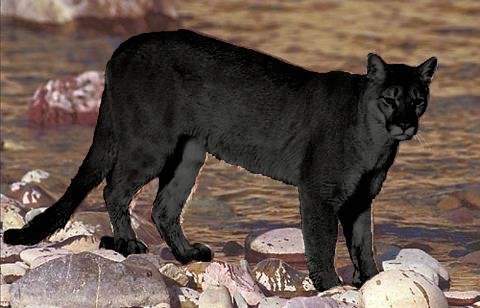
Computer-generated mock-up of a black puma (Dr Karl Shuker)
In all the time that I have been researching and documenting creatures of cryptozoology (almost 30 years now!), I have encountered few subjects engendering more controversy and confusion than the reality, or otherwise, of black pumas. Consequently, I have explored various aspects of this most contentious mystery cat in a number of different publications of mine. Yet as the subject still incites heated debate even today, I feel that it is now time to assemble together my disparate writings concerning it, and present them here (together with some previously-unpublished information) as a ShukerNature review article.
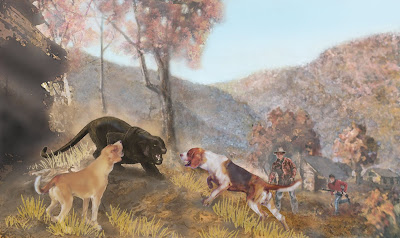 North American mystery black panther – a melanistic leopard, or a black puma? (William Rebsamen)
The two most commonly-voiced identities for Britain’s elusive ebony-furred mystery cats, as well as those reported in continental Europe, North America, and Australia, are escapee/released black panthers (i.e. melanistic, all-black specimens of the leopard
Panthera pardus) and black (melanistic) pumas. Yet whereas the former is plausible, the latter is little short of impossible - for two extremely good, fundamental reasons.
REASON #1: CONSPICUOUS BY ITS ABSENCE
Ordinarily, the puma
Puma concolor (aka the cougar, mountain lion, panther, catamount, and painter) occurs in two separate colour forms (morphs) – tawny-red, and slaty-grey, both of which are common.
 A normal tawny-coloured puma
Conversely, even though this species has the greatest native distribution range of any modern-day wild cat, occurring from the northernmost regions of North America to the southern tip of South America, the number of confirmed black pumas can be counted on the claws of one paw!
Not a single scientifically-confirmed preserved specimen exists. In 1843, a bona fide black puma was shot in the Carandahy River section of Brazil by professional hunter William Thomson, but regrettably its skin was not retained. In addition, I have seen various online mentions of an enigmatic taxiderm cat dubbed the 'Cherokee cougar' that has been claimed to be a black puma. Measuring 6 ft 2 in (1.87 m) long, and variously said to have been shot in Tennessee or Montana, it has been denounced by sceptics as a normal puma that has been dyed black, or some entirely different feline species. However, hair samples from it that were tested by researchers from the zoology department of East Tennessee State University confirmed that they had not been dyed, and DNA samples verified that it was a puma. Nevertheless, photos of it (not seen by me so far) apparently suggest that it is dark brown rather than truly black.
Unfortunately, however, no primary sources concerning this potentially significant specimen are provided by any online documentation that I have encountered so far. So if any reader can provide some, or can offer any further information or first-hand observations regarding it, I would greatly welcome receipt of them.
In 1998, American mystery cat investigator Keith Foster of Holcolm, Kansas, informed me that what had been reported to him by the person concerned as being a "glossy black puma" had been shot and killed in Oklahoma several years previously after it had been killing sheep on his father's farm. Afterwards, this person (a church pastor who was known to Keith) contacted the authorities, and the Oklahoma Department of Wildlife duly confiscated the cat's carcase. Nothing more was heard about it after that, but Keith vowed to trace it. Unlike so many cryptozoological cases featuring a missing specimen, moreover, Keith did succeed in doing so, but was disappointed to discover that it wasn't glossy black in colour after all, merely grey.
As for pictorial evidence, only one clear, unequivocal photograph of a black puma is known. Reproduced below, this photo depicts a dead specimen shot in 1959 by Miguel Ruiz Herrero in the province of Guanacaste along Costa Rica's north Pacific coast. Estimated to weigh 100-120 lb, its carcase is seen here alongside Ruiz's herdsman, but what happened to it afterwards is unknown.
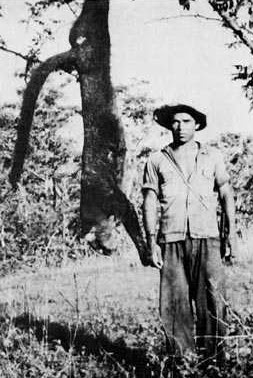 Ruiz's black puma (Miguel Ruiz Herrero)
In view of such exceptional scarcity of tangible evidence, it is evident that the prospect of any of Britain's, Europe's, or Australia's black mystery cats being escapee/released black pumas is unlikely in the extreme. After all, if there were such extraordinarily rare non-native cats as black pumas in captivity in any of these regions, they would surely have attracted immense publicity, and would have been far too valuable to be allowed to escape or to be released by their owners.
But what about in North America, where the puma is a native species? Surely a black morph could have arisen here? After all, countless sightings of seemingly very large all-black cats claimed by their eyewitnesses to be melanistic pumas have been reported all over this continent (most especially in the east), and continue to be today. There are even Native American traditions appertaining to such beasts, which they termed 'black devils' or 'devil cats'. But could they truly be melanistic pumas? Not according to Reason 2.
REASON #2: THE TWO-TONE DILEMMA
Whereas most melanistic cat forms are uniformly black all over, so-called black pumas only have black upperparts. Their underparts are noticeably paler, usually slate-grey or dirty cream. This provides crucial evidence for discounting such cats as the identity of Britain’s, Europe's, North America's, and Australia's pantheresque mystery cats, because these latter felids, just like bona fide black panthers (and also like melanistic specimens of the jaguar
Panthera onca), are black all over.
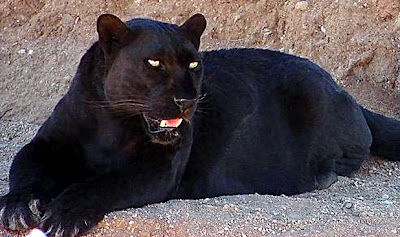 A black panther, i.e. melanistic leopard (Qilinmon at the English language Wikipedia)
The black puma's distinctive two-tone colouration, black dorsally and paler ventrally, can be clearly discerned in Ruiz's specimen. Equally, the Carandahy River specimen's appearance was described by Thomson in his book
Great Cats I Have Known (1896) as follows:
"The whole head, back, and sides, and even the tail, were glossy black, while the throat, belly, and inner surfaces of the legs, were shaded off to a stone gray."THE JAGUARETE – AN AMALGAMATED ANOMALY?Yet although exceedingly scarce today, black pumas do seem to have been more common in past ages, certainly in South (even if not in North) America, because there are a number of reports and even one or two early illustrations of such cats, sometimes dubbed ‘couguars noires’, in archaic natural history tomes. And these reports and illustrations often compare closely with the (very) few verified modern-day specimens - although in some cases there appears to have been confusion between, and amalgamation of, reports of black pumas and reports of black jaguars.
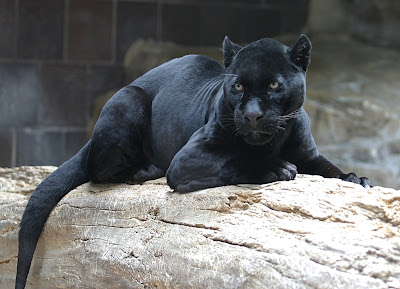 A black (melanistic) jaguar (cburnett/Wikipedia)
I examined this confusing situation as follows in my very first book,
Mystery Cats of the World (1989):
"Referred to in Latin America as `black tigers', [melanistic jaguars] tend to be noticeably large, especially in the Mato Grosso. According to various antiquarian zoology tomes and native Guyanan beliefs however, a further type of black tiger would seem to exist within this continent, one which allegedly is very different morphologically from the typical melanistic jaguar. Nevertheless, its precise identity has never been satisfactorily ascertained.
"Nowadays a totally forgotten felid, this mysterious melanistic was referred to as the `cougar noire' by the eminent eighteenth-century naturalist de Buffon, and as the `jaguarete' (a less ambiguous name, which I therefore prefer and shall use hereafter in this book) by his equally eminent contemporary Thomas Pennant. However, in the virtually verbatim version of Pennant's description which appeared in Thomas Bewick's A General History of Quadrupeds, S. Hodgson referred to it merely as `the black tiger'. Hodgson's choice of name would seem to imply that the jaguarete is truly nothing more than a straightforward melanistic jaguar. Yet neither the illustration which accompanied Pennant's description nor that (by Bewick) which accompanied Hodgson's is compatible with such an identity. To quote Pennant:
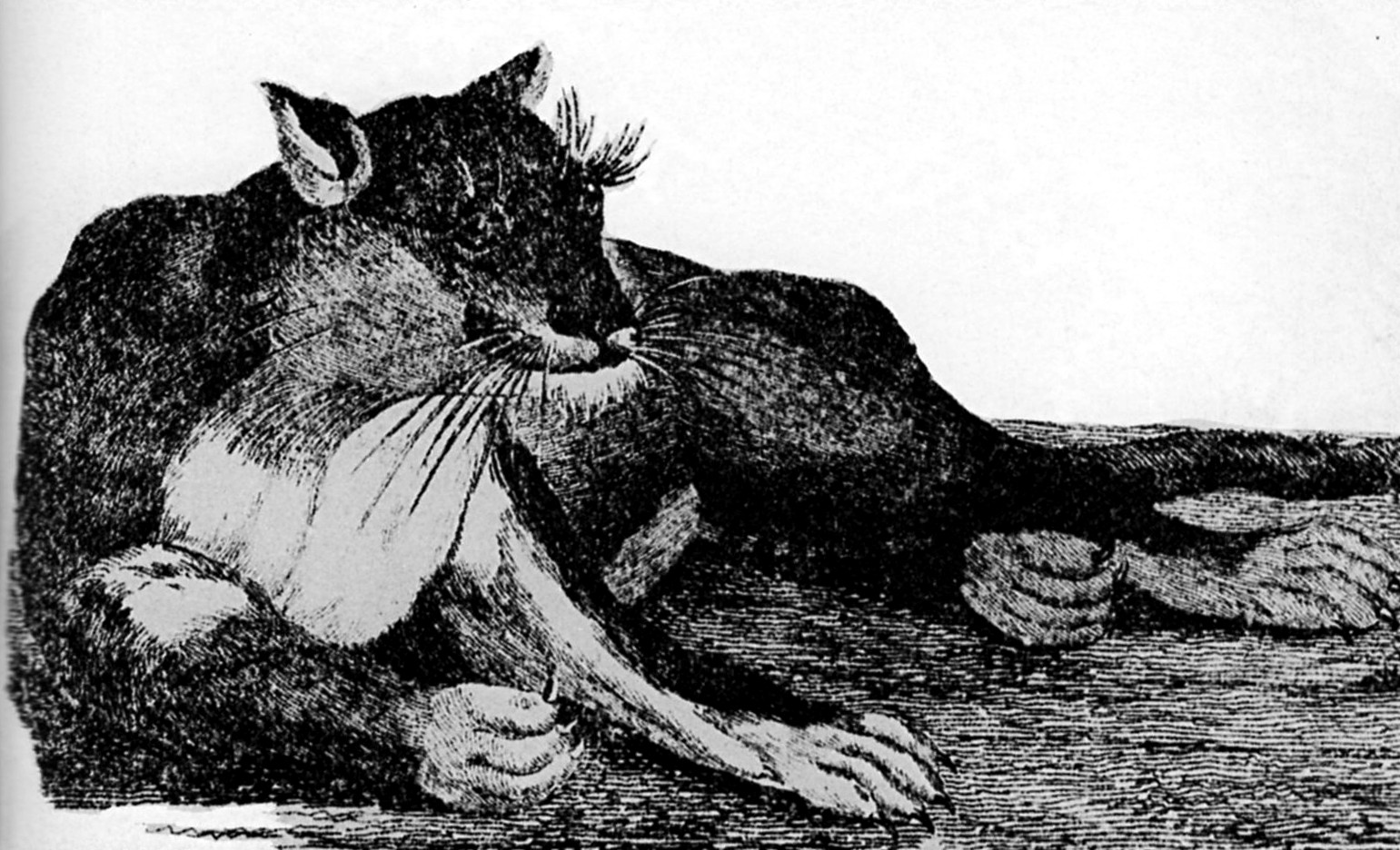
"'Head, back, sides, fore part of the legs, and the tail, covered with short and very glossy hairs, of a dusky-color; sometimes spotted with black, but generally plain: upper lips white: at the corner of the mouth a black spot: long hairs above each eye, and long whiskers on the upper lip; lower lip, throat, belly, and the inside of the legs, whitish, or very pale ash-color; paws white: ears pointed. Grows to the size of a heifer of a year old: has vast strength in its limbs. Inhabits Brasil and Guiana (Guyana]: is a cruel and fierce beast; much dreaded by the Indians; but happily is a scarce species.'" Bewick's 'black tiger', in which it is clearly two-tone (like a black puma) rather than uniformly black (like a black jaguar)
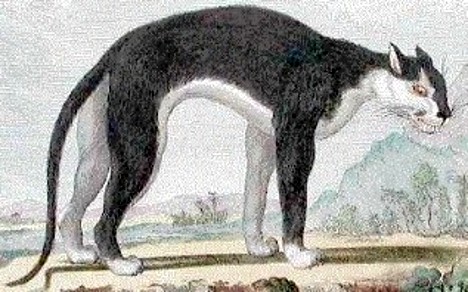
"In addition, Hodgson noted that it frequented the seashore and that it preyed upon a variety of creatures (including lizards, alligators and fishes) as well as devouring turtles' eggs and (rather curiously) the buds and leaves of the Indian fig."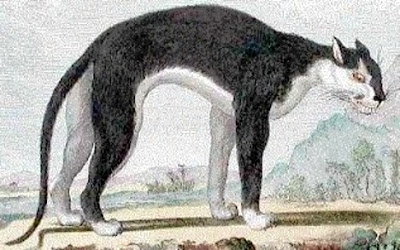 Buffon's two-tone 'cougar noire'
Subsequent to writing
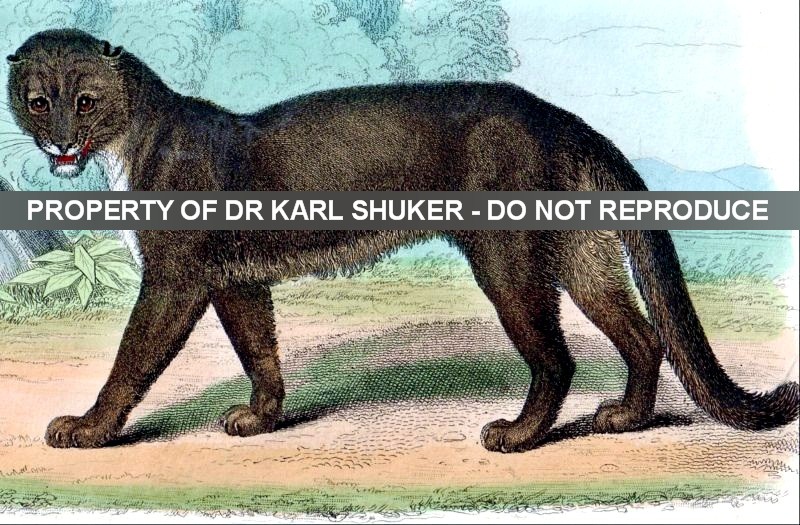
Mystery Cats of the World, I discovered that in 1778, German naturalist Johann Christian Daniel Schreber had formally described the jaguarete and christened it
Felis discolor ('two-coloured cat'). Yet, paradoxically, the accompanying colour illustration of it merely showed a mid-/dark-brown cat resembling a normal puma!
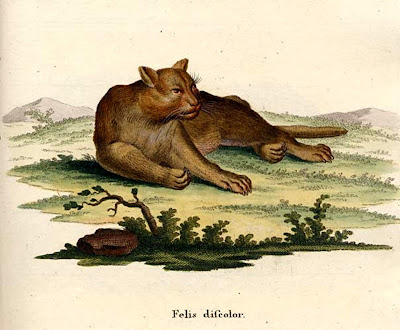 Schreber's monotone 'two-coloured cat' Felis discolor
Returning to my book's account of this mysterious cat:
"What could the jaguarete be? On first sight, a black jaguar identity seems most likely - in most specimens, the rosettes can indeed be seen as cryptic markings against the coat's abnormally dark colouration. However, the black jaguar is dark dorsallv and ventrally, just like the black panther and other melanistic felid individuals, thereby contrasting markedly with the near-white underparts, lowers jaw and paws of the jaguarete. Of course, it may be that the jaguarete is nothing more than an inaccurate description of a black jaguar, but arguing against this is the statement in a footnote by Pennant that two jaguaretes were actually shown in London during the eighteenth century; hence their appearance would have been familiar to naturalists of that time."In my book, I went on to consider two additional jaguar possibilities. One was that the jaguarete was a jaguar possessing the rare recessive black-and-tan mutant allele of the agouti gene in homozygous (two-copy) form, because this yields a cat with black dorsal pelage but light or cream underparts, which corresponds well with the shot black pumas of Thomas and Ruiz. The other possibility was a pseudo-melanistic jaguar, i.e. one in which its rosettes had freakishly multiplied and amalgamated to yield a similar appearance – black dorsally and normal, paler colouration ventrally.
However, having given the matter of the jaguarete further consideration since writing that book, I now deem it more plausible that like so many other cryptids (such as the great sea serpent and the Nandi bear), the jaguarete was in reality a non-existent composite beast, erroneously created by combining together reports of wholly different animals. In the case of the jaguarete, those animals would seem to be normal South American melanistic jaguars (explaining the spots) and rare but nevertheless real South American melanistic pumas (explaining the two-tone colour scheme, which matches that of the Ruiz and Thomas cats). Certainly, some of the images that I have seen of the jaguarete greatly resemble black pumas of this nature, even including the puma's characteristic black facial bar, as seen, for instance, in the illustration below:
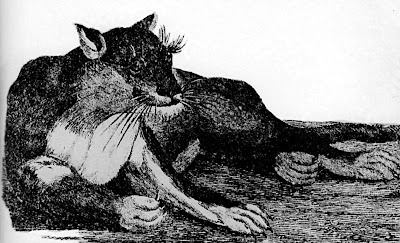 Engraving of the jaguarete in Thomas Pennant's A History of the Quadrupeds (1781)THE YANA PUMA – NEITHER PUMA NOR JAGUAR?
As if the jaguarete had not muddied – and muddled - the taxonomic waters sufficiently in relation to black pumas and black jaguars, South America may also be home to a further melanistic mystery cat, and of quite prodigious size, as documented by me in another of my books,
The Beasts That Hide From Man (2003). Known as the yana puma, it may even have been the inspiration for one of Sir Arthur Conan Doyle's most famous short stories, 'The Brazilian Cat', which was first published by
Strand Magazine in 1898, then republished in a 1923 collection of his horror stories,
Tales of Terror and Mystery.
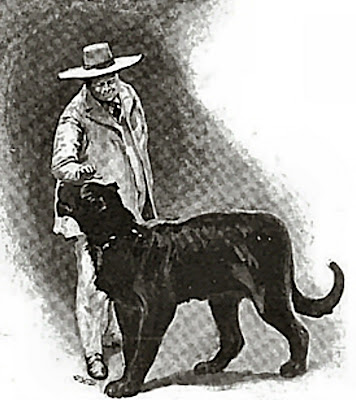 One of the illustrations by Sidney Paget accompanying the original 1898 publication of 'The Brazilian Cat'
Here is a condensed version of my book's account of the yana puma:
"Several years ago, I read a short story by Conan Doyle called 'The Brazilian Cat', published in 1923, which featured a huge, ferocious, ebony-furred felid that had been captured at the headwaters of the Rio Negro in Brazil. According to the story: "Some people call it a black puma, but really it is not a puma at all". Yet there was no mention of cryptic rosettes, which a melanistic (all-black) jaguar ought to possess, and it was almost 11 ft in total length - thereby eliminating both puma and jaguar from consideration anyway. Hence I simply assumed that Doyle's feline enigma was fictitious, invented exclusively for his story - but following some later cryptozoological investigations of mine, I am no longer quite so sure.
"To begin with: in Exploration Fawcett (1953), the famous lost explorer Lt.-Col. Percy Fawcett briefly referred to a savage 'black panther' inhabiting the borderland between Brazil and Bolivia that terrified the local Indians, and it is known that Fawcett and Conan Doyle met one another in London. So perhaps Fawcett spoke about this 'black panther' and inspired Doyle to write his story. But even if so, it still does not unveil the identity of Fawcett's panther. Black pumas are notoriously rare - only a handful of specimens have been obtained from South and Central America (and none ever confirmed from North America). Conversely, black jaguars are much more common, and with their cryptic rosettes they are certainly reminiscent of (albeit less streamlined than) genuine black panthers, i.e. melanistic leopards. However, the mystery of Brazil's black panthers is far more abstruse than this... [I then went on to discuss the Brazilian jaguarete, referring to the accounts of Buffon and Pennant already incorporated in this present ShukerNature article.]
"Yet as it seemed to be nothing more than a non-existent composite creature - 'created' by early European naturalists unfortunately confusing reports of black jaguars with black pumas - the jaguarete eventually vanished from the wildlife books. Even so, its rejection by zoologists as a valid, distinct felid may be somewhat premature. This is because some reports claimed that the jaguarete was much larger than either the jaguar or the puma - a claim lending weight to the prospect that a third, far more mysterious black cat may also have played a part in this much-muddled felid's history.
"Dr Peter J. Hocking is a zoologist based at the Natural History Museum of the National Higher University of San Marcos, in Lima, Peru. Aside from his official work, for several years he has been collecting and investigating local Indian reports describing various different types of mysterious, unidentified cat said to inhabit the Peruvian cloudforests. One of these, of great relevance here, has been dubbed by him 'the giant black panther'.
"In an article published by the journal Cryptozoology in 1992, Dr Hocking revealed that this particular Peruvian mystery cat is said to be entirely black, lacking any form of cryptic markings, has large green eyes, and is at least twice as big as the jaguar. Moreover, the Quechua Indians term it the yana puma ('black mountain lion'). This account immediately recalls Conan Doyle's story of the immense Brazilian black cat. The yana puma is apparently confined to montane forest ranges only rarely visited by humans, at altitudes of around 1600-5000 ft. If met during the day, when resting, it is generally passive, but at night this mighty cat becomes an active, determined hunter that will track humans to their camps and has sometimes slaughtered an entire party while they slept, by lethally biting their heads.
"When discussing the yana puma with mammalogists, Hocking has frequently been informed that it is probably nothing more than a large melanistic jaguar. Yet as he pointed out in his article, such animals do not attain the size claimed for this mysterious felid (nor do melanistic pumas) - and the Indians are adamant that it really is quite enormous. Nevertheless, the yana puma could still merely be a product of native exaggeration, inspired by real black jaguars (or pumas) but distorted by superstition and fear.
"However, a uniformly black, unpatterned felid does not match either a black jaguar or a black puma - yet it does compare well with Conan Doyle's Brazilian cat. Moreover, as some jaguarete accounts spoke of a black cat that was notably larger than normal jaguars and pumas, perhaps the yana puma is not limited to Peru, but also occurs in Brazil. Is it conceivable, therefore, that Doyle (via Fawcett or some other explorer contact) had learnt of the yana puma, and had based his story upon it? If so, it would be one of the few cases on file in which a bona fide mystery beast had entered the annals of modern-day fiction before it had even become known to the cryptozoological - let alone the zoological - community!"Particularly intriguing in relation to the yana puma is an illustration that I recently came upon while browsing through Sir William Jardine's tome
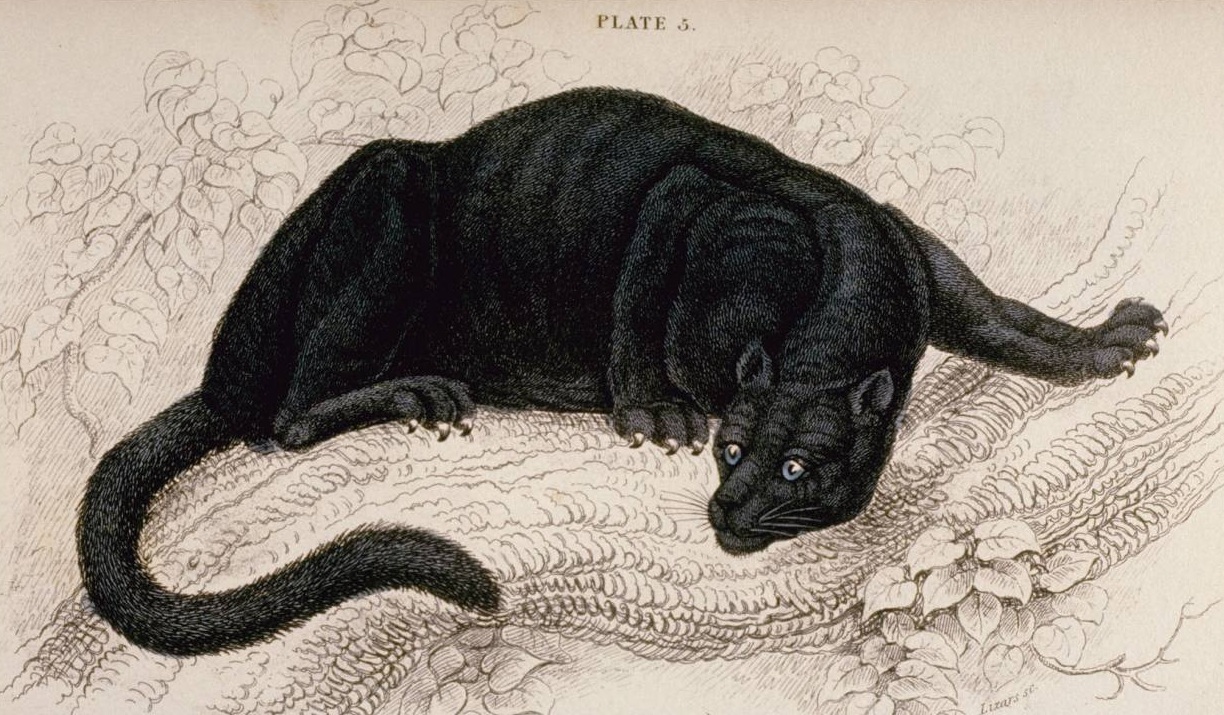
The Natural History of the Felinae (1834). It was a magnificent watercolour drawing by James Hope Stewart of an alleged black puma from Paraguay, dubbed ‘
Felis nigra’, with big green eyes and unpatterned coat.
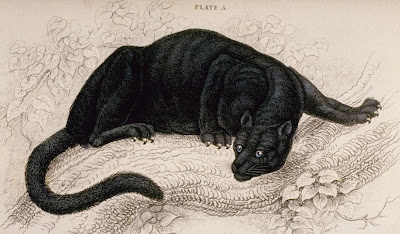 ‘Felis nigra’, a black puma – or even the yana puma?
Yet unlike other abnormally dark pumas on record, the Jardine individual was black all over, rather than being black dorsally and paler ventrally. Consequently, its uniformly black, unpatterned pelage, together with its large green eyes, accord well with native descriptions of the Peruvian yana puma.
THE ONÇA-CANGUÇÚ - A WHITE-THROATED, TUFT-TAILED JAGUAR?One further South American mystery cat worthy of mention here is a remarkable Brazilian felid known locally as the onça-canguçú. Its existence has lately been confirmed via the procuring of physical remains by Dutch zoologist Dr Marc van Roosmalen, who has discovered numerous new and unclassified mammalian forms in Brazil during his researches there over the past two decades, but its taxonomic identity currently remains undetermined. I have documented all of Marc's discoveries in my book
The Encyclopaedia of New and Rediscovered Animals (2012), so here is what I wrote about his mystery cat:
"White-Throated Black Jaguar
Last, and most mysterious, of all, this unclassified big cat, which is known locally as the onça-canguçú (‘bigger jaguar that goes in pairs’), resembles a very large black (melanistic) jaguar Panthera onca, but, uniquely, has a white throat and a tufted tail. Moreover, unlike normal melanistic jaguars, which, when viewed at certain angles, can be seen to be rosetted, the onça-canguçú is pitch-black with no coat patterning whatsoever. Marc has yet to see this creature personally, and also narrowly missed the opportunity to inspect one pelt – a hunter who had killed one of these cats threw its pelt away shortly before Marc arrived asking about this feline cryptid. Happily, he later obtained both a pelt and a skull, which should greatly assist in determining the onça-canguçú’s zoological status."
 Dr Marc Van Roosmalen surrounded by specimens of some of the new Brazilian mammals that he has discovered, with the onça-canguçú's pelt and skull visible on the floor in this photograph's bottom-left-hand corner (Dr Marc van Roosmalen)
As only its throat (as opposed to its entire ventral surface) is white, as it compares in size to a large black jaguar (and hence is evidently bigger and burlier than a puma), and as it has a tufted tail (an extraordinary feature possessed only by the lion among known felids), I do not personally consider the onça-canguçú to have any relevance to the question of whether black pumas exist in South America. However, it will be most interesting to discover what DNA analyses on samples of the pelt owned by Marc reveal, and how closely the skull compares anatomically to those of jaguars and those of pumas.
ARE BLACK PUMAS AN OPTICAL ILLUSION?
Over the years, a number of explanations for claimed sightings of native black pumas in North America and escapee/released non-native black pumas elsewhere have been put forward, proposing that they are merely normal pumas observed under abnormal conditions. When tested, however, such theories have failed to deliver. To quote once again from my
Mystery Cats of the World:
"[As contemplated by veteran puma investigator Bruce Wright:] Could normal-coloured pumas appear black when wet? To investigate this, Wright took the fresh hide of a newly killed puma from Vancouver Island, suspended it by its edges, filled it with water and left it overnight. When he examined it the following morning, however, despite viewing and photographing it from every conceivable angle, he was unable to make it appear black in colour. He also considered the possibility that backlighting of normal pumas could create the illusion of black fur, but this, when checked, proved untenable too."A BLACK PUMA AT LONDON ZOO?Finally: The following account and images, included here as a ShukerNature exclusive, are excerpted from my forthcoming book
Cats of Magic, Mythology, and Mystery (CFZ Press: Bideford, 2012). Once this book has been published, I shall remove the watermarks from the images below:
"As far as I was aware, no such animal [black puma] had ever been kept in captivity, at least not in Europe. But all that changed a while ago during one of my numerous visits to one of my all-time favourite places – Hay On Wye, Herefordshire’s world-famous ‘Town of Books’, nestling on the Welsh border.
"In addition to around 30 bookshops at present, this small town also has shops devoted to antiquarian prints. As an avid collector of such items, I was browsing in one of these shops one sunny Saturday afternoon during the late 1990s when I came upon a truly remarkable example – remarkable because it is not often that an antiquarian print depicts a cryptozoological cat!
"The print in question, which was an original hand-coloured copper engraving dating from 1862 (as written in pencil on its reverse), and which I naturally lost no time in purchasing, is duly reproduced here (its previous appearance, in an article of mine published by the now defunct British monthly magazine Beyond, where it was reproduced in its original full-colour format, may well have been the first time that it had ever been published anywhere), and appears to portray a bona fide black puma." My black puma engraving (Dr Karl Shuker)"Certainly, it comes complete with jet-black upperparts, slaty-grey underparts, and white chest – very different from normal pumas, which are either tawny brown-rufous or silver-grey (the puma exhibits two distinct colour morphs), but matching precisely those few confirmed black puma specimens. Most interesting of all, however, is the engraving’s caption: “The Puma. In the Gardens of the Zoological Society”. This means that if the puma in the engraving has been coloured accurately, and there is no reason why it should not have been, a black puma, that most mysterious of mystery cats, was once actually on display at London Zoo!
"When I first discovered this engraving, I wondered whether its astonishing black puma was exhibited at London Zoo at the same time as the zoo’s unique captive woolly cheetah, bearing in mind that the engraving was dated 1862. Who knows, if so, it may even have been in the enclosure next door!
"In February 2011, however, I discovered a second copy of the same puma engraving, but this one was dated 1825. (Moreover, the hand-colouring on this latter version, reproduced here, is much more skilful.)"
 The second version of the black puma engraving (Dr Karl Shuker)
"So which (if either) is the correct date for it? The mystery deepens, and darkens – which is very apt for anything featuring a black puma at its core!"
Indeed it is. For as I have shown here, the all-too-commonly-cited 'explanation' in media reports of black mystery cats being black pumas is woefully unsubstantiated at the present time by confirmed evidence of such cats' existence. Or, to rephrase this situation in a more succinct manner – AWOL black pumas RIP!













 Posts
Posts