Dr KARL SHUKER

Zoologist, media consultant, and science writer, Dr Karl Shuker is also one of the best known cryptozoologists in the world. He is the author of such seminal works as Mystery Cats of the World (1989), The Lost Ark: New and Rediscovered Animals of the 20th Century (1993; greatly expanded in 2012 as The Encyclopaedia of New and Rediscovered Animals), Dragons: A Natural History (1995), In Search of Prehistoric Survivors (1995), The Unexplained (1996), From Flying Toads To Snakes With Wings (1997), Mysteries of Planet Earth (1999), The Hidden Powers of Animals (2001), The Beasts That Hide From Man (2003), Extraordinary Animals Revisited (2007), Dr Shuker's Casebook (2008), Karl Shuker's Alien Zoo: From the Pages of Fortean Times (2010), Cats of Magic, Mythology, and Mystery (2012), Mirabilis: A Carnival of Cryptozoology and Unnatural History (2013), Dragons in Zoology, Cryptozoology, and Culture (2013), The Menagerie of Marvels (2014), A Manifestation of Monsters (2015), Here's Nessie! (2016), and what is widely considered to be his cryptozoological magnum opus, Still In Search Of Prehistoric Survivors (2016) - plus, very excitingly, his four long-awaited, much-requested ShukerNature blog books (2019-2024).

Dr Karl Shuker's Official Website - http://www.karlshuker.com/index.htm

IMPORTANT: To view a complete, regularly-updated listing of my ShukerNature blog's articles (each one instantly clickable), please click HERE!

IMPORTANT: To view a complete, regularly-updated listing of my published books (each one instantly clickable), please click HERE!

IMPORTANT: To view a complete, regularly-updated listing of my Eclectarium blog's articles (each one instantly clickable), please click HERE!

IMPORTANT: To view a complete, regularly-updated listing of my Starsteeds blog's poetry and other lyrical writings (each one instantly clickable), please click HERE!

IMPORTANT: To view a complete, regularly-updated listing of my Shuker In MovieLand blog's articles (each one instantly clickable), please click HERE!

IMPORTANT: To view a complete, regularly-updated listing of my RebelBikerDude's AI Biker Art blog's thematic text & picture galleries (each one instantly clickable), please click HERE!

Search This Blog


PLEASE COME IN, I'VE BEEN EXPECTING YOU...

PLEASE COME IN, I'VE BEEN EXPECTING YOU...
WELCOME TO SHUKERNATURE - ENJOY YOUR VISIT - BEWARE OF THE RAPTOR!


Showing posts with label pushmi-pullyu. Show all posts

Sunday, 20 March 2016

WHATEVER HAPPENED TO THE HUEQUE? SEEKING THE LOST LLAMA OF CHILE


Vidaurre's engraving from 1776 depicting four of the five South American camelids once recognised – llama (top left), hueque aka Chilihueque (top right), vicuna (bottom left), guanaco (bottom right) (public domain)

Llamas are very familiar animals to science and the general public alike. As will now be revealed in this ShukerNature blog article, however, they may well have once shared their native Andean homelands with a highly unfamiliar, all-but-forgotten close relative whose zoological identity and disappearance have remained unexplained for well over 300 years.


ASIAN CAMELS AND SOUTH AMERICAN LLAMAS – THE LAST OF THEIR DYNASTY

Back in prehistoric times, the camelids were a very diverse taxonomic family of artiodactyl (even-toed) ungulates, distributed widely across the globe and represented by small, large, humped, humpless, short, tall, and sometimes very tall forms (such as North America's prairie-inhabiting giraffe camel Aepycamelus, aka Alticamelus).

Early restoration of Aepycamelus the giraffe camel by Heinrich Harder in 1920 (public domain)

Today, however, this once-mighty and extremely diverse dynasty is reduced to just six representatives – the two species of humped camel (one-humped dromedary Camelus dromedarius and two-humped Bactrian C. bactrianus) native to Asia (plus feral populations variously established in parts of Europe and Australia); and the four humpless species native to South America. These latter four species are the vicuna, alpaca, llama, and guanaco.

Following the discovery and conquest of South America by the Spanish during the 1500s, its humpless camelids attracted great interest from Western naturalists, with the llama in particular featuring in a number of bestiaries (such as Edward Topsell's famous work The History of Four-Footed Beasts and Serpents, 1658), in which it was generally referred to as the allocamelus.

The llama or allocamelus as depicted in Edward Topsell's bestiary The History of Four-Footed Beasts and Serpents (1658) (public domain)

It even entered European heraldry, where it was sometimes dubbed the ass-camel, and was duly represented with the head of an ass and the body of a short-legged, convex-backed camel.

The New World's camelid quartet also incited much confusion as to how they were related to one another. For whereas the vicuna and guanaco are wild species, the llama and alpaca are entirely domesticated.

Llama (© Dr Karl Shuker)

And to make matters even worse, the term 'llama' eventually established itself colloquially as a term not just specific to its own particular single species but also as a general term covering all four South American species.

Vicunas (© Haplochromis/Wikipedia CC BY-SA 3.0 licence)

Eventually, the consensus was that the small goat-like vicuna was not just a valid species but one so distinct from the others that it deserved its own genus, and was duly dubbed Vicugna vicugna. The remaining trio were housed together in a second genus, Lama, and were formally christened Lama guanicoe (=huanacos) (the guanaco), L. glama (the llama), and L. pacos (the alpaca), with both the llama and the alpaca being deemed to be domesticated descendants of the guanaco.

Guanaco (public domain)

DNA studies published in 2001, however, revealed that the alpaca is in fact most closely related to the vicuna, and is believed to have descended from this latter species, not from the guanaco after all. Consequently, the alpaca is now housed with the vicuna in the genus Vicugna, as Vicugna pacos.

Alpacas (public domain)

In addition, there are two non-taxonomic breeds or varieties of alpaca – the rare Suri alpaca, sporting a long, shiny, very soft, slightly-curled fleece, which is very expensive; and the more common Huacaya alpaca, sporting a shorter, fluffier fleece, which is far less expensive.


CAMELID HYBRIDS – THE HUARIZO AND THE CAMA

Yet even though they are now split into separate genera, the alpaca and the llama are sufficiently closely related genetically to yield viable crossbred offspring– a hybrid resulting from interbreeding between a male llama and a female alpaca is known as a huarizo. Much smaller than llamas, it is greatly valued for its very lengthy fleece and gentle disposition, but is usually sterile. Remarkably, moreover, there have even been cases of successful intergeneric hybridisation in captivity between male dromedaries and female llamas, the resulting camel x llama crossbreed being referred to as a cama.

Adult cama (© unknown to me – all information would be welcomed; photographs included on a strictly non-commercial Fair Use basis only)

This surprising feat was first achieved in 1998, via artificial insemination, at the Camel Reproduction Centre in Dubai, the aim being to create an animal with the size, patience, and stamina of a camel but with a fleece at least as good as (if not better than) a llama's. The first cama, a male, born in 1998, was named Rama; a second cama, a female, was born in 2002, and was named Kamilah. In each case, it looked like a large version of its llama mother in overall appearance, and lacked its camel father's hump, but it did possess his small ears and short tail.


A HISTORY OF THE HUEQUE, CHILE'S MISSING MINI-LLAMA

Hybrids notwithstanding, what is not widely known nowadays is that in addition to the vicuna, alpaca, guanaco, and llama, not so very long ago there may also have been a fifth New World camelid species, or at least a well-defined variety of one of the still-existing quartet. Formerly found in Chile, this seemingly-lost and certainly long-forgotten llama was known as the hueque, or the chilihueque in full.

Between the 16th and 17th Centuries, Spanish-speaking travellers who visited the central and south-central valleys of Chile reported the presence in territories owned by the Araucanians (i.e. the Mapuches peoples known here as the Moluche) of a small, distinctive type of llama not seen anywhere else. Moreover, the travellers learnt that its existence here pre-dated the Hispanic conquest, and it may well have been adopted by the Moluche from the Inca culture. This intriguing creature was the hueque, which was generally bred not as a beast of burden (like the llama is in other South American countries) but for its meat and in particular for its fleece, which was extremely soft, luxuriant, and so long that it dragged on the ground as the animal walked.

Having said that, Chilean Jesuit priest and naturalist Father Juan Ignacio Molina noted in his 2-volume magnum opus The Geographical, Natural and Civil History of Chili (1782) that when the Dutch sea captain Admiral Joris van Spilbergen had landed on Chile's small Mocha Island in 1614, he had observed hueques being used to pull small carts by Mapuches living there. Confusingly, however, further on in his book Molina contradicted himself by stating that what van Spilbergen had seen hueques being used for on Mocha Island was pulling ploughs.

Father Juan Ignacio Molina (public domain)

Writing in 1550 after having conquered southern Chile, the Spanish conquistador Pedro de Valdivia stated that the hueque was very abundant in this region, and that not only were the inhabitants dressed exuberantly in the most elegant woollen clothes but even their houses were stocked full of wool. Also present here was a second camelid, known as the luan, but it was the fleece of the hueque that was always used to manufacture the most prized, sought-after woollen garments. Indeed, the Spaniards were so impressed by this animal's superior fleece that they dubbed it 'the sheep of the land',

The luan was generally identified as the guanaco, but what exactly was the hueque? There was no doubt that it too was some type of llama (using this term in its general sense here), but its precise nature incited much controversy among early naturalists. Two conflicting schools of thought eventually arose. One asserted that it was a local (semi-)domesticated variety of the guanaco distinct from the llama, the other claimed that it was one and the same as the llama and that it had been introduced here from further north, but neither option garnered a significant majority of support. This remains true today.

Guanaco photographed in Chile's Torres del Paine National Park (public domain)

The few illustrations of the hueque that were produced while it still existed generally depicted it as being similar to the llama but somewhat smaller in overall size, with a slightly shorter neck and legs, but sporting a thicker fleece. However, these were based merely upon verbal accounts received from others, rather than upon first-hand observations made by the engravers themselves, so they may not be wholly accurate representations of this lost form. Written accounts of the hueque by Molina and others claimed that it occurred in several different colours – white, brown, black, and grey. Molina also stated that it was approximately 6 ft long, and stood about 4 ft tall.

Perhaps the most natural-looking representation of an alleged hueque, depicted alongside a llama, is the one reproduced below:

An engraving from a book by Amédée-François Frézier, published in 1716, depicting a llama (on the left) and an alleged hueque (on the right) (public domain)

It appeared as Plate 22 in A Voyage to the South-Sea and Along the Coasts of Chili and Peru in the Years 1712, 1713 and 1714, which was written by French explorer Amédée-François Frézier and published in 1716. Unfortunately, however, whereas the alleged hueque was portrayed in side view, the llama was merely depicted standing face-on, thereby preventing direct morphological comparisons of these two camelid types to be readily made.


WHY DID THE HUEQUE DIE OUT, AND WHAT EXACTLY WAS IT?

The reason why the hueque had vanished by the end of the 17th Century, possibly even earlier, remains unclear. However, its extinction coincided with a major influx of domestic cattle into this region of Chile, brought here from elsewhere for their meat, milk, leather, and as sturdy beasts of burden, as well as European sheep introduced for their wool and meat. Consequently, it has been surmised that not only did they render the hueque superfluous, but these non-native livestock beasts may also have carried with them diseases hitherto unknown here and to which the hueque had no resistance, thus wiping it out.

As for the hueque's identity, that is still unresolved too – or is it? Although, as noted earlier, attempts have been made by various researchers to link the hueque to either the guanaco or the llama, I personally favour a third candidate – the alpaca. So too did English writer and alpaca authority William Walton when describing the alpaca of Peru in his book An Historical and Descriptive Account of the Peruvian Sheep, Called Carneros de la Tierra (1811), though his contribution to the debate concerning the hueque's identity had long been forgotten until I encountered his book recently.

A guanaco with a Peruvian warrior, from Walton's above-cited book (public domain)

Of the four still-extant South American camelids, it is unquestionably the alpaca that offers the closest correspondence to the hueque. After all, both the hueque and the alpaca were/are bred predominantly for their fleece; both of them yielded/yield wool so profuse and luxuriant that it could/can reach the ground (especially in Suri alpacas); and both of them were/are smaller and more compact than the larger, longer-necked, longer-limbed llama and guanaco.

Could it be, therefore, that a variety of alpaca was either raised within or introduced into central and southern Chile from northern Chile or Peru (where the alpaca occurs naturally), and it was this alpaca form that was in reality the mysterious, now-vanished hueque? If nothing else, it is interesting to note that in an engraving from Gómez de Vidaurre's Compendio della Storia Geografica, Naturale e Civile del Regno del Chile (1776), depicting four South American camelids and opening this present ShukerNature blog article, the hueque is included, but the alpaca is absent. Is this strange omission of such a well known relative in favour of the much more obscure hueque an indication that these two forms were actually one and the same creature?

Llama pattern on a Chilean alpaca-wool jumper that was owned by my mother Mary Shuker (© Dr Karl Shuker)

After all, if the hueque were actually a separate, distinct species in its own right and was once abundant in southern Chile, plentiful remains of this creature would surely have existed and would have been readily delineated by scientific scrutiny from those of the four known South American camelids. Yet no formal scrutiny and osteological differentiation seems to have been documented, thereby indicating that the hueque was indeed conspecific with one of the pre-existing quartet of species.

Consequently, I conclude that the hueque was most likely to have been a breed or variety of alpaca. Sadly, however, we may well be more than 300 years too late to ever know for sure.

And finally, on a much lighter note, straight from a famous if fictitious animal linguist's circus of exotic creatures, here is the rarest llama-inspired cryptid of all:

Courtesy of Doctor John Dolittle, my very own pushmi-pullyu (© Dr Karl Shuker)


Monday, 24 September 2012

A SNAKE WITH A HEAD AT EACH END? - THE AMPHISBAENA AWAKES!


Amphisbaena portrayed in a mediaeval bestiary

As documented in a previous ShukerNature blog article (click here to read it), freak two-headed (aka bicephalic or dicephalous) snakes, although rare, are by no means unknown. In some examples, the two heads each emerge directly from the body; in certain others, they each possess their own neck that emerges independently from the body; and in a few instances, one head emerges directly from the body whereas the other emerges via a neck. However, what they all have in common is that both heads occur at the same end of the body, the front (anterior) end, with a tail at the posterior end.

This is why the freak specimen of rough earth snake Virginia striatula (a small, non-venomous, fossorial colubrid) discovered three weeks ago by workmen at the home of the Logan family in South Carolina (and cared for since then by the grandfather of the two Logan children, Preston and Savanna) is so very special – because this remarkable little snake's two heads are located at opposite ends of its body! Instead of possessing a tail, it sports a head at the posterior end of its body, plus a head at the anterior end as normal. This extraordinary teratological condition is known as amphicephaly, and, as will be seen a little later here, is so rare that the Logans' new pet may be the only modern-day example ever confirmed – always assuming, however, that it really is amphicephalous.

The Logan family's putative amphicephalous snake (© Foxcarolina.com)

On 24 September 2012, America's Fox News released a short video of the snake as part of an interview with the Logan family concerning it (click here to view it), and their report claims that the snake definitely has two heads, each with its own pair of eyes, a mouth, and a tongue, but that one head is more dominant than the other, though each head will take control of the body's movements. Having watched the video closely, I have been unable to spot a tongue emerging from the mouth of the subordinate head, in contrast to the constant tongue-flicking behaviour of the dominant head. However, the subordinate head does appear to possess a pair of eyes (or eye-like markings?). So, could the Logans' snake truly be amphicephalous, and, if so, are there any verified precedents? Or is there some other, more orthodox, conservative explanation?

A normal rough earth snake (Jscottkelley/Wikipedia)

Quite a number of snake species (especially fossorial ones) and also lizard species (ditto) have a tail that closely resembles their head both in shape and in colouration, and they often move their tail in a manner that deftly mimics the head's movements. The purpose of this deceptive duplication is to confuse predators so that if they do attack, they seize the least important body end (the tail, which can often be regenerated later), rather than the head. This condition thereby constitutes 'pseudo-amphicephaly'. Such species include southeast Asia's red-tailed pipe snake Cylindrophis ruffus, the Indian sand boa Eryx johnii, the Australian stump-tailed lizard Trachydosaurus rugosus (=Tiliqua rugosa), and in particular the so-called worm-lizards or amphisbaenians.

Two Iberian amphisbaenians or worm-lizards Blanus cinereus (Richard Avery/Wikipedia)

In contrast, genuine amphicephalous individuals are rarely if ever recorded (until now?). Probably the best modern-day review of such animals was a paper by Prof. Bert Cunningham of Duke University, published by Scientific Monthly in 1933. His paper considered a selection of reptilian examples of potentially genuine amphicephali.

What an amphicephalous lizard might well look like if such a creature could truly exist  ((c) Dr Karl Shuker)

However, these were mostly collected from medieval bestiaries and other antiquarian writings, which tend not to be the most reliable or scientifically accurate of sources. And certainly, the vast majority of those examples seemed to be either misidentifications of pseudo-amphicephalous species or deliberate fakes. Two, conversely, may well have been the genuine article.

One of these was a supposed amphicephalous snake specimen catalogued in 1679 within the famous natural history collection of the eminent Dutch biologist Jan Swammerdam (1637-1680). Moreover, it was personally observed a year later by another prominent scientist, Dutch physician-entomologist Steven Blankaart (1650-1704) – all of which lends a degree of veracity to this specimen's authenticity.

Jan Swammerdam's reputed amphicephalous snake, drawn by Blankaart and published in 1680

The second example was a lizard with a head at each end, represented by an illustration in Historia Serpentum et Draconum by Italian naturalist Ulisse Aldrovandi (1522-1605), published posthumously in 1640. Aldrovandi is said to have made his drawing from the living animal, which, if true, increases the likelihood of this specimen having been truly amphicephalous.

Aldrovandi's drawing of an alleged amphicephalous lizard

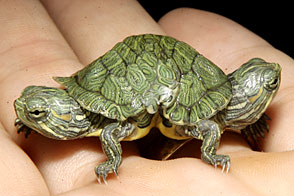
Also worth recording here is a pair of conjoined (i.e. 'Siamese') terrapin twins reported in 1928 by C.H. Townsend. For whereas conjoined terrapins (a fair number of which have been documented down through the years) are generally linked to one another laterally (i.e. side by side) or ventrally (belly to belly), these two individuals were joined to each other posteriorly (rear-to-rear). This yielded a double animal that approached the genuine amphicephalous state. Other, more recent examples of this semi-amphicephalous version of conjoined terrapins are also known.

A semi-amphicephalous example of conjoined terrapins (Matt Rourke)

Returning to the medieval bestiary sources consulted by Prof. Cunningham, these would certainly have referred to the most famous amphicephalous beast of all, albeit one that is entirely mythical – the amphisbaena. Generally categorised as a serpent dragon, i.e. limbless like a snake but dragon-headed (though occasionally portrayed as legged), the amphisbaena had a head at each end of its body, and could therefore move in either direction – sometimes accomplished by grasping one head in the jaws of the other so that its body became a hoop that could roll rapidly over the ground.

An amphisbaena was almost impossible to approach unseen, because only one head slept at a time, the other one staying awake, particularly when this creature was laying eggs. And if an amphisbaena were cut in half, the two segments would promptly rejoin.

Flemish artist Peter Paul Rubens's famous painting 'The Head of Medusa' (c.1617-1618), in which an amphisbaena can be seen (directly below Medusa's head and directly above some leaves at bottom mid-centre of painting) among the diversity of snakes breaking free from Medusa's hair following her death by decapitation - click painting to enlarge it (public domain)

According to Greek mythology, the amphisbaena was spontaneously generated from drops of blood falling onto the desert sands from the severed head of the gorgon Medusa when her slayer, the hero Perseus, flew over Libya with it on his journey back home to the Greek island of Seriphos. Although the amphisbaena's principal diet was ants, it was claimed by some writers to be extremely venomous, and one was blamed for the subsequent death of Mopsus, a seer who was also one of the famed Argonauts that accompanied Jason on his quest for the Golden Fleece.

Amphisbaena reported from Mexico, depicted in Johannes Faber's Thesaurus (1651), but suspiciously similar in form to the amphisbaena depicted by Rubens in his Medusa painting (public domain)

Yet despite its deadly nature, the dual-headed amphisbaena was often cited by early scholars for its medicinal qualities. Sometimes a living specimen was needed, otherwise the skin of one was sufficient. Among the assorted ailments that it reputedly eased were arthritis, chilblains, and the common cold, as well as assuring a safe pregnancy, and keeping warm during the winter if working outside. Eating the meat of an amphisbaena could even attract lovers, and killing one during a full moon would imbue its slayer with great power provided that he was pure of heart and mind.

Amphisbaenas often featured in Mesoamerican and Inca cultures too, frequently depicted with a vertically undulating body, and symbolised eternity. Some of the most spectacular renditions are composed of turquoise mosaic, a stone believed by the Aztecs to emit smoke, and therefore a very fitting mineral for portraying a dragon, especially in versions representing Xiuhcoatl - known variously as the fire serpent or the turquoise serpent. In these New World versions, one head was sometimes much larger than the other, rather than always being identical as in the original Old World amphisbaena.

The turquoise serpent, sculpted from turquoise and pine resin, 15th-16th-Century, Mexico, housed at the British Museum (Sarah Branch/Wikipedia)

In Chile, the oral traditions of the Elqui villagers tell of a 6-ft-long spotted amphisbaena known as the culebrón. During the day, it crawled very slowly upon the ground, but at night it took flight, because, uniquely among amphisbaenas, this version sported a pair of wings

Perhaps the strangest South American amphisbaena, however, was the manora, whose basic form resembled a giant earthworm. Its head and tail ends were indistinguishable from one another, but its body was covered all over with sharp feather-like quills.

Today, the legendary amphisbaena gives its name to a group of real-life reptiles, the amphisbaenians, which are also known as worm-lizards. Their heads are so similar in appearance to their tails that it can be difficult to distinguish which end is which, thus recalling the two-headed amphisbaena of legend.

19th-Century engraving of a spotted amphisbaenian Amphisbaena fuliginosa from Trinidad

Having said that, the legendary amphisbaena underwent a profound transformation during medieval times. It gained not only a pair of legs but also a pair of wings, as well as a clearly-delineated tail – at the end of which was its second head. It also acquired the literally petrifying, gorgonesque ability to turn anyone who looked at it to stone with just a single glance. This advanced version of the amphisbaena is known as the amphisien, and commonly occurs in heraldry.

The amphisien version of the amphisbaena, as depicted in the Aberdeen Bestiary (Aberdeen University Library MS 24)

In modern-day fiction, the most famous amphicephalous creature must surely be the pushmi-pullyu, featuring in Hugh Lofting's beloved series of 'Doctor Dolittle' novels for children (click here for a ShukerNature post devoted to this twin-headed wonder beast). In reality, however, no such animal could exist, because as mammals have a head at one end of their body and an anus at the other, an amphicephalous mammal would lack an anus and therefore be unable to defaecate.

My very own pushmi-pullyu ((c) Dr Karl Shuker)

Surely, therefore, this same argument negates the plausibility of the Logan family's alleged amphicephalous snake too? Not necessarily - because in snakes, being limbless and proportionately very long and slender, the end of the abdominal body region merges entirely into the tail (in mammals, conversely, outwardly the tail appears merely as a slender offshoot from the much broader, limbed abdominal body region). Consequently, the external excretory orifice in snakes (which is actually a cloaca, as it also functions as a genital orifice) is situated not at their posterior pole but about a quarter of the way up from this. Theoretically, therefore, an amphicephalous snake could actually have two cloacae, each positioned some distance away from the opposite head.

What an amphicephalous grass snake Natrix natrix might look like if such a creature could exist ((c) Dr Karl Shuker)

But how might an amphicephalous snake arise in the first place? If due to some developmental malfunction an early snake embryo were to split laterally from the head downwards to nearly the end of the tail, this would yield two almost completely separate snakes. However, they would remain permanently attached to one another because of their undivided (and hence shared) terminal tail portion. Nevertheless, each snake would possess its own fully-formed cloaca-containing abdominal body section. Consequently, this would then be an amphicephalus, and possibly even a viable one (always assuming, of course that such a specimen survived up to birth/hatching).

No mention of cloacal presence has been reported for the Logans' snake, but it will be very interesting to see whether further reports, containing additional details or confirmation of its dual anatomy, emerge in due course. After all, it's not every day that a veritable resurrected beast of classical mythology hits the news headlines around the world.

The amphisbaena awakes? Let's wait and see...so watch this space!

An ornament portraying the amphisbaena of classical mythology (Dr Karl Shuker)


Friday, 18 March 2011

THE CRYPTOZOOLOGICAL WORLD OF DOCTOR DOLITTLE. PART 1: IN PRAISE OF THE PUSHMI-PULLYU.


Long before I’d even heard of Dr Bernard Heuvelmans, let alone read his seminal cryptozoological tome, On the Track of Unknown Animals, I’d already been greatly influenced by a very noteworthy, albeit entirely fictitious, figure of considerable relevance to mysterious and undiscovered beasts. I am referring of course to animal linguist genius Doctor Dolittle (or Dr John Dolittle MD, to give him his full title), created by Hugh Lofting. His fascinating adventures and discoveries featured in no less than 12 wonderful children’s novels by Lofting - all of which I had read and re-read many times with great joy during my formative pre-teen years.

They also formed the basis for an equally delightful film musical, ‘Doctor Dolittle’, released by 20th Century Fox Studios in 1967. One of my all-time favourite films, it starred Rex Harrison in the eponymous role, alongside Anthony Newley, Samantha Eggar, Richard Attenborough, and a scene-stealing supporting cast of real-life animals. It featured a very tuneful selection of thoroughly charming songs too, composed by Leslie Bricusse (one of which, ‘Talk to the Animals’, went on to win an Academy Award for Best Song).

Showing the film musical's version of the pushmi-pullyu (Dr Karl Shuker)

During his varied escapades as chronicled by Lofting, the good Doctor encountered many different kinds of animal, ranging from the mundane to the marvellous - including a select few that were unquestionably unknown to modern-day science, and which so enthralled me that I can state in all honesty that the onset in my childhood of what would become a lifelong interest for me in cryptozoology was due in no small way to my fascination with these latter mystery beasts.

Consequently, it seemed only right that ShukerNature should survey some of Lofting’s most significant literary cryptids from the Doctor Dolittle series of novels, so here are six of my particular favourites.


THE PUSHMI-PULLYU
 
Out of all of the extraordinary creatures that appeared in Hugh Lofting’s series of Doctor Dolittle novels, it was the pushmi-pullyu that was unquestionably the most readily identifiable member of Dolittle’s marvellous menagerie, due not only to Lofting’s own input but also to this bicranial wonder’s very memorable appearance in the afore-mentioned Doctor Dolittle film musical from 1967.

Here is how Lofting introduced the pushmi-pullyu, native to darkest Africa and exceptionally elusive, in the very first Dolittle novel, The Story of Doctor Dolittle (1920):

"Pushmi-pullyus are now extinct. That means, there aren't any more. But long ago, when Doctor Dolittle was alive [early 1800s], there were some of them still left in the deepest jungles of Africa; and even then they were very, very scarce. They had no tail, but a head at each end, and sharp horns on each head. They were very shy and terribly hard to catch...[The native people] get most of their animals by sneaking up behind them while they are not looking. But you could not do this with the pushmi-pullyu because, no matter which way you came towards him, he was always facing you. And besides, only one half of him slept at a time. The other head was always awake and watching. This was why they were never caught and never seen in Zoos. Though many of the greatest huntsmen and the cleverest menagerie-keepers spent years of their lives searching through the jungles in all weathers for pushmi-pullyus, not a single one had ever been caught. Even then, years ago, he was the only animal in the world with two heads."

This is not entirely true, of course. There are many fully-confirmed cases of dicephalous or bicephalic (i.e. two-headed) animals on record, including various specimens of two-headed snakes, terrapins, lambs, calves, and even, rarely, humans. However, in every one of these cases, the two heads emerge either from a single neck or, if each head has its own neck, from a single upper torso. What made the pushmi-pullyu so very special is that its heads emerged from opposite ends of its body. Indeed, its body was actually two front halves fused together in opposite directions at their mid-riff.

Such an extraordinary entity is known technically as an amphicephalus, and in reality is exceedingly rare. Indeed, I know only of a few semi-amphicephalic terrapins, which were conjoined twins joined end to end, and, in contrast to the pushmi-pullyu, each twin had an almost fully-formed body, not just a front half.

A semi-amphicephalic terrapin (public domain)

The much more extreme condition exhibited by the pushmi-pullyu, conversely, would have rendered it an anatomical impossibility in real life – if only for the fundamental physiological reason that it would not have been able to defaecate, having no anus! Happily, such indelicate matters were discreetly passed over by Lofting, who wrote his novels in a more genteel age when, unlike in today’s brasher times, such subjects were most definitely off-limits in a children’s book (even though I would hazard a guess that, schoolboys being schoolboys whatever decade they happened to be born in, the pushmi-pullyu’s excretory paradox attracted its fair share of sniggers and risible comments even back in the 1920s!).

What an amphicephalic llama would look like

Moving swiftly on: just as intriguing as its anatomy was its taxonomy. Just what was the pushmi-pullyu? In the film musical, it was simply portrayed as an amphicephalic Tibetan llama (even though Tibet is normally home to lamas, not llamas!), but in the novel Lofting revealed that it had a much more complex, interesting ancestry:

"Excuse me, [said Doctor Dolittle] surely you are related to the Deer Family, are you not?"

"Yes," said the pushmi-pullyu "to the Abyssinian Gazelles and the Asiatic Chamois on my mother's side. My father's greatgrandfather was the last of the Unicorns."


Lofting's own drawing of the pushmi-pullyu (public domain)

Lofting also included the sketch of the pushmi-pullyu reproduced here (Lofting provided all of the illustrations himself for the Dolittle books), which portrays each of its heads with a pair of short horns, curling backwards slightly at their tips, and each head also possesses an extraordinarily large lower jaw (mandibular prognathism?). Whatever it was, therefore, it clearly was not of llama extraction.

Reading through the pushmi-pullyu’s description of its own ancestry, one might initially assume that the most cryptozoological aspect of it was this very curious creature’s derivation on its paternal side from the unicorn lineage. In reality, however, its maternal side was no less interesting either, because there is no such animal as the Asiatic chamois known to science. The only modern-day chamois, Rupicapra rupicapra, is almost entirely confined to Europe (it also exists a little way into Asian Turkey). So how can we explain Lofting’s assertion?

It may of course simply be that Lofting was mistaken, wrongly assuming that the chamois was Asian in zoogeographical distribution. Alternatively, he may have been loosely referring to one of the chamois’s close relatives - the serows, the gorals, the tahrs, or the takins, all of which, like the chamois, are known as goat-antelopes, but all of which, unlike the chamois, are Asian.

Chamois on Czechoslovakian postage stamp (public domain)

Back in the age when the Doctor Dolittle books were set (the early 1800s), anything – or anyone – with two heads invariably winded up on display in a sideshow or circus. And sure enough, so did the pushmi-pullyu, though in this instance it was a voluntary act, as it wanted to help the Doctor raise enough money to pay for a boat that he had borrowed but which had later been shipwrecked. The pushmi-pullyu’s arrival at the circus - whose astonished owner, the normally world-weary, seen-it-all showman Albert Blossom, was forced to concede in a boisterous song-and-dance number that “I’ve never seen anything like it!” (listen to it here) - provides one of the most entertaining scenes of all in the film musical, enhanced enormously by a glorious, deliberately over-the-top performance by none other than Richard Attenborough, the eminent actor brother of Britain’s foremost television naturalist, David Attenborough.

The pushmi-pullyu at Blossom's Circus in the 1967 20th Century Fox Studios film musical, 'Doctor Dolittle' ((c) 20th Century Fox - reproduced here on a strictly non-commercial Fair Use basis for educational/review purposes only)

How sad, therefore, that the pushmi-pullyu was not real – one could well imagine the whispered, reverential tones of Richard’s brother discussing its origins and behaviour in an episode of ‘Life On Earth’!

Join me again for Part 2 of this article (click here to access it), when I’ll be casting a glance over a couple of giant aquatic cryptids encountered by the good Doctor on his travels; and click here to access Part 3, when I'll be investigating two huge insects and a beautiful bird all known well to him but not known at all to the rest of science.

 
And here's one I made earlier - my very own pushmi-pullyu! ((c) Dr Karl Shuker)