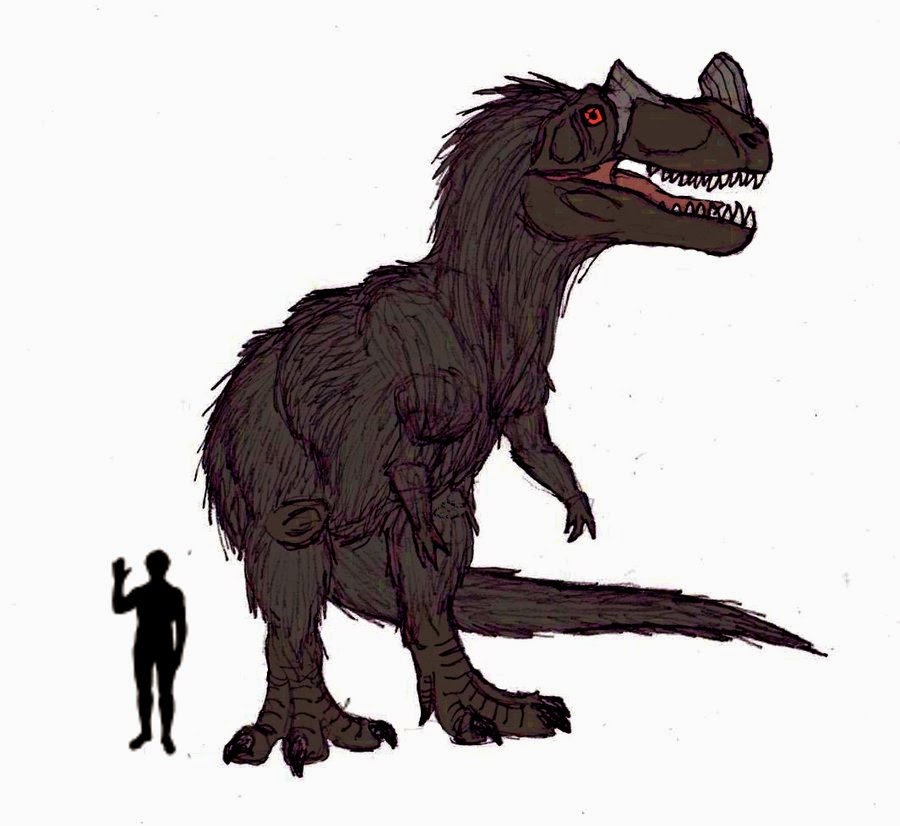
Artistic
representation of the Partridge Creek monster (© Connor Lachmanec, aka
TheMorlock on deviantart.com)
The Arctic
wastelands of the Yukon Territory, on the borders
of Canada and Alaska, are surely the
last place anyone might expect to meet a dinosaur - which is why the following
case merits a prominent place among the dubitanda of cryptozoology.
The
extraordinary tale of the beast from Partridge Creek debuted on 15 April 1908, within the pages of a French journal
called Je Sais Tout ('I Know All'), and was recounted by one of the creature's
eyewitnesses, French traveller Georges Dupuy. According to Dupuy, the adventure
had begun one day in 1903, when a banker from San Francisco called James Lewis
Buttler and a local gold prospector named Tom Leemore were hunting three large
moose amid the marshy tundra countryside near the Yukon's Clear Creek, about 100 miles east of Dawson City. Suddenly, one
of these burly deer raised its head as if it had heard something unexpected in
the vicinity, and just as it did so a second member of the trio emitted a loud
bellow of alarm, sending all three of them fleeing southwards with all speed.

A hunted
moose fleeing the scene, an engraving from 1897 by Arthur Heming
Standing 7
ft at the shoulder and weighing up to half a ton, as the world's
largest living species of deer the moose is not a creature to be readily
intimidated by anything - which is why the two hunters were so surprised by
their quarry's impromptu flight. When they reached the spot from where the
moose had fled, however, the reason for these creatures' uncharacteristic
behaviour became clear - there in the snow was the clear impression of an
enormous body belonging to some unidentifiable beast of monstrous proportions.
The beast's
belly had ploughed into the river bed's swampy mud a massive furrow 30
ft long, 12 ft wide, and 2
ft deep, which was flanked by gigantic footprints measuring 2.5
ft across and 5 ft in length, each
also yielding impressions of sharp 1-ft-long claws. Completing the clues left
behind by this unseen goliath was the imprint of a mighty 10-ft-long tail
spanning 16 in across its
middle.

The
first of two illustrations depicting the Partridge Creek monster in the Je
Sais Tout article
Notwithstanding
the nightmarish visions conjured up by such dramatic dimensions, the two men
decided to follow the monster's tracks, which led after several miles to a
gulch known as Partridge Creek, where the tracks simply came to an end - giving
the men cause to speculate that it must have leapt directly up into the gulch's
encompassing cliffs.
Following this,
they made their way by canoe along the McQuesten River to the nearby
outpost of Armstrong Creek - an Indian village where Buttler had earlier
arranged to meet Dupuy to take him hunting, and which was home to the Reverend
Father Pierre Lavagneux, a French-Canadian Jesuit priest. When Dupuy and the
priest heard about the monster, they were highly sceptical at first, but
eventually Buttler persuaded them to return to Partridge Creek with Leemore and
himself in a second search for it, aided by some local Indians.
After a day's
intensive but fruitless search of the immediate area and some distance beyond
it in all directions, however, the party of weary beast hunters had resigned
themselves to failure, and decided to establish camp at the top of a rocky
ravine. Thoughts of confronting monsters had been largely suppressed by the
more practical goal of preparing a warm meal - until, wholly without warning,
they received a terrifying reminder of the reason for their presence there. A
hideous roar broke the Arctic stillness, and as the startled hunters reached
for their rifles, one of them pointed with shaking hand to the opposite side of
the ravine - where the crimson rays of the dying sun revealed a heart-stopping
sight. A veritable monster in every sense of the word was clambering up its
slope!

The
second of two illustrations depicting the Partridge Creek monster in the Je
Sais Tout article
Black in colour,
at least 50 ft long, and
estimated by Buttler to weigh about 40 tons, their horrific visitor continued
to climb upwards for a time, mercifully unaware of its terrified human
eyewitnesses' close proximity. When it was about 200 paces away, it paused for
10 minutes or so, furnishing them with ample opportunity to observe it at close
range in all its spine-chilling glory. Although profusely splattered with thick
mud, its hide could be seen to bear many coarse, grey-black bristles like those
of a wild boar, and a hideous mass of blood and saliva oozed from its cavernous
jaws. Most remarkable of all, however, was the rhino-like horn perched
prominently if somewhat incongruously near the end of its snout.
The Indians
cowered in terror behind a large rock, and the others were rendered momentarily
speechless by the monstrous apparition, but when it became clear that it had
not detected them the priest gained sufficient control of his voice to whisper
between still-chattering teeth: "A ceratosaurus...It's a ceratosaurus of
the Arctic Circle!". Ceratosaurus nasicornis was a large
flesh-eating bipedal dinosaur of the Jurassic Period, related to the later,
larger Tyrannosaurus rex and readily identified via the large horn near
the tip of its upper jaw.

A
modern-day reconstruction of Ceratosaurus nasicornis (©
DiBgd/Wikipedia)
As they
continued to watch, the beast suddenly reared up onto its massive hind legs
like a hellish kangaroo, gave voice to an ear-splitting roar again, and then
disappeared back down into the ravine via a single immense bound. Not too
surprisingly, the beast hunters found that the thrill of pursuing this creature
had lost its former charm, and the following morning they journeyed back to
Armstrong Creek. Dupuy later attempted to interest the Canadian governor at Dawson City in supplying
them with a large-scale hunting party of mules and 50 armed men, but when this
failed he returned home to France.
The matter was
not quite over, however, for in January 1908 he received a letter from Father
Lavagneux, dated Christmas Day 1907, in which the
priest informed him that on Christmas Eve, and while in the company of ten
Indians, he had seen their monstrous quarry once again - this time racing at
speed over the creek's frozen river, with what seemed to be the carcase of a
caribou clamped between its great jaws. Tracks identical to those found back in
1903 were clearly visible in the deep mud, and were followed by Lavagneux and
company for at least two miles before being obliterated by falling snow.
That appears to
have been the last time that the beast of Partridge Creek was spotted, either
by Lavagneux or by anyone else, for there does not seem to be any further
records on file alluding to this extraordinary creature. Bearing in mind,
however, that the existence of such an entity calls for our belief not only in the
post-Cretaceous persistence of an endothermic hairy dinosaur but also its existence in what must
surely be the least compatible habitat for any type of large reptile living
today, its lack of cryptozoological credibility should hardly come as a great
surprise!
This ShukerNature post was excerpted from my book In Search of Prehistoric Survivors, which will be reissued later this year.

The
original edition of In Search of Prehistoric Survivors


 Posts
Posts