Dr KARL SHUKER

Zoologist, media consultant, and science writer, Dr Karl Shuker is also one of the best known cryptozoologists in the world. He is the author of such seminal works as Mystery Cats of the World (1989), The Lost Ark: New and Rediscovered Animals of the 20th Century (1993; greatly expanded in 2012 as The Encyclopaedia of New and Rediscovered Animals), Dragons: A Natural History (1995), In Search of Prehistoric Survivors (1995), The Unexplained (1996), From Flying Toads To Snakes With Wings (1997), Mysteries of Planet Earth (1999), The Hidden Powers of Animals (2001), The Beasts That Hide From Man (2003), Extraordinary Animals Revisited (2007), Dr Shuker's Casebook (2008), Karl Shuker's Alien Zoo: From the Pages of Fortean Times (2010), Cats of Magic, Mythology, and Mystery (2012), Mirabilis: A Carnival of Cryptozoology and Unnatural History (2013), Dragons in Zoology, Cryptozoology, and Culture (2013), The Menagerie of Marvels (2014), A Manifestation of Monsters (2015), Here's Nessie! (2016), and what is widely considered to be his cryptozoological magnum opus, Still In Search Of Prehistoric Survivors (2016) - plus, very excitingly, his four long-awaited, much-requested ShukerNature blog books (2019-2024).

Dr Karl Shuker's Official Website - http://www.karlshuker.com/index.htm

IMPORTANT: To view a complete, regularly-updated listing of my ShukerNature blog's articles (each one instantly clickable), please click HERE!

IMPORTANT: To view a complete, regularly-updated listing of my published books (each one instantly clickable), please click HERE!

IMPORTANT: To view a complete, regularly-updated listing of my Eclectarium blog's articles (each one instantly clickable), please click HERE!

IMPORTANT: To view a complete, regularly-updated listing of my Starsteeds blog's poetry and other lyrical writings (each one instantly clickable), please click HERE!

IMPORTANT: To view a complete, regularly-updated listing of my Shuker In MovieLand blog's articles (each one instantly clickable), please click HERE!

IMPORTANT: To view a complete, regularly-updated listing of my RebelBikerDude's AI Biker Art blog's thematic text & picture galleries (each one instantly clickable), please click HERE!

Search This Blog


PLEASE COME IN, I'VE BEEN EXPECTING YOU...

PLEASE COME IN, I'VE BEEN EXPECTING YOU...
WELCOME TO SHUKERNATURE - ENJOY YOUR VISIT - BEWARE OF THE RAPTOR!


Showing posts with label coati. Show all posts

Thursday, 27 January 2022

CAUGHT ON THE HOP BY PHANTOM KANGAROOS AND OTHER OUT-OF-PLACE MYSTERY MACROPODS: Part 2 – ESCAPEES AND OTHER EXPLANATIONS

 
On the alert – an adult eastern grey kangaroo (© fir0002/Wikipedia – GFDL 1.2 licence)

As revealed in Part 1 of this three-part ShukerNature article (click here to read Part 1), eyewitness descriptions of elusive kangaroo-like beasts sighted across North America vary considerably from one to another – to the extent whereby it is possible to divide such creatures, based upon their reported morphological and behavioural attributes, into several categories. Clearly, therefore, more than one type of animal is involved in the enigma of America's mystery macropods, as will now be demonstrated.


ESCAPEE THEORY

The majority of reports describe animals that resemble and behave like normal kangaroos and wallabies; such creatures are readily identified by their observers as macropods, and do not appear in any way strange in themselves (except for the ease with which they evade capture). They are made mysterious in fact only by being macropods in America – and thereby out-of-place and of undetermined origin. Hence it seems likely that such animals are indeed normal, known species of kangaroo and wallaby – but where have they come from?

In their native Australian homeland, certain macropod species, e.g. the red kangaroo Macropus rufus and certain wallabies, inhabit open plains and semi-desert areas, whereas various other wallabies and the eastern grey kangaroo M. giganteus prefer woodland regions. Such habitats are of course also found in America, and correspond closely with their Australian counterparts. Accordingly, if any American captive specimens (maintained as exhibits in zoos, circuses, and parks, or in private households as pets) have escaped in the past, the chances are that if they were fortunate enough to locate habitats comparable with those of their native Antipodean homeland, then they survived.

 
Red kangaroos in their semi-arid native Australian habitat, but not dissimilar from habitats on the southwestern U.S.A. (public domain)

Additionally, if a pair (or indeed a number) of specimens escaped together, they may well have established a thriving naturalised population (as has happened in several different, widely dispersed localities within the U.K., for instance – see later). Having said that, the theory of escapees has been put forward so frequently to explain away sightings of mystery or out-of-place beasts in America, Britain, and elsewhere that it has virtually become a cryptozoological cliché. In some cases, moreover, it is painfully inadequate as a satisfactory solution to such sightings.

In the case of the 'normal' category of New World phantom kangaroos, however, it does present itself as a tenable solution. Certainly, many sightings of such beasts can be compared favourably with known species. The 5-6-ft reddish-brown individuals are plausibly identifiable as male red kangaroos; comparably-sized greyish-black specimens are likely to be either female red kangaroos or eastern grey kangaroos; both species are common zoo exhibits. Similarly, the 3-ft specimens resemble various wallaby species. Indeed, the creature photographed in colour at Waukesha, Wisconsin, during April 1978 (see Part 1 of this present article) specifically resembles Bennett's wallaby Notamacropus rufogriseus (as also noted by Coleman in Mysterious America), native to Tasmania but a very frequent exhibit in zoos and parks worldwide.

 
Bennett's wallaby squatting upright on its haunches (© Dr Karl Shuker)

The moniker of 'phantom kangaroo' has been applied to America's mystery macropods on account of their extreme elusiveness, in turn implying a paranormal connection. However, it should be remembered that all but the very biggest macropods are relatively defenceless and all are herbivores, thereby constituting the natural prey of large carnivorous species – which in Australasia meant (until relatively recent times, geologically speaking) not only the Tasmanian wolf (thylacine) and dingo but also the marsupial lion Thylacoleo. Consequently, a well-developed capacity for evanescence and concealment is a survival necessity for macropods.

Added to this is the fact that escapee macropods will clearly be very disoriented at first, unexpectedly finding themselves in totally unfamiliar surroundings with their previous, familiar routine of existence now gone. Their response (and that of any intelligent animal faced with such a situation) will be to display enhanced defensive and protective behaviour whilst acclimatising to their new surroundings. Moreover, as they will soon discover, in North America these new surroundings contain several very hostile species, which may include pumas, bobcats, lynxes, wolverines, wolves, bears, and humans toting rifles, thereby reinforcing and perpetuating such wariness upon the part of the macropods thereafter.

 
Red kangaroo in almost deer-like quadrupedal pose (© ltshears/Wikipedia – CC BY-SA 3.0 licence)

Consequently, if America's 'normal' contingent of phantom kangaroos does indeed consist of escapees and their wild-born descendants, it should be no surprise to learn that they are exceedingly elusive. Any incautious individuals will be killed very quickly following their original escape, by the predators already listed.

One final point concerning the escapee theory is that escapees are not always reported to the authorities – especially if they were pets or inhabitants of private collections and (as a result, for example, of such escapees having been brought into the country illegally, or having caused any disturbance, etc, while on the loose) their owners may themselves falling foul of the law. Indeed, unreported escapees (plus deliberately-released unwanted pets) have been responsible for establishing populations of exotic animal species in many parts of the world, and will no doubt continue to do so, albeit to the inevitable detriment of the native fauna.


MISTAKEN IDENTITY

One option that must always be considered when dealing with mystery creatures is the possibility that at least some such sightings are actually misidentifications of known native species.

Among the North American rodents is a group constituting the genus Dipodomys – the kangaroo rats. As one might expect from their name, these possess notably long hindlimbs and tail, much shorter forelimbs, and move via powerful bipedal bounds, thereby paralleling genuine macropods and occupying in America a similar ecological niche to that filled in Australia by some of the smaller desert-living macropods.

 
A kangaroo rat Dipodomys sp. (public domain)

Kangaroo rats inhabit dry or semi-dry sandy country, and are distributed from southwestern California southwards to central Mexico. The larger species, e.g. the giant kangaroo rat D. ingens, attain a total length of almost 2 ft. They are generally nocturnal creatures, but certainly any individuals observed at dawn or dusk could be mistaken for small wallabies. Indeed, kangaroo rats may well constitute the true identity of some of the so-called "baby kangaroos" that have been reported from many U.S. regions over the years.

Another instance of mistaken identity may perhaps be responsible for the second category of American phantom kangaroos. Although true kangaroos and wallabies adopt a quadrupedal posture not only when grazing but also while moving slightly when grazing, their mode of locomotion under all other circumstances is invariably one of bipedal bounding, with their tail stretched out horizontally behind and their body held comparably. Hence true macropods would not appear to be the identity of those wallaby-sized, less-frequently spied American 'kangaroos' that hop rapidly on all fours.

 
A Bennett's wallaby adopting a quadrupedal stance while stationary (© Dr Karl Shuker)

One group of native New World creatures, however, whose members are of comparable size and which do behave in this manner, consists of the surface-dwelling jack rabbits (which are actually hares!) of the western United States. Even so, there are certain problems with equating the quadrupedal 'kangaroos' with jack rabbits.

Firstly, whereas the former creatures apparently resemble typical macropods in all but their mode of progression, jack rabbits have notably short tails and long ears. Also, in view of the very familiar appearance of jack rabbits, it is difficult to imagine that they could be mistaken for kangaroos by observers. The same principle applies to suggestions that such beasts were really misidentified fawns. There is also the problem of the 5.5-ft-tall quadrupedal 'kangaroo' sighted by Louis Staub in Ohio as detailed in Part 1 of this article. No known lagomorph attains such a size. Equally, Staub specifically stated that he was sure that the creature was not a deer.

 
A black-tailed jack rabbit Lepus californicus in quadrupedal pose but with its huge ears instantly distinguishing it from all macropods (© Jim Harper/Wikipedia – CC BY-SA 2.5 licence)


EXOTIC EXPLANATIONS

One final animal species well worth mentioning in the context of quadrupedal macropod-like beasts is the mara or Patagonian cavy Dolichotis patagonum. This most interesting creature, a guinea-pig relative, is about 2.5 ft in total length, and is very distinct from more typical cavy species, having evolved notably long hind limbs and exhibiting a cursorial mode of existence. Intriguingly, however, its overall appearance when standing is reminiscent of a small macropod on all fours.

Could this specialised rodent therefore be responsible for some of the quadrupedal 'kangaroo' reports from the States? Sadly, the mara's distribution range is limited to South America's southern half. Consequently, although this species certainly bears comparison with the description of such creatures (especially the smaller ones), it would naturally be quite ludicrous even to contemplate the possibility of native maras having any involvement in America's phantom kangaroo phenomenon – but escapees from captivity are another matter, especially as this species is often exhibited in zoos.

 
An exquisite 19th-Century chromolithograph depicting maras in their native Patagonian pampas together with some rheas (public domain)

Indeed, as Loren Coleman reported in Fortean Times (spring 1982): following a spate of mystery macropod sightings in Tulsa, Oklahoma, during summer 1981, a strange bounding creature was actually captured right in the heart of Tulsa on 27 September of that year – and was found to be a mara. Its origin has never been ascertained, but it was presumably an escapee from captivity. Could an elusive naturalised population exist in that region, I wonder, descendants of original escapees? Certainly the Tulsa environment is compatible with mara survival.

It is evident that America's quadrupedal 'kangaroos' have yet to be identified with any degree of certainty. Clearly, therefore, it would be beneficial for future reports and sightings of such animals to be investigated in especial detail, and for them to be formally recognised hereafter as distinct entities from genuine phantom (i.e. 'normal') kangaroos.

 
White-snouted coati with upright tail and curled tail tip (© Dennis Jarvis/Wikipedia – CC BY-SA 2.0 licence)

Equally enigmatic, but equally likely to have an exotic explanation, is the 4-ft-tall bipedal creature – sporting a greyhound-shaped head, short brown fur, and a long tail held vertically with a distinct curl at its tip – sighted by a Mr Workman at Tucson, Arizona, during the early 1960s, as detailed in Part 1. Although bipedal and, according to Workman, resembling in outward appearance a kangaroo, it did not move via hopping but via walking – and on notably small hind feet. These latter features clearly dismiss a macropod identity from further consideration. So too does its vertically-held, curl-bearing tail (macropod tails are uniformly straight and are held horizontally). Clearly this creature merits its own category relative to other phantom kangaroo sightings.

However, although superficially perplexing, a most plausible solution has in fact been put forward with regard to its likely taxonomic identity. In a reply published beneath the original letter concerning this animal (ISC Newsletter, spring 1982), J. Richard Greenwell – Secretary of the International Society of Cryptozoology (ISC) – suggested that the latter could have been a coati.

 
A troop of white-nosed coatis with tails duly held vertically and curl-tipped (© Strobilomyces/Wikipedia – CC BY-SA 3.0 licence)

Coatis are lithe relatives of the raccoons, kinkajou, cacomistles, and other procyonid carnivores. They attain a total length of 4 ft, possess a slender head, and a highly inquisitive nature, in turn bestowing upon them a tendency to stand upright in order to observe more accurately any object that attracts their attention. Worthy of especial note – their tail is held vertically, and curls at its tip.

Moreover, although coatis constitute a primarily South American taxon, the distribution of the common coati Nasua narica extends as far north as the southern U.S.A., including Arizona. So far, therefore, the coati and Workman's creature accord very closely both morphologically and geographically. Even so, there are certain difficulties. The latter beast's head-and-body length alone measured 4 ft (its tail length was additional to this), and it actually walked bipedally. Coatis, conversely, do not attain this beast's total size; nor do they typically do more than stand bipedally – when moving, they usually bound on all fours.

 
Another photo of the same tails-aloft coati troop (© Strobilomyces/Wikipedia – CC BY-SA 3.0 licence)

However, it is certainly possible that Workman over­estimated the creature's size. Equally, some coati individuals will in fact walk at least a short distance bipedally, just like their larger relatives the bears. Indeed, in Part 1 of this article I included a link to a photo of a coati doing precisely that (here it is again); I have also personally witnessed a pet coati walking bipedally of its own free will (like a true cryptozoologist, however, I did not have a camera with me at the time to photograph this noteworthy behaviour!). In any case, the otherwise striking correspondence between Workman's animal and a coati – even to the curl-tipped, vertically-held tail – suggests that this is indeed the correct identity for that particular mystery animal.

Worthy of brief mention here is another phantom kangaroo case with procyonid pertinence. Following the fraught encounter by two policemen in 1974 with an irascible, 5-ft-tall macropod lookalike nicknamed the Chicago Hopper as detailed in Part 1, a mystery creature was in fact captured nearby. Not only that, it was actually offered as the Chicago Hopper's identity. In reality, however, this was a quite ridiculous state of affairs, because the captured critter in question was a kinkajou Potos flavus – a golden-coloured relative of coatis and raccoons, but which only attains a total length of 2.5 ft, and looks nothing whatsoever like a kangaroo! The fact that the kinkajou is restricted in the wild state to Central and South America raises some interesting questions regarding the capture of a living specimen in Arizona, but as the latter's species is a popular exotic pet and zoo exhibit, it was probably just another escapee or deliberate release from captivity. Regardless of origin, however, it was clearly unrelated to the Chicago Hopper incident.

 
Life-like engraving from 1849 depicting a kinkajou (public domain)


COUGH-LIKE SOUNDS

The Chicago Hopper is a representative of the last phantom kangaroo category delineated by me in Part 1, and whose members I dubbed there as aggressive growlers and shriekers. However, although united by their bellicose behaviour and vehement vocals, this category's members morphologically constitute a rather heterogeneous gathering. Consequently, as it is likely that more than one taxonomic identity is involved here, the principal examples will be considered individually.

Judging from the reports on record concerning the Chicago Hopper, this was in every way a normal kangaroo – except, it appeared, for its pugnacity and unexpected utterance of growling noises. Let us now examine these latter attributes closely. It attacked by using its hindlimbs as formidable kicking instruments – which is typical kangaroo behaviour. Furthermore, although many people apparently believe that kangaroos are actually mute or at least not prone to vocalisations of any form, in the event of imminent danger all adult kangaroos (but especially males) in fact produce notable cough-like sounds. These serve to alert all other kangaroos nearby.
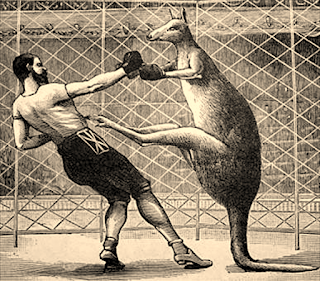
 
Vintage illustration of a boxing kangaroo using its hind feet very effectively – and emphatically! – to kick its human opponent (public domain)

When approached by the two policemen, the Chicago Hopper clearly considered itself to be under threat, and the two responses that it displayed were those that characterise adult kangaroos when exposed to such circumstances – it voiced its cough-like alarm signal (which could certainly sound like growling, especially to two witnesses who were probably not expecting such noises from a kangaroo), and it defended itself from possible attack by using its hind legs as weapons. In short, there is no reason whatsoever to consider further that the Chicago Hopper was anything other than a normal kangaroo. Of course, its origin is still a mystery, but as it is assuredly a 'normal' phantom kangaroo the possible solutions to this riddle have already been dealt with earlier here.

Conversely, the rapacious Tennessee "kangaroo" that attacked, killed, and partly devoured waterfowl and even a number of large dogs in 1934 is a very different matter. The problem with this particular case is that no report giving any specific morphological features concerning the animal appears to have been documented – it was simply described as resembling a "giant kangaroo". However, if the reports of its carnivorous activity are accurate, then it was most certainly not a macropod. (Having said that, such creatures are not entirely unknown to science – during the Australian Miocene epoch, around 20 million years ago, Queensland was home to some sizeable meat-eating macropods, belonging to the now long-extinct genus Ekaltadeta.) Additionally, the Reverend W.J. Hancock informed the New York Times that it was seen "...running across the field". As noted earlier, macropods do not run.

 
Artistic restoration of possible appearance in life of Ekaltadeta ima, a prehistoric species of carnivorous Australian macropod from the Miocene (© Nobu Tamura/Wikipedia – CC BY 3.0 licence)

Beyond this, however, it is virtually impossible to speculate regarding this cryptid's identity. If in spite of its carnivorous behaviour it resembled a kangaroo as far as its eyewitnesses were concerned, then presumably it was bipedal. Could it therefore have been a bear? Possibly, but surely it would be difficult to confuse a bear with a kangaroo. Sadly, it is likely that this intriguing mystery beast will remain mysterious, unless any report regarding it is uncovered that provides further morphological details.

Yet what of the shrieking mystery macropods? What might these be? As will be seen in Part 3, the concluding part of this ShukerNature blog article (click here to read it), one of the exciting possibilities concerning phantom kangaroos (especially the more bizarre forms) is that a totally unknown species may be involved. And don't forget to click here to read Part 1 if you haven't already done so.

 
How very unlike a macropod can a macropod look simply by changing its posture from its default bipedal stance, as demonstrated very readily by this reposing albino Bennett's wallaby (© Dr Karl Shuker)


Wednesday, 18 August 2021

THE PEEL STREET MONSTER - LOOKING BACK AT A LOCAL CRYPTID

 
Vintage illustration of a coati (public domain)

It's always good to stumble upon the history of a mystery beast not previously documented in the cryptozoological literature (which it hadn’t been, prior to my doing so in a Fortean Times article and subsequently in my book Extraordinary Animals Revisited), and especially when it happens to be a local one – having occurred just a few miles away from where I was born and still live. Yet although the case of the Peel Street Monster began in high drama, the outcome was distinctly underwhelming.

During winter 1933-34, rumours began circulating within the area of Brickkiln Street and Peel Street in the large urban West Midlands town (now city) of Wolverhampton, England, of a bizarre creature that was attacking children. One bold lad who tried to pursue this beast, which became known as the Peel Street Monster, presumably angered it, because it allegedly leapt at his throat, attempting to bite him.

 
Extraordinary Animals Revisited (© Dr Karl Shuker/CFZ Press)

There came a day in January 1934, however, when this vicious creature made one onslaught too many. A crowd of boys and youths, who included among their number a 17-year-old called Georgie Goodhead, were playing on the corner of St Mark's Street and Raglan Street, when another boy, Jackie Franklin, raced out of Peel Street and up towards them in a state of great alarm. Shouting for help, he told them that a youngster called Billy Wright (but not the famous future Wolverhampton Wanderers footballer of that same name, at least as far as I'm aware) was being attacked by the monster on some waste ground. Georgie and his mates raced back to Peel Street at once with Jackie, where they observed a peculiar-looking animal threatening a small boy. In a later Wolverhampton Express and Star newspaper report, Georgie recalled:

I went and saw a queer animal, far too big for a rat, leaping towards a child about five-year[s]-old. I shouted and the thing turned on me. It crouched, its eyes bulging, then it leaped like lightning.

According to the newspaper report, as the creature neared his throat Georgie picked up a brick and hit it with this hefty implement as hard as he could. The animal collapsed, falling into a pool of water, and was swiftly kicked to death by the crowd that had gathered to watch the boys confronting it. Happily, little Billy was unhurt, and was taken by some of the boys to his parents' sweetshop in Peel Street, while Georgie and Jackie gave a statement at the Red Lion police station and received half a crown each for their bravery.

As for the Peel Street Monster: apart from noting that it was a male, no-one had any idea what this mystifying beast was. According to media reports, naturalists, taxidermists, and vets were all called in to identify it, but to no avail. One unnamed 'expert' did suggest that it may be an anteater – in Wolverhampton?? Another one considered it possible that the creature (despite being dead!) might become a serious rival to the Loch Ness monster.

 
A ring-tailed coati Nasua nasua, the most familiar of the four recognised coati species and native to South America (© Dr Karl Shuker)

Events took an even more surprising turn the following day, when a second mystery beast was found in the Brickkiln region. This one, a female, was already dead, but it closely resembled the Peel Street Monster. Moreover, a photograph of it published in the Express and Star helped to identify its species.

It was a South American coati (coatimundi) – a long-tailed relative of the raccoon and belonging to the genus Nasua, with a head-and-body length of up to 2 ft, a thin tail of much the same length, and distinguished by its very elongate snout (responsible for the 'anteater' identity proffered for the Peel Street Monster?). But where had it, and the Peel Street specimen, come from? And if there had been a pair on the loose, could there be more?

The prospect of a plague of coatis terrorising the good residents of Wolverhampton may seem decidedly slim (not least because the favoured diet of coatis consists of invertebrates and small lizards – as opposed to small children!). Nevertheless, the council was clearly taking no chances, for as the Express and Star duly reported:

And fresh fears arose in Wolverhampton as rumours spread that there may be a colony of the creatures hiding in partly closed cellars. Hundreds of people gathered in Salop Street to watch council workers trying to ascertain if a colony of the creatures were hiding there. The crowds were so great they hampered the efforts of the official rat-catcher. In the search, weapons brought in to confront any coatimundis found included poison gas, traps, sulphur, terriers and ferrets. It was uncertain whether the ferrets were to be used following a suggestion that they might form part of the coatimundi diet [I don't think so!].

 
As ably demonstrated by this white-snouted coati Nasua narica: when walking quadrupedally, coatis are famous for often holding their tails vertically upright with a little curl at the tip, giving them an unexpected superficial resemblance to small furry sauropod dinosaurs! (© Dennis Jarvis/Wikipedia – CC BY-SA 2.0 licence)

Ferrets or no ferrets, the search did not find any other errant coatis. Police investigations did reputedly reveal that the female coati had been in a travelling menagerie that had parked here earlier (circuses and fairs would sometimes set up on this slum-area waste ground at that time), and had discarded the creature's body after it had died. However, the Peel Street Monster's origin remains a mystery to this day – as do various other aspects of this curious case.

Can we even be sure that the Peel Street Monster was a coati? For if the accounts of it are true, it must have been an exceptionally belligerent specimen. The Express and Star published a photo of this creature lying dead with a crowd of onlookers surrounding it, but its form cannot be discerned. And what happened to the two carcases? Some correspondences reminiscing about this incident appeared 50 years later in the Express and Star during March 1994, but conflicting recollections only served to muddy these already murky waters even further.

All in all, after also allowing for the likelihood of embellished descriptions with such an odd episode, the only thing that can be said with certainty regarding the Peel Street Monster is that something unexpected was seen and killed in Wolverhampton – a most unsatisfactory end to one of the most intriguing OOP animal cases on file from the West Midlands. True, coatis (unlike anteaters!) are nowadays often kept as exotic pets – a friend of mine at university owned one, and I also well remember about 10 years ago seeing one with a collar and lead being taken for a walk by its owner through another local Midlands town, duly attracting considerable interest and attention from passers-by, including me – but whether an escaped/released pet coati explains the Peel Street Monster is another matter entirely.

Finally: I was recently reminded of this curious case when Canadian Facebook friend Kevin Stewart kindly sent to me a scan of a Canadian newspaper cutting documenting it, which was particularly interesting to me as I was previously unaware that this relatively obscure, ostensibly local-interest-only UK story had ever attracted any overseas media coverage. The cutting was from Alberta's Edmonton Bulletin for 17 February 1934, so for the purposes of historical documentation, here it is – thanks Kevin!

 
Edmonton Bulletin newspaper report of 17 February 1934 concerning the Peel Street Monster public domain)


Thursday, 13 March 2014

THE STRIPED ANTEATER THAT MADE A BUFFOON OUT OF BUFFON


Colour plate of the fraudulent striped tamandua from Buffon's Histoire Naturelle (1749-1788)

There are four recognised species of modern-day South American anteater – or vermilinguan, to be taxonomically precise (the unrelated aardvark, the pangolins, and the echidnas are all sometimes referred to colloquially as anteaters too – respectively, the African anteater, the scaly anteaters, and the spiny anteaters). These are: the giant anteater Myrmecophaga tridactyla; the pygmy or silky anteater Cyclopes didactylus; and somewhat midway in size between these two species, the northern tamandua Tamandua mexicana and the southern tamandua T. tetradactyla (these two were previously lumped together as a single species, the tamandua T. tetradactyla).

Each of the two tamandua species is itself split into four subspecies, and although the most familiar appearance in both species is one in which the animal possesses a black vest-like coat pattern over its torso, with the remainder of its body and also its head of paler colouration, there is much variation in both coat colour and pattern.

Beautiful painting of a tamandua by J.G. Keulemans from 1871

Variation notwithstanding, however, no tamandua had ever been reported before (or, indeed, has been since) that even remotely resembled a certain extraordinary specimen sent during the 1700s to the pre-eminent French naturalist Georges-Louis Leclerc, Comte de Buffon (1707-1788), for examination. What made it unique was that, totally eschewing the traditional 'black vest vs paler elsewhere' tamandua image noted above, this particular individual was very distinctively patterned all over its body, legs, tail, and even its long snout with bold, highly contrasting black and gold stripes!

Needless to say, Buffon was captivated by this veritable bumblebee in anteater form, and in 1763 he duly incorporated it as a major new species, the striped tamandua, in his monumental, 36-volume magnum opus, Histoire Naturelle (1749-1788) (NB - one of the southern tamandua's four subspecies is also referred to sometimes as the striped tamandua, but it bears no resemblance to the singular specimen documented here, so it should not be confused with this latter animal). He even commissioned a full-colour plate for his Histoire Naturelle, portraying his striped tamandua there in all its banded beauty, which is the image opening this present ShukerNature post, and to my knowledge the only depiction of this creature ever produced.

Portrait of Georges-Louis Leclerc, Comte de Buffon, by François-Hubert Drouais (1725-1775)

Tragically for Buffon's reputation, however, when the striped tamandua's holotype was examined by other zoologists after his death, it was discovered that he had been the victim of a cunning hoax. The creature was not a tamandua at all, but was instead a coati – a long-nosed relative of the raccoons, occurring in three recognised species – which had been deftly modified to resemble an anteater (even its teeth had been removed), and whose stripes were equally artificial. The perpetrator of this cruel practical joke was never identified, but once their hoax had been exposed, the now-fraudulent striped tamandua made a swift, unmourned exit from the natural history tomes, never to return.

A ring-tailed coati Nasua nasua from South America


Wednesday, 13 April 2011

GOING WILD OVER THE WILD AMERICAN HOUND – YOUR ASSISTANCE IS REQUESTED!

Johann Daniel Meyer’s mysterious ‘wild American hound’

Here’s an odd little conundrum for you to cogitate upon at your leisure, should you be so inclined. During an online surfing session a few days ago, I happened upon the curious illustration presented above.

Details concerning it are sparse in the extreme, but here is what I have been able to uncover so far. Measuring 12 inches by 8 inches, the image has a German title that translates as ‘wild American hound’, and is a hand-coloured copperplate engraving by Johann Daniel Meyer that appeared in his Angenehmer und nützlicher Zeit-Vertreib mit Betrachtung curioser Vorstellungen allerhand kriechender, fliegender und schwimmender, auf dem Land und im Wasser sich befindender und nährender Thiere etc - a three-volume wildlife tome published between 1748 and 1756 in Nuremberg, Germany.

As can be readily perceived from this engraving, however, whatever the creature depicted by it may be, it is certainly not a hound, nor, indeed, a canid, of any kind (wild and/or American notwithstanding!). So what is it?

When I first looked at it, I initially thought of the Virginia opossum Didelphis virginiana, because the engraved creature does bear a degree of overall resemblance to this largest and most famous of modern-day New World marsupials. I even found an online photo of the Virginia opossum, reproduced here, that vaguely recalls it.

Virginia opossum

Even so, Meyer’s mystery beast can be readily differentiated by its wholly brown colouration, in particular its dark face and its body’s extremely short, uniformly brown fur – in stark contrast to the white face and the longer, shaggy, grey body fur of the Virginia opossum. Meyer’s beast may have a bare tail, which, if so, likens it to the latter species, but, equally, it may simply have very short fur – the engraving does not make this clear.


Engraving of kinkajou

In addition to the Virginia opossum, I have also considered those uniformly brown-furred, Neotropical raccoon cousins known respectively as the kinkajou Potos flavus and the olingos (a quartet of Bassaricyon species, including the recently-discovered olinguito B. neblina). Again, as shown here, superficially these are somewhat similar to Meyer’s beast, but none of them is native to North America.


Olingo (Fiona Reid – Field Guide to Mammals of Central America)

So unless the ‘American’ in ‘wild American hound’ was being used in its very broadest sense, i.e. appertaining to anywhere within the entire New World, rather than its much more common and more specific usage as a contraction of the United States of America, I have once again come to a halt in my search for this mystifying mammal’s taxonomic identity – unless, gentle readers, you could offer any suggestions or additional information? If so, please post details here, as I’d very greatly welcome them!


MAJOR UPDATE: 3 April 2014

I recently purchased a copy of the 2011 reprint of German publisher Taschen's modern-day (2001) reproduction compendium of all of the sumptuous colour plates that originally appeared in a gloriously-illustrated tome first published in four volumes from 1734 to 1765. Commissioned by Albertus Seba, one of the most celebrated collectors of natural history specimens ever (click here for more details regarding Seba in a separate ShukerNature blog post), this tome, or Thesaurus as it was entitled, was basically a lavish catalogue of his two internationally-renowned collections' specimens, each of which was described in Latin by Seba and supplemented by footnotes in French (the text from his Thesaurus is not included in the Taschen plates compendium).

Browsing through the Taschen compendium of the Seba Thesaurus's innumerable pictures, and marvelling at their detail, colour, and precision, I was startled to discover that one of the plates (specifically Plate 30 in what was Vol. 1 of Seba's Thesaurus) contained what was evidently the original illustration upon which the version from Johann Daniel Meyer's tome that opens this present ShukerNature blog post was based (and then reproduced in mirror-image format). For not only is the Seba version of this illustration much more detailed, but Vol. 1 of his Thesaurus (i.e. the volume that contained it) was published in 1734, more than a decade before the first volume of Meyer's tome. Here, then, was the original wild American hound, and the plate in question is duly reproduced below:


Plate 30 of Vol. 1 of Albertus Seba's Thesaurus - the wild American hound is positioned directly beneath the long tail plumes of the paradise flycatcher above it

Surely, therefore, Seba's historic tome would provide me with the long-awaited solution to the mystery of this enigmatic mammal's taxonomic identity? In reality, the mystery only deepened. In Taschen's modern reprint of Seba's Thesaurus, the compilers have valiantly attempted to identify all of the many species depicted in it, and have included these proposed identities beneath each plate. Many are recognisably correct.

When I looked to see their identity for the wild American hound, however, I was nothing if not startled to discover that they had labelled it as a mongoose, and had even included these creatures' taxonomic family name, Herpestidae, albeit with visible trepidation (a question mark had been added directly after it in parentheses). Yet if this individual had truly originated in America, it was highly unlikely to have been a mongoose, because these mammals are confined entirely to the Old World, True, mongooses have been deliberately introduced to several Caribbean islands, where they still thrive today. However, this misguided course of action (they prey upon many of the islands' rare, indigenous species) was only initiated during the early 1870s, i.e. over a century after the wild American hound had appeared in Seba's Thesaurus.

But that was not the end of the riddles and revelations exposed in Seba's Thesaurus. Turning to the Taschen plates compendium's specially-written introduction by its compilers, I discovered that the same illustration of the wild American hound was included there too, but this time unencumbered by the other creatures that were present alongside it in Plate 30, and reproduced in slightly larger size too. Here is this version:

The wild American hound, in Albertus Seba's Thesaurus

What made this especially interesting, however, was that the compilers had included beneath the illustration here Seba's own original description of what it was. Namely, "Wild dog from America with a very long tail". Obviously no mongoose, therefore, and clearly the origin of the name that Meyer had used for this animal in his own tome. Sadly, however, this does not assist in the latter's identification. However, perusing the Seba Thesaurus's better-quality illustration of it I realised that its overall body form, coupled with its long snout and extremely long tail, was reminiscent of the common coati Nasua narica, which is native to certain of the southernmost states of the USA, and lacks the vivid tail banding that is such a characteristic feature of its familiar South American relative, the aptly-named ring-tailed coati N. nasua.

Although the images in Seba's Thesaurus are very pleasing aesthetically, not all of them are especially accurate zoologically. So could the wild American hound illustration simply be a not overtly-accurate representation of the common coati? Interestingly, when moving about on the ground on all fours, coatis sometimes hold their lengthy tails up vertically or semi-vertically, corresponding well with the pose portrayed by the wild American hound in the Seba Thesaurus's illustration.


A common coati with its long tail held up semi-vertically ((c) Joseph C. Boone/Wikipedia)

The only way to be certain, however, is if the specimen that this bemusing picture depicts could be traced and examined. Many of the specimens from Seba's first collection are housed in the present-day Russian Academy of Sciences, and several (but by no means all) specimens from his second collection are also housed there (the remainder were sold off to a wide range of buyers, so may now be untraceable, always assuming that they have survived to the present day anyway). Perhaps somewhere among those many exhibits is Seba's wild American hound, still awaiting a conclusive taxonomic identification?

Cabinet of Natural Curiosities - the Taschen 2001 compendium of the Seba Thesaurus's illustration plates


SECOND UPDATE: 4 April 2014

Today I succeeded in tracking down online a pdf of the original, complete Seba's Thesaurus, containing not just the plates but also Seba's bilingual (Latin and French) descriptions of the animals depicted in the plates. Seeking out his description of the wild American hound in the hope that now I would finally discover exactly what it was, I was disappointed to find that Seba's description was only very short and consisted almost entirely of just a verbal morphological description of what can be readily observed in the plate's portrayal of this animal, e.g. its tail is very long, its fur is brown, its ears are small and erect, its eyes are large, etc.

Seba's description in French of the wild American hound, from Vol. 1 of his Thesaurus (1734)

However, it did also contain two tantalising but mystifying snippets. Seba stated that he had been sent his specimen of the wild American hound from what he referred to as the Promontory of Tiburon on the island of Martinique, and that it plundered in the forests ("il vit de rapine dans les forêts"). Did this phrase mean that it raided other animals' dens or birds' nests? As for its provenance, I have been unable to locate any Promontory of Tiburon present on the Caribbean island of Martinique, and none of the sparse number of mammalian species known to have inhabited it during the 18th Century (when Seba prepared his Thesaurus) matches the appearance of the wild hound of America (mongooses, as already noted, were not introduced into any Caribbean islands until the 1870s). Intriguingly, however, there is a forested region in California, USA, known as the Promontory of Tiburon. So could Seba have somehow mistaken the location of this promontory, wrongly claiming it to be on Martinique, so that in reality his wild hound of America specimen derived from California instead? This mystery becomes ever more mysterious! Stay tuned for further installments as my investigations into this very curious cryptid continue.