Dr KARL SHUKER

Zoologist, media consultant, and science writer, Dr Karl Shuker is also one of the best known cryptozoologists in the world. He is the author of such seminal works as Mystery Cats of the World (1989), The Lost Ark: New and Rediscovered Animals of the 20th Century (1993; greatly expanded in 2012 as The Encyclopaedia of New and Rediscovered Animals), Dragons: A Natural History (1995), In Search of Prehistoric Survivors (1995), The Unexplained (1996), From Flying Toads To Snakes With Wings (1997), Mysteries of Planet Earth (1999), The Hidden Powers of Animals (2001), The Beasts That Hide From Man (2003), Extraordinary Animals Revisited (2007), Dr Shuker's Casebook (2008), Karl Shuker's Alien Zoo: From the Pages of Fortean Times (2010), Cats of Magic, Mythology, and Mystery (2012), Mirabilis: A Carnival of Cryptozoology and Unnatural History (2013), Dragons in Zoology, Cryptozoology, and Culture (2013), The Menagerie of Marvels (2014), A Manifestation of Monsters (2015), Here's Nessie! (2016), and what is widely considered to be his cryptozoological magnum opus, Still In Search Of Prehistoric Survivors (2016) - plus, very excitingly, his four long-awaited, much-requested ShukerNature blog books (2019-2024).

Dr Karl Shuker's Official Website - http://www.karlshuker.com/index.htm

IMPORTANT: To view a complete, regularly-updated listing of my ShukerNature blog's articles (each one instantly clickable), please click HERE!

IMPORTANT: To view a complete, regularly-updated listing of my published books (each one instantly clickable), please click HERE!

IMPORTANT: To view a complete, regularly-updated listing of my Eclectarium blog's articles (each one instantly clickable), please click HERE!

IMPORTANT: To view a complete, regularly-updated listing of my Starsteeds blog's poetry and other lyrical writings (each one instantly clickable), please click HERE!

IMPORTANT: To view a complete, regularly-updated listing of my Shuker In MovieLand blog's articles (each one instantly clickable), please click HERE!

IMPORTANT: To view a complete, regularly-updated listing of my RebelBikerDude's AI Biker Art blog's thematic text & picture galleries (each one instantly clickable), please click HERE!

Search This Blog


PLEASE COME IN, I'VE BEEN EXPECTING YOU...

PLEASE COME IN, I'VE BEEN EXPECTING YOU...
WELCOME TO SHUKERNATURE - ENJOY YOUR VISIT - BEWARE OF THE RAPTOR!


Showing posts with label Lewis Carroll. Show all posts

Saturday, 7 December 2024

GREEN PIGS THROUGH THE LOOKING-GLASS - MUSING ON THE MOME RATHS AND OTHER CARROLLIAN CREATURES.

 
In Lewis Carroll's Looking-Glass Land, mome raths are small green pigs with long snouts (© Dr Karl Shuker)

Down through the years, I've documented here on ShukerNature, and subsequently in various of my books, a number of mysterious creatures featured in certain famous works of literary fiction, investigating their possible origins, in particular the real-life animals that may have inspired their creation.

Such book-dwelling beasts chronicled by me include (but are by no means limited to): the Cheshire cat and the mock turtle from Lewis Carroll's classic children's book Alice's Adventures in Wonderland (click here and here to read my respective accounts of them); the tiny but deadly snakeling Karait from Rudyard Kipling's stand-alone short story 'Rikki-Tikki-Tavi' (click here); the rather larger but no less lethal Indian swamp adder (aka the Speckled Band) and the giant rat of Sumatra confronted by the great detective Sherlock Holmes (click here and here); the dream-like hound of the hedges from Charles G. Finney's celebrated fantasy novel The Circus of Dr Lao (click here); the wild were-worms of the Last Desert as referred to by Bilbo Baggins in J.R.R. Tolkien's The Hobbit (click here); Sir Arthur Conan Doyle's huge Brazilian black cat (click here); Ron Weasley's giant spider nemesis in a Harry Potter novel (click here); plus a veritable menagerie of scientifically-unrecognised fauna, from a purple bird of paradise and gigantic luna moths that really are from the moon to some shy living dinosaurs, a giant pink sea snail, and the incredible bicranial pushmi-pullyu, all inhabiting the delightful Doctor Dolittle novels written by Hugh Lofting (click here, here, and here).

 
The 1969 Bancroft Classics #47 hardback edition of Through the Looking-Glass that I owned as a child (© Bancroft Books – reproduced here on a strictly non-commercial Fair Use basis for educational/review purposes only)

As it's been a quite while since I last wrote about any such literary cryptids, however, I feel that it's high time I did so again – and what better source to choose from than Lewis Carroll's second Alice book, Through the Looking-Glass, and What Alice Found There (to give it its full title), which was published in 1871, six years after Alice's Adventures In Wonderland. As a child I enjoyed this sequel novel even more than the original, afore-mentioned Alice book, because its storyline and characters were far less familiar to me.

In particular, I was fascinated by the poem 'Jabberwocky', one of the world's best known nonsense poems. Alice encounters it quite early in Through the Looking-Glass, but as it is written in mirror-image format, she initially finds its verses difficult to read. Moreover, even when she is able to read their reflection in the titular looking-glass, she still cannot understand them because she discovers that they are packed with bizarre made-up words – words that confused but captivated me just as much as they did with Alice, until she encountered the nursery-rhyme character Humpty Dumpty, a self-proclaimed etymological expert, who explained many of them to her.

 
The full version of Lewis Carroll's self-penned nonsense poem 'Jabberwocky', as featured in his second Alice novel, Through the Looking-Glass and What Alice Found There – please click this poem's picture here to enlarge it for reading purposes (public domain)

Moreover, the latent cryptozoologist stirring within me even as a youngster meant that I was additionally fascinated by this poem's tantalizingly brief, ambiguous references to a number of strange-sounding beasts that seemed endemic to Looking-Glass Land – creatures like the slithy toves, for instance, or the bandersnatch, the borogoves, the mome raths, and, needles to say, the eponymous monster itself, the jabberwock. Some of these were succinctly described by Humpty Dumpty, but others were not, thereby remaining enigmatic and elusive. Consequently, down through the years my childhood memories of this poem have inspired me to seek out further information concerning its fabulous if fictitious fauna in the hope of determining what kinds of creatures they were – and here is what I've found out.

As Humpty Dumpty explained to Alice, many of those weird words in 'Jabberwocky' are portmanteaus, i.e. they have been formed by combining two or more separate, well-known words together to yield a totally new albeit far less familiar one. 'Slithy', for instance, arises from the combination of 'slimy' and 'lithe', 'frumious' from 'fuming' and 'furious', 'mimsy' from 'flimsy' and 'miserable', 'chortled' from 'chuckled' and 'snorted', and so forth (Humpty Dumpty elucidating most of these for Alice). Then there are some that are simply extrapolations from existing words, such as 'beamish', defined by Carroll as beaming radiantly with joy or happiness (though, interestingly, scholars have subsequently discovered that this is one peculiar-sounding word in 'Jabberwocky' that Carroll did not invent, its usage having been traced back as far as 1530).

 
A chortling mome rath beneath a beamish moon!

For the most part, however, such forms of word derivation do not assist in revealing the respective natures of the various anomalous animals mentioned in 'Jabberwocky'. Consequently, it is fortunate that between Humpty Dumpty's in-book revelations, the accompanying illustrations prepared by Sir John Tenniel (who had previously prepared those that had illustrated the first Alice book), and various explanatory notes made by Carroll in a publication that preceded Through the Looking-Glass's first printing by almost 20 years, much of the mystery surrounding them can be dissipated.

The publication preceding Through the Looking-Glass was a periodical entitled Mischmasch, written and illustrated by Carroll himself, which was published in 1855. It was here in which the original, significantly shorter version of 'Jabberwocky' first appeared, consisting of just the first verse of what would subsequently become the full multi-verse version in Through the Looking-Glass, published 16 years later. Needless to say, therefore, as the jabberwock itself is not actually mentioned in the first verse, that original single-verse version was not titled 'Jabberwocky'. Instead, Caroll dubbed it 'Stanza of Anglo-Saxon Poetry'. And as will be seen, it is very intriguing how Carroll's concept of what some of his fictional creatures look like changed quite dramatically from his descriptions of them in this periodical to his descriptions of them (as verbalized via Humpty Dumpty) in the novel.

 
A vintage colorized version from 1927 of Tenniel's illustration depicting some of the cryptic creatures alluded to in Carroll's poem 'Jabberwocky'  - the two badger-faced animals with corkscrew-shaped muzzles and webbed feet are toves; the two long-legged birds (one of them is kneeling with legs bent) are borogoves; and the four small long-snouted pigs are mome raths (green in colour, according to Humpty Dumpty, hence tinted here accordingly), of which three are in the foreground above the toves and borogoves, with the fourth one just visible in the background to the left of the sundial) (public domain)

So let's begin our annotated checklist of the 'Jabberwocky' wildlife. The creatures first mentioned in it are the slithy toves, which as noted earlier are apparently slimy and lithe, and are the subjects of the most detailed description of any creature name-checked in the poem. According to Humpty Dumpty:

Toves are something like badgers, they're something like lizards, and they're something like corkscrews...Also they make their nests under sun-dials, also they live on cheese.

And that is still not all. For as noted in the poem, they "gyre and gimble in the wabe", which as defined by Humpty Dumpty means that they go round and round like a gyroscope, and bore holes like a gimlet. As for the wabe, he states that this is the grass plot around a sundial (where the toves make their nests) and is so named because it "goes a long way before it, and a long way behind it".


Only in Looking-Glass Land – a green pig beneath a blue moon!

Conversely, back in 1855 Carroll described the toves quite differently in Mischmasch, stating that they were "a species of Badger [which] had smooth white hair, long hind legs, and short horns like a stag [and] lived chiefly on cheese". Moreover, rather than defining the wabe as the grass plot around a sundial, he claimed that it was the side of a hill.

Moving on to the borogoves, they are described merely as mimsy in the poem itself, which as we have seen earlier indicates that they are flimsy and miserable. However, Humpty Dumpty expands upon this briefest of accounts by stating that a "borogove is a thin shabby-looking bird with its feathers sticking out all round, something like a live mop". Tenniel's picture illustrates them as vaguely stork-like, with very long legs (one of them is kneeling, so its lengthy legs are largely concealed beneath its body). Conversely, again, in his Mischmasch periodical Carroll had described this species as: "An extinct kind of Parrot. They had no wings, beaks turned up, and made their nests under sun-dials: lived on veal". Interestingly, therefore, it would appear that when writing Through the Looking-Glass, Carroll transferred to the toves the distinctive habit of making their nests under sundials that he had originally attributed in Mischmasch to the borogoves.

 
You lookin' at me? Is this mome rath feeling rather wrathful?

Now we come to my favourite members of the 'Jabberwocky' zoo (though you've probably already guessed that, by virtue of their pictorial preponderance in this blog article!). Namely, the mome raths. Humpty Dumpty merely describes them as "a sort of green pig", whereas in perhaps his single most dramatic change of identity for any animal referred to in this poem, Carroll stated in Mischmasch:

'Rath' is "a species of land turtle. Head erect, mouth like a shark, the front forelegs curved out so that the animal walked on its knees, smooth green body, lived on swallows and oysters.

Transforming from a green land turtle to a green pig in just 16 years is quite a metamorphosis, that's for sure! Having said that, I personally consider a small long-snouted green pig to be a much more delightful concept than a shark-mouthed, knee-walking land turtle, green-coloured or otherwise. And speaking of long-snouted: Tenniel appears to have been wholly responsible for giving that particular characteristic to the quartet of mome raths depicted by him, an example of artistic licence, perhaps, as it certainly does not feature in either of the verbal portraits quoted above for this porcine species.

 
A mome rathlet (or green piglet, if you prefer!) – how cute is that??

Perhaps the most unexpected of all portrayals of the mome raths, however, appears in Walt Disney's classic 1951 animated feature film Alice in Wonderland. One rather sad, downbeat scene features a tearful Alice having inadvertently become lost in the dark, forbidding Tulgey Wood, home of the jabberwock (but never seen in this movie version). Suddenly, a voice breaks the somber stillness, warning Alice somewhat peremptorily not to step on the mome raths. Shocked, she looks down, and there all around her are small entities resembling flowers but walking on two tiny legs. These very atypical mome raths duly assemble themselves in various shapes, culminating in a large arrow that points to the route leading out of Tulgey Wood, which a very thankful Alice swiftly follows. Although these floral mome raths are certainly endearing (albeit inexplicable!), I feel that some animated green pigs would have been more appealing to this movie's viewers, as well as being far more in-keeping with its somewhat psychedelic visuals.

But now to the descriptive component of this creature's name – from where is the 'mome' in 'mome rath' derived? Here, for the first time, we find little (if any) satisfactory explanations. Even the etymological egomaniac that is Humpty Dumpty confesses to Alice that he is uncertain regarding the derivation of 'mome' – an admission indeed! – offering only this vaguely hopeful suggestion: "I think it's short for 'from home', meaning that they'd lost their way, you know". Rather like Little Bo Peep's sheep, then? As for 'rath': whenever I read 'Jabberwocky' as a child, 'rath' always reminded me of the word 'rasher' – who knows, perhaps I was onto something!


A couple of seriously strange mome raths!

And with regard to this poem's claim that "the mome raths outgrabe", Humpty Dumpty reveals that "'outgribing' is something between bellowing and whistling, with a kind of sneeze in the middle" (with 'outgrabe' being the past tense of 'outgribe'). So now we know!

Moving now into the second verse of 'Jabberwocky', it includes three more mystery beasts, the first, and also the foremost, of these being this poem's eponymous beast itself – the jabberwock. Yet in spite of its being the title character, very little descriptive information is provided for this monster. It is said to have "jaws that bite" and "claws that catch", which apart from confirming that it does indeed possess these particular anatomical accoutrements is of very little use, bearing in mind that their respective, exceedingly succinct one-verb descriptions fit the activity of the jaws and claws of most animals thus equipped.

 
"Beware the Jabberwock, my son!"

The only other details provided are the statements in the fourth verse that the jabberwock has "eyes of flame", that it "came whiffling through the tulgey wood", and that it "burbled". The first statement is self-explanatory, and so, in a sense, is "whiffling" – for instead of being a Carrollian invention, this is a real word whose usage can be traced back as far as 1568, and is defined in the Merriam-Webster Dictionary as emitting or producing a light whistling or puffing sound. As for "burbled", Carroll stated in a letter dating from 1877 (six years after Through the Looking-Glass was published) that he didn't remember creating it, but surmised that it may be a composite of 'bleat', 'murmur', and 'warble'. Interestingly, 'burble' subsequently entered the English language as an accepted word, and today is defined in the Merriam-Webster Dictionary as a verb that means to make a bubbling sound, and also to babble or prattle, plus a noun that means prattle. So, surprisingly, it looks like when pondering the origin of 'burble', Carroll didn't consider two words that seem much more likely to have been bona fide components of it, namely 'bubble' and 'babble', than either 'bleat' or 'murmur' (though his third proposed component, 'warble', does still seems promising as a contender in this capacity).

Due to the scarcity of morphological details provided in thje poem, Tenniel was evidently given free rein when preparing his detailed full-page illustration of the jabberwock, which is reproduced in vintage colorized form below. As can be seen, Tenniel's terror is a most curious creature – combining a very lengthy elongate neck and tail, a pair of insect-like antennae, and a pair of catfish-like mouth barbels with huge bat-like wings, long bushy side-whiskers, and the incisors of a rabbit, plus, just for good monstrous measure, no doubt, it is wearing a very natty waistcoat!

 
Vintage colorized version of Tenniel's original illustration of the jabberwock, from Through the Looking-Glass (public domain)

The other two mystery beasts name-checked in the second verse are the jubjub bird and the frumious bandersnatch. No details whatsoever are given in it regarding the jubjub bird, but as the father in the poem tells his son to beware both of these entities, we must assume that they were dangerous ones. The only additional clue regarding the bandersnatch is Carroll's use of the portmanteau adjective 'frumious' to describe it. This is a word that Carroll deferred from defining until a few years later, in the preface to his lengthy stand-alone nonsense poem The Hunting of the Snark, published in 1876, and in which both the jubjub bird and the bandersnatch reappear. Two of this latter poem's main characters hear the jubjub bird's very scary cry (described as a shrill and high scream), whereas a third main character is attacked by the bandersnatch and is driven insane after trying to bribe it. In this composition's preface, Carroll states that 'frumious' is a composite of 'fuming' and 'furious', so clearly the bandersnatch is a beast best avoided!

Meanwhile, here is a very charming but somewhat idiosyncratic illustration from 1902 depicting the jubjub bird and the bandersnatch, prepared by Peter Newell (1862-1924), an American artist and writer of children's books, in which neither of these creatures seems even remotely belligerent, let alone frumious:

 
Illustration of the jubjub bird and the bandersnatch by Peter Newell in a 1902 edition of Through the Looking-Glass (public domain)

No further creatures appear in 'Jabberwocky', but those that are present there have frustrated and fascinated generations of readers eager to learn more about them, and no doubt will continue to so for the foreseeable future.

Except for this ShukerNature blog article's opening photograph of a mome rath, which I created by digitally manipulating a public-domain stock photo of a typical shorter-snouted pink porker, all mome rath illustrations included here (as well as the first jabberwock illustration) were created by Magic Studio.


In a mome rath galaxy far, far away, Through the Looking-Glass meets The Lord of the Rings, or could it be Planet of the Pigs?


Wednesday, 6 September 2017

DREAMCHILD AND VAMPIRES AND HOBBITS, OH MY! [an Eclectarium of Doctor Shuker crosspost]


'Kong: Skull Island' publicity poster and film still (© Jordan Vogt-Roberts/Legendary Pictures/Tencent Pictures/Warner Bros. Pictures)

I've viewed quite a number of fantasy-themed movies lately, some new, some vintage, some exceedingly obscure, but most of them offering various degrees of cryptozoological/zoomythological content and relevance. So be sure to click the link below to read my mini-reviews of these films, first published on my Facebook wall but now preserved together in my Eclectarium:

The Eclectarium of Doctor Shuker: DREAMCHILD AND VAMPIRES AND HOBBITS, OH MY!

An adult female graphorn with her calf - from 'Fantastic Beasts and Where to Find Them' (© David Yates/Heyday Films/Warner Bros. Pictures)


Tuesday, 31 January 2017

MAKING A MOCKERY OF THE MOCK TURTLE NO LONGER – ELUCIDATING LEWIS CARROLL'S LUGUBRIOUS CALF-HEADED CHELONIAN


A colourised version of one of Sir John Tenniel's famous original illustrations of the Mock Turtle with the Gryphon and Alice, from Alice's Adventures In Wonderland, 1865 (public domain)

Written by Lewis Carroll (the pen name of a socially shy Oxford University mathematician called Charles Lutwidge Dodgson), and originally published in 1865, one of my favourite childhood novels was Alice's Adventures In Wonderland (or Alice In Wonderland, to call it by its nowadays more commonly used shortened title). As is universally known, it was based upon an impromptu story told by Carroll to family friend Dean Henry Liddell's three young daughters one summer afternoon in July 1862 while he and the Reverend Robinson Duckworth were taking them on a rowing-boat ride along the Isis river (part of the Thames) not far from their home.

Photographed by Lewis Carroll in 1860, Alice Liddell as a 7-year-old child, the child who would later inspire Alice's Adventures In Wonderland (public domain)

One of the children was Alice Liddell, aged 10 at that time, whom Carroll made the heroine of the story after she'd asked him to tell them one that featured her in it. At the end of their boat ride, Alice begged Carroll to write the story down for her so that she would always have it, and so that same evening he duly began drafting out what would become three years later one of the best-loved children's novels of all time. Moreover, it would be followed in 1871 by an equally popular Alice-starring sequel, Through the Looking-Glass and What Alice Found There (which I actually liked even more than the first novel).

Lewis Carroll, photographed in 1863, just two years before the publication of his now-immortal children's novel (public domain)

Very fond of literary nonsense, witticisms, riddles, puns, and other word play, Carroll included many such examples in both of his Alice books. And as someone who read them countless times as a child and has always derived comparable pleasure from verbal drolleries, I greatly enjoyed spotting and making sense of them.

The first picture of the Mock Turtle that I ever saw, from my much-loved Marjorie Torrey-illustrated Alice In Wonderland book that my mother Mary Shuker bought for me when I was a very small child (© Marjorie Torrey/Random House – included here on a strictly non-commercial Fair Use basis only)

However, there was one example that not only delighted me due to the fact that it concerned a seemingly fictitious creature that I'd never heard of before (even as a child, mysterious monsters and mythical beasts always fascinated me – clearly a cryptozoologist in the making!), but also had long mystified me. This was because I felt quite sure that its unusual name and even more unusual form embodied more significance than I had perceived as a child, yet I couldn't decide just what that significance might be. Appearing towards the end of the first Alice novel (or AAIW, for short, as used hereafter in this article), in tandem with an example of that very famous legendary beast the griffin (or gryphon, a more classical spelling, used by Carroll in that book), the perplexing creature in question was referred to by Carroll as a mock turtle.

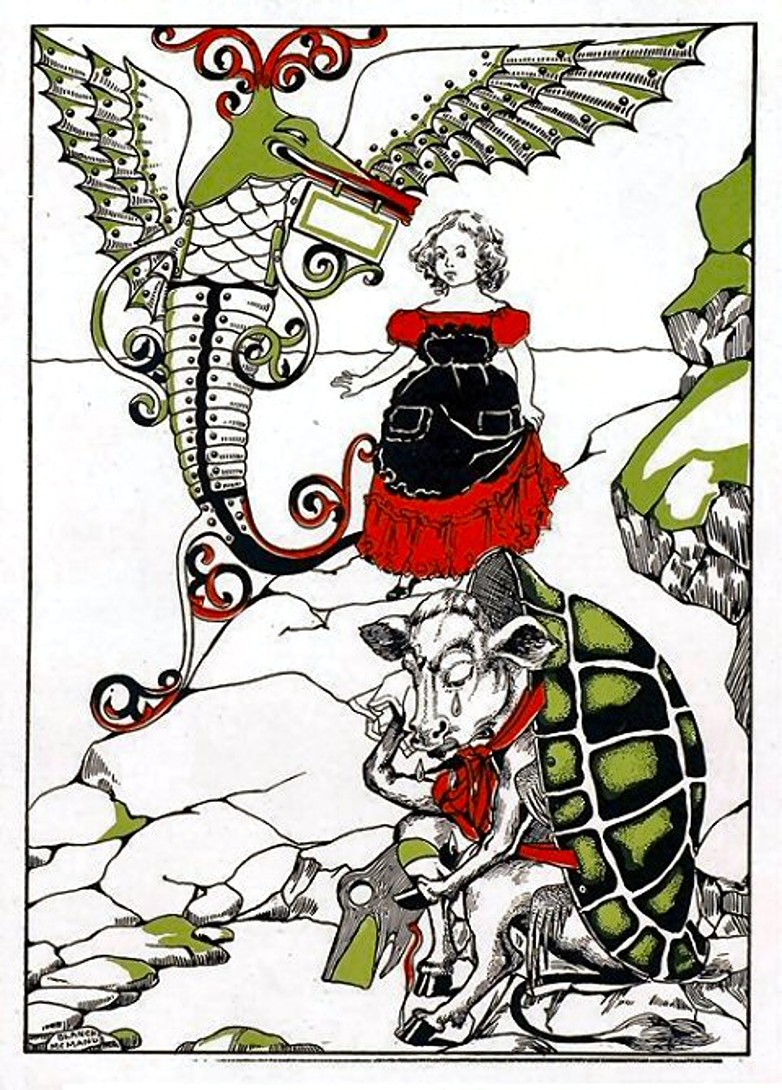
An exquisite Art Nouveau-inspired portrayal of the Mock Turtle and Gryphon, by Blanche McManus, 1899 (public domain)

In Carroll's account of the Gryphon and the Mock Turtle that the Queen of Hearts had taken Alice to meet, nothing of note concerning the morphology of either of them was included by him (devoting much of his coverage instead to their reciting and performing the Lobster Quadrille, a most unusual dance). Instead, all such details were imparted to the reader entirely by way of some excellent line drawings prepared by the renowned illustrator Sir John Tenniel working in strict accordance with Carroll's very exacting instructions. Carroll had initially planned to illustrate the book himself, and did so in a preliminary, then-unpublished, handwritten version entitled Alice's Adventures Under Ground (AAUG), which he presented to Alice Liddell on 26 November 1864. However, he recognised that his artistry was not of a sufficiently high standard for publication purposes, so he engaged Tenniel to prepare the required artwork for the final, longer version that became AAIW. (This was evidently a wise decision, judging at least from Carroll's bizarre illustration of the Mock Turtle that appeared in AAUG, in which its head resembled that of a seal, and its long, slender body looked as if it were composed entirely of overlapping roof tiles!)

Lewis Carroll's decidedly odd-looking drawing of the Mock Turtle, from Alice's Adventures Under Ground (public domain)

In Tenniel's drawings, the Gryphon was depicted in typical griffin form, as a composite of eagle and lion, deftly amalgamating the beaked head, taloned forelimbs, and plumed wings of the former with the furry body, clawed hind limbs, and long tuft-tipped tail of the latter. Conversely, whereas the Mock Turtle also appeared to be a composite creature, it did not resemble anything known to me from either fable or fact. Nor had I even heard of a mock turtle before. Evidently, therefore, I reasoned, unless it were an exceedingly obscure mythical beast it must have been one of Carroll's own inventions, but what had inspired him to fashion it in the extraordinary form that he had done, and where had its very distinctive, memorable name originated? These were the two questions that puzzled me for so long (back in those now far-distant days before the information super-highway of the internet had come into being!).

Sir John Tenniel's most famous depiction of the Mock Turtle and Gryphon, 1865 (public domain)

For in Tenniel's illustrations, this remarkable creature was portrayed with the familiar body shell and scaly front flippers of a real turtle, but sported the big-eared head, hoofed hind legs, and long tufted tail of a calf. In my youthful naivety, I simply assumed that the 'mock' aspect of its name related to the fact that because of these bovine attributes it wasn't a genuine turtle, with the latter attributes merely being humorous but hardly meaningful creations by Carroll. I now know of course that had I been alive during Victorian times when AAIW was written and published, I would have been readily aware of the true derivation of this term and the attendant significance of those attributes – especially as, albeit unrealised by me back in my childhood, Carroll had actually provided the answer to one of my afore-mentioned questions in his text:

Then the Queen left off, quite out of breath, and said to Alice, "Have you seen the Mock Turtle yet?"

"No," said Alice. "I don't even know what a Mock Turtle is."

"It's the thing Mock Turtle Soup is made from," said the Queen.

"I never saw one, or heard of one," said Alice.

Neither had I, but nor had I ever heard of mock turtle soup either, so I had assumed that this too was just another Carrollian invention. Many years later, however, I finally stripped bare the mystery surrounding the 'mock' moniker, and uncovered at last the truth behind this very tantalising turtle.

A colourised version of Tenniel's second original illustration of the Mock Turtle and Gryphon with Alice, 1865 (public domain)

It turned out that mock turtle soup was actually a bona fide dish, an English soup originally created during the mid-1700s but very commonly served in Victorian times. It earned its name from the fact that it was actually a cheap substitute for genuine turtle soup, which was a very expensive delicacy that few could afford. Instead of containing turtle flesh as its primary ingredient, mock turtle soup contained calf meat (veal), taken especially from those parts of a calf that were otherwise usually discarded, i.e. the head, hooves, and tail, and which therefore cost a lot less to produce than real turtle soup.

Classic illustration by Arthur Rackham of the Mock Turtle, Gryphon, and Alice, 1907 (public domain)

Suddenly, all became clear. His fondness for humorous word games, puns, and other literary trickery had clearly inspired Carroll to dream up a character that was then playfully put forward by him when recounting his story as the (non-existent) creature from which was derived a certain very common veal-containing dish from his time whose memorable name would be familiar to his young listeners and thus make them laugh – namely, mock turtle soup. That was why the Mock Turtle had a turtle's shell and front flippers but a calf's head, hind limbs, and tail – with typically witty Carrollian absurdity, it was the visual embodiment of what mock turtle soup pretended to contain (turtle) and what it actually did contain (the calf elements listed above).

In this illustration from 1916, the Gryphon and a particularly tearful Mock Turtle perform the Lobster Quadrille for a somewhat bemused Alice (public domain)

One further feature that was a major component of the Mock Turtle was its extremely lugubrious, sobbing demeanour. When Alice asked the Gryphon why his chelonian companion was so sorrowful, the Gryphon replied very dismissively that it was "all his fancy", that he didn't actually have any sorrow. Yet because the Mock Turtle briefly mentioned that he had once been a real turtle (but without providing any clues as to why he no longer was), there has been much speculation among Carrollian scholars as to whether this was the reason for his tearful melancholia, coupled perhaps with what may have been a poverty-stricken upbringing (when recounting his history to Alice, the Mock Turtle intimated that he was poor when young, revealing that he couldn't afford to study any extra subjects at school, only the regular ones).

The Mock Turtle is no less mournful in this illustration either, by Gwynedd Hudson, 1922, but Alice looks distinctly perturbed by their terpsichorean exuberance! (public domain)

As a wildlife enthusiast from the earliest of ages, however, it occurred to me a long time ago that a more likely origin for this particular characteristic of the Mock Turtle was that real turtles, which are all exclusively marine in the strict definition of the term 'turtle' traditionally employed in British English, rid their bodies of excess salt (derived from drinking seawater) by excreting it in the form of salty tear-like exudation trickling from glands near to their eyes, so that they look very much as if they are weeping profusely. Quite apart from being a mathematician and storyteller, Carroll was also a keen amateur naturalist (and is known to have made a particular study of those animals featuring in his Alice novels to ensure that his accounts of them were accurate). Consequently, he was assuredly aware of this specific behavioural occurrence in turtles, and had cleverly incorporated it with altered meaning into the Mock Turtle's persona, transforming it from a practical osmoregulatory activity into an entirely anthropomorphic emotional outpouring instead.

The Mock Turtle managed to be doleful even when dancing, as seen here in this lantern slide image from the early 1900s (public domain)

More than 150 years have passed since the Mock Turtle was introduced to the world in AAIW, and it has been depicted by over 70 artists within the numerous illustrated editions that have been published since the original one from 1865, containing Tenniel's drawings. It has also appeared in a considerable number of films and TV adaptations, in which it has been played by the likes of Cary Grant, Sir John Gielgud, Sir Michael Hordern, Donald O'Connor, Gene Wilder, and Ringo Starr, as well as being voiced by Alan Bennett in the 1985 film Dreamchild.

The Mock Turtle in a photo-still from Alice In Wonderland (1915), a very early silent film version written and directed by W.W. Young, starring Viola Savoy as Alice, and viewable online here (public domain)

What is particularly interesting, however, is that whereas earlier portrayals generally retained its appearance as originated by Tenniel following Carroll's instructions to him, there have been various later depictions that have strayed significantly from this. Moreover, the way in which they have strayed seems to indicate that those responsible may not have realised why this character's appearance was what it was in the original book, thereby, albeit inadvertently, making a veritable mockery of the Mock Turtle.

An illustration from 1907 by W.H. Walker featuring an accurately-depicted Mock Turtle but a very predatory-looking Gryphon in worryingly close proximity to Alice! (public domain)

The reason for my suspecting this to be the case is that the Mock Turtle has sometimes been depicted not as a half-turtle half-calf composite, but merely as a normal, ordinary turtle, i.e. with not just a turtle's body shell and front flippers but also a turtle's head, hind flippers, and tail – thereby entirely missing the etymological significance and origin of this Carrollian character. After all, if the Mock Turtle is presented as being exactly the same in appearance as a genuine turtle, how can the term 'mock' be justifiably applied to it? Equally, the crucial fact that it was specifically created by Carroll as the creature from which mock turtle soup is supposedly derived is wholly concealed visually if it is depicted simply as a totally normal-looking turtle. Consequently, I can only assume that those who have produced these latter images do not know about mock turtle soup. In a different but no less bizarre vein, I have also seen the Mock Turtle portrayed with the head, trotters, and curly tail of a pig, which if anything makes even less sense than depictions of it as a genuine turtle!

An unusual but thoroughly charming illustration from 1926 by A.L. Bowley, in which not only Alice but also apparently both the Mock Turtle and the Gryphon are depicted as youngsters (public domain)

Today, the Mock Turtle's fame stretches far beyond the confines of Carroll's beloved novel, appearing in a number of works by other authors inspired by Wonderland and its many strange but memorable inhabitants. As noted earlier, it features in many movie and TV dramatisations of AAIW too, as well as in various songs, and it has even lent its name to a popular Indie rock band, The Mock Turtles, hailing from Greater Manchester, England.

Still more dancing, but no sign of Alice in this illustration from 1928 – perhaps she'd become bored of it all by now and went home! (© Copyright holder and original source of this illustration presently unknown to me – reproduced here on a strictly non-commercial Fair Use basis only)

Nevertheless, at least for me there is one major disappointment associated with this memorable character – that it didn’t appear in Walt Disney's very colourful, classic animated film, Alice in Wonderland, first released in 1951. Very recently, however, I was most interested to discover that in fact, along with the Gryphon, the Mock Turtle had indeed been due to feature in it. In fact, cartoon versions of their characters had been produced, and were scheduled to appear in one scene, with the Mock Turtle even singing two specially-penned songs ('Beautiful Soup', sung to the tune of 'The Blue Danube', and 'Will You Join The Dance?', based upon the 'Lobster Quadrille' poem recited by this character in the novel'). Just before the film's completion, however, their scene and songs were axed. Happily, though, all was not entirely lost, because later on in the 1950s Disney produced an animated Wonderland-based commercial for Jell-O gelatin desserts in which the Mock Turtle and Gryphon did feature, together with Alice.

A very beautiful, colourful rendition of the Mock Turtle, Alice, and a fiery-plumed Gryphon by Harry Rountree, 1928 (© Harry Rountree, reproduced here on a strictly non-commercial Fair Use basis only)

Even so, failing to make the final cut in one of Disney's most delightful animated films would be enough, surely, to make anyone cry, let alone someone as famously weepy as the mournful Mock Turtle!

The Nursery "Alice" – a special edition of AAIW for very young children, simplified by Lewis Carroll and illustrated by Sir John Tenniel; it was published in 1890 and included both the Mock Turtle and the Gryphon on its front cover, prepared by one of Carroll's friends, E. Gertrude  Thomson (public domain)

To read a previous ShukerNature blog article concerning another of my favourite AAIW animal characters, the iconic and decidedly idiosyncratic Cheshire Cat, please click here.

One of my all-time favourite AAIW-inspired artworks, an absolutely spectacular and very original futuristic/fantasy take on the Mock Turtle, Gryphon, and Alice, by the world-renowned fantasy artist Rodney Matthews (© Rodney Matthews, included here on a strictly non-commercial Fair Use basis only)


Tuesday, 28 December 2010

THE SMILE ON THE FACE OF THE CHESHIRE CAT

Adopting my best Blofeld pose with Disney’s wonderful animated version of Lewis Carroll’s enigmatic Cheshire Cat (Dr Karl Shuker)


This is a section from my forthcoming, second book on mysterious and mythical cats, which is entitled Cats of Magic, Mythology, and Mystery, and covers not just cryptozoological cats (as did my Mystery Cats of the World book back in 1989) but also legendary, literary, and supernatural cats, as well as anomalous feline behaviour, feline symbolism and worship, and lots more! It will be published in autumn 2012.

As she said this, she looked up, and there was the Cat again, sitting on a branch of a tree...
"...I wish you wouldn't keep appearing and vanishing so suddenly: you make one quite giddy."
"All right," said the Cat; and this time it vanished quite slowly, beginning with the end of the tail, and ending with the grin, which remained some time after the rest of it had gone.
"Well! I've often seen a cat without a grin," thought Alice; "but a grin without a cat! It's the most curious thing I ever saw in my life!"

Lewis Carroll - Alice's Adventures In Wonderland


Ever since Lewis Carroll's classic children's book was first published in 1865, literary scholars, Carrollian biographers, and cat-lovers alike have debated the source of one of its most enigmatic characters - the famously evanescent Cheshire Cat, with its maniacal, detachable grin! What was Carroll's inspiration for such a surreal creation?

To begin with: as there is no such breed as a Cheshire cat, where did its name originate? Unlike most of its history, however, this seems to be quite straightforward.

Born in 1832 at Daresbury in rural Cheshire, Lewis Carroll (whose real name was Charles Lutwidge Dodgson) spent much of his childhood there and later at Croft, a little further north. Consequently, he would have frequently encountered various of the local farm, pet, and stray cats - in other words, cats of Cheshire.

Moreover, as pointed out by Martin Gardner in The Annotated Alice (1960), there was a popular saying, current during Carroll's time - "Grin like a Cheshire cat" - which must also, surely, have influenced his choice of a name for his fictitious feline.

Hardly surprisingly, that phrase has been mooted by several scholars as the origin of the Cheshire Cat's synonymous smile too - but there are a number of other, equally compelling claimants for that particular honour. For example, it is well known that during the period when Carroll and his family lived in Cheshire, there were several inns whose signboards portrayed broadly-grinning lions; their incongruous visages would undoubtedly have attracted the attention of anyone so captivated by the allure of the ludicrous as Carroll.

Notwithstanding this, he needed to look no further than his home county's celebrated cheeses for immediate inspiration. In her book Lewis Carroll: A Biography (1979), Anne Clark noted that a renowned medieval inhabitant of Chester, John Catheral, whose coat-of-arms from 1304 included a cat, always bared his teeth in a grin when angry - and died with a smile on his face, quite literally, while defending his beloved town. In honour of his valour, a longstanding tradition arose whereby Cheshire cheese-makers would mould their cheeses into the shape of a cat, and carve a wide grin upon its face. Once again, Carroll would certainly have seen such cheeses, and would have known the origin of their unusual form.

Another potential influence can still be found in the Wirral village of Brimstage, just north of the current Merseyside-Cheshire border. Dating back again to medieval times, there is a stone effigy of a cat, whose red-hued lips were shaped by its long-demised sculptor into a very definite grin. As pointed out by Roger Lancelyn Green in his monograph Lewis Carroll (1960), Carroll may never have visited Brimstage, but as an avid reader throughout his youth he is very likely to have encountered some details concerning it.


In a fascinating account entitled 'The Most Curious Thing I Ever Saw in All My Life', published in Cheshire Life in June 1960, the Reverend Kenneth Lee, Rector of Heswall, documented his own personal search for the answer to the longstanding literary mystery of the Cheshire Cat's origin, and revealed several important additional clues.

During his peregrinations around Cheshire, he visited the village of Grappenhall, not far from Carroll's home village of Daresbury. Here, in its church, high on the wall immediately above the large west window, he spotted a carving in black stone of a cat with a grinning expression on its face. A previous writer had already commented that this might have been the original of the proverbial Cheshire Cat, and Lee speculated that Carroll may well have visited Grappenhall when he was a boy.

In Pott Shrigley, another Cheshire village, Lee noted that the crest of the Pott family was a wild cat, as carved under the chancel arch here. He also recalled that certain other characters from Alice in Wonderland, including the King and Queen of Hearts, could have been inspired by figures carved in the old stone work outside this village's church - as suggested by members of the Archaeological Society following a visit here in 1922.

In addition, Lee visited Brimstage to observe the stone cat noted above, which is a corbel carved in red sand-stone, supporting a pier in one of the ancient chapel's side walls. It also gave its name to the village inn that was eventually taken down in 1931. According to Lee, this feline statue is believed to be linked with the Domville family who lived in Brimstage Hall during the early 1300s, and whose coat-of-arms was a red lion rampant. Some say that the statue is the work of a stone mason who had never seen a lion but was asked by the Domville family to carve one; the result was a large cat wearing what proved to be more of a grin than the fierce snarl that he had intended.

A second, equally interesting article dealing with the possible origin of the Cheshire Cat and entitled 'All This Grinning Cat Stuff', was published in Cheshire Life in November 1973. Its author was Jennifer R. Simpson, who delved much further back in time for solutions than previous writers - proposing that the Cheshire Cat tradition "...may represent the dim glimmer of ancient folk memories connected with the remote origins of our race".

According to Simpson's hypothesis, the Cheshire Cat-related themes already itemised here could comprise the last remnants, or memories, of the former existence in this English region of an ancient cat-venerating tribe called the Khatti, who migrated to Britain from Spain, having previously entered Spain from Mesopotamia.

However, it is a locality from Carroll's own time, one visited by him when he was still young, which has more recently disclosed an extraordinary secret that some Carrollian scholars believe to be the cryptic, much-disputed source not only of the Cheshire Cat's lingering leer but also of its own vanishing ability.


As revealed in London's Daily Telegraph and many other newspapers worldwide during July 1992, Joel Birenbaum from Chicago was one of a party of 35 members from the international Lewis Carroll Society who had lately visited St Peter's Church at Croft - the village to which the Dodgson family moved when Carroll was 11 years old. In the 10th Century church, where his father (the Rev. Charles Dodgson) became rector, Carroll would have knelt in prayer; and it was there, at the altar, while also kneeling, that Birenbaum noticed a small grinning cat.

Carved on a wall panel, in stone relief, it seemed very mundane, until Birenbaum knelt down further and then looked up - whereupon the cat began to vanish right before his eyes! Due to an optical illusion, whenever Birenbaum raised his eyes up towards it from a kneeling position, the image of the cat was rendered invisible - except, that is, for its carved smile, stretching virtually from ear to ear, which lingered in precisely the manner described by Carroll for the Cheshire Cat!

As soon as Birenbaum informed them of his remarkable discovery, each of the other 34 society members eagerly knelt down in turn in order to witness this extraordinary sight - and sure enough, the cat dutifully disappeared time after time, leaving behind only its grin to gratify its incredulous congregation of observers.

It seems evident that this fascinating carving did indeed play its part in Carroll's creation of the Cheshire Cat as a virtuoso of the vanishing act and the disembodied smile - but so too, surely, did most if not all of the other feline factors given here.

Rather than this complex story-book character and its idiosyncratic traits being spawned instantly, directly, and exclusively from the inspirational spark ignited by just a single factor, a more reasonable scenario is one in which they developed within Carroll's fertile imagination in a much more gradual manner - with each of the factors discussed here, every one in close proximity to Carroll during his youth, making its own contribution to their evolution.

But enough of the past, for the present is no less exciting. Today, thanks to its defiantly enigmatic grin (second in fame only to the rather more demure version gracing the lips of Leonardo da Vinci's 'Mona Lisa'!), the Cheshire Cat can bask in the secure knowledge that it remains one of the most popular literary felines of all time. Not bad for a character that didn't even appear in Carroll's original manuscript, entitled Alice's Adventures Under Ground - and reason enough, surely, to make any cat smile!

To read my ShukerNature blog article concerning another of my favourite Alice's Adventures In Wonderland animal characters, the lugubrious calf-headed Mock Turtle, please click here.


Sir John Tenniel's classic illustration of Alice meeting the Cheshire Cat from Alice's Adventures In Wonderland (1865)
 
And here's a Cheshire Cat encounter of a rather more creepy kind! (created by me using MagicStudio)