Dr KARL SHUKER

Zoologist, media consultant, and science writer, Dr Karl Shuker is also one of the best known cryptozoologists in the world. He is the author of such seminal works as Mystery Cats of the World (1989), The Lost Ark: New and Rediscovered Animals of the 20th Century (1993; greatly expanded in 2012 as The Encyclopaedia of New and Rediscovered Animals), Dragons: A Natural History (1995), In Search of Prehistoric Survivors (1995), The Unexplained (1996), From Flying Toads To Snakes With Wings (1997), Mysteries of Planet Earth (1999), The Hidden Powers of Animals (2001), The Beasts That Hide From Man (2003), Extraordinary Animals Revisited (2007), Dr Shuker's Casebook (2008), Karl Shuker's Alien Zoo: From the Pages of Fortean Times (2010), Cats of Magic, Mythology, and Mystery (2012), Mirabilis: A Carnival of Cryptozoology and Unnatural History (2013), Dragons in Zoology, Cryptozoology, and Culture (2013), The Menagerie of Marvels (2014), A Manifestation of Monsters (2015), Here's Nessie! (2016), and what is widely considered to be his cryptozoological magnum opus, Still In Search Of Prehistoric Survivors (2016) - plus, very excitingly, his four long-awaited, much-requested ShukerNature blog books (2019-2024).

Dr Karl Shuker's Official Website - http://www.karlshuker.com/index.htm

IMPORTANT: To view a complete, regularly-updated listing of my ShukerNature blog's articles (each one instantly clickable), please click HERE!

IMPORTANT: To view a complete, regularly-updated listing of my published books (each one instantly clickable), please click HERE!

IMPORTANT: To view a complete, regularly-updated listing of my Eclectarium blog's articles (each one instantly clickable), please click HERE!

IMPORTANT: To view a complete, regularly-updated listing of my Starsteeds blog's poetry and other lyrical writings (each one instantly clickable), please click HERE!

IMPORTANT: To view a complete, regularly-updated listing of my Shuker In MovieLand blog's articles (each one instantly clickable), please click HERE!

IMPORTANT: To view a complete, regularly-updated listing of my RebelBikerDude's AI Biker Art blog's thematic text & picture galleries (each one instantly clickable), please click HERE!

Search This Blog


PLEASE COME IN, I'VE BEEN EXPECTING YOU...

PLEASE COME IN, I'VE BEEN EXPECTING YOU...
WELCOME TO SHUKERNATURE - ENJOY YOUR VISIT - BEWARE OF THE RAPTOR!


Showing posts with label moa. Show all posts

Tuesday, 22 June 2021

THE DINOSAURS OF CRYSTAL PALACE - VISITING LONDON'S LOST WORLD. Part 3: THE RAVAGES OF TIME, AND AN AMERICAN DREAM DESTROYED

 
The dream that died – a 19th-Century engraving depicting Hawkins's planned Palaeozoic Museum for New York City; how magnificent it would have been (public domain)

In Parts 1 and 2 of this ShukerNature blog article (click here and here to access them), we paid a virtual, verbal visit to the ancient mammals and especially the enormous dinosaurs and other prehistoric herpetological creatures that are immortalized at Dinosaur Court in Crystal Palace Park, southeast London, via a series of artistically magnificent (albeit nowadays palaeontologically inaccurate) statues.

These were the first such statues ever created – dating back to 1853/4 – and were reconstructed by eminent British sculptor and artist Benjamin Waterhouse Hawkins under the guidance of Britain's foremost zoologist and palaeontologist at that time, Prof. Sir Richard Owen. Today, we turn our attention to the ongoing peril faced by these monumental wonders from a deadly combination of environmental and vandal-induced vicissitudes, as well as recalling Hawkins's tragically ill-fated American adventure.

 
Benjamin Waterhouse Hawkins (public domain)

In recent times, the Crystal Palace Dinosaurs have hit the news headlines for a variety of different reasons – some good, some not so good. Sadly, the most notable instance falls into the latter category. In May 2020, media reports worldwide revealed the shocking news that the nose and jaw tips of the magnificent Megalosaurus dinosaur statue had broken off. Photos accompanying these reports presented in stark close-up detail the severity of the damage, but opinions were mixed as to its cause. The Metropolitan Police were treating it as vandalism (and there are plenty of precedents with these statues to explain this view), whereas some historians noted that the nose and jaw tips had broken off along pre-existing fracture lines, thus suggesting that it may have happened naturally.

Indeed, when I read the reports I was reminded of a brief but prophetic observation made in a Tetrapod Zoology blog article of 11 December 2018 by British palaeontologist Dr Darren Naish following his visit to Dinosaur Court in September 2018 during its annual Open Day weekend there in which visitors were allowed the rare privilege of stepping forth onto the actual islands where Hawkins's statues stand, thereby enabling them to be viewed at much closer range than is normally possible. In his article, he stated: "…sections of the megalosaur’s nose look like they could fall off at any moment".

 
Hawkins's monumental Megalosaurus statue, photographed by me during my visit to Crystal Palace Park on 22 April 2010, when its nose and jaw tips were still intact (© Dr Karl Shuker)

Happily, however, in May 2021 Hawkins's Megalosaurus statue was restored to its former glory when it received a specially-created 'prosthetic jaw' and 22 teeth. The intricate restoration work that had created and fitted them had been financed by a grant from Historic England's Culture Recovery Fund plus support from Bromley Council and donations generated via fundraising carried out by the charity FOCPD – Friends of Crystal Palace Dinosaurs (more about this sterling organization later).

Certainly, following direct outdoor exposure to the elements for almost 170 years, many of Hawkins's statues, especially the larger ones, sport a distressing array of fractures, fissures, cracks, and breaks, and are in danger of losing toes, tails, teeth, and antlers. The distal region of the tail of his Hylaeosaurus dinosaur statue, for example, is already severed from the remainder of it. And at much the same time as the Megalosaurus disfigurement took place in May 2020, the antlers of the two Irish elk stags were also damaged, although this may have been due to the prevailing high winds.


Also snapped by me during my 2010 visit to Crystal Palace Park were these three photographs of Hawkins's two magnificent Irish elk stags with still-intact antlers (© Dr Karl Shuker)

Ironically, less than three months previously, in late February 2020, Historic England had announced that the Crystal Palace Dinosaurs were being added to its Heritage at Risk Register.

Speaking of Hylaeosaurus: many years after its statue had been created by Hawkins, the head either fell off of its own accord or had to be removed because its great weight was causing the statue's neck to snap (accounts differ), and a lightweight fibreglass replica was added in its place. Happily, however, the original head was preserved, and can still be seen, mounted upon a special inset plaque on the ground, but sited some distance away from the rest of this statue.

 
The mounted original head of Hawkins's Hylaeosaurus statue (© MrsEllacott/Wikipedia – CC BY-SA 4.0 licence)

In my view, however, undoubtedly the most devastating damage wrought upon any of Hawkins's Crystal Palace statues was suffered by the pair of smaller, Oolite pterosaurs mentioned by me yesterday in Part 2 of this ShukerNature blog article. After being on display in addition to the more famous larger pair of pterosaurs for approximately 80 years, they were destroyed sometime during the 1930s; it has been claimed that they were used as target practice when the grounds of Crystal Palace Park were being temporarily utilized as barracks. During the major restoration work that took place at Dinosaur Court in 2002, however, a gorgeous pair of golden-gleaming fibreglass replicas were installed, having been specially created by sculptor John Warne in consultation with geologist Peter Doyle and Morton Partnership. Tragically, however, they were heinously destroyed just three years later, in 2005, when vandals kicked them over and also stole their smashed fragments.

Nothing more was heard about the Oolite pterosaur replicas for almost a decade, until a blog article by Joe Cain uploaded on 18 July 2014 to the Friends of Crystal Palace Dinosaurs website sensationally revealed that their fragments had been discovered just a week previously. Although for security reasons their location was not disclosed, Joe stated that he and two colleagues had been given special access to the fragments, which enabled them to be counted and their condition assessed. Sadly, most were in poor condition, but he felt that there was enough for future work to be initiated at some stage. As for the two larger, Cretaceous pterosaurs, they have suffered a degree of damage too, including much of the long slender jaws of one of them having broken off in recent years (I was fortunate enough to see both of them fully intact back in 2010).

 
A 19th-Century illustration of Crystal Palace Park's Dinosaur Court, which depicts the original pair of small, subsequently-destroyed Oolite pterosaurs, arrowed (public domain)

Yet even the desecration of the Oolite pterosaurs almost pales into insignificance when compared to the nightmare of what happened to all of Hawkins's New York statues. Despite the initial success of his Dinosaur Court at London's Crystal Palace Park, the cost of the statues' creation had been prohibitive (approximately £13,750 – an enormous sum back in the 1850s). Consequently, in mid-1855 the Directors of the Crystal Palace Company, which had purchased the palace itself, had funded its removal from Hyde Park and its reassembling at Penge following the end of the Great Exhibition, and had also financed Hawkins's creation of all of the statues there, refused to provide him with any further funding to reconstruct some additional statues of extinct Cenozoic beasts that he'd wanted to display on the Court's Tertiary Island.

These were believed to include New Zealand's ostrich-like giant moa Dinornis, the Mauritius dodo, the antlered giraffid Sivatherium, a South American glyptodont (a giant armadillo-like armoured mammal with a fearsome mace-like tail), some snakes and turtles, plus a woolly mammoth, and at least one other prehistoric pachyderm too (variously claimed to be a Mastodon or a Deinotherium).

An amusing cartoon in an issue of the English satirical magazine Punch from 1855, lampooning the greatly-promoted educational benefit of Hawkins's Crystal Palace Park dinosaur statues (public domain)

Nevertheless, buoyed by the success of his existing statues at Crystal Park Palace, Hawkins subsequently launched into an even more ambitious project following a transatlantic invitation sent to him in May 1868 from Charles Green, the administrator of the Board of Commissioners of Central Park in New York City, USA. Green was well aware of how lucrative and educational the Crystal Palace dinosaurs had proved to be, attracting each year numerous paying visitors anxious to gaze upon and learn all about these prehistoric goliaths. So he offered Hawkins the opportunity to establish in Central Park a comparable attraction, but this time in the form of a unique museum that would house a diverse range of new life-sized statues, with especial emphasis upon prehistoric creatures of the New World.

Hawkins readily agreed to do so, dubbing this major new project the Palaeozoic Museum. Among the statues that he planned to produce for it were ground sloths, glyptodonts, mastodonts, and the American plesiosaur Elasmosaurus, as well as bipedal representations of the American herbivorous duck-billed dinosaur Hadrosaurus and carnivorous tyrannosaurid dinosaur Laelaps [now Dryptosaurus], plus the Eurasian giant deer or Irish elk Megaloceros giganteus, a species that he had already constructed for London's Dinosaur Court, and also New Zealand's giant moa Dinornis, which he had been prevented from constructing for the Court.

 
Ensconced within New York City's Central Park, Hawkins's studio in 1869, containing Hadrosaurus and Irish elk statues (public domain)

Hawkins set up a workshop studio in Central Park, and by early 1871 he had created several statues and the moulds for several more when disaster struck. One fateful evening in spring of that same year, a team of brutish despoilers broke into his studio, with what has traditionally been believed to be the blessing of 'Boss' William Marcy Tweed an extremely rich, influential mobster in all but name. Tweed had stealthily gained control over much of New York City, including the finances of the Park, having infiltrated its Board via several corrupt Commissioners loyal to him, but according to traditional belief he had no intention of funding the museum's establishment (being neither a fan of Hawkins in particular nor of fossils in general). So his covertly-hired team's specified task was to smash, destroy, remove, and bury every statue, mould, and sketch that they could find there – a despicable crime that they carried out like palaeontological Luddites with diabolical zeal and efficiency, duly ending any prospect of Hawkins and Green founding their Palaeozoic Museum.

[UPDATE: You will have noticed, however, that when blaming Tweed for this destruction, I have twice highlighted that this is the traditional belief regarding it. In reality, however, a revelatory re-examination of the salient facts, published in a May 2023 Proceedings of the Geologists' Association paper authored by Victoria Coules of Bristol's Department of History of Art and palaeontologist Prof. Michael Benton of Bristol's School of Earth Sciences, exposes the culprit not to have been Tweed at all. Instead, the villain in question was none other than Henry Hilton, Treasurer and VP of Central Park. It turns out that Hilton made the fatal decision at a specific meeting that the statues and moulds should be destroyed, and it was he who sent out the very next day the team responsible for doing so. But why? Apparently, Hilton was a very strange, eccentric character who is already known to historians for a number of other bizarre, senseless, disreputable acts, so this wanton vandalism is entirely in keeping with his notorious reputation.]

 
An oil painting by Hawkins depicting New Zealand giant moas, Dinornis (public domain)

Returning to England dejected and rejected, Hawkins spent the remainder of his days painting wildlife, dying in 1894, his American dream shattered, unfulfilled. Happily, however, in London's Crystal Palace Park his visionary creations live on (in all but the most literal sense!).

Moreover, today they have a major ally and protector, in the shape of a superb charity organization called Friends of Crystal Palace Dinosaurs or FOCPD (be sure to visit its official website here for full details concerning its founding, its aims, volunteering, donating, and so much more). FOCPD is enthusiastically supported by an eclectic range of members united by their love for Hawkins's iconic creations, drawing not just from the scientific community but from every walk of life. One of FOCPD's biggest supporters, who has extensively publicized on social media its worthy cause, is none other than Hampstead-born Saul Hudson, better known today as celebrated Guns N' Roses rock guitarist Slash.

 
Slash (© Raph_PH – GunsNRoses160617-41/Wikpedia – CC BY 2.0 licence)

FOCPD was specifically founded in 2013 to promote the longterm conservation of these statues plus the larger surrounding geological site, and its latest in a long line of major successes since then has been to raise the very substantial sum of money (approximately £70,000) required to design, construct, and then safely secure in place a robust lockable swing bridge, dubbed the Dino Bridge. This will exclusively enable FOCPD's workers, volunteers, and others involved in vital restoration and maintenance work here to access the islands whenever needed, but at all other times it can be locked away to prevent would-be intruders and trespassers from using it to access these statue sanctuaries.

On 13 January 2021, the Dino Bridge was formally installed, thereby marking the beginning of a major new phase in FOCPD's ongoing objective of protecting and preserving Hawkins's priceless, irreplaceable legacy – and, in so doing, maintaining interest in it. This in turn ensures not only the continuing physical survival of his creations but also that their unique scientific, historical, and artistic significance is fully understood and appreciated by current and future generations.

 
A view of Dinosaur Court in London's Crystal Palace Park (© Dr Karl Shuker)

For what is all too often not realized (yet is absolutely crucial to remember here) is that whereas in comparison to today's currently-accepted palaeontological reconstructions of the prehistoric beasts represented by them, Hawkins's statues are undeniably inaccurate and thoroughly outdated, they are nonetheless exceedingly accurate representations of the very limited fossil remains and attendant knowledge concerning them that were available to him back when he created them almost 170 years ago. Indeed, it is even probably fair to say that relatively speaking, Hawkins's statues are actually more precise life restorations of the fossils available to him and Owen for study than today's life restorations are of the vast array of fossils available to modern-day sculptors and artists. This is because even such visually insignificant yet taxonomically highly significant features as tooth structure were diligently replicated by Hawkins from the fossils available to him for study. So, viewed from that perspective, i.e. strictly in context, his Victorian statues not only were the earliest but also may well be the most faithful three-dimensional reconstructions of dinosaurs and other antiquated animals ever created.

This is surely a most fitting testimonial to the man who was the very first person to resurrect like a veritable naturalist of necromancy the long-dead, long-buried monsters from the vast mausoleum of our world's hitherto-unsuspected prehistoric past.

 
A tenacious testament to a uniquely appealing twinning of science with art – Hawkins's pioneering palaeontological statues of various aquatic prehistoric creatures at Crystal Palace Park (© CGPGrey-Wikipedia – CC BY 3.0 licence)

For further details concerning the history of Hawkins's Dinosaur Court statues and for very extensive, meticulous analyses of their morphological accuracy when compared with our present-day knowledge of the prehistoric creatures that they are based upon, I heartily recommend Crystal Palace Dinosaurs: The Story of the World's First Prehistoric Sculptures (1994), a fascinating, lavishly-illustrated book written and researched by Steve McCarthy, designed and produced by Mick Gilbert; plus the excellent online blog of British palaeontologist and palaeoartist Mark Witton (click here to access it).

In addition, my sincere thanks for sharing with me all manner of interesting, pertinent information go to Sam Crehan, Friends of Crystal Palace Dinosaurs (FOCPD), Mandy Holloway, Dr Darren Naish, Bob Skinner, and Sebastian Wang.

 
Crystal Palace Dinosaurs: The Story of the World's First Prehistoric Sculptures 
by Steve McCarthy and Mick Gilbert (© Steve McCarthy/Mick Gilbert – reproduced here on a strictly non-commercial Fair Use basis for educational/review purposes only)

But above all, I wish to dedicate this comprehensive 3-part ShukerNature article to my late mother, Mary Shuker (1921-2013), whose fascination with animals inspired my own and whose ever-present encouragement and support were crucial in helping me to achieve my lifelong ambition of becoming a zoologist. Down through the years, she had heard me speak of the Crystal Palace Dinosaurs so often that when in 2010 I finally decided to brave the turmoil of London's traffic and pay them a long-promised visit at Penge, she was almost as keen to see them as I was. So naturally I took her with me, and when traversing the long and winding public pathway on the park 'mainland' that encircles their island sanctuaries, she enjoyed observing these immensely impressive statues just as much as I did.

Indeed, although during the five decades that we shared, Mom and I had travelled the world together, taking her with me to visit and view so many exotic sights that she had always wanted to see but had never thought that she would, the simple joy of our day among the dinosaurs of Crystal Palace will always remain one of my most treasured memories of our life together.

 
My mother Mary Shuker with Hawkins's majestic Megalosaurus and Megatherium statues in Crystal Palace Park's Dinosaur Court on 22 April 2010 (© Dr Karl Shuker)

God bless you Mom, thank you for being the best person I shall ever know – how I wish that you were still here, that you could read and enjoy this article of mine, and remember once again, as I am doing now, our happy time spent together in the company of its stately, stupendous subjects.

Finally: if you haven't already perused Parts 1 and 2 of this 3-part ShukerNature blog article on the Crystal Palace Dinosaurs, please click here and here to do so.

 
'Jurassic Life of Europe', an 1877 oil painting by Benjamin Waterhouse Hawkins (public domain)


Sunday, 28 January 2018

WHITHER THE QUEENSLAND MOA? RECALLING AN ORNITHOLOGICAL ANOMALY FROM AUSTRALIA


Photographed in 2006 alongside the sturdy, relatively short-legged Aotea Moa Statue, designed and sculpted (in concrete?) by Robin Coleman of Marton, and standing outside the Aotea New Zealand Souvenir Store on Queen Street in the centre of Auckland, on North Island, New Zealand – might it have been inspired by a Pachyornis species? (© Dr Karl Shuker)

It is well established that the extinct moas constituted a group of ratites exclusive to New Zealand - which is why the little-known tale of Australia's unique Queensland moa is worth retelling. So here it is.

In 1884, this zoogeographical heretic was christened Dinornis queenslandiae by English-born zoologist Charles W. De Vis (at that time the director of the Queensland Museum), in a Proceedings of the Royal Society of Queensland paper. He based its species on a fossilised, incomplete left femur, spotted by him in a collection of bones from King's Creek, on Queensland's Darling Downs, that had been presented to the museum by a Mr J. Daniels of Pilton. Naturally, the specimen attracted great interest among ornithologists, as it extended the moas' distribution very considerably. No longer were they a novelty of New Zealand - always assuming, of course, that it really was a moa.

The contentious partial left femur upon which the Queensland moa was established (Figs 1 and 2 from De Vis's Proceedings of the Royal Society of Queensland paper, 1884 – public domain)

Over the years, however, this assumption became a much-debated issue.

In 1893, for instance, eminent New Zealand naturalist Captain Frederick W. Hutton deemed the bone to be from a cassowary-like species that probably represented the common ancestor of emus and cassowaries, which are currently classed together within the same taxonomic order, Casuariiformes (and click here to access my ShukerNature article documenting some very controversial cassowaries). He documented his opinion in a Proceedings of the Linnean Society of NSW paper.

Australian emu Dromaius novaehollandiae (top) and double-wattled aka southern cassowary Casuarius casuarius (bottom) (public domain)

Then in 1949 its species was readmitted to the moa brotherhood, when Dr Walter R.B. Oliver of Wellington's Dominion Museum renamed it Pachyornis queenslandiae in a Bulletin: Dominion Museum (New Zealand) paper. By the early 1960s, conversely, it was back among the emus and cassowaries, when in 1963, within a Records of the South Australian Museum paper, American ornithologist Dr Alden H. Miller (director of the Museum of Vertebrate Zoology at the University of California, Berkeley, for 25 years) classified it as an emu, dubbing it Dromiceius [=Dromaius] queenslandiae. It seemed as if this contentious species would be spending the rest of time ricocheting from one ratite family to another - but then came the study that finally brought its taxonomic tribulations to a long-awaited end.

This was when, in April 1967, osteologist Ronald J. Scarlett from New Zealand's Canterbury Museum examined the Queensland moa's femur and revealed that it was indeed from a Pachyornis moa, but specifically the heavy-footed moa P. elephantopus (the presence and precise shape of a bony femoral projection called the cnemial crest clinched this taxonomic identification). He also paid close attention to the other bones in the original King's Creek collection within which it had been found by De Vis back in the 1880s.

Skeleton of the heavy-footed moa Pachyornis elephantopus skeleton in the Naturhistorisches Museum of Basel, Switzerland (public domain)

In so doing, Scarlett recognised that the femur was strikingly different in general appearance and colour from the rest of this collection's material, and clearly had not been obtained with it. In addition, his very appreciable experience with moa bones derived from caves, Maori middens, swamps, and other sources of such remains enabled him to reveal something even more significant – the femur was readily identifiable as a bone originating from a midden in New Zealand's South Island. Consequently, it was not from Australia at all! In 1969, Scarlett documented his revelatory findings in a Memoirs of the Queensland Museum paper.

In short, the (in)famous Queensland moa was just another non-existent creature that had been granted a transient reality by the evocation of inaccurate information and incomplete investigation - a mere monster of misidentification, nothing more. Pachyornis queenslandiae - R.I.P.!

Reconstruction of the heavy-footed moa in life (© niaolei.org.cn – reproduced here on a strictly educational, non-commercial Fair Use basis only for the purposes of review)

My sincere thanks go to the late Ron Scarlett for so kindly communicating with me regarding this once-controversial form (and other moa mysteries) during the 1990s, and for bringing his study and published paper concerning it to my attention.

This ShukerNature article is excerpted and expanded from my book The Beasts That Hide From Man.

Alongside a life-sized statue carved in 2004 by Frank Triggs of the giant moa Dinornis at Chester Zoo, England, in 2013 (© Dr Karl Shuker)


Tuesday, 6 October 2015

A NEW ZEALAND MOA IN CAMBODIA?


Bayon glyph depicting mystery long-necked bird between rhinoceros and ox at Angkor Wat, Cambodia (public domain)

They say that beauty is in the eye of the beholder, and the same has certainly been true of cryptids on many occasions in the past. The following case may – or may not – constitute a further example of this cryptozoological rule of thumb.

In terms of their current native zoogeography, modern-day ratites all have very precise distributions on the continental level. The ostrich is nowadays entirely confined to Africa (its contingent in Asia Minor was hunted into extinction by the mid-20th Century), the rheas to South America, the emu to Australia, the now-extinct moas to New Zealand, the now-extinct elephant birds to Madagascar, and the cassowaries to Australia and New Guinea. However, there are no known modern-day ratites native to mainland Asia (nor are there any to Europe or North America either, for that matter), which makes a certain enigmatic carving present on a famous Indochinese temple of particular interest.

Vintage illustration of a giant moa Dinornis sp. alongside a kiwi (public domain)

Dating from the 12th Century and richly decorated with countless numbers of bas-relief glyphs carved upon its numerous sandstone columns and walls, depicting a wide range of deities and animals, Angkor Wat is a celebrated temple complex in Cambodia and constitutes the world's largest religious monument. It also lays claim to cryptozoological fame, courtesy of a specific glyph carved on a wall at Ta Prohm, one of the temples in this complex, because the animal portrayed by this glyph bears a remarkable superficial resemblance to one of the classic plate-backed stegosaurian dinosaurs from prehistoric times. Not surprisingly, this anomalous, ostensibly anachronistic carving has attracted considerable discussion and dissension as to what creature it does truly depict, and I have documented it in a number of my own publications.

Angkor Wat's 'stegosaur' glyph (© Jon and Leslie Burke)

However, there is also a second glyph at Angkor Wat that, although far less famous than the 'stegosaur', is no less intriguing from a cryptozoological viewpoint, because one identity scientifically proposed for the notably long-necked bird that it depicts is a New Zealand moa. This glyph can be found in a temple known as the Bayon, with the mystery bird in question being sandwiched between a carving of a rhinoceros to its immediate left and one of an ox (possibly a gaur) to its immediate right.

Close-up of Bayon glyph depicting rhinoceros, mystery long-necked bird, and ox at Angkor Wat, Cambodia (public domain)

As seen in the illustration reproduced here of this glyph's animal trio, the bird has stout legs, a noticeably plump winged body, and an extremely long slender neck with a small head atop. In the April 1986 issue of the German scientific periodical Natur und Museum, Drs G.H. Ralph von Koenigswald and Joachim Steinbacher correctly pointed out that the above morphology ruled out any of the local heron species (the same is true of storks, because both storks and herons possess very long, slender, bayonet-like beaks, whereas the carved bird's is shorter, stouter, and has a hooked tip). They also noted that the glyph carver's placing it between two such large mammals as a rhinoceros and an ox (and with its head almost as high as theirs despite the fact that its neck was not even upright but was being held at an angle of approximately 45°) was probably done specifically to demonstrate just how big this bird was.

April 1986 issue of Natur und Museum, featuring on its cover the avian subjects in the von Koenigswald-Steinbacher paper (© Natur und Museum)

Reflecting upon these factors, the authors suggested that perhaps the bird was a New Zealand moa, and, if so, quite probably the sturdy, relatively short-legged coastal moa Euryapteryx curtus (as opposed to the more famous and taller but much slimmer and longer-legged giant Dinornis moas). The moas were not believed to have become extinct in their native New Zealand domain until the mid-1400s (seemingly as a result of over-hunting and habitat destruction by the Maoris), i.e. around 250 years after the creation of Angkor Wat. Due to the extensive trade links and maritime travel that had been occurring in the southeast Asian-Australasian region for many centuries, the authors believed it likely that New Zealand's mighty moas would have been known about in Indochina at the time of Angkor Wat's creation, and that their spectacular appearance might well have inspired a carving of one to be produced amid the many other depictions of striking wildlife and mythological monsters present here.

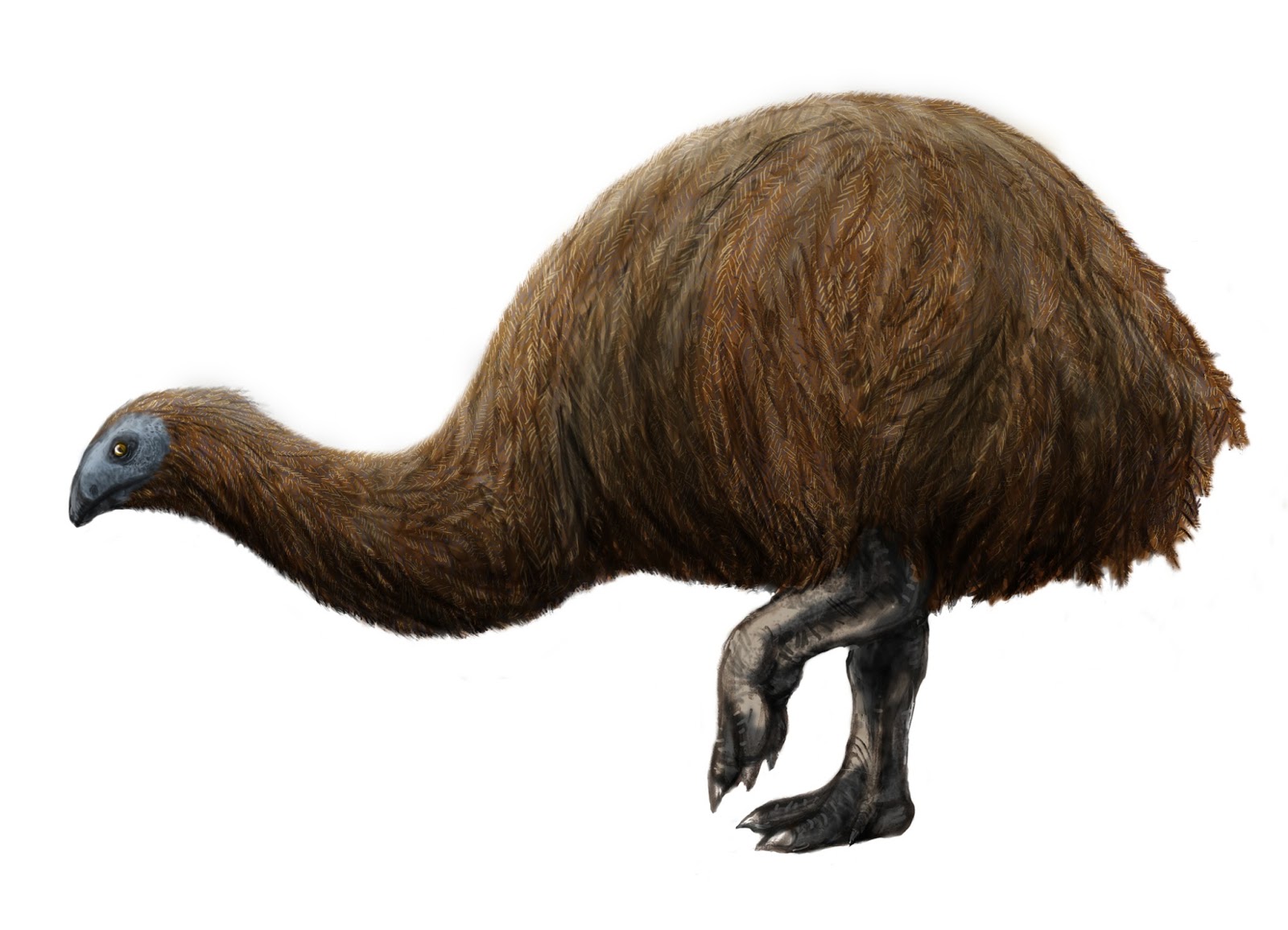
Restoration of Euryapteryx (© FunkMonk/Wikipedia CC BY-SA 3.0)

Moreover, as the authors also noted, traders throughout history have transported preserved and living specimens of unusual, exotic-looking animals far from their native homelands to those of the traders as curiosities for exhibition purposes. Hence it is remotely possible that merchants travelling between Australasia and Indochina brought a preserved or perhaps even a living moa back with them to Cambodia at some point during the quarter-millennium spanning Angkor Wat's completion and the moas' extinction in New Zealand.

Alongside a life-sized statue of a sturdy moa in Auckland, New Zealand (© Dr Karl Shuker)

And indeed, there are some very pertinent precedents for transporting living ratites from Australasia to Asia, because cassowaries are known to have been transported westwards by mariners in bygone centuries from their native Australian and New Guinea homelands to Indonesia and China. Indeed, as the authors also discussed in this same paper, there is even a glyph of a cassowary-like bird at the Tjandi-Panataran, a Hindu temple not far from Wadjak in Java and dating from around the 12th-15th Century, which may offer further evidence of such transportations. Additional details regarding this subject are contained in my book The Beasts That Hide From Man (2003) and also in a ShukerNature blog article on cassowaries (click here).

Glyph of cassowary-like bird at Java's Tjandi-Panataran temple (public domain)

Having said that, there might be an altogether much more mundane, prosaic explanation for the long-necked mystery bird of Angkor Wat. Namely, that its appearance may not be due so much to any taxonomic identity as a moa but rather to the fact that there was a space needing to be filled between the rhino and the ox, and a non-specific long-necked bird simply made an ideal space-filler, with any perceived similarities to Euryapteryx or any other moa being merely coincidental. In short, the bird's morphology was moulded by the specific shape of the space needing to be filled, nothing more.

Alongside a life-sized statue of a giant moa Dinornis sp. at Chester Zoo, England (© Dr Karl Shuker)

Indeed, a telling suggestion that this may well be the case is that whereas the wings of all moas were non-existent, the Angkor Wat bird has a very large, conspicuous wing readily visible. In addition, moa beaks were not hook-tipped. Such notable discrepancies as these would not be expected if the glyph provides as accurate a representation of the bird as it does for the rhinoceros and the ox, both of which are portrayed realistically and are readily recognisable.

Life-sized restoration of Dinornis moa at Tring Natural History Museum (© Dr Karl Shuker)

This ShukerNature blog article is excerpted from my latest book, A Manifestation of Monsters.