Dr KARL SHUKER

Zoologist, media consultant, and science writer, Dr Karl Shuker is also one of the best known cryptozoologists in the world. He is the author of such seminal works as Mystery Cats of the World (1989), The Lost Ark: New and Rediscovered Animals of the 20th Century (1993; greatly expanded in 2012 as The Encyclopaedia of New and Rediscovered Animals), Dragons: A Natural History (1995), In Search of Prehistoric Survivors (1995), The Unexplained (1996), From Flying Toads To Snakes With Wings (1997), Mysteries of Planet Earth (1999), The Hidden Powers of Animals (2001), The Beasts That Hide From Man (2003), Extraordinary Animals Revisited (2007), Dr Shuker's Casebook (2008), Karl Shuker's Alien Zoo: From the Pages of Fortean Times (2010), Cats of Magic, Mythology, and Mystery (2012), Mirabilis: A Carnival of Cryptozoology and Unnatural History (2013), Dragons in Zoology, Cryptozoology, and Culture (2013), The Menagerie of Marvels (2014), A Manifestation of Monsters (2015), Here's Nessie! (2016), and what is widely considered to be his cryptozoological magnum opus, Still In Search Of Prehistoric Survivors (2016) - plus, very excitingly, his four long-awaited, much-requested ShukerNature blog books (2019-2024).

Dr Karl Shuker's Official Website - http://www.karlshuker.com/index.htm

IMPORTANT: To view a complete, regularly-updated listing of my ShukerNature blog's articles (each one instantly clickable), please click HERE!

IMPORTANT: To view a complete, regularly-updated listing of my published books (each one instantly clickable), please click HERE!

IMPORTANT: To view a complete, regularly-updated listing of my Eclectarium blog's articles (each one instantly clickable), please click HERE!

IMPORTANT: To view a complete, regularly-updated listing of my Starsteeds blog's poetry and other lyrical writings (each one instantly clickable), please click HERE!

IMPORTANT: To view a complete, regularly-updated listing of my Shuker In MovieLand blog's articles (each one instantly clickable), please click HERE!

IMPORTANT: To view a complete, regularly-updated listing of my RebelBikerDude's AI Biker Art blog's thematic text & picture galleries (each one instantly clickable), please click HERE!

Search This Blog


PLEASE COME IN, I'VE BEEN EXPECTING YOU...

PLEASE COME IN, I'VE BEEN EXPECTING YOU...
WELCOME TO SHUKERNATURE - ENJOY YOUR VISIT - BEWARE OF THE RAPTOR!


Showing posts with label green dog. Show all posts

Wednesday, 18 May 2011

FROM THE HOUND OF THE HEDGES TO CHIA DOGS!

This delightful example of a Chia dog was photographed in Williamsburg, Virginia
(photo: http://www.livinginwilliamsburgvirginia.blogspot.com/)


Just over a month ago, on 12 April, I documented the wonderful Hound of the Hedges (click here for this ShukerNature post of mine), a unique (albeit fictitious) zoobotanical crossbred canid that featured in Charles Finney's surreal science fantasy novel The Circus of Dr Lao (1935).

Confirming that, as ever, fact is stranger than fiction, American correspondent Marc Gaglione has now brought to my attention the extraordinary real-life world of Chia Pets, which are common in the USA but which I haven't encountered here in the UK and hadn't even heard of before.


This is what Wikipedia says about them:

"Chia Pets are American styled animal-shaped terracotta figurines used to sprout chia, where the chia sprouts resemble the animal's fur.

"Produced by San Francisco, California-based company Joseph Enterprises Inc., Chia Pets achieved popularity in the 1980s following the 1982 release of a ram, the first Chia Pet. The catch phrase sung in the TV commercial as the plant grows in time lapse is "Ch-ch-ch-chia!". Moistened seeds of chia (Salvia hispanica) are applied to the grooved terra cotta figurine body.

"A range of generic animals has been produced, including a turtle, pig, puppy, kitten, frog, and hippopotamus, but cartoon characters including: Garfield, Scooby-Doo, Looney Tunes, Shrek, The Simpsons, and SpongeBob have also been licensed. Additionally, there are Chia Pets depicting presidents, including Barack Obama."


The Hippo of the Hedges? Now that's a cryptid I'd pay good money to see!


Chia ram or photoshopped Ram of the Hedges? You decide!

Tuesday, 12 April 2011

THE HOUND OF THE HEDGES - A FASCINATING FUSION OF FAUNA AND FLORA IN FICTION AND FACT!

The hound of the hedges – Tim Morris

What could a remarkable new discovery revealing that the zoological and botanical worlds are sometimes more intimately linked than ever before realised and my all-time #1 fictitious crypto-beast possibly have in common? Read on, and – extending my previous ShukerNature article’s theme of extraordinary green animals (click here to read it) - all will be disclosed!

A CHLOROPHYLLIC CANID

If I were asked to name my favourite real-life animal, I may need a couple of lifetimes to consider the myriad of diverse species populating this fertile planet of ours. If I were asked to name my favourite beast of legend, I might need a similar time-span to scour the far reaches of the human imagination in search of its most exotic examples, though I confess that the rare, evanescent unicorn may ultimately claim that prize. But if I were asked to name my favourite cryptozoological creature of literary fiction, I could do so in an instant – the hound of the hedges.

Where could you possibly encounter a dream-like dog whose fine green fur is composed of rich sweet-scented grass, its sharp teeth an array of prickly rose thorns, its curved claws a series of scratchy burrs, its viridescent blood a heady concoction of chlorophyll, and its long plumed tail an elegantly-woven plait of curling leafy ferns? Only in a circus, surely, and no ordinary circus at that – nothing less, in fact, than The Circus of Dr Lao, a truly weird but very wondrous novel first published in 1935 and conceived by the extraordinary imagination of fantasy writer Charles G. Finney. Here, frolicking amid the heterogeneous assemblage of sideshow marvels and misfits that include a werewolf, a satyr, a unicorn, the gorgon Medusa, a sea serpent, a sphinx, a roc’s egg ready to hatch, a mermaid, a chimaera, and a golden ass, can we find this unique and elusive canine cross-fertilisation of the animal and plant kingdoms – or, as it is known there, the hound of the hedges.

The Circus of Dr Lao by Charles G. Finney

But where and how did such a phytozoological wonder evolve? These and other important questions were answered as follows in his usual eloquent and informative manner by the circus’s enigmatic Chinese ringmaster-of-ceremonies, the eponymous Dr Lao:

“Possibly the strangest of all the animals in this menagerie, and certainly one which none of you should miss seeing, is that most unique of all beasts, the hound of the hedges. Evolved among the hedgerows and grassplots of North China this animal is the living, breathing symbol of greenness, of fecund, perennial plant life, of the transitional stage between vegetable and animal. The greatest scientists of the world have studied this hound and cannot decide whether he is fauna or flora. Your guess, ladies and gentlemen, is as good as the next. When you examine him, you will notice that, although his form is that of the usual dog, his various bodily parts are those of plants. His teeth, for instance, are stiff, thick thorns; his tail is a plait of ferns; his fur is grass; his claws are burrs; his blood is chlorophyll. Surely this is the weirdest beast under the casual canopy of heaven. We feed him hedge apples and green walnuts. Sometimes, too, though not often, he will eat persimmons. Let me advise you, good people, to see the hound of the hedges even though you must forgo seeing the mermaid or the werewolf. The hound is unique.”

The hound of the hedges – an exquisite gouache by William Lucius Appaloosius Steinmayer (http://www.elfwood.com/)

To a subsequent audience, Dr Lao expounded further on this astounding beast’s origin and singular attributes:

“Epitomising the fragrance of grassplots, lawns, and hedgy, thickset places, this behemoth of hounds stands unique in the mysterious lexicon of life. Most of the other curiosities of this circus, I regret to say, have a taint of evil or hysteria about them, but not this magnificent hound. He is as sweet as hay new mown with clover blossoms still unshrivelled lying in it. He is as sunny as the dewy mornings his parent grasses so much love. He is a grand beast, if beast he may be called. Also, though I refer to him in the masculine gender, such designation is very loose; for, as a matter of fact, this hound has sex only as a water lily might have sex. He is alone of his kind throughout the world; no mate and no sire; no dam and no brood. This hound is no more masculine than a horse radish, no more feminine than a cabbage, less carnal than a tiger lily, and as little lustful as a rose bush.

“We found him in North China along the canals where the ricefields flourish and where grasses and little stunted hedges grow. For a long, long time that land had been nothing but so much parched dust with no green thing growing upon it anywhere. Then the canals were constructed and brought water to it, and over its dry skin lovely green things commenced to grow. That which had seemed dead quickened into life. That which had seemed sterile glistened with fertility. And as a symbol and embodiment of that exuberant fecundity, the grasses and the weeds and the flowers and hedges and bushes each gave a little of themselves and created this hound, truly an unparalleled achievement in the annals of horticulture.

“We saw him first at dusk playing about the hedgerows, leaping, gambolling, biting at the hedge apples, pawing little holes in the ground and nosing fugitive seeds into them. Alarmed by us he romped about in great tearing circles, flitting through the grasses and disappearing behind hedges so swiftly the eye could hardly follow him. His beautiful greenness entranced us. We had never seen so wonderful a hound in all the world.”

Capturing the hound of the hedges – Boris Artzybasheff (1899-1965)

Mindful that such a miraculous creature would prove an irresistible attraction within their circus, Dr Lao and his companions lost no time in deciding the hound of the hedges’ fate:

“So we caught him. Out of his strange eyes he looked at us – eyes that were like green unripened pods. He was perfectly gentle. His tail of ferns wagged a little, switching his sides of green, green grass. From his panting mouth chlorophyll slavered. Around his neck a thin grass snake was curled, and his leafy ears harboured green katydids and tiny black crickets.

“In the meshes of our nooses he stood there regarding us. And, oh, that first close view of his great green glorious head! He was standing in the grasses, shoulder deep among the fresh green grasses; his parent grasses, the grasses that he loved. With their slim green fingers they caressed him and sought to shield him from us. They sought with their greenness to reabsorb his greenness, to hide him, to protect him; this their son. I tell you, nothing in the world has ever thrilled me as much as did the first sight of the hound of the hedges, and I have adored and studied animals for more than a hundred years.” I said: ‘Here is the masterwork of all life, here in this superb living body that is neither plant nor animal but a perfect balance of both. Here is a mass of living cells so complete in itself that it even demands no outlet for reproduction, content to know that, though it did reproduce its form a thousand times, it could never through that or through the evolutionary changes of a thousand generations improve upon its own victorious completeness.’

“Most immaculate of all was his conception among the humble weeds and grasses. All things trample them, devour them, plough them under and destroy them. But they endure and are beautiful and retain their gentleness and harbour no rancour. Yet once a great passion came to them, a pure passion not ever to be clearly understood; revolt was in it, and other things foreign to grasses; and out of that strange passion of the plants the hound of the hedges was conceived and born.”

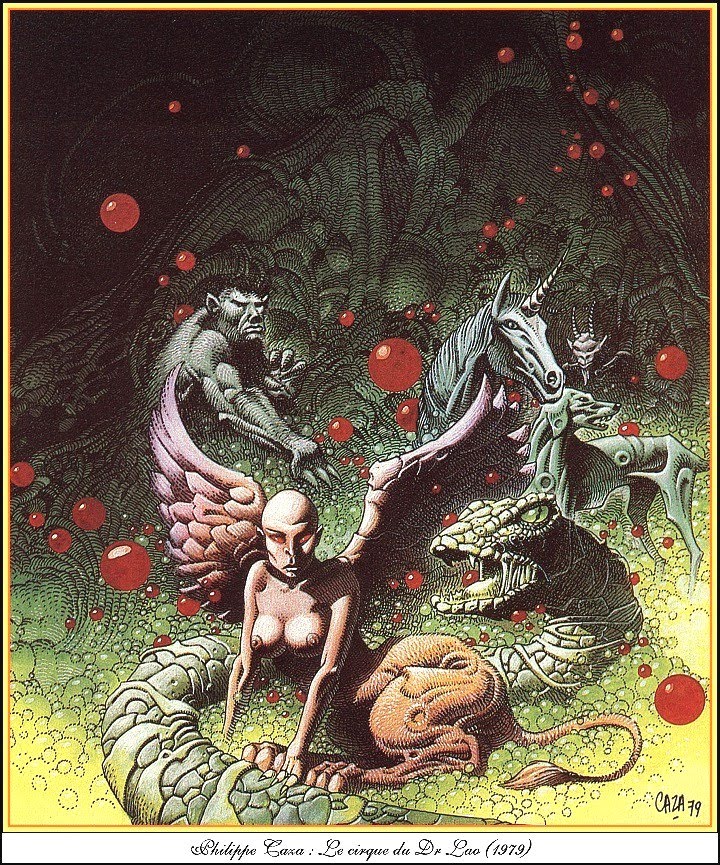
A cover for Le Cirque du Dr Lao prepared by Philippe Caza (the hound of the hedges is present directly below the muzzle of the unicorn)

Pondering further upon the exceptional manner in which this verdurous canine entity had been generated, Dr Lao came to a no less remarkable conclusion:

“And I wondered, too, for it had always been my belief that beauty was a modification of sex. Life sings a song of sex. Sex is the scream of life. Rutting and spawning the dance of life. Breed, breed, breed. Fill and refill the wombs of the world. Tumescence and ejaculation. Flinging out spore and seed and egg and bud. Quickening and birth. Sterility and death. That was life, I thought, and that was life’s means to the end that finally, after almost infinite centuries of trial and error, there might be produced the perfect living thing.

“But here was this hound, product of no trial and error process, lacking lust, unhampered by ancestral fears and instincts. And I wondered if in this hound of the hedges were not to be found the apogee of all that life could ever promise. For here were beauty and gentleness and grace; only ferocity and sex and guile were lacking.

“And I wondered: ‘Is this a hint of the goal of life?’”

Doctor Lao reached in the cage and patted the hound’s head. The beast soughed like the murmur of wind in sycamore leaves.

And what effect did Dr Lao’s articulate, lyrical outpouring of considered reflection concerning the truly astonishing hound of the hedges have upon its audience?

“What the hell is [he] talking about?” asked Quarantine Inspector Number One.

“I’ll be damned if I know,” said Quarantine Inspector Number Two. “Let’s go see the mermaid. That goddam dog looks like a fake to me, somehow.”

There’s a lesson for cryptozoology in there somewhere! Of course, they do say that beauty is in the eye of the beholder – but even then, the eye has to be open first, along with the mind.

THE CU SITH – GREEN FAIRY HOUND OF THE SCOTTISH HIGHLANDS


Is this what the cu sith looks like? (created using Magic Studio)

Intriguingly, green-furred hounds are not entirely confined to Dr Lao’s circus. True, its pelage may not be plant-derived, but a very large Celtic fairy hound with noticeably leafy-hued fur exists in the mythology of the Scottish Highlands, where it is referred to as the cu sith.


Moreover, there have even been claims that a real-life green dog exists in this region too. Here is what I’ve written about them in a book of mine on canine curiosities currently under preparation:

In the traditional folklore and legends of the Scottish Highlands, the cu sith is a magical dog as large as a year-old bullock and is further distinguished from all other dogs by its shaggy dark green fur. Other characteristic features include its huge paws, and its long tail, which is normally held in a tight coil or flat plait upon its back. Unlike most supernatural canids, when running through snow or mud the cu sith actually leaves behind footprints, which are as broad as those of a man, but its movements are totally silent - except for its triple-sounding bark, which can even be heard far out at sea by sailors aboard their ships.

Whereas the cu sith is merely mythological, however, a remarkably similar creature has been soberly reported in modern times by a number of eyewitnesses in Banffshire, who have commented not only upon its green fur but also upon its disproportionately small head - or, in some cases, its startling absence of a head! According to John Harries's Ghost Hunter's Road Book, if you should take the A939 from Grantown-on-Spey, and travel along the B9008, running past the Glenlivet Forest, you will reach the favourite haunt of this green-coated pony-sized ghost dog. Having said that, however, those who may be anxious to seek its acquaintance should do so with care - bearing in mind that the mere sight of Banffshire's green dog is said to portend imminent death, devastating storms, and other misfortunes.

Perhaps the most curious detail concerning this ominous entity is that when seen, it appears to be wholly oblivious of its eyewitnesses, never interacting with them in any way (unlike many cases featuring phantom black dogs and white dogs), but simply running ahead in a straight line almost like a projected three-dimensional film image. Accordingly, although the sight of this creature reputedly brings doom, it never physically causes anyone harm.

 
A second Magic Studio-created representation of the cu sith
 
But what have green-coated supernatural hounds of the Highlands (in passing) and Dr Lao’s grassy-furred hound of the hedges (in particular) to do with the recent zoological discovery that I briefly alluded to at the very beginning of this present article of mine? Quite a lot, as will now be seen.

THE AMPHIBIAN AND THE ALGA


As so often happens, while I was browsing the internet a few days ago for something totally different the Muse of Serendipity (or was it the Library Angel?) drew my attention to a fascinating report by Brandon Keim, posted here by the online science news service Wired Science on 4 April 2011. It summarised the eye-opening findings of a team of Canadian biologists as contained in the following recently-published paper:

KERNEY, Ryan; KIM, Eunsoo; HANGARTER, Roger P.; HEISS, Aaron A.; BISHOP, Cory D.; & HALL, Brian K. (2011). Intracellular invasion of green algae in a salamander host. Proceedings of the National Academy of Sciences, vol 108 (no 14; 5 April).

The spotted salamander - Scott Camazine-Wikipedia

As long ago as the 19th Century, researchers had known that the eggs of eastern North America’s spotted salamander Ambystoma maculatum contain a certain species of unicellular green alga, Oophila amblystomatis (the so-called salamander alga), and it was later shown that this was a true symbiotic relationship. The salamander’s eggs provide a nitrogen-rich environment in which the algae grow very efficiently, and the algae oxygenate the salamander embryo inside each egg (the algae release the oxygen as a by-product of photosynthesis fuelled by the carbon dioxide produced by the embryo), which in turn prevents the embryo from developing deformities.

However, this latest research has discovered that the salamander-alga bond is even more intimate than that. When the Canadian team examined the algae within the salamander’s eggs using a combination of chlorophyll autofluorescence and algal 18S rDNA amplification techniques, they found that the algae are not merely inside the eggs, but are actually present within the cells of the embryos themselves - having invaded their cells while the embryos were still at a very early developmental stage, and soon suffusing throughout their bodies but remaining in greatest concentrations along their gut. The purpose and benefits of such extraordinarily close and early algal association with this particular amphibian are currently undetermined.

True, it hardly compares to Dr Lao’s supremely foliaceous if wholly fictitious hound of the hedges, but this endosymbiotic union between salamander and alga is, nevertheless, more complete than any previous animal-plant relationship uncovered in vertebrates – yielding an ostensibly unlikely yet evidently mutually beneficial alliance between two of this planet’s most significant biological kingdoms.

Another front cover for The Circus of Dr Lao

NB – During the past week I have attempted several times to contact William Lucius Appaloosius Steinmayer at www.elfwood.com in order to request permission from him to include in this article of mine his beautiful gouache artwork of the hound of the hedges, but on every occasion the website has been down. On 9 April 2011, however, I was finally able to access the site, so I duly sent him a request, but as I have not received any response at present, I am unsure as to whether it has reached him. Consequently, if you are reading this, Lucius, please send me details of how I can contact you directly by email; and if you have any objection to my including your artwork here, please do let me know and I’ll remove it at once. Thanks very much
 
 
Beware the green fairy hound of the Highlands! (created using Magic Studio)


Sunday, 10 April 2011

HOW GREEN WAS MY POLAR BEAR?

Green polar bear at Singapore Zoo in 2004 (Singapore Zoo)


Although very commonly exhibited by birds, reptiles, amphibians, fishes, and an immense variety of invertebrates, green as a predominant colour is only very rarely displayed by mammals. Bearing in mind that many mammalian species live (or spend at least part of their time) in trees, or remain hidden amid bushes or dense undergrowth foliage from predators, one might have expected a substantial number of green mammals to exist, having evolved green fur for effective camouflage. Yet, strangely, this particular adaptation for survival has seldom occurred.

IT’S NOT EASY BEING GREEN...

One of the most notable of the few exceptions to this odd rule is West Africa’s green bush squirrel Paraxerus poensis. Its distinctive olive-green upperparts and greenish-yellow underparts do indeed provide it with efficient camouflage within its savannah and woodland habitat, protecting it in particular from predation by airborne squirrel-devouring eagles.

Green bush squirrel (Studio Creazioni Dami)

A marsupial counterpart of sorts is the green ringtail possum or toollah Pseudochirops archeri of northern Queensland, Australia. On 20 May 1961, a detailed analysis of the greenish-yellow colouration of this species’ fur was published by zoologists Drs Hobart M. Van Deusen and E.L. Stearns in the Journal of Mammalogy. This study revealed that its fur’s colour was due to a mingling of yellow, white, and black colours, produced in turn by the effects of varying amounts of melanism and xanthin (a yellow pigment) within individual hairs in combination with reflection of white light from the fur. Much the same effect is also responsible for the olive-tinted fur of the green (vervet) monkey Chlorocebus pygerythrus.

ALGAL ASSOCIATIONS AND INFESTATIONS

In addition to these naturally-green species, however, green colouration can also occur in mammals via botanical intervention. The most familiar example of this phenomenon is the green hue of sloths’ fur. The outer surface of each hair bears a number of diagonal ridges, and each of these ridges contains unicellular Cyanoderma and Trichophilus blue-green algae or cyanophytes. These thrive in the moist, warm climate of the sloth’s Neotropical rainforest habitat, and the sloth benefits from the effective camouflage that it gains from its alga-impregnated pelage. Consequently, the alga-sloth association is truly symbiotic, because both partners benefit from it.

Sloth on ground, revealing its fur’s green colouration

So far, therefore, all of the examples of green mammals presented here have involved species in which such colouration is, for one reason or another, a normal occurrence – nothing special or aberrant. Conversely, there are various other cases on record in which this particular hue’s occurrence is anything but normal, resulting in some decidedly strange and spectacular outcomes.

During the late 1970s, for instance, Canadian fur trappers were a source of considerable bewilderment to the international zoological community – because they insisted that they often encountered polar bears Ursus maritimus with bright green fur! Needless to say, such claims initially received short shrift from science, but the reports persisted – and eventually a green polar bear was actually captured!

At much the same time, and once again to the great surprise of zoologists everywhere, news emerged that polar bears in at least two California zoos (San Diego and Fresno) had turned green too. Detailed fur examinations took place, utilising hair samples not only from the captured green polar bear but also from the verdurous zoo specimens. The answer obtained from all of these specimens was the same, and involved a very curious twist to the trichological tale already documented here for the green sloths.

As published on 29 March 1979 in the scientific journal Nature by San Diego-based researchers Drs Ralph A Lewin and Phillip T. Robinson, it transpired that just as with sloths, the polar bears’ green colouration was due to attached cyanophyte algae - but there the similarity ended. For whereas the sloths’ algae were sited externally upon their fur, those of the polar bears were located internally. That is, they were actually present within the medulla (the hollow tubular section) of certain hairs in the bears’ pelage – predominantly the wider, stiffer guard hairs of the bears’ outer coat.

On initial consideration, one might imagine that the bright green hue bestowed upon them by this algal infestation would put the affected polar bears at a very considerable disadvantage, by making them extremely conspicuous against their snowy-white Arctic surroundings. With the exception of humans, however, the polar bear, being the top predator in this region, is not preyed upon or killed by any other species (though they will sometimes attack one another and even resort to cannibalism). Consequently, the enhanced visibility caused by the algae is less deleterious than would otherwise be the case. As for the California zoos’ green polar bears, a salt solution was applied to rid them of their unwanted algae.

A similar outbreak of green polar bears took place at Singapore Zoo in 2004, but this time they were cured of their algae by bleaching their fur with a hydrogen peroxide solution. In addition, three polar bears at Japan’s Higashiyama Zoo became stained with green during July 2008 after swimming in a pond overgrown with algae. A YouTube video of one of these Japanese green polar bears showing its unusual condition can be accessed here.

Alga-stained green polar bear at Higashiyama Zoo, Japan (Higashiyama Zoo)

As it happens, scientists should not have been too surprised about reports concerning green polar bears. A decade earlier, they had already been baffled by comparable stories of green seals, which by coincidence also emerged from Canada. The species in question was the grey seal Halichoerus grypus, and subsequent investigations revealed that algae were indeed involved (specifically, Enteromorpha groenlandica), but this time growing among the hairs present on the seals’ backs. Moreover, various currently-unidentified green algae may sometimes colour the pelage of monk seals Monachus spp.

A COUPLE OF PEPPERMINT PUPPIES...

Very occasionally, reports of green dogs and cats appear in the media. Usually, of course, there is a perfectly straightforward explanation – often involving an unfortunate interaction with a pot of green paint! Much more mysterious, conversely, was a case highlighted by several newspapers during April 1984 (but not on 1 April, I hasten to add!), concerning the alleged birth in northern Italy of a puppy with green fur. Apparently it was one of six puppies born to a farmer’s gun dog, yet the other five puppies were all normally-coloured.

Bearing in mind the considerable novelty of this occurrence if found to be genuine, the zoological world was surprisingly uninterested and unwilling to investigate it, though some unnamed scientists did suggest rather non-specifically that it may be due to a spontaneous mutation. More memorable was the opinion proffered by an equally nameless vet that it may be a form of dandruff. Any pet owner faced with the dilemma of a dog with green dandruff could perhaps be forgiven for wondering momentarily whether they should treat their unfortunate pet’s fur with shampoo or with weedkiller!

After being alerted to its existence by a report in the local Middlesbrough Evening Gazette newspaper on 29 January 1987, English cryptozoological researcher Richard Muirhead was able to view a week-old green puppy when he visited the home of its owners. The peppermint-tinted individual in question was one of nine puppies born to a three-year-old Labrador x collie bitch. As with the Italian green puppy, however, all of its siblings were of wholly unremarkable colour. A vet suggested that the extraordinary hue of the Middlesbrough individual may be due to ‘utera verdi’ [sic], i.e. uteroverdin.

First documented back in 1830, this is a thick, dark-green discharge (lochia) released by the placenta into the womb (uterus), staining anything with which it comes into contact, and can be observed passing from the vulva at the time of parturition, indicating placental separation for one or more puppies, and reliably signalling that whelping should begin within a few hours for a term bitch. However, as Richard rightly pointed out, if uteroverdin were responsible for the green colouration of this puppy’s fur, why hadn’t it also stained the fur of the puppy’s eight siblings? All nine of the puppies had shared their mother’s womb at the same time, so all nine should have exhibited at least some degree of staining. Moreover, if uteroverdin were indeed responsible here, there should be numerous reports on file of other green newborn puppies, because uteroverdin secretion is a common, typical occurrence.

AND A CUPRINOUS KITTEN FROM DENMARK

A no less extraordinary case, but this time featuring a bright green kitten, hit the news headlines in autumn 1995, just in time for me to prepare and include the following box feature concerning it in my book The Unexplained (1996):

‘Denmark’s Green Kitten’ (click the above box feature to read it directly in greatly-enlarged format)

During this viridescent kitten’s all-too-short time in the limelight (pun definitely intended!), I was kept up to speed regarding it by fellow zoologist and anomalous animals enthusiast Lars Thomas from Copenhagen University. By early February 1996, however, the remarkable saga itself was all but over, yet the mystery surrounding it remained unresolved, as noted by Lars in the last of various letters on this subject that I’d received from him during the previous weeks:

“Alas, the green cat is no longer green. Its colour has been fading all the time, and now you can only just, if the lighting is good, make out a weak greenish tinge on the legs and the stomach. And even that will probably disappear in a few weeks as well.

“No one has been able to ascertain the reason for the cat’s rather strange colour. At first it looked like the colour was purely structural, i.e. it was caused by the light being reflected in a certain way from the uneven surface of the hairs. But further studies showed that it was the actual hairs being green.

“The general theory is that the colour is the result of something the kitten has eaten or drunk. And the reason the colour is now fading is because the cat is now a pet, drinking clean water and milk, and getting food from a tin. But as to the substance that caused the colour, no-one has the faintest idea. The forensic laboratory in the State Hospital in Copenhagen has been studying hair samples of the cat for several months now, but has not come to any conclusion yet...

“I did manage to get one of the doctors at the laboratory talking, and he suggested that the colour might be caused by some form of mild copper-poisoning. This is very difficult to believe, as the cat has always been very healthy. A few cases of humans developing greenish hair from drinking copper-polluted water are known, but they had white [i.e. blonde] hair, and even then, the [green] colour was very weak. This kitten’s natural colour is bluish-grey, and the green colour was very strong.

“So, as you can see, the mystery has still not been solved.”

And as far as I’m aware, the same is true even today – but just in case I am mistaken about this, over to you Lars...!

A GREENER SHADE OF LION, THE EMERALD ISLE’S PHANTOM GREEN CAT, AND MR GREEN GENES – THE WORLD’S FIRST TRANSGENIC GLOWING GREEN CAT

Finally, three green felids of differing yet equally exotic form. In his book Simba: The Life of the Lion (1962), C.A.W. Guggisberg briefly mentioned that a prospector had once claimed to have spied a green lion in the forests of western Uganda. Whether the said green lion was stalking pink elephants at the time is not recorded!

Exquisite painting of a green lion (Felipe Soltero, at www.redbubble.com/people/SolteroArt)

As an interesting (albeit wholly unconnected!) aside, in alchemy the symbol representing Nature’s green raw energy was a green lion. This was also used to symbolise aqua regis – a greenish-tinged liquid created by mixing nitric acid with hydrochloric acid, and so corrosive that it could even dissolve gold - the noblest of all metals to the alchemist. This chemical process was often illustrated in alchemical manuscripts by images of a green lion devouring the golden sun.

Green lion devouring the sun, from the Rosarium Philosophorum (1550), an important alchemical treatise

In 1996, residents of Balbriggan, a town in County Dublin, Ireland, were claiming that a glowing green phantom cat had been seen there. Bearing in mind that a popular nickname for Ireland is the Emerald Isle, any reports of a green-hued spectre there – feline or otherwise - are nothing if not appropriate!

Nor should we – or, indeed, could we – forget the transgenic glowing green cats (not to mention mice, rabbits, pigs, and even monkeys) that have been created by various scientific teams during the past two decades by introducing genes controlling bioluminescence in certain animal species into the DNA of feline and several other mammalian embryos. In October 2008, the world’s first transgenic glowing green cat – created by scientists at New Orleans’s Audubon Centre for Research of Endangered Species - was introduced to the media. Named Mr Green Genes, in ordinary light he looked just like any other six-month-old cat, but when viewed in ultraviolet light his eyes, gums, and tongue glowed a vivid lime green. The gene responsible for this uncanny effect was derived from a jellyfish.

Moreover, in 1995 the world’s first transgenic glowing mammals were produced by a Japanese research team from Osaka University’s Microbiology Disease Research Institute. They created mice that glowed green under artificial light by taking a gene controlling the production of a luminous protein called aequorin in Aequorea victoria, a species of Pacific jellyfish, and incorporating it into mouse embryos.

Happily, these luminescent mammals’ weird-looking ability to glow like jellyfishes has not been accompanied by a similar ability to sting like them too! Firefly genes controlling the production of luminous enzymes called luciferases have also been incorporated into various transgenic mammals to induce glowing.

Continuing this theme of exotic and unexpected green fauna, in the very next ShukerNature blog post I’ll be examining my all-time favourite mystery beast from classic cryptofiction, surveying some Celtic canids of the supernatural variety, and reporting an extraordinary new discovery in the real world that represents the most intimate phytozoological association currently known that involves a vertebrate species – so don’t miss it!


This present article is excerpted from one of my in-progress books, The Anomalarium of Doctor Shuker, scheduled for completion and publication in 2012.