Exquisite
vintage chromolithograph depicting three different bird of paradise species
- greater, six-wired, and little king (public domain)
In the
Garden of Paradise, beneath the Tree of Knowledge, bloomed a rose bush. Here,
in the first rose, a bird was born: his flight was like the flashing of light,
his plumage was beauteous, and his song ravishing.
But when
Eve plucked the fruit of the knowledge of good and evil, when she and Adam were
driven from Paradise, there fell from the flaming sword of the cherub a spark
into the nest of the bird, which blazed up forthwith. The bird perished in the
flames; but from the red egg in the nest there fluttered aloft a new one - the
one solitary Phoenix bird. The fable tells us that he dwells in Arabia, and
that every hundred years he burns himself to death in his nest; but each time a
new Phoenix, the only one in the world, rises up from the red egg.
The bird
flutters round us, swift as light, beauteous in colour, charming in song. When
a mother sits by her infant’s cradle, he stands on the pillow, and, with his
wings, forms a glory around the infant’s head. He flies through the chamber of
content, and brings sunshine into it, and the violets on the humble table smell
doubly sweet.
But the
Phoenix is not the bird of Arabia alone. He wings his way in the glimmer of the
Northern Lights over the plains of Lapland, and hops among the yellow flowers
in the short Greenland summer. Beneath the copper mountains of Fahlun and
England’s coal mines, he flies, in the shape of a dusty moth, over the
hymn-book that rests on the knees of the pious miner. On a lotus leaf he floats
down the sacred waters of the Ganges, and the eye of the Hindoo maid gleams
bright when she beholds him.
The
Phoenix bird, dost thou not know him? The Bird of Paradise, the holy swan of
song! On the car of Thespis he sat in the guise of a chattering raven, and
flapped his black wings, smeared with the lees of wine; over the sounding harp
of Iceland swept the swan’s red beak; on Shakespeare’s shoulder he sat in the
guise of Odin’s raven, and whispered in the poet’s ear "Immortality!"
and at the minstrels’ feast he fluttered through the halls of the Wartburg.
The
Phoenix bird, dost thou not know him? He sang to thee the Marseillaise, and
thou kissedst the pen that fell from his wing; he came in the radiance of
Paradise, and perchance thou didst turn away from him towards the sparrow who
sat with tinsel on his wings.
The Bird
of Paradise – renewed each century - born in flame, ending in flame! Thy
picture, in a golden frame, hangs in the halls of the rich, but thou thyself
often fliest around, lonely and disregarded, a myth - "The Phoenix of
Arabia."
In
Paradise, when thou wert born in the first rose, beneath the Tree of Knowledge,
thou receivedst a kiss, and thy right name was given thee – thy name, Poetry.
Hans Christian Andersen – ‘The Phoenix
Bird’, in Hans Christian Andersen’s Fairy
Tales
Native
to New Guinea, its outlying islands, and (in the case of four species known as
riflebirds) the north-eastern perimeter of Australia, the dazzling,
flamboyantly plumed birds of paradise first became known to a greater portion
of the world during the 16th Century, when skins of these exquisite species
were brought to Europe by one of Ferdinand Magellan’s vessels. That, at least,
is the official history of these birds.
Less
well-publicised, however, is fascinating evidence which strongly implies that
the birds of paradise were known beyond Australasia many centuries before this,
and also that they may well hold the key to the identity of a spectacular,
much-celebrated bird of ancient mythology.
The
Egyptian phoenix must surely be the most famous of all fabulous birds.
According to its legend’s most familiar version, every 500 years (or every
century in certain other versions) it would construct its nest from twigs,
cinnamon, myrrh, and perfumed herbs; then, as the heat from the intense Eastern
sun ignited its nest, transforming it into a blazing pyre of conflagration, the
phoenix would raise its outstretched wings and dance, before perishing utterly
amidst the flames, which would flicker and burn as the years passed by until
only ash remained. From this spent mass of cinders, a new phoenix would rise,
reborn and whole, and wrap the remains of its nest in myrrh enclosed within
aromatic leaves; it would then fashion this into an egg, and fly triumphantly
to the temple of the Sun King at Heliopolis, Egypt, to place its egg on the
temple’s altar, before departing to construct a new nest and begin the cycle of
self-immolation and resurrection all over again.

Traditional
concept of the phoenix and its burning nest, dramatically depicted here in an
early engraving (public domain)
Most
of this has traditionally been dismissed as imaginative fiction. Admittedly,
scholars have attempted to identify the phoenix with various known species,
ranging from the peacock, flamingo, and golden pheasant Chrysolophus pictus to (with somewhat less conviction) certain exotic
parrots and other brightly plumaged cage-birds imported from the tropics, but
none of these identifications is very satisfactory. Alternatively, certain
species of perching bird, particularly some crows, seemingly experience a
pleasurable sensation from fanning their wings over burning straw or twigs;
sightings of this could have contributed to the phoenix legend - discussed by
Dr Maurice Burton in Phoenix Reborn
(1959).
As
documented by Texas University researcher Thomas Harrison (Isis, 1960), there had even been suggestions by some of the early
naturalists and poets that the phoenix could have been based upon a bird of
paradise, but as the phoenix legend considerably precedes these birds’
‘official’, 16th-Century debut in the West, this possibility received short
shrift - until 1957. But before we investigate this further, we should recall
how the birds of paradise themselves first came to Western attention.
It
was September 1522 when the survivors of the once-mighty expeditionary fleet of
renowned Portuguese explorer Ferdinand Magellan returned home to Europe,
arriving in Seville, Spain, and bringing with them all manner of exotic
treasures and relics from far-flung corners of the globe. Among these was a
series of truly exceptional bird skins, which had been purchased from natives
of New Guinea and various of its outlying islands. Their most
immediately-striking features were their extravagantly flamboyant feathers -
spectacular flourishes of gauzy, rainbow-hued plumes that billowed like dazzling
fountains from beneath their wings and tail.
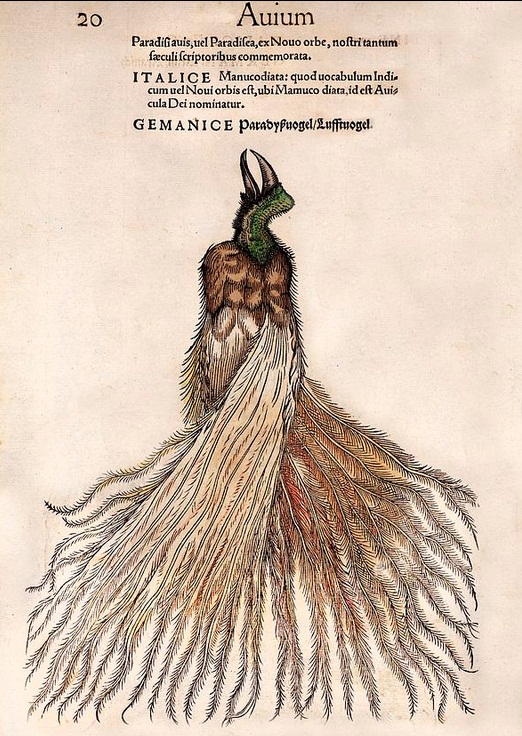
Bestiary
compiler Conrad Gesner's famous woodcut of an ostensibly footless bird of
paradise from his Historia Animalium
(1551-1558) (public domain)
When
examined more closely, however, these resplendent specimens revealed an even
more remarkable characteristic - they were wholly devoid of flesh, blood, and
bones. Their heads came complete with eyes and a beak, and their bodies had
wings, but otherwise it seemed that these extraordinary birds were composed entirely
of feathers - they did not even possess any feet! Yet there were no
recognisable signs that the skins had been in any way tampered with, so the
possibility of a hoax was discounted.
The
belief in fabulous sylph-like creatures such as these recurs in mythology
throughout the world, but never before had science obtained any hard evidence
in support of their reality. Needless to say, therefore, zoologists were
totally bemused, but at the same time thoroughly captivated, by these
astonishing specimens, and concluded from their near-weightless, fleshless, and
footless forms that they undoubtedly lived an exclusively aerial existence -
spending their entire lives, from birth to death, drifting ethereally through
the heavens, and presumably sustained solely upon an ambrosial diet of nectar
and dew imbibed in flight.
To
quote one zoologist of that time, they were nothing less than "...higher
beings, free from the necessity of all other creatures to touch the
ground". Not surprisingly, as birds that seemed to have originated from
Paradise itself, their species ultimately became known as the bird of paradise,
and also as the manucodiata ('birds of God'), the latter name preserved today by several bird of paradise species that are referred to zoologically as manucodes.
Early
engraving of a manucodiata (public domain)
Subsequent
expeditions to New Guinea brought back more skins, again purchased directly
from native tribes, and it soon became obvious that these exquisite creatures
comprised many different species, delineated from one another by their distinct
but all equally splendid plumages. No living specimens, however, were captured,
and it was not until the 19th Century that Western scientists penetrated the
dark New Guinea jungles to spy these gorgeous birds for themselves – one such
encounter calling forth a paean of praise and wonder from the pen of naturalist
Alfred Russel Wallace, who wrote in his diary:
The
feelings of a naturalist who at last sees with his own eyes a creature of such
extraordinary beauty and rarity so long sought after, would require a touch of
the poet to reach full expression. I found myself on a remote island, far from
the routes of the merchant fleets, I wandered through luxuriant tropical
forests...And here, in this world, I gazed upon the bird of paradise, the
quintessence of beauty. I thought of the long vanished ages during which
generation after generation of this creature...lived and died - in dark, gloomy
forests, where no intelligent eye beheld their loveliness. And I wondered at
this lavish squandering of beauty.
Only
then did scientists finally expose these extraordinary birds’ long-hidden
secret. The skins that had been arriving back in Europe were incomplete ones -
the New Guinea natives had developed to a fine art the immensely skilled
process of skin preparation whereby the flesh, blood, bones, and feet of these
birds were removed without leaving behind any readily-noticeable signs of their
former presence. In short, the birds of paradise were not ethereal,
everlastingly-airborne beings at all.
19th-Century
bird painter John Gould's superb illustration of a male and female greater bird of
paradise Paradisaea apoda – 'apoda'
translating as 'footless', derived from the earlier mistaken belief that this
and related species did indeed lack feet (public domain)
In
fact, as ornithologists swiftly discovered when at last able to examine
complete specimens, they were nothing more than gaudy relatives of the
sombrely-garbed rooks and ravens. Happily, however, their wonderful feathers
were genuine (although in most cases it was only males that sported such sumptuous plumage), therefore offering at least a measure of consolation and
compensation to scientists and poets alike for the otherwise traumatic
transformation of the miraculous manucodiata into first-cousins (albeit very
beautiful ones) of the crow family!
Upon
the arrival of the first bird of paradise skins in Europe, their unparalleled
beauty attracted equally unparalleled attention, not only from the scientific
world, however, but also from the fashion industry, whose wealthier patrons
yearned to be as glamorously decorated in these extravagantly beautiful plumes
as the birds of paradise themselves. During the 19th Century, when Wallace and
others finally spied living specimens in their native homelands, this
insatiable demand set in motion a traffic in bird of paradise skins on so great
a scale that it soon became evident to all that, if this trade continued for
much longer, many species would become extinct within a very short space of
time.
Accordingly,
many countries banned all import of these skins, and in the 1920s New Guinea
banned their export, thereby freeing the most famous and magnificent members of
its avifauna from any further massacres in the name of fashion, and enabling
their much-depleted numbers to recover. Nevertheless, a certain degree of skin
trade still occurred within New Guinea, and in 1957 a team of Australian
scientists set out to discover the extent of this traffic - never dreaming that
one of the outcomes of their investigations would be the disclosure of a
hitherto unknown facet of the Egyptian phoenix myth.
Phoenix with
wings outstretched amidst its fiery nest, illustration from Kinderbuch by Friedrich Justin Bertuch,
1806 (public domain)
According
to a detailed account in Purnell’s
Encyclopedia of Animal Life (1968-70, edited by British zoologists Dr Maurice
Burton and Robert Burton), the scientists learned to their astonishment that
the New Guinea native tribes had been killing the birds of paradise to obtain
their skins for trade with visiting Western seafarers long before the 16th
Century. In fact, this had been taking place as far back as 1000 BC, when bird
of paradise skins were transported thousands of miles westwards to Phoenicia -
birthplace of the phoenix legend. But that was not all.
To
preserve the skins’ delicate plumes during their long sea journey from New
Guinea to Phoenicia, the tribesmen had presented them to the sailors carefully
wrapped in a covering of myrrh skilfully fashioned into an egg-shaped capsule,
in turn enclosed within a parcel of burnt banana leaves. If we equate the
banana leaves of reality with the aromatic leaves of legend, the result is an
extraordinarily close correspondence with the famous myth of the phoenix.
All
that is missing is the blazing fire encompassing the bird on all sides - but
this is the easiest aspect of all to explain via the bird of paradise
hypothesis. One of the most magnificent and also one of the most abundant
species (even during the height of the fashion trade, and even though it was
especially sought-after due to its sumptuous plumes) is Paradisaea raggiana, Count Raggi’s bird of paradise.
John Gould's
gorgeous painting of a male Count Raggi's bird of paradise Paradisaea raggiana exhibiting its spectacular fiery plumage (public
domain)
A
crow-sized species, the male is a truly resplendent sight during the breeding
season, set apart by the breathtaking brilliance of the scarlet plumes that
surge from each side of its breast, cascading all around like a blazing
eruption of scorching flames. During the male’s pre-mating display, moreover,
it expands and elevates these huge sprays of plumes, and vibrates its body, so
that the resulting effect is uncannily like that of a bird dancing in the midst
of a coruscating inferno of flame!
Considering
that the abundance, the gorgeous appearance, and the notable popularity among
plume-hunters of Count Raggi’s bird of paradise would ensure that it was
well-represented in all series of skins sold by the natives to the Phoenicians,
and that the natives undoubtedly regaled them with vivid descriptions of its
striking courtship display, need we really look any further for the origin of
the Egyptian phoenix, and its dramatic dance of death in the fiery heart of its
blazing nest?
Additionally,
in his book Fabulous Beasts (1951)
Peter Lum stated that the Roman emperor Heliogabalus (reigned 218-222 AD) is
said to have dined upon a bird of paradise. Also, as V. Kiparsky noted
in an Arsbok-Societas Scientiarum Fennica paper from 1961, basing his
ideas upon accounts in ancient Russian literature tantalizingly comparable to
bird of paradise descriptions (most notably the famous Russian firebird or zhar ptitsa), a trade in their plumes
may have been taking place at a very early date in eastern Europe.
Stealing a
plume from the Russian firebird (public domain)
Finally:
Well worth pointing out here is that trade in bird of paradise plumes was also
taking place at an early age between New Guinea and China – as long ago as
China's Bronze Age (3100-300 BC), in fact, according to a fascinating section
in Civilisation Recast: Theoretical and
Historical Perspectives by Stephan Feuchtwang and Michael Rowlands, in
which they state:
…tropical
forest products and most importantly birds of paradise feathers were being
sought by the Bronze Age 'civilisations' of the China Sea.
(Incidentally, China does of course have its very own phoenix, the feng-huang, but this avian entity seemingly has a totally separate folkloric origin from Egypt's version, being widely believed to have been inspired by various species of Asian pheasant and peafowl, but as revealed elsewhere on ShukerNature there is nonetheless a line of conjecture linking it to birds of paradise too.) Moreover,
I recently learned from Australian Facebook friend Yarree Denamundinna that some bird of paradise plumes had
allegedly been discovered inside an ancient Egyptian tomb. I asked Yarree if he
could supply me with any published sources confirming this fascinating claim,
and if he can do so I shall publish details here.
A pair of
blue birds of paradise Paradisornis
rudolphi (my favourite species), painted by okapi-discoverer Sir Harry
Johnston (aka Sir Henry Hamilton Johnston), from Marvels of the Universe, Vol I (public domain)




 Posts
Posts