Dr KARL SHUKER

Zoologist, media consultant, and science writer, Dr Karl Shuker is also one of the best known cryptozoologists in the world. He is the author of such seminal works as Mystery Cats of the World (1989), The Lost Ark: New and Rediscovered Animals of the 20th Century (1993; greatly expanded in 2012 as The Encyclopaedia of New and Rediscovered Animals), Dragons: A Natural History (1995), In Search of Prehistoric Survivors (1995), The Unexplained (1996), From Flying Toads To Snakes With Wings (1997), Mysteries of Planet Earth (1999), The Hidden Powers of Animals (2001), The Beasts That Hide From Man (2003), Extraordinary Animals Revisited (2007), Dr Shuker's Casebook (2008), Karl Shuker's Alien Zoo: From the Pages of Fortean Times (2010), Cats of Magic, Mythology, and Mystery (2012), Mirabilis: A Carnival of Cryptozoology and Unnatural History (2013), Dragons in Zoology, Cryptozoology, and Culture (2013), The Menagerie of Marvels (2014), A Manifestation of Monsters (2015), Here's Nessie! (2016), and what is widely considered to be his cryptozoological magnum opus, Still In Search Of Prehistoric Survivors (2016) - plus, very excitingly, his four long-awaited, much-requested ShukerNature blog books (2019-2024).

Dr Karl Shuker's Official Website - http://www.karlshuker.com/index.htm

IMPORTANT: To view a complete, regularly-updated listing of my ShukerNature blog's articles (each one instantly clickable), please click HERE!

IMPORTANT: To view a complete, regularly-updated listing of my published books (each one instantly clickable), please click HERE!

IMPORTANT: To view a complete, regularly-updated listing of my Eclectarium blog's articles (each one instantly clickable), please click HERE!

IMPORTANT: To view a complete, regularly-updated listing of my Starsteeds blog's poetry and other lyrical writings (each one instantly clickable), please click HERE!

IMPORTANT: To view a complete, regularly-updated listing of my Shuker In MovieLand blog's articles (each one instantly clickable), please click HERE!

IMPORTANT: To view a complete, regularly-updated listing of my RebelBikerDude's AI Biker Art blog's thematic text & picture galleries (each one instantly clickable), please click HERE!

Search This Blog


PLEASE COME IN, I'VE BEEN EXPECTING YOU...

PLEASE COME IN, I'VE BEEN EXPECTING YOU...
WELCOME TO SHUKERNATURE - ENJOY YOUR VISIT - BEWARE OF THE RAPTOR!


Thursday, 9 September 2010

TRUNKO - TWO MORE PHOTOGRAPHS!!


Wide World Magazine article, August 1925

Hot on the heels of my last blog re Trunko, which documented a hitherto-unpublished Trunko photo (one of three snapped by the photographer in question), here is a second Trunko world-exclusive!

Thanks once again to the indefatigable efforts of my Trunko co-researcher Markus Hemmler, and also, independently, to the greatly-appreciated assistance of Paranormal Magazine editor Richard Holland (who owns a sizeable collection of the following publication), I am delighted to be able to present here an article published in August 1925 by Wide World Magazine that contains a detailed historical and eyewitness account of Trunko written by that same photographer, Mr A.K. Jones (named as Mr A.C. Jones in my previous blog because that was how he was referred to in the Margate Business Association website containing the Trunko photo by him that I blogged about previously), and which contains his other two Trunko photos! Please note that these photos are copyright to Mr A.K. Jones, and are presented here within the Wide World article solely for review/scientific critique purposes in accordance with the Fair Dealing/Fair Use convention on a strictly non-commercial basis.

So enjoy the article, and the Trunko photos, which in my view now make it absolutely certain that Trunko was indeed a globsterised whale carcase, and therefore was never alive in the oft-depicted exotic form of a white-furred, trunk-bearing, lobster-tailed marine cryptid.

To think that this article has been publicly available for 85 years, yet until now no-one in the cryptozoological or wider Fortean community had known about it! Suddenly, the prospect of the missing thunderbird photo no longer seems quite so unlikely after all!

As before, my most sincere and grateful thanks to Markus Hemmler (http://www.kryptozoologie-online.de/) for sharing his momentous finds with me.

Monday, 6 September 2010

BEHOLD, TRUNKO!!


Photograph of Trunko's beached remains (copyright A.C. Jones)


One of the most bizarre cryptids ever reported was the huge white-furred trunked sea monster that was allegedly observed from the shores of Margate, South Africa, by several eyewitnesses one day during the early 1920s (the precise date differs between accounts - see below) as it battled two whales out to sea for several hours before its lifeless 47-ft-long carcase was later washed up onto the beach, where it lay for several days before the sea took it back out, never to be seen again. During those several days, however, not a single scientist bothered to venture forth to examine or even observe this extraordinary creature's remains. Nor had its remains ever been photographed...or so I had always assumed - until now!

Yesterday, German correspondent Markus Hemmler emailed me with some remarkable news. He had discovered a website containing an allegedly genuine photograph of Trunko - a monicker, incidentally, that I had somewhat lightheartedly given to Margate's mystery sea monster in my book The Unexplained (1996) but which, to my great surprise, has since become its accepted name. Moreover, the photograph had been snapped by none other than Mr A.C. Jones of Johannesburg - the correspondent and photographer for an article on this entity that had been published in the Rand Daily Mail and also in Wide World Magazine way back in July 1925, thus providing a promising air of authenticity to the image.

Consequently, for the very first time in any cryptozoological publication and utilising the Fair Dealing/Fair Use convention, I now have pleasure in presenting in the context of review and on an entirely non-commercial basis a photograph of the tantalising Trunko's beached remains, snapped by A.C. Jones (the photo's copyright owner), and currently included by the Margate Business Association's website in a page devoted to the creature's history, which can accessed at the following url:

http://www.margatebusiness.co.za/index.php?option=com_content&view=article&id=64:the-legend-of-trunco&catid=1:mba-news&Itemid=2

The appearance of Trunko's remains in this photograph reaffirms my opinion - first presented in my book Extraordinary Animals Revisited (CFZ Press: Bideford, 2007), and now reproduced below - that it was a globster, not a bona fide cryptid. Here is what I wrote about Trunko in my above-noted book:

In his mighty tome, In the Wake of the Sea-Serpents (1968), veteran cryptozoologist Dr Bernard Heuvelmans defined and delineated the truly protean ‘great sea serpent’ to yield no less than nine morphologically-discrete taxa of sea serpent, which included various currently-unrecognised species of pinniped, cetacean, fish, reptile, and possibly an amphibian. However, at least one marine mystery beast included in his book appeared so bizarre that even Heuvelmans – “the Father of Cryptozoology” - was at a loss as how best to categorise it, and so, after briefly describing it, he simply omitted it entirely from his great scheme of sea serpent classification.

Known officially as the Margate sea serpent or more colloquially, in recognition of one of its most distinctive characteristics, as Trunko, this truly anomalous animal made its debut on the morning of 1 November 1922 [also variously claimed in some sources to be 25 October 1924 or 2 November 1924]. That was when, according to subsequent local newspaper reports, South African farmer Hugh Ballance looked far out to sea from the beach at Margate, Natal, and saw an amazing spectacle. With the aid of glasses, he could perceive what seemed to be two whales fighting with a huge sea monster, resembling a gigantic polar bear on account of the fact that it appeared to sport a dense snow-white pelage. According to Ballance, who was joined by an ever-increasing crowd of observers as the formidable battle continued, the creature reared fully 20 ft out of the water and struck repeatedly at the whales with what Ballance assumed was its tail - but to no effect, because after 3 hours the whales moved away and their furry attacker floated lifelessly at the surface.

Later that evening its dead carcase was found washed ashore, and was seen to be of colossal size, roughly 5 ft high and measuring 47 ft in total length, which included a 10-ft tail at one end (said in some later reports to be lobster-like), and, incongruously, an elephantine trunk at the other – in place of a head! This extraordinary structure was approximately 5 ft long and 14 in across, and its tip resembled the snout of a pig. Even more noticeable, however, was its luxuriant covering of fur or hair, 8 inches long, and, at least in Ballance’s view, exactly like a polar bear’s, yet with no sign of blood anywhere, despite the ferocity of the earlier sea-battle.

Incredibly, however, despite the huge number of onlookers that it attracted (some of whom brought in a team of 32 oxen to move it seaward, which they failed to do on account of its immense weight), and despite the fact that its corpse remained beached for 10 days, becoming ever more odiferous as decomposition set in, no scientist came to observe or to take samples from it for study. On the evening of the tenth day, the tide took it back out to sea, and the chance to investigate one of the most astonishing zoological secrets of the sea was lost forever.

All that we can do today, therefore, is speculate on what Trunko might (or might not) have been (always assuming, of course, that it was not a newspaper hoax). Certainly, based upon its description taken at face value, this supremely strange ‘marine elephant’ does not correspond with any known species of animal alive today or known from fossil remains. But perhaps there is more to its description than initially meets the eye, harbouring cryptic clues that may shed light on this otherwise decidedly shadowy mystery – a mystery, moreover, that is generally passed over or totally ignored even in the majority of cryptozoological publications.

However, one detailed and highly intelligent assessment of Trunko that does exist is by cryptid chronicler Lance Bradshaw, and it can be accessed on his Kryptid’s Keep website (http://www.angelfire.com/sc2/Trunko/trunko.html). In his discussion, Lance raises several valid, important points worthy of consideration here. Take, for instance, Trunko’s unique pelage. It has already been noted in this chapter that dead sharks can acquire, via the pseudo-plesiosaur effect, a covering of ‘hair’, which in reality is nothing more than connective tissue fibres that become exposed during decomposition of the carcase. However, if Ballance’s testimony is to be believed, Trunko bore its snowy fur while it was still very much alive, battling the whales. If this is true, then clearly its fur cannot be explained away as exposed connective fibres. Moreover, it also suggests that Trunko was mammalian, albeit wholly unlike any mammal previously recorded by science.

Yet this is not the only mystery associated with its fur. As Lance has pointed out, exclusively marine mammals, such as cetaceans, are not furry, because this would hinder their mobility. Conversely, marine creatures such as pinnipeds and polar bears, which are furry, do not spend their entire lives in the water. Consequently, if Trunko’s fur were a genuine feature of its morphology, this suggests that it must venture ashore sometimes. Yet as it was apparently limbless, but stupendous in size, how could it accomplish such a feat without becoming fatally beached, probably suffocating under its own weight, as beached whales so often do, even species much smaller than Trunko?

Then there is the equally odd matter of its trunk and supposed headlessness? Unless the head were so small that it imperceptibly graded into the trunk, how can Trunko’s acephalous condition be explained? The most reasonable solution is that the trunk was actually a neck, from which the head had become detached following the creature’s death. Yet as with its fur, Trunko was seen to possess a trunk with no head at its distal end while still alive.

Or was it? Trunko’s anomalous features are anomalous primarily because they were exhibited by Trunko while still alive, not just when it was dead. But was Trunko ever truly seen alive? The great battle with the whales took place some distance out to sea, not at the shore. Could it be, therefore, as postulated by Lance, that Trunko was not alive at all – that what was actually being seen by Ballance and the other observers on the beach was two whales tossing an already-dead carcase back and forth, playing with it just like killer whales, for instance, which are known for frolicking boisterously with their food, often throwing seal victims up and out of the water? During such exuberant activity, Trunko’s head may have been ripped off and eaten or lost, and possibly some heavy chafing of its skin might conceivably have yielded a shredded surface of exposed connective tissue fibres.

Perhaps the carcase was that of a decomposed shark, with the pseudo-plesiosaur effect creating its neck-like trunk and fur. Alternatively, it may even have been a globster - a quasi-octopus complete with hairy surface and a false tentacle resembling a trunk, engendered from the remains of some long-dead ‘globsterised’ whale. This, incidentally, as Lance has noted, would also explain the otherwise-anomalous lack of blood present when the carcase was washed up. A recently-dead mammal that had battled two whales, in contrast, would have been covered in wounds pouring with blood, or at least stained with it. Instead, Trunko’s snowy pelage was apparently immaculate, with (to quote Mack the Knife!) never a trace of red.

Having said that, I am not wholly convinced that even the above-described activity could yield the exceptionally distinctive snow-white pelage described for Trunko both while at sea and while beached, but at least the enigma of this creature’s hitherto unclassifiable morphology is now beginning to look a little less impossible than before. Nevertheless, with no physical remains to examine, the only hope of ever resolving this longstanding cryptozoological case satisfactorily is for another Trunko specimen to turn up one day, and for it this time to be treated with the scientific interest and rigour that it deserves. Interestingly, the prospect of a second Trunko appearing may not be as remote as it may seem. In fact, it may already have happened.

As I noted in my book From Flying Toads To Snakes With Wings (1997), which also contains coverage of Trunko, in November 1936 the carcase of an elephant-headed, white-furred, long-tailed sea serpent measuring 24 ft in total length was discovered on Alaska’s desolate Glacier Island. This time, moreover, its remains were examined, by a team led by Chugach National Forest supervisor W.J. McDonald, but no news of their findings has ever been released, and, as with Trunko, the Glacier Island sea serpent’s remains were not retained.

How extraordinary if, just like the globsters have now been shown to be, an entity as outwardly astonishing as Trunko ultimately proved to be nothing more than the decomposition-distorted remains of a long-deceased whale. Yet until physical evidence can be procured, it is destined to remain just as controversial as they too once were. [Although this is still true, A.C. Jones's newly-revealed photo strongly suggests that Trunko was indeed a globster.]

As for the occurrence and identity of globsters: in recent times and for the vast majority of cases, the following explanation has been confirmed to be the correct one, and which in my Extraordinary Animals Revisited book I formally dubbed 'the quasi-octopus effect' (mindful of 'the pseudo-plesiosaur effect' responsible for converting decomposing shark carcases into deceptively plesiosaurian ones):

After a whale dies, its body can float for months, decomposing, until eventually its heavy backbone and skull dissociate from their encompassing skin-sac of rotting blubber, and sink to the sea bottom, leaving behind a thick gelatinous matrix of collagen - the tough protein found in skin and connective tissue. It is this mass of collagen, still encased in its skin-sac, that washes ashore, as a globster. Furthermore, if a few of the whale's ribs remain within the collagen matrix, and any 'fingers' of fibrous flesh are attached to them, these resemble tentacles. And if the whale is a sperm whale, the spermaceti organ gives the resulting globster a bulky shape reminiscent of an octopus. DNA tests that were performed on samples of the tissue from the huge Chilean globster washed ashore in June 2003 independently confirmed its sperm whale identity.

All of which explains how a rotting whale can metamorphose with ease into a giant octopus - and also, it would now seem, into a surreal South African sea monster that had hitherto baffled the cryptozoological world for generations.

My grateful thanks to Markus Hemmler (http://www.kryptozoologie-online.de/) for bringing this cryptozoologically-significant photograph to my attention.

Saturday, 4 September 2010

A DEVIL OF A MYSTERY FROM SMETHWICK

The Shropshire Union Canal man-monkey (Richard Svensson)
 
There is a pub in Smethwick, just outside Birmingham, in the West Midlands, England, called the Blue Gate that may lay claim to erstwhile cryptozoological fame. Mysteries researcher and author Nick Redfern now resides in the USA, but he formerly lived only a few miles from Smethwick, and on 5 November 2007 he gave me the following fascinating information - derived from the great-uncle of a friend, Eddie, of Nick’s father.
 
Around the end of the 19th Century, Eddie’s great-uncle Ned was driving a pony and trap on Rolfe Street, Smethwick, late one night when he heard some strange noises behind him. Suddenly, a weird-looking animal leapt out at him, but he supposedly fought it off with his horse-whip. The creature was killed, placed in a glass case, and displayed in the Blue Gate pub on Rolfe Street for some time, where the locals dubbed it ‘Old Ned’s Devil’. Sadly, however, this mystifying specimen, for which no morphological description exists, apparently vanished years ago, and nothing more is known of it.
 
Living not too far from this area, I have made some enquiries myself, but no-one has been able to add to the above details given to me by Nick. I also included an item on it in my Alien Zoo column for Fortean Times not long after I received the original information on it from Nick, but it did not elicit any response from readers. So at present this is where the matter rests – except for the intriguing fact that the general storyline of the Smethwick mystery beast’s attack upon Eddie’s great-uncle is very similar to that for another bizarre beast from that same bygone period, the Shropshire Union Canal man-monkey (its history is encapsulated in my comment posted below this article of mine, in which I quote my coverage of it from my 1999 book Mysteries of Planet Earth).
 
As Nick has actually written a book about this latter beast, he is naturally particularly curious about the Smethwick equivalent, as indeed am I. Could the two stories stem from a single source, and, if so, how? Alternatively, were there truly two separate albeit very comparable incidents and, if so, what exactly was Old Ned’s Devil? An escapee/released exotic pet, possibly?
 
Earlier this year, seeking to revitalise this dormant mystery, I emailed its details to Professor Carl Chinn, the leading historian of the Black Country - the longstanding nickname of the former highly-industrialised region of the West Midlands (deriving the name from the thankfully long-vanished black smoke belched out by furnaces, factories, and other industries here) encompassing Sandwell, Dudley, Wolverhampton, Walsall, and the outskirts of Birmingham (including Smethwick). Prof. Chinn was so interested in it that on 15 July he included a sizeable section documenting its history in his weekly Black Country history double-page spread in the local Express and Star evening newspaper and also in his pages in the weekly Sandwell Chronicle from the same week. He requested anyone with information concerning the Smethwick Devil to write in, but as yet there has been no reply.
 
Nevertheless, at least the information has now been 'brought home', with its details having been made public in the very area where the events originally took place all those many years ago. After all, if there is indeed anyone out there who does know something, the Black Country is most likely where they will be.
 
Having said that, however, if there is any ShukerNature reader anywhere who can contribute ideas, information, etc, please do get in touch!


Wednesday, 25 August 2010

SPIDER OF BLUE, DILLY DILLY...

The blue mystery spider of Batley (Mary Howard)


Hot on the many heels of the shrieking centipede and the ant-mimicking tiger beetle documented in the previous ShukerNature comes yet another anomalous arthropod. This time? It's a bright-blue, seven-legged spider!

The original info was forwarded to me by Fortean Times, for whom I am preparing a full account of this remarkable case, and I have since been in contact with the eyewitnesses themselves, but here are the principal facts - and the all-important photograph:

The photo was snapped by Mary Howard, a retired biology teacher, outside her home in Batley, W Yorkshire, one early evening in June 2009, where it was also seen by her daughter, Louise Howard. In basic shape and form, the spider resembles a wolf spider or even one of those familiar long-legged Tegenaria house spiders that we've all seen scuttling across the carpet suddenly or attempting to clamber out of the bath, except for this extraordinary blue colour.

So, what are the options regarding its identity?

Is it:

1) A non-native species;

2) A freak blue specimen of a native species;

3) A normal spider exposed to UV light when photographed, making it fluoresce blue (many spiders do this);

4) A normal spider that has inadvertently covered itself in some blue dye, paint, chalk, etc;

5) A normal spider that has been deliberately painted blue, and probably held in place by one leg with tweezers while this was done (if the spider pulled away and its leg snapped off, this option would also explain its seven-legged state);

6) A normal spider in a photograph in which the spider has been photoshopped blue?

Those, as Shakespeare never wrote, are the questions!

Any thoughts or opinions would be greatly welcomed!


UPDATE - 20 April 2012

Since writing the above post, there have been several interesting developments, which I've documented in various of my Alien Zoo columns for Fortean Times, as well as in a longer, more detailed FT article. So here is an update of what has been happening in the world of mystery blue spiders!

Among the various comments that my above post elicited here on ShukerNature was one from a reader called Colin. After reading my longer FT article, Colin contacted me directly, and he now provided me with a more detailed account of his sighting. (In accordance with his request, I am not revealing Colin’s full name or address, but I have them on file.) Confessing that he hadn’t checked back on my blog after posting his original comment and thus hadn’t realised that I’d replied to it, Colin informed me that the location of his sighting was his own back garden in the town of Holmfirth – most famous until now as the setting for the filming of the BBC’s recently-ended long-running comedy series ‘Last of the Summer Wine’. Here is his description:

"The spider was almost precisely like the one in Mary Howard's picture, a bright royal blue but quite small, about 1 cm, or no more than 1/2". The plant pot I was removing had been weakened by frost damage over the last eight years and fell to pieces, spilling soil on to the hard standing where I park the car. There were various creepy crawlies, woodlice and such like running in all directions, including the blue spider. There was no 'nest' or multiple blue spiders, just the one and although it was remarkable enough in colour, it was small and my mind was on how I was going to gather up the soil from the pebbles...The location is in a small valley, south facing, sheltered and very warm for Northern England...Just to confirm, it wasn't a bit blue, or covered in a stain (though I have since wondered whether it was the result of a phosphorescent fungus from its dark, moist home) but really very bright, even vivid."

Phosphorescent fungi do sometimes stick to animals but usually glow green rather than blue, and the glow is normally noticeable only in the dark, not in daylight. In any case, why should only a single spider have become covered in it, and why have such spiders (or glowing woodlice too, etc) not been reported before? Clearly, the mystery of Yorkshire’s blue spiders has yet to receive a satisfactory explanation - unless of course Foggy, Compo, and Clegg have something to do with it?!

And still they came! After two separate but equally anomalous blue spiders had come to light in West Yorkshire within the space of a year, I subsequently learnt of a comparable encounter in the south of England. On 9 November 2010, after having read my FT article on these oddly-hued arachnids, long-time FT reader Carl Schalck sent me the following exciting news:

"Just thought I should let you know that last summer we had a fair few blue and black spiders in our garage in Lewes, East Sussex.

"I thought they were a bit strange, but I had no idea they were that rare. I think there were three of them, very similar to common garden spiders but covered in blue and black patches. They lived on the inside of the garage door."


What makes this report even more interesting is that, judging from Carl’s description, these spiders (unlike those from Yorkshire) do not appear to have been painted. This is because whereas even daubing a spider uniformly would not be an easy task, painting each of three spiders with a covering of blue and black spots would surely be nigh on impossible. And why on earth would anyone go to such an inordinate amount of trouble anyway? I already have on file records of confirmed colour mutation (though as yet not blue) in the common garden spider Araneus diadematus, so perhaps this trio represents a hitherto-unreported mutant version.

In July 2011, after reading my earlier blue spider accounts, Brian Weilert and his wife Stacia, a teacher, each sent me an email concerning a cobalt-blue spider with seven legs (a moulting injury?) that Stacia had captured a fortnight earlier in their garden in southeastern Kansas, USA. Since doing so, they had maintained it in a small specially-created habitat, and had been feeding it on live insects. It subsequently developed an eggsac, and produced a burrow. In response to their request for suggestions as to whom they should contact concerning this very notable spider, I urged them to bring it to the attention of researchers at any local museum, scientific institution, nature centre, or zoo, especially (in view of its eggsac) as it might well soon be bringing into the world an entire brood of spiderlings – which may or may not themselves be blue, depending upon the origin of their mother’s blue colouration. The Weilerts also sent me a couple of photographs of it, the clearer one of which I am reproducing here. It appears to be a lycosid wolf spider, of the genus Hogna – which is not known for natural blue species.

The blue wolf spider of Kansas (Brian and Stacia Weilert)

Until recently, the only logical non-hoax explanation for non-natural blue spiders seemed to be contact with some external source of blue pigment, such as paint or ink. On 4 January 2011, however, Norwegian correspondent Terje Jonassen alerted me to a remarkable but hitherto little-publicised discovery (documented in the Norwegian Journal of Entomology, 14 December 2010), which is as follows.

In recent times mostly, there have been over a hundred fully-confirmed, non-hoax cases of non-natural blue invertebrates, in particular woodlice, as well as dipterans (true flies) with aquatic larvae, which, when examined, were found to have been infected by a certain type of soil-inhabiting virus known as an invertebrate iridovirus (IIV). This virus is present in such high concentrations within the infected creature’s tissues that it forms crystalline aggregations. These emit a bright blue iridescence and thereby bestow this colouration upon the creature. IIV infection can be caused by feeding upon infected animals and also by parasitic nematode worms.

So it seems conceivable that the answer to the mystery of the blue spiders (or at least to some of them) may not involve encounters with external pigments or dyes but rather to internal IIV infection, most likely due to the spiders having consumed infected prey. Consequently, as noted earlier, I recommended to the Weilerts that they show their captive blue spider to local scientists, as that may provide the much-needed opportunity to investigate this exciting possibility directly.

I had been awaiting further news regarding the Weilerts' blue spider with great anticipation for some time, but when it finally came, via an email from Brian Weilert on 23 August 2011, it was not at all what I had hoped for or expected:

"Just a note to let you know how it all ended. The spiderlings hatched and were brown. We went away for a few days and when we returned she was dead and so were the babies. During this time Purdue University had contacted me. I took some photos of her, post mortem, as they requested and am sending them her body. Thanks for all your help during this episode."

I have already noted how infection by an iridovirus can result in freak blue invertebrates, which may therefore explain this and other, previously-reported freak blue spiders. But could the viral infection be directly transmitted from parent to offspring? Had the spiderlings been blue, this would not only have demonstrated pretty effectively that an iridovirus infection was indeed responsible here but also that it was directly transmissible. As they were not, however, the only hope left for a solution to the mystery of this particular blue spider is if the Purdue University researchers' investigations can conclusively identify the cause of its novel colouration. Once again, therefore, I now await further news from the Weilerts, and this time we can but hope that it is of a more positive, happier nature.

Saturday, 21 August 2010

SHRIEKING CENTIPEDES AND ANT-IMPERSONATING TIGERS.

In my book Extraordinary Animals Revisited (CFZ Press: Bideford, 2007), I devoted a chapter to cryptozoological and other controversial insects and related terrestrial arthropods. Recently, I learnt of two fascinating additions to this select company:


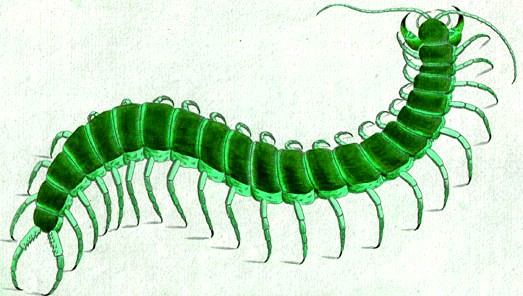
The upah envisaged as a green centipede (Dr Karl Shuker)


OOPS, IT’S THE UPAH – SUMATRA’S GIANT SHRIEKING CENTIPEDE!
Never heard of this cryptid before? Neither had I until I read explorer-ecologist Jeremy Holden’s illuminating account of it in the August 2009 issue of BBC Wildlife Magazine. Several years ago, while he had been visiting a small village in western Sumatra, the locals had solemnly revealed that the jungle creature they feared the most was a giant 1-ft-long tree-dwelling centipede with a thick ghostly-green body, an agonisingly painful bite, and – most extraordinary of all - the unique ability (for a centipede) to shriek or yowl like a cat. Although initially sceptical of such a bizarre beast, which the locals termed the upah, several weeks later while walking through the forest Jeremy suddenly heard a loud cat-like cry coming from high up in the canopy, followed by a rattling ‘churr’. He tracked the precise location of this eerie sound, using his binoculars, to a hollow branch, and his native guides excitedly confirmed that this was indeed the upah calling, but the creature itself remained unseen. More recently, however, while walking through Kerinci Seblat National Park with the eminent birdwatcher Frank Lambert during a return trip to Sumatra, Jeremy heard the very same cry – the cat-like yowl, then the rattling churr – once again emanating from the canopy. Sadly, however, the true originator of these sounds, although certainly elusive, proved to be something rather less exotic than a vocalising centipede. Instead, as instantly recognised by his birder companion, the species responsible was none other than the Malaysian honeyguide Indicator archipelagicus, a bird famous in ornithological circles for being much easier to hear than observe. Faced with such an anomaly – a creature often heard but seldom seen - it is understandable, perhaps, that the villagers’ imagination would, down through the ages, ultimately conjure up a truly dramatic yet wholly fictitious monster to explain it. There’s a lesson in here for cryptozoology somewhere! BBC Wildlife Magazine, vol 27, August 2009.

THE TIGER THAT THINKS IT'S AN ANT!
In the March 2009 issue of BBC Wildlife Magazine, TV explorer-presenter Steve Backshall reveals his close encounter with what appears to have been a very remarkable yet previously-undocumented and still scientifically-undescribed insect. While filming the documentary ‘Expedition Borneo’ in 2006, at one stage Steve found himself hanging precariously by his fingers from the edge of a steep vertical cliff face rising out of a remote hitherto-unclimbed canyon called Imbak. And while there, he was startled to see what looked on first sight to be a huge bright red ant, the size of a baby’s finger and the colour of molten lava, scuttling speedily along the rocks around his fingers. Closer observation, however, revealed to his amazement that this 'ant' was in fact an extraordinary, totally novel ant-mimic. Namely, a species of tiger beetle whose abdomen was greatly attenuated in an hour-glass shape, thus deceptively imitating the familiar ‘waist’ of genuine ants. Moreover, this imposter was actually hunting the smaller black ants milling around, seemingly tricked into complacency by their persecutor’s ant-like disguise. Because of his predicament, however, Steve was unable to capture this singular specimen, but when he eventually managed to extricate himself (by which time of course his veritable beetle in ant's cuticle was long gone) and described it back at camp to expedition entomologist George McGavin, George duly confirmed that nothing like it had been described before, and that it was therefore certainly a new species! BBC Wildlife, vol 27, March 2009.

Wednesday, 4 August 2010

GUESS WHAT THIS IS!!!


Here's a bit of fun - guess what this is!

Clues: it is the skull of a mythological(?) entity from somewhere in South America, and is totally genuine...sort of. You can tell from the pix below of me holding it that it's pretty sizeable, and the dentition may well guide you along the right path, but will it take you to the correct destination? Let me know what you think - and no cheating! (There's an easy way to find out what it is, but I ain't a-gonna tell ya how!)

All pix copyright Dr Karl Shuker

Me and a mystery skull:

Here it is:

Closer:
Even closer:
Close enough!!

Tuesday, 27 July 2010

COAST OF SKELETONS, DESERT OF DREAMS


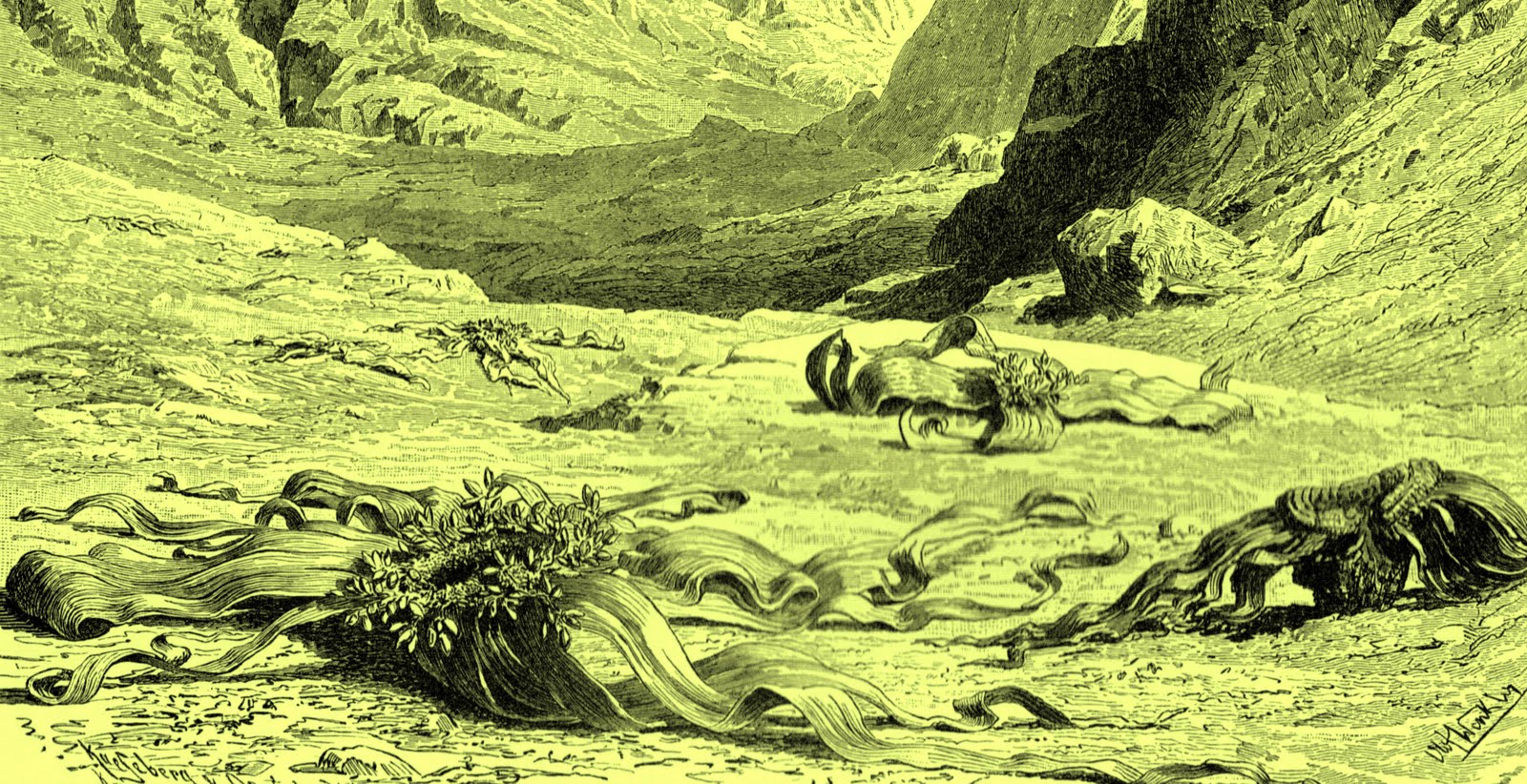
Welwitschia mirabilis engraving


Imagine a cold, barren, ghostly desertland whose fog-enshrouded coastline is littered with the sun-bleached wrecks of beached ships and the skeletons of dead sailors, whose sandy dunes not only move stealthily like stalking lions but also roar like them, whose pebbles unexpectedly split apart to reveal bright jewel-like flowers, whose ancient bizarre trees grow not upwards but lengthwise, extending enormous leathery leaves across the ground like alien ribbons, where elephants surf the sand dunes, and where slinking jackals and menacing hyaenas flit like sinister shadows around a long-abandoned oil rig that time and the elements have transformed into a towering edifice of rust and decay. This eerie, surrealistic vista may seem like the bleak landscape of a disturbed dream, but in fact it is an accurate portrayal of one of the world's most amazing regions - the Skeleton Coast, in southwest Africa.

Stretching over 400 km along the edge of northwestern Namibia and occupying more than 1.6 million hectares in area, the Skeleton Coast is bounded to the north by the Kunene River, to the south by the Ugab River, and is bisected horizontally by the Hoanib River. This remote, inhospitable territory was officially proclaimed a National Park in 1971, and in 1998 travel through it by tourists was formally permitted for the first time. Having said that, access to the northern half is still highly restricted, as this area is designated a natural wilderness, and adjoins Kaokoland, home to the nomadic, traditionalist Himba people. However, the southern half has swiftly become a very popular tourist attraction - for good reason. The Skeleton Coast offers strange, sometimes uncanny sights unique in the world.

Sandwiched between the Atlantic Ocean and the Namib Desert, it is chilled by the Benguela Current, travelling north from the frozen wastelands of Antarctica. Further cooling is provided by a dense night mist, which rolls 80 km or more inland every 10 days or so and condenses into a thick dew - but whose opaque treachery has lured many an unwary maritime vessel to its doom. Bearing silent testimony to this are the numerous disintegrating hulks of wrecked ships, fishing boats, even a downed bomber aircraft, and the whitened skeletons of their dead crew, resting for all eternity amid the sand - which earned this region its memorable name, coined by a local journalist during the 1930s.

Perhaps the most famous of such sights is the rotting fuel tank of the Dunedin Star, a British cargo vessel that was beached here in November 1942, and whose rescue resulted in a tugboat called the Sir Charles Elliott running onto the rocks and a Ventura bomber that dropped supplies subsequently nose-diving into the sea (its engine can still be seen here too). Other victims of the Skeleton Coast down through the years include the Montrose (wrecked here in 1973), the Suiderkus (beached in 1976), the Benguela Eagle (1975), and the steamer Eduard Bohlen (1909), as well as the fishing vessels Winston, Karimona, and Atlantic Pride. And long before any of these set sail, untold numbers of diamond seekers, anxious to gather the sparkling gems littering the sands of this ghostly terrain, paid with their lives when their boats were wrecked here.

Yet had they succeeded in landing safely, diamonds would not have been the only wonders to dazzle their senses. Had they explored the Hoarusib Canyon, for instance, they would have encountered an array of yellow-white, clay-constituting formations that resemble ethereal fairytale castles or weird exotic temples. They would also have marvelled at the 'living, talking' sand dunes known as barchans. Crescent in shape, and created by southwesterly winds in locations where there is little sand, these geological anomalies can travel up to 3 m a year, and as they move, they emit a rumbling basso-profundo roar.

But however spectacular its geological idiosyncrasies may be, they are no more so than its biological surprises. Bearing in mind that the Skeleton Coast embodies a veritable contradiction in terms, comprising a cold desert, it is little wonder that its wildlife is very definitely weird as well as wonderful. Take, for instance, its flowering 'pebbles'.

Look on the ground here, and you may well see what seem at first to be small, round, greyish-white rocks or stones, virtually covered in sand. A closer inspection, however, will reveal that these 'rocks' are actually pairs of succulent leaves - the water-storing leaves of Lithops, an amazing plant aptly dubbed the living stone. Expertly camouflaged, it escapes the attention of herbivorous animals during the dry season, but when the rainy season comes an incredible transformation occurs. Suddenly, the 'stone' seems to split apart - in reality, a stalk has grown up between its two leaves - and a large, bright, daisy-like flower blossoms. All too soon, however, the rainy season ends, the flower dies, and Lithops once more assumes its alter ego, as a pseudo-pebble amid a barren land of real ones.

Even more extraordinary, however, is the living fossil plant exclusive to this outlandish realm. Known formally as Welwitschia mirabilis, this ancient species is technically a conifer tree, but anything less like a tree yet nonetheless a plant would be difficult to imagine. To offset the harsh, inhospitable nature of this region, Welwitschia does not grow vertically to any extent - its trunk rarely exceeds 1 m. Instead, it sends out two enormous leaves that resemble thick leather ribbons, twisting and writhing across the sands, fraying at their edges but never shed and growing up to 5 cm every year, throughout the plant's life - and Welwitschia can live as long as 2000 years!

Never found more than 50 km inland from the Skeleton Coast's shore, Welwitschia utilises numerous tiny rootlets to absorb water stored in stream gravel after storms, and also obtains water from fog, condensing upon its pore-covered leaves. The plant's water and food supplies are all stored in a single massively thick root, up to 3 m long and resembling a gargantuan woody carrot, which anchors it firmly in the desert's soil.

As for its animal life, the Skeleton Coast can and does offer the eco-tourist an unparalleled spectacle of delights. Its mammals include prowling lions, elegant giraffes, burly black rhinoceroses, playful elephants that have been filmed surfing gleefully down the sand dunes, and graceful antelopes such as gemsbok and springbok that frequent the region's gravelly plains alongside stately ostriches. Equally noteworthy are its vivid diversity of waders and waterfowl, its ospreys, flamingos, ghost crabs scuttling sideways over the beaches, nocturnal gecko lizards that obtain water by licking dew off their eyes, and suitably-named headstander beetles that stand on their heads to catch precious drops of condensed fog, which trickle down their wing cases into their gaping mouths.

Perhaps the spookiest sight, however, are the phantoms that lurk in the shadows of a now-derelict oil-drilling rig, sited between the Huab River and the Koichab River. Some of these phantoms periodically take wing, revealing themselves to be cormorants, flying back and forth with fishes in their long beaks. Other, ground-based spectres prove to be jackals and heavily-maned brown hyaenas, scavenging for food. Most eyecatching of all, however, must surely be the Skeleton's Coast enormous breeding colony of Cape fur seals at Cape Cross, said to be the largest such colony in the world, containing 80,000-100,000 seals.

Bleak and barren it may be, but lifeless and dull the Skeleton Coast is certainly not, as testified by the ever-increasing numbers of tourists anxious to explore a land that is like no other on Earth - a land where the ghosts of the past and the wildlife of the present combine to guarantee a plentiful supply of sightseers in the future.