Dr KARL SHUKER

Zoologist, media consultant, and science writer, Dr Karl Shuker is also one of the best known cryptozoologists in the world. He is the author of such seminal works as Mystery Cats of the World (1989), The Lost Ark: New and Rediscovered Animals of the 20th Century (1993; greatly expanded in 2012 as The Encyclopaedia of New and Rediscovered Animals), Dragons: A Natural History (1995), In Search of Prehistoric Survivors (1995), The Unexplained (1996), From Flying Toads To Snakes With Wings (1997), Mysteries of Planet Earth (1999), The Hidden Powers of Animals (2001), The Beasts That Hide From Man (2003), Extraordinary Animals Revisited (2007), Dr Shuker's Casebook (2008), Karl Shuker's Alien Zoo: From the Pages of Fortean Times (2010), Cats of Magic, Mythology, and Mystery (2012), Mirabilis: A Carnival of Cryptozoology and Unnatural History (2013), Dragons in Zoology, Cryptozoology, and Culture (2013), The Menagerie of Marvels (2014), A Manifestation of Monsters (2015), Here's Nessie! (2016), and what is widely considered to be his cryptozoological magnum opus, Still In Search Of Prehistoric Survivors (2016) - plus, very excitingly, his four long-awaited, much-requested ShukerNature blog books (2019-2024).

Dr Karl Shuker's Official Website - http://www.karlshuker.com/index.htm

IMPORTANT: To view a complete, regularly-updated listing of my ShukerNature blog's articles (each one instantly clickable), please click HERE!

IMPORTANT: To view a complete, regularly-updated listing of my published books (each one instantly clickable), please click HERE!

IMPORTANT: To view a complete, regularly-updated listing of my Eclectarium blog's articles (each one instantly clickable), please click HERE!

IMPORTANT: To view a complete, regularly-updated listing of my Starsteeds blog's poetry and other lyrical writings (each one instantly clickable), please click HERE!

IMPORTANT: To view a complete, regularly-updated listing of my Shuker In MovieLand blog's articles (each one instantly clickable), please click HERE!

IMPORTANT: To view a complete, regularly-updated listing of my RebelBikerDude's AI Biker Art blog's thematic text & picture galleries (each one instantly clickable), please click HERE!

Search This Blog


PLEASE COME IN, I'VE BEEN EXPECTING YOU...

PLEASE COME IN, I'VE BEEN EXPECTING YOU...
WELCOME TO SHUKERNATURE - ENJOY YOUR VISIT - BEWARE OF THE RAPTOR!


Monday, 2 July 2012

AN HONOUR MOST GRACIOUSLY BESTOWED AND VERY GRATEFULLY RECEIVED


I am extremely proud to have received this award, which was devised by fellow cryptozoological writer/researcher Randy Merrill, and Liked on Facebook by so many other kindred spirits. Thank you all most sincerely - I very greatly appreciate it!


Tuesday, 26 June 2012

THE PARK OF THE MONSTERS - RENAISSANCE GARDEN FOR A GORGON

A colossal winged siren of stone at Bomarzo's astonishing Park of the Monsters (Burningmax/Flickr)


Several years ago, while browsing through a series of bookstalls in the indoor market of Bridgnorth, a town in Shropshire, England, I came upon a hardback travelogue book, dating from around the 1950s/early 1960s as far as I can recall, in which the writer described various sights that he had visited during his journeys around Europe (and possibly elsewhere). One chapter particularly interested me, as it described an extraordinary park located somewhere in continental Europe that was filled with huge, grotesque stone statues of monsters and other bizarre entities, but which had long since been abandoned and was now exceedingly overgrown, heightening its nightmarish aspect.

The face of Proteus, Park of the Monsters (Alessio Damato/Wikipedia)

Normally, anything as unusual as like this would have been enough for me to have purchased the book without hesitation, so I still don't understand why I didn't do so on this particular occasion. To make matters worse, I never even took notice of the book's title or author (I can only assume that I must have had other, more pressing matters on my mind that day!). As always happens in such a situation, of course, I later regretted not purchasing the book and resolved to do so when I was next in Bridgnorth (a town I often visit), but, as again always happens, when I did return, the book was gone, and the book stalls' owner did not even remember it.

A grim Janus-faced column in the Park of the Monsters (Burningmanx/Flickr)

Not long afterwards, moreover, he moved out of the market altogether, presumably selling his stock or taking it to set up elsewhere. So any chance of painstakingly going through all of his many books there in case it had been mis-shelved was gone too.

Neptune/Poseidon (Alessio Damato/Wikipedia)

Recently, recalling to mind that long-vanished book, I decided to see if I could discover any information online that may identify the mysterious garden of monsters that it had documented, and, happily, I succeeded! So here is what I found out:

One of the most spectacular works of Renaissance art can be found in one of Europe's strangest gardens. Dubbed the world's first theme park by some, it may be Renaissance by date but in appearance and content it is decidedly gothic. For although its official name is the Garden of Bomarzo (situated in Viterbo, northern Lazio, in Italy), it is most commonly referred to – and for very good reason – as the Park of the Monsters.

A moss-covered Pegasus fountain (Alessio Damato/Wikipedia)

It was created during the 16th Century by Duke Pier Francesco 'Vicino' Orsini (c.1528-c.1588), an ex-military officer who was also a leading patron of the arts, and devoted to his wife, Giulia Farnese. When she died, he established the garden (which he called his Sacred Grove) in tribute to her. It consisted originally of a wooded park at the bottom of a deep valley overlooked by Orsini's castle, but he then commissioned the sculpting of a host of arcane gargantuan statues to populate it, some hewn directly from the valley's natural bedrock, and many representing terrifying monsters or other figures from classical Greek mythology. More than two dozen were completed, plus various smaller exhibits such as a temple.

Cerberus, Greek mythology's triple-headed hound of hell (Burningmax/Flickr)

These awe-inspiring but very macabre stone colossi included Cerberus the three-headed hound of Hades, two mermaid-like sirens, a Pegasus fountain, a scarcely-attired reclining nymph, Neptune/Poseidon, the goddess Aphrodite, a giant (possibly Heracles) sculpted in the act of ripping apart another giant (Cacus?), the shape-shifting marine deity Proteus, and a winged woman sitting upon a vast tortoise.

A giant savagely dispatching his enemy in mortal combat ((Alessio Damato/Wikipedia)

Also present was the bizarre Mouth of Hell – the screaming face of a hideous ogre, whose mouth was a grotto big enough for people to walk through, and inscribed with the words "All reason departs".

The Mouth of Hell ((Alessio Damato/Wikipedia)

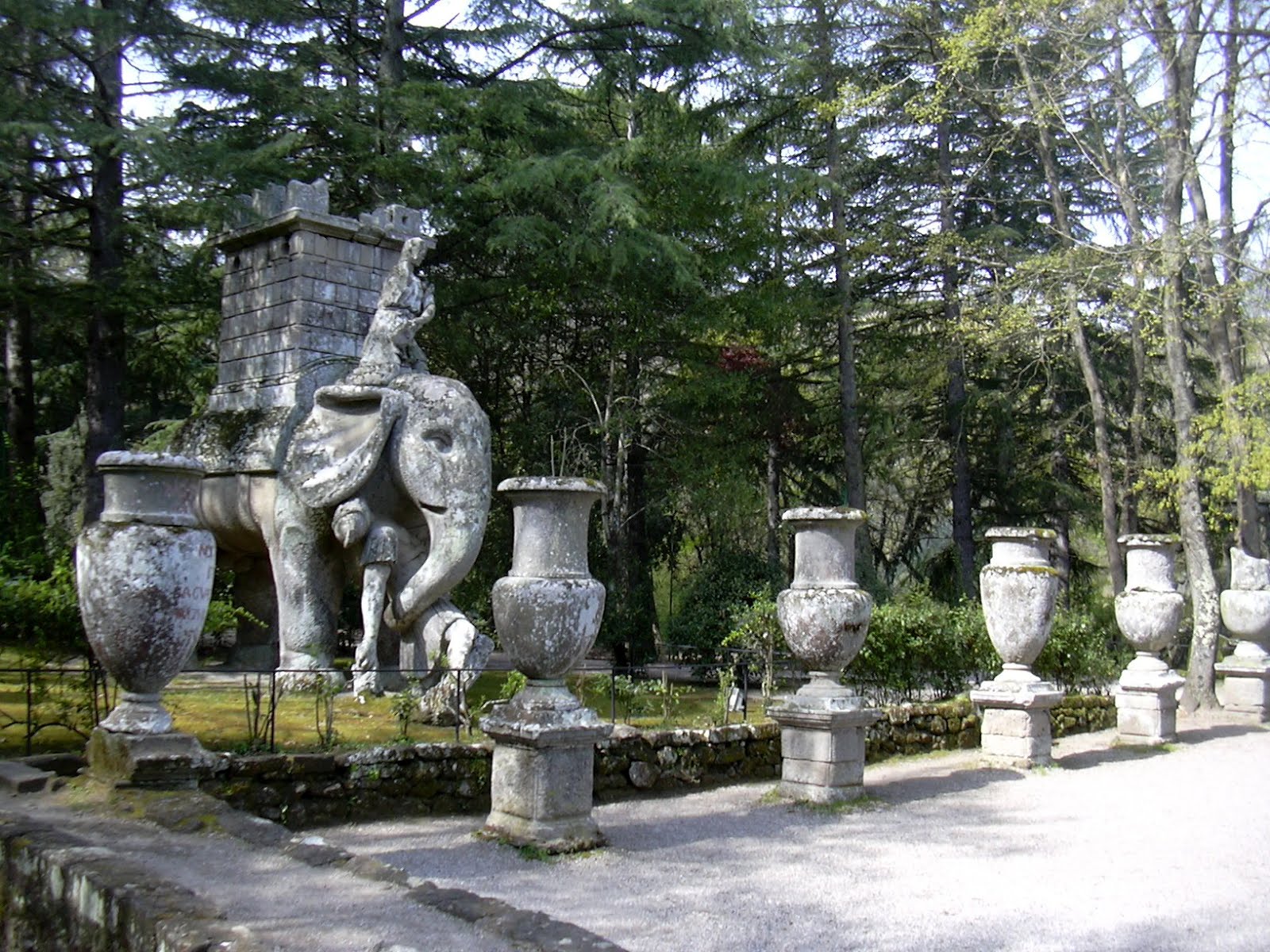
Assorted animals included a bear, a whale, and a war elephant of the Carthaginian general Hannibal (carrying a trampled Roman soldier in its great trunk).

War elephant gripping the soldier's dead body (Alessio Damato/Wikipedia)

Perhaps the most outstanding example of Orsini's bizarre statuary, however, was a stupendous sculpture of a winged classical dragon, crouching at bay with jaws open wide as it battled a dog (symbolising spring), a lion (summer), and a wolf (winter).

Bomarzo's great stone dragon battling a dog, lion, and wolf (Alessio Damato/Wikipedia)

Placed in an apparently random manner within the park, these daunting goliaths astonished all who saw them, but some felt that their grotesque, melancholic forms and erratic distribution mirrored Orsini's anguished, deranged state of mind resulting from his wife's death. There is controversy as to who designed and prepared the statues. Some experts attribute them to the acclaimed architect Pirro Ligorio. Others support claims that it was none other than Michelangelo who designed these great works, with some of his most talented students sculpting them. A third school of thought suggests that a team of prisoners of war awarded to the duke was responsible.

Siren and two lions (Samuele Ghilardi/Flickr)

Following his death, this nightmarish park was gradually abandoned, falling into an eerie state of disrepair, until by the 1800s many of the figures had become virtually hidden within a veritable jungle of overgrown vegetation and unchecked foliage. Orsini's forgotten menagerie of immense megaliths remained neglected and unvisited by all but vagrants and ne'er-do-wells (plus Salvador Dali in 1938, a visit that inspired his 1946 painting 'The Temptation of St Anthony') until as recently as 1970. This was when a successful restoration was initiated by the Bettini family owning the land containing this most surreal of gardens.

'The Temptation of St Anthony' (Salvador Dali)

Today, the Park of the Monsters is a major tourist attraction. Countless visitors wander now through its shadowy realm to encounter its frozen fauna of horror, where Orsini's dragon, winged steed, triple-headed hell hound, and all of his other weird figures stand forever in stony silence, as if the very gorgon Medusa had cast her evil gaze of petrification upon their grim gathering.

View from inside the Park of the Monsters, featuring the Carthaginian war elephant (Gabriele Delhy/Wikipedia)

And yes, just in case you're wondering, Italy's Park of the Monsters is definitely on my list of places to visit in the not-too-distant future – so watch this space for plenty of additional information and all-new photographs!

Reclining nymph (Burningmax/Flickr)

Monday, 25 June 2012

GOODBYE, LONESOME GEORGE - R.I.P. THE PINTA ISLAND GIANT TORTOISE

Lonesome George (Cryptomundo)


It is rare indeed for the precise date of extinction of a species or subspecies to be known, but there are a few notable examples.

On 3 July 1844, the last two confirmed specimens of the great auk Pinguinus impennis were clubbed to death and their single egg smashed (on the isle of Eldey, off Iceland). 1 September 1914 marked the death of the world's last known passenger pigeon Ectopistes migratorius (in Cincinnati Zoo). 21 February 1918 saw the death of the last verified Carolina parakeet Conuropsis carolinensis (also, remarkably, in Cincinnati Zoo). And on 7 September 1936 the last confirmed specimen of the Tasmanian wolf Thylacinus cynocephalus died (in Hobart Zoo).

Now, tragically, we can add another black day to that list - 24 June 2012, the day when Lonesome George, the world's only known surviving Pinta (=Abingdon) Island giant tortoise Chelonoidis nigra abingdoni, died. He was approximately 100 years old, and, with ironic inevitability, he was alone when death finally released him from decades of isolation from any other member of his subspecies.

Lonesome George's biography

Here, as a tribute to Lonesome George, is my documentation of his sad story and that of his entire race, which appeared in my recently-published book, The Encyclopaedia of New and Rediscovered Animals (2012):

The South American Galapagos archipelago is named after its giant tortoise Chelonoidis nigra (formerly known as Geochelone elephantopus); 'galapagar' is Spanish for 'a place where tortoises thrive'. An imposing sight, weighing in at a hefty 330-440 lb, and with a burly carapace (shell) at least 3.5 ft long, it once existed on no fewer than 11 of the islands, and occurred in so great a variety of shell shapes that it was once split into at least 15 different species. On some islands, its carapace was domed (as in smaller tortoises), on others it was flattened like a saddle. The largest island, Albemarle (also called Isabella), had five species, and ten other islands each had one; but nowadays these are all treated merely as distinctive subspecies of a single species.

19th-Century engraving of Abingdon (Pinta) Island giant tortoises

Regardless of their shell shapes, however, all of the islands' giant tortoises were united by at least one shared feature - a feature that proved to be their undoing. Their flesh was extremely tasty - prompting their slaughter en masse during the early 1800s by visiting sailors, whalers, and other seafarers, until several subspecies were exterminated.

One of the most distinctive was the saddle-shelled form on Abingdon (Pinta) Island, C. n. abingdoni, whose carapace was unusually thin. By the 20th century's opening years, its population had virtually disappeared, and during scientific expeditions to Abingdon in the 1930s and 1950s not a single specimen was observed (though it is now known that local fishermen found and slaughtered some for meat in the early 1950s). To make matters even worse, goats were introduced onto the island from 1954 onwards, whose insatiable appetites soon converted its all-too-small covering of foliage into an arid wilderness. Not surprisingly, the Abingdon Island giant tortoise was written off as extinct, but in 1964 no fewer than 28 dead specimens were discovered there. They appeared to have died about five years before, which meant that they must have been alive, but concealed, during the earlier searches. Even so, 28 dead specimens could hardly resurrect their subspecies from extinction.

An Abingdon (Pinta) Island giant tortoise exhibited at London Zoo in 1914

Nevertheless, it was resurrected in March 1972, for this was when - to the astonishment of herpetologists everywhere - a living specimen was encountered on Abingdon. Furthermore, tracks indicating the presence of others were also sighted. The live tortoise, a male (later christened Lonesome George), was swiftly transferred to the Charles Darwin Research Station on Santa Cruz for security. Still alive today (August 2011), George is believed to be 60-90 years old and in good health, but attempts to mate him with females of other Galapagos subspecies in order to preserve his genes in future generations of hybrids has so far proven unsuccessful.

Meanwhile, no other living pure-bred Abingdon giant tortoise has been found on Abingdon since the discovery there of George. Nor have any been confirmed existing in any zoo or private collection (although as first publicised in 2006, there is a possible pure-bred adult male, Tony, living at a Prague zoo, whose taxonomic identity is now under close investigation). However, in view of the tracks observed, it seems remotely feasible that specimens do still survive on Abingdon - a possibility reinforced in 1981 by the discovery on this island of some tortoise faecal droppings that appeared to be no more than a few years old. To encourage searches, a reward of $10,000 is being offered by the Charles Darwin Research Station to anyone who successfully discovers a living female Abingdon Island giant tortoise.

Sadly, any such find will now be too late for Lonesome George. However, it would resurrect his subspecies from extinction, so for that reason alone, the search must continue, in the memory of the Pinta Island giant tortoise's most prominent and poignant ambassador.

Lonesome George (Putneymark/Wikipedia)

Thursday, 21 June 2012

NESSIE AND THE NEWSPAPER CARTOON – IN SEARCH OF ITS SOURCE


The very considerable cryptozoological archives that I have amassed over many years of research began long ago with a series of humble little scrapbooks of interesting animal-related newspaper cuttings and magazine articles that I compiled as a child. Sadly, my enthusiasm for collecting and preserving these items was not matched at that tender age with the realisation that to render them of scientific worth I should also always note down their source and date of publication. Happily, I have since been able to trace the relevant details for many of them, but not all...

One item that falls into that latter, still-unsourced category is the wonderful Loch Ness Monster-themed newspaper cartoon appearing in this present ShukerNature blog. All that I can recall about it is that it was published during a flurry of media-hyped Nessie activity during the early 1970s, and probably appeared in either the Daily Mirror or the Sun. These are two British tabloid newspapers which, among a wide range of other newspapers (tabloids, broadsheets, nationals, locals), my parents read at that time (however, the cartoon's style and format do not match those of any of their other purchased newspapers from that same period). So if anyone happens to know the newspaper in which this cartoon appeared and/or the date on which it was published, I'd greatly welcome any details.

Incidentally, please forgive the poor quality of my photograph of it – but as this cutting is now roughly 40 years old, it has become somewhat yellowed and extremely tattered round the edges. Nevertheless, I am delighted to have it still, as it remains my all-time favourite cryptozoologically-themed newspaper cartoon.

UPDATE:

RESULT!! - I've just googled the cartoon's image, and up it came! Keith Waite was the cartoonist, and it was published in 2 April 1972 in the Sunday Mirror!

Here's a link to it:

http://www.cartoons.ac.uk/record/22263/zoom

In fact, the date of the cartoon should not come as any great surprise, as this was the very next day after a famous Nessie-inspired April Fool hoax. Here is what I wrote about that hoax in my book Extraordinary Animals Revisited (2007):

"Appropriately, however, the most famous cryptozoological April Fool involved the most famous cryptozoological creature - the Loch Ness monster. On 1 April 1972, newspapers worldwide reported the astonishing discovery of a 9-ft-long seal-like beast, weighing over half a ton, that had been found dead at the side of the loch. Soon afterwards, police intercepted a van transporting the body south to Flamingo Zoo Park in Yorkshire.

"When examined, it was found to be the carcase of a dead bull elephant seal, which had been deep-frozen for several days, giving it a peculiar greenish hue. Its whiskers had been shaved off too, and its cheeks had been stuffed with rocks.

"On 2 April, Flamingo Zoo Park's public relations officer, John Shields, confessed that it was an April Fool hoax, which he had secretly set up as a joke directed at the managing director of the company owning the zoo. Shields had used the body of an elephant seal that had died a week earlier at Dudley Zoo, owned by the same company."

Another mystery solved. If only all cryptozoological cases could be resolved so readily!

Monday, 18 June 2012

THE DAY I SAW A UNICORN ON SAFARI

Behold, the unicorn! (Dr Karl Shuker)

The last thing that I expected to see when visiting the West Midlands Safari Park last summer was a unicorn – but that is exactly what I did see there...well, sort of.

I've frequently read in accounts of unicorns the theory that some reported sightings were nothing more than long-horned antelopes viewed side-on, so that their two horns perfectly overlapped, creating the illusion of a single centrally-horned unicorn. And I admit that I've always tended to think "Yeah, right, I'll believe that when I see it". Well now I do, because I have – and here's the proof!

Driving through one of the ungulate paddocks at the safari park, I came upon an addax Addax nasomaculatus resting on the ground with head raised, the two spiralled horns of this pale Sahara Desert antelope perfectly discernible as I photographed it.

Before... (Dr Karl Shuker)

And then, suddenly, it turned sideways slightly, as I was still photographing it, and there – only for a split second, but right before my astonished eyes – was a unicorn!

During... (Dr Karl Shuker)

A momentary metamorphosis, from a commonplace antelope of reality to a wondrous beast of legend. And then, it moved its head just a fraction – and the spell was broken, the illusion dispelled. The unicorn was gone, as if it had never been, and the addax had returned, wholly unaware of the magical presence that it had briefly conjured forth.

After... (Dr Karl Shuker)

But my camera had recorded its transient alter ego – a single wonderful photograph of a modern-day marvel, a unicorn beheld and bedazzling. And what more fitting animal to have evanescently assumed this fairest of forms than the white-coated, spiral-horned addax?

I felt strangely blessed as I continued upon my safari journey, the image of the unicorn that never was, almost was, and truly was, if but for the most fleeting of instants, still alive and entrancing within the shadowed glades of my memory.

The full sequence of addax-unicorn-addax transformation (Dr Karl Shuker)

Worth noting, incidentally, is that not all unicorn reports described the horn as pointing forwards – some claimed that it was directed backwards, as with, for instance, the desert-dwelling black-horned karkadann of Persia. Similarly, there are several different descriptions relating to its horn's supposed colour – white, black, red, and even all three together!

Two different karkadann depictions

For further information concerning the history and surprising diversity of unicorns, see my book Dr Shuker's Casebook (CFZ Press: Bideford, 2008).

Saturday, 16 June 2012

FLOWER-GENERATED BIRDS, AND TURTLES THAT FLY

Flying turtles illustration from Athanasius Kircher's tome China Illustrata (1667) [note also the flying dragon in the background!]


How often is it that when pursuing one line of investigation, a second, wholly unrelated but equally interesting one presents itself and is so captivating that to ignore it would be entirely futile?

So it was when I began to seek out information concerning a truly extraordinary illustration of supposed flying turtles native to Henan in China, which appeared in German Jesuit scholar Athanasius Kircher's tome China Illustrata (1667). Or, to give it its full title, China monumentis, qua sacris qua profanis, nec non variis naturae and artis spectaculis, aliarumque rerum memorabilium argumentis illustrata.

Athanasius Kircher (1601/1602-1680)

On 15 June 2012, I had received via a clickable link placed upon my Facebook wall by New Jersey-based colleague Robert Schneck a copy of this illustration, and as I could think of few creatures less likely to have acquired a mastery of the air than a turtle, I was naturally perplexed and piqued by curiosity in equal measures. China Illustrata had originally been published in Latin, but browsing online I soon discovered an English translation of it, and sure enough, there inside I found not only the illustration but also an explanation of it by Kircher.

But before I reveal just what that explanation was, I'd like to digress for a while if I may, in order to document a separate but equally memorable entry that I chanced upon in Kircher's selfsame tome, and which shone some very welcome light upon a riddle of Nature that until then had long mystified me.

Within my library are quite a few delightful works of what I refer to as pseudozoology. Most of these are large, lavishly-illustrated books purporting to be republished tomes of arcane natural history, but which upon reading are swiftly recognised as adroitly-constructed fiction penned with tongue very firmly in cheek. An excellent example of this highly-specialised genre is a truly spectacular tome entitled Inventorum Natura: The Expedition Journal of Pliny the Elder (1979), compiled and exquisitely illustrated by celebrated fantasy writer-artist Una Woodruff.

Inventorum Natura: The Expedition Journal of Pliny the Elder (1979) by Una Woodruff.

The premise behind this very elaborate and skilfully-prepared volume is that it is a painstaking reconstruction of a supposedly long-lost work written in Latin by the real-life Roman author-naturalist Pliny the Elder (who died during the eruption of Mount Vesuvius in 79 AD), describing the astonishing fauna and flora that he allegedly observed during a purported three-year expedition to distant lands, an incomplete version of which Woodruff happened to rediscover. The creatures documented in it include many famous legendary beasts, including the basilisk, manticore, unicorn, Eastern dragon, griffin, hydra, vegetable lamb or barometz, Chinese hua fish (depicted on the book's front cover), merman, and Western dragon. However, it also included a few examples that I had never read anything about elsewhere, so I wondered whether these may have been specially created for this book.

One of them was the bird plant, which according to Inventorum Natura was a variety of grass native to mainland Asia whose flowers transformed into small brightly coloured birds. The accompanying double-spread illustration (part of which is reproduced here) revealed how these flowers gradually metamorphosed into birds, which eventually broke free of the plant's flower stems to become independent, free-flying entities comparable in every way externally to genuine egg-hatched birds but remaining wholly botanical internally.
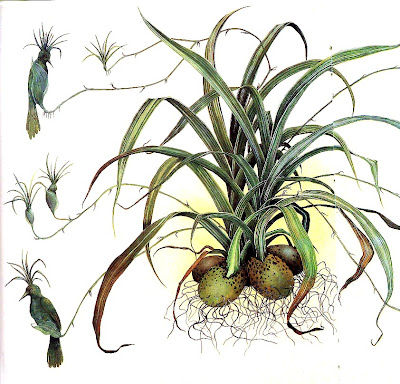
The bird plant (Una Woodruff, in Inventorum Natura)

Other bird-engendering plants featured in an equally sumptuous work of pseudobotany by Una Woodruff, entitled Amarant: The Flora and Fauna of Atlantis by a Lady Botanist (1981). One of these was portrayed on its front cover too, as seen here.
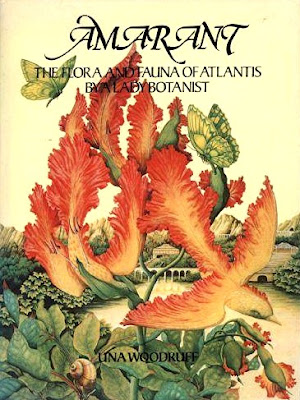
Amarant (Una Woodruff)

Until Robert's link containing Kircher's flying turtle illustration appeared on my Facebook wall, I had all but forgotten the bird plant, but while perusing Kircher's China Illustrata, I was startled yet delighted to discover the following highly illuminating section:

"In Suchuen [sic – Sichuan] Province there is said to be a little bird which is born from the flower called Tunchon, and so the Chinese call it Tunchonfung. The Chinese say that this measures its life by the life of the flower, and that flower and bird die at the same time. The bird has a variety of colours. When flying and beating its wings, the bird looks like a beautiful flower flying across the heavens. Whether an animal, bird, or insect could really be produced from a plant is doubtful. We have denied this in Book Twelve of our Subterranean World. It is not possible for the vegetable level of nature to progress to the sentient, since it is impossible to skip a level in nature and produce an effect inconsonant with one's own nature. I think it would be possible for these birds' eggs, which are no larger than peas, to be laid in the pods or leaves, or to be deposited on the flowers. A flying creature might seem to be born like a flower, if the egg were broken and the seed of the bird were mixed with the moisture of the flower. Also, if a person with a vivid imagination gazes at the variety of the colours of flowers, the fantastic colours of the birds' wings might seem to be derived from the flowers. This can even be frequently seen in Europe."

Clearly, therefore, there is indeed a genuine tradition of belief, albeit one founded upon a fallacy, that small birds can be generated from flowers. Sadly, there are insufficient details to identify either the tunchon or the tunchonfung with any degree of certainty, although it is possible that the latter is a species of sunbird (nectariniid). Native to Africa, Asia (including China's Sichuan Province), and Australasia, sunbirds are small, extremely brightly coloured, and mirror ecologically albeit not taxonomically the New World hummingbirds. Feeding primarily upon nectar, moreover, they spend much of their time in such close proximity to flowers that this intimate association may well have inspired an erroneous belief that these diminutive birds were actually being engendered by the flowers.

Sunbird alongside a bird of paradise flower (Public domain)

But what about China's supposed flying turtles – did I find anything about them in Kircher's tome too? Indeed I did. Accompanying the illustration that initiated everything documented here was the following information:

"The Chinese Flora says that in the kingdom of Honan [=Henan, nowadays a province in central China] are found turtles which are green or blue, and that there are also some with wings on their feet, who in this way they compensate for the slow progress they can make on foot. I, however, could not easily believe that these swimming creatures have wings, for it seems to violate the primary nature of a turtle. Rather, turtles give off a sticky liquid around their feet, as the drawing shows, and in time this becomes cartilaginous and resembles a limb which flaps around as they move. This is not used for flying, so when the matter is examined, it turns out to be different than is commonly believed."

The Chinese Flora referred to above by Kircher was Flora Sinensis (1656), authored by Polish Jesuit missionary Michael Boym. It was one of the first European books ever to have been written about China's natural history; despite its title, it included information concerning a number of animals as well as plants.

Illustration of squirrel chasing turtle from Flora Sinensis

As for China's flying turtles: here was a situation where one mystery appeared to have been solved only by the citing of another one, because the notion of turtles' feet secreting a sticky substance that hardens to yield flapping quasi-wings was certainly new to me. Happily, however, at the very same time that I was pondering this riddle, a second Facebook-mediated message was winging its way to me from Robert Schneck. And in this latter one, Robert informed me that according to his own investigations, Kircher's documentation of a supposed Chinese belief in flying turtles was an error caused by mistranslation of Chinese sources. What these had actually referred to were turtles with moss, algae, or weeds growing upon their limbs, but unfortunately this had been mistranslated by Kircher (or by earlier non-Chinese works that he had directly consulted), yielding turtles with wings on their limbs instead.

In short, another seemingly impossible beast had been unmasked as entirely plausible after all, albeit very different in form from how it had originally been described. Never mind. The flying turtles of Henan may never have existed, but at least they inspired a delightful illustration, one that also serves as a very evocative reminder of the perils of mistranslation – or, how Chinese whispers can engender Chinese flying turtles!

My sincere thanks to Robert Schneck for bringing to my attention the enigma of Henan's flying turtles and, by doing so, also assisting me in resolving a second mystery of unnatural history – by enabling me to uncover a factual origin for the bird plant fallacy.

Tuesday, 12 June 2012

BLACK LIONS - MANIPULATION, MELANISM, AND MOZAICISM

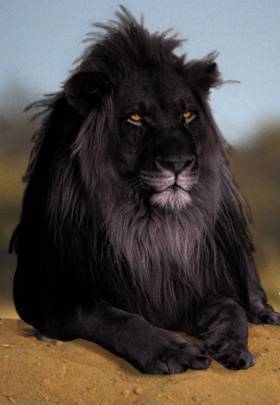
Photoshopped black lion #1 (tumblr.com)

In recent weeks, two very stunning black lion photographs have been circulating online. One of them is the picture above, opening this ShukerNature blog post, and the other one is documented further down in it. Why they attracted such interest is that according to mainstream zoology, black lions simply do not exist. If they did, and were wholly black in colour, they would most probably be melanistic specimens, analogous if not homologous genetically with black panthers (melanistic leopards) and mutant all-black individuals of other felid species.

Sadly, for those hoping that these two photos therefore represented some major cryptozoological discovery, the reality, as is true ever more frequently nowadays, is that they are nothing more than Photoshopped images.

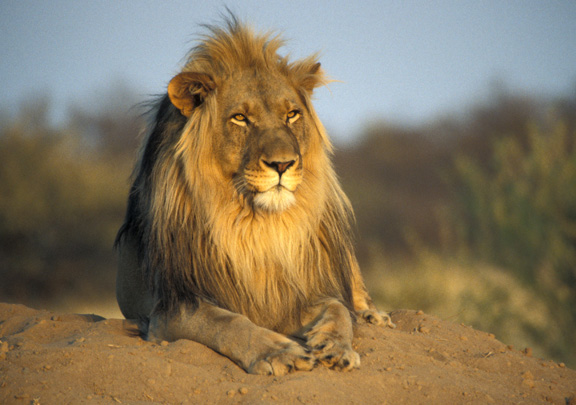
I traced Photo #1 (above) to the following specific link: http://24.media.tumblr.com/tumblr_m4qd4hvuEr1rv9dvno1_400.jpg (on the following site: martincito1.tumblr.com – which has now vanished!), but I have no idea whether martincito1 created it, or simply added it from elsewhere to their galleries of images there. However, it is unmistakeably a product of photomanipulation, because I also traced the original photo that had been used – depicting a normal tawny lion photographed in Namibia and present on the Leopalmerphotography website (it can be accessed at http://www.leopalmerphotography.co.uk/male%20lion.jpg).

Photoshopped black lion Photo #1 alongside the original Leopalmerphotography photo that the unknown photomanipulator has used to create it (tumblr.com/Leopalmerphotography.co.uk)

As for Photo #2 (below):

Photoshopped black lion #2 (PAulie-SVK/deviantART.com)

This is actually a photograph of a bona fide exotic lion – namely, a white lion – that has been skilfully converted digitally into a black one (I discovered the original photo on the following site http://www.cutehomepets.com/the-white-lion). Moreover, as I learnt when he kindly posted details upon my Facebook wall on 10 June, cryptozoological colleague Mike Covell successfully traced Photo #2 to digital artist PAulie-SVK, who had created it and placed it in one of their galleries on the deviantART.com site, after which it had been posted elsewhere online by persons unknown wrongly assuming it to be a genuine specimen. (Here is the specific page: http://paulie-svk.deviantart.com/art/Black-Melanistic-Lion-292088989)

Photoshopped black lion #2 (PAulie-SVK/deviantART.com) with original white lion photograph beneath it (cutehomepets.com)
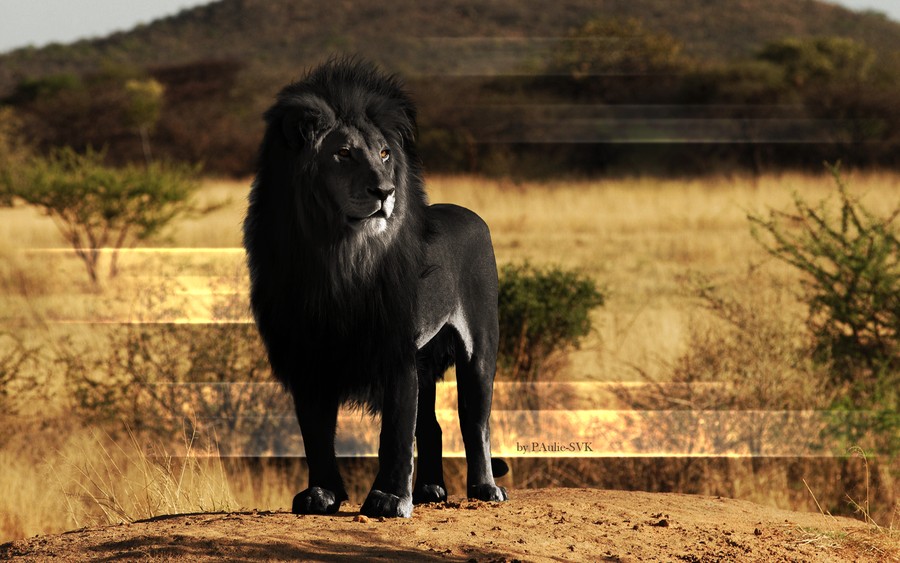
A third online image of a black lion, see Photo #3 (below), is another Photoshopped black lion by PAulie-SVK (this time manipulating an image of a normal tawny lion), produced in wallpaper format (available here: http://paulie-svk.deviantart.com/art/Black-Lion-wallpaper-306684136)

Photoshopped black lion #3 (PAulie-SVK/deviantART.com)

The original, tawny lion photograph (http://www.serengetibook.com/wp-content/uploads/2010/12/lion-shutterstock.jpg) used to create the third black lion photo

But what about real black lions? What do we know of such ebony-furred enigmas? As already noted, no confirmed sightings exist and only a few sparse, unconfirmed reports, most of which I summarised as follows in my book Mystery Cats of the World (1989):

"According to W.L. Speight, in 1940, an experienced game warden once stated that he had spied a whole pride of pitch-black lions in the Kruger National Park. Half a century earlier, a very dark brown specimen had been killed by soldiers of the Luristan Regiment and was seen by archaeologist Sir Henry Layard at Ispahan in what is now Iran. And an account of a black lioness observed at very close quarters was included in Okavango, by June Kay."

Additionally, in a letter of 20 January 1980 to American cryptozoologist Loren Coleman (who has kindly shared its contents with me), wild cats author C.A.W. Guggisberg stated:

"While there are black leopards in the Aberdares, there never was any talk of black lions. A few years ago a rumour went round that black lion cubs were seen somewhere in western Tanzania, but this was never confirmed."

More recently, media reports emanating from South Africa in 2008 carried bizarre stories of big black lions that had allegedly escaped from the Kruger National Park and were now roaming the streets of Matsulu township outside the Mpumalanga capital, terrifying residents who claimed that they were too afraid to walk outside at night. No tangible evidence for their presence was produced, however, and even if lions were genuinely on the prowl there, they may well have simply been dark brown individuals, or normal lions that had rolled in black mud (like the specimens lately photographed at Madikwe, Tanzania, by Grant Marcus – click here http://www.grantmarcus.com/?p=670 to access his website with some superb photos of them). They might even have been nothing more remarkable than ordinary lions glimpsed at night, or during the day but with bright sunlight behind them.

Lion covered in black mud (Gerry van der Walt)

In 1975, at Glasgow (formerly Calder Park) Zoo in Scotland, a lion cub named Ranger was born with a black chest and one black leg. This was possibly an example of mozaicism – the development of fixed, irregular patches of pigment on an individual’s body – as these patches never expanded into other areas. Richard O’Grady, the zoo’s director, planned to breed Ranger when old enough with his mother, Kara, in the hope of producing an all-black specimen, but as I learnt from Richard, although such matings did occur on several occasions, no offspring resulted, even though Ranger and Kara were both in excellent health. Ranger was also mated with other lionesses, but always with the same non-result, suggesting that he may have been sterile. Ranger was euthanased in 1997.

Ranger as a cub with his mother Kara (Richard O'Grady/Zoological Society of Glasgow & West of Scotland)

Finally: Before leaving the subject of black lions, it should be explained that the so-called 'black lion' that Marco Polo claimed to have spied in Kollam, India, during his alleged travels in Asia was actually nothing more than a melanistic leopard!


UPDATE - 13 August 2012

An additional black lion item of particular interest has recently emerged. I've discovered that celebrated lion conservationist George Adamson's autobiography My Pride and Joy (1986) briefly notes that "an almost entirely black" lion was spied in Tanzania. Sadly, however, no additional details concerning this remarkable animal or the sighting's background were given.


UPDATE - 1 October 2012

A new black lion photograph has begun circulating online, but is it genuine? Check here to read my investigation of this latest image.