Dr KARL SHUKER

Zoologist, media consultant, and science writer, Dr Karl Shuker is also one of the best known cryptozoologists in the world. He is the author of such seminal works as Mystery Cats of the World (1989), The Lost Ark: New and Rediscovered Animals of the 20th Century (1993; greatly expanded in 2012 as The Encyclopaedia of New and Rediscovered Animals), Dragons: A Natural History (1995), In Search of Prehistoric Survivors (1995), The Unexplained (1996), From Flying Toads To Snakes With Wings (1997), Mysteries of Planet Earth (1999), The Hidden Powers of Animals (2001), The Beasts That Hide From Man (2003), Extraordinary Animals Revisited (2007), Dr Shuker's Casebook (2008), Karl Shuker's Alien Zoo: From the Pages of Fortean Times (2010), Cats of Magic, Mythology, and Mystery (2012), Mirabilis: A Carnival of Cryptozoology and Unnatural History (2013), Dragons in Zoology, Cryptozoology, and Culture (2013), The Menagerie of Marvels (2014), A Manifestation of Monsters (2015), Here's Nessie! (2016), and what is widely considered to be his cryptozoological magnum opus, Still In Search Of Prehistoric Survivors (2016) - plus, very excitingly, his four long-awaited, much-requested ShukerNature blog books (2019-2024).

Dr Karl Shuker's Official Website - http://www.karlshuker.com/index.htm

IMPORTANT: To view a complete, regularly-updated listing of my ShukerNature blog's articles (each one instantly clickable), please click HERE!

IMPORTANT: To view a complete, regularly-updated listing of my published books (each one instantly clickable), please click HERE!

IMPORTANT: To view a complete, regularly-updated listing of my Eclectarium blog's articles (each one instantly clickable), please click HERE!

IMPORTANT: To view a complete, regularly-updated listing of my Starsteeds blog's poetry and other lyrical writings (each one instantly clickable), please click HERE!

IMPORTANT: To view a complete, regularly-updated listing of my Shuker In MovieLand blog's articles (each one instantly clickable), please click HERE!

IMPORTANT: To view a complete, regularly-updated listing of my RebelBikerDude's AI Biker Art blog's thematic text & picture galleries (each one instantly clickable), please click HERE!

Search This Blog


PLEASE COME IN, I'VE BEEN EXPECTING YOU...

PLEASE COME IN, I'VE BEEN EXPECTING YOU...
WELCOME TO SHUKERNATURE - ENJOY YOUR VISIT - BEWARE OF THE RAPTOR!


Saturday, 5 July 2014

THE EMELA-NTOUKA – NEW CORROBORATIVE EVIDENCE FOR THE CONGO'S CRYPTIC 'KILLER OF ELEPHANTS'?

Reconstruction of the emela-ntouka (© David Miller under the instruction of Prof. Roy P. Mackal)

I've been promising ShukerNature readers for almost a year now that I'd write up this fascinating discovery and post it – so now I have done, and here it is!

A little over 30 years ago, the most famous creatures of cryptozoology were Nessie, the yeti, a sundry array of sea serpents, and the North American bigfoot. In 1982, however, following his return to the USA in December 1981 at the end of the second of two expeditions to the People’s Republic of the Congo (formerly the French Congo), veteran American cryptozoologist Prof. Roy P. Mackal revealed to an astonished media and general public that the elusive swamp monster that he had been searching for in the Congo may conceivably be a living dinosaur! A new cryptozoological star had been born – an elusive long-necked mystery beast bearing an extraordinary outward resemblance to a sauropod, and known to the local Congolese pygmies as the mokele-mbembe. But this wasn't the only Congolese cryptid that Mackal's team had learnt about during their forays there. Less familiar but definitely no less interesting was a second major mystery beast claimed by the pygmies to inhabit that country's vast Likouala swamplands – a truly extraordinary (and exceedingly formidable) horned creature known to them as the emela-ntouka, or ‘killer of elephants’.

Another reconstruction of the emela-ntouka (© Hodari Nundu/Deviantart.com)

The size of an elephant itself, but semi-aquatic, the emela-ntouka is said to have a long heavy tail, four sturdy legs, and, most notable of all, a very long, sharp horn borne upon its snout. On first sight, this cryptid sounds like some form of rhinoceros. However, its long heavy tail differs dramatically from the short, lightweight version possessed by all known rhino species. So too does its horn, for whereas those of rhinoceroses are nothing more than masses of compressed hair, according to native testimony the emela-ntouka’s is said to resemble the ivory tusk of an elephant. As ivory is only associated with tusks and teeth, not horns, however, it is probable that if the pygmies' claim about it is correct, the emela-ntouka's horn is composed of bone.

Its behaviour is also very distinctive. Although wholly herbivorous, the emela-ntouka is claimed to be extremely belligerent, so much so that if even something as mighty as an elephant or buffalo enters a lake in which one of these creatures is residing, the latter will not hesitate to attack the intruder - stabbing and disembowelling its hapless victim with its formidable snout-horn.
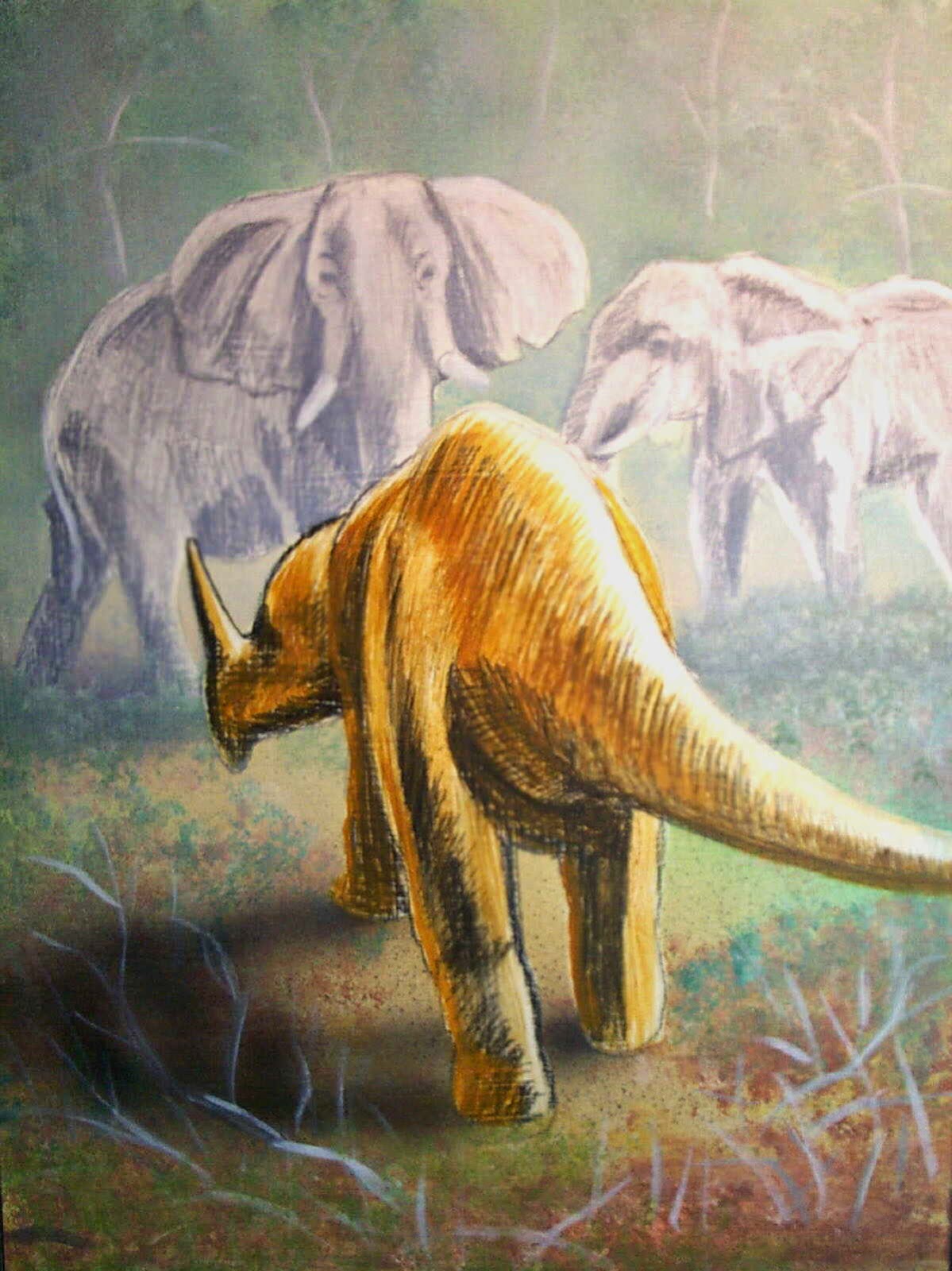
An emela-ntouka facing off a wary herd of elephants (© William Rebsamen)

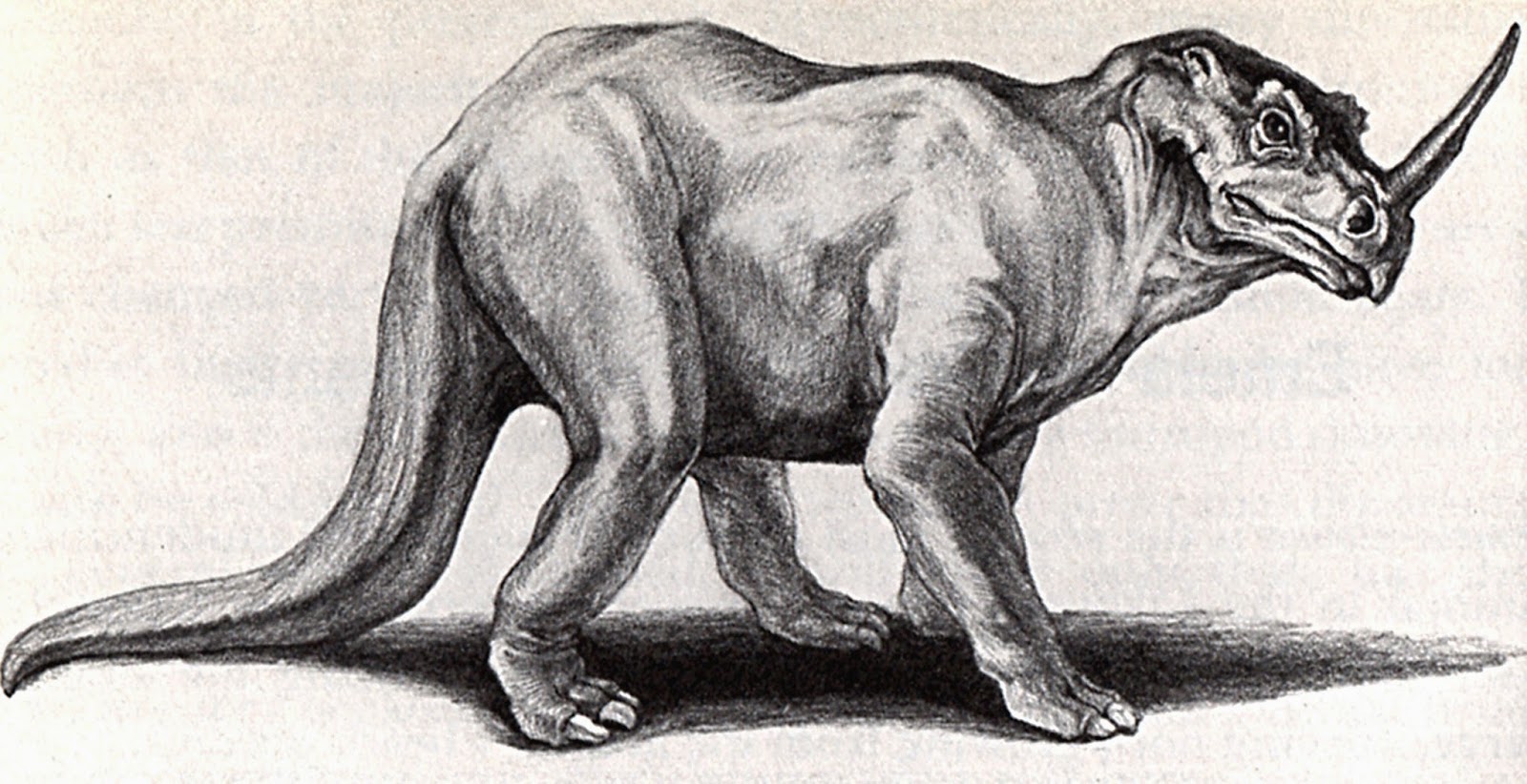
Following his own investigations of this extraordinary beast, Mackal proposed, albeit cautiously, that it may actually be a surviving ceratopsian or horned dinosaur – i.e. belonging to a group of huge herbivorous dinosaurs that included such prehistoric stalwarts as Triceratops and Styracosaurus. Many ceratopsians possessed more than one horn, but at least one famous example, Centrosaurus (formerly called Monoclonius), bore only a single horn, at the end of its nose – and reconstructions of Centrosaurus certainly recall descriptions of the emela-ntouka. Moreover, because the horns of ceratopsians were true horns (composed of bone), not compressed hair, they may well have resembled ivory, just like the emela-ntouka’s; and all ceratopsians had long heavy tails, providing yet another match with the emela-ntouka.

Modern restoration of Centrosaurus in life (© Nobu Tamura/Wikipedia)

Indeed, the only major discrepancy between the pygmies' description of this cryptid and palaeontological reconstructions of ceratopsians is that the latter dinosaurs bore a huge bony frill around their neck, protecting this otherwise-vulnerable body region from attack by carnivorous dinosaurs, whereas no such frill has been reported for the emela-ntouka. However, if the latter beast is indeed a surviving ceratopsian, it is the product of 64 million years of continued evolution, i.e. from when the most recent fossil ceratopsians died out right up to the present day - a immense period of time during which evolution could readily have engineered the reduction or complete elimination of a frill (especially as such a heavy accoutrement would no longer be needed following the extinction of the mighty carnivorous dinosaurs).

The emela-ntouka envisaged as a reptile (© Sebastian Tawil)

Equally interesting is that, as with the mokele-mbembe, reports of creatures resembling the emela-ntouka are not confined to the Congo’s Likouala swamplands. The Democratic Republic of Congo (formerly Zaire) also has its own counterpart, dubbed the irizima, and there are even reports from as far west as Liberia. Moreover, several notable East African lakes, including Lakes Bangweulu, Mweru, and Tanganyika, as well as the Kafue swamps, are said to be inhabited by a very comparable cryptid known as the chipekwe, which kills hippopotamuses with its horn, but does eat them. Occasionally, one of these aggressive animals has itself been killed by native hunters, but, sadly, no remains have ever been made available for scientific analysis. However, the ivory-like horn is said to be highly prized by them, so perhaps there is a chipekwe horn or two preserved in a local chief’s dwelling somewhere in East or Central Africa and awaiting discovery by a sharp-eyed Western explorer, scientist, or missionary?

The emela-ntouka/chipekwe as portrayed in its jungle swampland domain, complete with hippos! (© Dr Karl Shuker)

Meanwhile, French cryptozoologist Michel Ballot has lately found what may be the next best thing. Since 2004, he has conducted a number of excursions into Cameroon, seeking evidence for the existence of unknown aquatic beasts. In 2005, during his second expedition, travelling through a region of northern Cameroon bordering the Central African Republic, he visited a village where he saw (and purchased) a large, truly remarkable wooden carving. It depicted in great detail a strange beast with four sturdy legs, a long heavy tail, and a head whose nose bore a long horn.

Although this carving doesn’t match any known animal alive today, as can be seen from the photograph of it reproduced below in this present ShukerNature blog article (and also click here for Michel's own account of it, with additional photos) it is a faithful representation of the emela-ntouka.

Photograph of the more detailed, better-known of the two emela-ntouka carvings encountered by Michel Ballot in Cameroon (© Michel Ballot)

Interestingly, this carving portrays the emela-ntouka with a pair of small frilly ears, almost like miniature elephant’s ears, a feature not previously reported for this cryptid but which, if genuinely possessed by it, indicates a mammalian rather than a reptilian identity. Moreover, in his own account Michel revealed that in 2005 he had actually found not one but two such carvings, in separate locations and created by separate artists, but identical in appearance. Judging from the photo below of the second one, however, it is less detailed and less well-executed than the first, more famous carving.

Photograph of the second, less-publicised emela-ntouka carving encountered in Cameroon by Michel Ballot (© Michel Ballot)

Now, in a ShukerNature world-exclusive, I can reveal a third, independently-obtained but undeniably corroborative piece of iconographical evidence for the veracity of this specific morphological identikit relative to the emela-ntouka.

And here is where that remarkable piece of evidence came to light. Situated in the Central African Republic (CAR), to quote from their website (click here) the Dzanga Sangha Protected Areas or APDS:

"…are internationally known for their beautiful rainforests, host to a remarkable diversity of wildlife, comprising western lowland gorillas, forest elephants, bongo antelopes, forest buffalos and a multitude of bird species. Furthermore, a rich local culture, comprising the Sangha Sangha fishermen as well as hunting and gathering BaAka, are present in the area. Apart from conservation and local development efforts, Dzanga Sangha operates as an eco-tourism and research centre. A variety of well developed tourism activities and a beautiful hotel complex, overlooking the Sangha River, are at your disposal.

"Sharing borders with Cameroun and Congo, the Dzanga Sangha Protected Areas are part of the Trinational Sangha (TNS) complex, currently in the process to become a UNESCO World Heritage Site. Roundtrips to the other National Parks (Lobéké in Cameroun and Nouabalé Ndoki in Congo) can be organized with ease."

Dzanga Sangha (public domain)

On 8 August 2012, I receieved a fascinating email and attached set of four photographs from Anette Stichnoth of Hannover, Germany. The photographs, taken by a friend of hers from the above-mentioned APDS and named Cem Kok, were of four drawings on display at the first, now-dismantled Dzanga Sangha Exhibition (Cem was currently working on the second one), held in the APDS - with whom Anette was working in the capacity of utilising its exhibition's artworks as designs on souvenirs, such as t-shirts and mugs, that could be sold to APDS visitors in order to raise money for the area's continuing conservation. In relation to this, she asked me if I had any idea what the entities were that the drawings depicted, because she wanted to produce an information card for each one but no-one whom she had previously contacted had been able to identify them.

The artist responsible for these four drawings was a Frenchman named Jean Claude Thibault, who had produced them during the early 1990s or late 1980s. He had lived in the Central African Republic (a former French colony) for a number of years, but could not be contacted personally concerning his drawings because he had died in Bangui, the CAR's capital, a couple of years ago.

After examining Thibault's drawings, it was clear to me that they were nothing if not interesting from a cryptozoological standpoint. Three of them depicted humanoid or semi-humanoid beings, and are exclusively documented in a separate ShukerNature blog article (click here) - but the fourth one was very different, and is reproduced below.

Thibault's fourth drawing from the first Dzanga Sangha Exhibition (©  Jean Claude Thibault)

As can be seen, it portrays one elephant fleeing in the background, plus a second one that has been stabbed in its underside by a horned beast bearing an uncanny resemblance to Michel Ballot's Cameroon-procured emela-ntouka carvings!

In order to compare those works of art directly, I have horizontally flipped one of Michel's photographs of the more detailed of the two Cameroon emela-ntouka carvings, thereby enabling its orientation to match that of the creature in Thibault's drawing. So here now are the two images placed alongside one another:

Michel Ballot's Cameroon-procured emela-ntouka carving (top); and Thibault's Dzangha Sangha Exhibition drawing, cropped to concentrate upon the horned beast depicted in it (bottom) (© Michel Ballot/(©  Jean Claude Thibault)

And as can be readily discerned, there is no doubt whatsoever that these two artworks are indeed depicting the same species of animal – whatever that may be! Every major morphological feature - from those strange little frilly ears, and sharp vertical snout-horn, to the very long, broad, sweeping tail with its distinctive dorsal ridge or keel, and the relatively short, sturdy, bent legs with well-differentiated digits - is portrayed in an identical manner by the carving and the drawing. Even the seemingly stylised, non-differentiated pointed teeth are the same in both pieces.

Fascinated by this extraordinary correspondence between works of art created in two entirely different countries by artists very unlikely to have ever seen each other's work, I swiftly emailed Anette for additional information. Unfortunately, however, she didn't have anything further of substance to offer me at that time, but promised to contact me again once she had obtained more details – and almost exactly a year later, she did so.

On 18 August 2013, Anette emailed me a series of descriptions for the four drawings that she had lately been given by a CAR local with knowledge of his country's legendary creatures and entities. The one depicting the emela-ntouka was labelled as 'Mokele-Mbembe', and the creature was said to inhabit the deepest stretches of the River Ndoki. Referring to it as a mokele-mbembe may seem strange on first sight. However, as I discussed in my book In Search of Prehistoric Survivors, in central Africa (i.e. not just the CAR but also the two Congos, Cameroon, etc) the long-necked lake-dwelling cryptid (mokele-mbembe) and the horned lake-dwelling cryptid (emela-ntouka) are often conflated in local reports, with features of one sometimes being wrongly attributed to the other, so this is not as surprising as it might otherwise seem.

Cropped version of Thibault's emela-ntouka drawing (© Jean Claude Thibault)

Due to how astonishingly similar Thibault's CAR emela-ntouka drawing was to Michel Ballot's Cameroon emela-ntouka carvings in terms of the creature's morphology, I had initially wondered whether the former had been directly copied from the latter. Perhaps Thibault had seen online images of the Cameroon carvings? However, when I learnt that Thibault had produced the drawing a decade or more before Michel had even encountered the carvings, let alone photographed them and brought them to public attention by uploading the photos onto the internet, it is surely evident that they are of independent origin, neither one influenced by the other. After all, it is highly unlikely that the Cameroon villagers responsible for the carvings had ever seen Thibault's drawing, which had only been exhibited publicly within the CAR, never outside it.

Equally relevant is that although the carved animals and the drawn one possess identical morphologies, the specific poses respectively adopted by them are not the same at all. Both carved animals are standing stationary, in a neutral behavioural pose, with the head held at a normal height, the hind limbs close together, and the tail (curving to the right in the original, non-flipped version of Michel's photograph of the first carving, to the left in the second carving) held laterally for much of its length and very close to the body. The drawn animal, conversely, is in ferocious attack mode, with its head lowered as it belligerently drives its horn into the body of its hapless pachyderm victim, its hind legs splayed well apart in order to brace itself as it performs the powerful thrusting stab with its horn, and its tail (curving to the left) held out further away from its body in a much wider arc and portrayed throughout its length from above. In short, the two carved animals and the drawn animal indisputably portray the same species, but the two carved animals' shared pose is very different from the drawn animal's - thereby further indicating that the drawing was not copied from or influenced by the carvings or vice-versa.

Yet as the carvings and the drawing correspond with one another so closely morphologically speaking, we must conclude that the image of the emela-ntouka provided by them is an accurate one – that it really does possess small frilly ears, a vertical snout-horn, bent legs, and a very broad, lengthy, powerful tail. The ears alone are enough to demonstrate that it is clearly mammalian in nature (as they are clearly bona fide ears and not, for instance, an abbreviated ceratopsian frill), thereby eliminating a surviving ceratopsian dinosaur from serious consideration in the future. Yet it does not compare with any known species of mammal. Indeed, it is not even possible to allocate this mysterious creature with ease to any existing taxonomic order of mammals. Having said that, however, the image of it yielded by the carvings and the drawing does remind me a little of Arsinoitherium zitteli.

Restoration of Arsinoitherium zitteli in life (© Dmitry Bogdanov/Wikipedia)

Dating from the late Eocene, this was a massive elephantine horn-bearing species of fossil African ungulate belonging to the extinct order Embrithopoda. Named after eminent palaeontologist Dr Karl Alfred von Zittel and Queen Arsinoe I, the wife of the Egyptian pharaoh Ptolemy II (its remains were found in present-day Egypt's Faiyum Oasis), it was believed to have been aquatic in lifestyle, spending much of its time wading and swimming in rainforest swamps rather than walking on land, as it was unable to straighten its legs (thus recalling the emphatically bent legs of the emela-ntouka depicted in the drawing and carvings). Moreover, it is particularly famous for its pair of truly enormous, laterally-sited snout horns, composed of bone but hollow and covered in keratinised skin.

Skeleton of Arsinoitherium zitteli (© Dr Karl Shuker)

According to their known fossil record, embrithopods officially died out almost 30 million years ago (Arsinoitherium was their last known genus), but could the emela-ntouka possibly be a single-horned, scientifically-undiscovered, modern-day representative? The hefty, lengthy tail, however, poses a notable problem - why would an embrithopod evolve such a decidedly non-ungulate feature? Going full circle, a more conservative alternative would be a species of semi-aquatic water rhinoceros, as first suggested by certain cryptozoologists many years ago. Yet in spite of its single horn, the heavy-tailed creature portrayed by the carvings and drawing bears scant resemblance to any of the diverse array of rhino forms on record from either the present day or prehistoric times.

Currently, therefore, the emela-ntouka remains an enigma, but at least it is one that now appears to have a well-defined albeit extremely perplexing morphology.

Swedish artist Richard Svensson's delightful take on the emela-ntouka (© Richard Svensson)

If you wish to learn more about or offer assistance to the Dzanga Sangha Protected Areas (APDS), please visit their website here.

For an extensive account of the emela-ntouka, chipekwe, and other African counterparts, check out their coverage in my book In Search of Prehistoric Survivors (1995).


UPDATE: A SECOND THIBAULT DRAWING OF THE EMELA-NTOUKA

Today, 9 July 2014, I received an extremely interesting email from French cryptozoologist Michel Raynal (thanks Michel!), which provided me not only with additional information concerning the emela-ntouka drawing by Jean Claude Thibault documented here, but also with sight and details of a second one prepared by him, as now revealed.

The drawing already documented here was #12 of twelve Thibault drawings of mythological/legendary entities from the CAR that in 1996 were featured in a special calendar produced by the World Wide Fund for Nature (WWF) in the CAR to raise funds for the Doly-Lodge Project in Bayanga, the largest village within the APDS. So this was not a worldwide calendar, but one specifically for the APDS in the CAR. The emela-ntouka drawing subsequently reappeared in 2000 within an article concerning this cryptid published in issue #3 of the Bangui-based anthropological periodical Zo, and written by Alfred J-P. Ndanga, from Bangui University's Department of Anthropology and Palaeontology. Intriguingly, throughout the article Ndanga referred to the creature not as the emela-ntouka but rather as the mokele-mbembe - another instance of conflating these two great water cryptids of central Africa. 

As for the second Thibault drawing of the emela-ntouka: this appeared in a Congolese newspaper (date and title currently unknown to me), and is reproduced below (note that once again this cryptid is mis-labelled as a mokele-mbembe):


The emela-ntouka (© Jean Claude Thibault)


Friday, 4 July 2014

THE 'OTHER' ENCOUNTER BETWEEN A BRITISH SAINT AND A BRITISH LAKE MONSTER

St Mochua and the lake monster of Connaught, Ireland (© William Rebsamen)

Every self-respecting cryptozoologist knows – or should know – about the famous encounter claimed for St Columba and the Loch Ness monster during the 6th Century AD (its specific date varies from one authority to another). Having said that, in reality the encounter apparently took place not in the loch itself but in the River Ness – so the creature in question may not have had any bearing upon the cryptids allegedly frequenting the loch, but may simply have been a vagrant sea creature of known form, such as a bearded seal or possibly even a walrus.

Anyway, regardless of its specifics, this encounter is, as I say, a very famous one in the annals of cryptozoology.

St Columba confronting the monster in the River Ness (© William Rebsamen)

Far less famous, however, yet no less interesting, is the 'other' encounter between a British saint and a British lake monster (by which I mean a saint and a lake monster from the British Isles, a geographical term embracing the major islands of Great Britain and Ireland plus the many smaller islands collectively surrounding them) – which is the subject of this present ShukerNature blog post.

Born Crónán mac Bécáin sometime during the late 6th Century or early 7th Century AD (his age upon death is unrecorded but he is known to have died on 30 March 637 AD), St Mochua as he became was a notable early Irish saint. After completing his education at Bangor, he was reputedly led through many regions of Ireland by a miraculous fountain that could move of its own accord, and during that time he performed a considerable number of miracles himself. One of these involved a lake monster.

At one point during his fountain-guided travels, Mochua crossed the River Shannon and entered the territory of Omania (aka Hy-Many) in the province of Connaught, where he visited Kellach, who was the son of Ragallus, king of Connaught. During Mochua's stay, Ragallus went out hunting a stag, which in order to escape pursuit, leapt from a steep precipice on the shore of a lake and swam to a large rock, jutting forth above the lake's waters like a small island, where the creature sought sanctuary. Different reports cite different lakes (or loughs) as being the one in question here – including County Galway's Lough Ree, Lough Cime or Cimbe (aka Hackett), and Lake Raminium.

Lough Ree (public domain)

According to traditional legend, Mochua had stated that God would safeguard anyone who was bold enough to dive into the lake and swim after the stag, so with Ragallus's permission one brave man did precisely that, reaching the rock-island and killing the stag. When he attempted to swim back to the lake's shore with his slain quarry's carcase, however, a water monster that lived in this body of water and was held in great dread by the populace on account of its murderous nature suddenly rose up from the depths and promptly devoured the hapless swimmer.

When this happened, Ragallus angrily chastised Mochua, as his prediction had seemingly failed to come true, but in response Mochua confronted the monster and prayed – whereupon the monster abruptly vomited forth the swimmer, who was alive and totally unharmed. Moreover, never again did this great water beast attack any other swimmer. Ragallus and his subjects duly gave thanks to God for this miracle, and Mochua was afterwards greatly revered here.

Whether any such monster truly existed or whether this is just a hagiographical legend is unclear (who knows, it may even be derived directly from the earlier one featuring St Columba). And even if it did exist, there does not appear to be any description of the creature on record that might allow a serious attempt to be made at identifying its species.

Reconstruction of the Lough Nahooin horse-eel – one of several horse-eels reported in modern times from the lakes of County Galway in Connaught - based upon eyewitness accounts (© Orbis Books)

Nevertheless, bearing in mind that the loughs of Connaught, including Ree, have featured prominently in modern-day reports of Irish freshwater monsters, notably those of the sinuous horse-eel variety, it is an intriguing story, and perhaps even one of bona fide cryptozoological relevance and precedence.

Check out my book In Search of Prehistoric Survivors (1995) for additional details concerning Irish horse-eels.


Thursday, 3 July 2014

THE CURIOUS CASE OF ROTHSCHILD'S LOST TUSK AND THE NON-EXISTENT ELEPHANT PIG - AN ENDURING CRYPTOZOOLOGICAL CONUNDRUM FROM AFRICA

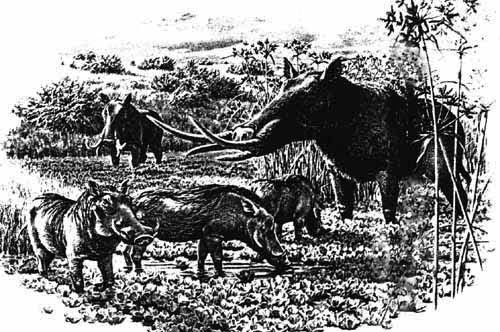
Afrochoerus purposefully portrayed here as originally conceived when first discovered, i.e. erroneously sporting the tusks of a prehistoric elephant (© Hodari Nundu/deviantart.com)

I first came upon the following crypto-case many years ago when browsing through Dr Bernard Heuvelmans's book Les Derniers Dragons d'Afrique (Plon: Paris, 1978), and it has fascinated me ever since. Recently, I obtained some additional, previously-undisclosed information concerning it, and which turned out to be something of a conundrum in itself. Consequently, it is high time that I finally presented the remarkable story behind one of the most intriguing and potentially significant examples on record of an apparently lost specimen of possible cryptozoological relevance. So here it is – the story, that is, not the specimen itself, sadly!

It all began in an Ethiopian ivory market, one of many in this country's capital, Addis Ababa, back in the opening years of the 20th Century (when Ethiopia was still called Abyssinia). In 1904, Baron Maurice de Rothschild and French zoologist Henri Neuville were visiting this particular ivory market during an East African expedition when they noticed a very odd-looking tusk on a stall owned by some ivory merchants from India. Although in excellent condition, supposedly of modern age (i.e. not fossilised, though possibly several centuries old), and superficially similar to an elephant tusk but with a very dark patina, in terms of length it only measured 0.56 m (22 in) in a straight line and only 0.74 m (29 in) following its curve, so it was smaller than most elephant tusks of comparable proportions that they had previously sold. In addition, it bore a series of longitudinal, regularly-spaced, narrow grooves or corrugations on what appeared to be its upper side and a single long but very broad groove on its apparent underside, instead of being smooth-surfaced like regular elephant tusks. Consequently, it had not attracted interest from potential buyers.

Three different views of the mystery tusk purchased in Addis Ababa by Rothschild and Neuville, as depicted in their 1907 paper documenting it

The ivory merchants were unable to provide any information regarding this odd tusk's original geographical provenance or from what type of animal it had been obtained. Indeed, they considered it not to be a tusk at all, but rather some form of horn. Nevertheless, intrigued by its strangeness, and no doubt encouraged by its lower-than-normal price, Rothschild and Neuville duly purchased it. Moreover, while still in East Africa, Neuville was informed by some Somali hunters and camel herders that tusks like this one came from an aquatic, hippopotamus-sized creature of great strength, whose tusks curved downwards to the ground, and which inhabited certain very large East African lakes. According to them, one of these lakes is what is now known as Lake Abaja (formerly called Lake Margherita) where they claimed to have seen a living specimen, and another such lake is situated on the border of Kenya and Uganda.

Following their return to Europe, Rothschild and Neuville's unusual zoological purchase was exhibited at three separate scientific meetings. Namely, the Société Philomathique of Paris on 14 January 1905; the Zoological Society of London on 14 November 1905 (where it was presented by Lord Walter Rothschild, distantly related to Maurice de Rothschild, who was a lifelong zoological researcher and prodigious collector of wildlife specimens that he housed at his own personal natural history museum at Tring in Hertfordshire); and the Academy of Sciences, Paris, on 11 December 1905. (Oddly, a short notice in the Zoological Society's Proceedings documenting the tusk's exhibition there claimed that two such tusks, not one, had been obtained by Rothschild and Neuville and had been exhibited at the Society.)

Rothschild and Neuville then prepared an extensive scientific paper documenting their anomalous tusk, which was published on 15 October 1907 in the French journal Archives de Zoologie Expérimentale et Générale (4th Series), was over 50 pages long, and was aptly entitled 'Sur une Dent d'Origine Énigmatique'. In it, they compared the tusk closely with a range of others, including those of elephants, hippos, walruses, and wild pigs, as well as a large selection of freak, malformed elephant tusks housed at London's Natural History Museum and elsewhere. However, Rothschild and Neuville claimed that not only externally but also in terms of its internal grain structure as seen when viewed in cross-section, it differed markedly from all of them, and even from known fossil species of tusked mammal – to such an extent, in fact, that they considered it plausible that this unique specimen did indeed derive from some still-undiscovered animal species, exactly as claimed by the Somalis.

Line illustration of the Rothschild-Neuville mystery tusk, from their 1907 paper documenting it

Although referred to for the sake of convenience as a tusk both here in the present ShukerNature blog article and also in the Rothschild-Neuville paper, this enigmatic object was technically a tusk section, not a complete tusk, having been sectioned some way between its tip and its base, with the latter not being present. From their examination of it, Rothschild and Neuville considered that had it been present in its entirety, it would have been almost semi-circular in shape, and that the section preserved was probably derived from a right-hand tusk. Intriguingly, the tip showed no sign of having been sharpened, whereas elephants tend to sharpen their tusks' tips on hard objects that they encounter. From the trace of the pulp cavity remaining, the authors considered it likely that their perplexing tusk had exhibited continuous growth in life, like elephant tusks, rather than like normal teeth that do not grow continuously through life.

The Rothschild-Neuville mystery tusk was totally devoid of enamel (moreover, it occurs only at the onset of tusk development in elephants, whereas a thick layer is present in hippo tusks; enamel occurs at the tip in walrus tusks, though this tends to be worn off as the animal matures). However, there was a layer of cement, which, although not particularly thick, was very extensive (a cement layer replaces the enamel layer in elephant tusk development). As for its anomalous grooves, superficially similar structures are also borne upon the surface of hippo tusks, but their arrangement is very different from that of the Rothschild-Neuville mystery tusk's grooves. This is also true of the grooves that sometimes occur on wild pig tusks, and those present on various teratological tusks from elephants that were examined by the authors. Several distinctive traits can be found in diseased examples of elephant tusks, but none of those traits was exhibited by their mystery tusk, which appeared to be perfectly healthy, thus eliminating another possible explanation of it. For further morphological and histological details, please consult the meticulous description in their original paper.

A couple of hippopotamus tusks, the upper one revealing the grooves on its upper side, the lower one revealing those on its underside (© Dr Karl Shuker)

Having assessed all of their mystery tusk's characteristics, Rothschild and Neuville concluded that it compared more closely with elephant tusks than with those of any other mammal, but that even with these it also exhibited notable differences. Consequently, their preferred hypothesis was that it had therefore originated from a species of large mammal still unknown to science but probably most closely related to proboscideans (Proboscidea is the taxonomic order containing elephants).

Notwithstanding this exciting possibility, however, the Rothschild-Neuville mystery tusk rapidly sank into zoological obscurity following their paper's publication in October 1907, with only Heuvelmans's aforementioned documentation of it in his 1978 book briefly raising its profile. And yet with modern-day advances in microscopical, chemical, and genetic analyses readily available, surely a re-examination of this specimen utilising these techniques might unlock the secret of its original owner's still-cryptic taxonomic identity? Quite possibly, if only this mystery tusk's current whereabouts were known.

Les Derniers Dragons d'Afrique, 1978 (front cover illustration © Alika Lindbergh/Plon)

French cryptozoologist Michel Raynal was in direct, frequent correspondence with Heuvelmans for many years, and I recently learnt from him that Rothschild and Neuville had deposited their mystery tusk at France's National Museum of Natural History in Paris and that it had been accorded its own accession number. However, he had been told by Heuvelmans about 20 years ago (Heuvelmans died in 2001) that the tusk could not be found there by the museum staff when he (Heuvelmans) had requested sight of it, not even when he had given them its correct accession number. So it had probably been lost many years earlier. But what was Heuvelmans's opinion concerning the possible identity of the mysterious creature from which the Rothschild-Neuville tusk had originated? This is where the story becomes even more intriguing, because Heuvelmans expressed two very different opinions concerning this issue – one publicly, another one privately.

The more conservative (relatively speaking) of the two is the opinion that he expressed publicly, in his book Les Derniers Dragons d'Afrique (1978).  Here he suggested that the unrevealed tusk-bearer may be an unknown species of proboscidean. In his classic book On the Track of Unknown Animals (1958), Heuvelmans had referred to a cryptic aquatic proboscidean, the so-called water elephant,  which I have also reviewed in various of my own writings, particularly in my book In Search of Prehistoric Survivors (1995) and most recently on my ShukerNature blog (click here).

Said to inhabit certain Congolese lakes (Lord Walter Rothschild had collected reports appertaining to this cryptid there and also in Tanzania as well as South Africa, as noted in the Rothschild-Neuville paper), and sighted on two separate occasions during the first decade of the 20th Century by French explorer M. Le Petit, the water elephant, as its name suggests, allegedly spends much of its time submerged, only emerging onto land during the evening. It is readily distinguished from normal elephants morphologically too, via its very elongate, ovoid head and its extremely short, tapir-like trunk. However, it is also said to lack tusks. If so, while again distinguishing it from normal elephants, by definition this characteristic also eliminates it from consideration as the originator of the Rothschild-Neuville mystery tusk.

Artistic representation of the Congolese water elephant (© Markus Bühler)

Nevertheless, following publication of the Rothschild-Neuville paper, Le Petit was urged by Paris's National Museum of Natural History to pursue reports of a similar creature supposedly inhabiting Lake Chad in West Africa. Moreover, according to an article penned by Prof. Emile Trouessart in the 21 January 1911 issue of the French periodical La Nature, Le Petit would be accompanied by noted French zoologist Dr Emile Gromier, and the suggestion was that both the West African water elephant and the unknown originator of the Rothschild-Neuville mystery tusk may be a living deinothere.

Deinotheres were very large and highly unusual proboscideans known only from fossils, and characterised by their lower jaw's downward-curving pair of tusks. A deinothere had been discounted by Rothschild and Neuville in their paper as a plausible identity for their tusk's originator, but Heuvelmans did not discount a relatively small, amphibious, scientifically-undetected modern-day version out of hand when documenting the water elephant and the Rothschild-Neuville tusk in his books. As for the planned expedition to Lake Chad: I have been unable to discover whether Le Petit and Gromier ever did go there – but even if they did, they certainly didn't find a deinothere.

Reconstruction of a deinothere (© Dmitry Bogdanov/Wikipedia)

Heuvelmans's second, privately-expressed opinion as to what creature the Rothschild-Neuville mystery tusk may have come from is even more radical than an undiscovered species of probiscidean. In a couple of emails sent to me by Michel Raynal during June 2014, Michel stated:

"In Heuvelmans's dossier on the tooth in Lausanne [the site of his Centre de Cryptozoologie], I noticed that there is an article on Afrochoerus, making me think that Heuvelmans believed that the "owner" of this tooth was more or less related to this fossil suid…

"Heuvelmans seemed to believe that it was a living Afrochoerus (he even told me, when I visited his "centre de cryptozoologie" in the 1980s, "je sais ce que c'est" = I know what it is).

"However, Afrochoerus tusks are somewhat different."

They are indeed! In fact, the tusks of this African fossil pig once yielded a very notable controversy of their own.

Dating from the Pliocene epoch, Afrochoerus nicoli was formally described in 1942 by celebrated palaeontologist Dr Louis Leakey from the famous Olduvai fossil deposits in Tanzania, with substantial additional finds excavated there in subsequent years. Its most striking features were the tusks originally uncovered with it, which were disproportionately long, and in early reconstructions, portraying it with these huge tusks pointing forward, it resembled a bizarre hybrid of wild pig and mastodont!

Erroneous restoration of Afrochoerus as an elephant-tusked giant warthog alongside modern-day warthogs (picture source unknown to me)

In fact, this was quite prophetic, because palaeontologists now know that these tusks weren't suid (pig) tusks at all, but were in reality from Stegotetrabelodon – a genus of fossil gomphothere elephant! What had happened was that Afrochoerus had been based upon cranial remains of a bona fide fossil suid called Metridiochoerus compactus, the giant warthog, that had been discovered in close proximity to some tusks from Stegotetrabelodon, but which had been mistakenly assumed to be all from the same animal. In short, Afrochoerus – the extraordinary 'elephant pig' - was a non-existent composite, whereas the real tusks of M. compactus are nothing more than slightly larger versions of those possessed by modern-day warthogs, and project sideways, not forwards.

Accurate reconstruction of Metridiochoerus (© Nobu Tamura/Wikipedia)

Consequently, although he apparently did not realise it, by favouring Afrochoerus as the identity of the Rothschild-Neuville tusk's owner at the time that he did, Heuvelmans was still supporting a proboscidean candidate (albeit a different one from the deinothere option), because the tusks to which he was comparing the latter mystery tusk were actually elephant tusks, not pig tusks.

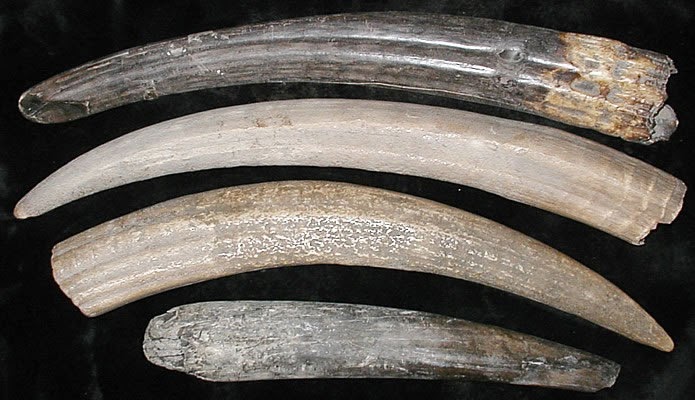
But could this mystery tusk have derived from something other than a proboscidean? When I inspected the illustrations of it in the Rothschild-Neuville paper, images of walrus tusks immediately came to mind, even though the authors had discounted this possibility in their paper. True, there are certain discrepancies. The underside of walrus tusks have a single wide groove (just like the mystery tusk), but the upper side typically bears only a series of very fine longitudinal cracks of varying lengths. Also, walrus tusks are generally long and fairly straight, whereas if Rothschild and Neuville were correct in assuming that in its entirely their tusk would have been almost semi-circular in shape, this would also argue against a walrus tusk as its identity. So too does the dark brown patina exhibited by their tusk.

A batch of confiscated illegally-trafficked walrus tusks and tusked walrus skulls as well as some polar bear pelts (© US Fish and Wildlife Service)

However, I have seen photos of walrus tusks that do bear deep longitudinal grooves. Moreover, when I recently consulted Paolo Viscardi, the natural history curator at London's Horniman Museum, who also favours a walrus tusk as the best candidate for this enigmatic specimen, he stated:

"Walrus tusks can also be quite strongly curved and if they [Rothschild and Neuville] were extrapolating the curve and complete length based on pulp cavity extent beyond the sawn region, they may have been wildly out if they didn't have Walrus in mind, since Walrus cavity space is less extensive than what we see in something like an Elephant or Hippo."

Moreover, although the authors stated that it was not a fossil tusk, fossil walrus tusks do sometimes have a dark patina.

Walrus tusks, including fossil specimens displaying a very dark patina (click here for image source)

But how would a walrus tusk have reached the ivory market of Addis Ababa anyway, bearing in mind that walruses only occur in the Arctic Ocean and the subarctic zones of the Atlantic and Pacific Oceans? Fellow Rothschild-Neuville tusk researcher Matt Salusbury, author of the book Pygmy Elephants (2013) in which this specimen is briefly referred to, suggested in an email to me of 30 June 2014 that whalers and immigrants from Scandinavia all en route to South Africa just prior to the tusk's appearance in Addis Ababa may have brought it with them.

Intriguingly, in South Africa's Orange Free State there are ancient bushman cave paintings that portray an unidentified creature bearing a remarkable resemblance to a walrus, and which has been colloquially dubbed the jungle walrus. The most famous one (portrayed below), which appeared in Rock-Paintings in South Africa (1930) by George William and Dorothea Bleek, can be found in a cave in Brakfontein Ridge, which was at one time (and perhaps still is?) contained within the grounds of a farm called 'La Belle France'. Just an imaginary beast, or a bona fide cryptid with possible relevance to the Rothschild-Neuville tusk?

The mysterious 'jungle walrus' as depicted in a cave painting at Brakfontein Ridge, South Africa

Of course, as noted earlier here, if only the Rothschild-Neuville tusk could be scientifically examined utilising the plethora of modern-day techniques readily available nowadays, its secrets would soon be teased out and laid bare. Yet as also noted earlier here, it was apparently lost long ago somewhere within the labyrinthine interior of its final resting place, the National Museum of Natural History in Paris – or was it?

Matt Salusbury has informed me (click also here) that he is currently pursuing the tantalising possibility that the tusk may not have been mislaid but simply mislabelled, and is hoping to have its accession number rechecked and also those of comparable specimens there, such as walrus tusks, to determine whether this most mystifying specimen is actually hiding in plain sight - not lost at all, therefore, merely overlooked. He is also the accession logs at London's Natural History Museum, the Zoological Society of London, and the Tring Natural History Museum, too just in case the tusk was transferred from Paris to any of these English repositories. I wish Matt every success in his exciting undertaking, and very much hope to be able to announce here soon that the Rothschild-Neuville mystery tusk has indeed resurfaced – which would be a major success for contemporary cryptozoology. So watch this space!

Line drawings from Heuvelmans's 1978 book based upon the photo of three views of the mystery tusk that appeared in the Rothschild-Neuville paper of 1907 (© Plon)