Dr KARL SHUKER

Zoologist, media consultant, and science writer, Dr Karl Shuker is also one of the best known cryptozoologists in the world. He is the author of such seminal works as Mystery Cats of the World (1989), The Lost Ark: New and Rediscovered Animals of the 20th Century (1993; greatly expanded in 2012 as The Encyclopaedia of New and Rediscovered Animals), Dragons: A Natural History (1995), In Search of Prehistoric Survivors (1995), The Unexplained (1996), From Flying Toads To Snakes With Wings (1997), Mysteries of Planet Earth (1999), The Hidden Powers of Animals (2001), The Beasts That Hide From Man (2003), Extraordinary Animals Revisited (2007), Dr Shuker's Casebook (2008), Karl Shuker's Alien Zoo: From the Pages of Fortean Times (2010), Cats of Magic, Mythology, and Mystery (2012), Mirabilis: A Carnival of Cryptozoology and Unnatural History (2013), Dragons in Zoology, Cryptozoology, and Culture (2013), The Menagerie of Marvels (2014), A Manifestation of Monsters (2015), Here's Nessie! (2016), and what is widely considered to be his cryptozoological magnum opus, Still In Search Of Prehistoric Survivors (2016) - plus, very excitingly, his four long-awaited, much-requested ShukerNature blog books (2019-2024).

Dr Karl Shuker's Official Website - http://www.karlshuker.com/index.htm

IMPORTANT: To view a complete, regularly-updated listing of my ShukerNature blog's articles (each one instantly clickable), please click HERE!

IMPORTANT: To view a complete, regularly-updated listing of my published books (each one instantly clickable), please click HERE!

IMPORTANT: To view a complete, regularly-updated listing of my Eclectarium blog's articles (each one instantly clickable), please click HERE!

IMPORTANT: To view a complete, regularly-updated listing of my Starsteeds blog's poetry and other lyrical writings (each one instantly clickable), please click HERE!

IMPORTANT: To view a complete, regularly-updated listing of my Shuker In MovieLand blog's articles (each one instantly clickable), please click HERE!

IMPORTANT: To view a complete, regularly-updated listing of my RebelBikerDude's AI Biker Art blog's thematic text & picture galleries (each one instantly clickable), please click HERE!

Search This Blog


PLEASE COME IN, I'VE BEEN EXPECTING YOU...

PLEASE COME IN, I'VE BEEN EXPECTING YOU...
WELCOME TO SHUKERNATURE - ENJOY YOUR VISIT - BEWARE OF THE RAPTOR!


Friday, 14 August 2015

MEDIEVAL SNAIL-CATS IN ILLUMINATED MANUSCRIPTS - OR, CURIOUS CRITTERS FROM THE MENAGERIE OF MARGINALIA


A snail-cat, depicted in the Maastricht Hours – an illuminated devotional manuscript produced in the Netherlands during the early 1300s (public domain)

After my exhaustive books Mystery Cats of the World (1989) and Cats of Magic, Mythology, and Mystery (2012) were published, I might have been forgiven for thinking that I must surely have documented a representative selection of examples for every anomalous feline form ever recorded – but I would have been wrong, as now revealed here.


The vast assembly of curious creatures inhabiting the exquisite world wrought by generations of medieval monks and lay artists laboriously creating illuminated manuscripts of religious tracts and other devotional works is like none other anywhere in the history of zoological artwork. Alongside such stalwarts of classical Western mythology as dragons, unicorns, griffins, wildmen, and demons are all manner of truly bizarre entities that are commonly termed grotesques, for good reason. Impossible hybrids, crossbreeds, and composites of every conceivable (and inconceivable!) combination, they exhibit a surreal 'mix 'n' match' approach to morphology, deftly and effortlessly uniting the head(s) of one species with the limbs of a second, the wings of a third, and the body of who knows what from who knows where. In cases where these grotesques are more comical than frightening in form, however, they are generally referred to as drolleries.

As mentioned in previous ShukerNature blog articles and other publications of mine, I've always been especially interested in the more unusual contingent of animal life –real, imaginary, and those somewhere in between (I believe the term that I'm looking for here is cryptozoology!). Consequently, it should come as no surprise to learn that this marginalia menagerie, i.e. the zoological monsters and monstrosities lurking amid the margins (and sometimes cavorting among the illuminated letters too) of medieval manuscripts, have long held a particular fascination for me, and I have spent many long but very pleasant hours scrutinising examples from these sources as depicted in books, articles, and online, as well as sometimes directly examining such manuscripts themselves, thus embarking upon an entertaining if unequivocally esoteric safari seeking cryptic creatures of the decidedly uncommon and uncanny kind.

A virginal maiden attended by a spotted unicorn, depicted in the Maastricht Hours (public domain)

Thus it was that I was recently delighted to encounter not one but three different examples of a particular mini-monster of the marginalia variety that I had never previously spotted within the medieval manuscripts' sequestered yet richly ornate realm of emblazoned folios and ornamented parchment. Moreover, unlike so many others sharing its domain, this creature exhibited a well-defined, memorable – even quaint – form, an engaging little drollery combining the whorled shell of a snail with a cat's emerging head and neck (sometimes its front paws too). And so, gentle reader, without further ado I give you the snail-cat – or, should you prefer it, the cat-snail.

(Incidentally, as will be revealed later here, the artistic motif of animals housed in snail shells is by no means confined to cats. On the contrary, so many variations upon this molluscan theme are on record, including humans as well as animals, that these entities even have their very own term – malacomorphs, which translates as 'shell forms'.)

Back to the snail-cats: out of this current trio of molluscan moggies (or feline malacomorphs, to employ the more technical moniker for such incongruous crossbreeds), the first one to come to my attention did so while I was browsing through the British Library's online digital version (click here) of the Maastricht Hours – a sumptuously illustrated version of the once-popular book of hours. But what is a book of hours?

A manticore bishop with curlicue tail, from the Maastricht Hours (public domain)

Back in the 12th Century, the most common books owned by families in Europe wealthy enough to possess such items were psalters – which normally contained the 150 psalms of the Old Testament and a liturgical calendar. They were also beautifully illustrated by monks. Subsequently developed from the psalter was the breviary, which contained all the liturgical texts for the Office (aka the canonical prayers), whether said in choir or in private. During the 14th Century, however, books of hours appeared on the scene. A type of prayer book designed for laypeople, they largely eclipsed psalters and breviaries, and whereas these latter works had been illuminated predominantly by monks (monasteries being the principal producers of books back then), books of hours could be commissioned by the wealthy from professional scribes and lay-owned illuminators in towns and cities, and many of these beautiful works still survive today. Here is Wikipedia's definition of the book of hours:

The book of hours is a Christian devotional book popular in the Middle Ages. It is the most common type of surviving medieval illuminated manuscript. Like every manuscript, each manuscript book of hours is unique in one way or another, but most contain a similar collection of texts, prayers and psalms, often with appropriate decorations, for Christian devotion. Illumination or decoration is minimal in many examples, often restricted to decorated capital letters at the start of psalms and other prayers, but books made for wealthy patrons may be extremely lavish, with full-page miniatures.

Books of hours were usually written in Latin (the Latin name for them is horae), although there are many entirely or partially written in vernacular European languages, especially Dutch. The English term primer is usually now reserved for those books written in English. Tens of thousands of books of hours have survived to the present day, in libraries and private collections throughout the world.

Unidentified creature in the Maastricht Hours (public domain)

The typical book of hours is an abbreviated form of the breviary which contained the Divine Office recited in monasteries. It was developed for lay people who wished to incorporate elements of monasticism into their devotional life. Reciting the hours typically centered upon the reading of a number of psalms and other prayers. A typical book of hours contains:

·                     A Calendar of Church feasts
·                     An excerpt from each of the four gospels
·                     The Little Office of the Blessed Virgin Mary
·                     The fifteen Psalms of Degrees
·                     The seven Penitential Psalms
·                     A Litany of Saints
·                     An Office for the Dead
·                     The Hours of the Cross
·                     Various other prayers

In its Catalogue of Illumination Manuscripts, the British Library lists the Maastricht Hours as MS [Manuscript] Stowe 17. Written in Latin (using Gothic script), but with a calendar and final prayers in French, it was produced during the first quarter of the 14th Century in Liège, the Netherlands, probably for a noblewoman, who may be represented as a kneeling female figure in several places throughout the manuscript. It is lavishly illustrated throughout, and its margins in particular are crammed with all manner of grotesque beasts and other figures, often engaged in bizarre, surprising forms of behaviour, especially so in view of their setting – a religious devotional book.

A fiddle-playing dog in the Maastricht Hours (public domain)

Handsomely bound in blind-tooled blue leather, it was once owned by Richard Temple-Nugent-Brydges-Chandos-Grenville (1776-1839), 1st Duke of Buckingham and Chandos, who resided at Stowe House, near Buckingham in Buckinghamshire, England, where it formed part of the famous Stowe Library (hence its Stowe designation by the British Library). After a series of intervening changes of hand, however, it was finally purchased in 1883 by the British Museum, together with 1084 other Stowe manuscripts.

The Maastricht Hours consists of 273 folios. Like other manuscripts from the Middle Ages, it was bound without page numbers. In relation to such manuscripts, the term 'folio' (commonly abbreviated to 'fol' or simply 'f') is used in place of 'page', and the front or top side of each folio is referred to as the recto ('r'), with the back or under side of each folio being the verso ('v'). Consequently, as examples of how folios are designated in such manuscripts, the front side of a manuscript's fifth folio would be referred to as f 5r, and the back of the manuscript's 17th folio as f 17v. Bearing in mind that some consist of as many as 300 folios or even more, illuminated manuscripts housed in libraries sometimes have the respective number of each constituent folio lightly pencilled upon its recto side's top-right corner, for ease of access to specific folios.

Folio 185 recto (f 185r) of the Maastricht Hours, depicting a scowling snail-cat (public domain)

On f 185r of the Maastricht Hours, which contains a prayer for the family of the book's owner, a scowling snail-cat is clearly visible, perched upon an illuminated curl sweeping underneath the prayer. Its shell is dextral in shape, i.e. its whorls spiral to the right, and disproving the opinion of some writers who have suggested that perhaps snail-cats depicted in medieval manuscripts are simply ordinary domestic cats sitting inside empty (albeit exceedingly large!) snail shells with their head and neck sticking out of the shell's aperture, this particular snail-cat confirms its bona fide hybrid nature by sporting a pair of antenna-like snail stalks on top of its head. Unlike those of real snails, however, its stalks do not bear eyes at their tips – its eyes being set in its face instead, like those of normal cats.

Close-up of the Maastricht Hours snail-cat (public domain)

Incidentally, the specific conformation of this snail-cat's shell is very reminiscent of a fossil ammonite shell. Who knows – perhaps one of the illuminators working on the Maastricht Hours had seen such a specimen at some time, and incorporated its form into his snail-cat's design.

The Maastricht Hours snail-cat compared with a fossil shell from the common British ammonite Peltoceras; the latter illustration is from C.P. Castell's book British Mesozoic Fossils (BMNH, 1962)  (public domain/© C.P. Castell/BMNH - inclusion here strictly on Fair Use/non-commercial basis only)

But this is not the only shelly surprise contained within this manuscript's folios. Several other entities of equally unexpected shell-bearing status can also be found here, as now shown.

Snail-youth on f 8r and in close-up (public domain)

The head and shoulders of a curly-headed youth(?) emerge from a sinistral shell (its whorls spiralling to the left) at the bottom of f 8r, as do those of an unidentified horned ungulate at the bottom of f 11r.

Enshelled unidentified ungulate on f 11r and in close-up (public domain)

A bearded dextral-shelled snail-man with emerging upper torso including arms can be seen at the bottom of f 193v:

Snail-man on f 193v and in close-up (public domain)

A dextral-shelled snail-goat appears on f 222v:

Snail-goat on f 222v and in close-up (public domain)

And on f 272r a woman is shown dancing before a smaller dextral-shelled snail-human whose face has been obscured by wear and tear of the book down through the centuries.

Woman dancing before smaller snail-human on f 272r and in close-up (public domain)

Whoever produced the artwork for this manuscript evidently had a serious passion for manufacturing malacomorphs!

My second snail-cat turned up in the Bibliothèque Mazarine's MS 62, NT Épîtres de Saint Paul (originally the personal library of Cardinal Mazarin, the celebrated Italian cardinal and diplomat who served as Chief Minister to the French monarchy from 1642 until his death in 1661, the Bibliothèque Mazarine is the oldest public library in France). As its title suggests, this manuscript contains the Epistles of St Paul from the New Testament, written in the Vulgate Latin translation. It consists of 149 folios, dates from the final quarter of the 14th Century, and was originally owned by the Convent of the Minimes in the village of Nigeon, located on the hill of Chaillot, near Paris.

F 70v of the Bibliothèque Mazarine's MS 62, NT Épîtres de Saint Paul, revealing the presence of a snail-cat in the left-hand margin (public domain)

On f 70v of this manuscript, one of the quadrants in the elaborately illuminated margin's left-hand side contains a delightful snail-cat, one that in sharp contrast to the distinctly unfriendly version in the Maastricht Hours is happily smiling, is housed within a sinistral snail shell, and is revealing its front paws. It lacks the snail horns of the Maastricht snail-cat, but its ears are unusually long and pointed.

Close-up of the snail-cat in f 70v of the Bibliothèque Mazarine's MS 62, NT Épîtres de Saint Paul (public domain)

As with the Maastricht Hours, moreover, its snail-cat is not the only malacomorph drollery present in this manuscript. Browsing through its complete collection of illuminated folios online (click here), I also spotted a snail-griffin on f 89v whose shell is attached solely to its haunches, with the rest of its body entirely external to it; a bearded human-headed snail-monster on f 102v; and a strange dog-like snail-monster bearing what resembles a reverse coxcomb upon its head on f 112.

Snail-griffin (top left), human-headed snail-monster (top right), and dog-like coxcombed snail-monster (bottom), from the Bibliothèque Mazarine's MS 62, NT Épîtres de Saint Paul (public domain)

Snail-cat #3 appears in a Paris-originating book of hours manuscript entitled Horae ad Usum Parisiensem, which dates from the final quarter of the 15th Century, consists of 190 folios plus four additional folios in parchment, and is written in Latin. It is held in the National Library of France's Department of Manuscripts, but can be viewed in its entirety online here.

Its snail-cat appears on f 187r, and like the previous example it is smiling with front paws present outside its shell, whose whorls spiral in a dextral configuration. Its ears are less pronounced and pointed than those of snail-cat #2, and it lacks the snail horns of snail-cat #1.

Snail-cat on f 187r and in two close-ups, from Horae ad Usum Parisiensem (public domain)

Whereas the illuminator of the Maastricht Hours exhibited a definite obsession with malacomorphs, the artist responsible for the marginalia menagerie in Horae ad Usum Parisiensem showed far more interest in composite centaurs, depicting a wide range of forms, but only one malacomorph other than the snail-cat. This second malacomorph is itself a composite, combining the turbaned head, arms, and upper torso of a man with a pair of large bat-like wings the lower torso and front paws of a leonine creature, and a sinistral snail shell; it appears on f 46r.

Composite malacomorph on f 46r from Horae ad Usum Parisiensem (public domain)

During my browsing of various other illuminated manuscripts online in recent times, I've collected a number of additional malacomorphs, and a small selection of the more interesting and unusual ones is presented below.

An unidentified (possibly porcine?) but unequivocally angry malacomorph appears on f 109v of esteemed Flemish author-poet Jacob van Maerlant's manuscript Van Der Naturen Bloeme, produced in The Hague, Netherlands, in c 1350. This is in turn a free translation of 13th-Century Brabant author Thomas of Cantimpré's 20-volume magnum opus De Natura Rerum.

Jacob van Maerlant's angry malacomorph (public domain)

The Luttrell Psalter is an illuminated manuscript produced sometime during 1325-1340 for the wealthy Luttrell family of Irnham in Lincolnshire, headed by Irnham's lord of the manor, Sir Geoffrey Luttrell, who commissioned its preparation. It consists of 309 folios, is written in Latin, and is now held in the British Library as Additional Manuscript (Add. MS) 42130, after having been acquired by the British Museum in 1929.

It is famous for its extraordinary array of truly monstrous marginalia grotesques, prepared by anonymous illuminators. Indeed, in her fascinating book Monsters and Grotesques in Medieval Manuscripts (2002), Alixe Bovey, a curator in the British Library's Department of Manuscripts, notes that the realistic scenes of daily life on a medieval estate such as owned by the Luttrells as portrayed in this psalter are interspersed with:

…creatures of such startling monstrosity that they prompted one scholar to comment that 'the mind of a man who could deliberately set himself to ornament a book with such subjects…can hardly have been normal'. While it seems unwise to use the margins of the Luttrell Psalter to diagnose the mental condition of its artists, there can be no doubt that the artist who illuminated many of its pages had an exceptionally fertile imagination.

Indeed he did, and as proof of that, here is a noteworthy avian malacomorph that appears on f 171v of the Luttrell Psalter:

Avian malacomorph from the Luttrell Psalter (public domain)

The Hours of Joanna the Mad is an illuminated book of hours manuscript that had originally been owned by Joanna of Castile (1479-1555), the (controversially) mentally-ill consort of Philip the Handsome, king of Castile. It had been produced for her in the city of Bruges (in what is now Belgium) some time between 1486 and 1506, but is now held as Add. MS 18852 in the British Library. As with so many others of its kind, this illuminated manuscript's margins are plentifully supplied with grotesques and drolleries, including a couple of very distinctive malacomorphs – one of which is a bearded snail-man, the other a snail-stag.

The bearded snail-man, from f 91r in the Hours of Joanna the Mad (public domain)

A mirror-image pair of snail-stags from f 305r and f 305v (hence they do not face each other, but I've realigned them to do so here) in the Hours of Joanna the Mad (public domain)

An antiphonary is one of the liturgical books intended for use in the liturgical choir, and many medieval examples were elaborately illuminated. One of these is the multi-volume antiphony produced during the 1400s for the Augustinian monastery of San Gaggio (i.e. Pope St Caius) in Florence, Italy, and among its numerous marginalia is a collared snail-dog, with horns or horn-like ears:

Collared snail-dog from the Antiphony of San Gaggio (public domain)

The Tours MS 0008 manuscript held by the Bibliothèque Municipale in Tours, France, dates from c.1320, originated in Spain, and consists of an illuminated Bible with Latin text, which contains a veritable pantheon of marginalia, including two appearances by snail-goats. In one of these appearances, the horned, beardy-chinned malacomorph in question is defiantly sticking its tongue out at a knight about to shoot it with an arrow (on f 89r); and in the other (on f 327v), it is using its tongue to do something unmentionable to a certain part of a nearby monkey's anatomy!

Two snail-goats in the Tours MS 0008 manuscript (public domain)

The Breviary of Renaud de Bar is MS 107 in the collections of the Bibliothèque Municipale in Verdun, France. Dating from the early 1300s, it was commissioned for Renaud de Bar, the bishop of Metz, by his sister, Marguerite, who was the abbess of Abby St Maur. On f 97r is a snail-monk holding a forked club; similarly, on f 107 v, a snail-woman is wielding a forked club and also holding a shield as she confronts a girl wearing nothing but a cap and a mantle that she is holding open towards the malacomorph like some medieval flasher! And on f 160v, yet another forked club is being parried, this time by a man with a shield opposing a rearing snail-goat with long curved horns.

Three scenes featuring marginalia malacomorphs from the Breviary of Renaud de Bar (public domain)

The Varie Hours is an exceedingly ornate illuminated book of hours commissioned by 15th-Century French court official Simon de Varie. Completed in 1455, it was subsequently divided into three volumes; the first two are held at the National Library of the Netherlands in The Hague, the third at the J. Paul Getty Museum in Los Angeles, USA.

What is especially interesting in terms of its profuse array of marginalia is that this particular book of hours depicts malacomorphs of a fundamentally different nature from those hitherto observed by me in illuminated manuscripts. For instead of possessing spherical spiralled shells like typical land snails, they sport long, pointed spiralled shells similar to those of certain marine gastropods such as Turritella. Two of these atypical malacomorphs can be found on the same folio – f 72 in Vol. 3 – one of which is a snail-goat (at the bottom), and the other (at the top) a composite with the head of a bearded be-turbaned man but the furry upper torso and pawed forelegs of an undetermined animal.

Two malacomorphs on f 72 in Vol. 3 of the Varie Hours (public domain/courtesy of the J. Paul Getty Museum)

Returning once more to snail-cats, and having established that the snail-cat motif is not unique to a single illuminated manuscript, the obvious question now needing to be answered is: what – if anything – does it represent? In medieval lore, each type of animal was invested with certain attributes and thus came to symbolise various specific human emotions and characteristics – love, apathy, piety, hatred, power, deceit, joy, sinfulness, charity, betrayal, loyalty, greed, honesty, lust, virtue, and so forth.

In view of its famous slowness of pace, in Christian symbolism the snail came to epitomise the deadly sin of sloth and laziness. And the cat fared little better in such symbolism, traditionally deemed to personify lasciviousness and cruelty, and to be in league with the forces of darkness. Consequently, it does not bode well for a snail-cat present in a Christian illuminated manuscript to symbolise anything positive or benevolent.

Having said that, however, there is no indication that these feline malacomorphs were intended to signify anything at all. This is because their appearances as marginalia in various folios from such manuscripts seem not to correspond in any way with the main content or text of those particular folios. The same is also true not only for other malacomorphs but also for many marginalia grotesques and drolleries in general.

A typically surreal example of marginalia (on f 145r) from the Luttrell Psalter (public domain)

If anything, their presence often tends to be more subversive than pertinent, i.e. suggesting that the illuminators have inserted them as sly or playful attempts to mock, deflate, or even act as light, comic relief to the strictly serious, devotional nature of the folios' principal content rather than to instruct or act in any kind of directly relevant, contextual manner.

Moreover, in some cases this phantasmagorical menagerie of marginalia might be nothing more significant than the product of illuminators' attempts to stave off boredom when faced with the exceedingly long and very tedious task of copying or illuminating a major manuscript.

In short, snail-cats and various other bizarre fauna of the folios may simply be medieval doodles, originally executed centuries ago merely as brief, functionless escapes from ennui, but cherished today in their own right as fascinating, captivating fantasies that add charm, surprise, and not a little rebellion to the sternly religious literary abodes in which they linger and lurk, always ready to startle unwary readers with their extraordinary forms and outrageous, humorous behaviour – and long may they continue to do so!

Close-up of the snail-stag from f 305v in the Hours of Joanna the Mad (public domain)


Monday, 10 August 2015

THE HYDRA OF LERNA – GETTING AHEAD (OR SEVERAL!) IN FICTION, FAKERY, AND FACT


Exquisite depiction of Heracles battling the hydra by John Singer Sargent, 1921 (public domain)

Among the most unusual, and deadly, dragons, of classical mythology was the Lernaean hydra - whose slaying constituted one of the twelve great labours of the Greek hero Heracles (Hercules in Roman mythology).

Although this monster is usually depicted as wingless and only two-legged, thereby resembling the lindorm morphological category of dragon, it was more than ably compensated by virtue of its numerous heads (generally given as nine, but sometimes only seven, or as many as thirteen), each borne upon a separate neck. And each time that a head was cut off, two new ones grew in its stead, until Heracles successfully countered this by burning each neck as soon as its head was lopped off.

Yet despite this brave act putting an end to the hydra as a living entity, its name and fame have lived on, passing down throughout history, remaining vibrant and indescribably versatile even today - as will now be revealed.

The hydra as portrayed in Conrad Gesner's famous bestiary Historiae Animalium (1558) (public domain)


HOW HERACLES DISPATCHED THIS MANY-HEADED DRAGON OF CLASSICAL MYTHOLOGY

The chimaera - a lion-headed monstrosity with a goat's head sprouting from its back, and a living serpent for a tail. The dragon Ladon - ferocious protector of the Hesperides' garden of the golden apples. Orthos, a fearful hound with two heads - and his even more hideous brother, the three-headed hell-hound, Cerberus. These were just a few of the gruesome monsters spawned in ancient Greece by the union of a terrifying hundred-headed giant called Typhon and his equally loathsome bride, the serpent-bodied Echidna - but none was more horrifying than the most terrible member of their vile brood, for that was the hydra.

Little wonder, then, that even the fearless hero Heracles was somewhat apprehensive as he stood outside the vast dank cave at Lerna that harboured this monstrous creature. As the second of his twelve great labours, he had been sent to this tormented district of Argolis, in southern Greece, by the cowardly king Eurystheus, who had commanded him to liberate Lerna by slaying the hydra - which was wilfully slaughtering its populace, and blighting with virulent vapour its countryside, transforming it into a gloomy wilderness of marshland.

French engraver Bernard Picart's dramatic depiction of Heracles clubbing the hydra (public domain)

Assisted by his nephew Iolaus, who had faithfully accompanied him on this dangerous quest, Heracles lit a series of torches that they had fashioned from bundles of grass, and fired them into the hydra's grim lair in order to expel its foul occupant. Great clouds of evil-smelling smoke billowed out of the cave-mouth, and at the very heart of this choking mass of fumes something writhed, and roared. The two men backed away, coughing and wiping the acrid vapour from their streaming eyes - and when they looked back, they beheld a sight so dreadful that even the fiery blood of Heracles ran cold in his veins.

The smoke had dispelled, exposing an immense bloated mass of pulsating flesh, obscenely corpulent and of a sickening pallid hue. Superficially, it invited comparison with a grotesque octopus or squid, for above this obese, sac-like body thrashed a flailing mass of lengthy tentacle-like appendages - but that was where any such resemblance abruptly ended. For as Heracles and Iolaus could see only too clearly, these 'tentacles' were, in fact, long, powerful necks - and each of these necks, nine in total number, terminated in an evil horned head, the head of a dragon. This, then, was Heracles's grisly adversary - the Lernaean hydra.

Heracles and Iolaus dispatching the hydra with club and fire, depicted in 1545 by German engraver-painter Hans Sebald Beham (1500-1550) (public domain)

When its heads spied him, they emitted a deafening sibilation of hissing fury that whistled through his ears like a thousand shrieking ghosts, and each lunged forward, intent upon seizing this puny, vainglorious human in its bone-crunching jaws. Undaunted, Heracles raised his mighty club, and swung it down with terrible force, crushing into a shapeless mass the skull of the nearest of the nine - but to his horror, the head did not die. Instead, its flattened cranium promptly expanded, enlarged, and split into two - and each of the two halves immediately transformed into a new head. From the single original version, shattered by Heracles's club, two brand-new heads had instantly regenerated! Moreover, this deadly duplication occurred every time that he succeeded in destroying one of its heads.

Soon, the hydra would possess such a quantity of heads that it would certainly quash even the unrivalled monster-annihilating prowess of Greece's most exalted hero - unless he could devise a method of preventing them from replicating. Glancing at the smouldering sheaves of grass that he had used to drive out the beast from its cavernous retreat, however, Heracles suddenly saw an answer to his dilemma, and he quickly set Iolaus to work, preparing a new set of flaming torches.

Heracles clubbing the ferocious hydra, depicted by the Baroque-Era French engraver Gilles Rousselet (1610-1686) (public domain)

Yet another of the hydra's heads swung down, jaws fully agape in a bid to grasp Heracles with its venomous fangs, and once again he crushed its skull with a single crunching blow of his bloodied club - but before it could begin to bifurcate into two new heads, Iolaus handed him a fiery brand, which he thrust into the gory pulp of the original smashed skull. The flames incinerated its flesh, which meant that it could no longer replicate - Heracles had discovered the secret of destroying the hydra!

From then on, the battle became increasingly one-sided - each head that attacked was swiftly destroyed with physical force and burning flame, until at last only a single head remained. This one, however, was immortal, immune to the scorching rapture of fire - but not to the merciless, decapitating thrust that it received from Heracles's razor-sharp sword.

An uncommonly hirsute seven-headed dragon, as portrayed in this early 20th Century illustration by John D. Batten (public domain)

The most terrible polycephalic dragon that the world had ever seen was no more, and never would be again - not even Typhon and Echidna could have spawned its hideous likeness a second time.


WAS THE MYTHICAL HYDRA INSPIRED BY MAINSTREAM CEPHALOPODS?

It is interesting to note that certain depictions of the Lernaean hydra on ancient Greek pottery were quite evidently inspired not by a reptilian dragon, but rather by either an octopus or a squid.

Heracles and the Hydra Water Jar (Etruscan, c. 525 BC) (© Getty Villa - Collection /Wikipedia)

Both of these multi-tentacled cephalopod molluscs are common in the seas off Greece and its islands, and it is easy to understand how, after seeing a captured specimen on land flailing its tentacles about its large bulbous body, the legend of a monster with numerous necks could have arisen.

Depiction of Heracles battling an octopus-like hydra on ancient Greek pottery, as reproduced upon a Greek postage stamp from 1970 in my collection (© Greek postal service)

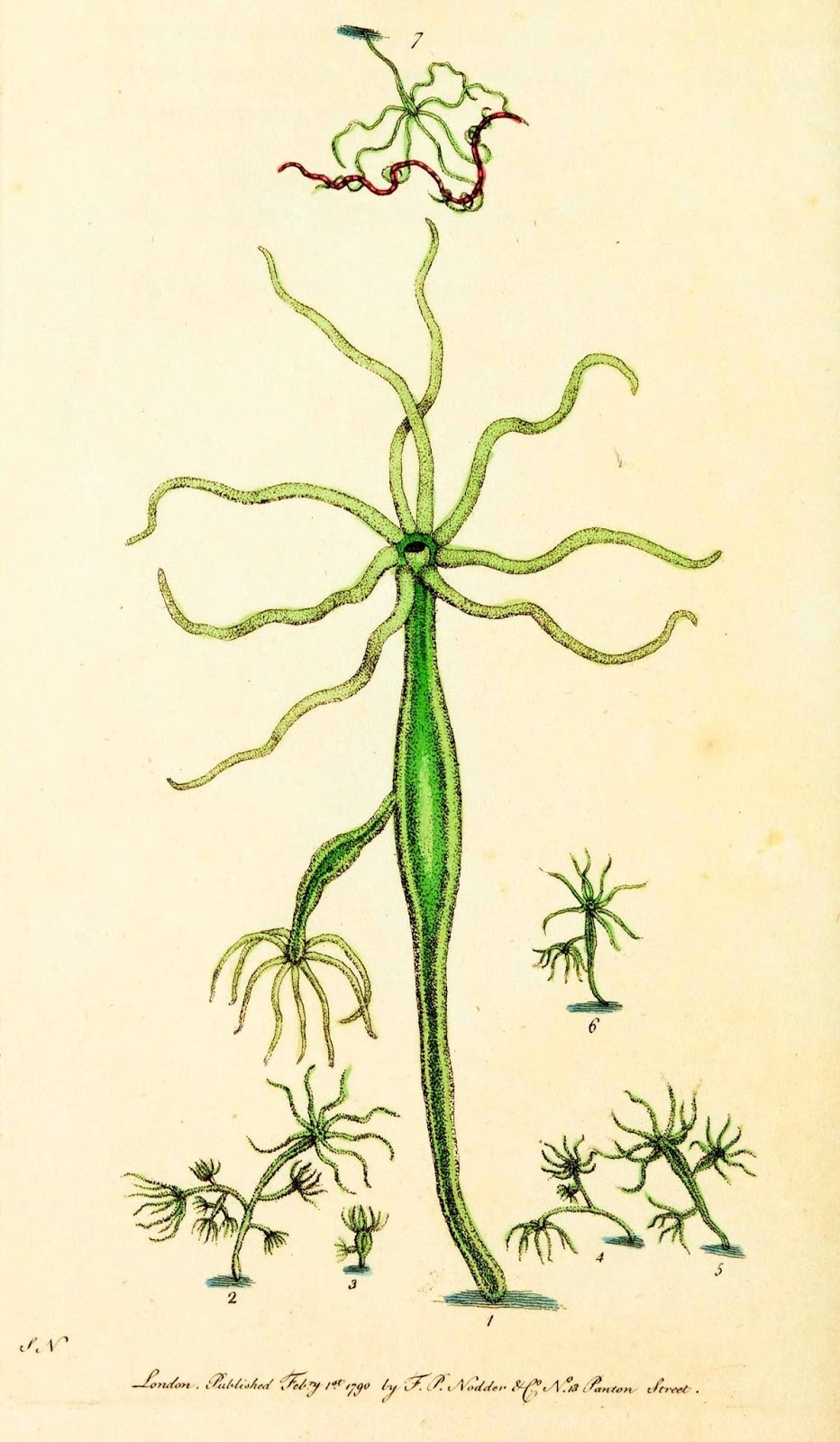
In modern-day zoology, the hydra lives on at least in name if not in nature, courtesy of a group of small freshwater cnidarian polyps known as hydras. These can readily yield multi-headed forms if injury, or deliberate intent via laboratory experiments, divides their original single heads into two or more sections, each section duly regenerating into a complete head but remaining attached to the single body. Also, several buds can develop asexually from a single body, each with its own head; usually they then break off to become separate entities, but sometimes they remain attached to their progenitor polyp.

Vintage illustration from The Naturalist's Miscellany, vol. 1, 1789, depicting the green hydra Hydra viridis (public domain)


LINNAEUS AND THE HOAXED HYDRA OF PRAGUE

Truly marvellous in its own deceiving manner was the hoaxed hydra that was removed from a church in Prague in 1648 and subsequently owned by Johann Anderson, the Burgomaster of Hamburg. So spectacular was this preserved wonder that Anderson even rejected an offer of 30,000 thalers for it from Frederick IV, king of Denmark. In basic form, the hydra resembled a standard lindorm, sporting a long tail and sturdy scaled body but only two limbs and no wings. Instead of just a single neck and head, however, it boasted no less than seven of each, with all of the necks emerging from a common base.

Yet despite the hydra's extraordinary appearance, its perceived monetary value eventually decreased, until by 1735 negotiations had begun for its sale at a mere 2000 thalers. Before these could be completed, however, eminent naturalist Carl Linné (who subsequently Latinised his name to Linnaeus) examined this celebrated specimen, and exposed it as a fraud. The heads, jaws, and feet were those of weasels, and a series of snake skins had been pasted all over its body.

Depiction of the hoaxed hydra of Hamburg in Albertus Seba's Cabinet of Natural Curiosities (Vol. 1), 1734 (public domain)

Linnaeus speculated, however, that this exhibit had probably been created not by wily vendors to sell as a supposedly genuine hydra to some unwary buyer for an eye-watering sum of money, but rather by monks as a representation of the seven-headed dragon of the Apocalypse with which to chastise and terrify disbelievers. Yet whatever the reason, the result was outstanding, but even so, once this hoaxed hydra's true nature had been revealed by Linnaeus, the deal for its sale fell through, and shortly afterwards the hydra itself vanished – never to be seen again.

Incidentally, the seven-headed dragon of the Apocalypse, bearing ten horns and seven crowns, was the guise assumed by the devil, who fought with his rebel angels against the valiant St Michael and the mighty hosts of Heaven, as narrated in the Bible's Book of The Revelation of St John the Divine. Ultimately, St Michael cast the dragon out, hurling him down to earth with his mutinous acolytes. It is illustrated in various of the tapestries constituting the medieval French Apocalypse Tapestry (Tapisserie de l'Apocalypse), which depicts the Apocalypse from the Revelation of St John. The oldest surviving French tapestry, it was commissioned by Louis I, the Duke of Anjou, and was produced between 1377 and 1382.

'The Beast From the Sea' ('La Bête de la Mer'), one of a series of tapestries constituting the medieval Apocalypse Tapestry (Tapisserie de l'Apocalypse); this one depicts the Dragon of the Apocalypse handing its sceptre of authority to the leopard-bodied Beast from the Sea, also seven-headed but with lion heads, not dragon heads (public domain)


THE HYDRA IN DREAMS, THE HEAVENS, HERALDRY, AND ART

Different types of dragon mean different things in dreams. A classical dragon with wings, for instance, can epitomise a transition, an ascent from a lower to a higher level of maturity. A many-headed hydra, conversely, signifies that the dreamer is plagued by a recurrent problem, one that he has tried to deal with several times but always unsuccessfully, so it is still appearing in his life, awaiting a satisfactory, conclusive resolution.

Heracles attacking and being attacked by the hydra as portrayed in this postage stamp issued by Monaco in 1981, from my collection (© Monaco postal services)

Heracles's most formidable foe is represented in the night sky by a constellation, but no ordinary, insignificant one – nothing less than Hydra, the largest constellation of all, and one of the 48 constellations first recognised by Ptolemy. Yet despite its name, the distribution of its stars across the sky is such that Hydra the constellation bears much more of a resemblance in shape to a writhing single-headed serpent than to the polycephalic monster battled by Heracles. This in turn can cause a degree of confusion with another constellation, Hydrus, which is represented as a water snake. Moreover, Hydra itself is adapted from an ancient Babylonian serpent constellation.

Hydra constellation, in Urania's Mirror (public domain)

Heracles himself is also represented in the night sky by a constellation – Hercules (his Roman name). Fifth largest in the night sky and another of Ptolemy's 48 originals, this constellation, interestingly, is believed by some researchers to have originally been united by ancient Babylonian sky-watchers with Draco, yielding a serpent-bodied human.

The dragon is a very popular symbol in heraldry, and appears in many different forms. One of these is the hydra, but no ordinary one. As if this monstrous creature were not deadly enough already, a seven-headed hydra sporting a pair of wings appears in the crest of various French families, including Barret, Crespine, and Lownes.

The hydra being clubbed by Heracles in a painting by Antonio del Pollaiolo (public domain)

Popular subjects for Renaissance artwork were the twelve labours of Heracles, including the slaying of the Lernaean hydra. Having said that, it was a decidedly scrawny, unimpressive specimen that was clubbed senseless by the hero in the painting by Italian artist and sculptor Antonio del Pollaiolo (1432-1498). Equally unimposing (albeit feather-winged) was the individual confronted by Heracles in an oil painting on wood from 1555-56 by Italian painter Marco Marchetti of Faenza.

Hydra oil painting by Marco Marchetti of Faenza (public domain)

Fortunately, however, more formidable depictions of this many-headed lindorm also exist, such as the robust portrayal by Spanish painter Francisco de Zurbarán (1598-1664), as well as various post-Renaissance examples, like the vibrant engraving by Bernard Picart (1673-1733), and a truly exquisite portrayal by American artist John Singer Sargent (1856-1925), which opens this present ShukerNature blog article.

Francisco de Zurbarán's dark, nightmarish portrayal of the battle between the hydra and Heracles, painted in 1654 (public domain)

Nor could we – or should we – forget the huge, spectacular sculpture of Heracles confronting a truly terrifying hydra created by Danish Symbolist-allied sculptor Rudolph Tegner (1873-1950), installed in Elsinore, Denmark.

Rudolph Tegner's spectacular sculpture at Elsinore, Denmark (© Rudolph Tegner/Flickr / inclusion here strictly on Fair Use/non-commercial basis only)

Perhaps the strangest hydra portrait, however, is its depiction as a giant multi-limbed lobster-bodied monstrosity battling Heracles and Iolaus in an engraving dating from 1565.

The hydra portrayed as a weird composite of many-headed dragon and multi-limbed, carapace-bodied crustacean (public domain)


THE HYDRA IN THE MOVIES AND IN LITERATURE

The hydra has featured in a number of films, and also in various works of fiction.

In the classic stop-motion fantasy film 'Jason and the Argonauts' (1963), featuring the astonishing creations of Ray Harryhausen, the Golden Fleece sought by Jason and his men is guarded by the Colchis dragon. Although this is usually depicted as a winged classical dragon, for maximum visual appeal Harryhausen represented it in this film as a multi-headed hydra-like version instead. It kills one of Jason's men, the treacherous Acastus, before being slain by Jason himself, who is then able to steal the Golden Fleece, and later returns with it in triumph to Thessaly.

Ray Harryhausen's spectacular Colchis hydra in the 1963 British Columbia Pictures fantasy movie 'Jason and the Argonauts' (© Columbia Pictures / inclusion here strictly on Fair Use/non-commercial basis only)

In 1997, the Disney animated feature film 'Hercules' was released, and, as befitting a movie based (albeit loosely) upon tales from Greek mythology, it included an epic battle between the young demi-god hero and the Lernaean hydra. This multi-headed dragon has been summoned by Hades to destroy Hercules, but when he successfully kills it by causing a landslide, our hero finds himself elevated to celebrity status among the general public.

CineTel Films released a made-for-cable-television movie entitled 'Hydra' in 2009, subsequently making it available internationally on DVD. A slick blend of thriller, horror, action, and mythology, it tells the tale of how the legendary Lernaean hydra is reawakened from centuries of dormancy by a major seaquake near its volcanic Mediterranean island domain. The bloodthirsty many-headed monster, no doubt hungry after its prolonged fasting, proceeds to chomp up everyone who sets foot on its island, including a party of man-hunters, some of their ex-convict targets (one of whom is played by Hollywood and television actor George Stults), and even one of the film's two leading protagonists, a female archaeologist. The special effects breathing life into the hydra are as impressive as its rapacity for its human prey is unrelenting.

Poster from the 2009 CineTel Films movie 'Hydra' (© CineTel Films / inclusion here strictly on Fair Use/non-commercial basis only)

William Beckford's initially anonymous Gothic novel Vathek, published in 1786 and telling the fall from power into eternal damnation of the Caliph Vathek of the Abassides, features a winged hydra called Ouranabad.

A Ballantine Books edition of Vathek (© Ballantine Books / inclusion here strictly on Fair Use/non-commercial basis only)

Dragons of a traditional, ferocious nature appear in various volumes of the long-running series of children's fantasy novels entitled The Spiderwick Chronicles (2003-2004) and Beyond the Spiderwick Chronicles (2007-2009) by Tony DiTerlizzi and Holly Black. These include serpent dragons like the venomous worms reared by the evil ogre Mulgarath, and a huge many-headed hydra with gills known as the Wyrm King.

An acid-spitting hydra, whose life-force is linked to the ever-increasing appearance of Monster Donut shops, appears in Rick Riordan's teenagers' fantasy-adventure novel, The Sea of Monsters, the second in his bestselling Percy Jackson series, but it is slain by a cannon from a battleship.

The Wyrm King – Book #3 in the Beyond the Spiderwick Chronicles series, published in 2009 (©Tony DiTerlizzi and Holly Black/Simon & Schuster / inclusion here strictly on Fair Use/non-commercial basis only)

Inventorum Natura: The Expedition Journal of Pliny the Elder (1979) is a spectacular tome compiled and exquisitely illustrated by fantasy writer-artist Una Woodruff. The premise behind this very skilfully-prepared volume is that it is a painstaking reconstruction of a supposedly long-lost work written in Latin by real-life Roman author-naturalist Pliny the Elder (23-79 AD), describing the astonishing fauna and flora that he allegedly observed during a purported three-year expedition to distant lands, an incomplete version of which Woodruff happened to rediscover. It includes several types of dragon – the pyrallis, basilisk, sea dragons, dragon-fishes, amphisbaena, Eastern dragons, Western dragons, and a British hydra.

Britain's very own hideous hydra, from Inventorum Natura (© Una Woodruff)


A UBIQUITY OF HYDRAS

Nor is this the extent of the hydra's popularity – indeed, even today it is virtually ubiquitous in the frequency and diversity of namesakes and commemorations. These include (but are by no means limited to):  Hydra, the outermost known moon of the dwarf planet Pluto, discovered in June 2005; Hydra, an American professional wrestler; Hydra, one of the the Saronic Islands of Greece in the Aegean Sea, which I visited back in 1977 (though technically this is named after the water springs there rather than the monster);  Hydra, a fictional secret terrorist organisation in the Marvel comics, and also a villain in Lee Falk's comic strip 'The Phantom'; Hydra, an American southern rock band; the Hydra Trophy, which is awarded to the winner of the roller derby WFTDA Championships; Hydra, a chess computer; 'HMS Hydra', the name of several different Royal Navy vessels; Hydra, an early computer software operating system, created in 1971 at Carnegie-Mellon University; Hydra 70, an air-to-ground rocket; Hydra, a monstrous opponent waiting to be faced in the role-playing video game 'Titan Quest', released worldwide by THQ in June 2006; 'Hydra', a song by American rock band Toto from their 1979 album 'Hydra'; Hydra, the professional name of Texas-born roller derby skater Jennifer Wilson; and The Hydra, a literary magazine once edited by WW1 war poet Wilfred Owen and including poems by fellow war poet Siegfried Sassoon.

The hydra as featured in the role-playing video game 'Titan Quest', released by THQ (public domain)

Its debut may have been countless centuries ago, but from Heracles to Percy Jackson as just two of its numerous assailants upon its lengthy journey through time and culture the hydra shows no sign of diminishing on the world stage, the endless fascination with its terrifying ability to regenerate and duplicate its head count undoubtedly ensuring its survival to scare and surprise us for a very long time to come.

Heracles versus Hydra (© Ken Barthelmey/Deviantart.com - click here to view more of Ken's outstanding artwork in his deviantart gallery)


This ShukerNature blog article is excerpted and expanded from my books Dragons: A Natural History and Dragons in Zoology, Cryptozoology, and Culture.


Thursday, 6 August 2015

EXPOSING THE CON IN ANACONDA - OR, HOW I MONSTERED A MONSTROUS SNAKE HOAX


The online photo of a supposed gargantuan anaconda shot in Africa's Amazon River !! (photo-manipulated photograph's creator(s) unknown to me)

Less than a month after debunking a trio of quasi-coloured mock pythons on ShukerNature (click here), I was able to do the same to an even more outrageous hoax of the constrictor kind, this time involving a much-manipulated photograph of a green anaconda Eunectes murinus.

According to the record books, this anaconda species, the biggest known to science, rarely exceeds 20 ft long. However, many reports have been filed concerning a truly colossal form of anaconda supposedly existing amid the vast jungle swamplands and lagoons of Brazil and elsewhere in South America – the so-called sucuriju gigante – that allegedly far exceeds that size. In 1907, the subsequently-lost explorer Lieut.-Col. Percy Fawcett reputedly shot an estimated 62-ft specimen as it began to emerge from Brazil's Rio Abuna but couldn't salvage its monstrous form, and there have even been a few photographs made public that allegedly portray killed but never-preserved specimens of it (click here for my ShukerNature coverage of some examples). Could the subject of this present ShukerNature blog article be another such picture? I don't think so!

Photograph of a supposed 130-148-ft-long sucuriju gigante killed in or around 1932 at Manaos, Brazil, after having been captured alive (public domain)

During the late evening of 1 August 2015, I saw the startling photograph opening this ShukerNature article posted on Facebook friend Simon Hicks's 'Zen Yeti' FB group page. If it were genuine, the slain anaconda featured in it would be truly gargantuan – but was it genuine? The oddly-contorted, compressed coils of the snake didn't look natural, but any specimen that so dwarfed the humans standing around it (yet standing around it in a remarkably unconcerned, disinterested manner, I might add, for persons supposedly in such close proximity to so immense a snake, dead or otherwise) is always going to attract suspicion anyway.

It was linked to the timeline of one Rakesh Mintu Bjp, and when I clicked that link it took me to an annotated version of the photo on this person's timeline. I also checked online outside Facebook, and the photo and annotation had already appeared on many other websites during the past month or so. Consequently, neither had originated with Bjp – he had merely posted one such copy on his FB timeline, as had several other persons, I discovered, which means that the originator of the photo and annotation is currently unknown. Anyway, this is the annotation:

"World's biggest snake Anaconda found in Africa's Amazon river. It has killed 257 human beings and 2325 animals. It is 134 feet long and 2067 kgs. Africa's Royal British commandos took 37 days to get it killed."

Even if the photograph hadn't seemed dubious before (which it had!), after reading the garbled nonsense above I could now have no doubt whatsoever that it was a blatant, and exceedingly silly, hoax. And how did I know this? Where to begin?!!

Well, first and foremost: unless someone has sneaked it into Africa without telling me, the Amazon River is famous for being the largest in South America.

Secondly: unless someone had thoughtfully embedded a veritable 'kill-o-meter' inside the anaconda, how could anyone state so precisely how many humans and animals it had killed?

Thirdly: its length is more than 4 times the maximum confirmed length for any modern-day snake, and more than 3 times the maximum estimated length for the longest snake ever known from planet Earth – Titanoboa cerrejonensis, from the Palaeocene epoch in what is now Colombia, which is believed to have attained a maximum length of around 42 ft and a weight of around 2500 lb (1135 kg – only about half that of the photo's mega-anaconda).

Titanoboa life-sized model exhibit of the Smithsonian Institution, in the Natural History Museum © Ryan Quick/Wikipedia – Creative Commons Attribution 2.0 Generic License)

Fourthly: there is no such regiment as Africa's Royal British commandos.

Fifthly: how on earth could it take 37 days to kill this snake, huge though it would have been if real? A concerted artillery or machine-gun salvo to its head would surely have dispatched it in a far shorter time period.

And sixthly (if such a word exists!):  regardless of how long it took to kill this alleged ophidian behemoth, where are the wounds, the signs of how it met its end? It looks extraordinarily, inexplicably, unbloodied - indeed, entirely unmarked, unwounded in any way - to my eyes.

Just after midnight on 2 August, I posted on my 'Journal of Cryptozoology' FB group's page a link (click here - but only accessible to members of my FB group) to the photo as it appeared on Rakesh Mintu Bjp's timeline.

All that was now needed was the original, non-manipulated anaconda photograph to bring this sorry snake saga to a well-deserved end, and, after spending all of 2 minutes online using Google Image after having posted the fake photo's link on my 'Journal of Cryptozoology' page, I duly uncovered it, here, on a page dealing with anacondas, from a Brazilian biology website entitled 'Bio Curiosidades'. If you scroll down the page, it is the fifth photo from the top of the page.

The original, non-manipulated anaconda photograph (© www.ninha.bio.br)

The fake photograph had been produced by person(s) unknown simply by horizontally-flipping the above, original photograph to create a mirror-image version of it, then compressing it horizontally to yield those oddly-shaped coils, then either superimposing from a second photo the people and background around it, or, more probably, superimposing it upon a second photo containing the people and background.

After finding this photograph on the 'Bio Curiosidades' website, I duly posted on my 'Journal of Cryptozoology' FB group page a link to it, beneath my previous one linking to the fake photo. Case closed.

Thus endeth the tale of the giant anaconda that was merely a giant con.

The original, non-manipulated anaconda photograph alongside the fake, photo-manipulated version; NB - I have horizontally-flipped the original photo here in order to provide a direct comparison of it alongside the fake photo (© www.ninha.bio.br for original photo/creator(s) of fake photo unknown to me)