Dr KARL SHUKER

Zoologist, media consultant, and science writer, Dr Karl Shuker is also one of the best known cryptozoologists in the world. He is the author of such seminal works as Mystery Cats of the World (1989), The Lost Ark: New and Rediscovered Animals of the 20th Century (1993; greatly expanded in 2012 as The Encyclopaedia of New and Rediscovered Animals), Dragons: A Natural History (1995), In Search of Prehistoric Survivors (1995), The Unexplained (1996), From Flying Toads To Snakes With Wings (1997), Mysteries of Planet Earth (1999), The Hidden Powers of Animals (2001), The Beasts That Hide From Man (2003), Extraordinary Animals Revisited (2007), Dr Shuker's Casebook (2008), Karl Shuker's Alien Zoo: From the Pages of Fortean Times (2010), Cats of Magic, Mythology, and Mystery (2012), Mirabilis: A Carnival of Cryptozoology and Unnatural History (2013), Dragons in Zoology, Cryptozoology, and Culture (2013), The Menagerie of Marvels (2014), A Manifestation of Monsters (2015), Here's Nessie! (2016), and what is widely considered to be his cryptozoological magnum opus, Still In Search Of Prehistoric Survivors (2016) - plus, very excitingly, his four long-awaited, much-requested ShukerNature blog books (2019-2024).

Dr Karl Shuker's Official Website - http://www.karlshuker.com/index.htm

IMPORTANT: To view a complete, regularly-updated listing of my ShukerNature blog's articles (each one instantly clickable), please click HERE!

IMPORTANT: To view a complete, regularly-updated listing of my published books (each one instantly clickable), please click HERE!

IMPORTANT: To view a complete, regularly-updated listing of my Eclectarium blog's articles (each one instantly clickable), please click HERE!

IMPORTANT: To view a complete, regularly-updated listing of my Starsteeds blog's poetry and other lyrical writings (each one instantly clickable), please click HERE!

IMPORTANT: To view a complete, regularly-updated listing of my Shuker In MovieLand blog's articles (each one instantly clickable), please click HERE!

IMPORTANT: To view a complete, regularly-updated listing of my RebelBikerDude's AI Biker Art blog's thematic text & picture galleries (each one instantly clickable), please click HERE!

Search This Blog


PLEASE COME IN, I'VE BEEN EXPECTING YOU...

PLEASE COME IN, I'VE BEEN EXPECTING YOU...
WELCOME TO SHUKERNATURE - ENJOY YOUR VISIT - BEWARE OF THE RAPTOR!


Sunday, 24 February 2013

THE TAILED SLOW LORISES OF ASSAM'S LUSHAI HILLS - AN ENDURING PRIMATOLOGICAL MYSTERY

Only known photograph of tailed lorises from Assam's Lushai Hills (PZSL/public domain)

Whereas some cryptids attract and retain widespread interest and attention, others are forgotten almost as soon as they are documented, even though their mystery remains unsolved. Sadly, the tailed slow lorises of the Lushai Hills fall into the latter category of cryptozoology.

Two of these white-coated, woolly-furred prosimians were captured and photographed by a Mr T.D. La Touche of the Geological Survey of India during December 1889 (though not documented until 1908), in the jungle near Fort Lungleh in Assam's Lushai Hills, during the Lushai Expedition of 1889-90. However, they escaped shortly afterwards, and were not recaptured. Overall, they seemed akin to the familiar slow lorises of the genus Nycticebus, as they possessed short but stout limbs, a large rounded head, flat face and small muzzle, short roundish ears, large eyes each encircled by a dark triangular patch, and a narrow black stripe running from the skull's occipital region along the entire length of the back.

The Indian slow loris Nycticebus bengalensis, which only possesses a vestigial tail, depicted in a painting from 1867

However, as clearly revealed in the photograph opening this present ShukerNature blog post, and which originally appeared in a short article by Dr Nelson Annandale, Superintendent of the Indian Museum, documenting them in the Proceedings of the Zoological Society of London for 17 November 1908, the remarkable loris form represented by these two briefly captive specimens differed dramatically from all other lorises in one very conspicuous way - it had a thick bushy tail! In stark contrast, the tail of all known species of slow loris is vestigial.

Moreover, confirming that the tail was not simply an optical illusion within the photograph, Mr La Touche assured Dr Annandale that it was indeed present in both of the captive animals. And in a postscript of 5 January 1909 to his PZSL article, Annandale announced that he had learnt from a Colonel E.W. Loch that the tailed slow loris of the Lushai Hills was well known to him too.

Close-up of one of the captive tailed slow lorises of Lushai Hills, clearly revealing its long thick tail (PZSL/public domain)

Consequently, unless it is a teratological, freak variety of the Indian slow loris N. bengalensis, the tailed slow loris of Lushai Hills constitutes a radically new species of slow loris still awaiting official recognition - for which, in my book, The Lost Ark: New and Rediscovered Animals of the 20th Century (1993), I proposed Nycticebus caudatus ('tailed slow loris') as a suitable name.

Perhaps the greatest riddle of all, however, is why such a visually distinct form of loris has apparently never been reported since the 1908 PZSL account's 1909 postscript, not even by local Indian naturalists who would surely have been fascinated by such a creature. Judging from Col. Loch's statement that it was well known to him, the two captured specimens were not the only ones that existed back in the early 20th Century, so what has happened since then - has this unique form died out? Clearly, the mystery of the tailed slow lorises of the Lushai Hills endures, even if, tragically, the lorises themselves no longer do.

This ShukerNature blog post is an expanded excerpt from my book The Encyclopaedia of New and Rediscovered Animals (Coachwhip: Landisville, 2012).


Thursday, 21 February 2013

TRAILING THE MITLA – A DOG-LIKE CAT, OR A CAT-LIKE DOG?


Flash card illustration of the mitla prepared by Jeremy Mallinson for showing locals during his search for this mysterious mammal in Bolivia (© Jeremy Mallinson)

Certain of South America's alleged mystery cats may in reality be of canine rather than feline identity. One of these ambiguous animals is the mitla, which was first brought to western attention by the famous lost explorer Colonel Percy Fawcett. In Exploration Fawcett (1953), while referring to the Madidi region of Bolivia, he noted:

"In the forests were various beasts still unfamiliar to zoologists, such as the mitla, which I have seen twice, a black doglike cat about the size of a foxhound."

American zoologist and cryptozoologist Ivan T. Sanderson claimed that during an animal collecting trip to South America, he had unsuccessfully attempted on several occasions to shoot one of these creatures, but had obtained a legless native skin of one, which he likened to that of a huge black serval with pricked ears and tiny lynx-like tail. Regrettably, however, he did not mention what happened to this cryptozoologically priceless skin afterwards.

The dark/black phase of the jaguarundi – one suggested identity for the mitla (Bodina/Wikipedia)

In September 1965, Jersey Zoo director Jeremy Mallinson set off on a one-man, two-month-long expedition to Bolivia in search of the mystifying mitla, but did not uncover the secret of its identity:

"By the time we paddled our way across the confluence of the Abuna with the Madeira...I recognised that I had not thrown any further light on the question of whether Colonel Fawcett’s legendary animal had ever existed or not. Perhaps the mitla had been nothing more than a melanistic form of one of the several species of South American tiger cats or, as has been suggested, the black form of the jaguarundi which can grow to about the size of a foxhound and could, to a non-zoologist, appear to be half-dog, half-cat. Both Señor Carlos and Professor Gaston Bejarano had confirmed that the black form of the jaguarundi occasionally occurred in the north-eastern regions of Bolivia. However, I had learnt one important fact from my travels in this great integrated region of rivers and forests: that while these remoter areas of the Amazon basin still remain in existence, the forests could well harbour such animals as the mitla that are still strange to science, but it would only be by chance if their presence ever came to light."

Jeremy Mallinson – Travels in Search of Endangered Species (1989)

Some reports may indeed involve dark individuals of the jaguarundi Puma yagouaroundi, or even a strange sometimes-black relative of weasels called the tayra Eira barbara.

The tayra, a large South American mustelid (copyright owner's name inset in photo)

However, retired Chicago University biologist and spare-time cryptozoologist Dr Roy P. Mackal favours the South American bush dog Speothos venaticus as a likely identity – thus proposing that the mitla may not be a dog-like cat, but rather a cat-like dog. This species is a savage, pack-hunting canid, native to Guyana, Brazil, Paraguay, Bolivia, Peru, Colombia, and Panama. Having said that, however, the bush dog is reddish-brown in colour, not black, as described for the mitla (though juvenile bush dogs are indeed uniformly black). Moreover, it is relatively short-legged, not recalling the foxhound comparison given by Fawcett for the mitla.

South American bush dogs

In any case, if the mitla is truly a feline canid rather than a canine felid, in my view there is an even better candidate for it, as I first proposed in my book Mystery Cats of the World (1989). Namely, the small-eared dog Atelocynus microtis, also called the zorro. This little-known, dark-furred species has occasionally been exhibited in captivity, and is characterised by its remarkably gracile, feline gait - far-removed indeed from the more boisterous, less agile movements of most dogs.

A small-eared dog or zorro recently photographed in the wild by a concealed camera in Ecuador (© Tiputini Biodiversity Station)

Until recently, the zorro had not been reported from Bolivia itself, but was known to occur in various of Bolivia's neighbouring countries. And as it has never been well-studied in the wild, it would not be too surprising if the zorro were formally discovered in Bolivia too at some stage in the future - a prediction supported by this species' compelling correspondence to descriptions of the mitla.

And sure enough, a reliable observation of the zorro in northern Bolivia at 14°25'47.9994"S, 63°13' 47.9994"W by biologist R. Wallace has lately been recorded. This constitutes its species' most southerly record, in fact, and is in close proximity, moreover, to the Madidi where Fawcett reported the mitla – thereby enhancing the prospect that zorro and mitla are one and the same creature.

Early photograph of a captive zorro, exhibited at London Zoo in 1913

This ShukerNature blog post is an expanded, adapted excerpt from my latest book, Cats of Magic, Mythology, and Mystery (CFZ Press: Bideford, 2012).


Wednesday, 20 February 2013

FAWCETT'S DOUBLE-NOSED ANDEAN TIGER HOUND - A CANINE ANOMALY NOT TO BE SNIFFED AT!


Exploration Fawcett (1953), compiled from the field notes of the famous lost South American explorer Lieutenant-Colonel Percy Fawcett by his son Brian, includes tantalising snippets concerning a variety of seemingly undescribed species, such as a Bolivian dog-like cat (or cat-like dog?) called the mitla (click here for more details), and a giant toothless river shark (possibly a huge catfish? - click here), plus vague mentions of swamp-dwelling relics of the dinosaurian age (click here).

Lieut.-Col. Percy Fawcett

One additional mystery beast documented within his book but attracting only scant cryptozoological attention, conversely, is a startling oddity encountered by Fawcett in 1913 while visiting Santa Ana, a post on the Marmoré River passing through East Bolivia:

Here we saw for the first and only time a breed of dog known as the Double-Nosed Andean Tiger Hound. The two noses are as cleanly divided as though cut with a knife. About the size of a pointer, it is highly valued for its acute sense of smell and ingenuity in hunting jaguars. It is found only on these plains.

A somewhat droll cartoon of a double-muzzled dog appears on the inside cover of Fawcett's book:

Fawcett's cartoon sketch of the double-nosed Andean tiger hound from Exploration Fawcett

Otherwise, this twin-snouted canine curiosity was duly forgotten - until almost a century later, when, as reported in London’s Daily Mail newspaper (10 September 2005), modern-day explorer Colonel John Blashford-Snell spied a remarkably similar beast while recently leading an expedition through the very same area.

While staying at a remote village there, he saw a dog whose nostrils were set totally apart from one another, like the barrels of a double-barrelled shotgun. Making enquiries, he learnt that this dog, called Bella, was not a deformed specimen but one of a distinct, highly-prized, but nowadays rare breed in this area, which was referred to by the same name that Fawcett had recorded - the double-nosed Andean tiger hound ('tiger', incidentally, is a term that in Latin America refers to jaguars).

Section of the Daily Mail article of 10 September 2005 featuring Bella and Colonel John Blashford-Snell's expedition - click picture to enlarge it (© Daily Mail, London)

Photos of Bella brought back by Blashers attracted such interest from Dr Tito Ibson Castro, president of the Bolivian Veterinary Association, that a sequel expedition was duly planned, to obtain genetic material and thus determine the origin and relationships to other dog breeds of this dual-nosed wonder. And so it was that during summer 2006 Blashers returned to Bella's village.

As reported in a Daily Mail article of 25 September 2006, however, he was greatly saddened to learn that Bella had died after having given birth to a litter of four pups (all split-nosed), sired by a normal unsplit-nosed dog. Moreover, three of these pups had also died, but he was delighted to discover that the fourth, a male, had survived and was now a healthy 10-month-old, whom Blashers dubbed Xingu after the lost city that Fawcett had vainly sought. For a photo of Xingu, click here.

Worthy of note is that Xingu in turn sired a litter of four pups, whose mother had a normal, unsplit nose. Two of the four pups were split-nosed, and both of these died after three days; the other two were normal, and both of those survived.

Interestingly, a few days after newspaper accounts of Bella had appeared in Britain, the Daily Mail (17 September 2005) published a follow-up feature containing photos of other, putative Bellas sent in by readers.

Section of the Daily Mail article of 17 September 2005 featuring Henry the Pachon-Navarro and other split-nosed dogs - click picture to enlarge it (© Daily Mail, London)

The most noteworthy of these was a photo of Henry, a Pachon-Navarro. This rare Iberian breed, related to pointers, is characterised by a very unusual skull, formed into two separate channels with a ridge wide enough for human fingers to be placed inside. Intriguingly, split-nosed Spanish pointers were taken to Latin America by the conquistadors during the 16th Century. So perhaps Henry and Bella have a common ancestor, not just an uncommon nose.

Finally: here, just for a little light relief, is a very different tiger hound (plus my sincere apologies to William Blake for my own variation upon his 'Tyger Tyger' poem!):


Tiger hound-dog, hear him bark
In the forests of the dark.
What immortal hand he licks
That pats his head and throws him sticks?


This ShukerNature post is an expanded, updated excerpt from my book Extraordinary Animals Revisited (CFZ Press: Bideford, 2007).


Tuesday, 12 February 2013

THE BLACK PUMA THAT NEVER WAS - A CASE OF MELANISTIC MISIDENTIFICATION

Holding a model of a black (melanistic) leopard, aka a black panther (Dr Karl Shuker)

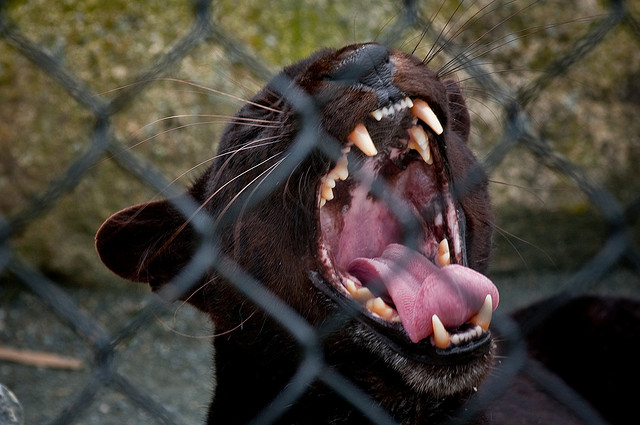
At the beginning of February 2013, I came upon a very remarkable online photograph of a captive cat. According to the several websites that included it in their accounts, it was either a black puma or an extremely dark brown one. For all the reasons that I give here (in what is the most extensive investigation of the black puma scenario ever published, and which is also included in my book Cats of Magic, Mythology, and Mystery, 2012), however, bona fide black pumas are all but non-existent even in the wild state, and not a single confirmed specimen is known to be in captivity anywhere in the world at this present time. (Several years ago, conversely, I discovered a colour engraving from the 1800s that apparently portrayed a black puma exhibited at London Zoo during the 19th Century - again, click here for more details and sight of that engraving.)

Moreover, to my eyes this snarling/yawning cat looked far more like a black (melanistic) leopard than any puma (black or otherwise), especially in relation to the large size of its upper canines (even though they were partly obscured by the cat's upper lip).

Snarling normal-coloured puma for comparison purposes (Jukani.co.za)

Interested to learn more, I attempted to trace this intriguing photo's origin, and I eventually discovered that it had been snapped on 1 July 2009 by photographer Leo Druker at the Kisma Preserve in Trenton, Maine, USA, during a trip to Maine that year. He included the photo on one of the pages of his Flickr photostream site (click here for direct access to that page), and here is the photograph itself:

Leo Druker's photograph of the alleged black puma (© Leo Druker/Flickr)

As can be seen from its Flickr page, this photo has been entitled 'Puma'. However, the first three tags that Mr Druker has applied to the photo are 'puma', 'panther', and 'black panther'. This immediately suggested to me an explanation for what until now had seemed an extraordinarily perplexing situation – after all, had this cat truly been a black puma, its extreme rarity would have ensured its being exceedingly famous worldwide, surely?

However, the tags suggested otherwise. In the UK and mainland Europe, the term 'black panther' (indeed, often simply 'panther' alone too, nowadays) is applied almost exclusively to the melanistic or so-called black (in reality, extremely dark brown) morph of the leopard Panthera pardus. In North America, conversely, it can also be applied to melanistic specimens of the jaguar P. onca and to putative (albeit currently unverified) melanistic specimens of the puma Puma concolor. Even the term 'panther' is in North America an alternative term for the puma (as too are 'painter', 'cougar', 'catamount', and 'mountain lion').

Could it simply be, therefore, that this cat had been labelled a 'black panther' at the Preserve, and that the photographer had been wrongly informed or had mistakenly assumed that it was therefore a black puma – when in reality it was merely a black leopard?

Photograph of a yawning black leopard for comparison purposes (Associated Press/London Daily Telegraph)

I posted enquiries concerning the photo on Facebook, and received many suggestions from a number of FB friends, some of whom even attempted to contact the Preserve directly via phone using the phone number on its website, but the number was not currently in use, and there is no email contact address either. Its website's information does include mention of normal pumas maintained there, but nothing whatsoever about any black or dark puma, which, as already noted, would certainly be expected if so rare and exotic a felid as that were truly present there.

I also emailed Mr Druker via his Flickr photostream site, on 2 February 2013, requesting more information concerning the photograph and the cat that it depicts, but I have not received any reply to date.*

Photograph of a snarling, dark phase jaguarundi for comparison purposes (© Bruno Damiani CB/Arkive)

Some of my FB colleagues favoured a jaguarundi Puma yagouaroundi as a possible identity for the photographed cat. Yet whereas this species does possess a dark grey colour phase, I have never seen a specimen as dark as the photographed cat, and the latter's face did not seem reminiscent of a jaguarundi's to me. The jaguarundi has a very distinctive, unusually broad nose, which the photographed cat does not have, and the latter's fur is uniformly dark, whereas the fur of the dark grey phase of the jaguarundi is visibly ticked. Consequently, as far as I was concerned the cat in the photo was not a jaguarundi. But what was it? My investigation seemed to have reached an impasse.

And then I noticed that on its Flickr page, Leo Druker's photo of the melanistic mystery cat was visible to view at several different magnifications, including 3079 x 2045, the largest of all, and which was far larger than the 640 x 425 version that I'd previously been viewing. So I switched to this largest size (click here), and immediately noticed at its much-increased magnification that the left side of the cat's face (as seen in the photograph) bore a number of cryptic rosettes. No puma, not even a spotted cub, has facial rosettes. And nor does any jaguarundi. But a black leopard does! (So too does a black jaguar, but the photographed cat's face does not seem sufficiently burly to be a jaguar.)

The photographed cat seen at highest magnification, revealing its facial rosettes - click photo to enlarge it and see them (© Leo Druker)

There could no longer be any doubt. The black/dark puma in the photograph was a puma no longer, but merely a black leopard – the unsuspecting victim of a melanistic misidentification caused by an ambiguous term, 'black panther'.

NB – The photograph of the erstwhile melanistic mystery cat snapped by Leo Druker is included here on a strictly fair usage basis, for review purposes only, not for any commercial gain whatsoever; and it is copyrighted to Mr Druker.

My thanks to Loren Coleman, Raven Meindel, BCIB, and all of the many other Facebook friends who so kindly volunteered information, opinions, and assistance in relation to my investigation of this photograph.


*UPDATE: 17 February 2013

Today I received the following interesting and informative email from Leo Druker:

"Dr. Shuker,
Sorry it's taken me a while to respond - I very rarely check my mails here on Flickr.
I'm almost positive that this was, as you inferred, a black leopard. I have no reason to think that the Kisma Preserve would have a black puma, especially one that is as rare as you have said, without the world at large knowing all about it.
Hope this helps!
Cheers,
Leo"

This noteworthy email from the photo's own photographer - many thanks indeed, Leo, for kindly responding to my enquiry - is surely enough for the case of the black puma that never was to be firmly put to rest for good.


For more information regarding black pumas, check out my latest book, Cats of Magic, Mythology, and Mystery (CFZ Press: Bideford, 2012).


Monday, 11 February 2013

THE AZIWUGUM - AN INUIT DOG WITH SCALES, FROM 'THE BOOK THAT GOT AWAY'

The aziwugum (Stephen Player)

Back in July 2012, ShukerNature exclusively presented some excerpts from The Great Mystery Atlas  - which is the only contracted, in-production book that I have ever been associated with that was never eventually published (albeit for reasons entirely unrelated to my involvement with it, I hasten to add!), and which I therefore dubbed 'The Book That Got Away' (click here for further details).

One of those excerpts contained an illustration by this book's artist, Stephen Player, of an unusual dog-like beast with scales, but whose name did not appear there, so I was later asked what animal it was. As it was such an unusual creature, I thought that this would make an interesting subject for a brief ShukerNature post of its own, and so here it is - with the original illustration of it opening this post.

Appearing in traditional Inuit mythology, this remarkable if legendary entity is known as the aziwugum, and is indeed said to be superficially canine in form, resembling a great dog, but is covered in black fish-like scales rather than fur. Moreover, its long muscular tail is so powerful that it can allegedly kill a human with just a single blow from it.

As far as I'm aware, there are no folktales of Inuits attempting to tame an aziwugum, but this is probably just as well - because if it became tame and friendly, and began wagging its tail, it could soon annihilate an entire Inuit settlement!


Friday, 8 February 2013

THE BILI (BONDO) APES – UNMASKING THE CONGO'S GIANT CHIMPANZEES


This photograph of a shot Bili ape appeared in Vol. 1 of Adolf Friedrich Herzog von Mecklenburg’s tome Vom Kongo zum Niger und Nil: Berichte der Deutschen Zentralafrika-Expedition 1910/1911, which was published in 1912 – more than a century before this highly distinctive ape form’s reality was formally recognised by science


Here's the latest in my occasional series of ShukerNature cryptozoology articles re anomalous and controversial chimpanzee forms (click here for my account of the pygmy chimpanzee or bonobo, here for the koolookamba, here for Ufiti, and here for 'apeman' Oliver).

Until quite recently, even amid the many remote regions of darkest Africa, the possibility of an unknown form of anthropoid existing there yet still eluding scientific recognition seemed ludicrous - but then came the Bili (aka Bondo) ape.

The saga of this remarkable, highly controversial primate began more than a century ago, when in 1898 a Belgian army officer returned home from what is now the Democratic Republic of Congo with some gorilla skulls obtained by him in a forested region near the village of Bili, on the Uele River in northern Congo's Bondo area - even though no other gorillas had been found within hundreds of miles of Bili before (or since). He donated them to Belgium's Congo Museum in Tervueren, where in due course they were examined by its curator, Henri Schouteden. He was sufficiently struck by their anatomical differences from other gorilla skulls as well as by their unique provenance (roughly halfway between the extreme edges of the western and eastern distribution of any gorilla populations) to classify them as a new subspecies of gorilla, which he dubbed Gorilla gorilla uellensis.

Less convinced of their separate taxonomic status, conversely, was mammalogist Prof. Colin Groves, whose examination of these skulls in 1970 led him to announce that they were indistinguishable from western lowland gorillas. Thereafter, the Bili ape sank back into obscurity - until 1996, when Kenyan-based conservationist and wildlife photographer Karl Ammann, intrigued by its strange history and apparent disappearance, set out on the first of several Congolese quests to rediscover this mysterious primate.

And rediscover it he did, bringing back such compelling evidence for its presence that several other notable investigators launched their own searches, and returned with equally fascinating clues concerning the Bili ape's nature. Such researchers included primatologist Dr Shelly Williams from Maryland's Jane Goodall Institute, Dr Richard Wrangham from the Leakey Foundation, Dr Christophe Boesch from Leipzig's Max Planck Institute for Evolutionary Anthropology, Dr Esteban Sarmiento from New York's American Museum of Natural History, and Dr George Schaller from New York's Wildlife Conservation Society.

What made their various finds so especially interesting was the ambivalent identity that they collectively yielded for the Bili ape - because, uniquely, it deftly yet bemusingly combines characteristics of gorillas with those of chimpanzees, creating a shadowy anthropoid that is at once both yet neither. For instance: if the Bili ape is a chimpanzee, it is a veritable giant, because videos of living specimens and photographs of dead ones suggest a height of 5-6 ft - a mighty stature supported by the discovery of enormous footprints, some measuring almost 14 in long, and therefore nearly 2 in longer even than those of the mountain gorilla!

A dead Bili ape, revealing its noticeably large size (http://www.factzoo.com/mammals)

Also, very large ground nests constructed by Bili apes have been found that compare with those created by gorillas; normal chimps build smaller, tree-borne nests. Further evidence of the Bili ape's great size comes from local Bondo hunters, who distinguish two distinct apes - 'tree-beaters' (normal chimps) and 'lion-killers' (the Bili apes). The latter earn their name from their combined size and ferocity, a mix potent enough to ensure their terrestrial safety even in a jungle profusely populated by lions and leopards.

Indeed, so unafraid of these great cats are the Bili apes that according to media claims they hoot loudly when the moon rises and sets - an activity unknown among normal, smaller chimps, who avoid doing so in case they attract predators. However, these latter claims have been denied by Amsterdam University field researcher Cleve Hicks, who spent a year with colleagues tracking Bili apes during from mid-2005 to June 2006, followed by a second study spanning July 2006-February 2007.

Particularly noticeable is the presence of a pronounced sagittal crest running along the top of one of the original skulls collected by the Belgian army officer, and also on a Bili ape skull found by Ammann in 1996 - because this crest, normally an indication of powerful jaws as the jaw muscles are attached to it, is characteristic of gorillas, not of chimps. Conversely, the facial anatomy of the Bili skulls is decidedly chimp-like, not gorilla-like. In addition, hair samples taken from Bili ape ground nests have been shown to contain mitochondrial DNA similar to that of chimps, and the fruit-rich content of examined faecal droppings is again consistent with a chimp identity - although, perplexingly, the droppings themselves outwardly resemble those of gorillas.

So what is the Bili ape - a gorilla-sized chimp (freak population?/new subspecies?/new species?), an aberrant form of gorilla (freak population?/new subspecies?/new species?) that has evolved certain chimp-like anatomical and behavioural characteristics, or even possibly a genuine chimpanzee-gorilla hybrid? No confirmed crossbreeding between chimp and gorilla has ever been recorded, but the two species are sufficiently similar genetically to engender viable offspring. Mitochondrial DNA is passed down exclusively from the maternal parent, so if such interspecific matings are indeed occurring they must involve female chimps and male gorillas, to explain why the mitochondrial DNA from the Bili ape samples is chimp-like.

Happily, however, the Bili ape's identity was eventually unmasked. Comprehensive DNA analyses, including nuclear DNA (thus shedding light on both the maternal and the paternal lineages of the Bili ape), had been underway since autumn 2003 at Omaha's Henry Doorly Zoo, under the auspices of conservation geneticist Dr Ed Louis, and involving DNA comparisons with gorillas, chimps, and also bonobos (pygmy chimps).

So too had analyses of mitochondrial DNA taken from faecal samples conducted by Dr Cleve Hicks and other Amsterdam University colleagues, who had also examined these primates' behaviour in the field. And in 2006, this latter team announced that their findings all confirmed that the Bili ape belongs to a known subspecies of chimp – the eastern chimpanzee Pan troglodytes schweinfurthii. Presumably, therefore, the Bili ape's very distinctive morphological features have evolved through its population's isolation from others of this subspecies but involve relatively little change at the genetic level. After years of mystery and intrigue, the riddle of the Bili ape had at last been solved.


This ShukerNature post is excerpted from my book The Encyclopaedia of New and Rediscovered Animals (Coachwhip: Landisville, 2012).


Wednesday, 30 January 2013

FROM BLACK LIONS TO LIVING SABRE-TOOTHS - MY TOP TEN MYSTERY CATS

Photoshopped  photograph of a black lion ((PAulie-SVK/deviantART.com)

As I have revealed in my very first book, Mystery Cats of the World (1989), and also in my very latest book, Cats of Magic, Mythology, and Mystery (2012), among mammalian cryptids there is an unrivalled diversity of mystery cats on file. Some of these, the so-called alien big cats (ABCs) of black pantheresque or brown puma-like form frequently reported in particular from Britain, Continental Europe, North America, and Australasia, are most probably nothing more than escapee/released specimens of known but non-native species (or out-of-place native species in the case of pumas in the eastern USA). Much more exotic and intriguing are those crypto-cats that may be unconfirmed mutant forms of known species, entirely new but still-undescribed species, or even bona fide prehistoric survivors. So here, in no particular order, are my own personal Top Ten mystery cats of these more exotic varieties – check them out and decide for yourself what they might, or might not, be!


BLACK LION

Judging from the unprecedented amount of online interest in this particular mystery cat as well as various impressive but confirmed fake (i.e. photoshopped) photographs of such creatures that have been circulating on the Net for some time (one ShukerNature post of mine on this subject – click here – has so far notched up more than three quarters of a million hits in just a few months!), the black lion may well lay claim to being the most fascinating of all feline cryptids. Moreover, several sightings have been reported over the years, but none has ever been confirmed.

For instance, in his autobiography My Pride and Joy (1986), George Adamson of 'Born Free' fame briefly referred to "an almost entirely black lion" allegedly having been spied in Tanzania, but he provided no additional details. Six years earlier, wild cats author C.A.W. Guggisberg, writing to American cryptozoologist Loren Coleman, mentioned that black lion cubs had lately been reported from western Tanzania, but their existence had not been verified. In her book Okavango, June Kay included an account of a black lioness having been sighted at very close range; and at the end of the 19th Century archaeologist Sir Henry Layard apparently observed the body of a very dark brown lion killed by soldiers of the Luristan regiment. Most dramatic of all, however, was the claim made in 1940 by W.L. Speight that an experienced game warden had once stated that he had spied an entire pride of pitch-black lions in the Kruger National Park.

A second photoshopped photograph of a black lion (tumblr.com)

I cannot help but wonder whether such creatures as those were nothing more than ordinary lions that had rolled in thick black mud – photos of mud-caked lions show that they can indeed appear black in colour. Equally, however, melanism is a fully-confirmed phenomenon among several other species of wild cat, including the leopard, jaguar, serval, clouded leopard, and Temminck's golden cat, to name but a few. So perhaps a few genuine specimens of melanistic lion have indeed occurred from time to time – but until the existence of one is scientifically verified, the black lion must remain a cat of cryptozoology.


ONZA

On the evening of 1 January 1986, Andres Rodriguez encountered a very large form of cat near his home in Sinaloa, Mexico. Fearing that it was about to attack him, Rodriguez was forced to shoot it dead. He expected it to be either a puma Puma concolor or a jaguar Panthera onca, Mexico’s two largest species of cat, and was very surprised, therefore, to discover that it differed from both of them.

Although it resembled a puma in colour, the creature’s legs were longer and its body was much slimmer, so that in basic outline it seemed more like a cheetah. When a local naturalist examined it, he announced at once that it was an onza – Mexico’s legendary, third type of big cat.

The Rodriguez onza (International Society of Cryptozoology)

For over three centuries, Mexicans had been reporting sightings of a very distinctive form of long-limbed, tan-furred cat that they referred to as an onza, but scientists had always assumed that such accounts were merely based upon poorly-observed pumas. Now that a complete onza specimen had finally been obtained, however, it seemed that the Mexicans had been correct after all. But what is the onza? Several identities have been offered, including a starved puma, a crossbreed of puma and jaguar, a new puma subspecies, and a completely new species in its own right. Perhaps the most intriguing suggestion was that it is a bona fide living fossil. Twelve thousand years ago, the New World still housed a native species of puma-like cheetah (sometimes considered, conversely, to be a cheetah-like puma) known as Truman's cheetah Miracinonyx trumani, so could the onza be a direct descendant of this species?

The Rodriguez onza’s body was transported to a scientific laboratory in Mexico, where it became the subject of detailed research. Early studies showed that it contained adequate amounts of body fat, proving that it was not merely an emaciated puma, and further research ruled out the crossbreed option and also the living fossil possibility. Indeed, when the full studies were eventually published in the late 1990s, they revealed that no genetic differences had been found between this specimen and specimens of the puma, suggesting that despite its distinctive appearance the Rodriguez onza was nothing more than a puma after all. This find corresponded with the predictions made by me in 1998 when I opined in an article documenting this mystery cat that the onza as a whole was most probably no more than a somewhat gracile (long-limbed) mutant version of the puma (and hence would be extremely similar genetically to normal pumas), and that the Rodriguez specimen may not even be a genuine onza, but merely an infirm, malformed puma.


NUNDA

Judging from an appreciable amount of intriguing, reliable anecdotal evidence currently on record, Africa may house several types of large cat still eluding scientific detection. The most formidable of these is assuredly the nunda (‘fierce animal’) or mngwa (‘strange one’ in Swahili), reported from Tanzania's coastal forests. It is described by native hunters as a huge, terrifying man-eating cat, with tabby-striped fur, and great claw-bearing paws that leave behind tracks resembling a leopard's in shape, but comparable in size to those of the very largest lions.

Reconstruction of a nunda attack (William Rebsamen)

Victims of alleged attacks by nundas, as well as nunda fur and tracks, have been examined by animal experts, who are convinced that such a creature does exist. It has been suggested by some cryptozoologists that the ferocious nunda, which has occasionally been heard to purr but never roar, may be a gigantic version of the African golden cat Profelis aurata. This is a medium-sized species with an extraordinarily variable coat, which inhabits many parts of tropical Africa, and is greatly feared by its human neighbours, but is very elusive and rarely seen.


FUJIAN BLUE TIGER

In September 1910, while hunting in southeastern China’s Fukien (now Fujian) Province, American missionary Harry R. Caldwell was watching a goat when one of his native helpers directed his attention towards something else, moving nearby. Caldwell thought at first that it was another native, dressed in the familiar blue garment worn by many in that region, but when he peered more closely he realised to his great surprise that he was actually looking at the chest and belly of a very large tiger. However, this was no ordinary tiger, because its black-striped fur was not orange-brown in colour as in normal specimens, but was instead a very distinctive shade of blue.

Caldwell decided to shoot this extraordinary creature, in order to prove that it really did exist, but the tiger was watching two children gathering vegetation in a ravine nearby, and he knew that if he tried to shoot it from where he was sitting he might injure the children too. Consequently, he moved a little to one side, to alter the direction of his planned shot, but while he was doing this the tiger disappeared into the forest and was not seen by him again that day. Nevertheless, he knew that blue tigers had been spied several times here (Caldwell himself had sighted such a creature once before, in spring 1910), and others have been seen since, but none has ever been shot or captured, though a few tantalising blue hairs have been observed on their trails.

Painting of a Fujian blue tiger based upon Caldwell's description (William Rebsamen)

Although a blue tiger may seem impossible, in reality it is quite easily explained. Such tigers almost certainly possess two mutant gene forms that in combination are responsible for the smoky blue-mauve fur colouration (termed ‘blue dilution’) characterising the Maltese breed of domestic cat (as well as a few freak specimens of blue lynx and blue bobcat obtained over the years). As for its black stripes, these may well be a polygenic creation, i.e. they are due to the action of modifying genes functioning independently of the combined effect of the non-agouti and dilute alleles.

Indian white tigers are well known nowadays, and a black tiger was born at an Oklahoma zoo during the 1970s. So perhaps one day a Fujian blue tiger will be captured, finally confirming the reality of these beautiful if highly unusual, ethereal animals too.


DINGONEK

One of tropical Africa’s most extraordinary cryptids is an unexpectedly walrus-like water beast known to the Wa-Ndorobo tribe as the dingonek. Its most famous western eyewitness was an explorer called John Alfred Jordan, who in 1907 spied and unsuccessfully shot at one in the River Maggori (Migori), which runs into Lake Victoria. He described it as being 4.6-5.5 m long, covered in scales, with a spotted back as wide as a male hippo’s, hippo-sized footprints too but also possessing long claws, a broad tail, and a massive head whose jaws sported a huge pair of projecting walrus-like upper tusks. If the scales were merely clumps of wet fur, as some cryptozoologists have suggested, then the dingonek is probably mammalian and bears a close resemblance to similar mystery beasts reported elsewhere in Africa, such as the mourou n’gou (‘water leopard’) in the Central African Republic, the coje ya menia (‘water lion’) in Angola, and the simba ya mail (‘water lion’) in the Democratic Republic of Congo (formerly Zaire).

Brackfontein Ridge cave painting of a walrus-like mystery beast

Veteran cryptozoologist Dr Bernard Heuvelmans boldly speculated that such creatures may represent living sabre-tooths that have become secondarily aquatic. Intriguingly, there is an ancient cave painting at Brackfontein Ridge in South Africa’s Orange Free State that depicts a still-unidentified creature bearing a remarkable resemblance to a walrus, including its long downward-curving tusks, lengthy elongated body, and paddle-like limbs. Moreover, unlike a true walrus but like the mystery beasts noted here, it also possesses a long tail. Could this be an early portrait of a dingonek-type cryptid?


QUEENSLAND TIGER

Since the mid-1800s, reports have regularly emerged from the forested areas of northern Queensland, Australia, that tell of confrontations by aboriginals and Western settlers with a large, tiger-like creature. Reportedly the size and shape of a leopard, but bearing black/dark grey and white bands around its body, with a distinctly cat-like head, and with very prominent, peculiarly tusk-like teeth at the front of its mouth, this unidentified feline animal has become known as the Queensland tiger or yarri (an aboriginal name for it, meaning ‘attack’ or ‘threaten’).

Due to its extremely aggressive nature, this cryptid has generally been avoided by eyewitnesses who have encountered it, but occasionally a specimen has been shot and killed. Ironically, however, not realising its scientific significance, on each occasion that this has happened its carcase has been discarded, rather than made available for scientific study. In one instance, the carcase was simply left outside, where its head and body were soon devoured by wild pigs, and its pelt rotted away.

The Queensland tiger, based upon eyewitness accounts (Dami Editore s.r.l.)

As almost all of Australia's native mammals are marsupials (pouched mammals), this mysterious beast is probably a marsupial too, but it does not resemble any living species discovered by science so far. A mere 10,000 years ago, however, many more Australian marsupials existed, including a sizeable cat-like species known as the marsupial lion Thylacoleo carnifex, whose fossil remains have been found in Queensland.

Very significantly, reconstructions of its likely appearance when alive, based upon studies of its remains, portray a creature bearing a remarkable resemblance to eyewitness descriptions of the Queensland tiger - sharing its size, shape, and even its strange tusk-like teeth (in Thylacoleo, its tusks were incisors, not canines, and were thus located at the front of its mouth, just like the Queensland tiger's tusks). As the marsupial lion is believed to have been a tree-climbing, forest-dwelling species, it was probably striped too, for effective camouflage.

Accordingly, some cryptozoologists have postulated that the Queensland tiger may turn out be a modern-day species of marsupial lion. Whether it proves to be a living species, conversely, is another matter; there have been very few reports of Queensland tigers in recent years, leading to speculation that this remarkable beast may have lately died out, before science was even able to confirm its reality, let alone its identity.


TSHENKUTSHEN

According to the Shuar Indians in the Macas region of Ecuador, this locality is home to a rare but very remarkable mystery cat known as the tshenkutshen or rainbow tiger – for good reason. Reputed to be the size of a jaguar, it is predominantly black in colour, but is ornately decorated with several stripes of different colours – black, white, red, and yellow – on its chest, “just like a rainbow”, in the words of one native hunter interviewed by Spanish cryptozoologist Angel Morant Forés during a visit to southern Ecuador in July 1999. Said to inhabit the Trans-Cutucú region, Sierra de Cutucú, and the Sangay volcano area near Chiguaza, Ecuador’s mystifying rainbow tiger is described by the Shuar as having monkey-like forepaws and being an exceptionally good tree-climber, leaping from tree-trunk to tree-trunk at great speed, and greatly feared as an extremely dangerous animal.

Representation of the tshenkutshen (Tim Morris)

One such cat may well have been killed in 1959 by Policarpio Rivadeneira, a Macas settler, while walking through the rainforest of Cerro Kilamo, a low mountain near the Abanico River. He had seen the creature leaping from tree to tree and, scared that it would attack him, shot it. When he examined it, he discovered that it was a jaguar-sized cat, but instantly distinguishable from all cats that he had ever seen by virtue of the series of multicoloured stripes running across its chest, as well as by a hump on its back, and also by its clawed but otherwise remarkably simian forepaws. Sadly, Rivadeneira does not appear to have retained the creature’s carcase, or even its pelt, so as yet there is no physical evidence available to verify this extraordinary felid’s existence.

I find it difficult to believe that any felid would exhibit such a dramatic pelt. Conversely, its arboreal adeptness calls to mind the southeast Asian clouded leopards, so I have less problem accepting this aspect of the rainbow tiger.


MOUNTAIN TIGER

The Zagaoua tribe of Ennedi in northern Chad, West Africa, believe in the existence of a remarkable mystery cat known as the mountain tiger or tigre de montagne. According to their testimony, this unidentified animal is as large as a lion, with red fur and white stripes, no tail, and a huge pair of fangs that project conspicuously from its mouth. When an old native game tracker was shown pictures of various animals, living and extinct, by Christian Le Noel, a French hunting guide, in the 1960s, he positively identified the mysterious mountain tiger as Machairodus – the African sabre-toothed tiger, officially believed to have died out over a million years ago.

The mountain tiger, based upon eyewitness accounts (Tim Morris)

A very similar creature to Chad’s mountain tiger has also been reported from the Central African Republic, where it is referred to variously as the gassingram and vassoko. The mountain ranges of these countries are extremely remote and little-explored, making it difficult to rule out the possibility that a large unknown species of cat does indeed exist here.

Moreover, comparable beasts have been documented from certain South American countries too, including Colombia and Peru, where they are said to be striped and extremely elusive, as well as from Mexico.


MAROZI

Kenya’s Aberdares Mountains are believed by local hunters as well as some western naturalists to harbour small maneless lions that retain their juvenile spots throughout their lives, instead of losing them when mature. Skins of this strange form of lion, referred to by native people here as the marozi (‘solitary lion’ – it does not live in prides like savannah lions do), have occasionally been obtained. One pair of skins – a male and female - received favourable attention and interest from carnivofre expert Reginald Pocock at London’s Natural History Museum, where they are still preserved.

A pair of marozis (William Rebsamen)

Sceptics dismiss marozis as merely freak specimens of the normal lion, but it is interesting to note that they are only reported from shady mountain forests, where their mottled coat, smaller body size, and near-absence in the male of a mane would all be favourable traits for a feline predator here, aiding camouflage and movement in this particular terrain. Perhaps the lion has evolved a distinct montane version, specifically adapted for success in this very different habitat from the lion’s more typical savannah home.

Supporting this possibility is the apparent existence of comparable mystery cats in other mountain ranges in East and Central Africa. Here they are referred to variously as the ntarargo (in Uganda), ikimizi (in Rwanda), bung bung (Cameroon), and abasambo (Ethiopia).


WINGED CATS

The concept of domestic cats with wings would normally be confined to fantasy books and ‘silly season’ tabloid stories, were it not for the remarkable fact that such creatures are unquestionably real. As the world’s leading investigator of winged cats, I have revealed and documented dozens of verified cases from around the world. One of the earliest, and still among the most famous, cases was that of a kitten from Wiveliscombe in Somerset, which was photographed in the Strand Magazine in November 1899, clearly revealing a pair of large fluffy wing-like extensions arising from its back.

Other noteworthy examples include: a black-and-white cat with a very sizeable pair of ‘flappable’ furry dorsal ‘wings’ that was captured in some stables at Summerstown, Oxford, in 1933 and later photographed for news reports and exhibited at the local zoo; a record-breaking Swedish example from 1949 with a wingspan of almost 30 cm; a beautiful winged Angora cat called Angolina, owned by a porter living near Spain’s Houses of Parliament, which entranced Madrid’s media in 1959; also in 1959, a specimen of confused sex from Pineville, West Virginia, known in press reports as Thomas-Mitzi that was the subject of an ownership case but shed its wings while being exhibited in court; another densely-furred winged cat photographed sometime prior to the 1970s that made a home for itself in a Manchester builder’s yard; a fluffy-winged tabby spied in April 1995 in Backbarrow, Cumbria, and owned by the village’s retired postman; a Japanese specimen stroked by Rebecca Hough while staying in Kumamoto, Kyushu, on 23 May 1998; and even a historical report of a winged cat encountered in some woods at Walden, in Concord, Massachusetts, by writer Henry David Thoreau and later documented by him in his book Walden; Or Life in the Woods (1854).
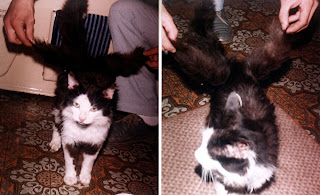
The Anglesey winged cat (Wyn Williams)

Yet despite the relative abundance of winged cat reports and photos, any explanation for these extraordinary animals remained conspicuous only by its absence, until in the early 1990s I uncovered the long-awaited answer while researching for clues in various obscure tracts of veterinary literature. I discovered that true winged cats (as opposed to ones whose wings are merely clumps of matted fur) exhibit a rare, little-known genetic disorder known as feline cutaneous asthenia (FCA), in which the skin is extremely stretchable, especially on the back, haunches, and shoulders – so much so that even if a cat with FCA merely rubs itself against something, or grooms itself with its paws, this can be enough to stretch its skin outwards in long, furry, wing-like extensions. And because these extensions often contain muscle fibres, they can sometimes even be gently raised or lowered, exactly as reported by certain winged cat eyewitnesses. Moreover, because the skin of FCA cats is so fragile, occasionally the wings are stretched out too far, and they will then simply peel away from the rest of the cat’s skin, falling off as if moulted and without any bleeding occurring, which would therefore explain Thomas-Mitzi’s dramatic loss of wings in the courtroom. After countless years of baffling their startled observers, the mystery of the winged cats was finally solved.


Some of the above accounts are excerpted or adapted from those that I wrote for Chambers Dictionary of the Unexplained (2009). For additional information concerning all of the mystery cats documented here, and many others too, don't miss my latest book, Cats of Magic, Mythology, and Mystery (CFZ Press: Bideford, 2012).