Dr KARL SHUKER

Zoologist, media consultant, and science writer, Dr Karl Shuker is also one of the best known cryptozoologists in the world. He is the author of such seminal works as Mystery Cats of the World (1989), The Lost Ark: New and Rediscovered Animals of the 20th Century (1993; greatly expanded in 2012 as The Encyclopaedia of New and Rediscovered Animals), Dragons: A Natural History (1995), In Search of Prehistoric Survivors (1995), The Unexplained (1996), From Flying Toads To Snakes With Wings (1997), Mysteries of Planet Earth (1999), The Hidden Powers of Animals (2001), The Beasts That Hide From Man (2003), Extraordinary Animals Revisited (2007), Dr Shuker's Casebook (2008), Karl Shuker's Alien Zoo: From the Pages of Fortean Times (2010), Cats of Magic, Mythology, and Mystery (2012), Mirabilis: A Carnival of Cryptozoology and Unnatural History (2013), Dragons in Zoology, Cryptozoology, and Culture (2013), The Menagerie of Marvels (2014), A Manifestation of Monsters (2015), Here's Nessie! (2016), and what is widely considered to be his cryptozoological magnum opus, Still In Search Of Prehistoric Survivors (2016) - plus, very excitingly, his four long-awaited, much-requested ShukerNature blog books (2019-2024).

Dr Karl Shuker's Official Website - http://www.karlshuker.com/index.htm

IMPORTANT: To view a complete, regularly-updated listing of my ShukerNature blog's articles (each one instantly clickable), please click HERE!

IMPORTANT: To view a complete, regularly-updated listing of my published books (each one instantly clickable), please click HERE!

IMPORTANT: To view a complete, regularly-updated listing of my Eclectarium blog's articles (each one instantly clickable), please click HERE!

IMPORTANT: To view a complete, regularly-updated listing of my Starsteeds blog's poetry and other lyrical writings (each one instantly clickable), please click HERE!

IMPORTANT: To view a complete, regularly-updated listing of my Shuker In MovieLand blog's articles (each one instantly clickable), please click HERE!

IMPORTANT: To view a complete, regularly-updated listing of my RebelBikerDude's AI Biker Art blog's thematic text & picture galleries (each one instantly clickable), please click HERE!

Search This Blog


PLEASE COME IN, I'VE BEEN EXPECTING YOU...

PLEASE COME IN, I'VE BEEN EXPECTING YOU...
WELCOME TO SHUKERNATURE - ENJOY YOUR VISIT - BEWARE OF THE RAPTOR!


Saturday, 17 April 2010

NUNDA - IN SEARCH OF THE STRANGE ONE

Nunda ((c) William M. Rebsamen)

There is an old, traditional Tanzanian folktale that tells of the Sultan Majnun's youngest son who went seeking a murderous feline monster called the nunda, which had killed his three brothers and many other hapless humans too. Evidently not the most zoologically-knowledgeable of people, he proceeded to kill several different animals, including a zebra, a rhinoceros, an elephant, a civet, and a giraffe, each time mistakenly assuming that this must be the nunda. Eventually, however, he encountered the real nunda, lying asleep under the shade of a tree. As large as a donkey, with distinctive brindled fur, huge claws, and enormous teeth, it was a terrifying sight, but the Sultan's son slew it as it slept, and returned home in triumph, having rid his father's kingdom of this malevolent scourge.

Reminiscent of the dragon-slaying tales popular in Europe, this is a quaint story - or it would be, if that indeed was all that it was. During the early 1920s and again in the 1930s, however, while acting as Native Magistrate at a small Tanzanian coastal village called Lindi, Captain William Hichens had good reason to think otherwise.

'Nunda' in Swahili translates as 'strange one', and according to the people of Lindi and elsewhere along the seaward edge of Tanzania, the feline monster of the above folk tale is no myth. Also known to them as the mngwa, and said to inhabit this country's temperate coastal forests, they readily distinguish it from both the lion and the leopard - the two known species of big cat inhabiting this region of Africa. Its footprints are very characteristic, resembling a leopard's in shape, but as large as a lion's. The nunda itself is also said to be as big as the biggest lions, with unmistakable greyish fur striped with tabby-like markings.

However, Hichens assumed the nunda was wholly legendary - until the following incident took place in 1922, recalled by him 5 years later in an article on African mystery beasts:

"It was the custom for native traders to leave their belongings in the village market every night, ready for the morning's trade; and to prevent theft and also to stop stray natives sleeping in the market-place, an askari or native constable took it in turns with two others to guard the market on a four-hour watch. Going to relieve the midnight watch, an oncoming native constable one night found his comrade missing. After a search he discovered him, terribly mutilated, underneath a stall. The man ran to his European officer, who went with me at once to the market. We found it obvious that the askari had been attacked and killed by some animal - a lion, it seemed. In the victim's hand was clenched a matted mass of greyish hair, such as would come out of a lion's mane were it grasped and torn in a violent fight. But in many years no lion had been known to come into the town."

Hichens was both shocked and greatly perplexed - but the people of Lindi were neither. They assured him that it was the work of a nunda, and an old native governor of the district confirmed that a nunda had carried out several other attacks here in the past. Moreover, shortly afterwards two men informed Hichens that they had been passing by the market on the night in question, and had been horrified to see an enormous brindled cat leap out of the shadows and pounce upon the unfortunate askari. But that was not the end of the matter.

A couple of nights later, a second askari met his death in the same manner, and in one of his clenched fists was found more of the strange, brindled grey fur. Over the next month, several further killings took place up and down the coast, but despite the local police force's best efforts, the perpetrator was never caught. During the 1930s, however, another, identical series of killings occurred in Hichens's district. One lucky survivor was an old, extremely experienced hunter, to whom lions and leopards were very familiar beasts. He stated adamantly that his attacker had been neither of these, but had instead been a nunda.

A very vibrant artistic evocation of the nunda's unbridled ferocity ((c) Simon Wyatt)

Apart from Hichens, another Westerner with experience of the nunda was Patrick Bowen, who obtained some fur left behind by this feline assassin after it had made off with a human victim. He also observed its footprints, which were indeed huge. So what could it be?

Four explanations come to mind. The first, and least zoological, of these is that there was no feline nunda, certainly as far as the Lindi killings documented here were concerned. The following information, quoted from Wild Cats of the World (2002) by Mel and Fiona Sunquist, may have significant bearing upon this:

"...witch doctors in the Singida area, in what was at that time Tanganyika [now Tanzania], ran a lucrative extortion business in the early twentieth century by threatening to turn themselves into lions and kill people who did not pay them. Many people were murdered by young men dressed as lions, wearing lion paws as gloves on their hands and feet. These mjobo, or "lion men," reappeared in the same area in 1946, some twenty-five years later, and 103 deaths were attributed to their activities. Murders were made to look like the work of man-killing lions, and the common belief in were-lions was exploited by secret societies."

Could it be that the Lindi killings were also the work of these lion men? The timings are similar – two separate outbreaks, one during the early 20th Century and a second over a decade later. Claims that the killings resembled maulings from some great cat are also consistent with this theory, and what better way to increase fear among the highly superstitious local people than to spread rumours that the assailant was not even a lion but rather a greatly-feared mythical feline monster – the nunda? And to provide physical evidence for this claim, what easier way than to place clumps of grey fur in the hands of the murder victims, fur that was clearly not from a lion but matched the folklore descriptions of the nunda? In reality, of course, the fur could have originated from anything, even a domestic dog, but as long as it didn't look like a lion's and did look like the fabled nunda's, that was all that was required of it. Even the extra-large footprints would not be beyond the ingenuity of the lion-men to fake, thereby yielding further evidence of nunda presence in the eyes of the frightened locals. Consequently, although I don't entirely deny the reality of the nunda, I do consider this particular explanation the most plausible for the two outbreaks of nunda-attributed Lindi killings.

Assuming that the nunda does indeed exist, however, three other options exist. Firstly, it may conceivably be a wholly unknown species, lurking undetected by science amid Tanzania's dense forests.

Secondly, it could be an exceptionally large form of aberrantly-patterned leopard. Striped leopards have been recorded in the past, and the nunda's footprints do resemble a leopard's, except for their larger size. Having said that, however, the concept of a ferocious lion-sized leopard is not a very comforting one, to say the least!

Thirdly, and perhaps most intriguing of all, is the identity put forward by veteran cryptozoologist Dr Bernard Heuvelmans. He has suggested that the nunda may be an undiscovered giant version of the African golden cat Caracal (=Profelis) aurata. Normally measuring up to 4.5 ft in total length, and native to East as well as West Africa, this is not only one of Africa's most elusive but also one of its most morphologically versatile species of cat. Its pelage can vary in colour from gold, through a wide range of reds, browns, and greys, to a melanistic all-black form, and superimposed upon this diverse range of background colours there can sometimes be an equally broad spectrum of dark spotted patterns too.

Spotted morph of the African golden cat, painted in 1873 by John G. Keulemans (public domain)  

Consequently, as argued by Heuvelmans, of all the known feline species native to Africa, it is the golden cat that offers the greatest likelihood of yielding the brindled grey-hued pelage characterising the nunda. In addition, despite being only a medium-sized cat, the golden cat inspires extraordinary fear and tribal superstition throughout its wide distribution range, on account of its extremely savage, bloodthirsty nature. Also of note: eyewitnesses have claimed that despite its huge size, the nunda does not roar like a lion or leopard, but purrs, just like an overgrown domestic cat. And the throat structure of the golden cat is such that it does indeed purr (which lions and leopards cannot), rather than roar.

So what would a golden cat be like if increased in size to the stature of a lion (or at least to that of a leopard, thus allowing for a degree of fear-induced exaggeration by those who have encountered such a creature), and bestowed with a brindled grey pelage? Perhaps we already know the answer to this question - and perhaps that answer is the nunda...

Further information concerning the nunda and other African mystery cats can be found in my books Mystery Cats of the World and Cats of Magic, Mythology, and Mystery.



Friday, 2 April 2010

APRIL FOOL'S FAUNA


Lirpa loof (Philippa Foster)


What do you call a newly-found hairless mole-like creature from the Antarctic, with a heat-emitting bony plate on its brow for melting tunnels in the ice beneath unsuspecting penguins, which the creature can then seize and devour? A successful April Fool joke, that's what!

The story of the hot-headed naked ice borer, a 6-inch-long surprise recently revealed in the frozen southern continent, was featured in the April 1995 issue of the American science magazine Discover, and even included an impressive photo. Such a distinctive new species naturally attracted a lot of interest, and reports subsequently appeared in several other publications - until June 1995, that is, when Discover's editors triumphantly exposed the ice-borer as a spoof. In the true spirit of the event, however, the original Discover article had contained a quite obvious clue as to the ice-borer's real identity. The name of the wildlife biologist who had supposedly found it was given as Aprile Pazzo - Italian for 'April Fool'!

Even at the best of times, cryptozoology is perpetually on the lookout for frauds and hoaxes when assessing reports of mysterious animals. It must always be especially vigilant near the onset of the fourth month, however, because the unveiling of sensational new species is a perennially popular choice for an April Fool spoof. Some of them, moreover, have become classics in their field, like the following example.

In spring 1984, London Zoo received a wonderful new animal, which immediately became a popular star - and for good reason. How many animals can you think of that can perfectly mimic their human observers? Yet this remarkable creature, standing upright on its back legs, would wave when the crowd waved, and even clapped its front paws together when the crowd applauded. It resembled a shaggy bear, dark on top with a white chest, white toes, and a long white mandarin-like moustache that drooped down over its cheeks. According to the label on its enclosure, it was from an eastern Himalayan locality a few hundred miles north of Bangladesh, and the local people there called it a lir-pa loof. Zoologically, it was the only known member of a new mammalian family, and had been dubbed Eccevita mimicus.

The lir-pa loof generated an incredible amount of public interest. During the first week after its arrival, London Zoo received around 1000 telephone calls from people requesting further information about it, and the Natural History Museum and the BBC were similarly bombarded. When you're as famous as this, there is only one thing to do - make your television debut. And that is precisely what the lir-pa loof did - appearing with its keeper, George Callard, on the popular BBC show 'That's Life', hosted by Esther Rantzen.

By now, there were ample clues for exposing the secret of this creature (whose loose-fitting skin could so easily conceal a child or kneeling adult!). Spelled backwards, 'lir-pa loof' becomes 'april fool'. The date of its debut on 'That's Life' was April 1. And for the more classically-minded, the lir-pa loof's generic name, Eccevita, is Latin for 'That's life'.

Amazingly, however, there were still a surprising number of people who believed in the lir-pa loof's authenticity - until the very next 'That's Life' show. That featured the second (and final) appearance of this marvellous mammal and its keeper, singing "We apologise".

Animal April Fools come in many forms. Some are simple, slapstick fun, like Charlie the 'chickpanzee'. This genetically-engineered miracle combined the DNAs of a chicken and a tamarin monkey, and appeared in London's Daily Mirror newspaper on April 1 1991. More deceptive was George - a vicious crossbreed between a goldfish and a piranha but outwardly resembling true goldfishes. Photographed in the Daily Mail on April 1 1987, George appeared alongside his 12-year-old owner, Amanda Baker - nursing a bandaged finger. People who were not experienced fish fanciers probably didn't realise that piranhas and goldfish are far too distantly related to yield hybrid offspring, but the Daily Mail owned up on April 2 - enabling goldfish owners everywhere to breathe a sigh of relief again at feeding time.

On April 1 1989, London's Today newspaper included an amusing spoof concerning the arrival at London Zoo of a living sauropod-type dinosaur from Guinea - clearly inspired by real reports of the mokele-mbembe from the People's Republic of Congo. Also in 1989, the April 1 issue of Garden News featured a front-page special on the astounding germination of a prehistoric plant from fossilised dinosaur droppings. Aptly dubbed the dinosaur vine, it was being studied by Professor Adge Ufult - just say his name outloud!

Appropriately, however, the most famous cryptozoological April Fool involved the most famous cryptozoological creature - the Loch Ness monster. On April 1 1972, newspapers worldwide reported the astonishing discovery of a 9-ft-long seal-like beast, weighing over half a ton, that had been found dead at the side of the loch. Soon afterwards, police intercepted a van transporting the body south to Flamingo Zoo Park in Yorkshire.

When examined, it was found to be the carcase of a dead bull elephant seal, which had been deep-frozen for several days, giving it a peculiar greenish hue. Its whiskers had been shaved off too, and its cheeks had been stuffed with rocks.

On April 2, Flamingo Zoo Park's public relations officer, John Shields, confessed that it was an April Fool hoax, which he had secretly set up as a joke directed at the managing director of the company owning the zoo. Shields had used the body of an elephant seal that had died a week earlier at Dudley Zoo, owned by the same company.

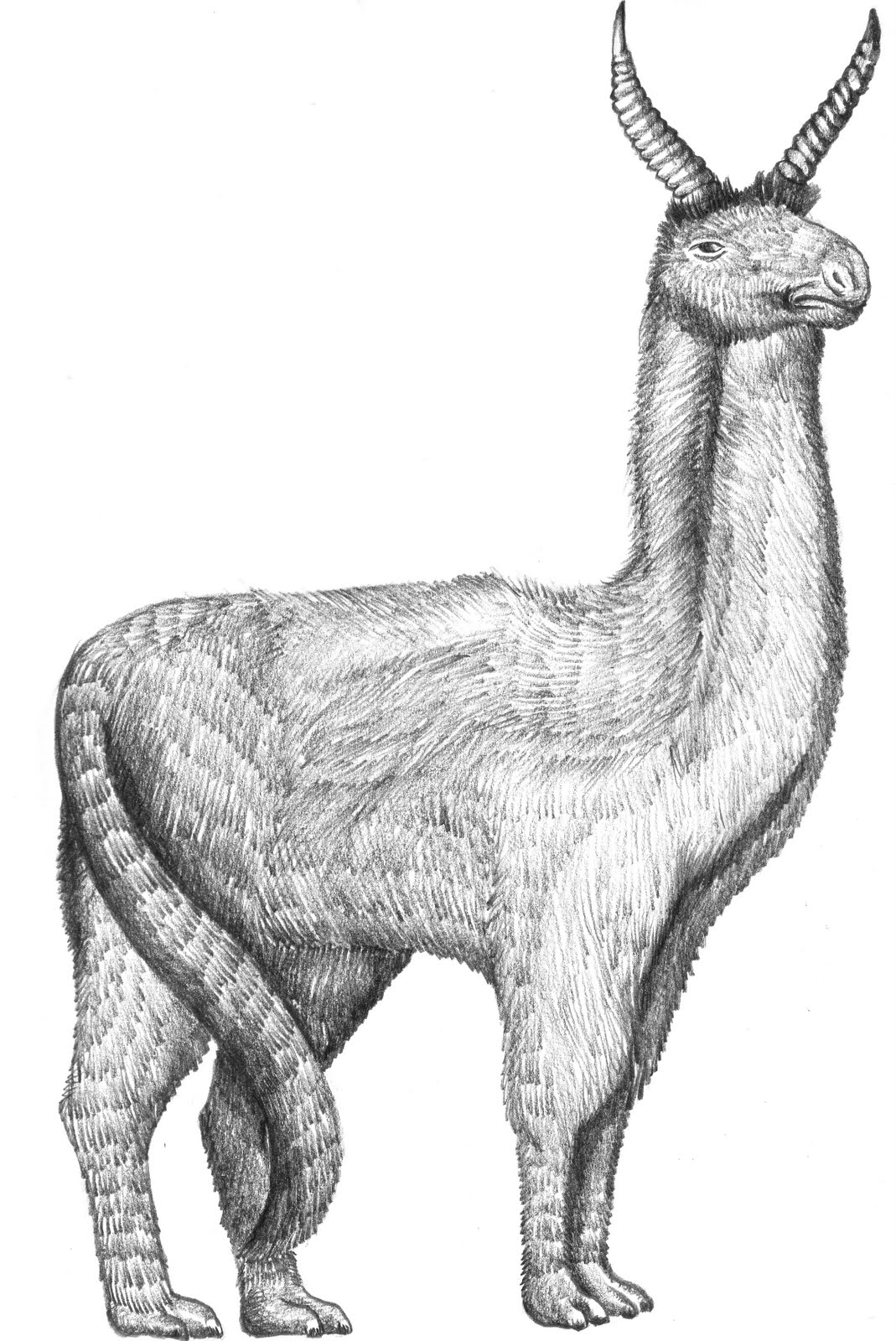
Lastly, a modern-day online classic. On 1 April 2008, the nowpublic.com website published a news report by Bill Adler announcing the escape from Washington DC's National Zoo of a particularly rare creature known as the loof lirpa. Its photo revealed it to be a llama-like beast but sporting a pair of long slender gazelle-like horns. Native to Patagonia, it is further distinguished by its distinctive odour, likened to cheap cologne, and although usually a mild-mannered species, this particular individual, an adult male, had been ready to mate when it escaped and so may well be feeling aggressive. Needless to say, however, there was no need to be alarmed - as long as you took the trouble to notice which phrase this exotic animal's name spelt out if read backwards!


Loof lirpa (Tim Morris)

Wednesday, 24 March 2010

THE HAIRLESS BLUE HORSE OF SOUTH AFRICA

One of the astonishingly beautiful Blue Horse series of paintings by Franz Marc (1880-1916)
 
Long before the hairless blue dogs of Texas were even a twinkle in the eyes of their controversial canine progenitors, another equally strange creature of unfurry skin and cyanescent hue had briefly gained headlines of its own - but this creature, long-forgotten until its remarkable history was recalled in my book From Flying Toads To Snakes With Wings (1997), was not a dog...  
 
A HORSE OF A VERY DIFFERENT COLOUR
 
Mystery animals come in all shapes, sizes - and shades. Certainly, the following hitherto-obscure example is a particularly dramatic case in point - one that could be aptly described as a horse of a different color, in every sense of the phrase!
 
While in South Africa during 1860, a merchant by the name of Lashmar encountered a feeding herd of quaggas - those odd-looking relatives of zebras that were striped only on the front half of their body and which became extinct in 1883. As subsequently reported by C.O.G. Napier in the long-vanished English magazine Land and Water (February 22 1868), while observing them Lashmar suddenly spotted in their midst a strange-looking creature that was drastically dissimilar in appearance from the others, and discovered to his astonishment that it was not a quagga at all, but was instead a hairless blue horse!
 
Once he had convinced himself that this ethereal entity was indeed real, he was quick to recognize its great worth as an outstanding novelty for exhibition purposes, and thus lost no time in successfully capturing it - after which he was able to study its extraordinary appearance closely, recording the following details.
 
Its skin was smooth and delicate in texture, feeling to the touch like india-rubber, and very warm, and forming curious wrinkles when the animal moved - recalling to mind the more ornate, ostentatious creases and loose folds of skin sported by that increasingly popular breed of mastiff-related dog known as the shar-pei. Unlike the latter, however, the horse was wholly hairless, not even possessing any hair roots. In color, its skin was blue-mauve over most of its body, but with a buff face and a large patch of the same color extending over half of its back with numerous blotches. Its tail resembled that of a pig. In overall appearance and when seen at a distance, this singular steed looked as if it had been sculpted from some rare variety of oriental blue marble.
 
After capturing it, Lashmar sent it to South Africa's Cape Colony, from where it was brought over to England in 1863. There, it was broken in at Astley's, and ridden for three parts of the season with Lord Stamford's hounds. It was also examined by Professor Spooner of the Veterinary College, London, who delivered a lecture concerning its unique appearance to his students. Purchased by a MrÁMoffat, in February 1868 it was exhibited in London's famous Crystal Palace, but its original blue coloration had been gradually fading ever since its capture, transforming into a rather more nondescript isabelline-grey. According to Moffat, the horse stood 14.2 hands high (i.e. just under five feet tall), was symmetrically shaped, and performed well in harness, but required warm clothing on account of its hairless nature. Moffat washed it each day, to keep it in good health.
 
Since its Crystal Palace days, nothing more seems to have been documented regarding this strange animal - its ultimate fate, therefore, is unknown, and prior to this present account its very existence had long since been forgotten.
 
As an inevitable consequence of its many decades of obscurity, the reason for its bizarre appearance has never been explained. However, the creature with which it seems to correspond most closely with regard to its curious skin is the Chinese crested dog - a superficially chihuahua-like breed that is without hair over much of its body, and which has portions of blue skin coloration. This breed's hairless state is caused by the possession of a mutant form of one of the genes controlling hair development, whereas its blue shading arises via the presence of the pigment eumelanin in its skin. Comparable conditions in a horse could yield the type of specimen captured by Lashmar.
 
Needless to say, nothing like it has ever been reported since. Perhaps the only example in any way reminiscent is a mare owned by Harold T. Sills of Prospect, Dordrecht, in South Africa's Cape Colony. Unlike Lashmar's specimen, it possessed a normal coat of hair, but the hair itself was blue. Sills wrote about this animal to English naturalist William T. Tegetmeier, who published in The Field (August 31 1901) the following extract from Sills's letter to him:
 
"I have a colonial-bred mare that is a very light blue; that is, she is nearly white, with the exception of mane, tail, and legs, which are bluish, and a black star on her forehead. The mare is about 7 years old now, and was born with this black star. It is the only case I have ever seen or heard of."
 
Freakish blue animals have occasionally been reported from other mammalian species, notably various wild cats - with pelts of blue lynxes and bobcats occasionally obtained by the fur trade. In southeastern China's Fujian Province, an elusive strain of blue-furred tiger allegedly existed at one time (and may still do so today). During September 1910, the renowned Methodist missionary Harry Caldwell actually encountered one of these extraordinary creatures at close range, and attempted to shoot it to provide unequivocal proof of its reality - but was unable to do so because of the possibility that he might have injured two children collecting vegetation a little further away, who were in direct line of his planned shot. And an exotic white cheetah with remarkable blue spots was once brought to the Mogul naturalist Jahangir at Agra.
 
Nevertheless, the mystery of Lashmar's blue horse remains unsolved - and not only on account of its color and hairlessness. There is one final anomaly that seems never to have attracted attention even during this animal's brief period of celebrity status. Namely, how can we possibly explain its presence amid a herd of quaggas? Where had such a bizarre beast originally come from, and why was it now associating with a herd of creatures belonging to a wild species only distantly related to its own? Is it even conceivable that this abnormal creature was not a domestic horse at all, but was in reality a freakish mutant specimen of quagga - a sport of nature set apart from its brethren morphologically, but nevertheless recognized by them as being one of their own kind and hence permitted to feed and associate with them? Who can say?
 
Just like the quaggas that were themselves destined to be lost forever, there is little doubt that the secret of this strangest of all steeds died with its originator - yet another mystery beast to be reported, recorded, and afterwards conveniently forgotten like so many before, and so many since.
 
 
A digitally-created hairless blue horse, created by Daisiem and appearing on the now-defunct Worth1000 website devoted to photoshopped creations and competitions ((c) Daisiem/Worth1000 - reproduced here on a strictly non-commercial Fair Use basis for educational/review purposes only)
 
Excerpted from my book From Flying Toads To Snakes With Wings (Llewellyn: St Paul, 1997.


Wednesday, 17 March 2010

MORE MADAGASCAN MYSTERY MAMMALS

Yes, I do enjoy the occasional alliteration!

African pygmy hippopotamus (Dr Karl Shuker)

But seriously: in a recent ShukerNature blog entry, I documented a selection of reports suggesting the possible survival into recent history of various giant lemurs on Madagascar. However, these are not the only cryptozoological mammals on record from this Indian Ocean island mini-continent, as demonstrated by the following pair of enigmas.


WHAT’S IN A (VERY LONG) NAME? THE KILOPILOPITSOFY

Also known as the tsomgomby, lalomena, or railalomena, the kilopilopitsofy is an unidentified beast spoken of by the Belo-sur-mer villagers to scientists Dr David A. Burney and Ramilisonina during their ethnographical researches on Madagascar in the mid-1990s.

As with a mystery lemur called the kidoky (see my earlier blog), they received consistent reports of this mystery animal from several different eyewitnesses, including, once again, Jean Noelson Pascou, who was able to describe the kilopilopitsofy in considerable detail, following his own sightings of it, one of which was made as recently as 1976. According to Pascou, it is cow-sized but hornless, has very dark skin, pink colouration around its eyes and mouth, fairly large floppy ears, big teeth, large flat feet, is nocturnal, and escapes from danger by running into the water.

When shown photos of various animals, another kilopilopitsofy eyewitness selected a hippopotamus as bearing the closest resemblance to the kilopilopitsofy. Moreover, when asked to describe the sounds that the latter mystery beast makes, Pascou, who was well known in the village as a skilled imitator of local animal noises, gave voice to a series of deep, drawn-out grunts, which the startled scientists realised were very similar to the sounds made by the common African mainland hippopotamus. Yet no species of hippopotamus is supposed to exist on Madagascar – or not any longer, that is.

Alongside the hippos statue at Marwell Zoo, July 2013 (Dr Karl Shuker)

In fact, living alongside the giant lemurs on Madagascar were once no less than three different species of endemic Malagasy hippopotamus. These were: the lesser Malagasy hippo Hippopotamus laloumena (a small relative of the common African mainland species, H. amphibius); the Malagasy dwarf hippo H. lemerlei (an even smaller, dwarf species); and the Malagasy pygmy hippo Hexaprotodon madagascariensis (a distinctive pint-sized species more closely related to the African mainland pygmy hippo). Just like the giant lemurs finally became extinct, however, so too did all three Madagascan hippo species, once again having been hunted and eaten by humans, but with subfossil evidence confirming that at least one species, the Malagasy dwarf hippo H. lemerlei, was still alive as recently as 1000 BP. Furthermore, judging from the testimony of Pascou and others with regard to the mystifying kilopilopitsofy, zoologists as well as cryptozoologists now consider it plausible that at least one of Madagascar’s diminutive trio of hippos actually persisted into much more recent times, and perhaps even into the present day.

As for this mystery beast’s floppy ears, they deem it possible that these were actually loose jowls and cheeks, misidentified as ears when seen fleetingly at night. Alternatively, it may be that they really are ears, larger than those of typical hippos, which have evolved to help dissipate heat if, as seems to be the case, the dwarf hippo in particular was (or is?) more terrestrial than typical hippos.

In 1876, the skin of an alleged tsomgomby was actually shown to Westerner Josef-Peter Audebert, who likened it to that of an antelope (no species of which exists on Madagascar), and stated that it had supposedly come from the south of the island. If only this skin had been preserved – DNA analyses would have unmasked its owner’s identity and, perhaps, finally resolved the longstanding mystery of this very perplexing Madagascan cryptid.


FUSSING OVER A FOSSA

Known zoologically as Cryptoprocta ferox, the fossa is Madagascar’s largest native mammalian carnivore, and superficially resembles a small long-tailed puma, but is more closely related to the civets and genets (viverrids). It has a total length of 1.4-1.7 m, but there was once an even bigger species, the giant fossa C. spelia, which measured a formidable 3 m long. Although officially believed to have died out at least several centuries ago, reports of a very large, fierce cat-like beast stalking this island’s most inaccessible forests and known locally as the antamba have led to speculation that perhaps the giant fossa may still exist. As might be expected, the antamba did not escape the attention of the indefatigable Admiral de Flacourt, who documented it as follows:

The Madagascar antamba is an animal as large as a dog, with a round head, and, according to the relations of the Negroes, resembling the leopard. It devours both men and cattle, and is only found in the most desert[ed] parts of the island.

In November 1999, fossa expert Luke Dollar, intrigued by persistent rumours concerning the antamba, trekked in search of it through northeastern Madagascar’s Zahamena National Park, also known as the Impenetrable Forest, and said to harbour this elusive beast. Unfortunately, he did not sight it, but has not given up hope that it does exist, as most of this uninviting region has never been scientifically explored.

Fossas have enormously long tails in proportion to their total body length (Dr Karl Shuker)

Also worth noting is that, although once again still-unconfirmed by science, there have been a number of reports of melanistic (all-black) fossas in certain eastern rainforest areas of Madagascar.

Fossa (public domain) 


Monday, 22 February 2010

TRANSLATING A TURKISH DELIGHT...OR TWO


The following report on the subject of winged cats appeared online in 2008. Unfortunately, it is written in Turkish, a language that I cannot decipher. However, I would very much like to know what it says as it includes two winged cat photos that I have never seen before (plus one of the famous Chinese winged cat of 2007), and which I include here, that may represent cases unknown to me. Consequently, I am reproducing the article's text below, and would be very grateful if anyone out there with a knowledge of Turkish could send me a translation of it.


09-01-2008

Kanatlı Kediler
Kanatlı Kediler, bugüne dek kediler üzerinde yapılmış olan gözlemlerde kimi kedilerde kanatsı eklere rastlanması ile, bu tür kedileri tanımlamak için kullanılan bir terimdir. Niagara Şelalesi yakınlarında bulunan bir kedi iskeleti durumun doğruluğunu kanıtlamıştır.Kedilerde kanatsı eklerin oluşmasında üç sebep dikkati çeker. Bunlardan ilki, uzun tüylü türlerde, tüylerin birbirine dolanarak keçeleşmesidir. Bu keçeleşme sorunu, nadir de olsa kısa tüylü türlerde de görülebilmektedir. Dökülen tüylerin keçeleşen tüylere yapışıp birkaç tüy dökme mevsimi sonunda kanatsı yapılar oluşturabilmeleri mümkündür. Ancak bu durum, kanatların tek açıklaması değildir.İkinci neden, insanlarda görülen Ehlers-Danlos Sendromunun (derinin elastik olması) bir benzerinin (feline cutaneous asthenia) kedilerde görülmesidir. Bu nedenle oluşan kanatsı yapılar omuz, bel ve kalça bölgesinde görülür. Bu tür kanatları olan kedilerin bir kısmının kanatlarını oynatabildikleri görülmüştür.Üçüncü oluşum şekli ise, yapışmış organ veya ekstra organ gelişimidir.Kanat benzeri yapıların oluşumunu tecrübeli kedi sahipleri ve besleyicileri çok çabuk anlayabilirken, acemiler ilk oluşumu sırasında anlayamayabilmektedir.Kanatlı Kedilerin Tarihi1990'ların başlarında, kanatlı kedi olgusunda uzun süren çalışmaları bulunan İngiliz zoolog ve kriptozoolog Dr. Karl Shuker, popüler medyada yayınlanan kanatlı kedi haberleri ile feline cutaneous asthenia arasında bağlantı bulunduğunu gösteren ilk kişidir.1862 yılında Henry David Thoreau bu konuyu raporlayan ilk isimdir: " Birkaç yıl önce ormanlarda yaşıyordum. Lincoln'de gölete yakın, Mr. Gillian Baker'in çiftlik evinde kanatlı bir kedi olduğu söyleniyordu. Haziran 1842'de görmeye gittiğimde, alışkanlığı üzre ava gittiğini öğrendim. Eşi bana onun çevreye kısa bir süre önce geldiğini söyledi, ve Nisan ayında evlerine almışlardı. Onun, koyu kahverengimsi-gri renkli olduğunu, boğazında beyaz bir nokta bulunduğunu, beyaz ayaklarının olduğu, ve bir tilki gibi büyük çalı gibi bir kuyruğu olduğunu; kışın kürkün, kalınlaşıp yanlarından dışarıya doğru düzleştiğini ve 12,5 inçe ulaştığını söyledi."(vikipedi alıntı)

Wednesday, 17 February 2010

MADAGASCAR'S ELUSIVE MEGA-LEMURS AND MINI-MEN


Restoration of Palaeopropithecus ingensin life (Markus Bühler)


The fourth largest island in the world, Madagascar is a veritable miniature continent, brimming with extraordinary animals found nowhere else in the world, including such exotic avifauna as vangas and neodrepanidids, remarkable reptiles that include boas more closely-related to counterparts in South America than to any Old Word snakes plus the world’s greatest diversity of chameleons, and, most famous of all, its wonderful assemblage of lemurs and exotic striped civets. Yet as if all of these were not exciting enough, only a few centuries ago in some cases this zoological treasure trove of endemics also boasted some truly astonishing animals – and none more so than its impressive number of giant lemurs far bigger than anything known to exist today. Today, of course, these creatures are long gone – or are they? Read this investigation of Madagascar’s most astonishing mystery beasts – and decide for yourself.

TRATRATRATRA GOODBYE…?
In 1658, after having resided in Madagascar for a number of years as its governor, French explorer Admiral Étienne de Flacourt published a major tome, Histoire de la Grande Isle de Madagascar, which documented his experiences and discoveries here. It contains a wealth of zoological information, some of which is also of cryptozoological interest, including the following passage:

"Trétrétrétré [or tratratratra in English] is an animal as big as a two-year-old calf, with a round head and a man’s face; the forefeet are like an ape’s, and so are the hindfeet. It has frizzy hair, a short tail and ears like a man’s…One has been seen near the Lipomani lagoon in the neighbourhood of which it lives. It is a very solitary animal, the people of the country are very frightened of it and run from it as it does from them."

At the time, this report was dismissed by European naturalists as nothing more than native folklore. Also discounted were the description and accompanying sketch of what appears to have been the same or at least a very similar unidentified species, but in this instance called the thanacth, documented by André Thévet in his Cosmographie Universelle (1575); the creature in question had been brought to him, while based on the Red Sea, as a curiosity to see by natives from an unspecified eastern land that some authorities now believe may have been Madagascar.

A few centuries later, however, palaeontologists in Madagascar began unearthing fossilised remains of enormous lemurs, which, when dated, proved in some cases to be from creatures that had only died out a few hundred years earlier. Moreover, reconstructions of the likely appearance in life of certain of these animals seemed more than a little reminiscent of the mystifying tratratratra.

Consequently, in his seminal cryptozoological book On the Track of Unknown Animals (1958), Dr Bernard Heuvelmans boldly proposed that this latter mystery beast may indeed have been a surviving representative of the sloth lemur Palaeopropithecus ingens, a giant lemur shown from radiocarbon dating of subfossil remains to have existed until at least the 1500s. As big as a chimpanzee, somewhat sloth-like when in trees but probably at least partly terrestrial due to its large size and weight, Palaeopropithecus would have appeared very spectacular and somewhat awe-inspiring to the native people - hence, if indeed synonymous with the tratratratra, their fear of it.

However, it is now known that Palaeopropithecus had a very pronounced snout, which contrasts with the man-like (and thus presumably flattened) face described by de Flacourt for the tratratratra. Conversely, a second identity offered for it by Heuvelmans, the large extinct lemur Hadropithecus, did have a relatively flattened, ape-like or humanoid face (in stark contrast to the decidedly long-muzzled, canine faces of most known modern-day lemurs), and is known to have existed until around 1000 years ago.


Model of Palaeopropithecus by Markus Bühler (image courtesy of Markus Bühler)

It has lately been confirmed that the giant lemurs were hunted – quite probably into extinction - by humans (who first reached Madagascar around 2000 years BP - Before Present). In April 2002, at a meeting of the American Association of Physical Anthropology, a team of scientists from Massachusetts University and Oxford’s Natural History Museum revealed that some remains of Palaeopropithecus ingens and Megaladapis (another extinct giant lemur, see below) from Taolambiby (a subfossil site in southwestern Madagascar), which were originally collected back in 1911 but only lately studied, showed classic signs of butchering. As the scientists pointed out, the characteristics of the tool-induced bone alterations (sharp cuts near joints, spiral fractures, and percussion striae) suggested dismembering, skinning, and filleting.

Moreover, the giant lemurs also suffered from habitat destruction via extensive deforestation. Nevertheless, there are still areas of dense, remote Madagascan forest little-visited by humankind even today, where reports of bizarre beasts continue to emerge from time to time. One of the most pertinent of these reports relative to the tratratratra controversy was published in Jane Wilson’s fascinating book Lemurs of the Lost World (1990). After mentioning de Flacourt’s account of this cryptid, she notes:

"Although this description may be distorted, it is the last accepted sighting of the now extinct giant lemurs. A few may have survived until the 1930s, however, when a French forester came face to face with an animal sitting four feet high and described it as being unlike other lemurs he had seen. It did not have a muzzle but was like a gorilla with ‘the face of one of my ancestors’."

Or the face of the last tratratratra, perhaps? Although unlikely, it is not impossible that a very small, relict population of at least one species of giant lemur does still persist in Madagascar, highly elusive, nocturnal, and actively avoiding humans whenever possible.

ON THE TRACK OF THE TOKANDIA
In earlier works, the tratratratra was often synonymised with another giant Madagascan lemur, the so-called koala lemur Megaladapis edwardsi. Like Palaeopropithecus, this species is now known from dated subfossil remains to have still existed as recently as 1500, and may well have met its demise at the hands – and weapons – of humans. It derives its common name from the outward similarity of its general body form to that of Australia’s familiar koala – but a koala on a gigantic scale, as this tree-dwelling lemur sported a skull the size of a gorilla’s, and weighed a massive 75 kg or so. It had proportionately long forearms, extraordinarily cow-like jaws, a very elongate face, huge grasping hands and feet, and quite possibly a short tapir-like nasal trunk. Although clearly adapted for life in the trees, its huge size indicated that this monstrous lemur may well have spent quite a lot of time on the ground.


Megaladapis edwardsi (Markus Bühler)

The extended shape of its face and heavy bovine jaws clearly argue against Megaladapis being one and the same as the tratratratra, and in later publications this identification has indeed been discounted in favour of Palaeopropithecus or Hadropithecus, as already discussed here. However, there is another Madagascan mystery beast that Megaladapis does compare well with – a huge, largely terrestrial mammal known as the tokandia. Just like modern-day sifakas and certain other lemurs, the tokandia is said to move on the ground via a series of bounds or leaps, but also jumps into trees, where it spends time too. Moreover, unlike the tratratratra, the face of the tokandia is claimed by the locals not to be man-like, but its cries are allegedly very like those of humans. Accordingly, Dr Heuvelmans and other cryptozoologists have identified the tokandia with Megaladapis. Whether it still exists today, conversely, is another matter entirely, as there do not seem to be any modern-day accounts of the tokandia. Also, even in the least-accessible surviving forests of Madagascar, a koala-shaped lemur the size of a bear would surely be somewhat difficult to overlook.

Megaladapis reconstruction from 1902.


NO KIDDING, IT WAS A KIDOKY
Having said that, there is tantalising evidence that some other form of very large, still-undiscovered species of lemur does still exist in this insular mini-continent. During late July and early August 1995, Fordham University biologist Dr David A. Burney and Madagascan archaeologist Ramilisonina conducted ethnographical research at three remote southwestern Madagascan coastal villages, in particular Belo-sur-mer. Here, interviewing the local people, they collected testimony from eyewitnesses describing three different mysterious beasts, two of which may well be species still unknown to science. One of these creatures was referred to as the kidoky, and according to consistent local descriptions (obtained by interviewing the eyewitnesses completely independently of one another) it apparently resembles those relatively large, principally tree-dwelling lemurs known as sifakas. However, in terms of overall size the kidoky was said to be much larger.

One such animal was reputedly sighted as recently as 1952, by an educated villager called Jean Noelson Pascou. When interviewed by the two scientists, Pascou was adamant about what he had seen, and stated that the kidoky had dark fur, but with a white spot below its mouth and another one upon its brow.

When on the ground, sifakas move via a very characteristic series of sideways bipedal bounds and if threatened will flee up into the trees. In contrast, the kidoky allegedly flees by running away in a series of short, forward leaps reminiscent of a baboon’s mode of locomotion, and usually remains on the ground, rather than taking to the trees. Its face is quite round and man-like, but its loud whooping call is more similar to that of the decidedly dog-headed indri (currently the largest known species of living lemur).

As noted by the two scientists, in terms of overall morphology and lifestyle the kidoky brings to mind two officially extinct genera of giant lemur – Archaeolemur and Hadropithecus, both of which exhibited terrestrial adaptations and were the closest equivalents in lemur terms to the baboons. Like other giant lemurs, however, they are assumed to have died out several centuries ago – but if the testimony of Pascou and other Belo-sur-mer villagers are to be believed, this assumption may well be premature.

THE HABÉBY – A LEMUR IN SHEEP’S CLOTHING?
One of the most mystifying of all Madagascan cryptids is the habéby. Also called the fotsiaondré, it is likened both in size and in overall appearance to a large white sheep, with long furry ears, and a long muzzle, whose coat is dappled with brown or black, and whose feet are reputedly cloven. The Betsileo tribe aver that it inhabits the wastelands of the Isalo range, and that it can sometimes be seen on moonlit nights. For – bizarrely for any sheep – the habéby is claimed to be strictly nocturnal, which presumably explains why it is also said to have very large staring eyes, another very unsheep-like characteristic. Equally odd, if it is indeed a sheep, is that there has never been any report or any tradition of horned habébys, i.e. habéby rams.

Faced with these disconcerting inconsistencies with any typical ovine identity, it is little wonder that zoologists have considered it much more feasible that the habéby is (or was) an elusive species of very large terrestrial lemur, which would explain its night-time activity and associated large eyes. Of course, lemurs are not cloven-footed, but perhaps a predominantly terrestrial, giant form may have evolved superficially hoof-like claws to assist its locomotion on the ground.

MAKING AN ASS OF THE MANGARSAHOC
Equally unexpected in Madagascar are reports of a mysterious white ass with huge ears that almost cover its face. This unlikely-sounding beast is referred to as the mangarsahoc, and, like the tratratratra, was briefly documented by Admiral de Flacourt in his great tome:

"Mangarsahoc is a very large beast, which has a round foot like a horse’s and very long ears; when it comes down a mountain it can hardly see before it, because its ears hide its eyes; it makes a loud cry in the manner of an ass. I think it may be a wild ass."

In 1770, this strange creature was also reported by the Comte de Modave, who claimed that it lived some 10 leagues from Fort Dauphin, and that the local tribespeople were terrified of it:

"[Yet] at bottom it is but a wild ass; many are found in this part of the island, but you must look for them in the woods, for they never leave these lonely places and are hard to approach."

Intriguingly, tracks of hooves said to be from the mangarsahoc have actually been found, and several sightings have been reported in the Ankaizinana forests as well as in the Bealanana and Manirenjy districts, according to Heuvelmans. Yet no specimen has ever been obtained, and, as with the habéby, Heuvelmans was more inclined to deem this evanescent creature a giant lemur than a hoofed, ungulate mammal. Tellingly, it has a vile reputation among the native people, who firmly believe that the mere sight of it will bring bad luck. This seems an unusual superstition to become attached to a wild horse, yet is of the very same kind often associated with some of the more striking, nocturnal lemurs – in particular, for instance, the rather eerie-looking (albeit entirely harmless, inoffensive) aye-aye.

So could the mangarsahoc once again be an undiscovered species of very large, terrestrial, pseudo-hoofed lemur? Or might it instead be a non-existent composite beast, engendered by confusion between Madagascar’s extra-large lemurine cryptids and a very different mystery beast, the tongue-twistingly-named kilopilopitsofy?

KALANORO – MADAGASCAR’S LITTLEFOOT
Perhaps it is only fitting that on such a cryptozoologically paradoxical island as Madagascar, where there are alleged sightings of giant lemurs, elephant birds, and dwarf hippos, there should also be reports not of a bigfoot-type man-beast comparable to those reported from many other regions of the world, but rather a littlefoot – an elusive hairy ape-man, yet of only very short height. Known as the kalanoro, many accounts of it exist, including the following detailed example, published in 1886 by G. Herbert Smith within the Antananarivo Annual:

"We next come to the forest, and from there we get endless stories of the Kalanoro, a sort of wild-man-of-the-woods, represented as very short of stature, covered with hair, with flowing beard, in the case of the male, and with an amiable weakness for the warmth of a fire. An eye-witness related that once, when spending a night in the heart of the forest, he lay awake watching the fire, which had died down to red embers, when suddenly he became aware of a figure answering to the above description warming himself at the fire, and apparently enjoying it immensely. According to his story, he put a summary end to the gentleman’s enjoyment by stealing down his hand, grasping a stick, and sending a shower of red-hot embers on to his unclothed visitor, who immediately, and most naturally, fled with a shriek. Another tells how, on a similar occasion, the male appeared first, and after inspecting the premises and finding, as well as a fire, some rice left in the pot, summoned his better half; the pair squatted in front of the fire and – touching picture of conjugal affection – proceeded to feed one another!

"One must confess that the creature described looks suspiciously like one of the larger sorts of lemur; but in a village near Mahanoro, and on the verge of the forest, the inhabitants say that very frequently these wild people come foraging in their houses for remnants of food, and may be heard calling to one another in the street. "

Back in the 1930s, French palaeontologist Prof. Charles Lamberton speculated that perhaps the kalanoro was based upon folk memories of the last Hadropithecus, the large extinct lemur mentioned earlier in this feature that had a remarkably human profile. However, I am not convinced by a lemur identity for this cryptid, and I certainly disagree with Smith in his view that the kalanoro as described by him in his reports resembles a large lemur. On the contrary, it seems much more humanoid than lemurine, and nowhere was there any mention of a tail. Yet with the exception of the largest officially-living lemur, the near-tailless indri, lemurs generally have very lengthy, noticeable tails. So unless there is a completely unknown, dramatically different species of lemur out there whose evolution has yielded a veritable human counterpart, tailless and bipedal, it seems much more likely that if the kalanoro is more than just a Madagascan counterpart of the Western world’s Little People or fairy folk (or even mermaid – some kalanoro accounts claim that it is amphibious and female!), it may well be a primitive form of human.

Certainly, it bears more than a passing resemblance to reports of Sumatra’s elusive orang pendek or ‘short man’, which in turn has been associated lately with the startling discovery on the nearby Indonesian island of Flores of a dwarf fossil species of human, Homo floresiensis. Could the kalanoro be something similar? Tragically, we may never know, for although it was clearly once a well-known entity on Madagascar, the days when it would visit people’s fires and forage in their houses for food seem long gone - just like, apparently, the kalanoro itself.

In his book’s coverage of Madagascan creatures of cryptozoology back in 1958, Dr Bernard Heuvelmans wrote:

"In Madagascar fortunate circumstances have almost enabled us to watch the extinction of the giant fauna of the past, but we have missed our opportunity."

Judging from the reports presented here before you, it is not entirely beyond hope that small numbers of one or more species of giant lemur may still linger in the most inaccessible, least visited regions of this extraordinary island.

Tuesday, 9 February 2010

THE GORGAKH, AND TWO LESSER-KNOWN INDONESIAN CRYPTIDS

The gorgakh - a depiction of deception (photo owner unknown to me)


I've always had an especial interest in lesser-known mystery beasts, and a couple of my favourites hail from Indonesia.

One of these, which, sadly, I did not learn about in time to include within my book Mystery Cats of the World (Robert Hale: London, 1989) is a very peculiar cat said to inhabit the Lesser Sunda islands of Alor and Solor. According to orang pendek investigator Debbie Martyr, who wrote to me concerning this cryptid, it is only the size of an ordinary domestic cat, but is instantly distinguished from all felids, domestic or otherwise, by the pair of noticeable knob-like structures projecting from its brow, which resemble short stubby horns!

Pangolin (Piekfrosch-Wikipedia)

Another member of the Lesser Sundas island group is Rintja, which is reputedly home to a scaly mystery beast known as the veo. It is described by the island's native hunters and other eyewitnesses as measuring at least 10 ft long, with an armour of large overlapping scales covering much of its body, but with hair on its head, throat, belly, inner limbs, and tail tip. Its head is long, its feet are armed with very large claws, and if threatened it will rear up onto its haunches and slash out with the razor-sharp claws on its forepaws. The veo apparently spends its days up in the mountains, but comes down to the coast at night, where it feeds upon termites and ants, as well as any small animals left stranded on the beach by the outgoing tide. Except for its massive size, the veo's description very closely corresponds with that of the pangolins or scaly anteaters, some species of which do inhabit Asia, though none attains its size. However, during the Pleistocene epoch, ending 10,000 years ago, a giant species of pangolin, Manis palaeojavanicus, existed on Java and Borneo. Is it possible, therefore, that it, or a related species, lingers undiscovered by science on Rintja?


UPDATE: 23 August 2012

Today, I encountered a rash of online reports concerning a mysterious creature called a gorgakh that had lately been killed by villagers in Swabi, Pakistan, and was said to dig up newly-buried humans from their graves and devour them. It included the following striking photograph of the creature's carcase held upright for the camera:

The gorgakh photograph (photo's owner is unknown to me)

This picture has also been posted on YouTube (click here). As can readily be seen, however, the gorgakh is merely a dead pangolin, and as suggested in some of the reports, it appears far bigger than it actually is due to the fact that it is positioned much closer to the camera than are the various people featured in this same photograph - a classic case of forced perspective. Moreover, because pangolins are exclusively insectivorous, lack teeth, and are incapable even of chewing, we can swiftly discount the lurid claims about its corpse-consuming proclivities too. Exit the gorgakh as a valid cryptid.

One final point that needs to be made, however, is that despite some online reports inferring that pangolins are restricted to Africa, they do occur in Asia too, and one species, the Indian pangolin Manis crassicaudata, is native to parts of Pakistan. Consequently, there is no mystery as to this deceased specimen's procurement here either.

The Indian pangolin (Dushy Ranetunge-Wikipedia)