Dr KARL SHUKER

Zoologist, media consultant, and science writer, Dr Karl Shuker is also one of the best known cryptozoologists in the world. He is the author of such seminal works as Mystery Cats of the World (1989), The Lost Ark: New and Rediscovered Animals of the 20th Century (1993; greatly expanded in 2012 as The Encyclopaedia of New and Rediscovered Animals), Dragons: A Natural History (1995), In Search of Prehistoric Survivors (1995), The Unexplained (1996), From Flying Toads To Snakes With Wings (1997), Mysteries of Planet Earth (1999), The Hidden Powers of Animals (2001), The Beasts That Hide From Man (2003), Extraordinary Animals Revisited (2007), Dr Shuker's Casebook (2008), Karl Shuker's Alien Zoo: From the Pages of Fortean Times (2010), Cats of Magic, Mythology, and Mystery (2012), Mirabilis: A Carnival of Cryptozoology and Unnatural History (2013), Dragons in Zoology, Cryptozoology, and Culture (2013), The Menagerie of Marvels (2014), A Manifestation of Monsters (2015), Here's Nessie! (2016), and what is widely considered to be his cryptozoological magnum opus, Still In Search Of Prehistoric Survivors (2016) - plus, very excitingly, his four long-awaited, much-requested ShukerNature blog books (2019-2024).

Dr Karl Shuker's Official Website - http://www.karlshuker.com/index.htm

IMPORTANT: To view a complete, regularly-updated listing of my ShukerNature blog's articles (each one instantly clickable), please click HERE!

IMPORTANT: To view a complete, regularly-updated listing of my published books (each one instantly clickable), please click HERE!

IMPORTANT: To view a complete, regularly-updated listing of my Eclectarium blog's articles (each one instantly clickable), please click HERE!

IMPORTANT: To view a complete, regularly-updated listing of my Starsteeds blog's poetry and other lyrical writings (each one instantly clickable), please click HERE!

IMPORTANT: To view a complete, regularly-updated listing of my Shuker In MovieLand blog's articles (each one instantly clickable), please click HERE!

IMPORTANT: To view a complete, regularly-updated listing of my RebelBikerDude's AI Biker Art blog's thematic text & picture galleries (each one instantly clickable), please click HERE!

Search This Blog


PLEASE COME IN, I'VE BEEN EXPECTING YOU...

PLEASE COME IN, I'VE BEEN EXPECTING YOU...
WELCOME TO SHUKERNATURE - ENJOY YOUR VISIT - BEWARE OF THE RAPTOR!


Wednesday, 25 June 2014

THE FIRST NESSIE BOOK, AND A COMPREHENSIVE LOCH NESS MONSTER BIBLIOGRAPHY


The Home of the Loch Ness Monster (image supplied to me by Errol Fuller)

It was 80 years ago this year when the pamphlet pictured above in this present ShukerNature blog post was published. A humble, unassuming little offering entitled The Home of the Loch Ness Monster, just 18 pages long, containing only a single illustration, and privately published by its author, a retired British army man named Lieutenant-Colonel William Horsburgh Lane who lived in a house on the shores of Loch Ness, it documented Lane's considered belief that the Loch Ness monster (LNM) may be a giant form of salamander. This particular zoological identity would be revisited and revitalised more than four decades later by Chicago University biochemist and veteran Nessie researcher Prof. Roy P. Mackal in his own much more detailed, highly-acclaimed study, The Monsters of Loch Ness (1976), which remains a standard work on the subject.

Conversely, Lane's very modest contribution to the LNM literature is all but forgotten today and exceedingly rare, making it much sought-after by Nessie aficionados – but not only because if its scarcity. What gives his pamphlet a unique, unassailable, and truly historic place within the cryptozoological canon, and the reason why I am celebrating today its publication in that long-ago year of 1934, is that it was the very first entire, stand-alone work (i.e. book, pamphlet, magazine, as opposed to merely an article in a magazine or a report in a newspaper) devoted exclusively to the LNM.

This, therefore, is where it all began – the trickle that became a stream that became a river that became a veritable ocean of Nessie-themed books published in the 80 years that have followed in the wake of Lane's pamphlet – and what a number there have been, as I am about to reveal.

Nessie conceived as a long-necked seal (© Robert Elsmore)

I recently disclosed on Facebook that I am currently completing a compendium volume that brings together pretty well everything that I have ever written on the subject of the LNM – drawn from my books, articles, and ShukerNature blog posts, expanded and updated as required, and accompanied by a purposefully eclectic selection of illustrations, many of which have never been published before, including a number specially prepared for it by some very talented artist friends of mine.

Entitled Here's Nessie! A Monstrous Compendium From Loch Ness, it will also include what I am hoping will be the most comprehensive bibliography of Nessie-themed non-fiction books ever compiled. As with all such lists, however, no matter how comprehensive it may seem to be to its compiler, there will always be some entries that he will have overlooked, and especially so in relation to foreign–language (non-English) books.

A model of Nessie conceived in classic plesiosaur mode (© Jeff Johnson)

Consequently, in the hope of plugging as many potential gaps in this bibliography as possible, I am presenting below the version that I have compiled so far, and would very greatly welcome any suggested additions from readers (and also any info regarding the few missing places of publication in the list). Please note, however, that I am not looking for books that only contain a single chapter or two on Nessie – all books included in this bibliography must be ones that are devoted entirely to the LNM (or to any other Scottish loch monsters), and they must also be works of non-fiction, not novels or other works of fiction. Thanks very much in advance for any assistance that you may be able to offer me, and enjoy the list!

My very own tartan Nessie! (© Dr Karl Shuker)

My sincere thanks to Errol Fuller for originally bringing Lieut.-Col. Lane's pamphlet to my attention, and for very kindly supplying me with the image of its front cover that opens this ShukerNature blog post.


A BIBLIOGRAPHY OF NESSIE-THEMED NON-FICTION BOOKS


ANON., They Saw Nessie (Or Thought They Did!): Eye-Witness Sightings of the Monster Over the Years (Northern Books, from Famedram: Gartocharn, 1984).

ABELS, Harriette & SCHROEDER, Howard, The Loch Ness Monster (Crestwood House: New York, 1987).

AKINS, William, The Loch Ness Monster (Signet: New York, 1977).

ARMSTRONG, Edward, Sticking My Neck Out (Privately published: [no place of publication details], 1983).

BAUER, Henry H., The Enigma of Loch Ness: Making Sense of a Mystery (University of Illinois Press: Urbana, 1986).

BAUMANN, Elwood D., The Loch Ness Monster (Franklin Watts: New York, 1972).

BAXTER, Colin, The Loch Ness Monster (Colin Baxter Photography: Grantown on Spey, 2012).

BENDICK, Jeanne, The Mystery of the Loch Ness Monster (McGraw-Hill: London, 1976).

BERTON, Jean, Les Monstres du Loch Ness et d'Ailleurs (France-Empire: Paris, 1977).

BINNS, Ronald, The Loch Ness Mystery Solved (Open Books: Shepton Mallet, 1983).

BORDER, Rosemary, Loch Ness Monster (Macdonald Phoebus: London, 1979).

BRASSEY, Richard, Nessie the Loch Ness Monster (Orion: London, 2010).

BURTON, Maurice, The Elusive Monster: An Analysis of the Evidence From Loch Ness (Rupert Hart-Davis: London, 1961).

BYRNE, Gerald, Gestalt Forms of Loch Ness (JRP Ringler: Zurich, 2011).

CAMPBELL, Elizabeth M. & SOLOMON, David, The Search For Morag (Tom Stacey: London, 1972).

CAMPBELL, Steuart, The Loch Ness Monster: The Evidence (Aquarian: Wellingborough, 1986; rev. edit., Aberdeen University Press: London, 1991).

CARNEY, James, Loch Ness Monster (Colin Baxter Photography: Grantown on Spey, 2009).

CARRUTH, J.A., Loch Ness and Its Monster (Abbey Press: Fort Augustus, 1945).

CASSIE, R.L., The Monsters of Achanalt (2 vols) (D. Wyllie & Sons: Aberdeen, 1935-36).

COOK, D. & COOK, Y., The Great Monster Hunt: The Story of the Loch Ness Investigation (Grosset & Dunlap: New York, 1969).

CORNELL, James, The Monster of Loch Ness (Scholastic Book Services: New York, 1977).

DINSDALE, Angus, The Man Who Filmed Nessie (Hancock House: New York, 2013).

DINSDALE, Tim, Loch Ness Monster (Routledge & Kegan Paul: London, 1961; 4th edit., 1982).

DINSDALE, Tim, The Story of the Loch Ness Monster (Allan Wingate: London, 1973).

DINSDALE, Tim, Project Water Horse: The True Story of the Monster Quest at Loch Ness (Routledge & Kegan Paul: London, 1975).

FLITCROFT, Jean, The Loch Ness Monster [The Cryptid Files #1] (Darby Creek Publishing: Minneapolis, 2014).

GANTES, Rémy, Le Mystère du Loch Ness (Etudes Vivantes: Paris, 1979).

GIBSON, John A. & HEPPELL, David (Eds), Proceedings of the Symposium on the Loch Ness Monster: "The Search For Nessie in the 1980s" (Scottish Natural History Library: Foremount House, 1988).

GOULD, Rupert T., The Loch Ness Monster and Others (Geoffrey Bles: London, 1934).

GRIMSHAW, Roger & LESTER, Paul, The Meaning of the Loch Ness Monster (Birmingham University: Birmingham, 1976).

HAMILTON, W.D. & HUGHES, J., The Mysterious Monster of Loch Ness (Fort Augustus Abbey Press: Fort Augustus, 1934).

HANSEN, Kim M., Mysteriet om Nessie: Søslangen i Loch Ness (Gyldendal: Copenhagen, 1988).

HARMSWORTH, Tony, The Mysterious Monsters of Loch Ness (Precision Press: 1980).

HARMSWORTH, Tony, Loch Ness: The Monster (Peter Gray Ltd: Tillicoultry, 1985).

HARMSWORTH, Tony, Loch Ness, Nessie & Me: The Truth Revealed [vt Nessie Understood] (Harmsworth.net: Drumnadrochit, 2010).

HARRISON, Paul, The Encyclopedia of the Loch Ness Monster (Robert Hale: London, 1999).

HASTAIN, Ronald & WITCHELL, Nicholas, Loch Ness and the Monster: A Handbook For Tourists (J. Arthur Dixon: Inverness, 1971).

HAUF, Monika, Nessie – Das Ungeheur von Loch Ness (Bohmeier Verlag: Leipzig, 2003).

HILE, Lori, The Loch Ness Monster (Capstone Global Library: Oxford, 2013).

HOLIDAY, F.W., The Great Orm of Loch Ness: A Practical Inquiry Into the Nature and Habits of Water-Monsters (Faber & Faber: London, 1968).

JAMES, David, Loch Ness Investigation (Loch Ness Phenomena Investigation Bureau: London, 1968).

KALLEN, Stuart A., The Loch Ness Monster (Referencepoint Press: San Diego, 2008).

KIRKPATRICK, Betty, Nessie: The Legend of the Loch Ness Monster (Crombie Jardine Publishing: Cheam, 2005).

KLEIN, Martin, et al., Underwater Search at Loch Ness [Monograph No. 1] (Academy of Applied Science: Belmont, 1972).

LANE, W[illiam].H., The Home of the Loch Ness Monster (Moray Press: Edinburgh, 1934).

MacRAE, Jim, Loch Ness Monster Handbook (John G. Eccles: Inverness, 1974).

MACKAL, Roy P., The Monsters of Loch Ness (Macdonald and Janes: London, 1976).

MARTIN, David & BOYD, Alistair, Nessie: The Surgeon's Photograph Exposed (Martin and Boyd: East Burnet, 1999).

MEREDITH, Dennis L., The Search at Loch Ness: The Expedition of the New York Times and the Academy of Applied Science (Quadrangle: New York, 1977).

MILLER, Connie C., El Monstruo del Lago Ness: El Misterio Sin Resolver / The Loch Ness Monster: The Unsolved Mystery (Blazers Bilingual: North Mankato, 2009).

MUNRO, Donald J., Loch Ness Mystery (Privately published: [no place of publication details], 1937).

OUDEMANS, A.C., The Loch Ness Animal (Leyden: London, 1934).

OWEN, William, Loch Ness Revealing Its Monsters (Jarrold: Norwich, 1976).

OWEN, William, The Loch Ness Monster [vt Scotland's Loch Ness Monster] (Jarrold: Norwich, 1986).

PARKS, Peggy J., The Loch Ness Monster (KidHaven: Farmington Hills, 2006).

PERERA, Victor, The Loch Ness Monster Watchers (Capra Press: Santa Barbara, 1974).

PICKNETT, Lynn, The Loch Ness Monster (Pitkin Pictorials: Andover, 1993).

RINES, Robert H., et al., Underwater Search At Loch Ness (Academy of Applied Science: New York, 1972).

RUSSELL, Jessie & COHN, Ronald (Eds), Loch Ness Monster in Popular Culture [a hard-copy compilation of Wikipedia articles] (Bookvika Publishing: Moscow, 2012).
 
RUSSELL, Jessie & COHN, Ronald (Eds), Loch Ness Monster [a hard-copy compilation of Wikipedia articles] (Bookvika Publishing: Moscow, 2012).

SAN SOUCI, Robert D. (Ed.), The Loch Ness Monster: Opposing Viewpoints (Greenhaven Press: San Diego, 1989).

SCHACH, David, The Loch Ness Monster (Torque Books: Minneapolis, 2010).

SEARLE, Frank, Nessie: Seven Years in Search of the Monster (Coronet: London, 1976).

SEARLE, Frank, The Story of Loch Ness (John Eccles: Inverness, 1977).

SEARLE, Frank, Around Loch Ness: A Handbook For Nessie Hunters (John Eccles: Inverness, 1977).

SENSICAL, Benjamin, Loch Ness: An Explanation (Privately published: [no place of publication details], 1982).

SHINE, Adrian, Loch Ness? (Loch Ness Project: Drumnadrochit, 2006).

SHUKER, Karl P.N., Here's Nessie! A Monstrous Compendium From Loch Ness (CFZ Press: Bideford, 2016).

SIEVERT, Terri, The Unsolved Mystery of the Loch Ness Monster (First Fact Books: North Mankato, 2013).

SNYDER, Gerald S., Is There a Loch Ness Monster? The Search For a Legend (Julian Messner: New York, 1977).

THORNE, Ian, The Loch Ness Monster (Crestwood House: New York, 1978).

TROUPE, Thomas K., The Legend of the Loch Ness Monster (Picture Window Books: North Mankato, 2011).

VIBE, Palle, Gaden I Loch Ness (Rhodos: Copenhagen, 1970).

WALLACE, Holly, The Mystery of the Loch Ness Monster (Capstone Global Library: Oxford, 2006).

WATSON, Roland, The Water Horses of Loch Ness (CreateSpace: London, 2011).

WELSH, Lily (Ed.), Monsters and Myths: Loch Ness and the Monster [a hard-copy compilation of Wikipedia articles] (Webster's Digital Services: 2010).

WHYTE, Constance, The Loch Ness Monster (Headley Brothers: London, 1951).

WHYTE, Constance, More Than a Legend: The Story of the Loch Ness Monster (Hamish Hamilton: London, 1957; rev. 1961).

WITCHELL, Nicholas, The Loch Ness Story (Terence Dalton: Lavenham, 1974; 3rd edit., Corgi Books: London, 1989).

WITCHELL, Nicholas, Loch Ness and the Monster (J. Arthur Dixon: Newport, 1975).


My little collection of Nessie figurines (© Dr Karl Shuker)

This Loch Ness monster bibliography is excerpted from my forthcoming book, Here's Nessie! A Monstrous Compendium from Loch Ness, which will be published in 2016 by CFZ Press.


Thursday, 19 June 2014

NYOLS AND NET-NETS AND BITARRS, OH MY! - ON THE TRACK OF AUSTRALIA'S ELUSIVE (OR ILLUSIVE?) MINI-MEN


My copy of Patricia Wrightson's famous children's novel An Older Kind of Magic (1972), in which I first learnt of nyols, net-nets, and several other examples of Australia's ancient, traditional mini-humanoid entities that she incorporated into her story; its front cover illustration in this Puffin paperback edition features nyols and net-nets (cover illustration © Jack Newnham/Puffin Books)


"Beneath the earth are older things than perhaps we understand: as old as the ground in which they live, and part of it. Every so often, when the time is right, they appear again above the earth to visit the world that once was theirs alone."

Patricia Wrightson – An Older Kind of Magic


The following ShukerNature article was originally inspired in no small way by the above book, which was a favourite of mine as a youngster.

According to the traditional beliefs of the native Australian (Aboriginal) peoples, Alcheringa - the Dreamtime - was the Time of Creation. As described by Mudrooroo Nyoongah in Aboriginal Mythology (1994), it "symbolizes that all life to the aboriginal peoples is part of one interconnected system, one vast network of relationships which came into existence with the stirring of the great eternal archetypes, the spirit ancestors who emerged during the Dreamtime".

In the Dreamtime, all of today's Australian animals existed in human form, as kangaroo-men, emu-men, koala-men, even starfish-men, and so forth, only later transforming into animals. However, there were also many much stranger beings - some monstrous, some humanoid or part-humanoid. These are discounted as fictitious by westerners and are largely unknown outside Australia. However, this vast continent's indigenous nations firmly believe that they still exist even today, and can occasionally be seen - if you know where, and how, to look for them...
 

THE SHADOW PEOPLE - FROM NYOL TO NINGAUI

According to the Wiradjuri people of New South Wales's central west, the elders always tell their children to count their shadows when playing, and be sure to tell them if they count an extra one - for that will surely mean a winambuu or a yuuri is playing with them.

Roughly equivalent to the Little People elsewhere in the world, the winambuu and yuuri (pronounced ‘yawri’) resemble small dwarf-like beings, only 3 ft tall and hairy. They can be benevolent or antagonistic, depending upon their prevailing mood and the manner in which they are treated by humans, often acting as tricksters, but serving as guardians of certain localities too. Also spoken of in New South Wales, but this time by the Gumbangirr people, are the bitarr, who derive great pleasure from playing with Gumbangirr children.

An antagonistic human bamboozled by mischievous nyols, as illustrated in Patricia Wrightson's children's novel An Older Kind of Magic (illustration © Noela Young/Puffin Books)

Concealed to all but the sharpest of native eyes in the eastern Australian state of Victoria as they play amid the shadows of dusk are the nyols. These small humanoid entities have stony-grey skin, and spend their daytime underground like Antipodean gnomes, inhabiting subterranean caverns in deep rocks. According to Kurnai tradition, they can be good or evil, and will sometimes steal the memory of humans that they encounter.

The net-nets also hail from Victoria and inhabit rocky caverns, but mostly above-ground, and have brown skin with long claws instead of nails. In some ways the Australian counterpart of leprechauns, net-nets tend to make nuisances of themselves with humans – stealing things, and deceiving human hunters. Further details of nyols and net-nets can be found in Massola Aldo's book Bunjil's Cave (1968) – a fascinating collection of traditional folklore drawn from Victoria's Aboriginal nations.

Bunjil's Cave (© Massola Aldo/Lansdowne Press)

Ask any zoologist what a ningaui is, and if they are well-informed they will reply that it is a tiny shrew-like form of Australian marsupial mouse, the first known species of which were formally documented by science as recently as 1975.

To the native Australian Tiwi people, conversely, ningauis are much more ancient, familiar entities - and it is from these that the ningaui marsupial mice derive their name. In traditional Tiwi Aboriginal lore, the ningauis (‘short ghosts’) comprise a hairy race of 2-ft-tall Dreamtime beings with short feet and a passion for eating raw food, as they have no knowledge of how to make fire. They are active only at night, and inhabit dense mangrove swamps on Melville Island, off Australia's northern coast. The ningauis assisted in the earliest Kulama ceremonies, which are initiation rites into religious cults and feature the special preparation for eating of an otherwise poisonous yam known as the kulama.

A southern ningaui Ningaui yvonneae, one of three species of marsupial mouse named after the mythical humanoid ningauis (© miss.chelle.13/Wikipedia)


JUNJUDDIS AND THE GREY PEOPLE

Some investigators claim that there are undiscovered tribes of Aboriginal pygmies inhabiting remote regions of Australia, such as the Cairns rainforest, smaller than the short-statured tribes already known to have once existed there.

Amateur historian Frank O’Rourke of Bloomfield, Queensland, has been actively researching reports of pygmies in the Cairns outback for many years, having amassed records dating back to the times of first European settlement. He has even unearthed some long-forgotten photographs from the 1880s depicting extremely small Aboriginal people little more than 3 ft tall, from the Bloomfield region, found among documents housed in Brisbane’s John Oxley Library.

Moreover, fellow Queensland investigator Grahame Walsh has long been on the prowl through the rugged bush terrain around Carnarvon Gorge  in search of junjuddis – very small ape-like entities only 3 ft or so tall, with hairy humanoid bodies but long ape-like arms, and a somewhat odiferous presence. A former Carnarvon National Parks and Wildlife officer, Walsh has no doubt that these weird mini-beings are real, and has even encountered their tracks, preserved by him afterwards as plaster casts – which he likens to the footprints that a 5-year-old child would make. During the 1970s, there was a spate of junjuddi sightings, but fewer in recent times, because people rarely traverse the wildernesses nowadays. Similar pygmies are claimed to exist in the mountains of Arnhem Land north of the Roper River in the Northern Territory, where they are called the burgingin.

A junjuddi (© Tim Morris)

In late October 2002, announcing her then-forthcoming Quest Trek 2002 expedition in search of putative surviving thylacoleonids or marsupial lions in the Flinders Range region of South Australia, Aussie cryptozoologist Debbie Hynes also referred to a much less familiar crypto-subject, the Grey People. This is the name given by Westerners here to a mysterious race of very small, furry, black-skinned humanoids, which walk upright but are only 3-4.5 ft tall, with sloping brows, pronounced eyebrow ridges, and ape-like faces. Long spoken of in the local desert Aboriginals’ legends, they also have their own Aboriginal name, and they appear in ancient rock art, but are still being reported today too.

According to Debbie, in 2001 an American back-packer startled one of these beings when he returned to his camp and discovered it stealing his belongings. Debbie’s own guide for her expedition was a trapper back in the 1950s and 1960s, who mentioned to her that on one occasion he’d been followed by some Grey People, hoping to steal rabbits from his traps, and during that trip he’d found one sprung trap containing a fresh human-like fingernail but no bigger than the nail of a young child’s little finger; he assumes that in springing it, a hand of one such entity had been caught by the trap.

How extraordinary it would be if the preternatural gnomes and dwarfs of Australia’s Dreamtime proved to be bona fide (albeit exceedingly elusive) pygmy tribes still evading formal scientific recognition. After all, certain strange Dreamtime entities, once deemed entirely fabulous, have since been shown to have been inspired by erstwhile native species of animal – so perhaps Australia’s s shadowy Little People may also have an origin in reality instead of reverie.


STICK MEN AND NIGHT SPIRITS

Stranger in form than the Aboriginal Little People are the various 'stick beings' of Dreamtime tradition. They include the desert-dwelling mimi of Arnhem Land in the Northern Territory. Said to have sported human form before the coming of the first Aboriginals, these spirit people are nowadays tall but exceptionally thin, resembling animated sticks, and are thus able to live inside the narrowest rocky crevasses and amid the densest bush or scrub. Many ancient but finely-executed rock paintings exist in this region that depict mimi, portraying them dancing, running, hunting various creatures, and are usually painted only in red ochre. According to Aboriginal lore, these are the work of the mimi themselves, i.e. self portraits. Furthermore, it is the mimi who supposedly taught the first Aboriginal people in northern Australia how to paint, as well as how to hunt and cook kangaroos and other animals.

Nevertheless, mimi are not always benevolent, and today they are feared by native people here, because their diet not only includes yams, of which they are exceedingly fond, but also any unwary humans that they may choose to seize with their skeletal hands, especially if provoked. Consequently, when passing through mimi-frequented territory, it is best to choose a windy day. This is because these weird-looking entities are frightened to venture forth in such weather, in case their fragile thread-like necks should be broken by the blustery power of the wind.

A mimi in Aboriginal art (click here for my source of this image)

An even more malevolent race of stick beings are the vampire-like gurumukas, frequenting Groote Eylandt ('Great Island') in the Gulf of Carpentaria. These spindly nocturnal spirits have long projecting teeth, and if one of them should encounter a native Australian walking alone at night, it will bite the back of his neck, causing him to die in great pain unless rescued and swiftly tended to by a medicine man.

Equally malign are the nadubi of Arnhem Land, which are equipped with barbed stingray-like spines projecting from their elbows and knees. These bizarre spirit beings also seek solitary humans, and if they should find one and succeed in stabbing a spine into his body, he will surely die unless the spine is removed immediately by a wise shaman.

A quinkin (© Tim Morris)

The largest and most famous of all spirit stick men, however, are the quinkin, from Queensland's Cape York Peninsula. These giant entities represent the embodiment of human lust - on account of their excessively large (and often grotesquely-shaped) male sexual organs. As with the mimi, there are many prehistoric cave paintings depicting the quinkin, in Cape York's Laura rock galleries.


NEITHER MAN NOR BEAST - CLOSE ENCOUNTERS OF THE SPOOKY KIND

The most frightening monsters in any culture are those that appear partly, but not entirely, human, and this is certainly true of the Australian Dreamtime beings.

The yara-ma-yha-who is a truly grotesque spirit entity, which has red hair, red skin, huge eyes, lives in fig trees, and superficially resembles a small, toothless old man. However, it is also equipped with some decidedly non-human attributes. There are suckers on the ends of its long fingers and toes through which it sucks the blood of any unsuspecting human that it can leap upon. Its incredibly flexible jaws are not hinged at the back, hence they can open so wide that it can swallow its human victim whole. And its massive stomach is so obese that it can readily hold its victim until he is totally digested! Sometimes, however, it does not digest its victim, but regurgitates him and reswallows him several times. Each time, its victim becomes smaller, and redder - until at last he has transformed into a yara-ma-yha-who.

A yara-ma-yha-who (© Tim Morris)

The Aboriginals' ancestors travelled to Australia from southern Asia, which is home to several species of small, tree-dwelling, carnivorous/insectivorous primate known as tarsiers. Although harmless to humans, tarsiers do have enormous eyes and suckers on the ends of their fingers, and can look very unnerving at times! Cryptozoologists have speculated that perhaps the yara-ma-yha-who is a distorted, much-exaggerated folk memory of a tarsier, passed down from the Australian Aboriginals' Asian ancestors.

Tarsiers can look very unnerving at times, especially when aggressive like this particular individual. So don't make them angry – you wouldn't like them when they're angry! (© Serafin "Jun" Ramos, Jr/Wikipedia)

Similarly, just as there are many reports in southern Asia of giant bat-like entities - referred to in Java, for instance, as the ahool, and in Seram as the orang bati ('flying man') - native Australian lore also contains legends of veritable 'bat-men', known as the keen-keeng. Long ago, this tribe of half-humans inhabited a huge cave on the Western Australian border, and worshipped a fire god, to whom they sacrificed living humans. In their normal state, the keen-keeng were outwardly human, which greatly assisted them when luring victims to their cave, but they could be distinguished by their hands, which lacked the first two fingers of human hands. Their greatest difference, however, was their magical aerial ability - for whenever they chose, the keen-keeng could raise their arms above their heads and instantly transform them into a pair of large, powerful wings. This talent enabled these eerie entities to travel great distances when seeking potential sacrifice victims, but they were finally destroyed by two wise medicine men known as the Winjarning brothers.

A keen-keeng abducting the Winjarning brothers, as depicted by Alice Woodward upon the front cover of the 2003 Courier Dover edition of W. Ramsay Smith's classic book Myths and Legends of the Australian Aborigines, first published in 1932 (© Alice Woodward/Courier Dover Publications)

Another semi-human monster vanquished by the Winjarnings was Cheeroonear, who lived with his wife and dogs in a dense forest near Nullarbor Plain, which overlaps the present-day Australian states of South Australia and Western Australia. According to William Ramsey Smith's Myths and Legends of the Australian Aboriginals (1930), Cheeroonear was:

"...a being with ears and face like a dog, but without a chin. From the lower jaw there hung a flesh-like bag, shaped like the pouch of a pelican, and leading into the stomach. The ribs did not join in the centre to form a chest with one cavity, but were arranged so as to make two compartments. The compartment on the left side contained the lungs, and the one on the right side held the heart and its vessels, leaving the throat like a wide sack between the two, so that when it held water or food it looked like a tube...He stood eight feet high. His arms reached below his knees to his ankles. When he stretched or opened his fingers he could touch the ground. He could pick up objects from the ground without stooping."

Responsible for the disappearance of several people from human camps around the edge of the forest, Cheeroonear was finally ambushed by the Winjarnings, with the assistance of a dense fog sent by the God of the Dewdrops, and duly slain with their warrior boomerangs.

A potkoorok (© Tim Morris)

Happily, not all semi-human Dreamtime entities are dangerous or evil. The potkoorok of Victoria, for instance, is a shy, inoffensive man-frog, resembling a small human but with a wet pear-shaped body, long mobile fingers, and huge webbed feet. Highly reclusive, it actively hides away from human eyes in deep pools and rivers.


Nyol, net-net, and ningaui, yuuri and yara-ma-yha-who, quinkin, mimi, potkoorok, and many more too - distant denizens of the Dreaming, but for whom there no longer seems to be any time in today's 'civilised', westernised world. Yet time is never still, and one day theirs too may come again.


This ShukerNature article is a greatly-expanded, updated version of a chapter section from my book Dr Shuker's Casebook: In Pursuit of Marvels and Mysteries (CFZ Press: Bideford, 2008).


Tuesday, 17 June 2014

IS IT A BIRD? IS IT A PLANE? NO - IT'S BATSQUATCH!

Spectacular rendition of batsquatch by tattoo artist and friend Gary Stanley aka Stigmata, originally prepared by him specifically for a magazine article of mine during the late 1990s – cheers, Gaz! (© Gary Stanley/Stigmata)

Twenty years ago this year, one of the most bizarre winged entities ever reported made its first – and seemingly only – appearance, at least as far as the media headlines were concerned, but do any ShukerNature readers have additional information? As revealed, here, moreover, it may not have been entirely unprecedented.

It was 9.30 am on 19 April 1994, and 18-year-old high school student Brian Canfield was driving a truck from Buckley to his home at Camp One in the foothills of Mount Rainier, above Lake Kapowsin in Washington State, USA, when for no apparent reason his truck abruptly came to a halt. Then, about 30 ft ahead, descending onto the road with a sizeable thud, appeared a creature of nightmare!

Standing perfectly still on its hind legs, at least 9 ft tall, and covered in bluish fur, it had a wolf-like face, yellow eyes with half-moon pupils, tufted ears, a large mouth well supplied with sharp white teeth (but no fangs), bird-like feet, powerful arms, and fingered hands. It also had a pair of huge wings, which lay folded behind its broad shoulders as this monstrous being gazed at the unbelieving trucker for several minutes in a terrifying face-off.

A second wonderful illustration of batsquatch by another very talented friend of mine, Swedish artist/film-maker Richard Svensson (© Richard Svensson)

Canfield's macabre confrontation finally ended when his astonishing visitor began twitching its fingers, then unfolded its wings, which were so enormous that they spanned the entire width of the road, and slowly took off into the air - stirring up such extensive turbulence before soaring away towards Mount Rainier that Canfield's truck rocked and swayed. Once it had departed, his truck inexplicably came alive again, enabling him to drive home.

Later that day, still greatly frightened but this time accompanied by his mother and a neighbour, Canfield returned to the location of his incredible encounter. He hoped to find something that could provide physical proof of his story's veracity, but was unable to do so. Notwithstanding this, his reputation for honesty and abstemious lifestyle were such that no-one acquainted with him had any doubt that he was telling the truth. Even newspaper columnist C.R. Roberts, who interviewed him in the Tacoma News Tribune on 1 May (following an earlier article regarding batsquatch in that same newspaper on 24 April), was convinced of his sincerity.

As for the amazing creature seen by him, its surrealistic similarity to a bigfoot (sasquatch) incongruously sprouting a pair of bat-like wings was sufficient for the media to dub it 'batsquatch' - a memorable name for a truly unforgettable entity.


Sketch of batsquatch by artist Dave Kiele, based upon Brian Canfield's description, which appeared in the Tacoma News Tribune on 24 April 1994 (© Dave Kiele/Tacoma News Tribune)


Although no further reports of batsquatch appear to have emerged, when first reading Canfield's description of it I thought of another remarkable encounter on file, which Geoffrey Hodson claimed to have experienced while visiting England's Lake District in June 1922. He later documented it in his book Fairies at Work and at Play (1925):

"My first impression was of a huge, brilliant crimson, bat-like thing, which fixed a pair of burning eyes upon me. The form was not concentrated into the true human shape, but was somehow spread out like a bat with a human face and eyes, and with wings outstretched over the mountainside. As soon as it felt itself to be observed it flashed into its proper shape, as if to confront us, fixed its piercing eyes upon us, and then sank into the hillside and disappeared. When first seen its aura must have covered several hundred feet of space, but in a later appearance, in which it again showed itself, the actual form was probably ten to twelve feet high."

Hodson was a Theosophist, and believed that the above entity was a deva - an elemental nature spirit. Devas advising and assisting the human workers at Findhorn in Scotland and Perelandra in the U.S.A. were deemed to be responsible for the astonishingly successful cultivation of extra-large vegetables and flowers in the gardens of these experimental spiritual communities, despite the poor quality of the soil and the adverse climate.

Abstract deva

Could batsquatch have been a deva? In spite of its daunting appearance, it made no attempt to harm or even threaten Canfield, merely observing him for a time before disappearing, just like the being observed by Hodson in the Lake District.

Also worth recalling here is an episode recounted to me on 9 October 2010 by New Zealand colleague Mark Phillipps, but whose source he was unable to recollect (click here for more details regarding this and also another strange entity mentioned to me by Mark):

"If I remember correctly, there were two men walking along some rough coastal cliffs (it may have been in Britain but I cannot be sure) when they came over a rise and saw a very large orange bat-like creature sunning itself on the rocks just above the water line.

"I believe they described it as being a good thirty or forty feet across."

If this account is familiar to anyone, I'd greatly appreciate receiving details of its source, which I will also pass on to Mark – thanks very much.


This ShukerNature post is excerpted and expanded from my book Mysteries of Planet Earth (1999).


Sunday, 15 June 2014

GLOWING MUDSKIPPERS AND FLASHLIGHT FROGS – TWO BIOLUMINESCENT MYSTERY BEASTS?


Artistic representation of the unidentified flashlight frog (© Connor Lachmanec, aka TheMorlock on Deviantart.com)

Bioluminescence is the emission of light by certain life forms. These include many known species of bacteria, fungi, protozoans, invertebrates, and fishes, but there are also several controversial examples, including the following couple – both of which may constitute remarkable new species still undescribed by science.


SEEING RED IN SERAM

One evening in June 1986, while working on the small eastern Indonesian island of Seram (Ceram) for the VSO, tropical agriculturalist Tyson Hughes spied some very eyecatching, unidentified fishes in a river.

Some typical, non-bioluminescent mudskippers (© Bjørn Christian Tørrissen/Wikipedia)

They resembled the familiar 'fish-out-of-water' mudskippers in general size and shape. However, quite apart from inhabiting freshwater rather than intertidal habitats, these curious fishes encountered by Tyson further differed from all known species of mudskipper by emitting a bright, pulsating red light.

Artistic representation of Seram's mudskipper-like glowing mystery fish (© Ursulav/New Cryptozoology Wikia)

Tyson earnestly attempted to catch one of them, but failed to do so.


THE FROG WITH THE LUMINOUS NOSE

In one of his famous nonsense poems, Edward Lear wrote about the dong with the luminous nose, whereas the following cryptid was apparently a frog with a similar attribute, yet was anything but nonsensical.

Swedish artist Richard Svensson's wonderful interpretation of Edward Lear's dong with the luminous nose (© Richard Svensson)

While visiting an animal fair at Newton Abbot in Devon, England, in June 1997, Devon-based CFZ founder Jonathan Downes noticed a cage containing some tree frogs, reputedly from northern Cameroon in western Africa and priced at £25 per frog. Jon was intrigued by these creatures, which each bore a blue spot on its snout, because he could not identify their species. He was even more intrigued when informed by their vendor that the blue spot on their snout glowed in the dark like a flashlight, possibly to attract insects as prey.

A typical green tree frog, conspicuously lacking the flashlight frog's unique glowing snout spot (public domain – for my source of it, click here)

Nevertheless, Jon felt that £25 was too expensive a sum, so he resisted the temptation to buy one - a decision that he would soon bitterly regret. For when he later described these curious flashlight frogs to various herpetological colleagues, he was shocked to discover that there is no species of frog known to science that can glow. Consequently, he had missed the opportunity to purchase a specimen of what might not only be a completely unknown species, but also exhibit a talent unique even among the world's considerably varied array of frogs.


This ShukerNature blog post is excerpted in slightly expanded form from my book Mysteries of Planet Earth (1999) – the first publication ever to document either of these mystery beasts (contrary to various erroneous online claims, the flashlight frog did not appear in one of my earlier books, From Flying Toads To Snakes With Wings (1997)). Today, 15 years later, both of them are still unidentified and unexamined by science - so if anyone reading this blog post (especially anyone with knowledge of or firsthand experience in the exotic pet trade) has any additional information concerning these or any other mysterious glowing creatures, I'd welcome any details that you'd like to post here.


Friday, 13 June 2014

THE PARTRIDGE CREEK MONSTER - A LIVING DINOSAUR IN THE YUKON?


Artistic representation of the Partridge Creek monster (© Connor Lachmanec, aka TheMorlock on deviantart.com)

The Arctic wastelands of the Yukon Territory, on the borders of Canada and Alaska, are surely the last place anyone might expect to meet a dinosaur - which is why the following case merits a prominent place among the dubitanda of cryptozoology.

The extraordinary tale of the beast from Partridge Creek debuted on 15 April 1908, within the pages of a French journal called Je Sais Tout ('I Know All'), and was recounted by one of the creature's eyewitnesses, French traveller Georges Dupuy. According to Dupuy, the adventure had begun one day in 1903, when a banker from San Francisco called James Lewis Buttler and a local gold prospector named Tom Leemore were hunting three large moose amid the marshy tundra countryside near the Yukon's Clear Creek, about 100 miles east of Dawson City. Suddenly, one of these burly deer raised its head as if it had heard something unexpected in the vicinity, and just as it did so a second member of the trio emitted a loud bellow of alarm, sending all three of them fleeing southwards with all speed.

A hunted moose fleeing the scene, an engraving from 1897 by Arthur Heming

Standing 7 ft at the shoulder and weighing up to half a ton, as the world's largest living species of deer the moose is not a creature to be readily intimidated by anything - which is why the two hunters were so surprised by their quarry's impromptu flight. When they reached the spot from where the moose had fled, however, the reason for these creatures' uncharacteristic behaviour became clear - there in the snow was the clear impression of an enormous body belonging to some unidentifiable beast of monstrous proportions.

The beast's belly had ploughed into the river bed's swampy mud a massive furrow 30 ft long, 12 ft wide, and 2 ft deep, which was flanked by gigantic footprints measuring 2.5 ft across and 5 ft in length, each also yielding impressions of sharp 1-ft-long claws. Completing the clues left behind by this unseen goliath was the imprint of a mighty 10-ft-long tail spanning 16 in across its middle.

The first of two illustrations depicting the Partridge Creek monster in the Je Sais Tout article

Notwithstanding the nightmarish visions conjured up by such dramatic dimensions, the two men decided to follow the monster's tracks, which led after several miles to a gulch known as Partridge Creek, where the tracks simply came to an end - giving the men cause to speculate that it must have leapt directly up into the gulch's encompassing cliffs.

Following this, they made their way by canoe along the McQuesten River to the nearby outpost of Armstrong Creek - an Indian village where Buttler had earlier arranged to meet Dupuy to take him hunting, and which was home to the Reverend Father Pierre Lavagneux, a French-Canadian Jesuit priest. When Dupuy and the priest heard about the monster, they were highly sceptical at first, but eventually Buttler persuaded them to return to Partridge Creek with Leemore and himself in a second search for it, aided by some local Indians.

After a day's intensive but fruitless search of the immediate area and some distance beyond it in all directions, however, the party of weary beast hunters had resigned themselves to failure, and decided to establish camp at the top of a rocky ravine. Thoughts of confronting monsters had been largely suppressed by the more practical goal of preparing a warm meal - until, wholly without warning, they received a terrifying reminder of the reason for their presence there. A hideous roar broke the Arctic stillness, and as the startled hunters reached for their rifles, one of them pointed with shaking hand to the opposite side of the ravine - where the crimson rays of the dying sun revealed a heart-stopping sight. A veritable monster in every sense of the word was clambering up its slope!

The second of two illustrations depicting the Partridge Creek monster in the Je Sais Tout article

Black in colour, at least 50 ft long, and estimated by Buttler to weigh about 40 tons, their horrific visitor continued to climb upwards for a time, mercifully unaware of its terrified human eyewitnesses' close proximity. When it was about 200 paces away, it paused for 10 minutes or so, furnishing them with ample opportunity to observe it at close range in all its spine-chilling glory. Although profusely splattered with thick mud, its hide could be seen to bear many coarse, grey-black bristles like those of a wild boar, and a hideous mass of blood and saliva oozed from its cavernous jaws. Most remarkable of all, however, was the rhino-like horn perched prominently if somewhat incongruously near the end of its snout.

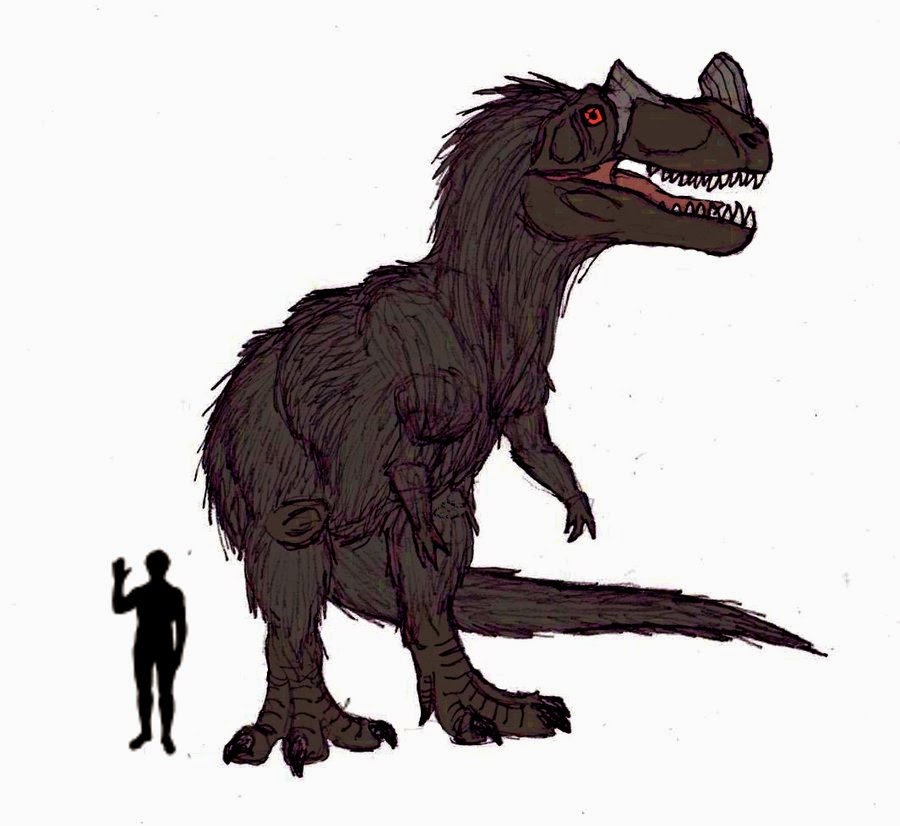
The Indians cowered in terror behind a large rock, and the others were rendered momentarily speechless by the monstrous apparition, but when it became clear that it had not detected them the priest gained sufficient control of his voice to whisper between still-chattering teeth: "A ceratosaurus...It's a ceratosaurus of the Arctic Circle!". Ceratosaurus nasicornis was a large flesh-eating bipedal dinosaur of the Jurassic Period, related to the later, larger Tyrannosaurus rex and readily identified via the large horn near the tip of its upper jaw.

A modern-day reconstruction of Ceratosaurus nasicornis (© DiBgd/Wikipedia)

As they continued to watch, the beast suddenly reared up onto its massive hind legs like a hellish kangaroo, gave voice to an ear-splitting roar again, and then disappeared back down into the ravine via a single immense bound. Not too surprisingly, the beast hunters found that the thrill of pursuing this creature had lost its former charm, and the following morning they journeyed back to Armstrong Creek. Dupuy later attempted to interest the Canadian governor at Dawson City in supplying them with a large-scale hunting party of mules and 50 armed men, but when this failed he returned home to France.

The matter was not quite over, however, for in January 1908 he received a letter from Father Lavagneux, dated Christmas Day 1907, in which the priest informed him that on Christmas Eve, and while in the company of ten Indians, he had seen their monstrous quarry once again - this time racing at speed over the creek's frozen river, with what seemed to be the carcase of a caribou clamped between its great jaws. Tracks identical to those found back in 1903 were clearly visible in the deep mud, and were followed by Lavagneux and company for at least two miles before being obliterated by falling snow.

That appears to have been the last time that the beast of Partridge Creek was spotted, either by Lavagneux or by anyone else, for there does not seem to be any further records on file alluding to this extraordinary creature. Bearing in mind, however, that the existence of such an entity calls for our belief not only in the post-Cretaceous persistence of an endothermic hairy dinosaur but also its existence in what must surely be the least compatible habitat for any type of large reptile living today, its lack of cryptozoological credibility should hardly come as a great surprise!


This ShukerNature post was excerpted from my book In Search of Prehistoric Survivors, which will be reissued later this year.

The original edition of In Search of Prehistoric Survivors