Dr KARL SHUKER

Zoologist, media consultant, and science writer, Dr Karl Shuker is also one of the best known cryptozoologists in the world. He is the author of such seminal works as Mystery Cats of the World (1989), The Lost Ark: New and Rediscovered Animals of the 20th Century (1993; greatly expanded in 2012 as The Encyclopaedia of New and Rediscovered Animals), Dragons: A Natural History (1995), In Search of Prehistoric Survivors (1995), The Unexplained (1996), From Flying Toads To Snakes With Wings (1997), Mysteries of Planet Earth (1999), The Hidden Powers of Animals (2001), The Beasts That Hide From Man (2003), Extraordinary Animals Revisited (2007), Dr Shuker's Casebook (2008), Karl Shuker's Alien Zoo: From the Pages of Fortean Times (2010), Cats of Magic, Mythology, and Mystery (2012), Mirabilis: A Carnival of Cryptozoology and Unnatural History (2013), Dragons in Zoology, Cryptozoology, and Culture (2013), The Menagerie of Marvels (2014), A Manifestation of Monsters (2015), Here's Nessie! (2016), and what is widely considered to be his cryptozoological magnum opus, Still In Search Of Prehistoric Survivors (2016) - plus, very excitingly, his four long-awaited, much-requested ShukerNature blog books (2019-2024).

Dr Karl Shuker's Official Website - http://www.karlshuker.com/index.htm

IMPORTANT: To view a complete, regularly-updated listing of my ShukerNature blog's articles (each one instantly clickable), please click HERE!

IMPORTANT: To view a complete, regularly-updated listing of my published books (each one instantly clickable), please click HERE!

IMPORTANT: To view a complete, regularly-updated listing of my Eclectarium blog's articles (each one instantly clickable), please click HERE!

IMPORTANT: To view a complete, regularly-updated listing of my Starsteeds blog's poetry and other lyrical writings (each one instantly clickable), please click HERE!

IMPORTANT: To view a complete, regularly-updated listing of my Shuker In MovieLand blog's articles (each one instantly clickable), please click HERE!

IMPORTANT: To view a complete, regularly-updated listing of my RebelBikerDude's AI Biker Art blog's thematic text & picture galleries (each one instantly clickable), please click HERE!

Search This Blog


PLEASE COME IN, I'VE BEEN EXPECTING YOU...

PLEASE COME IN, I'VE BEEN EXPECTING YOU...
WELCOME TO SHUKERNATURE - ENJOY YOUR VISIT - BEWARE OF THE RAPTOR!


Sunday, 11 September 2011

A NEWLY-PUBLISHED REVIEW OF MY ALIEN ZOO BOOK


Journal of Scientific Exploration, Vol. 25, No. 3, pp. 609-610, 2011.

Karl Shuker’s Alien Zoo by Karl P. N. Shuker. CFZ (Centre for Fortean Zoology) Press, 2010. 392 pp. $26.99, softcover. ISBN 9781905723621.

This book is an excellent introduction to cryptozoology as well as a feast for people already interested in the subject. There are interleaved chapters dealing on the one hand with specific topics in some depth, on the other hand with snippets of relevant news items from the years 1995 to 2010, arranged chronologically. The items are from columns Shuker wrote for Fortean Times, and several have been updated with more recent information.

The wide scope of cryptozoology is illustrated, and the approaches to specific subjects illuminate the inevitably interdisciplinary character of cryptozoological research: an inescapably needed background of zoological knowledge, plus sophisticated understanding of how to weigh different kinds of evidence, which ranges from actual specimens through photographs and paintings of (claimed) specimens through written reports from the most varied sources to, not least, eyewitness accounts.

That complexity calls for expert guidance, and Shuker is fully equipped to provide it, with a Ph.D. in zoology, membership in learned societies, and long fascination with and work in cryptozoology. Those credentials do not necessarily entail good judgment, of course, and in this vital respect Shuker is very trustworthy indeed. He is determinedly skeptical and his assessments are based squarely on empirical evidence. In cryptozoology as in anomalistics more broadly, the rarest and most desirable resources are compendia that can be relied upon to be factually accurate and judicious in making judgments. In those respects, I rate Shuker’s works as highly as I (and others, of course) rate the works of Jerome Clark. As to specifically cryptozoology, Shuker’s work inevitably reminds one of that of Bernard Heuvelmans, often described as the founder of cryptozoology and also a zoologist by orthodox training. Heuvelmans broke barriers and displayed the bravado needed by those who bring into existence some new institution or subject; Shuker displays the qualities needed by the successors who bring more order and judiciousness to the field.

Alien Zoo offers the pleasure of browsing in the knowledge that one will be able to enjoy it over a long time: Each of the “topic” chapters is an independent essay, and the collections of news snippets in each year or set of years can be taken in one or in several gulps.

The introductory essay, debunking a story published by a quite well-known writer on oddities of Nature, sets the stage appropriately by illustrating Shuker’s diligent perseverance in tracking down evidence and then determinedly hewing to that evidence.

Over the years I’ve read quite widely in cryptozoology, yet I found new specifics here as well as welcome interpretations of more familiar subjects, for instance on the “mystery cats” reported from all sorts of places around the world. New to me were such things as angel feathers, bacteria reproducing in clouds, or the possible relationship between fruit bats and primates—the latter highly instructive about the complex task of tracing evolutionary lineages even in the era of DNA analysis.

I recommend Alien Zoo highly and without reservation. Readers should not neglect what looks at first like many pages of advertisements at the back of the book: On pp. 381–382 there is a list of other works by Shuker that those who appreciate Alien Zoo will then want to read, too. One of my own favorites is the 1995 In Search of Prehistoric Survivors.

HENRY H. BAUER
Professor Emeritus of Chemistry & Science Studies
Dean Emeritus of Arts & Sciences
Virginia Polytechnic Institute & State University
hhbauer@vt.edu
www.henryhbauer.homestead.com

Tuesday, 6 September 2011

HORSE-COWS, SHEEP-PIGS, AND THE REAL BABE!

Babe the Sheep-Pig, created by Dick King-Smith


Countless fully-authenticated cases testify that closely-related animal species sometimes mate successfully with one another, yielding hybrid progeny. Also on file, however, are reports of certain highly controversial hybrids - supposedly resulting from crossbreeding between pairs of animal species generally considered to be too distantly related to yield viable offspring.


UNMASKING THE JUMAR

Take, for instance, the jumar - purportedly the product of an illicit liaison between a horse (or donkey) and a cow (or the reverse cross). The birth of such a creature would require a successful mating between species from two entirely discrete taxonomic orders of hoofed mammal - Perissodactyla (odd-toed ungulates, which include horses and donkeys) and Artiodactyla (even-toed ungulates, which include cattle) - whose respective members are far too dissimilar genetically to yield viable offspring.

Horse x cow interbreeding - not a viable prospect, surely...?

Yet there are many cases of supposed jumars on record, dating back at least as far as 1546, when documented by the learned physician/mathematician Jerome Cardan. It seemed to gain its name from the famous bestiary compiler Conrad Gesner; in the first volume of his great work Historia Animalium (1551), he wrote about a creature resulting "...from a she-ass and a bull, which as I hear is met with at Gratianopolis, and is called the jumar in French".

Referring to the jumar in Magiae Naturalis (1558), Neapolitan physicist Giovanni Battista della Porta stated: "I myself saw at Ferraria, certain beasts in the shape of a Mule, but they had a Bull's head, and two great knobs instead of horns: they also had a Bull's eyes, and were exceedingly stomackful, and their colour was black...I have heard, that in France, they be common: but I could see none there, though I have passed through the whole country".

Photoshop's answer to the jumar

Throughout the 17th Century, scholars readily accepted the jumar's reality, but during the 18th Century scepticism grew, voiced in particular by the eminent French zoologist George de Buffon in his Histoire Naturelle. Buffon oversaw the dissection of two supposed jumars, one from the Pyrenees, the other from Dauphiné, but found no trace of bovine characters in either specimen.

The same outcome was obtained from the dissection of two jumars at the instigation of Cardinal Delle Lanze. They were nothing more than small, stunted mules, just like other jumars subsequently examined. Experiments striving to induce matings between stallions and cows, and between bulls and mares, were wholly unsuccessful too. And so, by the end of the 1700s this impossible hybrid had finally been exposed and expunged.

Exit the jumar.


CUINO - IN SEARCH OF THE REAL BABE

Whereas novelist Dick King-Smith's world-famous if entirely fictitious sheep-pig Babe was merely a piglet trained to herd sheep, there are many reports on file of what were supposedly the real thing.

Accepted by some writers until much more recently than the jumar, yet scarcely less improbable, was the cuino - claimed to be a hybrid of sheep and pig, and widely met with in the Mexican state of Oaxaca. At the turn of the 19th Century, a highly-esteemed American journal called the Breeder's Gazette published a detailed article concerning the cuino, in which it stated that this remarkable crossbreed results from matings between sows and polled (de-horned) rams of the typical long-legged, light-bodied Mexican sheep.

In a somewhat contradictory account, the article claimed that the cuino has: "...the form and all the characteristics of the pigs, but he is entirely different from his dam; he is round-ribbed and blocky, his short legs cannot take him far away from his sty, and his snout is too short to root. His head is not unlike that of the Berkshire. His body is covered with long thick curly hair, not soft enough to be called wool, but which, nevertheless, he takes from his sire. His colour is black, white, black and white or brown and white".

No, these are NOT photoshopped - these are real! (click photo for enlargement)
See below* for details concerning their zoological identity (photo/website credits as given in photos).

In 1900, this and various similar accounts, including one concerning Brazilian cuinos, came to the attention of W.B. Tegetmeier of London's Zoological Society, who duly denounced the cuino's crossbred identity in a series of communications within The Field. The matter was finally resolved in 1902, when he received a cuino skull from a Mexican correspondent.

Quoting Tegetmeier's response:

"I was very glad to receive the skull, but, as I anticipated, it has no hybrid character about it whatever. It is purely and simply the skull of a pig. Without stopping to enter into such details as the character of the orbit, or the articulation of the lower jaw, which are utterly distinct in the sheep and in the pig, I need only call attention to the teeth in the fore part of the upper jaw. These are present as in the pig, and perfectly developed, whereas in the sheep, as every anatomist knows, the fore part of the jaw is utterly destitute of teeth, there being only a horny pad against which the lower incisors act. No zoologist could for a moment regard the skull as showing the slightest trace of ovine structure. In order to obtain corroboration of these facts I exhibited the skull at the last meeting of the Zoological Society, and its true character was recognised by every anatomist and zoologist present who noticed it."

Farewell the cuino.

However, there are no less than three surviving, genuine breeds of pig that are often dubbed sheep-pigs on account of their very distinctive and decidedly unporcine woolly coats. These curly-haired curiosities are collectively known as mangalitzas (aka mangalitsas), and although originally bred in Hungary and the Balkans, mangalitzas are now reared elsewhere in the world too. Indeed, it is more than likely that some reports of cuinos were actually based upon sightings of mangalitza-like pigs, i.e. freak hairy specimens of Mexican pig breeds, or possibly even early imported specimens of genuine mangalitzas.

Swallow-bellied mangalitza hog at the Franciscan Monastery gardens in Kadaň, Czech Republic (click photo for enlargement)

Traditionally maintained as lard pigs, they subsequently fell out of favour when the popularity of lard diminished. As a result, some breeds of mangalitza eventually died out, such as the black, the wolf, and the baris, although there are plans to reconstruct them in Hungary via selective backbreeding using a mixture of other breeds.

Prior to its extinction, the black mangalitza had been bred with the blonde mangalitza (two specimens of which arrived in April 2010 at Tropical Wings Zoo in Essex, England, as part of an education and breeding program, and are featured in the two photos* included earlier in this blog post), yielding the swallow-bellied mangalitza (which, like the bird that it is named after, has a dark upper body but paler underparts). And by breeding the swallow-bellied mangalitza with the szalonta (a hardy, unfleeced Hungarian breed), a further form known as the red mangalitza has been created, sporting a ginger fleece. The red, blonde, and swallow-bellied trio still exist today, but remain scarce enough to be categorised as rare breeds. There was once an additional, totally separate breed of woolly pig - the Lincolnshire curly-coat - but just like the black, wolf, and baris mangalitzas, it too, sadly, is now extinct

Hair today, gone tomorrow - 'twas ever thus.

Tuesday, 23 August 2011

WELCOME TO MY ECLECTARIUM!


It's taken a while, but I've finally got around to establishing a blog devoted to my varied interests outside cryptozoology, animal mythology, and poetry.

Entitled 'The Eclectarium of Doctor Shuker', it will encompass everything from fantasy art and novels, James Dean, masks, Forteana, motorbikes, clowns, science fiction, ancient civilisations, science anomalies, stamp collecting, Sherlock Holmes, animation, the supernatural, rock 'n' roll music, quiz trivia, and much more.

If it's unusual, intriguing, and obscure, there's a good chance it will appear here, sooner or later! So please check it out, at:

http://eclectariumshuker.blogspot.com/

Tuesday, 16 August 2011

SURF HIPPOS, HERE THEY COME!

Surfing hippopotamus (picture source unknown)

Hippopotamuses surfing in the sea may seem as improbable as polar bears gambolling across the desert, but as the remarkable photograph above readily demonstrates, in the world of nature few things are even impossible, let alone merely improbable. For although the common hippopotamus Hippopotamus amphibius is traditionally associated with freshwater habitats, such as rivers and lakes, it does also frequent saltwater in certain localities. These include the southern Orango group of islands, part of the Bijagos Archipelago in the Atlantic Ocean off the western coast of Guinea Bissau (formerly Portugese Guinea) in western Africa, which are now a national park. Saltwater hippos occur off the Kenyan island of Manada Toto too, and - the location of the stunning photo here - in the Petit-Loango Reserve in southwestern Gabon. Here, the hippos spend much of the day taking their ease in swamps and lagoons close by, but emerge at dusk to graze upon grass along the beach and indulge in boisterous surfing safaris out to sea.

Photos of surfing hippos in South Africa (sources unknown) 

What makes such scenes even more extraordinary than their mere setting is the fact that despite being intimately associated with water, hippos are far from being the animal world's most competent swimmers.

Only when seen in its entirety on land, can the hippo's immense size be fully comprehended (Dr Karl Shuker) 

Indeed, even though their massive bulk (they are beaten in the heavyweight stakes among terrestrial mammals only by the elephants and some rhinoceroses) is effectively buoyed by their aqueous surroundings, these gargantuan cousins of pigs and peccaries (but actually most closely allied to whales, dolphins, and other cetaceans) often do not venture into expanses of lake or river deeper than their own bodies.

Common hippopotamus (Dr Karl Shuker)

Even hippos seen with just their heads above water are, in reality, usually standing on the riverbed or lake bottom, stretching their necks to keep their heads above water, ably assisted by the evolutionary relocation of their eyes, ears, and nostrils close to the top of their heads. If, moreover, a hippo does decide to dive or swim underwater, a reflex action closes its ears and nostrils entirely, and it will commonly stay wholly submerged for 3-5 minutes - but may, if required, continue to do so for up to 30 minutes! And as the surfing hippos ably prove, if necessary it can indeed swim unaided by terra firma beneath its feet.

Note the hippo's upward-opening nostrils (Dr Karl Shuker) 
 
Equally interesting is that despite their far-from-streamlined form, hippos are able to attain some nifty turns of running speed - even underwater. One hippo was timed charging along the bed of a river at a highly respectable 5 miles per hour, in spite of the appreciable drag effect of its watery surroundings acting upon it. And on land, hippos can readily outpace human runners, having been timed at up to 30 miles per hour - so beware!

Hippopotamus figurine carved out of blue sodalite

Certainly, hippos, in spite of being predominantly peaceful creatures, have acquired a formidable reputation as arguably the most dangerous animal to humans in Africa - adult females are notoriously ferocious if challenged or disturbed when they have calves. Their weapons are of course their colossal mouths, armed with huge curving tusks. Including their gum-embedded roots, the lower canine teeth of a hippo can sometimes grow up to 3 ft long - the length of an average human arm! And when a male hippo opens its stupendous jaws to yawn - not an indication of boredom, incidentally, but a sign of aggression toward another male seeking to invade its territory, or of courtship intent toward a female - the resulting gape can be up to 150°. Only whales among mammals can outgape a yawning hippo!

Hippo gape (Aqwis/Wikipedia)

Indeed, it has been claimed that a hippo can open its jaws wide enough to accommodate a 4-ft-tall child inside! And this beast's mighty maws are so powerful that an adult specimen can bite a 12-ft-long crocodile in half! But even when not chomping a croc, male hippos fighting for territory can inflict terrible wounds upon each other, and even kill one another, with their huge curved tusks.

Skull of common hippopotamus
 
So tough, in fact, are these awesome teeth that little more than a century ago hippo ivory was popular among dentists for use in manufacturing human artificial teeth - once they had succeeded in dissolving with acid the yellow enamel covering the ivory, because this enamel is as hard as glass and accounts for a third of each tusk's total weight! Much further back in time, the ancient Egyptians carved amulets for babies out of hippo ivory, believing that this substance had the power to ward away demons. Furthermore, the Egyptian goddess of childbirth, Taueret, was popularly portrayed as a bipedal hippopotamus. 

Statuette of Taueret carved out of faience (Jon Bodsworth) 
 

Undoubtedly, the hippo attracted great interest from early humans, and not just on account of its huge size and formidable jaws, but also due to the longstanding belief that it could sweat blood. The explanation for this curious but totally inaccurate notion is that in order to ensure that its thick, almost-hairless skin remains supple and moist when out of the water, and also to avoid it becoming sunburnt, the hippo secretes a sticky, oily, pink-hued substance from glands beneath the surface of its skin, which on first glance can appear a little like seeping blood but is in reality an efficient, ready-made sun-block! It may also act as an antibiotic, helping to promote germ-free healing of wounds inflicted upon each other by bellicose male hippos. 
 
Having said that, a rare bona fide pink hippopotamus was photographed in Kenya's Masai Mara Game park during late September 2010 by British tourist brothers Will and Matt Burrard-Lucas (and others have previously been reported in Uganda). Apparently a leucistic individual, exhibiting reduced body pigmentation, photos and a full news report of this extraordinary creature can be found here: http://www.dailymail.co.uk/news/article-1315917/Rare-pink-hippo-images-captured-Masai-Mara-Kenya.html 

Another of the hippo's secrets, conversely, has only been revealed quite recently. Not surprisingly, for a creature that spends so much of its time partly or fully submerged, the hippo is able to vocalise not merely on land but underwater too - thanks to a stentorian voice and powers of vocal projection that would put even the most skilled of human opera singers to shame. Hippos can communicate with one another directly through the medium of water via ear-splitting bellows of such potent force that they can be both heard and physically felt by anything positioned up to 50 ft away! But that is not all - scientists have lately discovered a hitherto unsuspected infrasonic component to this bellow, an amazing rumble beneath the threshold of human hearing but which can be detected underwater by other hippos as far away as 18.7 miles!

Hippo swimming (Dr Karl Shuker)
 

No less amazing than its voice, however, are the eyes of the hippo - due to the bizarre shape of their pupils, each resembling an inverted, smooth-cornered capital 'T'! Yet again, this is an evolutionary adaptation to assist the hippo in its amphibious lifestyle, for it uniquely (among mammals) enables the hippo to see above and below the water surface with the same intensity of light, thus yielding a complete view, unimpeded by the water. 
 
Pygmy hippopotamuses 


Less familiar, smaller, and much daintier than the well known, common hippopotamus is the much more terrestrial, forest-dwelling pygmy hippo Choeropsis (=Hexaprotodon) liberiensis, which looks more like an over-sized shiny-black pig than a hippo. For many years, the very existence of this reclusive animal was discounted by science, in spite of longstanding native testimony and reports brought back to Europe by western travellers. Some even attempted to dismiss it as nothing more than a freak, stunted version of the common, larger species. As noted in my book The New Zoo: New and Rediscovered Animals of the Twentieth Century (2002; new, greatly-expanded edition due out later this year!!!), not until five living specimens were brought back alive by German explorer Hans Schomburgk in 1913 was the pygmy hippo scientifically accepted as a second, valid species of hippopotamus in its own right. 
 
Pygmy hippos


Most remarkable of all, however, is that there could even be a third, supposedly long-extinct species of hippo still awaiting scientific detection - on the island of Madagascar. Several millennia ago, at least three different species of undersized, dwarf hippo existed here, but these are officially deemed to have died out long ago. However, even today locals in southwestern Madagascar occasionally claim to encounter a shy, unidentified mystery beast that they refer to as the kilopilopitsofy or tsomgomby, which, when described by them, sounds irresistibly similar in both appearance and habits to a small form of hippo. Even the alleged vocalisations of the kilopilopitsofy seem remarkably reminiscent of the bellows of a hippo. 

Is the kilopilopitsofy a surviving species of Madagascan dwarf hippo? (Dr Karl Shuker)
 

Clearly, the fascinating realm of the river horse - the literal translation of 'hippopotamus' - may still have some hefty surprises in store! 

My late grandmother Gertrude Timmins's blue hippopotamus ornament - a fond memory from my childhood (Dr Karl Shuker) 

 
NB - Unless stated otherwise, all images included in this post are, to the best of my knowledge, in the public domain.


Saturday, 16 July 2011

THE HOBBIT ACTOR AND A REAL-LIFE SHELOB – OR SOMETHING PRETTY DARN CLOSE?


With my very own Shelob! (credit: Dr Karl Shuker)

British actor Dominic Monaghan has starred in many films and TV series, but is probably best-known for his role as the hobbit Merry in Peter Jackson’s spectacular ‘The Lord of the Rings’ (LOTR) trilogy of movies, based upon J.R.R. Tolkien’s monumental fantasy epic.

However, following a tip-off from a member of my regular pub quiz team (thanks Mark!; who said that pub quizzes aren’t educational?!), earlier this year I came upon a very intriguing online report previously unknown to me that suggested Dominic might have been taking his LOTR role even more seriously than expected. In LOTR, two of Merry’s fellow hobbits, Frodo and Sam, experience a life-threatening encounter with Shelob – a colossal spider. Yet whereas Shelob was fictional, the media report, which was reproduced on several websites, claimed that Dominic was planning to launch a 12-man expedition in search of a real-life mega-spider that, if proven to exist, would be the world’s largest.

Dominic Monaghan in his LOTR role as the hobbit Merry (credit: New Line Cinema Productions)

According to this report (click here to view it), which was written by Alexandru Stan and published on InOut Star’s website on 12 March 2008, the spider in question was called the hercules baboon spider, measured 14-15 inches across, and, of particular interest, was known only from a single specimen obtained in Nigeria during the early 1900s, which is now preserved in alcohol at London’s Natural History Museum.

As the Life Sciences Consultant for Guinness World Records (formerly known as The Guinness Book of Records), I am naturally well aware that the current record-holder as the world’s largest species of spider by mass is the goliath bird-eating spider Theraphosa blondi. This nocturnal burrowing species, native to wet swamps and marshy areas in the mountain rainforests of northeastern South America, boasts a leg span of up to 11 in (the diameter of a dinner plate!), and can weigh over 6 oz.

Indeed, the biggest specimen of this species on record was a 12-year-old captive female called Rosi, which sported a body length alone of 119.4 mm (4.7 in), i.e. not including its leg length, and weighed an astonishing 175 g (6.17 oz) – which is almost as heavy as six house sparrows! Consequently, any spider that allegedly exceeds these dramatic dimensions, and, as a bonus, is also virtually unknown to science, is definitely going to attract my undivided attention!

An adult female specimen of the goliath bird-eating spider Theraphosa blondi

Eager to learn more, in case Guinness’s existing record for the largest spider species by mass needed to be amended, I lost no time in researching this subject personally and also contacting a number of likely sources of further information, including the Natural History Museum itself, as well as a number of other institutions, organisations, and individuals. Over the next few weeks, a welter of information came my way, the most informative of which can be summarised as follows.

Firstly, I discovered to my surprise that in spite of the report’s claim that only a single specimen of hercules baboon spider existed, there seemed to be a veritable embarrassment of specimens out there in the pet trade, and there was even a plentiful supply of videos posted on YouTube of what were claimed to be hercules baboon spiders. Something, clearly, was amiss here – but what?

After learning of my desire to discover as much as I could regarding this enigmatic species, palaeontologist Dr Darren Naish, who shares my own interest in cryptozoological matters, sent me the following illuminating email on 16 March 2011:

"It is implicated by spider people that the things now being called 'hercules baboon spiders' are actually nothing of the sort (they're actually king baboon spiders), and that the animal that really should go with this name is indeed only known from the type specimen."

Pursuing this promising lead, I discovered that the ‘real’ hercules baboon spider is Hysterocrates hercules, which is genuinely known only from its type specimen or holotype – a female collected by a Lieutenant Abadie at Jebba in what was then Upper Niger, now Nigeria. Characterised by a black cuticle covered with a thick coating of dark olive-brown hairs, and shining with a greyish silky sheen under reflected light, as well as by having the fourth leg unthickened, this unique specimen is held at the Natural History Museum, and its species was formally described in the 14 November 1899 issue of the Proceedings of the Zoological Society of London by none other than renowned British zoologist Reginald I. Pocock.

As for the so-called hercules baboon spider specimens in the pet trade and on YouTube, these pretenders to the throne of H. hercules are indeed specimens of the related but smaller king baboon spider Pelinobius muticus (aka Citharischius crawshayi, a junior synonym), which is an East African species with a leg span of up to 8 in. So there was the first riddle concerning the hercules baboon spider duly solved.

The hercules imposter – a king baboon spider Pelinobius muticus

On 21 April, I received another very insightful email, this time from Richard Gallon, the administrator of the British Tarantula Society Study Group:

"I can confidently state that Pocock’s holotype specimen of Hysterocrates hercules (which I have measured and examined for forthcoming taxonomic papers) does not even come close to members of the genus Theraphosa in terms of leg-span or body mass.

"Pelinobius muticus females are large and bulky, but not as large as H. hercules or any Theraphosa. Indeed there are several South American genera (e.g. Pamphobeteus, Sericopelma, Lasiodora etc.) which are bigger than these African taxa."


Judging from this, Dominic’s notion that H. hercules may well be the world’s biggest spider appeared to be in error – an assumption comprehensively confirmed when I received on 21 May an email from Dr George Beccaloni of the Natural History Museum containing the following crucial details:

"With regard to the West African baboon spider Hysterocrates hercules, it is certainly very large, but the heaviest spider known is undoubtedly the 175 gram [6.17 oz] female Theraphosa blondi listed by Guinness, and the largest in terms of legspan is the giant huntsman Heteropoda maxima, from caves in Laos, which has an accurately measured maximum legspan of 300 mm [12 in]...Any claims of larger spider specimens remain to be proven - and I don't think that any baboon spider is likely to displace the current champions!"

On 3 June, Jan Beccaloni, the museum’s arachnid curator, also emailed me, kindly enclosing some information received from fellow arachnologist and theraphosid specialist Ray Gabriel from the British Tarantula Society, who stated that H. hercules is only about two-thirds the size of T. blondi.

So there it was – everyone was agreed that H. hercules was neither the heaviest species of spider nor even the species with the greatest leg span. And that seemed to be the end of the matter, until, in a subsequent email, Dr Beccaloni suggested a highly entertaining means of publicising this former controversy – by staging at the Natural History Museum a filmed comparison by volume of the type specimen of H. hercules with a suitably sizeable specimen of T. blondi, supervised by a member of the Guinness World Records (GWR) team. Needless to say, I considered this to be an excellent idea, and passed it on at once to the editor of GWR, Craig Glenday, who thought so too, and was happy to act personally in the capacity of official adjudicator.

And so it was that my original investigation of H. hercules ultimately led to a filmed ‘Battle of the Spiders’ weigh-in at the Natural History Museum later last month (June 2011), conducted by Dr George Beccaloni and witnessed by Craig Glenday for GWR. Utilising Archimedes’ Principle of liquid displacement as a means of accurately determining the volume of the challenger (the H. hercules holotype) and the defender (a hefty adult female T. blondi called Tracy, a long-deceased pet of Jan Beccaloni) as both were preserved in alcohol, the two species’ rival claims to the title of the world’s heaviest spider were finally put to the test.

The Natural History Museum’s online press release, containing a video of this historic arachnological bout, can be viewed here.

And the result? Tracy’s volume was found to be more than double that of the H. hercules holotype. In short, a straight knock-out, with T. blondi the undisputed heavyweight spider champion, retaining its title with ease.

Even so, as a nonetheless respectably (albeit not superlatively) large species yet still known only from a single specimen, H. hercules retains an air of mystique. Moreover, Dominic Monaghan never did succeed in launching an expedition to look for it. Consequently, an excellent way to bring this investigation to a satisfactory close would be for an intrepid spider seeker to pursue the hercules baboon spider in the field, as the rediscovery of this long-lost semi-Shelob is certainly long overdue! Any takers?

A model of the LOTR’s mega-spider, Shelob (credit: Dr Karl Shuker)

I wish to thank everyone who assisted me during my researches into this fascinating case, in particular Dr George and Jan Beccaloni of the Natural History Museum, Ray Gabriel and Richard Gallon from the British Tarantula Society, Craig Glenday at Guinness World Records, and Dr Darren Naish for their most welcome expertise and interest.


Sunday, 3 July 2011

SEEKING THE SANDEWAN - ON THE TRAIL OF A TRAIL...OF BLOOD!

A trail of blood

Cryptozoology - the study of mystery animals - has a seemingly infinite capacity for springing surprises, by unfurling accounts of extraordinary beasts of the most unexpected nature, met with at the most unexpected times. So it was that when English zoologist Carina Norris, arrived in southern Africa during the late 1990s for a well-earned vacation, she little realised that she would soon be pursuing the unique trail of a bizarre creature that apparently had never been documented before in the cryptozoological chronicles (my book Mysteries of Planet Earth, 1999, became the very first to do so). Nevertheless, trail it she did, so here is the strange history of the elusive sandewan.

It was in northern Zimbabwe's Chizarira National Park where their white guide showed Carina and fellow members of her trekking party the sandewan's sinister but diagnostic trail - for whereas other beasts leave behind footprints, the sandewan always yields a trail of blood. Carina's guide claimed that this creature was very much a legend of the local native trackers, and was not spoken of by the country's white inhabitants. Nevertheless, the characteristic sign of the sandewan's recent presence here was undeniably visible for all to see. It occurred on an area of rocky ground, and consisted of a series of large red spots, each an inch or two across, which led towards a cliff face, where they simply petered out.

The guide commented that various 'orthodox' explanations for such enigmatic trails as these had been proposed in the past, such as spots of fruit juice left behind by frugivorous monkeys, or simply bird droppings. However, in Carina's opinion the spots certainly looked like blood, thus indicating that it was the trail left behind by a wounded animal. Moreover, as the trail consisted of discrete spots, it seemed more likely that the animal was running and therefore not badly wounded, rather than being an extensively wounded animal that might be expected to drag itself along the ground, and thus leave a smeared trail instead.

Needless to say, however, nothing in cryptozoology is quite so straightforward as this, and the sandewan is no exception. From the amount of blood present in the trail, it seemed reasonable to assume that the creature in question was fairly large. Yet when Carina and her party followed its sanguineous progression, they discovered that it passed under low branches and through narrow crevices, where only a very small animal could move. And how could it simply vanish when it reached the cliff face - unless, as in all the best lemming legends, it hurled itself over the edge; or simply flew away, on unsuspected wings?

According to local lore, if anyone is fortunate enough to capture a sandewan and presents it to the tribal chief, he will receive great riches. Unfortunately, however, there does not appear to be any record of what a sandewan actually looks like, so unless you are successful in following its bloodied trail and can stealthily pounce upon it, your chances of gaining such wealth are somewhat on par with winning the Lottery jackpot

Yellow-spotted rock hyrax (D. Gordon E. Robertson/Wikipedia

It has been suggested, on account of its preference for rocky terrain, that the sandewan may be a hyrax, a very small hoofed mammal superficially resembling a burly guinea-pig yet taxonomically akin to the elephants (I saw rock hyraces Procavia capensis when I visited Table Mountain and the Shamwari Private Game Reserve in South Africa during 2008). However, these mammals are herbivorous, whereas the sandewan's trail of blood (assuming of course that the substance in question is genuinely blood) implies a carnivore.

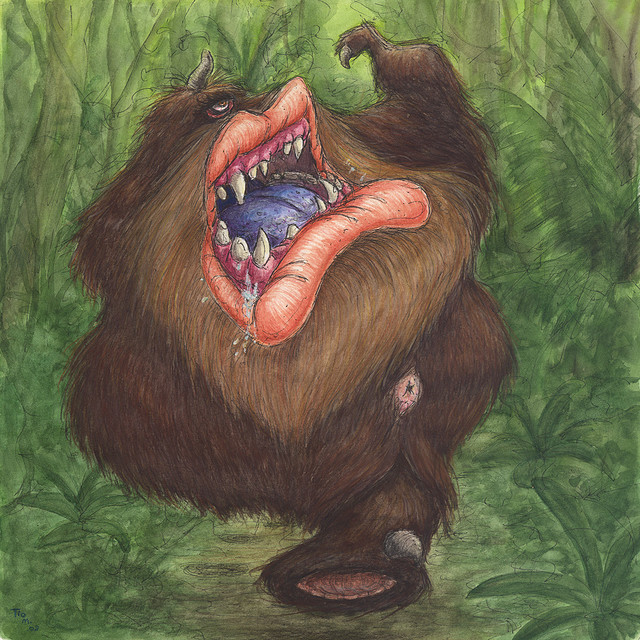
Although the biochemical nature of the sandewan's trail may be unique in cryptozoology, there are many other cases on record of mysterious tracks left behind by elusive beasts of wholly unknown morphology. One of the most peculiar of these is the amazing pe de garrafa ('bottle foot'), said to inhabit the dense verdant rainforests of Brazil. It is named after its extraordinary trail, which comprises a single line of deep prints resembling the circular holes that would be created by repeatedly pressing the bottom of a bottle into the ground!

Pe de garrafa (© Tio Merka


Among the various unsatisfactory identities that have been offered over the years for the mysterious maker of these tracks are an unknown form of bipedal South American ape, or even a deer with a broken leg. To quote the wry words of veteran cryptozoologist Dr Bernard Heuvelmans, however, in On the Track of Unknown Animals (1958):

"...it is hard to see how a limping animal could have left such a regular track, or indeed how anything short of a race of three-legged deer could have accounted for all the tracks of the pe de garrafa seen in the Amazon jungle."

Much closer to home, during the early snowy morning of 9 February 1855 a series of baffling tracks mysteriously appeared over a considerable area encompassing the Devon towns of Topsham, Lympstone, Exmouth, Teignmouth, and Dawlish. According to a detailed account published in The Times on 16 February, the track looked more like a biped's than a quadruped's. Each print was generally placed 8 in ahead of the one before, resembled a donkey's shoe, and measured 1.5-2.5 inches across. Moreover, these prints appeared in the most unexpected locations, running across the tops of houses and narrow walls, through gardens and courtyards enclosed by high walls, and even vanishing in the middle of open fields.

Painting of devil's hoofprints from 1855


Due to their mystifying nature and origin, Devon's eerie tracks became known as the devil's hoofprints. The most popular solution for them is they were made by fieldmice, but just like the sandewan's trail they have never been conclusively explained. A similar incidence of mystery tracks occurred during March 2009 in the Devon village of Woolsery.

As for the sandewan: unless someone can track it successfully to its lair, this bewildering beast's identity will doubtlessly remain unrevealed indefinitely. And as there are few things deemed by native hunters to be more dangerous than a wounded, bleeding animal - particularly one whose identity is not even known - how many hunters are likely to be brave (or foolhardy?) enough to attempt pursuing such a creature anyway?


UPDATE: 24 September 2012

Today, I was delighted to receive from Facebook friend Andrew D. Gable the following newspaper report concerning the sandewan, but this time from South Africa, showing that belief in this mystifying entity is not confined to Zimbabwe. Thanks, Andrew!

Sandewan newspaper report, Middlesboro (Kentucky) Daily News, 5 May 1939

Monday, 13 June 2011

THE TRANSFORMATION OF SAINT EUSTACIUS

'White Hart' - Mike Hearld


Certain religious stories, such as St George and the Dragon, have generated very considerable interest down through the centuries and have become extremely well known, but there are others that have attracted much less notice, yet are no less memorable. The following story is one of these hitherto-neglected Christian legends, which has always stayed in my mind ever since I first read it many years ago, so I finally decided to retell it in verse.

THE TRANSFORMATION OF SAINT EUSTACIUS

Through the emerald forests
Of golden-hued Dawn,
Rode Eustacius, a soldier
Of Rome, one fine morn,
As his hounds bayed all round him
With dark, fearful eyes,
Like a torrent of shadows
‘Neath newly-born skies.

So the soldier rode onward
Through golden-leaved trees,
While the hounds’ dismal howling
Still hung on the breeze
Like a dream half-forgotten
‘Twixt Future and Past –
Yet still doomed by its maker
Forever to last.

Then ahead of Eustacius
A white stag appeared,
And the soldier’s steed trembled,
Then, shivering, reared.
Just as if the stag’s presence
Imbued it with awe,
As the hunter peered onwards
And then, the deer, saw.

All at once, the stag stiffened,
Then fled through the trees,
But Eustacius pursued it,
Through clearings and lees.
On he chased this white wonder,
Past mountains and vales,
And the morn became noontide
In forests and dales.

Later, Evening drew gently
The curtains of Night
Far across the blue heavens,
Now dappled with light
From the glistening stars set
In countless array,
Each a tiny eye peering
Through blankets of grey.

And as they witnessed softly
The hunt far below,
E’en the moon wept in sadness,
And shrouded its glow
To give cover of darkness
‘Midst shadowy glades
To the hunted stag, weary
As still the hounds bayed.

But the stag was now tiring,
Its head dangled low,
As its heart heaved and pounded,
Its eyes full of woe,
Till it sank down exhausted
On carpets of dew,
As the hounds’ ghastly howling
More terrible grew.

Then Eustacius perceived it,
Stretched outwards to die,
As its fragile heart throbbed ‘neath
The sorrowful sky.
And the stag watched the soldier
With eyes dark and mild,
For it made no swift movement,
Yet cried like a child.

Then a pale shaft of moonlight
Fell softly from Space,
And its shimmering beauty
Lit up the deer’s face.
And as all the world waited,
The stag raised its head.
Its mouth opened, and then, with
A human voice, said:

“Why dost thou still pursueth
Me long through the trees?
I am Christ,” as Eustacius
Dropped low to his knees.
For the stag was surrounded
By radiant light,
Like a star incandescent
That passed from all sight

To the heavens resplendent
In Glory Divine.
Then Eustacius looked up, and
Drew slowly the Sign
Of the Cross there before him –
A new saint was born,
In the reincarnation
Of God’s golden Dawn.

This poem is just one of more than a hundred that are contained within Star Steeds and Other Dreams - my first volume of poetry, published by the CFZ Press in 2009.