Dr KARL SHUKER

Zoologist, media consultant, and science writer, Dr Karl Shuker is also one of the best known cryptozoologists in the world. He is the author of such seminal works as Mystery Cats of the World (1989), The Lost Ark: New and Rediscovered Animals of the 20th Century (1993; greatly expanded in 2012 as The Encyclopaedia of New and Rediscovered Animals), Dragons: A Natural History (1995), In Search of Prehistoric Survivors (1995), The Unexplained (1996), From Flying Toads To Snakes With Wings (1997), Mysteries of Planet Earth (1999), The Hidden Powers of Animals (2001), The Beasts That Hide From Man (2003), Extraordinary Animals Revisited (2007), Dr Shuker's Casebook (2008), Karl Shuker's Alien Zoo: From the Pages of Fortean Times (2010), Cats of Magic, Mythology, and Mystery (2012), Mirabilis: A Carnival of Cryptozoology and Unnatural History (2013), Dragons in Zoology, Cryptozoology, and Culture (2013), The Menagerie of Marvels (2014), A Manifestation of Monsters (2015), Here's Nessie! (2016), and what is widely considered to be his cryptozoological magnum opus, Still In Search Of Prehistoric Survivors (2016) - plus, very excitingly, his four long-awaited, much-requested ShukerNature blog books (2019-2024).

Dr Karl Shuker's Official Website - http://www.karlshuker.com/index.htm

IMPORTANT: To view a complete, regularly-updated listing of my ShukerNature blog's articles (each one instantly clickable), please click HERE!

IMPORTANT: To view a complete, regularly-updated listing of my published books (each one instantly clickable), please click HERE!

IMPORTANT: To view a complete, regularly-updated listing of my Eclectarium blog's articles (each one instantly clickable), please click HERE!

IMPORTANT: To view a complete, regularly-updated listing of my Starsteeds blog's poetry and other lyrical writings (each one instantly clickable), please click HERE!

IMPORTANT: To view a complete, regularly-updated listing of my Shuker In MovieLand blog's articles (each one instantly clickable), please click HERE!

IMPORTANT: To view a complete, regularly-updated listing of my RebelBikerDude's AI Biker Art blog's thematic text & picture galleries (each one instantly clickable), please click HERE!

Search This Blog


PLEASE COME IN, I'VE BEEN EXPECTING YOU...

PLEASE COME IN, I'VE BEEN EXPECTING YOU...
WELCOME TO SHUKERNATURE - ENJOY YOUR VISIT - BEWARE OF THE RAPTOR!


Saturday, 8 April 2017

SEEKING THE SANDWELL VALLEYGATOR!


North America's common snapping turtle, from John Edwards Holbrook's book North American Herpetology (1842) (public domain)

It may be the town in which I was born, but West Bromwich in the West Midlands, England, is more readily associated with football, courtesy of West Bromwich Albion FC, than cryptozoology - until the Sandwell Valleygator came on the scene, that is, as now recalled in this ShukerNature retrospective.

Also nicknamed the Sandwell Snapper in early media accounts and initially likened to a crocodile, caiman, or alligator, this elusive aquatic cryptid first reared its snouted head on 30 March 1999. That was when fisherman Mike Sinnatt saw what he initially thought to be "a marvellously shaped piece of wood", measuring over 2 ft long, suddenly come alive and attempt to seize an unsuspecting Canada goose on Swan Pool.

Partial view of Sandwell Valley RSPB Reserve (© Bill Payer/Wikipedia - CC BY-SA 2.0 licence)

Situated in an RSPB (Royal Society for the Protection of Birds) reserve within the Sandwell Valley Country Park - a verdant oasis for nature right in the heart of urbanised West Brom - Swan Pool measures more than a mile in circumference, and is not only inhabited by a rich variety of waterbirds but also is popular for angling, yachting, and wind-surfing.

Or at least it was until, within a short time of Sinnatt's sighting, a dozen other similar reports had surfaced, all describing a fairly sizeable four-legged aquatic beast with a notable snout, long tail, and a penchant for snapping at anything avian or piscean that came too near. Eyewitnesses included local angler Tony Price and pool lifeguard Ricky Downes, who spied its two "very chunky" hind legs and tail.
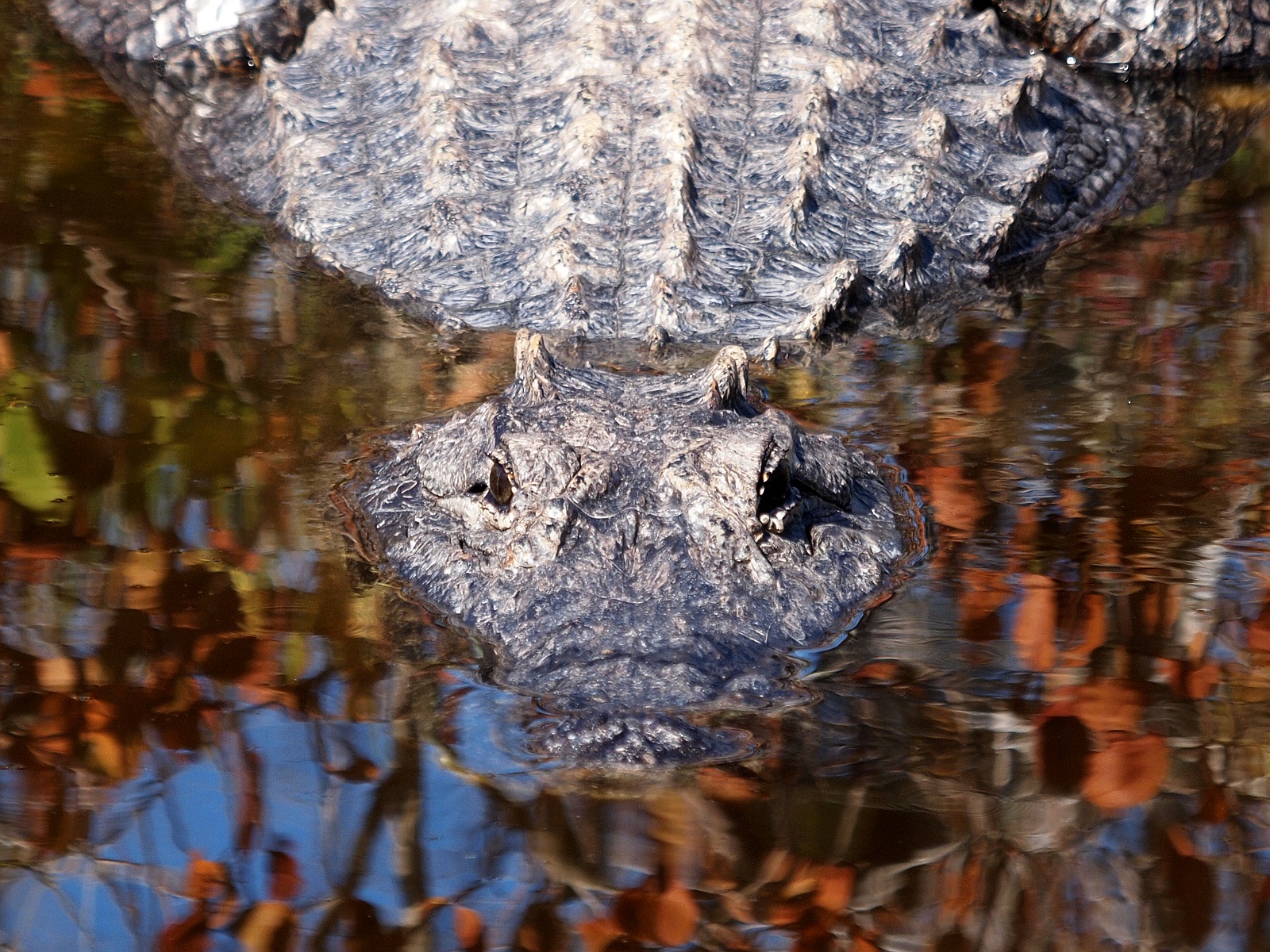
Was an alligator lurking in the Sandwell Valley?? (public domain)

Occurring so close to the beginning of April, the Sandwell Valleygator was originally dismissed by sceptics as a hoax, but this was strenuously denied by Sandwell Council, who were so concerned about the potential danger posed to the general public by the creature that they closed the pool to all watersports throughout the Easter Bank Holiday (3-6 April 1999). Needless to say, however, the considerable media publicity generated not only locally but also nationally and even internationally by Swan Pool's stealthy snapper resulted in a massive influx of visitors here (estimated at more than 9,000) during the Bank Holiday, all eagerly scanning the reed beds and shallows in search of its cryptic alligatorian (or crocodilesque?) interloper.

As I deemed it highly unlikely that the creature would appear when confronted by such a barrage of human activity, however, I waited until the holiday period was over before visiting Swan Pool myself. Walking around this sizeable lake, peering at the large island present at its centre, at the smaller pools and marshes fringing its border, and down into its murky depths, it swiftly became evident that an aquatic creature of the proportions described by the Valleygator's eyewitnesses could live out a secluded, rarely-spied existence here indefinitely.

I’m keeping a sharp lookout for the Sandwell Valleygator! (© Dr Karl Shuker)

Yet although neither the Valleygator itself nor any convincing reports of it surfaced during the Bank Holiday or my own subsequent visit, official opinion as to its identity had by now veered away from the scenario of a vicious snap-happy crocodile, caiman, or suchlike to the rather more placid scenario of a giant salamander. Specifically, the North American hellbender Cryptobranchus alleganiensis, which measures up to 30 in long, subsists upon small animal life such as frogs, fishes, snails, crustaceans, and insect larvae, and is native to the eastern United States.

Such a beast could certainly survive, therefore, in the prey-filled, temperate waters of Swan Pool. However, the fatal flaw in this otherwise promising proposal is that unlike certain crocodilian species the hellbender is hardly ever maintained in captivity by private individuals, especially in Britain. So the chance of one having escaped (or been deliberately released) and taken up residence in Swan Pool is extremely remote.

Head-on with a hellbender (public domain)

On 7 April, Swan Pool was formally re-opened, with the Sandwellmander, as it had by now been redubbed in media accounts, no longer deemed to pose a risk to watersport enthusiasts. Or, to quote from a local newspaper report the optimistic words of Sandwell's senior countryside ranger Roy Croucher: "We have decided to re-open the pool on the basis that this thing is not going to leap out of the water and grab someone around the throat".

Less than a week later, however, an unexpected water beast did make an appearance - a North American common snapping turtle Chelydra serpentina, discovered sunbathing on a marsh close to Swan Pool. As its name suggests, this belligerent, sturdy species of freshwater tortoise is famous for snapping viciously, possesses a prominent snout, a long tail, and can grow up to 2 ft long (its close relative the alligator snapping turtle Macrochelys temminckii can reach lengths of almost 3 ft). Hence it exhibits the very same features consistently described by eyewitnesses of the Swan Pool mystery beast. Moreover, in sharp contrast to the hellbender, the snapping turtle is commonly kept by professional and amateur herpetological enthusiasts alike, so an escapee (or even a deliberately released) specimen of this species turning up here is by no means implausible.

Handle with care! A common snapping turtle (public domain)

All of which only adds, therefore, to the mystery of why, or how, an unnamed Sandwell Council spokesman could confidently state in subsequent media accounts that this captured snapping turtle was not the elusive Swan Pool cryptid. How did he, or anyone else, know? Snapping turtles are readily able to walk on land, so one could easily have made its way back and forth between Swan Pool and any of the neighbouring marshes

In late July 2001, moreover, a notable sequel occurred - the netting in Swan Pool of an 18-in-long American common snapping turtle, weighing in at a hefty 4 lb. Captured alive but in a distinctly irate state by teenager Harry Billingham, assisted by his stepdad Mark, Harry's brother Jack, and friend Dean Cooke, the aggressive reptile was swiftly brought to the attention of the local RSPCA office by its astonished captors.

A snapper rises to the occasion (public domain)

As this species is not native to Britain or anywhere else in Europe, the Swan Pool specimen must have been abandoned there by someone, no doubt when it was much smaller - hence quite some time ago, and possibly far back enough for it to have been responsible for the 1999 Sandwell Valleygator flap? Perhaps, when some initial media accounts nicknamed it the Sandwell Snapper, they were closer to the truth than anyone realised.

Further support for this identity as a plausible solution to the Valleygator mystery was obtained on 18 July 2003, when a second sizeable adult American common snapping turtle, sporting a shell diameter of 14 inches and believed to be up to 20 years old, was snared in another West Midlands pool, this time one just north of Slacky Lane in Walsall. As for the Valleygator itself, meanwhile, nothing more has been seen or heard of it, so one or both of the above-mentioned snappers captured respectively near to or at Swan Pool may indeed have been responsible for those pre-Easter sightings of it back in spring 1999. Then again...

A snapper seen underwater (© Manfred Werner/Wikipedia CC BY-SA 3.0 licence)


Saturday, 1 April 2017

A COMPLETE BIBLIOGRAPHY OF MY BOOKS


My first 25 books - click picture to enlarge (© Dr Karl Shuker)

Today is the fourth anniversary of my mother Mary Shuker's passing. I owe my lifelong love of reading, writing, and nature to Mom - her love for all wildlife nurtured my own from my earliest days, and her impeccable command of the English language tutored and guided my own throughout my life. Consequently, to commemorate and celebrate her kindly, positive, and truly immeasurable influence upon my entire existence and career, the present ShukerNature blog article is dedicated to my mother, and consists of a frequently-requested, currently-complete listing of all of the books that I have written, have acted as consultant for, have contributed to, or to which I have written a foreword. It will be updated whenever new books need to be added here.

Without you, Mom, none of my writings would have existed - God bless you, and thank you for the inestimable love, joy, happiness, and blessings that you gave to me and bestowed upon me by being in my life as my mother.

Mom and my Jack Russell terrier Patch during the mid-late 1970s (© Dr Karl Shuker)


Extraordinary Animals Worldwide (Robert Hale: London, 1991)


Dragons: A Natural History (Aurum Press: London/Simon & Schuster: New York, 1995)


From Flying Toads To Snakes With Wings: From the Pages of FATE Magazine (Llewellyn Publications: St Paul, Minnesota,1997)


The Hidden Powers of Animals: Uncovering the Secrets of Nature (Reader's Digest: Pleasantville/Marshall Editions: London, 2001)

The New Zoo: New and Rediscovered Animals of the Twentieth Century [fully-updated, greatly-expanded, new edition of The Lost Ark] (House of Stratus Ltd: Thirsk, UK/House of Stratus Inc: Poughkeepsie, USA, 2002)


Dragons in Zoology, Cryptozoology, and Culture (Coachwhip Publications: Greenville, 2013)


Still In Search Of Prehistoric Survivors: The Creatures That Time Forgot? (Coachwhip Publications: Greenville, 2016)

Some alternative-cover editions of various of my books (© Dr Karl Shuker)

NB - Several of my books have also been published in editions sporting various alternative covers and/or titles, and/or also in various foreign-language editions, as demonstrated via the selections of examples depicted directly above and directly below this present paragraph, but for reasons of conciseness I have not itemised these editions separately here.

A selection of the many foreign-language editions of my book Dragons: A Natural History currently published - click picture to enlarge (those shown here are as follows - From left to right, top row: English, Czech, Italian, Spanish, and Japanese; bottom row: Estonian, Hungarian, German, Dutch, and French. There are others, but I don't have copies of them so far - publishers are not always good at sending complimentary copies to the authors!) (© Dr Karl Shuker) 

Consultant and also Contributor

Man and Beast (Reader's Digest: Pleasantville, New York, 1993)

Secrets of the Natural World (Reader's Digest: Pleasantville, New York, 1993)

Almanac of the Uncanny (Reader's Digest: Surry Hills, Australia, 1995)


Consultant

Monsters (Lorenz Books: London, 2001)


Contributor

Fortean Times Weird Year 1996 (Fortean Times/John Brown Publishing Ltd: London, 1996)

Mysteries of the Deep (Llewellyn: St Paul, 1998)

Guinness Amazing Future (Guinness: London, 1999) 

The Earth (Channel 4 Books: London, 2000) 

Chambers Dictionary of the Unexplained (Chambers: Edinburgh, 2007) 

Chambers Myths and Mysteries (Chambers: Edinburgh, 2008) 

The Fortean Times Paranormal Handbook (Dennis Publishing: London, 2009) 


Folk Horror Revival: Field Studies (Wyrd Harvest Press/Lulu, 2015) 

Tales of the Damned: An Anthology of Fortean Horror (Fortean Fiction: Bideford, 2016)

Plus numerous contributions to the Centre for Fortean Zoology's Animals and Men Yearbooks, Fortean Studies volumes, and various other annual publications.


Contributor (CD ROM Format)

Of Monsters and Miracles (Croydon Museum Services & Interactive Designs Ltd: Oxton, 1995)


Editor

Journal of Cryptozoology [currently the world's only peer-reviewed scientific journal devoted to cryptozoology] (CFZ Press: Bideford, 2012-present day)


Contributor of Foreword to Other Authors' Books

DOWNES, Jonathan, The Smaller Mystery Carnivores of the Westcountry (CFZ Publications: Exwick, 1996) 

SCREETON, Paul, Whisht Lads and Haad Yor Gobs: The Lambton Worm and Other Northumbrian Dragon Legends (Northeast Press Ltd: Pennywell, 1998) 

BEER, Trevor, Trevor Beer's Nature Watch (Halsgrove: Tiverton, 1998) 

BEER, Endymion, Down Ferny Lane (Edward Gaskell: Bideford, 2005) 

JAMES, Corinna, and DOWNES, Jonathan (eds) CFZ Expedition Report 2006 Gambia (CFZ Press: Bideford, 2006) 

ARNOLD, Neil, Monster! The A-Z of Zooform Phenomena (CFZ Press: Bideford, 2007) 

DOWNES, Jonathan, and DOWNES, Corinna (eds), CFZ Expedition Report 2007 Guyana (CFZ Press: Bideford, 2007)

WOODLEY, Michael A., In the Wake of Bernard Heuvelmans: An Introduction to the History and Future of Sea Serpent Classification (CFZ Press: Bideford, 2008) 

DOWNES, Jonathan (ed.), CFZ Expedition Report 2008 Russia (CFZ Press: Bideford, 2008) 

MOLLOY, Nick, Predator Deathmatch (CFZ Press: Bideford, 2009) 

FREEMAN, Richard, CFZ Expedition Report 2010 India (CFZ Press: Bideford, 2010) 

PACIOREK, Andrew L., Strange Lands: A Field-Guide to the Celtic Otherworld (Andrew L. Paciorek: Howden-le-Wear, 2011) 

GERHARD, Ken, Encounters With Flying Humanoids: Mothman, Manbirds, Gargoyles and Other Winged Beasts (Llewellyn Publications: St Paul, Minnesota, 2013) 

LANG, Rebecca (ed.) The Tasmanian Tiger: Extinct or Extant? (Strange Nation Publishing: Sydney, 2014) 

MUIRHEAD, Richard, Muirhead's Mysteries (CFZ Press: Bideford, 2016)

XU, David C., Mystery Creatures of China: The Complete Cryptozoological Guide (Coachwhip Publications: Greenville, 2018)


And finally: something a little different...

Something a little different - how various of my books' front covers would look if viewed as negatives (© Dr Karl Shuker)


Wednesday, 29 March 2017

A COUPLE OF CRYPTO-PLATYPUSES FROM NORTH AMERICA


Platypus, painted by John Lewin, 1808 (public domain)

The egg-laying, venom-spurred, electroreceptive, and thoroughly astonishing duck-billed platypus Ornithorhynchus anatinus has always been one of my favourite wild animals, and even today I can still readily recall how, as a small child during the early 1960s, my tiny plastic platypuses from my model zoo would, if left overlooked on a carpet or rug at home, unerringly find themselves sucked up into my unsuspecting mother's vacuum cleaner, resulting in an all-too-familiar, ominous clattering sound that always swiftly ensued before they were ejected in varying states of mangled morphology!

Platypus, depicted upon an Australian postage stamp issued in 1937 (public domain)

Famed as an exclusively Australian oddity in the modern-day living state, no platypus species, from either the present or the palaeontological past, has ever been confirmed from North America – which is why the following couple of cryptozoological cases have long intrigued me.

A platypus being shown to the public (© TwoWings/Wikipedia CC BY-SA 3.0)

Mystery beast investigators everywhere owe a great debt of thanks to longstanding cryptozoological and herpetological enthusiast Chad Arment, author of The Search For Hidden Animals (1995), for establishing a highly successful internet cryptozoological discussion group cz@onelist.com (subsequently cz@yahoogroups.com) – that lasted for many years online. As its webmaster, Chad oversaw discussions concerning all manner of fascinating cryptids, including numerous examples not aired outside of cyberspace. Among the most remarkable, however, is one that Chad himself brought to the group's attention - the exceedingly curious case of the putative platypus from San Luis Valley, in Colorado.

Platypus engraving, 1800s (public domain)

In a short cz@onelist posting of 18 June 1999, Chad referred to Christopher O'Brien's book The Mysterious Valley (1996), in which O'Brien had briefly mentioned that strange animals have been seen for many years in San Luis Valley and that during the 1960s some individuals claimed to have found a supposed platypus in a high mountain lake within the Blanca Peaks area.

Platypus swimming (© Klaus/Wikipedia CCBY-SA 2.0 licence)

Not surprisingly, Chad was curious to learn whether anyone else knew anything further. On 7 August 1999, Colorado-based cz@onelist crypto-contributor Bobbie Short posted an e-mail received by her that same day from a correspondent, Rob Alley, concerning this same subject. It read as follows:

Several years ago Mike F., a successful Ketchikan businessman, contractor and retired fisherman asked me following a chat about Sasquatches whether I had ever studied or read anything about platypuses in North America, specifically whether I knew of any prehistoric giant forms. When I got back to him on this and replied that there may have been a slightly larger earlier form known but not in N.A., but nothing really big, he looked puzzled. I asked him why and after a moment's hesitation he answered that as a young man forty or so years ago he had stood on shore near Mountain Point south of Ketchikan [in Alaska, USA] and spent a minute watching an animal in the water at very close range that simply resembled a giant platypus. He described the creature as dark with a bill and feet like a platypus only the overall size was six feet or possibly greater. He gave no mention of the tail if there was one. The sighting was in shallow water on a rocky shoreline and the creature was close to the surface. I could probably get a few more details such as season and so on. This man is an experienced commercial fisherman and stated categorically that it was not a known species of seal. Ocean temp here doesn't vary much from 50 degrees. All I have right now.

I've never seen or known of a platypus sitting upright – but if one did, or could, it may look like this wonderful 19th-Century natural history book engraving (public domain)

The platypus is an egg-laying, monotreme mammal, and as noted by Rob Alley there are indeed larger species of monotreme on record, but these are all fossil forms, from Australasia (one such species, originally thought to have been a giant platypus, has since been reclassified as a zaglossid spiny anteater). In more recent years, fossil remains of monotremes have also been uncovered in the New World, but currently only in South America.

My painted concrete platypus (© Dr Karl Shuker)

These latter remains consist of a single upper and two lower teeth, which were found in Patagonia, Argentina, and date from the lower Palaeocene epoch (61 million years ago). In 1992, the species from which they originated was formally christened Monotrematum sudamericanum (but more recently some researchers have reclassified it within the existing Australian fossil genus Obdurodon). Its teeth are approximately twice as large as those of any other species of platypus, living or fossil, and it is currently the only platypus species known from outside Australia.

Platypus, from Wild Life of the World, A Descriptive Survey of the Geographical Distribution of Animals Volume III, by Richard Lydekker, 1916 (public domain)

As for living representatives, however, only one platypus species, Ornithorhynchus anatinus, is known, and that is of course exclusively Australian and freshwater. So if it was definitely not a seal, just what did Michael F. see near Mountain Point? An otter is the most likely non-cryptozoological possibility. Yet if his sighting was as good as it appears to have been, such an identity can hardly reconcile his description of a platypus-like bill and feet.

Platypus diving underwater (© Ester Inbar/Wikipedia free use)

As for the mountain lake, unnamed by Christopher O'Brien: in an e-mail to me of 26 September 1999, Bobbie stated that Blanca Peak is in Colorado's Sangre de Cristo mountains and the only lake up that high (approximately 14,300 ft) is Lake Como, so this is presumably the body of water in which the creature was sighted.

Platypuses, painted by John Gould, mid-1800s (public domain)

Nevertheless, these two mystery platypus-lookalike beasts - one freshwater in Colorado, the other marine in Alaska - remain among the most tenuous, but also most tantalising, to have emerged from the depths of the Crypto-Web.

And finally – Ever imagined Ernst Stavro Blofeld as a cryptozoologist? Imagine no longer: "Good evening, Dr Shuker, I've been expecting you..." (© Dr Karl Shuker)


UPDATE: 30 March 2017

Today, Chad Arment kindly drew to my attention a third crypto-platypus version reported from North America, but this time from Canada. In John Warms's book Strange Creatures Seldom Seen (2015), John collated a number of reports received by him of a mysterious aquatic beast allegedly resembling the North American beaver Castor canadensis in overall appearance and size, but instantly differentiated from this familiar rodent species by sporting a distinctive duck-like beak, which has reputedly been seen in several Manitoban and Saskatchewan lakes. Moreover, it is known locally by various First Nation names that translate into English as duck beaver, beaver duck, or duck mole.

Artist Jarmo Sinisalo's rendition of the Manitoba crypto-platypus or duck beaver based upon several eyewitness descriptions and sketches, and appearing in John Warms's book (© Jarmo Sinisalo/John Warms/Coachwhip Publications)

John also recorded claims that specimens of this cryptid have actually been killed, but as is all too often the norm in cryptozoology these potentially invaluable specimens were never preserved and submitted for formal scientific examination to determine their precise zoological identity. One person affirmed that he had once captured such a creature in a beaver lodge - so could it be that at least this Canadian crypto-platypus form is in fact a developmentally aberrant, teratological version of the normal beaver? It could explain why, if true, a specimen was discovered inside a beaver lodge.


This ShukerNature blog article is excerpted and expanded from my book Extraordinary Animals Revisited.


Sunday, 19 March 2017

THREE-HORNED RHINOCEROSES AND ALBRECHT DÜRER'S SHOULDER-HORNED SURPRISE


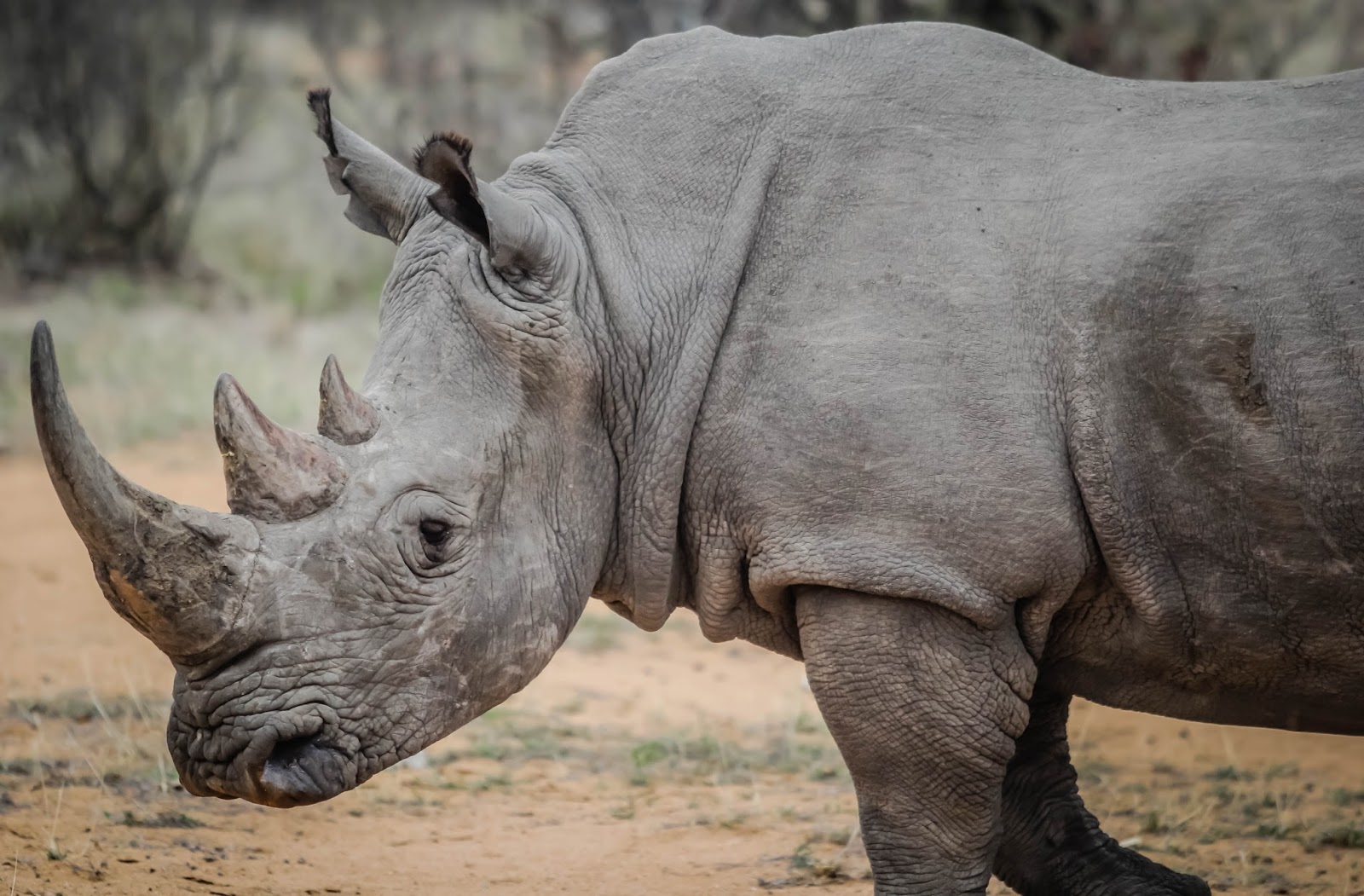
Digital creation of a three-horned white rhinoceros (digital manipulation © Dr Karl Shuker using a public domain photograph)


There was the forest three-horned dark rhino that would be in small herds that would occasionally run into the snares of man. These forest rhinos were deemed by many as a prized possession.

   Douglas S. Taylor – Sword of Souls: Chronicles of Caledon


The three-horned rhinoceroses referred to in the above quotation are fictitious, but factual records do indeed exist of rhino specimens possessing extra (supernumerary) horns. Of the five species of rhinoceros alive today, two of them (the great Indian Rhinoceros unicornis and the Javan R. sondaicus) each typically sports one horn, whereas the other three (the Sumatran Dicerorhinus sumatrensis, African white Ceratotherium simum, and African black Diceros bicornis) each typically sports two. Very rarely, however, exceptions to this standard rule arise, and as reported widely in the media during late December 2015 one such exception has lately been encountered and photographed in Namibia's Etosha National Park by 73-year-old Jim Gibson.

Eschewing its species' normal two-horn condition (and its taxonomic name too), the adult black rhinoceros Diceros bicornis (translating as 'two-horned two-horned') in question also bears a slender but distinctive, forward-curving third horn, sprouting forth from the centre of its brow (click here to see photos of this singular beast, and here to view a short video clip of it). Its extra horn would not cause this rhino any discomfort; and if resulting from a non-genetic developmental abnormality occurring when the rhino was a foetus, it would not be inherited by any of its offspring. If caused by a mutant gene, however, it could be inherited - this latter situation probably explaining why triple-horned black rhinoceroses were once quite common around Zambia’s Lake Young.

On 10 February 1906, big game hunter Abel Chapman shot a three-horned black rhinoceros at Elmenteita in British East Africa (now Kenya), and a photograph of Chapman posing alongside its head subsequently appeared in his book Retrospect: 1851-1928 (1928). That same book also included a drawing of this animal. And a similar specimen was exhibited alive at Lisbon Zoo, Portugal, as documented in two International Zoo Yearbook reports of 1978.

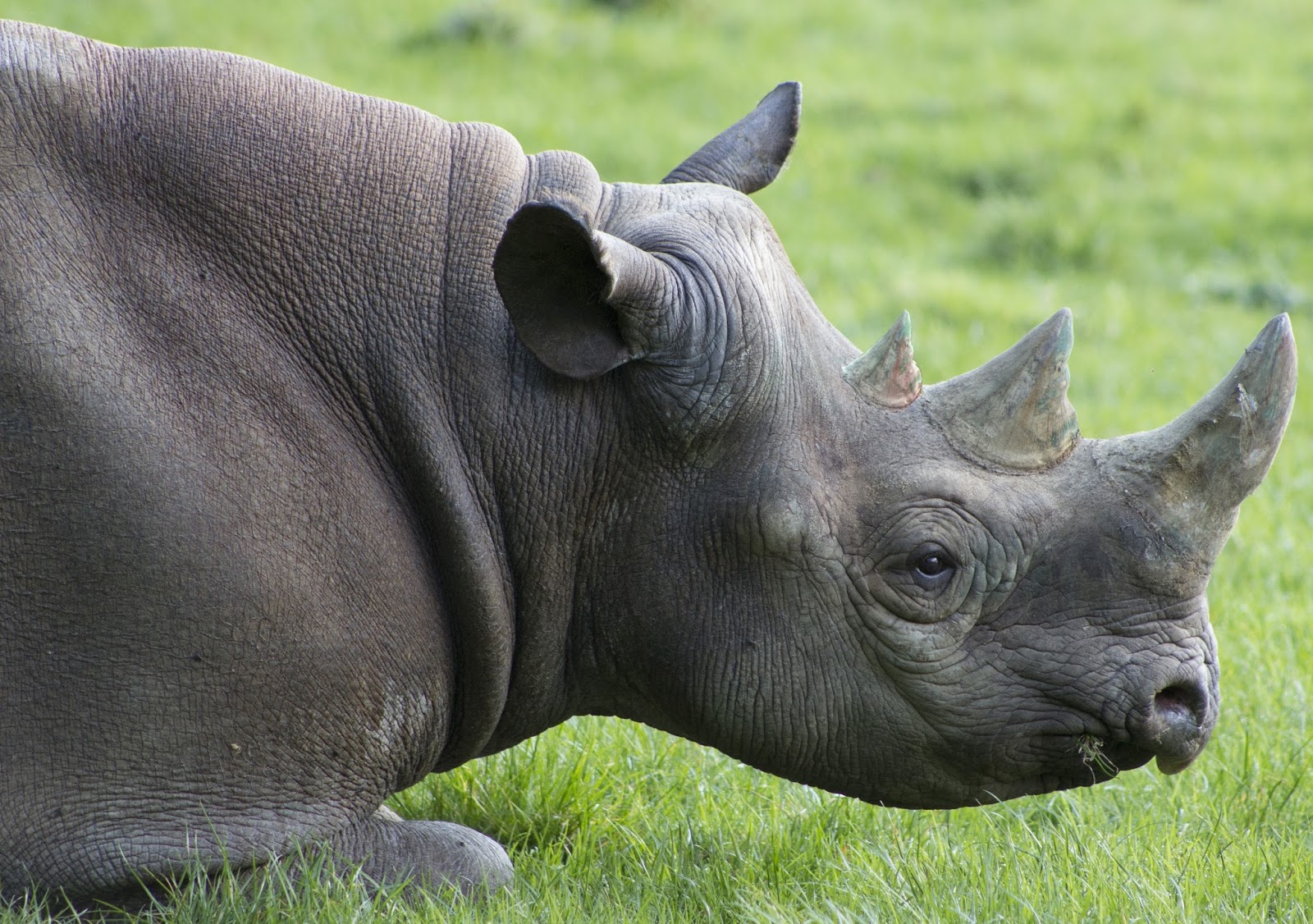
Digital creation of a three-horned black rhinoceros (digital manipulation © Dr Karl Shuker using a public domain photograph)

Three-horned examples of unspecified two-horned rhinoceros species in southern Africa were alluded to by Swedish explorer-naturalist Charles J. Andersson in his book Lake Ngami (1861), which documented his four years spent exploring southwestern Africa, including time spent during 1854 at this nowadays very famous but then newly-discovered lake in Botswana:

I have met persons who told me that they have killed rhinoceroses with three horns; but in all such cases (and they have been but few), the third, or posterior horn is so small as to be scarcely perceptible.

Even Linnaeus mentioned three-horned rhinoceroses - to his description of the black rhinoceros in Gmelin’s edition (1788) of Systema Naturae was added: “Rarior est Rhinoceros tricornis, tertia cum cornu ex alterato priorem excrescente”. In the past, moreover, Sumatran native hunters asserted that three-horned specimens of the Sumatran rhinoceros were occasionally met with too.

In most cases, the extra horn is usually nothing more than a small, rounded knob - a rudimentary third horn positioned behind the two normal ones. Similarly, towards the end of the 19th Century, London Zoo exhibited a female great Indian rhinoceros that bore a rudimentary second horn upon her forehead. Alternatively, a pseudo-third horn can develop via the splitting into two of one of the normal, pre-existing horns, as seen in the following photograph of one such zoo specimen:

Captive rhinoceros with pseudo-third horn (© Owen Burnham)

Occasionally, even more extreme cases are recorded. One such individual was the abnormal female black rhinoceros shot during August 1904 in a dense covert west of Kenya’s Jambeni Mountains, at an elevation of 4150 ft above sea-level, and reported by Colonel W.H. Broun in the Proceedings of the Zoological Society of London on 14 November 1905. In addition to the two normal horns, this rhino had a third, rudimentary horn between its ears, plus a fourth, equally diminutive example located about 4 in further back.

During his extensive black rhinoceros researches, renowned German zoologist Dr Bernard Grzimek encountered reports of a five-horned specimen, and even of rhinos with horns growing out of their bodies. He also suggested that the famous woodcut of a great Indian rhinoceros bearing an incongruously-sited horn on its shoulder produced by Albrecht Dürer in 1515 (and later copied by Conrad Gesner in his Historiae Animalium, Liber I, 1551) may have been truly based upon an abnormally horned specimen.

Albrecht Dürer’s famous shoulder-horned rhinoceros woodcut (public domain)

At one time, this idea was discounted in favour of the theory that the horn was either an error on the part of Dürer, or, if genuine, merely an excrescence developed by the rhinoceros in question during its long confinement in the ship bringing it from India to Portugal’s King Manuel the Great, at Lisbon (the king then offering it up as a gift to Pope Leo X). Moreover, as discussed in 1961 via an entire paper on the subject written by Dr K.C.A. Schulz and published in African Wild Life, rough sores of a horny nature have been observed for some time among black rhinos too.

However, Grzimek’s view was reinforced in spring 1968, when Prof. Heini Hediger photographed a white rhinoceros living in San Francisco Zoo that bore a bona fide, unequivocal shoulder horn, measuring some 4 in high. Prof. Hediger subsequently documented this distinctive creature via an illustrated Zoologische Garten article published in 1970.

At present, the precise reasons for the development of extra horns by rhinoceroses remain relatively unclear. In some cases, a genetic origin is indicated, especially when they involve several multi-horned specimens inhabiting one specific locality, as with the Lake Young individuals. Injury-induced development (echoing the ‘excrescence theory’ for Dürer’s specimen) may also occur - as documented from various antelopes and deer possessing supernumerary (and often oddly located) horns, sometimes emerging from the forehead, face, or even sites on the body.

Digital creation of a three-horned southern white rhinoceros (photograph and digital manipulation © Dr Karl Shuker)

NB – As noted in their respective credits above, all of the photographs of three-horned rhinoceroses included here have been created by me via digital manipulation of existing photographs of normal two-horned specimens, because although, as this present article of mine unequivocally demonstrates, rhinos with supernumerary horns are a reality, I am not aware of any existing photos of such specimens other than those of the above-documented Namibian individual and the photo in Abel Chapman's book depicting him alongside his three-horned rhino head (unfortunately, however, I have so far been unable to obtain sight of this latter picture). Consequently, if anyone knows of any photographs depicting supernumerary-horned rhinos, or drawings based upon documented specimens of such creatures, I would greatly welcome details.

Finally: if three-horned rhinoceroses are not exotic enough for you, how about three-humped camels and a bull African elephant with two trunks? If you think that I'm joking, be sure to click here on ShukerNature and discover that I'm not!

This ShukerNature blog article is excerpted and greatly expanded from my book Extraordinary Animals Revisited.