Dr KARL SHUKER

Zoologist, media consultant, and science writer, Dr Karl Shuker is also one of the best known cryptozoologists in the world. He is the author of such seminal works as Mystery Cats of the World (1989), The Lost Ark: New and Rediscovered Animals of the 20th Century (1993; greatly expanded in 2012 as The Encyclopaedia of New and Rediscovered Animals), Dragons: A Natural History (1995), In Search of Prehistoric Survivors (1995), The Unexplained (1996), From Flying Toads To Snakes With Wings (1997), Mysteries of Planet Earth (1999), The Hidden Powers of Animals (2001), The Beasts That Hide From Man (2003), Extraordinary Animals Revisited (2007), Dr Shuker's Casebook (2008), Karl Shuker's Alien Zoo: From the Pages of Fortean Times (2010), Cats of Magic, Mythology, and Mystery (2012), Mirabilis: A Carnival of Cryptozoology and Unnatural History (2013), Dragons in Zoology, Cryptozoology, and Culture (2013), The Menagerie of Marvels (2014), A Manifestation of Monsters (2015), Here's Nessie! (2016), and what is widely considered to be his cryptozoological magnum opus, Still In Search Of Prehistoric Survivors (2016) - plus, very excitingly, his four long-awaited, much-requested ShukerNature blog books (2019-2024).

Dr Karl Shuker's Official Website - http://www.karlshuker.com/index.htm

IMPORTANT: To view a complete, regularly-updated listing of my ShukerNature blog's articles (each one instantly clickable), please click HERE!

IMPORTANT: To view a complete, regularly-updated listing of my published books (each one instantly clickable), please click HERE!

IMPORTANT: To view a complete, regularly-updated listing of my Eclectarium blog's articles (each one instantly clickable), please click HERE!

IMPORTANT: To view a complete, regularly-updated listing of my Starsteeds blog's poetry and other lyrical writings (each one instantly clickable), please click HERE!

IMPORTANT: To view a complete, regularly-updated listing of my Shuker In MovieLand blog's articles (each one instantly clickable), please click HERE!

IMPORTANT: To view a complete, regularly-updated listing of my RebelBikerDude's AI Biker Art blog's thematic text & picture galleries (each one instantly clickable), please click HERE!

Search This Blog


PLEASE COME IN, I'VE BEEN EXPECTING YOU...

PLEASE COME IN, I'VE BEEN EXPECTING YOU...
WELCOME TO SHUKERNATURE - ENJOY YOUR VISIT - BEWARE OF THE RAPTOR!


Tuesday, 17 June 2014

IS IT A BIRD? IS IT A PLANE? NO - IT'S BATSQUATCH!

Spectacular rendition of batsquatch by tattoo artist and friend Gary Stanley aka Stigmata, originally prepared by him specifically for a magazine article of mine during the late 1990s – cheers, Gaz! (© Gary Stanley/Stigmata)

Twenty years ago this year, one of the most bizarre winged entities ever reported made its first – and seemingly only – appearance, at least as far as the media headlines were concerned, but do any ShukerNature readers have additional information? As revealed, here, moreover, it may not have been entirely unprecedented.

It was 9.30 am on 19 April 1994, and 18-year-old high school student Brian Canfield was driving a truck from Buckley to his home at Camp One in the foothills of Mount Rainier, above Lake Kapowsin in Washington State, USA, when for no apparent reason his truck abruptly came to a halt. Then, about 30 ft ahead, descending onto the road with a sizeable thud, appeared a creature of nightmare!

Standing perfectly still on its hind legs, at least 9 ft tall, and covered in bluish fur, it had a wolf-like face, yellow eyes with half-moon pupils, tufted ears, a large mouth well supplied with sharp white teeth (but no fangs), bird-like feet, powerful arms, and fingered hands. It also had a pair of huge wings, which lay folded behind its broad shoulders as this monstrous being gazed at the unbelieving trucker for several minutes in a terrifying face-off.

A second wonderful illustration of batsquatch by another very talented friend of mine, Swedish artist/film-maker Richard Svensson (© Richard Svensson)

Canfield's macabre confrontation finally ended when his astonishing visitor began twitching its fingers, then unfolded its wings, which were so enormous that they spanned the entire width of the road, and slowly took off into the air - stirring up such extensive turbulence before soaring away towards Mount Rainier that Canfield's truck rocked and swayed. Once it had departed, his truck inexplicably came alive again, enabling him to drive home.

Later that day, still greatly frightened but this time accompanied by his mother and a neighbour, Canfield returned to the location of his incredible encounter. He hoped to find something that could provide physical proof of his story's veracity, but was unable to do so. Notwithstanding this, his reputation for honesty and abstemious lifestyle were such that no-one acquainted with him had any doubt that he was telling the truth. Even newspaper columnist C.R. Roberts, who interviewed him in the Tacoma News Tribune on 1 May (following an earlier article regarding batsquatch in that same newspaper on 24 April), was convinced of his sincerity.

As for the amazing creature seen by him, its surrealistic similarity to a bigfoot (sasquatch) incongruously sprouting a pair of bat-like wings was sufficient for the media to dub it 'batsquatch' - a memorable name for a truly unforgettable entity.


Sketch of batsquatch by artist Dave Kiele, based upon Brian Canfield's description, which appeared in the Tacoma News Tribune on 24 April 1994 (© Dave Kiele/Tacoma News Tribune)


Although no further reports of batsquatch appear to have emerged, when first reading Canfield's description of it I thought of another remarkable encounter on file, which Geoffrey Hodson claimed to have experienced while visiting England's Lake District in June 1922. He later documented it in his book Fairies at Work and at Play (1925):

"My first impression was of a huge, brilliant crimson, bat-like thing, which fixed a pair of burning eyes upon me. The form was not concentrated into the true human shape, but was somehow spread out like a bat with a human face and eyes, and with wings outstretched over the mountainside. As soon as it felt itself to be observed it flashed into its proper shape, as if to confront us, fixed its piercing eyes upon us, and then sank into the hillside and disappeared. When first seen its aura must have covered several hundred feet of space, but in a later appearance, in which it again showed itself, the actual form was probably ten to twelve feet high."

Hodson was a Theosophist, and believed that the above entity was a deva - an elemental nature spirit. Devas advising and assisting the human workers at Findhorn in Scotland and Perelandra in the U.S.A. were deemed to be responsible for the astonishingly successful cultivation of extra-large vegetables and flowers in the gardens of these experimental spiritual communities, despite the poor quality of the soil and the adverse climate.

Abstract deva

Could batsquatch have been a deva? In spite of its daunting appearance, it made no attempt to harm or even threaten Canfield, merely observing him for a time before disappearing, just like the being observed by Hodson in the Lake District.

Also worth recalling here is an episode recounted to me on 9 October 2010 by New Zealand colleague Mark Phillipps, but whose source he was unable to recollect (click here for more details regarding this and also another strange entity mentioned to me by Mark):

"If I remember correctly, there were two men walking along some rough coastal cliffs (it may have been in Britain but I cannot be sure) when they came over a rise and saw a very large orange bat-like creature sunning itself on the rocks just above the water line.

"I believe they described it as being a good thirty or forty feet across."

If this account is familiar to anyone, I'd greatly appreciate receiving details of its source, which I will also pass on to Mark – thanks very much.


This ShukerNature post is excerpted and expanded from my book Mysteries of Planet Earth (1999).


Sunday, 15 June 2014

GLOWING MUDSKIPPERS AND FLASHLIGHT FROGS – TWO BIOLUMINESCENT MYSTERY BEASTS?


Artistic representation of the unidentified flashlight frog (© Connor Lachmanec, aka TheMorlock on Deviantart.com)

Bioluminescence is the emission of light by certain life forms. These include many known species of bacteria, fungi, protozoans, invertebrates, and fishes, but there are also several controversial examples, including the following couple – both of which may constitute remarkable new species still undescribed by science.


SEEING RED IN SERAM

One evening in June 1986, while working on the small eastern Indonesian island of Seram (Ceram) for the VSO, tropical agriculturalist Tyson Hughes spied some very eyecatching, unidentified fishes in a river.

Some typical, non-bioluminescent mudskippers (© Bjørn Christian Tørrissen/Wikipedia)

They resembled the familiar 'fish-out-of-water' mudskippers in general size and shape. However, quite apart from inhabiting freshwater rather than intertidal habitats, these curious fishes encountered by Tyson further differed from all known species of mudskipper by emitting a bright, pulsating red light.

Artistic representation of Seram's mudskipper-like glowing mystery fish (© Ursulav/New Cryptozoology Wikia)

Tyson earnestly attempted to catch one of them, but failed to do so.


THE FROG WITH THE LUMINOUS NOSE

In one of his famous nonsense poems, Edward Lear wrote about the dong with the luminous nose, whereas the following cryptid was apparently a frog with a similar attribute, yet was anything but nonsensical.

Swedish artist Richard Svensson's wonderful interpretation of Edward Lear's dong with the luminous nose (© Richard Svensson)

While visiting an animal fair at Newton Abbot in Devon, England, in June 1997, Devon-based CFZ founder Jonathan Downes noticed a cage containing some tree frogs, reputedly from northern Cameroon in western Africa and priced at £25 per frog. Jon was intrigued by these creatures, which each bore a blue spot on its snout, because he could not identify their species. He was even more intrigued when informed by their vendor that the blue spot on their snout glowed in the dark like a flashlight, possibly to attract insects as prey.

A typical green tree frog, conspicuously lacking the flashlight frog's unique glowing snout spot (public domain – for my source of it, click here)

Nevertheless, Jon felt that £25 was too expensive a sum, so he resisted the temptation to buy one - a decision that he would soon bitterly regret. For when he later described these curious flashlight frogs to various herpetological colleagues, he was shocked to discover that there is no species of frog known to science that can glow. Consequently, he had missed the opportunity to purchase a specimen of what might not only be a completely unknown species, but also exhibit a talent unique even among the world's considerably varied array of frogs.


This ShukerNature blog post is excerpted in slightly expanded form from my book Mysteries of Planet Earth (1999) – the first publication ever to document either of these mystery beasts (contrary to various erroneous online claims, the flashlight frog did not appear in one of my earlier books, From Flying Toads To Snakes With Wings (1997)). Today, 15 years later, both of them are still unidentified and unexamined by science - so if anyone reading this blog post (especially anyone with knowledge of or firsthand experience in the exotic pet trade) has any additional information concerning these or any other mysterious glowing creatures, I'd welcome any details that you'd like to post here.


Friday, 13 June 2014

THE PARTRIDGE CREEK MONSTER - A LIVING DINOSAUR IN THE YUKON?


Artistic representation of the Partridge Creek monster (© Connor Lachmanec, aka TheMorlock on deviantart.com)

The Arctic wastelands of the Yukon Territory, on the borders of Canada and Alaska, are surely the last place anyone might expect to meet a dinosaur - which is why the following case merits a prominent place among the dubitanda of cryptozoology.

The extraordinary tale of the beast from Partridge Creek debuted on 15 April 1908, within the pages of a French journal called Je Sais Tout ('I Know All'), and was recounted by one of the creature's eyewitnesses, French traveller Georges Dupuy. According to Dupuy, the adventure had begun one day in 1903, when a banker from San Francisco called James Lewis Buttler and a local gold prospector named Tom Leemore were hunting three large moose amid the marshy tundra countryside near the Yukon's Clear Creek, about 100 miles east of Dawson City. Suddenly, one of these burly deer raised its head as if it had heard something unexpected in the vicinity, and just as it did so a second member of the trio emitted a loud bellow of alarm, sending all three of them fleeing southwards with all speed.

A hunted moose fleeing the scene, an engraving from 1897 by Arthur Heming

Standing 7 ft at the shoulder and weighing up to half a ton, as the world's largest living species of deer the moose is not a creature to be readily intimidated by anything - which is why the two hunters were so surprised by their quarry's impromptu flight. When they reached the spot from where the moose had fled, however, the reason for these creatures' uncharacteristic behaviour became clear - there in the snow was the clear impression of an enormous body belonging to some unidentifiable beast of monstrous proportions.

The beast's belly had ploughed into the river bed's swampy mud a massive furrow 30 ft long, 12 ft wide, and 2 ft deep, which was flanked by gigantic footprints measuring 2.5 ft across and 5 ft in length, each also yielding impressions of sharp 1-ft-long claws. Completing the clues left behind by this unseen goliath was the imprint of a mighty 10-ft-long tail spanning 16 in across its middle.

The first of two illustrations depicting the Partridge Creek monster in the Je Sais Tout article

Notwithstanding the nightmarish visions conjured up by such dramatic dimensions, the two men decided to follow the monster's tracks, which led after several miles to a gulch known as Partridge Creek, where the tracks simply came to an end - giving the men cause to speculate that it must have leapt directly up into the gulch's encompassing cliffs.

Following this, they made their way by canoe along the McQuesten River to the nearby outpost of Armstrong Creek - an Indian village where Buttler had earlier arranged to meet Dupuy to take him hunting, and which was home to the Reverend Father Pierre Lavagneux, a French-Canadian Jesuit priest. When Dupuy and the priest heard about the monster, they were highly sceptical at first, but eventually Buttler persuaded them to return to Partridge Creek with Leemore and himself in a second search for it, aided by some local Indians.

After a day's intensive but fruitless search of the immediate area and some distance beyond it in all directions, however, the party of weary beast hunters had resigned themselves to failure, and decided to establish camp at the top of a rocky ravine. Thoughts of confronting monsters had been largely suppressed by the more practical goal of preparing a warm meal - until, wholly without warning, they received a terrifying reminder of the reason for their presence there. A hideous roar broke the Arctic stillness, and as the startled hunters reached for their rifles, one of them pointed with shaking hand to the opposite side of the ravine - where the crimson rays of the dying sun revealed a heart-stopping sight. A veritable monster in every sense of the word was clambering up its slope!

The second of two illustrations depicting the Partridge Creek monster in the Je Sais Tout article

Black in colour, at least 50 ft long, and estimated by Buttler to weigh about 40 tons, their horrific visitor continued to climb upwards for a time, mercifully unaware of its terrified human eyewitnesses' close proximity. When it was about 200 paces away, it paused for 10 minutes or so, furnishing them with ample opportunity to observe it at close range in all its spine-chilling glory. Although profusely splattered with thick mud, its hide could be seen to bear many coarse, grey-black bristles like those of a wild boar, and a hideous mass of blood and saliva oozed from its cavernous jaws. Most remarkable of all, however, was the rhino-like horn perched prominently if somewhat incongruously near the end of its snout.

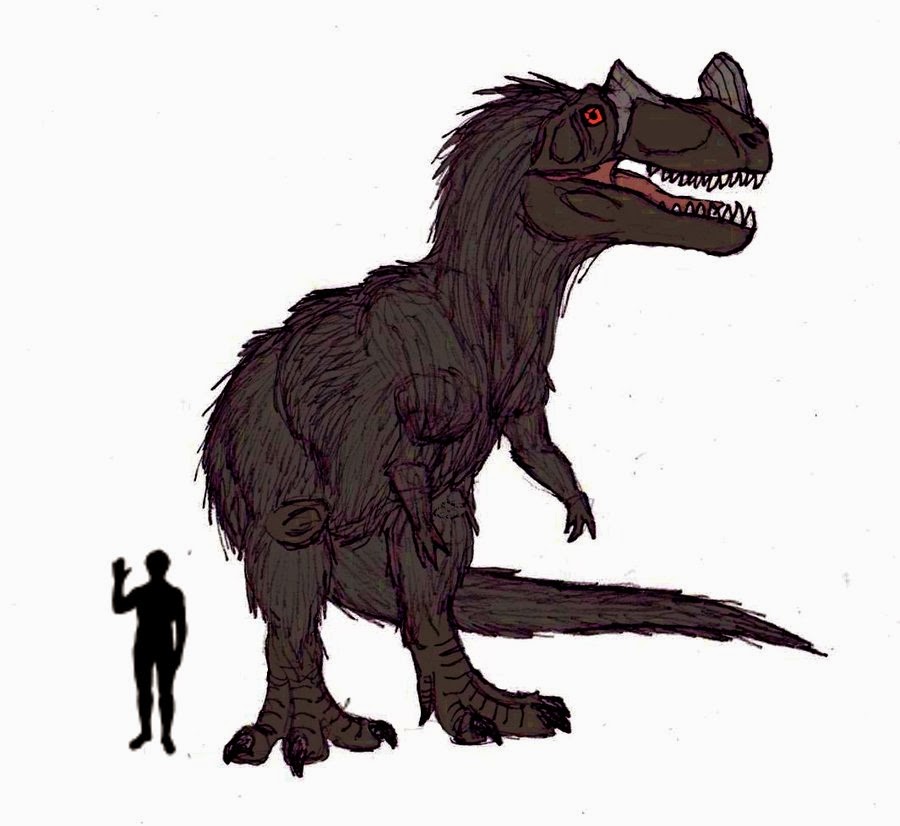
The Indians cowered in terror behind a large rock, and the others were rendered momentarily speechless by the monstrous apparition, but when it became clear that it had not detected them the priest gained sufficient control of his voice to whisper between still-chattering teeth: "A ceratosaurus...It's a ceratosaurus of the Arctic Circle!". Ceratosaurus nasicornis was a large flesh-eating bipedal dinosaur of the Jurassic Period, related to the later, larger Tyrannosaurus rex and readily identified via the large horn near the tip of its upper jaw.

A modern-day reconstruction of Ceratosaurus nasicornis (© DiBgd/Wikipedia)

As they continued to watch, the beast suddenly reared up onto its massive hind legs like a hellish kangaroo, gave voice to an ear-splitting roar again, and then disappeared back down into the ravine via a single immense bound. Not too surprisingly, the beast hunters found that the thrill of pursuing this creature had lost its former charm, and the following morning they journeyed back to Armstrong Creek. Dupuy later attempted to interest the Canadian governor at Dawson City in supplying them with a large-scale hunting party of mules and 50 armed men, but when this failed he returned home to France.

The matter was not quite over, however, for in January 1908 he received a letter from Father Lavagneux, dated Christmas Day 1907, in which the priest informed him that on Christmas Eve, and while in the company of ten Indians, he had seen their monstrous quarry once again - this time racing at speed over the creek's frozen river, with what seemed to be the carcase of a caribou clamped between its great jaws. Tracks identical to those found back in 1903 were clearly visible in the deep mud, and were followed by Lavagneux and company for at least two miles before being obliterated by falling snow.

That appears to have been the last time that the beast of Partridge Creek was spotted, either by Lavagneux or by anyone else, for there does not seem to be any further records on file alluding to this extraordinary creature. Bearing in mind, however, that the existence of such an entity calls for our belief not only in the post-Cretaceous persistence of an endothermic hairy dinosaur but also its existence in what must surely be the least compatible habitat for any type of large reptile living today, its lack of cryptozoological credibility should hardly come as a great surprise!


This ShukerNature post was excerpted from my book In Search of Prehistoric Survivors, which will be reissued later this year.

The original edition of In Search of Prehistoric Survivors


Monday, 9 June 2014

KING HARES AND GIANT RABBITS - KEEPING CRYPTOZOOLOGY ON THE HOP!

Statue of a giant hare at Hay on Wye (© Dr Karl Shuker)

Hares are among the most delightful and enigmatic of British mammals, and down through the ages they have been many things to many people – symbols of fertility, the moon, and Easter, to name but a few. They have also been described in many ways – magical, mystical, and even mad, but never monstrous, surely? However, a number of eyewitness accounts have been filed from various parts of the British Isles that describe mysterious, unidentified animals resembling hares, or even rabbits, but of truly monstrous, massive proportions. What could such extra-large lagomorphs be? Here is a selection of reported encounters with these so-called king hares and giant rabbits.


THE KING HARE OF DORSET

It was to the following mystery beast that the term 'king hare' was first applied. During a lengthy two-month-long hike from the Cotswolds, through the Wiltshire Downs and west Dorset's coastal regions, before ending in Butleigh near Glastonbury in Somerset, by early September 1976 Louise Hodgson had reached the Dorset hamlet of Uploders. She and two gypsy men whom she'd met a little earlier were walking their dogs together along a lonely track there one evening, in search of some hares or rabbits to catch and eat, when they came to a valley, in which they spied a group of about ten hares together – an unusual sight in itself, as these animals are normally solitary at that time of year.

Brown hares depicted in an engraving from 1892

But even more unusual was the presence of what they initially took to be a roe deer among the hares – until they peered closer and realised to their amazement that it too was a hare, but one of enormous dimensions. They stayed for a while, gazing in wonder at this prodigious creature and keeping hold of their dogs to ensure that they did not chase after it, before finally walking away, leaving behind the king-sized hare and its normal brethren.


THE MEGA-BIG BUNNY OF BANBURY

Banbury in Oxfordshire was the epicentre of a couple of notable sightings in more recent times. The first of these took place one early evening during summer 2005. Driving home to Wendlebury, just 20 miles south of Banbury, Clive Parker observed squatting at the roadside what he considered to be a gigantic rabbit. He estimated it to be as big as a large dog, light brown in colour, with a somewhat pointed face, and sitting on its haunches watching him as he drove past. It took a few seconds for this bizarre sight to register in his shocked mind, but once it did he stopped and swiftly reversed to the spot where he'd seen this creature. Inevitably, however, the mega-bunny was gone.

A Flemish giant fawn doe, weighing approximately 20 lb (public domain)

Clive Parker was alone when he made his observation, but the second sighting, which occurred on 24 October 2006, featured multiple eyewitnesses. These were Tim Hill, his family, and some friends, who were all taking part in a canal boat journey, travelling north along the Napton-Banbury route. On the highest stretch of the canal, they looked to their right across a sloping field, and spied what they assumed at first to be a deer. Roughly the size of a golden retriever dog, it sported reddish-gold fur, but seemed to have rather big ears for a deer. When Tim's wife Mandy and one of their friends, David, both looked at it through binoculars, however, they were astonished to discover that it was what they later described as a giant rabbit. While everyone was watching it, this remarkable animal bounded away into a hedge close by, and was not seen by them again. They felt that it was too chubby and rounded to have been a hare, and was not like a wallaby or kangaroo either – it was simply like a normal domestic rabbit, but one of decidedly abnormal stature.


THE WOR-RABBIT OF FELTON

Just a few months before the Banbury encounter by Tim Hill and company, a similar mystery creature had been hitting the news headlines much further north, in and around the village of Felton in Northumberland. The first media reports emerged during early April 2006, when twelve disgruntled local gardeners who maintained allotments on public ground in Felton complained that their prized vegetables were being regularly trampled upon and munched during night-time raids carried out by a dog-sized rabbit, black and brown in colour, and which left behind giant-sized footprints bigger even than a deer's. The first sighting had been made in February by one of the gardeners, Jeff Smith, and three other villagers also caught sight of it later.

Poster for Wallace & Gromit – The Curse of the Were-Rabbit (© USA Theatrical and Worldwide DVD-Video/DreamWorks Animation)

With such reports receiving publicity not only so soon after April Fool's Day but also not long after the cinema release of the Wallace and Gromit film The Curse of the Were-Rabbit, a degree of scepticism was undoubtedly justified, but the allotment gardeners' protestations continued unabatedly, and the evidence of their squashed (and scoffed) produce was there for all to see. In addition, they announced that they were hiring two gunmen to mount guard upon their allotments, and who would shoot the giant rabbit on sight. Thanks to global online interest in this elusive animal, however, which by now had been variously – and amusingly - dubbed Bigs Bunny and the Wor-Rabbit in media accounts, the gardeners' statement swiftly attracted condemnation from readers worldwide. Some even offered to pay for the rabbit's unharmed capture and transportation to them.

Such requests proved unnecessary, however, when on 11 May, Rael Rawlinson, a local 18-year-old student, revealed that a month earlier, while she was driving along a road near to Felton with friends late one night, what she referred to as a "massive, abnormally big" rabbit had abruptly bounded across the road directly in front of them and had been fatally run over by her car. Such was the impact of the collision that her car's bumper had been cracked and was virtually hanging off, and when examined a tuft of rabbit fur was found attached to it. Getting out of her car, Rael had scrutinised the creature's body, which she claimed was at least 2 ft long and was very tall too, but she did not think to salvage it. When she told others what had happened, they visited the spot to find the body, but it had gone, no doubt taken by a fox or stray dog. And as no further nocturnal escapades in the allotments have been reported, it does indeed seem that the Felton mega-rabbit is no more.


KING HARES AND GIANT RABBITS IN IRELAND

Giant lagomorphs are apparently not confined to the island of Great Britain – comparable creatures have also been reported from Ireland.

During the late 1970s, while fishing one day with his father in a rowing boat at Lough Ree on the River Shannon, Morgan C. Jones of Dublin caught sight of what, when viewed through binoculars, seemed to resemble a huge rabbit, on an island in the middle of the lough.

Irish hares (Archibald Thorburn, public domain)

Almost a decade later, during the mid-1980s, aged in his 30s, Andrew Munro of County Cork was in his mother's garden when, while walking through a gateway, he almost collided with an enormous hare. Standing on its hind legs with ears erect, it was over 4 ft tall as far as Andrew could estimate, and he and the hare stood looking at each other for what seemed like ages, even if in reality it was no more than a couple of minutes. This spell was abruptly broken, however, when Andrew's dog spotted the hare and immediately charged towards it. But with just a few huge leaps, the king hare readily evaded its canine aggressor, showing no fear – indeed, it actually seemed contemptuous of the dog – as it bounded swiftly out of the garden, across the drive, through the fence, and across a nearby field, leaving Andrew's frustrated dog far behind.


IN SEARCH OF IDENTITIES

So what could these most curious of creatures be? As far as the giant rabbits are concerned, the most likely, reasonable explanation is that they are merely escaped or even deliberately released specimens belonging to one or more of the several breeds of giant domestic rabbit that have been developed in modern times, originally for their meat but which have become increasingly popular nowadays as pets too.

A Flemish Giant alongside an adult Shetland Sheepdog (© Stamastisclan/Wikipedia)

Notable among these breeds is the Flemish Giant, originally bred as early as the 16th Century near Ghent in Belgium. Nowadays a frequently-exhibited show breed around the world and occurring in a wide range of colours, it can weigh as much as 30 lb without being obese, and in overall size is comparable to a cocker spaniel. Another extremely large breed is the Continental Giant, descended from the Flemish Giant. The world's largest rabbit currently alive is a Continental Giant named Ralph, who tips the scale at a truly staggering, non-obese weight of 55 lb!

Click here to view a YouTube video of Ralph, the world's largest rabbit.

There is little doubt that an absconded Flemish Giant or Continental Giant could plausibly explain the Banbury mega-rabbit, and rabbit experts consulted by the irate allotment owners in Felton also consider this a likely explanation for the demised wor-rabbit. Sadly, however, it is unlikely that they would survive long in the wild. Their huge size would readily attract unwelcome, potentially lethal attention from birds of prey, foxes, and stray dogs; and they would have no knowledge of how to avoid motor vehicles, as the Felton wor-rabbit fatally demonstrated.

But what of the king hares? The British Isles is home to two indigenous species of hare. The most common, widespread, and familiar of these is the brown hare Lepus europaeus, which is absent from Ireland as a native species (though it has been introduced into Northern Ireland) but is distributed throughout Great Britain and various offshore islands. One of the world's largest species of hare, it can attain a body length of up to 30 in, plus a tail length of up to 6 in, which means that individuals at the upper end of this species' size range can be as much as 3 ft, and can weigh up to 11 lb, i.e. as big as a decent-sized dog.

The brown hare (public domain)

As many people do not realise that hares in Britain can attain such notable dimensions, the sight of an exceptionally large hare coupled perhaps in some cases with less than accurate size-estimation skills on the part of its observer(s) may be sufficient to 'create' a king hare. Moreover, there might be individual hares possessing a mutant gene that expresses extra-large body size, or even suffering from a hormonal imbalance that results in gigantism, comparable to various endocrinologically-based conditions recorded from humans.

The second species of British hare is the mountain hare Lepus timidus, which, as its name suggests, is particularly adapted for a montane existence, and famously turns white in winter. It has been introduced into Scotland's Lowlands, many of its islands, and to the English Pennines, but is indigenous to the Scottish Highlands, and also to Ireland - represented here by a very distinctive subspecies, the Irish hare L. t. hibernicus, found nowhere else.

White winter phase of the mountain hare (public domain)

This is another large hare, only slightly smaller than the brown hare, and all that has been suggested above as explanations for king hare sightings in Great Britain applies equally to such sightings in Ireland too – plus one intriguing additional possibility.


BELGIAN HARES AND PATAGONIAN CAVIES

After Morgan C. Jones had observed a giant rabbit on the island in the River Shannon where he and his father were fishing, his father told him that during the 1940s, a very large domestic breed of lagomorph known as the Belgian hare, much bigger in size than the Irish hare, was introduced into the Irish Republic as a potential food source. Unfortunately, it bred so prolifically, posing a major risk to the ecosystem, that it was subsequently eradicated, with the last specimens having been corralled on the very island where Morgan had seen his giant rabbit – thus suggesting that what he had spied was an elusive, still-surviving Belgian hare. Making this even more interesting is the fact that despite its name, the Belgian hare is not a hare at all, but a breed of rabbit, albeit one bred specifically to look superficially hare-like, hence its name.

Belgian hare (© Quimby/Wikipedia)

There is also the prospect that some supposed king hares and giant rabbits, especially if only glimpsed briefly, were not bona fide lagomorphs at all, but were instead escapee or naturalised wallabies (there are naturalised populations living in several regions of Great Britain), or even those introduced but successfully-thriving small Asian deer known as muntjacs. One further non-native species well worth considering in relation to this prospect is a very curious South American rodent known as the mara or Patagonian cavy Dolichotis patagonum. It is very commonly exhibited in zoos and wildlife parks, but despite being related to guinea pigs it is extremely hare-like in overall appearance, due to its long limbs and ears plus its general body form and stance.

As seen here, the mara or Patagonian cavy can look very hare-like (public domain)

Moreover, as one of the world's largest rodents, it could easily be mistaken for a giant hare by observers not familiar with its species, so an escapee mara existing in a given area could certainly explain reported sightings there of supposed king hares or long-legged giant rabbits.


AND FINALLY…

Remembering the hare's many traditional links to pagan lore, the occult, and even Faerie, it is only fitting that the final account of a giant mystery hare documented here is one that seemingly transcends normal cryptozoological boundaries and ventures into the preternatural.

My figurine of a pixie riding a white hare (© Dr Karl Shuker)

While walking alone one bright summer morning through Windsor Great Park, Sibell Lilian Blunt-Mackenzie, 3rd Countess of Cromartie (1878-1962), saw a bizarre-looking animal slowly approaching her. It resembled a hare, and moved with a typically leporine, loping gait too, but it was huge, as big as a goat! Making it even more caprine in appearance, however, was the pair of curved horns that it bore upon its head. The countess was so astonished by this uncanny beast that she stood motionless, until, as it passed by her, she struck out at it with her parasol – and it immediately vanished! A strange tale indeed, but when dealing with creatures as magical and evanescent as hares, nothing should really surprise us. Or, to put it another way: hare today, gone tomorrow!

The beautiful (if inaccurately-entitled?) painting A Rabbit Among the Fairies (the 'rabbit' is surely a brown hare!), by the popular Victorian fantasy artist John Anster Fitzgerald

Source acknowledgement: Some of the above reports originally appeared in the readers' letters pages of the British monthly periodical Fortean Times.


STOP PRESS - A LOST KING HARE PHOTOGRAPH?

Shortly after posting this ShukerNature blog article online, I received a couple of very interesting tweets (Twitter messages) from Mary Epworth. Mary lives on the East Hertfordshire/West Essex border, and she mentioned in her first tweet that she has been told about king hare stories from that area. Moreover, in her second tweet she stated: "There is supposedly a photo of one in a pub, but nobody knows which".

Is there anyone from Mary's part of the world reading this article of mine who does know which pub has this potentially significant crypto-photo? If so, I'd very much like to hear from you!

Holding a magical white hare at Easter (© Dr Karl Shuker)


Tuesday, 3 June 2014

BLUE LIONS OF AFRICA AND ASIA

Computer-generated image of a blue lion (© Dr Karl Shuker)

Welcome to the 400th ShukerNature blog post! To celebrate this milestone, I now have pleasure in presenting a creature that is unusual even by ShukerNature standards! Namely, the blue lion.

In various of my books, articles, and ShukerNature posts concerning cryptozoological and mythological big cats, I have documented lions of many different hues and shades, including black lions (click here, here, and here), white lions (click here), grey lions, red lions, golden lions, and even an alleged green lion (click here) – but never a blue lion. Blue tigers, yes (click here) – blue lions, no. Until now, that is.

Fractal blue lion (© Artisenems)

Within the past fortnight, however, I have encountered two entirely independent sources of blue lions – one from Africa, the other from Asia. So here they are.

The first is an African folktale contained in a fascinating, beautifully-illustrated book that I recently purchased. Entitled Fabulous Beasts: Myths and Legends and published in 1994, it is the English-language edition of an original French book - Les Animaux Fantastiques (1991), written by Claude-Catherine Ragache, and illustrated by Marcel Laverdet.

Fabulous Beasts: Myths and Legends (incidentally, the monkey riding the blue lion in this book's front cover illustration is actually from a different folktale in the book, not from the one featuring the blue lions) (© Cherrytree Books/Marcel Laverdet)

According to the folktale in question, at the bottom of a certain great river in Africa lives a pride of lions with deep blue fur. These exotic felids seek out their prey on land each evening, and whatever – or whoever – they capture is then brought back by them to their underwater den, and stored inside one of many huge glass jars that serve as their larder. One day, they captured a newborn baby and duly placed it, still alive, inside one of their jars, to be devoured later. Devastated, its distraught mother flung herself into the river, but when her husband learnt what had happened, he dived in and followed her footprints along the river bed (this river possesses magical powers that prevent anyone entering it from drowning). He soon found her, so together they then trekked to the den of the blue lions, cautiously entered it, and found the jar containing their baby. But before they were able to rescue it, one of the blue lions caught sight of them, and forced them inside the jar too.

Fortunately, however, the husband had brought with him a magic ngona (antelope) horn, which, when he pointed it at each of them, so reduced them in size that they were all able to crawl inside the horn and remain hidden there. The following day, the blue lion that had discovered the husband and wife came to the jar to take them out with their baby so that the pride could devour all three of them, but the only thing that the lion could see inside the jar was an old antelope horn. The perplexed cat angrily bit it, but instead of the horn crunching up, it was the lion's teeth that shattered! Totally enraged by now, the lion spat the horn out, and with such force that it flew up through the water and out of the river altogether, landing safely on the river bank – where the family swiftly crawled out, regained their normal size, picked up the magic horn, and ran home to their village, with their rescued baby safe and sound.

A blue lion confronting the husband and wife with their baby – a gorgeous illustration from Fabulous Beasts: Myths and Legends (© Marcel Laverdet)

No specific details regarding the origin of this folktale (other than it is African) is given in the above book. However, African Genesis (1983) by Prof. Leo Frobenius and Douglas C. Fox contains a very similar folktale, which is attributed to the Wahungwe of Zimbabwe. Indeed, the only notable difference is that in the latter version, there is no mention that the water lions' fur was blue.

Although this is merely a traditional native folktale, the annals of African cryptozoology contain many accounts of supposedly genuine aquatic mystery cats, including various ones known locally as water lions - though as far as I am aware, none of them has blue fur!

A cosmic blue lion (artist unknown to me)

As for Asia's blue lion: in Buddhism, Bodhisattvas are beings who are seeking enlightenment or are on the path to enlightenment, and are sometimes deemed to be deities. The most significant Bodhisattva, and one of the Lord Buddha's most important disciples, is Manjusri, who is associated with transcendent wisdom. According to popular Chinese mythology, as noted in Patricia Bjaaland Welch's book Chinese Art: A Guide to Motifs and Visual Imagery (2008), consulted by me recently, Manjusri (aka Wenshu in Chinese) has been linked with the five-peaked holy mountain of Wutai Shan in Shanxi Province since the 4th Century, and has supposedly been sighted riding a blue lion in this mountain's higher reaches, above the many temples and monasteries located here.

Blue lion (© Artisenems)

For more information on varicoloured lions, check out my books Mystery Cats of the World (1989) and Cats of Magic, Mythology, and Mystery (2012).